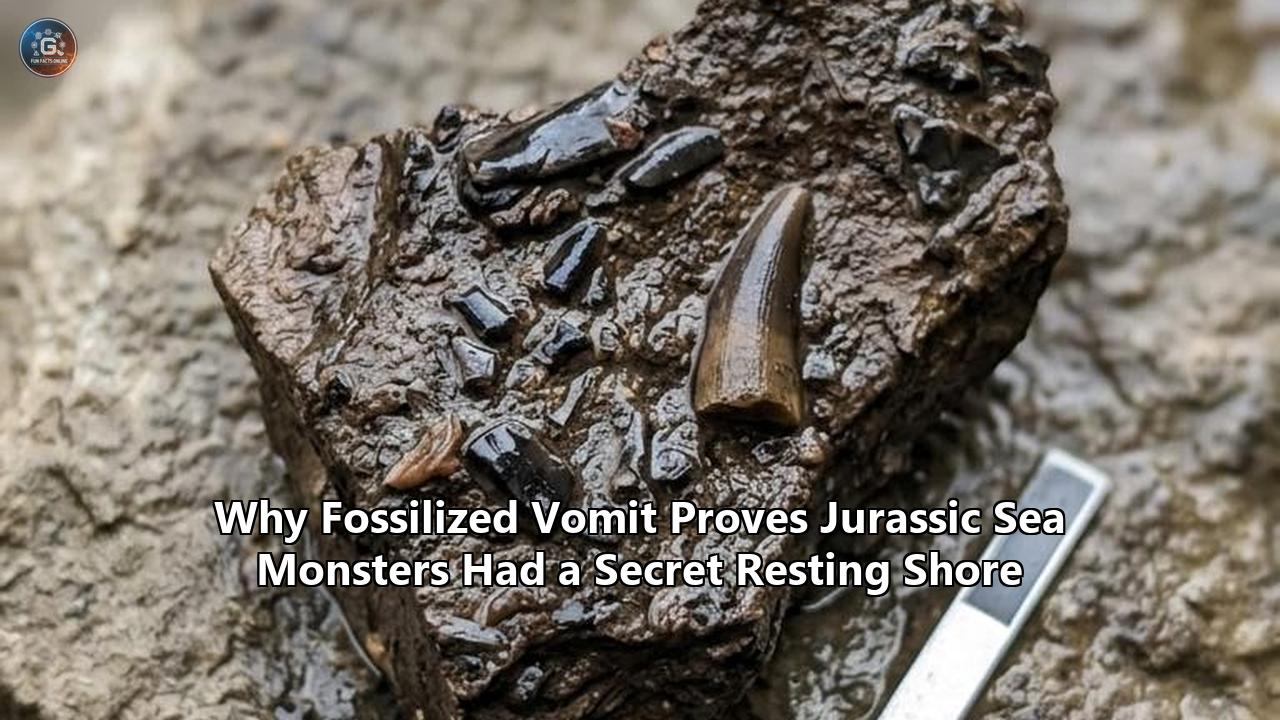
Deep beneath the waters of the North Sea, encased within cylindrical cylinders of sandstone pulled from more than a mile below the seabed, paleontologists have identified an unprecedented behavioral record of Mesozoic marine life: petrified mounds of prehistoric regurgitation.
A newly published investigation in Geological Magazine reveals that 160-million-year-old long-necked plesiosaurs routinely abandoned their offshore hunting territories and migrated into shallow coastal river deltas for the explicit purpose of resting, sleeping, and vomiting up the indigestible remains of their meals.
The research, led by Dr. Dirk Knaust, a trace fossil specialist with Norwegian energy company Equinor ASA, centers on more than 20 compact masses of fossilized digestive ejecta—known technically as regurgitalites—discovered within rock cores drilled for an offshore carbon capture and storage initiative near the Troll field. Ranging from the size of a walnut to that of a mango, these compacted masses consist of dense clusters of bivalve shells, marine worm tubes, and crinoid fragments bound tightly together.
For decades, paleontologists pictured plesiosaurs as nearly continuous open-ocean rovers, fully adapted to pelagic life and largely untethered from nearshore confines once their evolutionary lineage severed ties with land. The discovery of these gastric pellets upends that assumption. By analyzing the forensic composition of the stomach contents against the sedimentary environment where they settled, Knaust established that these marine reptiles systematically fed on deep-water seafloor invertebrates, then swam significant distances into freshwater-dominated estuarine shallows to process their meals.
The discovery provides direct physical proof that Jurassic marine reptiles maintained specialized coastal staging areas—secret resting shores where they could recuperate away from open-water apex predators, conserve energy, and rid their digestive tracts of hazardous shell debris.
+-----------------------------------------------------------------------------------+
|                           THE JURASSIC VOMIT TRAIL                                |
|                                                                                   |
|  [ DEEP MARINE BASIN ]                           [ COASTAL RIVER DELTA ]          |
|  Full Salinity (~35 PSU)                         Brackish to Freshwater (<10 PSU) |
|                                                                                   |
|  Cryptoclidid Plesiosaurs                        Plesiosaurs migrate to shallows  |
|  vacuum benthic ocean floor                      to rest, sleep, and digest       |
|            |                                                 |                    |
|            v                                                 v                    |
|  Swallow stenohaline prey whole:                 Oral ejection of gastric pellet: |
|  - Infaunal Bivalves                             - Concentrated shell hash        |
|  - Serpulid Worm Tubes                           - Preserved by mucus binder      |
|  - Articulate Crinoids                           - Sheltered in crustacean burrows|
|            |                                                 |                    |
|            +=================================================>+                    |
|                   Trans-Environmental Biological Vector                           |
+-----------------------------------------------------------------------------------+
Industrial Core Sampling Meets Deep-Time Forensics
The path to this discovery began not in a museum basement or along a windswept cliff face, but inside the industrial core-logging facilities of the Norwegian continental shelf. Over a three-decade career studying subsurface geology for Equinor, Knaust examined thousands of meters of continuous drill core extracted during petroleum appraisals and, more recently, reservoir evaluations for subsea carbon dioxide sequestration.
The critical specimens were retrieved from the Horda Platform, situated roughly 50 kilometers off the western coast of Norway. The cores penetrated Middle to Upper Jurassic strata—geological formations dating back roughly 160 million years to the Callovian and Oxfordian stages. During this interval, northwestern Europe was an archipelago of low-lying landmasses surrounded by warm, epicontinental seaways, bordered by extensive coastal river deltas where broad river channels discharged continental runoff into the sea.
While inspecting cross-sections of fine-grained deltaic sandstones, Knaust repeatedly encountered peculiar anomalous bodies. These were discrete, oval-to-irregular clumps, packed with broken and whole shells, measuring anywhere from three to ten centimeters across.
To the untrained eye, shell concentrations in marine rocks are often written off as tempestites—deposits left by violent prehistoric storms that swept coastal waters and winnowed debris into dense layers. Sedimentary hydrodynamics, however, operate under strict physics. Wave action and storm currents sort particles by density and surface area, depositing them in widespread, laterally continuous sheets or graded beds.
These North Sea samples violated every rule of hydrodynamic sorting:
- Discrete geometry: Instead of spreading into flat sedimentary beds, the shells were bound into isolated, three-dimensional ellipsoidal lumps surrounded by clean, undisturbed river sand.
- Mucilage preservation: The individual shell fragments appeared packed against one another at angles that suggested they were held together by a thick, organic slime or mucus matrix during deposition.
- Ecological chaos: The species inside the nodules did not represent communities that lived together in equal measure; they were crammed together haphazardly, containing a mixture of delicate worm casings and heavy bivalves.
When scanning electron microscopy and high-resolution computed tomography (CT) imaging confirmed that these nodules were biological ejecta rather than hydrological accumulations, the forensic investigation shifted from sedimentology to paleobiology. Through the meticulous study of fossilized vomit Jurassic marine reptiles left behind, researchers discovered an unprecedented window into Mesozoic physiology and behavior that skeletal remains could never preserve on their own.
The Salinity Paradox: Solving a Mesozoic Ecological Impossibility
The definitive breakthrough in identifying these deposits as regurgitated matter came from a stark environmental contradiction: the animals found inside the vomit could never have lived in the waters where the vomit was buried.
When Knaust cataloged the invertebrate fauna entombed within the regurgitalites, he identified three primary components:
- Thick-shelled infaunal and epifaunal marine bivalves.
- Calcareous tubes produced by serpulid worms.
- Skeletal ossicles and columnals belonging to articulate crinoids (sea lilies).
All three of these organismal groups are strictly stenohaline. They possess narrow physiological tolerances that require the high, stable salinity of an open, fully marine ocean—typically around 35 practical salinity units (PSU). If exposed to fluctuating, brackish, or freshwater conditions, modern articulate crinoids and open-marine serpulids experience osmotic shock and die within hours.
Yet the host rock surrounding these regurgitalites told the opposite environmental story. The cores consisted of progradational deltaic facies: sediments deposited at the mouth of an active, energetic river system where torrents of continental freshwater mingled with coastal shallows. The surrounding sand layers preserved carbonized plant fragments, terrestrial driftwood, and mud drapes formed by rhythmic freshwater tidal cycles. Nearby rock cores from the same stratigraphy even preserved footprints left by herbivorous dinosaurs traversing wet delta sands.
+------------------------------------------------------------------------------------+
|                         STENOHALINE VS. DELTAIC CONDITIONS                         |
+------------------------------------------------------------------------------------+
| PARAMETER             | PREY ORGANISMS (IN VOMIT)    | SURROUNDING HOST ROCK MATRIX|
+-----------------------+------------------------------+-----------------------------+
| Water Chemistry       | High Salinity (~35 PSU)      | Brackish / Fluctuating Saline|
| Preferred Habitat     | Deep, offshore marine floor  | Shallow river delta channel |
| Associated Fossils    | Sea lilies, marine worms     | Driftwood, dinosaur tracks  |
| Survival Limits       | Zero freshwater tolerance    | Constant freshwater influx  |
| Transport Agent       | Biological gut transport     | Fluvial sediment deposition |
+-----------------------+------------------------------+-----------------------------+
Stenohaline crinoids and deep-water bivalves could not have lived in this river delta. Nor could river currents have washed them into the delta from the open sea; rivers flow outward toward the ocean, carrying terrestrial sediment down to the sea floor, not pushing fragile ocean invertebrates miles upstream into river mouths.
The only physical mechanism capable of transporting kilograms of open-marine invertebrate shells from deep offshore water and concentrating them into tight masses within an estuarine river channel was a large, mobile biological carrier. An apex predator had eaten offshore, moved inland, and evacuated its stomach.
Bromalite Science: Distinguishing Regurgitation from Excretion
In paleontology, trace fossils derived from digestion are categorized under the umbrella term bromalites. These include coprolites (fossilized feces), regurgitalites (fossilized vomit), gastroliths (stomach stones swallowed to assist digestion or buoyancy), and cololites (fossilized gut contents preserved inside an animal's abdominal cavity).
Determining whether a fossilized mass entered the world through the mouth or the cloaca requires microscopic and chemical analysis of the bone and shell surfaces.
       BROMALITE CLASSIFICATION TREE
                     |
       +-------------+-------------+
       |                           |
  POSTERIOR                     ANTERIOR
 (Coprolites)               (Regurgitalites)
       |                           |
- Heavy bile staining       - Preserved in mucus
- Advanced acid digestion   - Superficial acid etching
- Pervasive fragmentation   - Intact shell structures
- Ground mineral groundmass - Absence of fecal matrix
Knaust established that these deposits were undeniably regurgitalites by examining the physical condition of the shells under polarized light microscopy and scanning electron microscopy:
1. Differential Acid Etching
When food travels the full length of a vertebrate digestive tract, it spends extensive periods in high-acid stomach environments followed by alkaline, enzyme-rich intestines. Bones and shells found in coprolites typically exhibit extreme corrosion. Calcareous shells become thinned, chalky, pitted, and frequently dissolve into a fine phosphatic or calcitic slurry.
In contrast, the shells extracted from the North Sea cores retained their structural integrity and sharp edges. Microscopic analysis revealed etching on the outermost layers of the shell calcite—clear evidence of initial immersion in digestive stomach acids—but the process had been interrupted. The prey had spent enough time in gastric juices to strip away soft tissues, but had been expelled before the hydrochloric acid could break down the calcium carbonate architecture.
2. Intestinal Geometry and Mechanical Limits
The sheer physical size of the shell fragments ruled out excretion. The regurgitalites contained unbroken bivalve valves measuring multiple centimeters in length, along with articulated segments of crinoid stems.
Plesiosaurs, like modern marine reptiles and birds, possessed narrow pelvic rings and soft, vulnerable intestines. Forcing several hundred grams of sharp, serrated, uncrushed bivalve shells through a delicate intestinal tract and cloaca would cause internal lacerations, fatal sepsis, or intestinal impaction. Expelling these coarse, calcitic materials back up the flexible, muscular esophagus as an oral pellet was the only physiologically viable path of disposal.
3. Matrix Composition
Coprolites are defined by their groundmass—a fine, phosphate-rich paste derived from digested muscle tissue, cellular waste, and bile salts. The North Sea specimens completely lacked a digested fecal paste. Instead, the voids between the shells were filled directly with the external deltaic sand that infiltrated the mass after it hit the riverbed, proving the shells were held together only by an external, degradable mucus coat rather than an internal digested fecal matrix.
Because this represents a distinct and repeatedly occurring trace fossil morphotype, Knaust formally introduced the new ichnogenus Vomitus to classify these Jurassic regurgitalites. He established three specific ichnospecies based on their dominant biological contents: one dominated by bivalve shells, one characterized almost entirely by serpulid worm tubes, and a third consisting primarily of articulate crinoids. The precise physical composition of fossilized vomit Jurassic sediments preserved demonstrates that these marine reptiles were targeting specific benthic populations during separate foraging excursions.
Profiling the Suspect: The Cryptoclidid Plesiosaur
Establishing that the specimens were regurgitalites confirmed that a large vertebrate was feeding offshore and traveling to coastal deltas. The next step was pinpointing which Jurassic predator produced them.
The Middle to Late Jurassic seas of northwest Europe were home to diverse marine reptiles, including ichthyosaurs, crocodylomorphs (such as the metriorhynchids), giant apex pliosaurs, and long-necked plesiosaurs.
Several meters away from the vomit deposits in one continuous drill core, researchers discovered a fossilized bone. Initial visual appraisal suggested a small dinosaur bone washed into the delta, but high-resolution CT scanning proved it was a vertebral centrum from an ichthyosaur. Alongside it were several genuine coprolites, chemically distinct and likely produced by a prehistoric crocodile.
However, forensic analysis systematically eliminated ichthyosaurs, pliosaurs, and crocodiles from the regurgitalite inquiry:
- Ichthyosaurs: These dolphin-shaped reptiles were specialized pursuit predators hunting the water column. Their fossil stomach contents and previously documented regurgitalites (such as those discovered in the Oxford Clay of Peterborough, England) are dominated by cephalopod hooklets, belemnite rostra, and delicate fish scales. They lacked the jaw mechanics or behavioral inclination to dredge hard-shelled bivalves and crinoids from the seafloor.
- Marine Crocodylomorphs: Late Jurassic coastal crocodiles like Metriorhynchus and Geosaurus were active piscivores and scavengers equipped with serrated teeth for gripping slippery fish or tearing flesh. Their coprolites and digestive ejecta contain chewed vertebrate bones, not wholesale collections of benthic marine invertebrates.
- Pliosaurs: Apex predators like Liopleurodon and Pliosaurus possessed massive skulls, bone-crushing bites, and powerful paddle propulsion. They preyed on other marine reptiles, large fish, and ammonites. A multi-ton apex pliosaur would not sustain its enormous caloric needs by grazing on tiny, low-yield serpulid worm tubes.
+-----------------------------------------------------------------------------------+
|                        MESOZOIC SUSPECT ELIMINATION MATRIX                        |
+-------------------+---------------------------+-----------------------------------+
| PREDATOR CANDIDATE| PRIMARY DIETARY REGIME    | JAW / DENTAL SPECIALIZATION       |
+-------------------+---------------------------+-----------------------------------+
| Ichthyosaurs      | Belemnites, squid, fish   | Slender snouts, conical teeth     |
| Pliosaurs         | Large vertebrates, sharks | Massive skulls, crushing bite     |
| Crocodylomorphs   | Teleost fish, carrion     | Elongated jaws, serrated teeth    |
| Cryptoclidids     | Benthic invertebrates     | Interlocking sieve/rake teeth     |
| (Culprit)         | (Bivalves, worms, crinoids| Small heads on flexible necks     |
+-------------------+---------------------------+-----------------------------------+
This process of elimination left long-necked plesiosaurs—specifically members of the family Cryptoclididae.
Cryptoclidids, which grew between four and eight meters in length, possessed anatomical specializations that puzzled paleontologists for generations. They had disproportionately small heads mounted on extremely long, muscular, and flexible necks. Their jaws were lined with dozens of slender, interlocking teeth that formed an intricate basket-like sieve or rake rather than a bone-crushing shearing tool.
Biomechanical models of cryptoclidid crania indicate that their jaw muscles were not configured to generate high bite forces. They could neither chew nor crush heavy armor. Instead, their anatomy was built for sweeping downward. A cryptoclidid plesiosaur could swim slowly above the seabed, craning its neck downward to dredge the soft mud, hoovering up clumps of bivalves, serpulid tube colonies, and crinoids whole.
Without teeth capable of crushing shells, the animal's stomach functioned as a settling chamber. Modern raptorial birds like owls, hawks, and herons swallow prey intact, allow gastric acids to dissolve the digestible protein and fat, and compress the remaining bones, fur, chitin, or shells into a tight, mucus-bound bolus.
The cryptoclidid plesiosaur employed this identical biological strategy. Once chemical digestion had stripped the meat from the bivalves and worms, the reptile's muscular stomach walls rolled the remaining calcitic debris into an elongated pellet and thrust it up through the esophagus, expelling the uncrushable garbage.
Taphonomy: The Mechanics of Preserving Ancient Vomit
Regurgitated food is by its very nature ephemeral. Under ordinary oceanographic conditions, a clump of vomit ejected into the sea has an extremely low chance of entering the fossil record.
Modern experiments on marine biological ejecta demonstrate that without immediate protection, gastric pellets disintegrate rapidly. Wave energy tears the uncompacted masses apart, tidal currents scatter individual shells across the sea floor, and benthic scavengers—from crabs to small fish—pick through the debris within minutes to consume residual gastric mucus and partially digested tissue.
For more than 20 separate pellets to fossilize within the same regional geological horizon, a rare alignment of physical and biological circumstances had to occur.
THE THREE-STAGE TAPHONOMIC PRESERVATION PIPELINE

  [1] Mucilage Cohesion
      Stomach lining secretes protective glycoprotein mucus;
      wraps sharp shells into a coherent, hydrodynamic packet.
               |
               v
  [2] Deltaic Sediment Influx
      River mouth channels deliver high-volume pulses of silt;
      rapidly buries pellet before scavengers locate it.
               |
               v
  [3] Subterranean Decapod Sheltering
      Ejected pellet rolls into an open Thalassinoides burrow;
      shielded from wave shearing within crustacean tunnels.
Knaust identified three primary environmental mechanisms that allowed these delicate masses to survive:
1. The Mucus Protective Envelope
The primary defense against immediate disintegration was the reptile's own gastric secretions. To protect the lining of its long esophagus from being slashed by sharp, broken bivalve shells during reverse peristalsis, the plesiosaur's digestive glands coated the entire pellet in a heavy layer of viscous, glycoprotein-rich mucus. When ejected into the water, this thick biological binder acted as a temporary adhesive, holding the hundreds of loose shells together as a cohesive mass even as it settled through the water column onto the sediment bed.
2. High-Sedimentation Deltaic Smothering
The depositional environment played an equally critical role. Unlike the starved sediment floors of deep marine basins, river deltas are characterized by rapid, episodic sediment loading. Rivers carrying erosion products from nearby landmasses continuously dump vast plumes of fine sand and river silt into the delta mouth. Pellets deposited on the floor of a delta channel were frequently smothered by subsequent sediment pulses within hours or days, sealing them beneath an anoxic barrier that locked out scavengers and oxygen-driven microbial decomposition.
3. Crustacean Burrow Subterranean Trapping
Perhaps the most ingenious preservation pathway revealed in the North Sea cores was the interaction between the vomit and subterranean seafloor life. Several of the analyzed regurgitalite specimens were discovered nested directly within ancient Thalassinoides trace fossils—extensive, subterranean burrow networks excavated in the sediment by decapod crustaceans such as ghost shrimp.
When a swimming plesiosaur vomited over the shallow delta bed, some of the dense pellets rolled along the bottom and fell into the open vertical shafts of these crustacean tunnels. Trapped inside a subterranean burrow beneath the surface layer of the seabed, the vomit was completely sheltered from tidal wave energy, bottom currents, and surface scavengers, remaining pristine until mineral-bearing fluids cemented the sand into stone.
When investigating how fossilized vomit Jurassic ecosystems created can survive millions of years, taphonomists find that it is precisely these micro-environmental shelters that make preservation possible.
The Secret Shoreline: Why Sea Monsters Needed Rest Stops
The existence of these regurgitalites in nearshore deltaic sandstones forces a fundamental reassessment of plesiosaur behavioral ecology. Why would an open-ocean marine reptile that fed on deep-water bivalves expend substantial metabolic energy swimming dozens of kilometers into shallow, brackish river mouths just to empty its stomach?
The answer lies in the behavioral strategies of modern marine vertebrates that share comparable physiological demands.
Plesiosaurs were fully aquatic, but they were still air-breathing, secondarily marine tetrapods. They lacked gills, had to surface regularly for oxygen, and were subject to intense physiological stresses from diving, thermoregulation, and digestion.
Modern pinnipeds (fur seals and sea lions) and marine crocodiles (Crocodylus porosus) exhibit behavioral patterns that mirror the North Sea plesiosaurs. While seals and crocodiles hunt extensively in open coastal or offshore marine waters, they do not remain in deep, turbulent waters to digest heavy meals. Instead, they seek out sheltered, low-energy environments—calm estuaries, mangrove bays, sandbars, or river deltas.
+-----------------------------------------------------------------------------------+
|               ECOLOGICAL COMPARISON: ANCIENT VS. MODERN FORAGERS                  |
+----------------------+---------------------------+--------------------------------+
| TRAIT / BEHAVIOR     | JURASSIC CRYPTOCLIDID     | MODERN FUR SEAL / SALTWATER CROC|
+----------------------+---------------------------+--------------------------------+
| Foraging Zone        | Deep shelf benthic floor  | Deep open water / outer reefs  |
| Primary Food         | Hard-shelled invertebrates| Squid, teleost fish, crustaceans|
| Digestion Strategy   | Gastric compaction/emesis | Oral ejection / gastric stones |
| Resting Habitat      | Estuarine river deltas    | River channels, calm sandbars  |
| Posture During Rest  | Semi-submerged in shallows| Hauled out or shallow-basking  |
| Threat Avoidance     | Apex macrophagous pliosaurs| Apex sharks, pelagic predators|
+----------------------+---------------------------+--------------------------------+
There are four primary biological drivers that compelled cryptoclidid plesiosaurs to retreat to these delta shores:
1. The Energy Cost of Specific Dynamic Action (SDA)
The physiological cost of processing a stomach packed with hard-shelled organisms is immense. Known in comparative physiology as Specific Dynamic Action, digestion diverts massive volumes of oxygenated blood away from locomotor muscles and into the gastrointestinal system.
An animal undergoing heavy digestion experiences reduced sprint speeds, diminished aerobic capacity, and decreased diving stamina. Floating in deep, wave-battered offshore waters during this vulnerable state is energetically costly. By moving into the quiet, sheltered, low-wave-energy channels of a river delta, plesiosaurs could conserve metabolic energy, reduce swimming effort, and direct their physiological resources entirely toward digestion.
2. Macropredator Evasion
The open waters of the Jurassic North Sea were dangerous ecosystems. The Middle and Late Jurassic saw the rise of massive macrophagous pliosaurs—creatures with skulls exceeding two meters in length and jaws designed to tear other marine reptiles in half. Cryptoclidids were slow, maneuverable swimmers, easily outmatched in open water by large pliosaurs or fast macropredatory sharks.
Deep-water pliosaurs, limited by their huge body profiles and high draft requirements, could not navigate shallow deltaic channels, sandbars, and shallow estuarine mudflats. The delta served as a geographic sanctuary. By seeking refuge in water only a few meters deep, the smaller long-necked plesiosaurs effectively placed themselves out of reach of open-ocean apex predators while they rested and slept.
3. Thermal Refugia and Metabolic Recovery
Plesiosaurs were homeothermic or gigantothermic, generating internal metabolic heat to maintain high activity levels in temperate seas. However, diving to the cold floor of deep marine basins drains core body heat over time.
Shallow river deltas, fed by warm continental runoff and heated by solar radiation across broad intertidal sandflats, provided a thermal sanctuary. Resting in warm coastal waters allowed these reptiles to elevate their internal metabolic rates, accelerating digestive enzymes and speeding up the processing of stomach contents.
4. Flotation, Sleep, and Submerged Resting
Unlike modern seals, adult plesiosaurs could not haul out onto dry land. Their skeletons, especially those of cryptoclidids measuring six meters long and weighing multiple tons, had become completely adapted to buoyancy. Their limbs were rigid flippers, their shoulder and pelvic girdles had evolved into broad ventral plates, and their vertebral columns lacked the structural weight-bearing architecture required to support their massive internal organs against gravity out of the water. Stranded on a beach, a plesiosaur would suffocate under its own weight, its lungs crushed against its ribs.
Therefore, their resting shores were water-bound refuges. They sought out shallow, sheltered river channels where the water was deep enough to float their bodies, yet shallow enough to let them rest their bellies against soft delta sands while effortlessly raising their long, flexible necks to the surface to breathe. Here, in the calm transition zones between river and sea, they could safely enter periods of torpor or sleep, eventually clearing their digestive tracts before returning offshore for the next foraging cycle.
Mesozoic Ecotones: A Landscape Shared by Dinosaurs and Marine Reptiles
The identification of these estuarine resting sites highlights the interconnected ecology of Jurassic coastal transition zones, known as ecotones.
Rather than viewing the terrestrial domain of dinosaurs and the oceanic realm of marine reptiles as separate worlds separated by an impassable barrier, the North Sea drill cores reveal a dynamic, overlapping boundary.
           THE MESOZOIC TRANSITIONAL ECOTONE

  [ LAND ]                                       [ OPEN SEA ]
  Vegetated floodplains                          Deeper marine shelf
  - Theropod dinosaurs                           - Large pliosaurs
  - Sauropod herds                               - Pelagic fish shoals
         \                                             /
          v                                           v
      +---------------------------------------------------+
      |         ESTUARINE DELTA RESTING REFUGE            |
      | - Shallow, sheltered brackish channels            |
      | - Cryptoclidid plesiosaurs resting & vomiting     |
      | - Decapod shrimp burrows trap pellets             |
      | - Crocodylomorphs patrolling the shallows         |
      +---------------------------------------------------+
During the Jurassic, the Horda Platform sat near the edge of low-lying regional landmasses dissected by meandering river systems. When river levels dropped during low tides or dry spells, vast swathes of fine delta sands were exposed to the air. Dinosaurs—including bipedal theropod carnivores and long-necked sauropod herbivores—walked across these damp coastal flats, leaving footprints that were subsequently baked by the sun, buried by river mud, and preserved in the very same rock formations that hold the plesiosaur regurgitalites.
Just meters away in the inundated channels, cryptoclidid plesiosaurs floated side-by-side with estuarine crocodiles, sharing the calm waterways with primitive bony fish and burrowing decapod crustaceans. As these marine reptiles rid themselves of their offshore stomach pellets, the shells rained down into the mud, occasionally commingling with driftwood, plant fronds, and terrestrial pollen washed down from the dinosaur-inhabited forests upstream.
This discovery confirms that shallow river deltas served as multi-species crossroads, acting as nursery grounds, predatory refuges, and metabolic rest stops where open-ocean reptiles, terrestrial dinosaurs, and freshwater life crossed paths daily.
Industrial Core Repositories: The New Paleontological Frontier
The recovery of trace fossils from deep offshore drill cores points to a quiet revolution underway within paleontology: the transition from traditional field outcrop prospecting to industrial subsurface archive exploration.
For more than a century, vertebrate paleontology relied almost entirely on surface geology—cliffs, quarries, road cuts, and badlands where natural erosion or industrial extraction exposed fossiliferous rocks. However, surface exposures represent only a microscopic fraction of Earth's sedimentary volume.
Offshore energy companies, in their search for hydrocarbons and subsea carbon storage capacity, have spent decades drilling thousands of continuous core holes across submerged continental shelves. These operations have pulled up tens of thousands of kilometers of pristine, un-weathered, chronologically continuous rock cylinders from deep underground.
Historically, core analysts focused strictly on reservoir quality: porosity, permeability, lithology, and hydrocarbon saturation. Trace fossils and unusual shell aggregates were routinely passed over or recorded merely as generic sedimentological markers. Knaust's discovery illustrates the enormous, untapped scientific value locked away in energy sector warehouses. By applying paleobiological rigor to these samples, scientists can extract detailed behavioral records from formations situated thousands of meters beneath modern ocean floors.
Furthermore, as nations accelerate subsea carbon capture and storage (CCS) infrastructure, geologists are re-examining these core libraries with updated techniques. The exact formations being evaluated as impermeable caprocks or porous storage sandstones for sequestering carbon dioxide—such as the Jurassic sandstones of the Troll region—are often the very same coastal deltas that preserved ancient animal behavior.
Analyzing samples of fossilized vomit Jurassic rocks hold in commercial core repositories proves that modern environmental infrastructure programs can unexpectedly yield deep-time biological discoveries.
Unresolved Questions and the Future of Bromalite Research
While the identification of the North Sea regurgitalites has answered how plesiosaurs processed benthic prey and where they rested, it opens an entirely new slate of geochemical and evolutionary questions.
1. High-Resolution Geochemical Provenance
The next frontier in studying these specimens is high-resolution isotopic tracing. By conducting strontium isotope ($^{87}\text{Sr}/^{86}\text{Sr}$) and oxygen isotope ($\delta^{18}\text{O}$) micro-drilling on the bivalve and crinoid shells preserved within the vomit, researchers can build precise chemical fingerprints of the water bodies where the prey grew.
Strontium ratios vary based on the age and composition of underlying continental drainage, while oxygen isotopes track ocean temperature and salinity gradients. Mapping the isotopic profile of the shells against the host delta rock will allow scientists to calculate the exact distance plesiosaurs traveled between offshore foraging beds and nearshore resting deltas—quantifying, for the first time, the regular cruising range of a Jurassic marine reptile.
2. Gastric Acid Strength and Digestive Evolution
The precise depth of acid erosion on the regurgitated shells offers an avenue to model Mesozoic gastric biochemistry. By comparing the microscopic dissolution patterns of the fossilized bivalves against laboratory-controlled acid bathes on modern mollusk shells, paleobiologists can reconstruct:
- The pH range of plesiosaur stomach acids.
- How long food remained in the gastric cavity before triggering oral emesis.
- Whether plesiosaurs possessed specialized physiological mechanisms to neutralize stomach acid in the esophagus during regurgitation to prevent chemical burns to their upper throats.
+-----------------------------------------------------------------------------------+
|                        FUTURE HORIZONS IN JURASSIC ETHOLOGY                       |
+--------------------------+--------------------------------------------------------+
| RESEARCH AVENUE          | METHODOLOGY & OBJECTIVE                                |
+--------------------------+--------------------------------------------------------+
| Isotopic Provenance      | Measure Sr & O isotopes in shells to map transit       |
|                          | distances from open marine shelf to delta rest stops.  |
| Gastric Acid Modeling    | Match acid-etching depth via SEM to quantify pH        |
|                          | levels and digestion duration in plesiosaur stomachs.  |
| Archive Re-Evaluation    | Audit global subsurface core repositories to locate    |
|                          | overlooked regurgitalites cataloged as shell hash.     |
+--------------------------+--------------------------------------------------------+
3. Re-evaluating Global Museum Archives
The naming of the ichnogenus Vomitus provides a diagnostic framework that will inevitably alter how geologists evaluate shell-rich core intervals worldwide. For over a century, unusual shell-rich nodules from the Jurassic Coast of the United Kingdom, the Posidonia Shale of Germany, and the western interior seaway of North America have occasionally been collected, filed away, or misclassified as abiotic storm debris.
Equipped with the criteria established by Knaust, paleontologists are now initiating targeted audits of existing core libraries and museum collections. Identifying additional regurgitalite horizons will help establish whether this nearshore resting strategy was an isolated regional adaptation of the North Sea cryptoclidids, or a universal survival strategy shared by marine reptiles across the Mesozoic globe.
What once looked like a messy, inconsequential pile of broken shells has revealed itself to be a sophisticated behavioral compass. Through the chemistry and geometry of prehistoric digestive waste, paleontologists are moving past the static limitations of bare bones—mapping the daily commutes, digestive strategies, and secret shoreline refuges of sea monsters that swam Earth's oceans 160 million years ago.
Reference:
- https://www.eurekalert.org/news-releases/1144388
- https://www.zmescience.com/science/news-science/jurassic-sea-monsters-may-have-swum-to-shore-to-vomit/
- https://www.bluewin.ch/en/lifestyle/after-the-shellfish-meal-everything-came-right-back-up-even-the-prehistoric-lizards-sometimes-felt-like-throwing-up-li.3610977
- https://www.sci.news/paleontology/jurassic-plesiosaur-regurgitalites-15088.html
- https://www.popsci.com/science/plesiosaur-vomit-pellet-fossils/
- https://www.tpimediagroup.org/thewetumpkaherald/news/national/new-research-reveals-sick-sea-monsters-swam-to-shore-to-vomit/article_4e92e399-04ae-5214-80d9-0731dfff8daa.html
- https://www.suncommercial.com/gcdailyworld/news/national/article_c1d5fd68-9b2a-5f77-831f-a6d02337eed3.html
- https://www.iflscience.com/ancient-plesiosaur-vomit-reveals-the-marine-reptiles-came-into-shore-to-barf-up-shellfish-remains-84733
- https://www.theguardian.com/science/2002/feb/12/dinosaurs.uknews
- https://www.discovermagazine.com/ancient-vomit-found-beneath-the-north-sea-hints-at-where-plesiosaurs-may-have-napped-after-dinner-49709
- https://connectsci.au/news/news-parent/10135/Fossilised-vomit-shows-plesiosaurs-swam-to-shore?searchresult=1