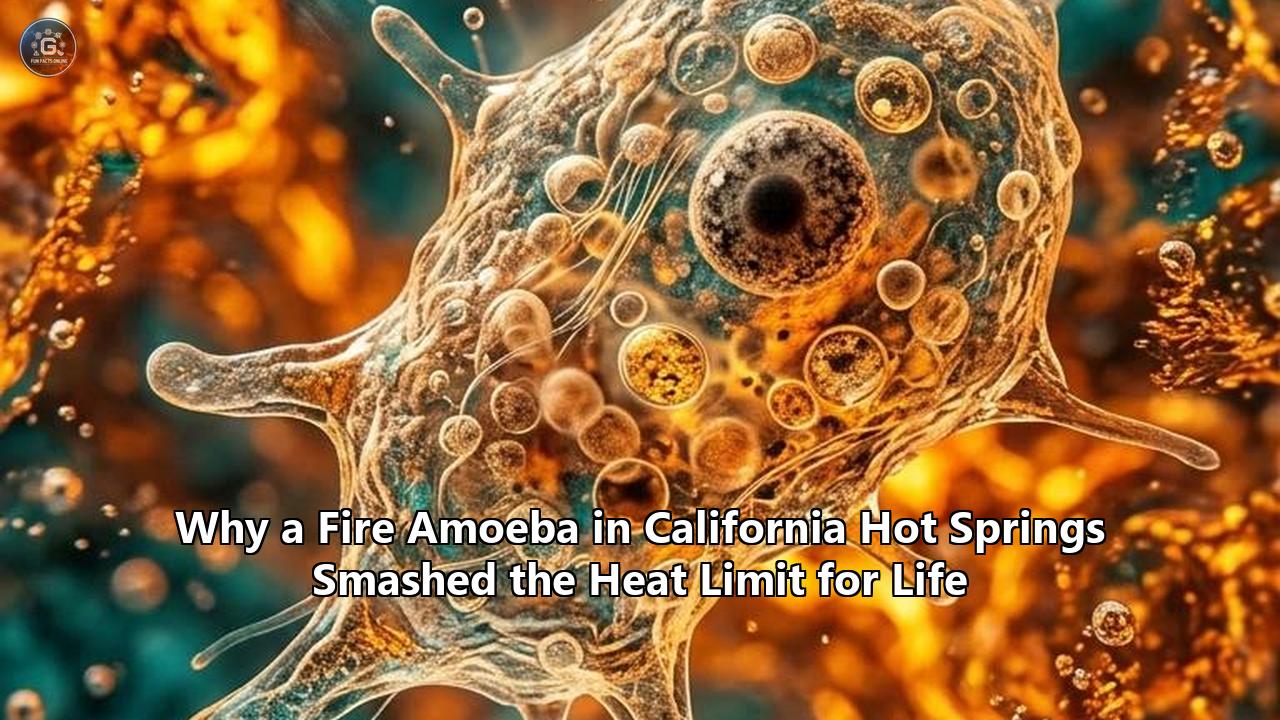
Deep within a hydrothermal stream at Lassen Volcanic National Park in Northern California, where geothermal heat pushes clear creek water to scalding temperatures, biologists have unearthed an organism that upends fundamental principles of thermal biology. In a study published in the journal Cell, researchers from Syracuse University revealed the isolation and characterization of Incendiamoeba cascadensis—informally dubbed the "fire amoeba"—a single-celled organism capable of moving, feeding, and undergoing cellular division at an astonishing 63 degrees Celsius (145.4 degrees Fahrenheit).
Led by microbial ecologist Angela Oliverio and doctoral researcher Beryl Rappaport, the NASA-funded team documented the amoeba maintaining normal mitotic division in conditions previously considered lethal to any life-form possessing a cell nucleus. Beyond replicating at 63°C, I. cascadensis remained active and predatory at 64°C (147.2°F) and successfully recovered from brief thermal spikes up to 70°C (158°F) by transitioning into a protective dormant state.
For more than half a century, cell biologists maintained that the structural machinery of eukaryotic cells—the intricate evolutionary lineage encompassing all protists, fungi, plants, and animals—faced an insurmountable physiological ceiling at approximately 60°C (140°F). While ancient, single-compartment prokaryotes such as bacteria and archaea survive in boiling deep-sea vents, complex cells were presumed too fragile to withstand such thermal kinetic energy. The discovery of I. cascadensis shatters that boundary, recalculating the thermal ceiling of complex cellular existence and resetting what biologists define as the heat limit for life in nucleated organisms.
The finding has ignited debates across evolutionary biology, astrobiology, and biophysics. By comparing competing scientific models of thermal cellular failure, evaluating high-throughput environmental sequencing against traditional culturing methodologies, and contrasting the survival strategies of prokaryotic extremophiles with complex cellular systems, researchers are uncovering the biological trade-offs that govern survival at the edge of thermodynamic possibility.
THERMAL CEILINGS ACROSS LIFE'S THREE DOMAINS
══════════════════════════════════════════════════════════════════════════════
Domain / Group             Record Holder               Max Growth Temp
──────────────────────────────────────────────────────────────────────────────
Archaea                    Methanopyrus kandleri       122°C (251.6°F)
Bacteria                   Geothermobacterium ferri.   100°C (212.0°F)
Eukaryota (Previous)       Cyanidioschyzon merolae     60°C  (140.0°F)
Eukaryota (New Record)     Incendiamoeba cascadensis   63°C  (145.4°F)
──────────────────────────────────────────────────────────────────────────────
Redefining the Heat Limit for Life: Organellar Membranes vs. Proteome Collapse
To understand how the fire amoeba survived where all other known eukaryotes perish, biophysicists are re-evaluating two competing schools of thought regarding what establishes the absolute heat limit for life in complex cells:
- The Membrane-Instability Model: Rooted in early work on geothermal microorganisms, this model posits that lipids inside cellular and organellar envelopes form the weakest link. As temperature rises, thermal kinetic motion increases within the lipid bilayer, transitioning biological membranes from a selective semi-fluid matrix into a disorganized, hyper-permeable liquid state. In complex cells, this breakdown is fatal: once the nuclear envelope, the endoplasmic reticulum, or the mitochondrial inner membrane leaks, proton gradients dissipate, ATP synthesis stalls, and cellular compartmentalization collapses entirely.
- The Proteome-Collapse Model: This counter-hypothesis argues that the structural collapse of proteins, rather than lipid dissolution, dictates the upper thermal threshold. At elevated temperatures, non-covalent interactions (hydrogen bonds, hydrophobic packing, and salt bridges) destabilize, causing enzyme active sites to unfold, irreversible protein aggregates to form, and ribosomal translation machinery to seize.
     THERMAL STRESS: COMPETING MECHANISMS OF CELLULAR FAILURE

     ┌────────────────────────────────────────────────────────┐
     │              Elevated Thermal Energy (>60°C)           │
     └───────────┬────────────────────────────────┬───────────┘
                 │                                │
                 ▼                                ▼
     ┌────────────────────────┐      ┌────────────────────────┐
     │  Membrane Instability  │      │   Proteome Collapse    │
     │      Hypothesis        │      │       Hypothesis       │
     ├────────────────────────┤      ├────────────────────────┤
     │ • Bilayer disorder     │      │ • Tertiary unfolding   │
     │ • Loss of gradients    │      │ • Aggregate toxicity   │
     │ • Organelle rupture    │      │ • Ribosome arrest      │
     └───────────┬────────────┘      └────────────┬───────────┘
                 │                                │
                 └───────────────┬────────────────┘
                                 ▼
                     Biophysical Cell Death
Data from the Syracuse University investigation demonstrates that I. cascadensis circumvents both failure modes through coordinated adaptations rather than relying on a single protective feature.
Transcriptomic analysis revealed that when the amoeba is shifted from a moderate 48°C to an extreme 61°C, its gene expression profile shifts dramatically. It rapidly downregulates baseline housekeeping pathways while driving a sharp surge in DNA repair transcripts, chaperonin complexes, and heat-shock protein networks designed to catch and refold destabilized polypeptides before toxic aggregates form.
Concurrently, biochemical profiling revealed that the surface architecture of its proteome exhibits an unusually high density of positive electrostatic charges. Known as "surface supercharging," this structural adaptation increases repulsive forces between neighboring folded proteins, preventing them from clumping together when kinetic vibrations pull their hydrophobic cores open.
On the membrane front, the amoeba manages thermal permeability by restructuring its lipid profile, increasing saturated fatty acid chain concentrations to stiffen internal envelopes while maintaining functional fluidity across its primary plasma membrane.
Where ordinary eukaryotic cells succumb to an unbalanced trade-off—either rigidifying their membranes to the point of freezing nutrient transport or prioritizing enzymatic flexibility at the cost of rapid thermal unfolding—I. cascadensis establishes a dynamic equilibrium, functioning at temperatures where human skin sustains third-degree burns within seconds.
Divergent Evolutionary Paths: Prokaryotic Simplicity vs. Complex Cellular Architecture
The discovery highlights an evolutionary disparity between simple prokaryotes and structurally complex eukaryotes.
Biologists have long known that hyperthermophilic bacteria and archaea dominate extreme geothermal environments. The single-celled archaeon Methanopyrus kandleri, isolated from deep-sea chimney walls, holds the absolute thermal record for Earth life, reproducing at a blistering 122°C (251.6°F) under hydrostatic pressure. Bacterial species like Geothermobacterium ferrireducens can grow efficiently at 100°C (212°F).
STRUCTURAL COMPARISON: PROKARYOTE VS. EUKARYOTE HEAT DEFENSES
──────────────────────────────────────────────────────────────────────────────
Feature                     Methanopyrus kandleri     Incendiamoeba cascadensis
──────────────────────────────────────────────────────────────────────────────
Cellular Organization       Single compartment        Nucleus, ER, Mitochondria
Membrane Architecture       Ether-linked monolayer    Saturated ester bilayer
Chromosome Structure        Circular, reverse gyrase  Linear chromatin, histones
Cell Division               Binary fission            Spindle-driven mitosis
Locomotion / Feeding        Passive / Chemotrophic    Active pseudopodia / Predatory
Upper Thermal Limit         122°C (251.6°F)           63°C (145.4°F)
──────────────────────────────────────────────────────────────────────────────
The biological trade-offs separating these domains explain why prokaryotes retain an overwhelming thermodynamic advantage:
- Compartmental Simplicity: Archaea manage a single cytoplasmic volume enclosed by an outer envelope. In hyperthermophiles, this barrier consists of ether-linked isoprenoid tetraether lipids forming a monolayer that cannot physically melt or separate like a standard bilayer.
- Specialized DNA Topochemistry: Hyperthermophilic archaea employ reverse gyrase—an enzyme that introduces positive supercoils into circular DNA molecules—preventing thermal denaturation of the genetic code at temperatures well above boiling.
- Cytoskeletal Fragility: Eukaryotes depend on dynamic, multiprotein cytoskeletal complexes made of actin microfilaments and tubulin microtubules. These elements must assemble and disassemble continuously to carry out phagocytosis, vesicular trafficking, and chromosome segregation during mitosis. Because cytoskeletal polymers rely on delicate non-covalent interfaces, elevated thermal energy typically breaks them apart, halting reproduction and motility.
Using high-resolution confocal microscopy, Oliverio’s team tracked the amoeba dividing at 63°C, capturing fluorescent markers of tubulin spindles orchestrating chromosome segregation and nuclear envelope reconstruction in real time.
Unlike archaea, which rely on primitive binary fission, the fire amoeba carries out mitotic division, coordinating distinct organellar systems under intense thermal stress.
                     MITOTIC STABILITY UNDER HEAT STRESS

  63°C Geothermal Medium
  ┌─────────────────────────────────────────────────────────────┐
  │                                                             │
  │     Microtubule Spindle Arrays                              │
  │     (Stabilized tubulin heterodimers withstand kinetic      │
  │      depolymerization)                                      │
  │               │                                             │
  │               ▼                                             │
  │         \   |   /                                           │
  │       ─── ◯ ◯ ◯ ───  ◄── Compacted Chromatin Bundles        │
  │         /   |   \        (Protected by thermal-stabilizing  │
  │                          histone-associated proteins)       │
  │               ▲                                             │
  │               │                                             │
  │     Structured Organellar Partitioning                      │
  │     (Saturated lipid envelopes prevent organelle lysis      │
  │      during cytoplasmic cleavage)                           │
  │                                                             │
  └─────────────────────────────────────────────────────────────┘
The energetic cost of this complexity is substantial. Unlike metabolic generalists, I. cascadensis is an obligate thermophile: in laboratory trials, it failed to divide at temperatures below 42°C and entered complete metabolic arrest below 40°C. Its peak growth rate occurs at 57°C.
The organism has sacrificed the ability to survive in temperate environments, evolving high-maintenance biochemical machinery to dominate hot-water niches where it faces virtually zero eukaryotic predation.
Methodological Paradigms: Environmental DNA Sequencing vs. Empirical Culturing
The discovery highlights an ongoing divide in modern microbiology: the tension between culture-independent metagenomic sequencing and empirical laboratory cultivation.
Over the past two decades, microbial ecology has shifted heavily toward environmental DNA (eDNA) metabarcoding. Researchers sequence the 18S rRNA genes of complex organisms directly from environmental samples, bypassing the arduous, uncertain process of isolating living strains.
Metagenomic databases had actually logged sequences closely related to Incendiamoeba from thermal features across the globe, including the Taupo Volcanic Zone in New Zealand and Norris Geyser Basin in Yellowstone.
However, because prevailing biological dogma maintained that no eukaryote could survive above 60°C, these environmental signals were repeatedly discarded or classified as artifactual:
- Bioinformatic cleanup pipelines regularly filtered out high-temperature eukaryotic hits, categorizing them as dead biomass, atmospheric dust contamination, or dormant cysts washed in from cooler tributary banks.
- Theoretical models assumed that sequences found in thermal pools operating at 60°C to 70°C represented organisms trapped in transient ecological sinks rather than active, replicating populations.
METHODOLOGICAL COMPARISON: DETECTING EXTREME LIFE
──────────────────────────────────────────────────────────────────────────────
Metric                      High-Throughput eDNA      Empirical Culturing
──────────────────────────────────────────────────────────────────────────────
Discovery Throughput        Massive (thousands/run)    Low (isolated single lines)
Physiological Validation    Indirect (inferred)        Direct (observed growth)
Thermal Limit Verification  Unreliable (cannot rule    Conclusive (visual mitosis
                            out dead biomass)          at temperature)
Cost and Labor              Moderate / Automated       Extremely high / Manual
Artifact Vulnerability      High (in silico filters   Low (living specimen
                            discard true anomalies)    proves viability)
──────────────────────────────────────────────────────────────────────────────
The Syracuse University team bypassed this analytical blind spot by returning to classical cultivation.
Between 2023 and 2025, Rappaport and Oliverio gathered sediment, biofilm, and water samples from 14 distinct locations along a neutral-pH geothermal branch of Hot Springs Creek near the Drakesbad area of Lassen Volcanic National Park. Instead of simply extracting DNA and archiving the sequence reads, the researchers placed live environmental inoculants into specialized liquid growth media, setting initial incubators to 57°C—the upper limit established for amoebic growth by Echinamoeba thermarum.
When an uncharacterized amoeba grew consistently at 57°C, the researchers avoided running standard metagenomic analyses immediately. Instead, they incrementally increased the incubator temperature: first to 60°C, then to 62°C, and ultimately to 63°C and 64°C.
Through direct visual verification—watching single cells search for prey, extend pseudopodia, and undergo cytokinesis under extreme heat—the team provided undeniable empirical proof of an active eukaryotic lifestyle where sequencing algorithms had only inferred passive environmental contamination.
Dynamic Locomotion vs. Static Dormancy: Two Alternate Escape Mechanics
In the shifting thermal gradients of Lassen’s volcanic springs, survival requires handling rapid fluctuations in water temperature. An unexpected surge of subterranean steam can raise ambient temperatures by 10°C in minutes.
To survive these sudden shifts, I. cascadensis balances two opposing strategies: behavioral evasion via morphological polymorphism and structural fortification via cellular encystment.
                     BEHAVIORAL AND STRUCTURAL DYNAMICS

                         Ambient Water Temperature
                    42°C ────────────────────────── 70°C
                                     │
                 ┌───────────────────┴───────────────────┐
                 ▼                                       ▼
     ┌───────────────────────┐               ┌───────────────────────┐
     │  Trophozoite State    │               │      Cyst State       │
     │      (42°C – 64°C)    │               │      (64°C – 70°C)    │
     ├───────────────────────┤               ├───────────────────────┤
     │ • Active predation    │               │ • Metabolic shutdown  │
     │ • Polymorphic shapes  │               │ • Thick polymer coat  │
     │   (broad vs. spindle) │               │ • DNA condensation   │
     │ • Sustained mitosis   │               │ • Reversible stasis   │
     └───────────────────────┘               └───────────────────────┘
1. Active Polymorphic Locomotion (42°C to 64°C)
During routine vegetative conditions, the amoeba alternates between two distinct body shapes depending on local thermal and nutrient conditions:
- The Trophic Foraging Form: A broad, flattened, slow-moving morphology characterized by multiple lobose pseudopodia. In this form, the organism moves across volcanic sediment beds, consuming heat-tolerant biofilm bacteria through phagocytosis.
- The Migratory Spindle Form: An elongated, streamlined morphology characterized by accelerated, monopodial cytoplasmic streaming. When local water currents become dangerously warm (approaching 64°C), the cell transitions into this spindle shape, tripling its crawl speed to navigate thermal gradients toward cooler micro-refuges.
The evolutionary trade-off is clear: the foraging morphology optimizes nutrient intake but leaves the cell exposed to dangerous thermal spikes, whereas the migratory morphology burns cellular energy stores while escaping localized boiling surges.
2. Static Protective Encystment (64°C to 70°C)
When temperatures exceed 64°C, active locomotion fails as cytoskeletal turnover rates decouple from ATP hydrolysis. At this threshold, the amoeba arrests motility, rounds into a sphere, and secretes an outer structural wall, forming a dormant cyst.
Inside this protective capsule, the cytoplasm condenses, cellular respiration drops to near-undetectable levels, and the genome associates with protective nuclear matrices.
Laboratory experiments revealed that encysted I. cascadensis cells can endure temperatures of 70°C (158°F) for five minutes without structural lysis. Once ambient temperatures return to optimal ranges (50°C to 57°C), the cysts excyst, emerging as active, predatory trophozoites within hours.
However, this resilience has its limits. When exposed to 80°C (176°F)—approaching the boiling point at Lassen's elevation—the encystment mechanism collapsed completely, causing irreversible membrane rupture and total cell death.
By developing both active locomotion to evade moderate thermal shifts and protective dormancy to outlast transient thermal spikes, I. cascadensis maintains an ecological advantage unavailable to non-motile geothermal algae and fungi.
                     TEMPORAL RESPONSE TO A 70°C THERMAL SPIKE

 Temperature
     ▲
70°C ┼                   ┌───────────────┐
     │                  /│  Cyst Stasis  │\
63°C ┼─ Mitotic Ceiling──┼────────────────┼──
     │                  /│               │ \
57°C ┼─── Trophozoite ──/│               │  \─── Trophozoite Resumed
     │    (Foraging)     │               │      (Post-Excystment)
     └───────────────────┴───────────────┴────────────────────────► Time
     0 min              2 min           7 min                  120 min
Astrobiological Modeling: Surface Life vs. Subsurface Microhabitats
The discovery of a high-temperature predatory eukaryote has altered astrobiological models assessing potential biosignatures on other worlds.
For decades, the search for extraterrestrial life has relied on a two-tiered habitability metric:
- Simple, prokaryotic analogues were considered viable within extreme environments up to roughly 120°C.
- Structurally complex organisms were assumed to require stable, temperate surface conditions not exceeding 50°C or, at most, the fungal ceiling of 60°C.
Because of this bifurcation, NASA’s mission planning frameworks regularly ruled out complex trophic food webs when assessing warm subsurface environments.
Target environments like the hydrothermal ocean floor of Saturn's moon Enceladus, the subsurface brine pockets of Jupiter's moon Europa, and geothermal aquifers beneath the Martian crust feature localized temperatures between 50°C and 80°C. Under traditional assumptions, these regions were categorized as capable of hosting only primitive, single-compartment chemoautotrophs.
Dr. Alison Olcott, program scientist for exobiology at NASA Headquarters, noted that I. cascadensis fundamentally alters these models. The existence of an obligate thermophilic eukaryote demonstrates that compartmentalized, nucleated life can sustain the heavy metabolic demands of predatory lifestyles in hot hydrothermal systems.
ASTROBIOLOGICAL LIFE-DETECTION PARADIGMS
──────────────────────────────────────────────────────────────────────────────
Environment Parameter       Traditional Model          Updated Post-Cascadensis
──────────────────────────────────────────────────────────────────────────────
Planetary Target Focus      Temperate surface soils    Active hydrothermal plumes
                            (<50°C)                    and vents (50°C–65°C)
Target Biomarkers           Prokaryotic equivalents    Complex sterols, complex
                            (hopanoids, simple lipids) organellar-derived polymers
Ecosystem Architecture      Monolayer chemoautotrophy   Multi-tiered trophic webs
                            only                       (primary producers + predators)
Instrument Calibration      Optimized for room-temp    Calibrated for heat-stable,
                            molecular stability        charge-shifted eukaryotic
                                                       proteins
──────────────────────────────────────────────────────────────────────────────
This shift presents a challenge for life-detection instrumentation design. Instruments sent aboard deep-space landers—such as gas chromatography-mass spectrometers (GC-MS) and microfluidic biomarker sequencers—are typically calibrated to identify biological indicators of simple life (such as isoprenoid lipids and short-chain amino acid ratios) when probing hot regimes.
Now, planetary scientists must broaden their search criteria. They must reconfigure detection suites to recognize complex eukaryotic biosignatures—such as advanced sterols, multi-ringed hopanoid alternatives, and functional organellar structural fragments—in geothermal samples previously thought far beyond the heat limit for life.
Applied Biotechnology: Bacterial Enzymes vs. Complex Eukaryotic Biocatalysis
Beyond evolutionary theory, the isolation of I. cascadensis creates clear practical opportunities for industrial biotechnology, setting up a technological contrast between bacterial enzymes and eukaryotic biocatalytic systems.
APPLIED BIOTECHNOLOGY: COMPARATIVE PLATFORMS
──────────────────────────────────────────────────────────────────────────────
Functional Trait            Prokaryotic System        Incendiamoeba Platform
                            (e.g., Taq / Pfu / E. coli) (Eukaryotic Thermophile)
──────────────────────────────────────────────────────────────────────────────
Thermal Stability           Extreme (>95°C)           High (60°C–70°C)
Post-Translational Mod.     Absent or minimal         Complete (mammalian-like)
Complex Protein Folding     Requires denaturing/      Endogenous heat-shock
                            renaturing in vitro       chaperonin folding in vivo
Bioreactor Contamination    High risk at 37°C         Zero risk at 60°C
Target Applications         PCR, simple synthesis     Thermostable biologics,
                                                      heat-resilient crops
──────────────────────────────────────────────────────────────────────────────
For decades, industrial bioprocessing has relied on enzymes from thermophilic bacteria and archaea. Reagents like Thermus aquaticus DNA polymerase (Taq) and Pyrococcus furiosus proofreading enzymes (Pfu) transformed molecular biology because they withstand repeated cycles near boiling.
Yet despite their durability, prokaryotic enzymes face severe functional limitations in pharmaceutical manufacturing:
- They lack the structural machinery needed to execute complex post-translational modifications (PTMs), including complex glycosylation, precise disulfide bond isomerism, and targeted phosphorylation.
- When pharmaceutical companies synthesize human therapeutic proteins, antibodies, or viral-vector vaccines, they must use eukaryotic host systems (such as Chinese Hamster Ovary, or CHO, cell lines) maintained at narrow, temperate conditions—typically 37°C.
- These low-temperature, neutral-pH bioreactors are highly susceptible to contamination by opportunistic bacteria, mycoplasma, and adventitious viruses, requiring expensive sterile infrastructure and frequent batch purges.
                  INDUSTRIAL FERMENTATION ENVIRONMENTS

     Traditional Mammalian Platform        Incendiamoeba-Derived Platform
     ──────────────────────────────        ──────────────────────────────
            Ambient Temp: 37°C                     Ambient Temp: 60°C

       ┌────────────────────────┐             ┌────────────────────────┐
       │   CHO / HEK Culture    │             │ Thermostable Eukaryote │
       │                        │             │                        │
       │   ⚠️ HIGH RISK:        │             │   🛡️ SELF-STERILIZING: │
       │   Bacterial infection  │             │   Thermal barrier kills│
       │   Viral contamination  │             │   common industrial    │
       │   Cooling energy costs │             │   contaminants         │
       └────────────────────────┘             └────────────────────────┘
The cellular machinery of I. cascadensis provides a biological blueprint to overcome these trade-offs:
- Self-Sterilizing Eukaryotic Bioreactors: By engineering cellular lines that integrate the thermal chaperonins and membrane-stabilization networks of I. cascadensis, biomanufacturing facilities could operate at 55°C to 60°C. At this temperature, the growth medium becomes self-sterilizing against common viral and bacterial contaminants, eliminating the need for expensive chemical antibiotics while reducing systemic batch failure rates.
- Enhanced Agricultural Resilience: Agronomists are evaluating the amoeba's thermal-response transcripts to support crop engineering. With extreme summer temperatures increasingly inducing leaf desiccation, pollen sterility, and Rubisco enzyme failure in global staple crops, importing electrostatic surface modifications or DNA-repair cassettes inspired by the fire amoeba could produce crops with far greater resilience during severe heat events.
However, engineering eukaryotic cells to tolerate extreme heat presents major technical hurdles.
Transferring a single bacterial gene into an industrial strain is straightforward; in contrast, the thermal resilience of I. cascadensis relies on a coordinated polygenic network, requiring thousands of simultaneous modifications across membranes, cytoskeletal systems, and the proteome. Translating the fire amoeba’s natural machinery into useful industrial tools will require years of synthetic biology development.
The Unresolved Frontiers of Thermal Biology
The discovery of Incendiamoeba cascadensis proves that eukaryotic life is far more resilient than five decades of laboratory models predicted. By surviving at 63°C and reviving after exposures to 70°C, a microscopic predator in Lassen Volcanic National Park has shown that the boundaries of complex life remain open to discovery.
This finding leaves several critical questions unanswered, driving new investigations across multiple fields:
- The Structural Mystery of Cytoskeletal Integrity: Scientists have not yet determined how the amoeba's tubulin microtubules and actin filaments avoid breaking down at temperatures that denature similar proteins in humans, plants, and insects. High-resolution cryo-electron microscopy studies are underway to map the precise amino acid substitutions that secure these structures.
- The True Planetary Distribution: The Syracuse University team noted that related, uncultivated genetic signatures have been detected in geothermal waters globally. Field teams are now preparing targeted isolation campaigns across geothermal fields in Yellowstone, Iceland, the Taupo region of New Zealand, and deep underwater hydrothermal rifts.
KEY MILESTONES: THE PATH AHEAD
══════════════════════════════════════════════════════════════════════════════
Milestone                   Target Horizon    Scientific Objective
──────────────────────────────────────────────────────────────────────────────
Cryo-EM Cytoskeletal        2026–2027         Map structural tubulin-actin
Structural Mapping                            co-factors conferring heat resistance
Global Sampling Campaigns   2027–2028         Sample high-temperature pools
                                              in Iceland, Taupo, and Yellowstone
Astrobiological Integration 2028–2029         Re-calibrate deep-space life
                                              detection algorithms (Enceladus/Europa)
Synthetic Strain Trial      2029–2030         Integrate cascadensis heat-shock
                                              cassettes into industrial yeast lines
──────────────────────────────────────────────────────────────────────────────
The most profound question is whether 63°C represents the true biophysical edge of complex life, or simply the highest temperature researchers have managed to sample and culture.
As field expeditions analyze additional extreme environments, the line separating the thermodynamic limits of simple and complex life continues to blur.
What was long accepted as an unyielding boundary for cellular complexity has been decisively broken by an amoeba navigating a boiling California stream, compelling scientists to re-examine how high the actual heat limit for life can climb before complex biological systems fail irrevocably.
Reference:
- https://finance.biggo.com/news/3b8b4deb-e77a-48f8-9217-3b085eef0981
- https://www.the-scientist.com/a-fire-amoeba-takes-first-place-for-eukaryotic-heat-tolerance-75025
- https://allatra.media/news/space-amoeba-divides-63c-heat-limit
- https://www.sciencenews.org/article/fire-amoeba-record-breaking-heat
- https://www.sciencealert.com/volcanic-springs-amoeba-survives-63-c-setting-a-new-heat-record-for-complex-life
- https://www.sci.news/biology/incendiamoeba-cascadensis-15086.html
- https://timesofindia.indiatimes.com/science/discovery/scientists-found-a-new-amoeba-in-californias-lassen-volcanic-national-park-that-can-reproduce-at-145f-stay-active-at-147f-and-recover-after-five-minutes-at-158f-setting-a-new-heat-record-for-complex-life/articleshow/134457302.cms
- https://gizmodo.com/say-hello-to-the-fire-amoeba-it-just-broke-a-heat-limit-scientists-thought-was-impossible-2000815396
- https://www.zmescience.com/science/news-science/63-c-amoeba-likes-it-hot/
- https://www.indiatoday.in/science/story/fire-amoeba-incendiamoeba-cascadensis-63c-hot-spring-3000954-2026-09-23
- https://www.facebook.com/gizmodo/posts/say-hello-to-the-fire-amoeba-it-just-broke-a-heat-limit-scientists-thought-was-i/1527547242571738/
- https://www.reddit.com/r/HotScienceNews/comments/1wo9o08/scientists_found_a_singlecelled_organism_that/