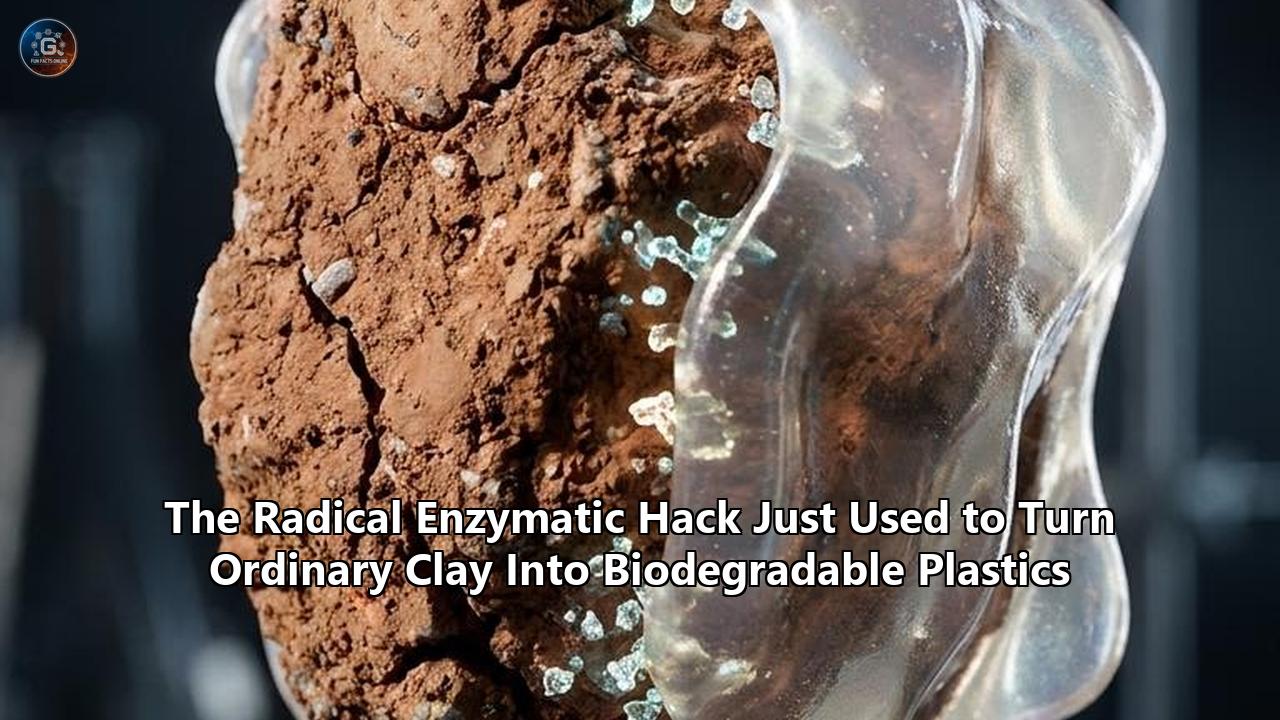
At a polymer pilot plant outside of Leipzig this week, materials scientists initiated the first commercial-scale extrusion run of a composite material that defies decades of petrochemical logic. By injecting a proprietary slurry of engineered esterase enzymes and common montmorillonite clay directly into a bio-based polymer melt, the team produced a packaging film with the tensile strength of conventional polyethylene terephthalate (PET). Yet, when exposed to ambient soil moisture and standard microbial activity, the plastic fully unzips its molecular bonds, mineralizing into water, carbon dioxide, and natural soil components within forty-five days.
This development bypasses the severe thermal limitations that have historically prevented biological catalysts from surviving the intense heat of plastic manufacturing. Researchers discovered that slipping custom-designed enzymes between the microscopic, negatively charged layers of aluminum silicate clay creates a thermal armor. The clay shields the delicate proteins from denaturing during the 200-degree Celsius extrusion process. Once the plastic is formed and eventually discarded, the intrusion of water swells the clay layers, releasing the dormant enzymes to consume the plastic from the inside out.
For the packaging industry, agricultural sector, and municipal waste authorities, this mechanism solves a structural deadlock. The mandate to abandon fossil-fuel-based plastics has been stymied by the profound physical limitations of current alternatives. By using an abundant, dirt-cheap mineral as both a mechanical reinforcer and a biological delivery vehicle, the consortium has charted a viable path toward materials that perform like synthetics but die like organic matter.
The False Promise of the First-Generation Biopolymer
To understand the weight of this week’s operational success in Leipzig, one must dissect the ongoing structural failure of the global bioplastics initiative. For the past twenty years, the materials sector has attempted to replace conventional plastics with bio-derived alternatives like polylactic acid (PLA) and polyhydroxyalkanoates (PHAs). The fundamental logic was that materials synthesized from biological feedstocks—such as fermented corn starch or microbial lipid storage—would naturally return to the earth.
The reality proved much more complex, revealing a deep flaw in how consumer waste systems interface with material science.
Pure biopolymers suffer from intrinsic thermal and mechanical deficits. Polylactic acid, the most widely commercialized bioplastic used in cold-drink cups and food containers, possesses poor gas barrier properties and a low heat-deflection temperature. If exposed to the heat of a standard dishwasher or left in a vehicle on a warm afternoon, PLA warps and degrades prematurely. To compensate for these weaknesses, manufacturers often increase the thickness of the material or blend it with less degradable synthetic co-polymers, directly undermining the environmental objective.
More critically, the end-of-life scenario for first-generation bioplastics revealed a massive infrastructural blind spot. While chemically capable of biodegrading, polymers like PLA require specific, aggressive conditions to initiate hydrolysis: temperatures consistently exceeding 60 degrees Celsius and highly managed moisture profiles. These conditions only exist inside specialized industrial composting facilities.
When a consumer tosses a PLA container into a backyard compost bin, a standard recycling receptacle, or when the plastic inadvertently enters the marine environment, it persists. In cold ocean waters or compacted municipal landfills lacking oxygen and heat, bioplastics behave virtually identically to petroleum-derived plastics. They physically fragment into microplastics over decades rather than chemically returning to basic biological building blocks.
This misalignment between laboratory capability and real-world infrastructure created a crisis of confidence. Municipal waste managers began sorting out bioplastics and sending them to incinerators or landfills because the sorting technology could not reliably separate PLA from standard PET, and the region lacked the high-heat industrial composters required to process the material. The proposed solution had inadvertently complicated the waste stream rather than clarifying it.
The Temperature Tolerance Trap
Engineers and synthetic biologists understood the core deficit: if the environment could not reliably provide the heat and specific microbial life necessary to degrade the plastic, the plastic needed to carry its own destruction mechanism.
The theoretical solution was to embed plastic-eating enzymes directly into the polymer matrix during manufacturing. If the enzyme was already distributed evenly throughout the plastic, it would not matter if the material ended up in a cold ocean or a backyard pile. The catalyst would simply activate upon exposure to water and begin clipping the polymer chains into harmless monomers.
However, translating this theory into industrial reality met a harsh thermal reality. Enzymes are complex, folded proteins. Their ability to catalyze reactions depends entirely on their three-dimensional shape. If an enzyme is heated beyond its specific tolerance threshold, the bonds holding its structure together break. The protein denatures, unfolding into a useless ribbon of amino acids, permanently losing its catalytic function.
Standard plastic extrusion and injection molding processes require temperatures ranging from 150 to 300 degrees Celsius to melt the polymer sufficiently for shaping. Most naturally occurring enzymes denature at temperatures well below 80 degrees Celsius. Even extremophile enzymes, sourced from organisms living in deep-sea hydrothermal vents, rarely survive the intense, sustained thermal and mechanical shear forces inside an industrial twin-screw extruder.
Attempting to mix liquid or powdered enzymes directly into molten plastic resulted in a graveyard of denatured proteins. The resulting materials looked and functioned like normal plastic, but when placed in soil or water, the "auto-destruct" sequence failed to initiate because the active biological agents had been cooked to death during manufacturing. The challenge was physical containment: researchers needed a microscopic, thermally resistant bunker to house the enzymes until the plastic was ready for disposal.
Engineering the Mineral Shield
The breakthrough executed at the Leipzig facility centers on the exploitation of phyllosilicates—specifically, montmorillonite and halloysite clays. These naturally occurring minerals possess a unique, highly ordered microscopic geometry.
Montmorillonite is a smectite clay composed of flat, nanometer-thick silicate sheets stacked on top of one another. Between these sheets are "galleries"—microscopic spaces that naturally house cations and water molecules. Halloysite features a similar composition but naturally rolls itself into hollow, microscopic tubes. Both minerals have high thermal stability, easily surviving temperatures exceeding 400 degrees Celsius, well above the melting points of commercial polymers.
The researchers developed an intercalation process to force custom-engineered esterase enzymes into these microscopic clay galleries. By manipulating the pH and ionic strength of an aqueous solution containing the enzymes and the purified clay, the proteins are chemically drawn into the spaces between the silicate layers.
Once the enzymes are trapped inside, the clay edges are treated with a hydrophobic surfactant. This effectively locks the biological payload inside the mineral armor. When this enzyme-loaded clay is introduced into the brutal environment of the plastic extruder, the ceramic nature of the silicate layers absorbs the thermal shock and mechanical shear. The enzymes remain safely insulated within the nanoscopic voids, their delicate folded structures perfectly preserved while the molten biopolymer flows around the clay particles to form the final packaging film.
This process essentially weaponizes dirt. The process of transitioning from untreated clay to biodegradable plastic composites solves the thermal vulnerability problem while simultaneously improving the physical performance of the plastic itself.
The Structural Dividend of Nanoclay
The integration of clay into the polymer matrix provides a massive secondary benefit that directly addresses the traditional weaknesses of bioplastics. When the enzyme-loaded clay particles are dispersed evenly throughout the polymer melt, they act as an intense reinforcing agent.
The flat silicate sheets create a "tortuous path" for gas molecules. If an oxygen or water vapor molecule attempts to pass through the packaging film, it cannot travel in a straight line. It must navigate around thousands of impermeable clay plates. This drastically improves the barrier properties of the biopolymer, allowing materials like PLA or starch-based plastics to protect perishable foods, carbonated beverages, or sensitive electronics just as effectively as fossil-derived plastics.
Furthermore, the rigid clay particles increase the elastic modulus and thermal deflection temperature of the plastic. A bioplastic cup that would previously warp in a dishwasher or a hot car maintains its rigid structure thanks to the mineral reinforcement.
This dual-action mechanism is what makes the recent production run so critical. The industry no longer has to compromise on performance to achieve environmental compliance. The exact same additive that acts as the physical reinforcement is quietly harboring the biological agent of the material’s eventual destruction.
The Trigger Mechanism: Controlled Destruction
The true elegance of the enzymatic hack lies in its activation sequence. A self-destructing plastic is useless if it begins degrading while sitting on a grocery store shelf or holding a liquid product. The enzyme must remain entirely dormant during the product's useful life and activate only upon disposal.
The clay armor dictates this timing. The hydrophobic treatment applied to the edges of the clay particles keeps ambient humidity and the moisture from the packaged product from reaching the enzymes inside the galleries. As long as the plastic matrix remains intact and relatively dry, the enzymes sit frozen in place.
When the plastic is discarded into soil or a marine environment, it encounters sustained, aggressive moisture and natural microbial colonization. Soil bacteria begin to excrete their own weak enzymes, causing micro-fractures in the polymer surface. Water slowly creeps into these fissures.
Montmorillonite clay is highly hydrophilic; it aggressively absorbs water when submerged. As the environmental moisture reaches the embedded clay particles, the water forces the silicate layers to swell and expand. This swelling breaks the hydrophobic seal and floods the galleries, waking the dormant esterases.
The enzymes immediately begin attacking the ester bonds of the surrounding polymer chains, cutting the long, tough molecular strings into short, water-soluble fragments. As the polymer matrix weakens, more water rushes in, swelling more clay particles, and releasing more enzymes. The degradation accelerates exponentially. A process that would take centuries for a conventional plastic, or years for a standard bioplastic in cold soil, is compressed into weeks.
Scaling the Strategy: Implementation and Economics
With the chemical mechanics proven, industry leaders and policymakers are rapidly calculating the logistics of mass adoption. Moving from a successful pilot plant extrusion to a global supply chain requires addressing the economics of raw materials, enzyme production, and modification of existing manufacturing hardware.
The primary financial advantage of this model is the cost of the host material. Bentonite, the raw ore from which montmorillonite is extracted, is mined globally at massive scales for applications ranging from drilling mud to cat litter. It is exceptionally cheap. While the biopolymer itself (such as PHA or PLA) remains more expensive than petroleum-based equivalents, replacing 10 to 15 percent of the polymer volume with cheap clay acts as a cost-reducer.
The variable cost lies in the production of the enzymes. To scale this, synthetic biology firms are utilizing precision fermentation. Genetically modified yeast and bacteria are grown in massive steel bioreactors, fed on simple sugars, and programmed to excrete the specific esterases required for the clay intercalation. As fermentation capacity expands globally, the cost of these specialized enzymes has plummeted by nearly 60 percent over the past three years.
Chemical companies are currently building out the infrastructure to handle the intermediate step: the intercalation facilities. These plants will take raw clay and purified enzymes, perform the loading and sealing process, and sell the resulting "active clay" masterbatch directly to plastic manufacturers.
Crucially, the plastic manufacturers do not need to purchase new extrusion or molding equipment. The active clay masterbatch can be dropped directly into their existing hoppers, blending with the polymer pellets just like a traditional colorant or UV-stabilizer. This zero-friction adoption curve is a primary reason the packaging industry is aggressively pursuing the technology. The transition requires no massive capital expenditure on the part of the factories actually stamping out the bottles and films.
Agricultural Mulch: The Perfect First Target
While consumer packaging commands the most public attention, the earliest large-scale deployment of this technology is happening in the agricultural sector, specifically with mulch films.
Global agriculture relies heavily on thin plastic sheets unrolled across miles of crop rows. These films suppress weeds, retain soil moisture, and increase soil temperature, dramatically boosting crop yields. However, retrieving these thin, dirt-caked, degrading films at the end of the harvest season is labor-intensive and economically unviable. Consequently, farmers often plow the plastic directly into the soil, or burn it at the edges of fields. Over decades, this practice has severely degraded soil health, leading to massive accumulations of microplastics that stunt root growth and disrupt water flow.
Standard bioplastic mulch films exist, but they have historically failed to degrade fast enough in colder climates before the next planting season, or they degrade too quickly, failing to suppress weeds during the critical mid-summer growing period.
The clay-enzyme composite offers a highly tunable solution. By adjusting the type of clay, the concentration of the enzyme, and the thickness of the hydrophobic coating, ag-tech engineers can precisely program the lifespan of the film. A farmer growing strawberries in California requires a film that remains robust for exactly eight months before dissolving. A farmer growing short-season vegetables in northern Europe might require a film that shatters and degrades in twelve weeks.
Field trials concluded last autumn demonstrated that by varying the ratio of halloysite tubes to montmorillonite plates in the masterbatch, the onset of enzymatic degradation could be controlled with a variance of less than ten days. When the film does break down, the residual materials left in the soil are simply the natural carbon monomers of the biopolymer (which act as microbial food) and microscopic clay particles, which are already a fundamental component of healthy loam.
The Marine Environment Challenge
While soil degradation has proven highly predictable, the behavior of these materials in marine environments remains a critical frontier. The global push for a unified UN treaty on plastic pollution focuses heavily on ocean accumulation, where plastics entangle wildlife and disrupt deep-water ecosystems.
Ocean conditions are fundamentally different from agricultural soil. The temperatures are lower, microbial density is vastly different, and the continuous motion of water creates different mechanical stresses on the materials.
Recent laboratory simulations utilizing cold, high-salinity water have shown promising, if slower, results for the enzyme-loaded clay composites. The high concentration of sodium ions in seawater actually accelerates the swelling of certain smectite clays. When the composite plastic is submerged, the salt water quickly infiltrates the matrix and expands the clay layers, exposing the enzymes.
The limiting factor is the ambient temperature of the ocean water, which slows the catalytic rate of the enzymes. To address this, synthetic biologists are currently utilizing machine learning algorithms to map and synthesize cold-adapted enzymes—specifically sourcing genetic code from psychrophilic (cold-loving) bacteria found in Arctic sea ice. By intercalating these cold-adapted proteases into the clay alongside standard mesophilic enzymes, the plastics can be equipped with a dual-trigger system. If the plastic lands in a warm landfill, the standard enzymes handle the degradation. If it washes into a cold ocean, the psychrophilic enzymes activate, ensuring the material breaks down before it can fragment into persistent microplastics.
Supply Chain Disruptions and Market Realignments
The validation of this method is forcing a rapid recalculation among traditional petrochemical giants. For decades, the fossil fuel industry has viewed virgin plastic production as a critical growth vector, particularly as the electrification of the automotive fleet threatens global demand for liquid fuels. The structural deficiencies of bioplastics provided a protective moat around the synthetic polymer market.
That moat is now evaporating. The combination of legislative pressure—such as expanded producer responsibility (EPR) laws taxing non-degradable packaging—and the sudden technical viability of high-performance biodegradable composites is shifting capital away from traditional naphtha crackers.
We are witnessing a new class of material suppliers emerging: hybrid agricultural-mining-biotech conglomerates. The supply chain for the new composite requires sugar or starch to ferment the biopolymer, precision fermentation to produce the enzymes, and mining logistics to supply the specialty clays.
This is creating unexpected economic geographies. Regions with massive agricultural outputs and deep bentonite reserves are suddenly positioned to become material hubs. The process relies heavily on local synthesis rather than extracting crude oil from one hemisphere, refining it in another, and shipping the pellets globally. The raw materials—plants and dirt—are distributed globally, allowing for highly localized production loops that slash transportation emissions.
Furthermore, the economics of the clay to biodegradable plastic methodology inherently scale down well. Unlike billion-dollar petrochemical refineries that require massive volume to achieve profitability, fermentation and clay intercalation can be operated efficiently at a regional level. This decentralization of plastic manufacturing provides resilience against the supply chain shocks that have routinely disrupted the chemical industry over the past five years.
Regulatory Pressures and Verification
As this material enters the broader market, regulatory agencies face a significant verification challenge. The historical abuse of the term "biodegradable" by companies selling oxo-degradable plastics—which merely shatter into invisible micro-fragments without chemically breaking down—has left regulators highly skeptical of new claims.
Standardizing the testing protocols for enzyme-embedded materials requires updating decades-old ASTM and ISO testing frameworks. Current standards for compostability often demand that materials break down within a highly specific timeframe under 58-degree Celsius conditions. They do not account for materials programmed to self-destruct in 20-degree ocean water or dry agricultural soil over a staggered timeline.
To prevent greenwashing, environmental protection agencies in the EU and North America are currently drafting specific testing mandates for internally catalyzed polymers. Manufacturers will be required to prove complete mineralization—meaning the plastic converts entirely into biomass, water, and gas—using isotopic tracing. By synthesizing the initial biopolymer with carbon-13 isotopes, regulators can track the exact fate of the carbon atoms in a sealed testing environment, ensuring that the plastic is not simply fragmenting into smaller, harder-to-detect pieces.
The transparency provided by the exact chemical nature of the clay and enzymes makes this verification easier than with proprietary chemical blends. The esterase enzymes are highly specific; they only cut targeted chemical bonds. By analyzing the breakdown products, independent labs can easily verify whether the plastic successfully mineralized or stalled mid-process.
Examining the Life Cycle Implications
A thorough analysis of this shift requires looking beyond the end-of-life phase and examining the full life cycle of the materials involved. Synthesizing biopolymers currently requires agricultural land, water, and fertilizers. While moving away from fossil fuels is a net positive for carbon emissions, expanding the cultivation of corn, sugarcane, or sugar beet to produce bioplastic feedstocks introduces tension regarding land-use and food security.
Here again, the use of clay acts as a vital buffer. Because the engineered composite utilizes up to 20 percent clay by weight, it directly reduces the amount of biological feedstock required per ton of finished plastic. Every kilogram of clay suspended in the matrix is a kilogram of corn that does not need to be grown, harvested, and fermented.
Simultaneously, researchers are shifting the biological feedstocks away from primary food crops toward agricultural waste and second-generation biomass. Pilot plants are currently extracting hemicellulose from oat husks, wheat straw, and forestry residues to synthesize the base polymers. When these waste-derived polymers are reinforced with the enzyme-loaded clay, the entire material loop is decoupled from human food supply chains and fossil extraction.
The energy required to process the clay is relatively low. Unlike energy-intensive smelting or refining, clay merely needs to be mined, washed, milled, and mixed in aqueous solutions for the enzyme intercalation. The water used in the loading process can be continuously recycled in a closed-loop system, minimizing the environmental footprint of the masterbatch production.
Looking Forward: Unresolved Questions and Next Milestones
While the Leipzig pilot plant validates the commercial mechanics of the process, the path to replacing millions of tons of global plastic packaging faces strict biological and logistical hurdles.
One primary unknown is the long-term ecological impact of depositing massive quantities of targeted esterase enzymes into wild soils and oceans. While the enzymes are proteins that naturally break down into amino acids, introducing concentrated bursts of these biological catalysts into micro-ecosystems during the degradation phase requires rigorous longitudinal study. Soil microbiologists are currently running multi-year soil column tests to ensure that the sudden influx of polymer-digesting enzymes does not inadvertently disrupt the natural carbon cycling of native fungi and bacteria.
There is also the challenge of enzyme shelf-life prior to the plastic manufacturing process. While the clay protects the enzymes from the extreme heat of the extruder, the "active clay" masterbatch must remain stable during shipping and storage in varying warehouse conditions. Engineers are experimenting with different cationic treatments on the silicate layers to further stabilize the proteins against premature moisture exposure during transport.
The next major milestone will occur late this year, when a coalition of beverage companies intends to release the first consumer-facing product: a rigid bioplastic bottle designed for cold, non-carbonated liquids. This deployment will test not only the barrier properties of the clay-polymer composite on a global logistics scale but also consumer behavior. Will consumers actively trust a plastic bottle that promises to vanish, and will municipal waste authorities adapt their sorting optical scanners to recognize and route these specific materials away from traditional recycling streams and into dedicated soil-composting avenues?
The era of relying entirely on external infrastructure to manage the chemical persistence of packaging has structurally failed. By internalizing the biological solution—forcing the material to carry its own destruction mechanism within a ceramic shield—the materials industry is attempting to rewrite the fundamental rules of polymer persistence. The successful transition of transforming clay to biodegradable plastic alternatives proves that the solution does not lie in building more complex recycling facilities, but in demanding that the materials we create take responsibility for their own disappearance.