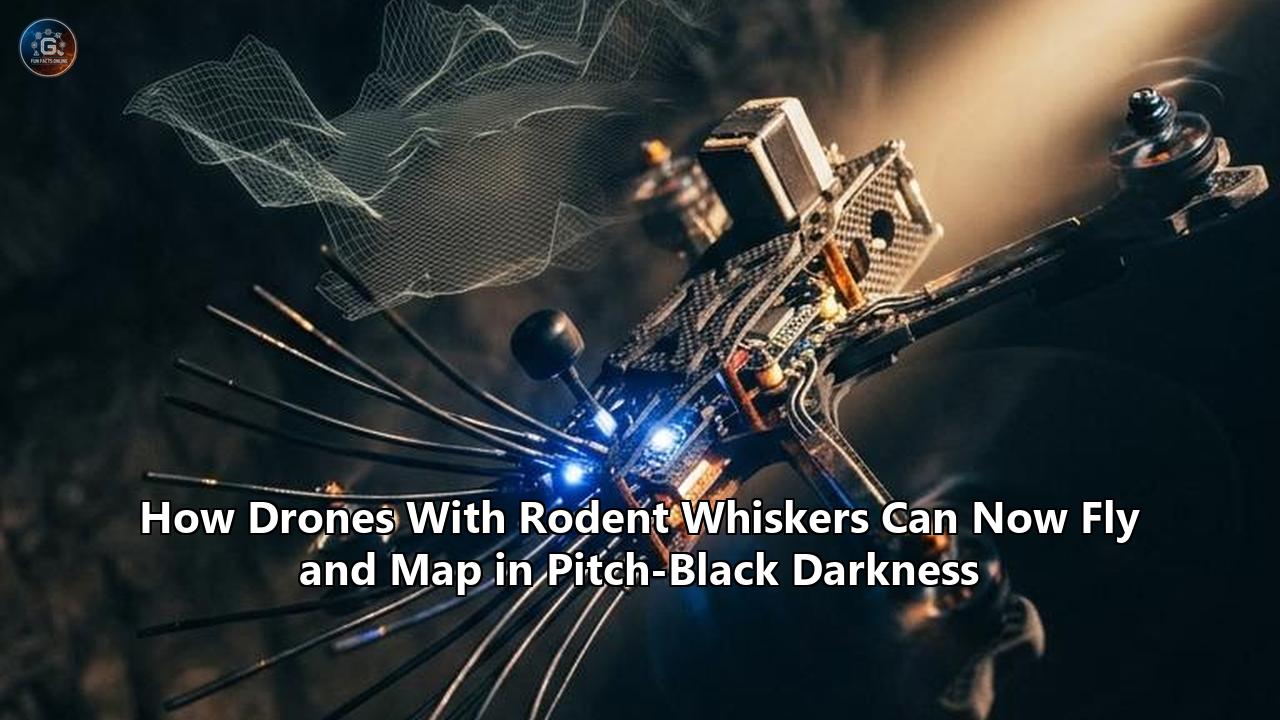
Inside an unlit subterranean test chamber at Delft University of Technology, an aerial vehicle weighing less than a common coffee mug lifted off the ground, hovered briefly, and accelerated into pitch-black darkness. It carried no light sources, no optical cameras, and no pulsed-laser LiDAR systems. Instead, protruding from its carbon-fiber nose was a pair of slender, flexible synthetic filaments modeled on the macrovibrissae of subterranean rodents.
Sweeping its body gently from side to side, the drone brought the tips of these artificial whiskers into grazing contact with an unseen concrete partition. At the base of each filament, an array of miniature barometric pressure sensors registered minute deflections at sub-millimeter precision. Within 1.4 milliseconds, an onboard microcontroller calculated the precise three-dimensional coordinate of the impact, adjusted rotor thrust to maintain a steady contact pressure of just a few millinewtons, and followed the continuous contour of the wall around sharp right-angle corners. In under two minutes, the aircraft navigated a completely dark maze, traced structural obstacles, mapped the spatial geometry of the enclosure, and found its way through a narrow exit hatch.
The development, published by roboticists Chaoxiang Ye, Dr. Salua Hamaza, and Guido de Croon from TU Delft’s BioMorphic Intelligence Lab, marks the first demonstration of autonomous, closed-loop flight navigation and 3D environment mapping driven entirely by tactile feedback on a sub-100-gram aerial platform.
“Here, we aim to equip drones with rich tactile sensing—not for manipulation in the air, but for a novel concept of tactile navigation: using touch to explore and fly through the unknown,” said Dr. Salua Hamaza, Associate Professor of Aerial Physical Interaction and Embodied Intelligence at TU Delft. “For tactile sensing to work on drones, it needs to be lightweight, low-latency, and low-power. Inspired by nature, we found the answer in whiskers.”
The breakthrough reconfigures a central tenet of autonomous aeronautics: that physical contact with the environment is an operational failure to be avoided at all costs. By transforming contact from a flight hazard into a high-density stream of spatial intelligence, the researchers have introduced an operational paradigm that operates precisely where conventional drone navigation technology suffers catastrophic blind spots.
The Degraded Environment Bottleneck: Where Optics and LiDAR Collapse
To understand why aerial robotics has turned to tactile bio-mechanics, one must examine the physical constraints that have long stymied micro aerial vehicles (MAVs).
Autonomous flight has traditionally relied on light. Visual Odometry (VO), Visual-Inertial Simultaneous Localization and Mapping (VI-SLAM), time-of-flight (ToF) depth cameras, and light detection and ranging (LiDAR) all presuppose a medium through which photons can travel cleanly from emitter to target and back to a receptor.
In pristine, illuminated indoor testbeds or clear open skies, these sensor suites provide millimeter-scale positioning. In practical search-and-rescue, structural inspection, and defense applications, however, environments are hostile to optical systems.
Smoke-filled collapsed buildings scatter laser beams, blinding LiDAR into reporting non-existent obstacles right in front of the lens. Airborne dust within mining tunnels coats optical sensors and creates heavy backscatter. Highly reflective metallic surfaces, mirrored windows, and deep-black void spaces generate specular reflections or absorb light entirely, leading to catastrophic state estimation divergence. In pitch-black sewers, sub-basements, or cavern systems, cameras require high-intensity LED illuminators that rapidly exhaust the modest 1S or 2S LiPo batteries powering micro-drones, cutting flight endurance down to mere minutes.
Ultrasound transceivers offer an alternative, but acoustic sensors are subject to acoustic echo confusion in tight metallic shafts and are severely degraded by the deafening aerodynamic noise and turbulent prop-wash of the drone’s own rotors.
Furthermore, weight remains an unforgiving physics ceiling. A drone weighing under 100 grams cannot carry a spinning multi-channel LiDAR puck, an array of mechanical gimbals, or the high-wattage graphical processing units needed to process millions of point-cloud coordinates per second. Micro-drones forced into confined, degraded environments face an unyielding trilemma:
- The sensor weight vs.
- Battery endurance vs.
- Computational payload capacity.
Robotics engineers reached an impasse. If aerial drones were ever to crawl through the narrow, debris-choked passages of an earthquake zone or inspect the interior of unlit industrial pipes, they could no longer rely exclusively on remote optical perception. They needed to interact physically with their surroundings without crashing.
2014–2018: Grounded Vibrissae and the Biology of Rodent Whisking
Roboticists did not invent touch navigation; they reverse-engineered it from biology.
For nocturnal mammals like Rattus norvegicus (the brown rat) and subterranean species such as the naked mole-rat, vision is a secondary sense. These animals spend their lifespans navigating lightless tunnels, dense clutter, and shifting burrows using facial vibrissae—specialized, highly compliant tactile hairs.
A rodent’s whisker contains no nerves along its shaft; it is a tapered, dead structural beam composed primarily of keratin. All mechanoreception occurs at the base, within the follicle-sinus complex (FSC). Inside the FSC, a dense array of low- and high-threshold mechanoreceptors (Merkel discs, lanceolate endings, and Ruffini corpuscles) detects the mechanical bending moments, shear forces, and vibrations generated whenever the whisker contacts an obstacle. By actively sweeping these whiskers back and forth—a behavior called "whisking"—at frequencies between 5 and 15 Hz, rodents rapidly extract contact distance, obstacle orientation, surface curvature, and surface texture without optical input.
Early attempts to translate vibrissal dynamics into robotics emerged between 2014 and 2018, primarily within terrestrial robotics. In 2014, researchers at the Lawrence Berkeley National Laboratory developed tactile sensor arrays using carbon nanotube-coated elastomeric fibers that simulated feline whiskers, demonstrating sensitivity capable of registering the weight of a single dollar bill resting on a table.
Four years later, in 2018, a joint research team from the University of Illinois at Urbana-Champaign and the Advanced Digital Sciences Center in Singapore presented a tactile whisker assembly composed of super-elastic Nitinol (nickel-titanium alloy) wire encased in polymer sheaths and connected to base-mounted strain gauges. The device mapped airflow and localized contact points by analyzing the differential strain along the wire.
Yet these early systems faced two severe structural hurdles that kept them grounded:
- Mechanical Bulk and Fragility: The strain gauges, optical encoders, and heavy mounting brackets used to capture mechanical deflection weighed scores of grams—acceptable for a multi-kilogram terrestrial rover or an industrial robotic arm, but prohibitive for a miniature quadcopter where every fraction of a gram penalizes flight dynamics.
- Computational Complexity: Processing continuous non-linear elasticity equations for flexible beams in real time required desktop workstations, rendering untethered edge implementation on micro-controllers impossible.
For years, whiskers remained a curiosity for ground rovers crawling over flat terrain. No team had demonstrated how a dynamic flying machine could survive the violent disturbances of physical contact while interpreting tactile signals mid-air.
2019–2021: Taking Whiskers Airborne and Crashing into the Rotor Wash
The initial move to transition whiskers to flight took place in 2019 at the University of Queensland, led by roboticist Pauline Pounds.
Pounds and her team recognized that small drones lacked the payload capacity for multi-sensor safety rings. Their solution dispensed with heavy metallic alloys and expensive strain gauges. Instead, they developed an ultra-lightweight fabrication process: heating ordinary ABS plastic and pulling it out into long, tapered filaments like sugar taffy.
The base of each ABS whisker was glued to a 3D-printed load plate resting upon a triangular arrangement of tiny, encapsulated MEMS (Micro-Electro-Mechanical Systems) barometers. Rather than measuring ambient air pressure, these barometers acted as miniature enclosed pressure pads. When the flexible whisker deflected, the load plate tilted, compressing one barometer and decompressing the others.
The sensor proved remarkably sensitive, measuring mechanical forces as minuscule as 3.33 micronewtons—a threshold so delicate that the team discovered human breathing within a meter of the workbench threw off calibration routines.
While Pounds demonstrated that whisker-based sensors could detect aerodynamic boundaries and act as a rudimentary proximity alarm to shut off motors before a high-speed collision, the system could not achieve sustained tactile navigation.
The transition to actual flight immediately ran into the wall of aeromechanics.
When a multirotor takes flight, its spinning propellers generate an aggressive, highly turbulent downwash. As the aircraft translates forward, backwards, or sideways, it experiences dynamic aerodynamic drag. For a sensor sensitive to micronewtons of force, the rotor downwash, environmental cross-winds, and vehicle translation looked identical to physical contact. The synthetic whiskers were constantly buffeted by phantom forces.
  [ Drone Forward Translation & Rotor Wash ]
                    │
                    ▼  (Dynamic Airflow & Induced Drag)
      ~~~~~~~~~~~~~~~~~~~~~~~~~~~~~~
      ══════════════════════════════ ◄── Synthetic Whisker Flexing
      ~~~~~~~~~~~~~~~~~~~~~~~~~~~~~~
                    │
         [ Follicle Sensor Base ]
                    │
                    ▼
  CANNOT DISTINGUISH: Strong Wind Gust vs. Wall Contact
Between 2021 and 2022, research at Carnegie Mellon University via the WhiskSight project untangled part of this puzzle. The CMU team demonstrated that an array of whiskers responds to global stimuli (such as wind gusts and rotor downwash) uniformly across all sensors, whereas solid physical contact causes asymmetric, localized deflections in individual whiskers.
This was a major analytical step forward, but closed-loop aerial navigation remained elusive. Knowing that a drone had scraped a surface was not enough; the drone needed to know where along the length of the whisker the impact had occurred, in what direction the surface was slanting, and how to command its motor mixers to ride that contour smoothly without bouncing uncontrollably off the wall.
2022–2024: Decoding Follicle Mechanics and Non-Linear Contact Physics
Between 2022 and 2024, the primary theoretical bottleneck shifted from physical hardware fabrication to the mathematics of large-deflection contact mechanics.
When an aerial vehicle interacts with a flat wall or a curved pipe, contact rarely occurs exclusively at the tip of the whisker. Instead, the flexible filament slides along the obstacle. The contact point changes dynamically from the tip toward the base as the vehicle moves forward.
Traditional beam models, such as the classical Euler-Bernoulli linear bending theory, rely on the assumption of infinitesimal deflections. When an artificial vibrissa bends into high-curvature arcs during flight, linear mechanics completely disintegrate.
The relationship between the base-sensor readings (the forces $F_x, F_y, F_z$ and moments $M_x, M_y, M_z$) and the true contact point $(x_c, y_c, z_c)$ along the shaft is governed by three complex phenomena:
- Non-linearity: Large material deformations do not scale proportionally with applied force.
- Mechanical Hysteresis: Polymeric filaments dissipate energy internally; the sensor outputs different values during loading (initial impact) than during unloading (rebound or disengagement).
- Non-Injective (Many-to-One) Mapping: A light force applied at the tip can generate identical base torque to a firmer force applied midway down the shaft.
In early 2024, Chaoxiang Ye and his colleagues at TU Delft’s BioMorphic Intelligence Lab published a pivotal paper detailing a solution: the Recurrent Multi-output Network (RMN).
The researchers realized that static snapshots of sensor data could never resolve the non-injective mapping problem. However, if the system treated the sensory feedback as a continuous temporal time series, the motion history disambiguated the signal. By tracking how force shifted over successive milliseconds, an intelligent algorithm could trace the continuous sliding motion of the contact point.
Ye’s framework utilized a lightweight recurrent neural architecture trained on empirical contact trajectories. The network achieved a contact point localization error of just 9.18 millimeters along the whisker shaft with an inference time of only 1.4 milliseconds.
The realization demonstrated that base-mounted barometric sensors could double as high-resolution spatial digitizers. The stage was set for the ultimate trial: cutting all optical cords, disabling visual estimation, and tasking a free-flying micro-drone with navigating in absolute darkness through tactile sensing alone.
2025–2026: The 34-Kilobyte Triumph — Autonomous Wall-Tracing and Darkness Mapping
The transition from a lab-bench proof of concept to a fully realized, untethered aerial system reached completion in late 2025 and early 2026, when Ye, Hamaza, and de Croon unveiled their fully autonomous tactile flight system.
  [ Obstacle / Wall Boundary ]
              ▲
              │   (Sliding Tactile Contact)
  [ Flexible Whisker Shaft (Sub-6mm Depth Estimation) ]
              │
  [ 3.2g Barometer-Based Mechanical Follicle ]
              │
              ▼   (50 Hz Continuous Pressure Sampling)
  [ STM32F405 Microcontroller (Running on 34 KB RAM) ]
              │
         ┌────┴─────────────────────────────┐
         ▼                                  ▼
  [ Tactile Depth & Slip ]       [ 3D Occupancy Point Cloud ]
  [ State Estimator      ]       [ Local Spatial Map       ]
         │                                  │
         └──────────────┬───────────────────┘
                        ▼
       [ Reactive Flight Vector Controller ]
                        │
                        ▼
  [ Real-Time Rotor Speed Adjustments (Thrust / Yaw) ]
The entire physical sensing apparatus weighed just 3.2 grams—light enough to mount directly to an off-the-shelf micro-quadcopter frame without degrading flight agility or severely depleting battery life.
At the core of the sensor are two forward-facing bio-inspired whiskers. Each whisker is secured in an artificial follicle containing three miniature MEMS barometers positioned in an equilateral layout beneath an elastic interface. Any three-dimensional deflection of the whisker causes mechanical compression across the barometer trio, generating differential pressure signals.
To extract actionable environmental geometry from these raw signals, the TU Delft team developed a three-stage processing pipeline optimized for flight-critical execution:
1. Rotor Downwash and Drift Decoupling
To prevent aerodynamic backwash from triggering false collisions, the team designed a dynamic baseline-tracking filter. By analyzing the high-frequency vibrational profiles generated by the motors and calculating ambient dynamic pressure variations, the algorithm strips away aerodynamic drag, isolating the distinct mechanical stress signatures of genuine surface contact.
2. Tactile Depth Estimation
Once contact is confirmed, the system maps base pressure differentials into a continuous metric: tactile depth. Tactile depth measures the Euclidean distance from the drone's frame to the surface point with which the whisker is interacting. The algorithm achieved depth estimation accuracy under 6 millimeters across diverse materials, ranging from rough structural drywall and masonry to flexible paper and soft curtains.
3. Tactile SLAM and Contour-Following State Machine
Using only tactile depth, inertial measurement unit (IMU) readings, and forward velocity estimates, the flight controller executes an active exploration state machine:
- Free-Flight Search: The drone moves forward through unmapped space at a regulated patrol velocity.
- Contact Intercept: Upon detecting surface contact, the drone immediately halts forward translation, evaluates surface normal angles via whisker deflection direction, and enters contour-following mode.
- Continuous Surface Tracing: The drone commands lateral thrust, maintaining the whisker's deflection at a specified target operating point (roughly 20 to 30 millimeters of displacement). This tactile impedance loop ensures continuous sliding contact while preventing the vehicle from banking too aggressively into the wall or losing contact entirely.
- Tactile Point-Cloud Generation: As the aircraft skims the perimeter of the room, every millimeter of estimated contact point is logged into a spatial coordinate buffer, incrementally building a 2D/3D map of the physical void without a single photon of light.
The computational efficiency of this framework stands out. Traditional visual-based drone navigation technology requires gigabytes of operating memory and multi-core processors running deep neural networks to extract depth from stereo image streams. The TU Delft tactile navigation framework executes onboard an STM32F405 microcontroller—a chip clocked at 168 MHz with only 192 kilobytes of onboard RAM.
Even more striking: the entire perception, depth estimation, wall-following controller, and mapping pipeline utilizes just 34 kilobytes of memory operating at a loop rate of 50 Hz.
“We wanted to show that touch does not have to come at the cost of size or computational power,” explained lead researcher Chaoxiang Ye. “Our entire tactile perception pipeline runs onboard using just 34 kilobytes of memory, allowing a tiny drone to sense and respond to its environment in real time.”
Aeromechanics of Gentle Contact: Transforming Collisions into Flight Vectors
The physics of flight makes the accomplishment at TU Delft counter-intuitive.
To aerodynamicists and flight control engineers, physical contact has long been viewed as the catastrophic breakdown of stable flight. A typical multirotor is an inherently unstable system governed by four independent thrust points. When an airborne drone contacts an obstacle, an external wrench (a combination of linear forces and rotational torques) acts on the vehicle’s center of mass.
If a drone's airframe strikes a wall:
- Normal contact force immediately imparts a pitch or roll moment across the airframe.
- The onboard proportional-integral-derivative (PID) attitude controller senses this tilt as an orientation error and commands opposing motors to spin at maximum RPM.
- The violent counter-torque causes the drone to push harder into the obstacle or bounce away chaotically, inducing rapid rotor stall, gyroscopic precession collapse, and a crash.
The TU Delft team solved this problem through embodied intelligence: embedding control solutions into the physical compliance of the hardware itself.
  Traditional Rigid Drone Interaction:
  [ Drone ] ──( Rigid Frame )──► || WALL ||
                 │
                 ▼
  High External Torque -> Attitude Controller Overreaction -> Motor Saturation -> CRASH

  Tactile Whisker Interaction:
  [ Drone ] ──[ Ultra-Flexible Whisker (Low Stiffness) ]──► || WALL ||
                 │
                 ▼
  Minimal Torque (<0.05 N·m) -> Sub-Millimeter Follicle Deflection
  PID Unaffected -> Wrench Treated as Navigational Guidance Vector
The synthetic whiskers are deliberately engineered with high compliance and low bending stiffness. When the whisker tip makes contact with a surface, the resulting reaction force transferred back to the quadcopter frame is measured in millinewtons.
The resulting torque experienced by the drone's center of mass remains well below the disturbance rejection threshold of standard attitude flight controllers (typically less than 0.05 Newton-meters). The flight controller does not treat the touch as an external disturbance that must be aggressively rejected; it treats the deflection as a state variable for guidance.
The mechanical geometry of the whisker mounts also mitigates the risk of entrapment. Rather than extending perpendicularly, the whiskers are swept along an angled forward rake. When the vehicle slides along a rough or irregular wall, the whisker naturally rides over textural undulations without catching or snapping.
If the drone encounters a sudden dead-end or a closed corner, the escalating compressive load along both whiskers triggers a reactive retreat maneuver: the flight loop instantly dials back throttle, performs a yaw rotation away from the deeper-deflected whisker, and re-establishes contour tracing along the adjacent opening.
Crucially, the system functions regardless of surface elasticity. In extensive validation trials, the drone demonstrated stable contour-following along rigid concrete partitions, polished smooth wood, corrugated cardboard, and hanging soft fabrics. Soft surfaces represent a notorious failure mode for optical time-of-flight sensors (which experience absorption) and sonar (which experiences acoustic dampening). The whisker, relying on mechanical displacement rather than reflection, traces soft contours without tearing through fragile barriers or losing positional tracking.
Comparative Sensor Analysis for Micro-Scale Aerial Platforms
To place the mechanical tactile approach in context, it helps to compare it against alternative sensing modalities currently integrated into micro-UAV airframes:
| Metric / Parameter | 2D/3D Micro LiDAR | Monocular / Stereo Vision | Ultrasonic Transceivers | Whisker Tactile System (TU Delft) |
|---|---|---|---|---|
| Payload Mass | 20g – 60g (Prohibitive for MAVs) | 5g – 15g (Camera + Carrier) | 4g – 10g | 3.2 grams total |
| Power Consumption | 2,000 – 8,000 mW | 1,000 – 3,500 mW | 150 – 500 mW | < 80 mW (Barometer Array) |
| Onboard RAM Overhead | Megabytes to Gigabytes | Hundreds of Megabytes | Kilobytes | 34 Kilobytes |
| Performance in Pitch Darkness | Operational (Active Light) | Fails Completely (Zero Photons) | Operational | 100% Operational |
| Performance in Dense Smoke/Dust | Fails (Severe Backscatter) | Fails (Visual Degraded) | Degraded by Temperature Shifts | Unaffected by Optical Particulates |
| Transparent / Specular Surfaces | Fails on Glass/Mirrors | Fails on Transparent Media | Fails at Sharp Angles | Unaffected (Measures Physical Force) |
| Sensing Range | Long (0.1m to 20m+) | Medium (0.2m to 15m) | Short (0.05m to 2m) | Near Contact (< 0.15m) |
| Primary Limitation | Excessive Weight and Power | Requires Ambient Illumination | Echo Ambiguity; Rotor Turbulence | Requires Physical Contact |
This comparison highlights that tactile flight is not meant to render optics obsolete in broad daylight. Instead, it establishes an autonomous baseline when conventional optical and electromagnetic sensors are completely blinded.
Real-World Theaters: Search-and-Rescue, Confined Inspections, and Optical Invisibility
The development of vision-free tactile autonomy alters how robotics teams approach real-world search, inspection, and reconnaissance missions in hostile terrain.
1. Urban Search-and-Rescue in Structural Collapses
During an earthquake, mine collapse, or industrial explosion, interior architectures collapse into chaotic, unlit labyrinths. These environments are characterized by heavy airborne particulate clouds (concrete dust, ash, chemical particulates), complete electrical blackouts, and unstable voids.
Full-sized commercial drones cannot penetrate these gaps; micro-drones equipped with standard visual-inertial odometry drift uncontrollably as their optical cameras lose feature tracking in the dust.
A micro-drone equipped with tactile whiskers can slip through a jagged 15-centimeter gap in collapsed concrete, descend into a pitch-black basement, follow structural perimeter walls, map the void volume, and identify survivable pockets without being impaired by suspended dust or absolute darkness.
  Search-and-Rescue Scenario: Confined Structural Collapse Void
  ┌────────────────────────────────────────────────────────┐
  │ [Collapsed Concrete Slab]                             │
  │     \                                                  │
  │      \   (Dense Dust & Zero Visibility)                │
  │       \                                                │
  │        ► [Tactile Whisker Micro-Drone]                │
  │           ├── Whisker feels perimeter wall             │
  │           ├── 34 KB RAM maps void boundary             │
  │           └── Locates survivor pocket without cameras  │
  │                                                        │
  │ [Unstable Rubble Floor]                                │
  └────────────────────────────────────────────────────────┘
2. High-Risk Industrial Infrastructure Inspection
Petrochemical facilities, power generation plants, and municipal water authorities rely on complex networks of underground culverts, sewer pipes, toxic fluid channels, and insulated steam pipes. Many of these assets are explosive environments where active high-intensity illuminators, laser arrays, or heavy power-draw electronics present thermal hazards.
Furthermore, the interiors of industrial pipelines are often visually featureless cylinders coated in dark slag, sludge, or grease. In this context, conventional drone navigation technology struggles with state estimation because visual SLAM requires surface texture to extract tracking points.
Tactile micro-drones can ride the curved walls of an unlit pipe network, utilizing the physical geometry of the conduit as a mechanical rail to trace structural integrity, detect blockages, and construct topological flow maps.
3. Low-Observable and Electronic-Warfare-Resistant Defense Missions
Modern military environments present an increasingly congested electromagnetic spectrum. Tactical operations within underground bunkers, tunnel systems, or fortified basements often face active signal jamming and intense electro-optical surveillance.
Standard optical drones rely on active light: infrared floodlights, laser rangefinders, or visible-spectrum LEDs. Through night-vision gear or optoelectronic detectors, an actively illuminated drone stands out like a flare. In contrast, a whisker-based tactical drone emits zero photons, requires no external radio-frequency guidance, and transmits no acoustic pulses. It glides through unlit subterranean tunnels in total silence, relying solely on mechanical touch and internal inertia. The result is an operationally undetectable platform for short-range reconnaissance within GPS-denied, electronically severed networks.
The Next Frontier: Whisker Arrays, Neuromorphic Fusion, and Swarms
The successful demonstration of closed-loop tactile navigation at TU Delft represents an initial milestone rather than an ultimate endpoint. As researchers push the limits of bio-inspired sensory autonomy, several critical engineering vectors are already in development:
1. Omnidirectional Tactile Domes
The current iteration uses a bilateral pair of forward-facing whiskers. This configuration limits tactile awareness to the forward and anterolateral sectors of the aircraft.
Engineers are working on integrating full-coverage vibrissal arrays—resembling the radial whiskers of a seal or the circumferential sensory bristles of insects. A micro-drone encircled by 12 to 16 micro-whiskers will maintain continuous tactile awareness above, below, and behind its chassis, enabling autonomous vertical ascent inside narrow industrial chimney flues and elevator shafts without risking rotor-blade strikes.
2. Fusion with Neuromorphic Event-Based Sensing
While touch excels in darkness and heavy smoke, it is inherently short-range: a whisker can only evaluate what it can physically touch.
The next frontier lies in hybrid perception architectures pairing tactile whiskers with neuromorphic event cameras. Event cameras do not capture traditional image frames; they record pixel-level brightness changes asynchronously at microsecond intervals with minimal power consumption.
In low-light or intermittently illuminated spaces, an event camera can track high-speed movements, while artificial whiskers handle close-quarters surface tracing, providing an integrated sensory continuum from long-range anticipation to contact-point precision.
  [ Neuromorphic Event Camera ]  ──►  Long-to-Mid Range Dynamic Awareness
               +
  [ Bio-Inspired Tactile Whisker ] ──►  Close-Range (<15cm) Physical Interaction & Mapping
               │
               ▼
  [ Unified Sub-Milliwatt Edge Autonomy Architecture ]
3. Tactile Exploration Swarms
Because the entire tactile processing pipeline runs on microcontrollers with tiny memory footprints (consuming only 34 KB of RAM), the computational requirements do not burden the aircraft's primary processors.
This unlocks the deployment of micro-swarms. Dozens of 50-gram whiskered drones, costing a fraction of a single LiDAR-equipped enterprise platform, could be released into a collapsed subway terminal or cave complex. Dispersing outward along separate walls like a colony of bats or a nest of subterranean rodents, each drone traces its own perimeter path. When the aircraft return to an external base station, their localized tactile coordinate buffers can be stitched into a unified 3D map of the subterranean complex.
Critical engineering challenges remain to be solved before widespread commercial field deployment:
- Mechanical Wear and Material Fatigue: Flexible polymer and composite whiskers subjected to thousands of continuous sliding cycles along abrasive masonry or jagged sheet metal experience surface erosion, altering their elasticity and bending profiles over time.
- Flight Velocity Ceilings: Tactile flight is inherently deliberate. A drone feeling its way along a wall must limit its translation velocity to allow the mechanical response of the whisker and the flight controller's attitude-adjustment loops to respond before the rigid frame strikes the obstacle. Scaling tactile flight from creeping survey speeds (under 0.5 meters per second) to high-speed dynamic flight remains an open research frontier.
A Structural Shift in Aerial Autonomy
The evolution of aerial robotics has long been defined by efforts to isolate the flying machine from the physical world. Drones were envisioned as detached eyes in the sky—aloof entities designed to observe from a distance, terrified of touching the structures they were deployed to document. Every algorithm, optical sensor, and safety bubble was designed around one mission requirement: never make contact.
The developments emerging from TU Delft show that physical isolation is a limitation rather than an asset.
By showing that a 3.2-gram assembly of artificial whiskers and barometers can guide a drone through unlit mazes on the computational budget of a digital wristwatch, roboticists have demonstrated that touch is a robust, lightweight foundation for spatial intelligence. As tiny autonomous platforms push deeper into the dark, smoke-choked, and GPS-denied environments of tomorrow, the future of drone navigation technology will not be defined solely by how well machines can see—but by how intelligently they can feel.
Reference:
- https://arxiv.org/html/2510.03119v1
- https://www.tomorrowsworldtoday.com/robotics/whiskers-allow-drones-to-navigate-at-night/
- https://ground.news/article/rodent-inspired-artificial-whiskers-enable-touch-based-drone-flight_4fc547
- https://www.tudelft.nl/en/ai/biomorphic-intelligence-lab/news/messages/a-biomorphic-whisker-sensor-for-aerial-tactile-applications
- https://www.semanticscholar.org/paper/Whisker-based-Tactile-Flight-for-Tiny-Drones-Ye-Croon/ae9167eef0a319f21dcac669f11eb2bed326696a
- https://boingboing.net/2019/06/11/cat-whiskers-for-flying-drones.html
- https://publications.ri.cmu.edu/whisker-inspired-sensors-for-unstructured-environments
- https://www.azorobotics.com/Article.aspx?ArticleID=253
- https://www.researchgate.net/publication/396223174_Whisker-based_Tactile_Flight_for_Tiny_Drones