On June 1, 2026, a research team led by geneticist Dr. Dieter Egli at Columbia University posted a landmark preprint on the bioRxiv server that fundamentally altered the trajectory of reproductive medicine. For more than a decade, the promise of eradicating hereditary diseases before birth had been stalled by a terrifying biological reality: the molecular scissors of traditional CRISPR-Cas9 genome editing frequently caused catastrophic, irreversible damage to the very chromosomes they were meant to repair.
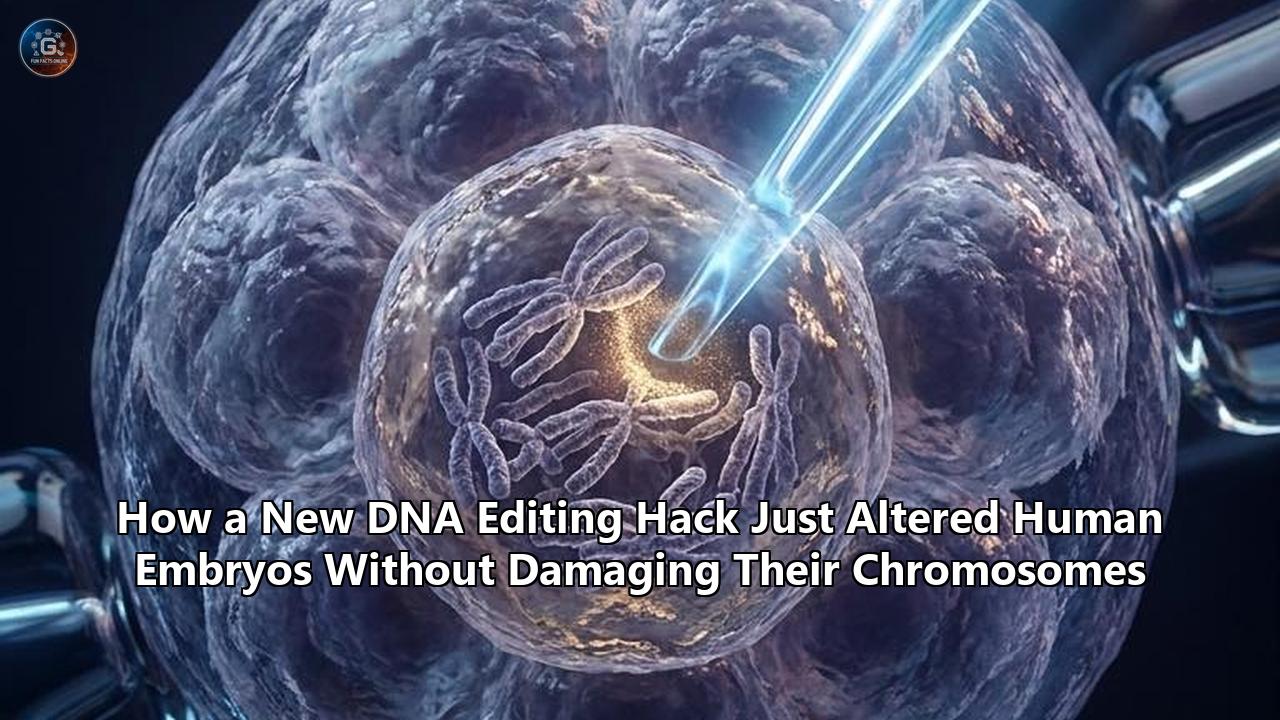
The new study, co-authored by an international team including researchers from Seoul National University and the Institute for Basic Science in South Korea, demonstrated that a newer, gentler genetic technology called base editing can successfully rewrite disease-causing mutations in early human embryos without causing large-scale chromosomal deletions or abnormalities.
By targeting PCSK9—a gene linked to high LDL cholesterol and cardiovascular disease—and HBG1 and HBG2, genes that regulate fetal hemoglobin and are primary targets for treating blood disorders like sickle cell anemia, the researchers achieved high editing efficiency. Most importantly, they did so without triggering the genomic instability that has long made embryo editing a clinical impossibility.
Yet, this biochemical triumph is not a green light for fertility clinics. Alongside the precision of the edits, the study laid bare a formidable obstacle: 80% of the successfully modified embryos became genetic "mosaics," containing a patchwork of both edited and unedited cells. If allowed to develop into children, these infants would still carry the very genetic diseases their parents sought to eliminate.
The implications of this work are vast. It marks a paradigm shift in our understanding of how human embryos handle DNA repair, validates base editing as the leading candidate for germline intervention, and has already mobilized private biotech capital to solve the mosaicism problem. It also forces a renewed, urgent global debate over the ethics of germline modification at a moment when the technical barriers to "designer babies" are beginning to crumble.
The Ghost of CRISPR-Cas9: Why Double-Strand Breaks Shattered Embryos
To appreciate the significance of Dr. Egli’s latest milestone, one must look back at the developmental wreckage left by first-generation genetic engineering.
When CRISPR-Cas9 burst onto the scientific scene in 2012, it was hailed as a molecular scalpel capable of cutting out faulty genetic sequences and replacing them with pristine code. But when researchers began testing this tool on human embryos, they discovered that the embryo’s biology did not behave like a standard laboratory cell line.
The turning point came in 2020, when Dr. Egli’s team at Columbia published a sobering study in the journal Cell. They had attempted to use CRISPR-Cas9 to correct a mutation in the EYS gene, which causes hereditary blindness, in early-stage human embryos. While the initial tests suggested the mutation had been successfully removed, a comprehensive genomic audit revealed a horrifying alternative: the chromosome carrying the mutation had not been repaired. Instead, the entire chromosome—or a massive portion of it—had simply vanished.
Traditional CRISPR-Cas9 (Double-Strand Break):
DNA Double Helix:  =====[ Cut ]=====
Outcome in Embryos: Severe repair deficiency -> Chromosome loss, aneuploidy, large-scale deletions

Base Editing (Single-Strand Nick & Chemical Conversion):
DNA Double Helix:  =====[ Chemical Change (A -> G) ]=====
Outcome in Embryos: Gentle, high-fidelity repair -> Chromosome remains fully intact and stable
Subsequent studies by Dr. Kathy Niakan at the Francis Crick Institute in London and Dr. Shoukhrat Mitalipov at Oregon Health & Science University confirmed this systemic vulnerability. When CRISPR-Cas9 cleaves both strands of the DNA double helix to create a double-strand break (DSB), it relies on the cell’s internal repair machinery to glue the ends back together.
In adult somatic cells, this machinery is highly active. However, during the first few days of embryonic development, human cells are uniquely deficient in executing homology-directed repair (HDR)—the high-fidelity pathway required to integrate a healthy genetic template.
Instead, embryonic cells either attempt to join the broken ends using error-prone non-homologous end-joining (NHEJ), resulting in random insertions or deletions (indels), or they fail to repair the break entirely. Unrepaired double-strand breaks destabilize the chromosome during cell division. During mitosis, the damaged chromosome is frequently left behind, leading to aneuploidy—an abnormal number of chromosomes—which causes embryo death, miscarriage, or severe congenital syndromes if the pregnancy progresses.
As gene-editing pioneer Dr. Fyodor Urnov of the University of California, Berkeley, famously warned in 2020, "If human embryo editing were space flight, the new data are the equivalent of having the rocket explode at the launch pad before take-off".
For six years, the scientific consensus remained unyielding: DNA editing human embryos was simply too dangerous to pursue clinically because the tools themselves were fundamentally genotoxic to early-stage human life.
The Chemistry of Base Editing: Precision Without Scissors
The breakthrough published by the Columbia team bypasses the "launchpad explosion" by changing the fundamental mechanism of genetic modification. Instead of cutting the DNA double helix, the team utilized "base editing"—a technology developed in 2016 by Dr. David Liu and his colleagues at Harvard University.
Often described as a molecular pencil or an "autocorrect" tool for the genome, a base editor is a multi-protein complex designed to perform chemical surgery on individual nucleotides without breaking the DNA backbone. The tool consists of:
- A catalytically impaired "dead" Cas9 (dCas9) or a Cas9 nickase (nCas9) that can locate a specific sequence of DNA using a guide RNA, but cannot cut through both strands.
- A deaminase enzyme fused to the Cas9 variant, which physically alters the chemical structure of a targeted nucleotide.
In the Columbia study, the researchers utilized an Adenine Base Editor (ABE). When the guide RNA steers the ABE to the target site, the deaminase enzyme targets an adenine (A) molecule and chemically converts it into inosine (I). The cell's replication machinery reads inosine as guanine (G).
Simultaneously, the Cas9 nickase puts a small nick in the opposite, unedited DNA strand. This nicks the non-edited strand, prompting the cell’s natural mismatch repair mechanisms to use the newly edited strand as a template, replacing the original thymine (T) with a cytosine (C) to complete the base pair.
Step 1: Target Identification
   Deactivated Cas9 (dCas9) + Guide RNA find the mutated site.
   [Targeted A-T Base Pair]

Step 2: Chemical Conversion (No Cut)
   Deaminase enzyme converts Adenine (A) to Inosine (I).
   [I-T Base Pair]

Step 3: Mismatch Repair (Nicking)
   Cas9 nickase nicks the opposite strand. The cell repairs the mismatch.
   Inosine (I) is replicated as Guanine (G), and Thymine (T) is replaced by Cytosine (C).
   [Final G-C Base Pair Completed Successfully]
Because the DNA double helix is never fully severed, the embryo's fragile repair mechanisms are not overwhelmed. In their bioRxiv preprint, Egli and his co-authors confirmed that this elegant chemical bypass worked with astonishing fidelity.
When they thoroughly sequenced the genomes of the edited human embryos, they found that small insertions or deletions were incredibly rare, and crucially, they detected absolutely no chromosomal abnormalities, large-scale deletions, or entire chromosome losses. The chromosomal integrity of the embryos remained completely intact, demonstrating for the first time that highly efficient DNA editing human embryos can occur without genotoxic consequences.
Who is Affected: Mapping the Immediate and Distant Stakeholders
The emergence of a safe, chromosome-preserving DNA editing hack ripples across medicine, business, law, and ethics. To understand the impact of this development, we must analyze the diverse groups of stakeholders whose futures are bound to this technology.
                  ┌─────────────────────────────────────────┐
                  │       Dieter Egli's 2026 Breakthrough   │
                  │  (Successful Base Editing of Embryos)   │
                  └────────────────────┬────────────────────┘
                                       │
         ┌─────────────────────────────┼─────────────────────────────┐
         ▼                             ▼                             ▼
┌─────────────────┐           ┌─────────────────┐           ┌─────────────────┐
│     Parents     │           │ Biotech Sector  │           │   Ethicists &   │
│   & Families    │           │   & Startups    │           │   Regulators    │
└────────┬────────┘           └────────┬────────┘           └────────┬────────┘
         │                             │                             │
         ├─ Homozygous carriers        ├─ Manhattan Genomics         ├─ Hank Greely (affluent
         │  who cannot use IVF         │  and Preventive             │  "designer baby" risk)
         │  selection alone            ├─ Nucleus Genomics           ├─ Ana Iltis (unforeseen
         └─ Elimination of heritable   │  (funding the next          │  long-term pediatric
            diseases at gamete level   │  phase of research)         │  health consequences)
                                       └─────────────────────────────┴───────────────────────┘
1. Families with Homozygous Genetic Mutations
For the vast majority of couples carrying genetic mutations, standard In Vitro Fertilization (IVF) paired with Preimplantation Genetic Testing (PGT) is sufficient. If both parents are heterozygous carriers for a recessive disease like cystic fibrosis, one out of four of their embryos will, on average, be completely healthy. The clinic simply screens the embryos and implants the healthy one, discarding the rest.
However, there is a subset of families for whom selection is mathematically impossible:
- Homozygous Carriers: If one parent is homozygous for a dominant genetic disease (such as Huntington’s disease), 100% of their embryos will inherit the mutation.
- Dual-Carrier Couples: In rare instances where parents carry multiple different severe mutations, the probability of finding an embryo that is clear of all diseases is vanishingly small.
- Low Embryo Yields: Older patients undergoing IVF often produce very few viable embryos. If their sole embryo carries a genetic mutation, they face the agonizing choice of either discarding their only biological chance at parenthood or knowingly giving birth to a child with a severe disease.
For these families, this research changes everything. It transitions the reproductive medicine paradigm from selection (discarding the bad) to correction (healing the existing).
2. The Biotech and Consumer Genetics Industry
The business of human reproduction is poised for a massive technological upgrade, and private capital is moving aggressively to claim the space.
In late 2025, two prominent biotech startups—Manhattan Genomics (founded by tech entrepreneur Cathy Tie and geneticist Eriona Hysolli) and Preventive (founded by CRISPR pioneer Lucas Harrington)—announced plans to actively explore gene editing in human embryos using base and prime editing.
Simultaneously, Nucleus Genomics, a New York-based consumer DNA sequencing and embryo-risk-screening startup led by CEO Kian Sadeghi and Chief Scientific Officer Dr. Nathan Treff, has stepped forward as a key funder for Dr. Egli's ongoing research.
                                 ┌─────────────────────────┐
                                 │    Nucleus Genomics     │
                                 │   (Kian Sadeghi, CEO)   │
                                 └────────────┬────────────┘
                                              │
                      Offers polygenic risk profiling for embryos
                      (Height, cardiovascular risk, etc.)
                                              │
                                              ▼
                    ┌────────────────────────────────────────────────┐
                    │ Funding Next-Phase Research with Dieter Egli   │
                    │  To eliminate mosaicism and refine base-editing│
                    └────────────────────────────────────────────────┘
For these companies, safe embryo editing is the holy grail. Nucleus Genomics already screens IVF embryos for thousands of genetic disorders and calculates polygenic risk scores for conditions like diabetes and heart disease. By funding the transition from screening to direct editing, these companies are positioning themselves to offer the ultimate premium reproductive service: a closed-loop platform that sequences, predicts, and then chemically corrects genetic liabilities before implantation.
3. Bioethicists and the Ghost of Eugenics
For ethicists, the realization of a safe DNA editing human embryos protocol is a deeply alarming development. While correcting a fatal blood disorder like sickle cell anemia is universally viewed as a compassionate medical goal, the boundary between therapy and enhancement is notoriously porous.
Stanford University bioethicist Henry "Hank" Greely expressed severe concern that the dramatic reduction in technical risk will tempt affluent individuals to establish private, unregulated IVF clinics to genetically customize their offspring. "Affluent individuals might be inspired by the study as a jumping-off point to base-edit their embryos," Greely warned. "But the result of premature, uncoordinated efforts could be children born with severe, unforeseen health problems".
Similarly, Dr. Ana Iltis, a bioethicist at Wake Forest University, cautions that assessing embryonic chromosomes under a microscope is not a guarantee of pediatric health. "Rather, clinicians must be certain that the intervention results in a healthy baby and a normal pregnancy," Iltis noted, adding that many subtle developmental, neurological, or immunological defects caused by epigenetic disruptions might not manifest until years or decades after birth.
Under the Hood: The Mechanics of the Columbia Experiment
The scientific paper published on bioRxiv is a masterpiece of molecular developmental biology, detailing how the team systematically solved the physical delivery and chemical execution of base editing in human zygotes.
The Target Selection: PCSK9 and HBG
The team focused on two highly clinically relevant genetic targets:
- PCSK9 (Proprotein Convertase Subtilisin/Kexin Type 9): Mutations in this gene can lead to familial hypercholesterolemia, resulting in abnormally high LDL cholesterol and premature cardiovascular disease. Deactivating this gene or correcting its disease-causing variants is a proven method to drastically lower lifelong cardiovascular risk.
- HBG1 and HBG2 (Fetal Hemoglobin): These paralogous genes produce fetal hemoglobin. In individuals with sickle cell anemia or beta-thalassemia, forcing the body to continue producing fetal hemoglobin into adulthood bypasses the defective adult hemoglobin, effectively curing the disease.
The Delivery Battle: Protein vs. RNA
One of the study’s most critical, underreported discoveries was the method used to introduce the editing machinery into the embryo.
Historically, researchers have delivered CRISPR instructions to cells in the form of messenger RNA (mRNA), allowing the cell's own machinery to translate the RNA into editing proteins. However, when Egli’s team attempted to inject base-editing mRNA into early human embryos, they encountered a biological wall: the embryos suffered early developmental arrest and died.
The researchers hypothesized that the early-stage human embryo recognizes synthetic mRNA as a viral pathogen, triggering an innate immune response that halts cell division. To bypass this cellular defense system, the team turned to ribonucleoproteins (RNPs)—purified, pre-assembled complexes of the base editor protein bound to its guide RNA.
By introducing the editor as an RNP directly during fertilization or at the pronuclear stage via electroporation (using brief electrical pulses to create temporary pores in the cell membrane), the embryos accepted the treatment. The RNPs performed their editing quickly and were then rapidly degraded by the cell's natural housekeeping proteins. This rapid clearance prevented the editing machinery from lingering in the cell, which dramatically lowered the risk of off-target edits. Crucially, more than a third of these RNP-treated embryos successfully developed to the blastocyst stage (days 5–6), allowing the researchers to successfully derive stable, edited embryonic stem cell lines.
Delivery Method Comparison in Human Embryos:

1. mRNA Delivery:
   [Inject mRNA] -> [Embryonic Immune System Detects Foreign RNA] -> [Developmental Arrest / Embryo Death]

2. RNP (Ribonucleoprotein) Delivery:
   [Electroporation of Pre-assembled Protein-RNA] -> [Rapid, Clean Base Editing] -> [RNP Degrades Naturally] -> [Normal Development to Blastocyst Stage]
The Analytical Breakdown
When the team analyzed the genetic outcomes, they observed high rates of success, but also a stark difference in editing fidelity between the two gene targets:
| Genetic Target | Cells Successfully Edited | Off-Target Activity / Unwanted Edits | Resulting Embryonic State |
|---|---|---|---|
| ---PCSK9--- | 76% (19 of 25 cells) | 0% (No unwanted base changes, insertions, or deletions) | Highly precise edit, but structurally mosaic across cells |
| ---HBG1 / HBG2--- | 52% (HBG1) & 68% (HBG2) | Moderate (Detection of single-G and double-GG insertions at edit site) | Mosaic repair with mild, localized mutagenic insertions |
While the PCSK9 edit was incredibly clean, the HBG targets revealed that base editing is not yet entirely perfect. The insertion of extra guanine bases (single-G or double-G) in some cells indicates that even without double-strand breaks, minor repair errors can still occur when editing complex loci like paralogous hemoglobin genes.
The Mosaicism Wall: The Genetic Patchwork Dilemma
Despite bypassing the catastrophic chromosomal damage of traditional CRISPR, the Columbia team ran headfirst into the single biggest hurdle preventing clinical germline editing: genetic mosaicism.
         ┌─────────────────────────────────────────────────────────┐
         │                    Fertilized Egg (Zygote)              │
         │                    Base Editor Injected                 │
         └────────────────────────────┬────────────────────────────┘
                                      │
                         [Delayed / Incomplete Editing]
                                      │
         ┌────────────────────────────┴────────────────────────────┐
         │              First Mitotic Division (2-Cell Stage)      │
         └──────────────┬───────────────────────────┬──────────────┘
                        │                           │
                        ▼                           ▼
            ┌───────────────────────┐   ┌───────────────────────┐
            │   Edited Cell (A->G)  │   │  Unedited Cell (Orig) │
            └───────────┬───────────┘   └───────────┬───────────┘
                        │                           │
                        ▼                           ▼
            ┌───────────────────────┐   ┌───────────────────────┐
            │    Edited Lineage     │   │   Unedited Lineage    │
            └───────────────────────┘   └───────────────────────┘
                                      │
                                      ▼
         ┌─────────────────────────────────────────────────────────┐
         │                    Mosaic Blastocyst                    │
         │   (A patchwork of corrected and diseased cells)         │
         └─────────────────────────────────────────────────────────┘
Genetic mosaicism occurs when an editing tool does not modify the target DNA before the fertilized egg undergoes its first division. If the base editor fails to edit both copies of the target gene in the single-cell zygote, the cell will divide, creating a multi-cell embryo where some cell lineages carry the genetic correction and others retain the original mutation.
In Egli's experiment, 80% of the embryos emerged as genetic mosaics. In a clinical scenario, this is a failure of the highest order.
If a mosaic embryo carrying a sickle cell mutation is implanted and allowed to develop into a baby, the child will be born with some tissues containing healthy hemoglobin and others containing sickled hemoglobin. Depending on which tissues are affected, the child could still suffer from full-blown sickle cell crises, organ damage, and chronic pain.
Furthermore, mosaicism presents an intractable diagnostic nightmare for IVF clinics. Currently, preimplantation genetic testing (PGT) involves extracting a small biopsy of 5 to 10 cells from the outer layer (trophectoderm) of a 5-day-old blastocyst. The DNA of these cells is then sequenced to determine if the embryo is healthy.
Diagnostic Trap of Mosaic Embryos:

   [Trophectoderm Biopsy (Outer Layer)] ───► Sequenced: "100% Edited & Healthy!"
                 ▲
                 │
   [Inner Cell Mass (Becomes the Baby)] ───► Unsequenced: "100% Unedited & Diseased!"
In a mosaic embryo, however, the biopsy is completely unreliable. A clinician might test five cells from the outer layer and find that they are all perfectly edited, leading them to declare the embryo "cured". Yet, the inner cell mass—the cluster of cells that actually develops into the fetus—could remain entirely unedited and diseased. Conversely, a healthy inner cell mass might be discarded because the biopsied cells happened to be unedited.
"The problem is that there is currently no way to test whether an edited embryo is a mosaic without destroying it," explained Dr. Bae Sang-su of the Seoul National University College of Medicine, a co-author of the study. "Until we can guarantee uniform, 100% edit penetration across all cells, clinical application is completely premature".
To solve this, researchers are exploring two main strategies:
- Gamete Editing: Instead of editing a fertilized embryo, scientists are attempting to edit sperm or egg precursor cells (primordial germ cells) in the laboratory. If a sperm or egg is edited and corrected before fertilization, the resulting zygote will inherit the corrected gene in every single cell, completely bypassing the mosaicism problem.
- Ultra-Early RNP Delivery: Perfecting the timing of electroporation so that the base-editing RNPs are actively editing the DNA at the exact millisecond the sperm enters the egg, ensuring the edit is finalized before the first DNA replication cycle begins.
Short-Term Consequences (1–3 Years)
While the ultimate dream of clinical germline editing remains years away, this technological breakthrough will trigger immediate, profound disruptions within the scientific, commercial, and regulatory landscapes over the next 12 to 36 months.
1. The Privatization of Germline Research
In many Western countries, public funding for research involving human embryos is heavily restricted. In the United States, the long-standing Dickey-Wicker Amendment bans the use of federal National Institutes of Health (NIH) funds for research in which human embryos are created or destroyed.
Consequently, pioneering embryo research has historically relied on private philanthropy or occurred in countries with more permissive regulatory environments, such as the United Kingdom or parts of East Asia.
However, the Columbia study signals a major shift toward private, venture-backed funding of germline research. The explicit financial backing of Dr. Egli’s next-phase research by Nucleus Genomics represents a new paradigm where commercial consumer genetics startups are directly funding basic academic research in human embryo modification.
Over the next three years, expect a surge of venture capital flowing into private laboratories dedicated to solving the mosaicism and delivery hurdles. By operating entirely outside the realm of federal funding, these private-academic partnerships will advance at a pace that bypasses the slow, risk-averse academic consensus.
2. A Preclinical Validation Arms Race
The publication of the Columbia preprint will trigger a global race among top-tier reproductive biology labs to replicate and improve upon these base-editing results.
We will likely see:
- The Rise of Prime Editing in Embryos: Researchers will quickly move to test "prime editors"—another variant of CRISPR developed by David Liu's lab that can write new genetic sequences into DNA without double-strand breaks. Prime editing offers even greater flexibility than base editing, as it can correct insertions and deletions, not just transition single letters.
- Gamete Editing Breakthroughs: Announcements of successful base-editing trials in human spermatogonial stem cells and immature oocytes will accelerate as labs attempt to bypass the mosaicism wall.
- Safety Verification Beyond Chromosomes: Independent experts will begin scrutinizing edited embryos for "off-target" base changes at the RNA level. Some base editors have been shown to cause transient, widespread mutations in cellular RNA, which could affect embryonic development in ways that cannot be detected by standard DNA sequencing.
Long-Term Consequences (Decades Forward)
Looking further into the future, the ability to safely modify the human germline without causing chromosome damage will fundamentally alter human evolution, society, and the global economy.
=========================================================================================
                               THE LONG-TERM EVOLUTIONARY TIMELINE
=========================================================================================

[ Decade 1: Therapeutic Correction ]
  - Monogenic disease eradication (Sickle Cell, Huntington's, Cystic Fibrosis).
  - High-cost, specialized clinical procedures for severe genetic risk families.

[ Decade 2: Polygenic Risk Mitigation ]
  - Transition from rare diseases to common complex diseases.
  - Parents edit embryos for multiplex targets: PCSK9 (heart disease), APOE (Alzheimer's).
  - Commercialization via premium IVF services ("Have your best baby").

[ Decade 3: Sociological Stratification & Human Customization ]
  - The "Gattaca" scenario: Hereditary class divisions based on edited genomes.
  - Biological enhancement (Stamina, longevity, cognitive resilience).
  - Permanent changes to the human gene pool (unintended evolutionary drift).
=========================================================================================
1. From "Selection" to "Correction" and the Death of Monogenic Disease
Within the next two decades, if mosaicism is resolved, base and prime editing will become standard tools in advanced IVF clinics. The current practice of preimplantation genetic testing, which is essentially a passive elimination process, will be replaced by active genetic correction.
Monogenic diseases that have plagued humanity for millennia—such as Huntington's disease, cystic fibrosis, Tay-Sachs, beta-thalassemia, and early-onset familial Alzheimer's—could be functionally eradicated from families carrying these lineages. Parents will no longer have to make the tragic choice of discarding embryos; they will simply submit them for a quick, automated chemical wash that rewrites the offending mutations before uterine transfer.
2. The Polygenic Slippery Slope and the "Best Baby" Economy
The real societal shift will occur when editing transitions from correcting rare, fatal monogenic diseases to modifying polygenic risk factors for common, complex chronic diseases.
As demonstrated in the Columbia study, the team edited PCSK9 to lower lifelong cardiovascular risk. Cardiovascular disease is the leading cause of death worldwide. If an IVF clinic can offer to chemically rewrite an embryo’s PCSK9 gene to guarantee that the resulting child will never suffer from high LDL cholesterol or heart attacks, how many parents would refuse?
From there, the pressure to edit will scale exponentially:
- APOE4 Correction: Rewriting the APOE4 allele to protect against late-onset Alzheimer’s disease.
- LRP5 Modification: Editing the LRP5 gene to grant high bone density and resistance to osteoporosis.
- CCR5 Deletion: Modifying the CCR5 gene to grant genetic immunity to HIV (the goal that He Jiankui pursued unsafely in 2018).
As consumer genomics companies continue to refine polygenic risk scores that correlate genetic patterns with complex traits like height, physical stamina, or cognitive resilience, affluent parents will inevitably demand edits to optimize these scores. The slogan "have your best baby," popularized by Nucleus Genomics in 2025, will transition from a marketing phrase for embryo selection into an active, biological customization service.
3. Sociological Stratification: The Creation of the "Gen-Rich"
If safe DNA editing human embryos remains an expensive, out-of-pocket medical procedure, it will inevitably become a luxury service reserved for the ultra-wealthy.
Over several generations, this will create a profound socioeconomic and biological divide. The wealthy will not only pass down financial capital, but also genetic capital—children who have been systematically optimized for health, longevity, and cognitive capability.
Meanwhile, poorer populations will continue to bear the burden of preventable genetic diseases and chronic health conditions. This biological class division, famously depicted in the science-fiction film Gattaca, would cease to be a dystopian warning and become an entrenched biological reality.
As Stanford’s Hank Greely warned, the emergence of safe, cheap, accessible embryo-editing protocols could tempt nations to engage in competitive genetic enhancement, seeking to optimize the health and productivity of their workforces to lower national healthcare costs and maximize economic output.
What to Watch Next: Upcoming Milestones
As the scientific community digests the implications of the Columbia University preprint, several critical milestones will signal whether this technology is marching toward clinical reality or if it has hit another biological wall.
1. Peer Review and Publication of the Preprint
The bioRxiv study is currently a preprint, meaning it has not yet undergone formal peer review by independent scientific experts. Over the coming months, journals will demand extensive verification of the genomic sequencing data.
Specifically, reviewers will closely examine whether the base editors caused any "off-target" edits (mutations in unintended areas of the genome) or "on-target" bystander mutations (unintended edits to neighboring nucleotides immediately adjacent to the target base). The publication of the peer-reviewed paper in a high-impact journal like Nature or Cell will be a massive validation of the work.
2. Solving the 80% Mosaicism Wall
Watch for follow-up papers from Egli’s lab, funded by Nucleus Genomics, specifically targeting the mosaicism rate. If researchers can demonstrate a reliable technique—such as electroporating RNPs into oocytes prior to fertilization—that drops the mosaicism rate from 80% to under 1%, the primary technical barrier to clinical trials will have been demolished.
3. Regulatory Posturing and Policy Showdowns
Currently, clinical germline editing is illegal or strictly banned in almost every country with advanced biotechnology capabilities. However, these laws were drafted under the assumption that embryo editing was fundamentally unsafe due to the chromosome-shattering risks of CRISPR-Cas9.
As base editing proves that embryos can be edited safely and without chromosomal damage, the scientific justification for these blanket bans will begin to erode. Watch for:
- The UK’s Human Fertilisation and Embryology Authority (HFEA): Known for its progressive yet rigorous regulatory framework, the HFEA may be the first to establish a pathway for highly restricted, preclinical research into therapeutic base editing.
- The FDA's Stance: In the United States, a congressional rider annually prevents the FDA from even reviewing applications for clinical trials involving heritable genetic modifications. Look for intense lobbying from biotech-backed groups to amend or remove this rider to allow clinical trials for lethal, unpreventable genetic diseases.
- Geopolitical Competition: Watch for a country with less restrictive regulatory oversight to announce the first approved clinical trial for heritable base-editing therapy, potentially forcing Western regulators to accelerate their own approval pipelines to avoid losing leadership in the biotech revolution.
The Columbia University breakthrough has successfully rewritten the rules of genetic engineering. By proving that we can edit human embryos without destroying their chromosomal architecture, Dr. Dieter Egli and his team have brought us to the threshold of a new evolutionary epoch.
How humanity chooses to navigate the remaining biological hurdles and the profound ethical questions that lie beyond them will shape the future of our species for generations to come.
Reference:
- https://crisp-bio.blog.jp/archives/40474750.html
- https://academic.oup.com/biolreprod/advance-article/doi/10.1093/biolre/ioag056/8503327
- https://www.biorxiv.org/content/10.64898/2026.05.30.728989v1
- https://biz.chosun.com/en/en-science/2026/06/06/OR7SQSIKGRBBHBSVM7OYTOWJTE/
- https://nashaniva.com/en/397036
- https://www.cuimc.columbia.edu/news/study-identifies-pitfall-correcting-mutations-human-embryos-crispr
- https://sciencenews.dk/en/crispr-cannot-correct-genetic-mutations-in-human-embryos
- https://www.progress.org.uk/genome-editing-in-human-embryos-has-unintended-side-effects/
- https://crisprmedicinenews.com/news/crispr-cas9-causes-unintended-on-target-mutations-in-early-human-embryos/
- https://www.eurekalert.org/news-releases/993403
- https://www.researchgate.net/scientific-contributions/Jimin-Kim-2295547671
- https://thevitalrecord.ai/2026/06/08/base-editing-of-human-embryos-avoids-the-chromosomal-damage-seen-with/
- https://frontlinegenomics.com/studies-find-crispr-gene-editing-of-human-embryos-give-rise-to-unwanted-results/
- https://crisprmedicinenews.com/news/start-ups-reignite-debate-over-crispr-embryo-editing/
- https://www.biotecnika.org/2026/06/scientists-edit-human-embryo-genes-with-greater-accuracy/
- https://www.gadgetreview.com/scientists-precisely-edit-human-embryo-genes-could-prevent-disease-or-create-designer-babies
- https://novaator.err.ee/1610047804/usa-teadlased-vahetasid-esmakordselt-inimembruote-dna-s-uksikuid-tahti
- https://www.biorxiv.org/content/10.64898/2026.05.30.728989v1
- https://thevitalrecord.ai/2026/06/08/base-editing-of-human-embryos-avoids-the-chromosomal-damage-seen-with/
- https://science.slashdot.org/story/26/06/07/0358254/scientists-edited-human-embryo-genes-but-questions-remain
- https://www.azernews.az/region/259432.html
- https://www.youtube.com/watch?v=Iuwf9Feafgk
- https://www.nyscf.org/resources/gene-editing-in-human-embryos-could-lead-to-an-unexpected-hazard/
- https://www.biotecnika.org/2026/06/scientists-edit-human-embryo-genes-with-greater-accuracy/
- https://www.reddit.com/r/Futurology/comments/1txlbfb/scientists_at_columbia_university_have_edited_the/