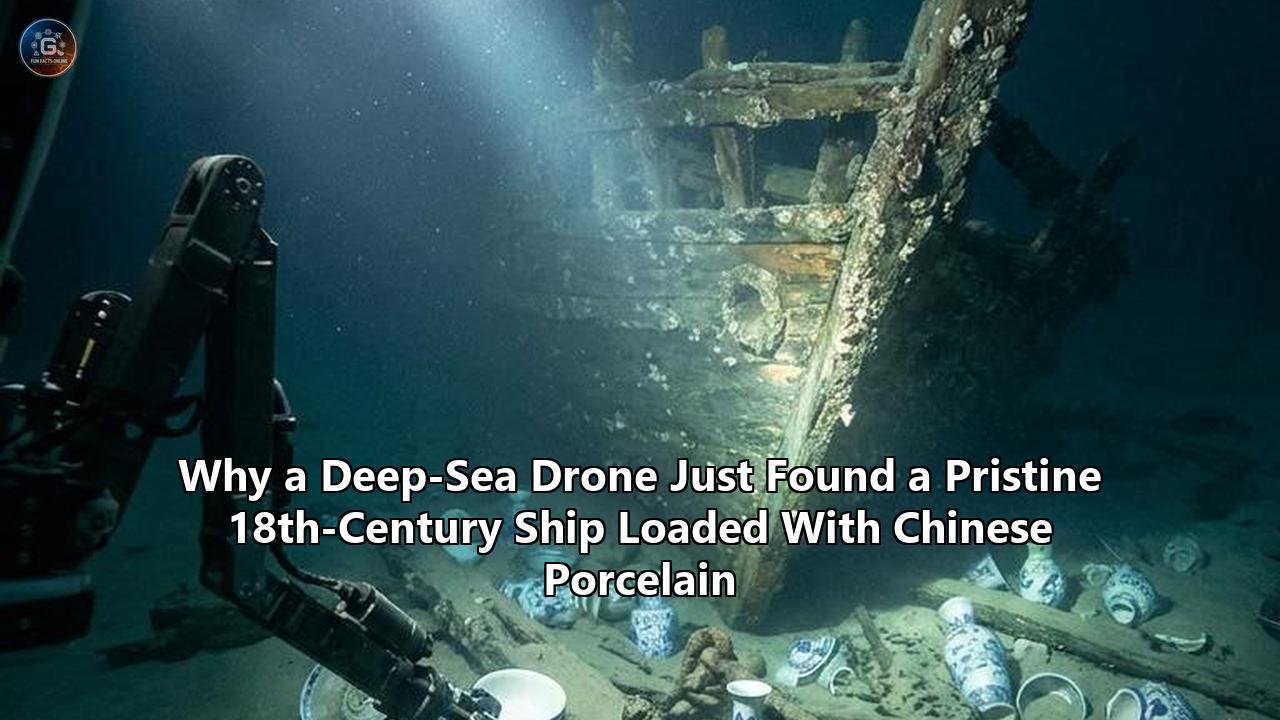
At a depth of 600 meters—nearly 2,000 feet below the surface of the Skagerrak Strait—the crushing pressure of the sea exerts roughly 60 atmospheres of force, plunging the ocean floor into perpetual near-freezing darkness. Yet, resting upright on this muddy seabed, a 72-foot-long, two-masted 18th-century merchant vessel remains so perfectly intact that stacks of delicate Chinese porcelain bowls lie undisturbed on its deck, looking as if they were manufactured yesterday.
In late May and June of 2026, the Norwegian Ministry of Climate and Environment and the Norwegian Maritime Museum unveiled the first recovered treasures from what has been dubbed the "Porcelain Wreck". Discovered by a private marine surveyor using a light remotely operated vehicle (ROV), this extraordinary site represents the best-preserved deep-sea cargo of Chinese porcelain ever found in Northern Europe.
The announcement has sent shockwaves through the global maritime archaeology community, not merely for the aesthetic beauty of its luxury cargo, but because the find marks a critical inflection point in the technological, ethical, and geopolitical landscape of deep-ocean exploration. By utilizing a specialized ROV equipped with highly sensitive, custom-made soft-robotic suction cups, researchers have successfully bypassed the traditional depth limitations of human divers, retrieving some 40 pristine artifacts from the site.
This monumental 18th century shipwreck discovery highlights the rapid divergence in how different global powers approach deep-sea heritage. While nations like China employ massive, state-sponsored manned submersibles to map deep-sea wrecks in the South China Sea, and France deploys military-grade robotic systems in the Mediterranean, Norway’s success in the Skagerrak relies on an agile, cooperative model that bridges private commercial technology and public heritage management. The result is a historic "time capsule" that offers an unparalleled look into the birth of global consumerism and the complex maritime trade networks of the mid-1700s.
                     ┌───────────────────────────────────────────────┐
                     │           THE "PORCELAIN WRECK"               │
                     │          Discovered: Sept 2025                │
                     │          Announced: June 2026                 │
                     │          Depth: 600 Meters (2,000 ft)         │
                     │          Location: Skagerrak Strait           │
                     └───────────────────────┬───────────────────────┘
                                             │
                       ┌─────────────────────┴─────────────────────┐
                       ▼                                           ▼
          ┌───────────────────────────┐               ┌───────────────────────────┐
          │      TECHNOLOGY USED      │               │     HISTORICAL CARGO      │
          ├───────────────────────────┤               ├───────────────────────────┤
          │ • Light Commercial ROV    │               │ • Dehua "Blanc de Chine"  │
          │ • Soft-Robotic Suction Arm│               │ • Batavia Ware (Brown/Blue│
          │ • 3D Photogrammetry       │               │ • German/English Crystal  │
          │ • Fiber-Optic Telepresence│               │ • Lübeck Galley Bricks    │
          └───────────────────────────┘               └───────────────────────────┘
The Watchmaker’s Eyes: An Accidental Discovery in the Deep
Unlike many state-financed scientific expeditions, the discovery of the Porcelain Wreck was a stroke of serendipity. In September of last year, Espen Saastad—a professional watchmaker by trade and watch designer at Saastad Ur in Porsgrunn, Norway—was conducting a routine seabed survey through his small commercial underwater robotics and surveying company. Operating a small, highly maneuverable ROV in the open, choppy waters of the Skagerrak Strait between Norway and Denmark, Saastad’s sonar caught an unusual anomaly.
"When the underwater ROV descended to the seabed, we turned on the sonar and moved towards the target," Saastad recalled. "Soon we began to see some artifacts—small pieces of leather, small pieces of wood—and then we realized we were approaching a shipwreck."
As the ROV drifted closer, Saastad’s real-time video feed illuminated a startling sight. "Suddenly, we realized it might be porcelain," he said. "As the robot got closer, we could see the decorative patterns on it and quickly identified it as Chinese porcelain."
Stacked in perfect, nested rows half-buried in the marine sediment were hundreds of intact plates, cups, and bowls. Recognizing the monumental historical value of what he had found, Saastad immediately contacted the Norwegian Directorate for Cultural Heritage (Riksantikvaren).
"I had to rub my eyes when I grasped the scale of this find. It is almost beyond belief."
— Hanna Geiran, Director General of the Norwegian Directorate for Cultural Heritage
The wreck, believed to have sunk around 1750, is a 22-meter (72-foot) vessel that has rested upright and undisturbed for nearly three centuries. Because the ship plunged straight down to a depth far beyond the reach of amateur divers and recreational looters, it remained protected from the light, strong surface currents, and human interference that typically dismantle shallow-water wrecks.
"We often find cargo and freight, but it's usually broken or covered by marine growth," said Sven Ahrens, Director of Research at the Norwegian Maritime Museum, which has been quietly leading the scientific investigation. "Here, whole plates were lying in stacks on the seabed."
Manned Submersibles vs. Remote Drones: Comparing Deep-Sea Toolkits
The successful survey and delicate retrieval of artifacts from the Skagerrak Strait highlight a fundamental debate within deep-sea archaeology: manned submersibles versus unmanned, remotely operated vehicles (ROVs).
As marine archaeologists push deeper into the ocean’s "twilight zone" (depths between 200 and 1,000 meters) and the abyssal plains beyond, they are forced to choose between the physical presence of human observers and the high-tech precision of robotic telepresence.
| Feature | Manned Submersibles (e.g., Shenhai Yongshi) | Remotely Operated Vehicles (e.g., Saastad’s ROV / ROV-C 4000) |
|---|---|---|
| Max Depth Capability | Extreme (1,500m to 11,000m) | Unlimited (Tethered to surface power) |
| Human Presence | On-site, real-time spatial awareness | Telepresence via fiber-optic video feeds |
| Operational Limits | Crucially restricted by human fatigue (max ~10 hours) | Virtually indefinite dive times |
| Cost & Logistics | Multi-million dollar research vessels, specialized crew | Scalable; can be run from small support vessels |
| Risk Profile | High physical risk to human lives in deep-sea capsules | Zero risk to human life; drone loss is purely financial |
| Manipulator Sensitivity | Heavy mechanical arms; limited "soft touch" feedback | Highly adaptable with pneumatic and soft-robotic grips |
The Manned Model: China's "Deep Sea Warrior"
In the South China Sea, China’s National Cultural Heritage Administration (NCHA) has spearheaded deep-sea investigations of two major Ming Dynasty shipwrecks discovered at 1,500 meters (nearly a mile deep). These operations rely on the Shenhai Yongshi (Deep Sea Warrior) and the Fendouzhe (Striver) manned submersibles, launched from massive scientific vessels like the Tansuo 1 and Tansuo 2.
On these missions, archaeologists must endure highly challenging physical environments. They crouch for up to ten hours inside a cramped, freezing titanium pressure capsule, with no access to food, water, or facilities, operating under constant life-safety risks.
The primary advantage of this approach is the unmatched spatial cognitive capability of the human eye. Being physically present on the seabed allows archaeologists to gain a holistic, three-dimensional understanding of how a wreck site lies, helping them make rapid, intuitive judgments about where to excavate.
However, the tradeoffs are severe. The logistics of mobilizing a manned fleet are incredibly expensive, requiring national-level funding and military-grade naval coordination. Furthermore, the heavy mechanical claws of manned submersibles historically struggled to handle fragile ceramics, requiring complex, custom-engineered soft-robotic gloves or bionic manipulators to avoid crushing 500-year-old clay.
The Unmanned Model: Norway’s Agile ROV Telepresence
In contrast, the Norwegian Maritime Museum's work on the Porcelain Wreck utilized a highly efficient, surface-controlled robotic workflow. Rather than putting humans in harm's way, archaeologists sat inside a comfortable, climate-controlled command container on the deck of a surface support ship, guiding a tethered ROV down a 600-meter fiber-optic umbilical cable.
                     SURFACE SUPPORT VESSEL
               ┌─────────────────────────────────┐
               │  [Command Container / Pilots]   │
               └────────────────┬────────────────┘
                                │
                                │ Umbilical Cable
                                │ (Power, Data, Video)
                                │
                                ▼
                       600 METERS DEPTH
               ┌─────────────────────────────────┐
               │        UNMANNED ROV DRONE       │
               │   - HD Cameras & Sonar          │
               │   - Thrusters & HMI Lights      │
               │   - Soft-Robotic Suction Arm    │
               └────────────────┬────────────────┘
                                │
                                ▼
               ┌─────────────────────────────────┐
               │    18th-CENTURY PORCELAIN WRECK │
               └─────────────────────────────────┘
This unmanned approach, which mirrors the French Navy’s recent exploration of the 1.5-mile-deep Camarat 4 merchant ship using the specialized ROV-C 4000, offers several distinct operational advantages:
- Continuous Operation: Unlike manned capsules that must ascend after a few hours due to power limits and human endurance, the ROV can stay submerged indefinitely, allowing for prolonged, methodical scanning and recovery.
- Cost Efficiency: By utilizing light, commercial surveying drones instead of deep-ocean deep-submergence rescue vehicles (DSRVs), the Norwegian Directorate was able to fund the entire project with a relatively modest grant of NOK 2.9 million (approximately $270,000 USD).
- Precision Robotics: Rather than using heavy hydraulic metal claws, the Norwegian team equipped their ROV with a specialized robotic arm tipped with custom-made silicone suction cups, designed and manufactured in France.
This soft-robotic system represents a technological milestone. By using pneumatic pressure differentials, the suction cup gently adheres to the smooth, glazed surface of a porcelain bowl. It lifts the fragile artifact, maneuvers it through the water column, and nests it inside a padded recovery crate on the ROV without scratching or applying localized shear stress. This eliminates the heavy-handed errors associated with traditional deep-sea salvage manipulators.
"As far as we know, this is the first time in Northern Europe that marine archaeologists have carried out such a salvage from a wreck at such a great depth," noted Frode Kvalø, the maritime archaeologist leading the project.
The Cargo: A Global Maritime Mystery in the Skagerrak
The nature of the cargo found aboard the Porcelain Wreck has profoundly challenged existing historical models of how luxury goods entered Northern European markets during the mid-18th century.
                       ┌─────────────────────────┐
                       │   THE LUXURY SPECTRUM   │
                       └────────────┬────────────┘
                                    │
         ┌──────────────────────────┼──────────────────────────┐
         ▼                          ▼                          ▼
 ┌───────────────┐          ┌───────────────┐          ┌───────────────┐
 │  HIGH-STATUS  │          │  MIDDLE-CLASS │          │     BULK      │
 ├───────────────┤          ├───────────────┤          ├───────────────┤
 │ • Crystal     │          │ • Chinese     │          │ • Barrels of  │
 │   Chandeliers │          │   Porcelain   │          │   Grain       │
 │ • Stemmed     │          │ • Tea, Herbs  │          │ • Wood Logs & │
 │   Wine Glass  │          │   & Medicines │          │   Tallow      │
 └───────────────┘          └───────────────┘          └───────────────┘
The ship was laden with a highly diverse, tiered cargo of high-status items, middle-class consumer goods, and bulk agricultural commodities:
1. Chinese Export Porcelain
The primary find consists of hundreds of pristine, tightly stacked ceramic vessels. Archaeologists have identified two dominant styles:
- Batavia Ware: Characterized by a rich, dark-brown iron glaze on the exterior of the vessel and classic cobalt-blue and white painted patterns on the interior. This style was immensely popular in European households as fashionable tableware.
- Dehua "Blanc de Chine": Exquisite, monochrome white porcelain produced in the ancient kilns of Dehua in southern China. Highly prized in Europe for its pure, translucent white clay body, "Blanc de Chine" was often imported as fine figurines, cups, and tea vessels to mimic the luxury of the European aristocracy.
2. High-Status Glassware and Lighting
Alongside the porcelain are parts of elegant, hand-blown crystal chandeliers, complete with curved glass arms. Art historians, including Geir Thomas Risåsen of the Norwegian Museum of Cultural History, have noted that these chandelier arms are crafted from exceptionally clear, pure, and high-quality glass. During this era, chandeliers were luxury lighting fixtures reserved for the highest echelons of society. The ship also carried a large quantity of delicate, stemmed wine glasses and goblets, likely manufactured in Germany, England, or the Netherlands.
3. Organic Commodities and Sealed Crates
The ROV’s video feeds also revealed barrels of grain and tightly sealed wooden crates. Because of the unique, low-oxygen preservation conditions at 600 meters, researchers believe these crates still contain intact organic materials such as tea, cocoa, coffee, and medicinal herbs—the very commodities that fueled the early modern colonial trade economy.
4. Bricks from the Galley
One of the most valuable clues for dating and identifying the ship is a mundane item: a brick salvaged from the ship's galley (the onboard kitchen). The brick bears a distinct manufacturer's stamp from the Lübecker Ratsziegelei, a historic brickyard in the German Hanseatic city of Lübeck that operated from the 15th century until 1772. This stamp confirms that the ship was built or repaired in Northern Europe and places a firm historical bracket on its operation.
                     CHINESE PORCELAIN PATHWAYS

  [Production: China] ────────► [Oceanic Transport] ────────► [European Hubs]
     - Jingdezhen (Blue/White)     - Dutch East India (VOC)      - Amsterdam
     - Dehua (Blanc de Chine)      - Swedish East India (SOIC)   - Copenhagen
                                   - Danish Asiatic Co. (DAC)    - Gothenburg
                                                                       │
                                                                       │ Auction
                                                                       ▼
  [Skagerrak Shipwreck] ◄──────── [Regional Galiot] ◄──────── [Local Merchant]
     - Sunk ~1750                    - Two-masted vessel         - Final Retail
     - 600m Depth                    - 5-6 Crew                  - Scandinavian
                                                                   Markets
To fully grasp why this specific cargo layout makes this 18th century shipwreck discovery so unique, it must be compared to direct bulk-export shipwrecks discovered elsewhere in the world.
Direct Bulk Export vs. Regional Distribution: Two Trading Models
In the field of maritime history, shipwrecks are generally categorized into two trade models: direct bulk-export lines and interregional distribution networks.
The South China Sea shipwrecks, such as the Northwest Continental Slope No. 1 (dating to the Ming Dynasty’s Zhengde period, 1506–1521), are prime examples of the direct bulk-export model. That ship was a massive Asian merchant junk carrying more than 100,000 pieces of export porcelain stacked over three meters high, moving straight from Chinese kiln ports like Jingdezhen toward international markets in Southeast Asia and the Indian Ocean. It was a floating warehouse carrying a single, highly concentrated category of manufacturing goods.
The "Porcelain Wreck" in the Skagerrak Strait tells an entirely different, more complex story. The vessel was not a massive ocean-going East Indiaman that had sailed all the way to China. Its physical dimensions—a 22-meter hull, likely a Dutch-style galliot—indicate it was a regional European cargo ship designed for coastal and North Sea transit, carrying a crew of only five or six men.
"The ship itself had not been to China to collect these goods," explains Frode Kvalø. "The porcelain must have come from a place where such goods were auctioned, such as Gothenburg, Copenhagen, or Amsterdam."
The Global-to-Local Intermediary System
By the mid-18th century, charter companies like the Swedish East India Company (based in Gothenburg), the Danish Asiatic Company (in Copenhagen), and the Dutch East India Company (VOC, in Amsterdam) imported millions of pieces of Chinese porcelain, tea, and silk. Upon arrival in these European hubs, the vast cargoes were unloaded and sold at highly publicized public auctions.
Local Scandinavian and Baltic merchants attended these auctions to purchase mixed lots of goods. They would bundle prestigious Chinese ceramics with regional European luxuries—like English or German crystal chandeliers—and everyday staples like German bricks, tallow, and Norwegian grain. These mixed cargoes were then loaded onto smaller coastal vessels like the Skagerrak galliot to be distributed to secondary ports along the rugged coasts of Norway, Sweden, and Denmark.
                     COMPARING HISTORICAL SHIPS

        ┌─────────────────────────────────────────────────────────┐
        │   SOUTH CHINA SEA NO. 1 (Ming Dynasty, ~1510)           │
        ├─────────────────────────────────────────────────────────┤
        │ • Cargo: 100,000+ Porcelain Pieces (Jingdezhen) │
        │ • Model: Direct Bulk Export                     │
        │ • Route: China to Indian Ocean                  │
        └─────────────────────────────────────────────────────────┘
                                     vs
        ┌─────────────────────────────────────────────────────────┐
        │   SKAGERRAK "PORCELAIN WRECK" (Mid-18th Century)        │
        ├─────────────────────────────────────────────────────────┤
        │ • Cargo: Mixed (Porcelain, Chandeliers, Grain, Tea)│
        │ • Model: Interregional Distribution      │
        │ • Route: European Hub (e.g., Gothenburg) to Norway│
        └─────────────────────────────────────────────────────────┘
The Porcelain Wreck provides physical evidence of this secondary "trickle-down" economy. It demonstrates how global trade had matured from a royal monopoly on exotic curiosities into a highly integrated, middle-class market economy. For the first time, ordinary citizens in relatively remote Norwegian coastal towns could purchase authentic Chinese-made porcelain plates and tea sets to display in their homes, a lifestyle shift fueled by agile regional cargo vessels.
The Conservation Dilemma: Passive Preservation vs. the Trawler Threat
The discovery of a pristine, undisturbed deep-sea shipwreck brings to the forefront a longstanding ethical and logistical debate within maritime archaeology:is it better to leave deep-sea wrecks undisturbed on the ocean floor (in-situ preservation), or should they be actively salvaged?
The Case for In-Situ Preservation
For decades, the consensus among academic archaeologists and international bodies, including the 2001 UNESCO Convention on the Protection of the Underwater Cultural Heritage, has been that in-situ preservation is the gold standard of cultural resource management. The arguments for this passive approach are compelling:
- Chemical Stability: When a wooden ship sinks into deep water, it eventually reaches a state of thermodynamic and chemical equilibrium with its surroundings. In cold, dark, low-oxygen environments like the bottom of the Skagerrak, the degradation of organic materials (wood, leather, paper, textiles) slows to a crawl.
- Protection from Marine Wood-Borers: The deep, cold waters of the Skagerrak (similar to the Baltic Sea) are largely inhospitable to Teredo navalis (the common shipworm), which is notorious for completely consuming exposed wooden ship structures in warmer, shallower waters within a matter of decades.
- Archaeological Context: Leaving artifacts exactly where they came to rest allows future generations of researchers to study them using superior, non-invasive technology, ensuring that valuable archaeological context is not lost during premature excavation.
                   THE UNDERWATER CONSERVATION CYCLE

                     ┌───────────────────────────┐
                     │     SHIP SINKS TO 600M    │
                     └─────────────┬─────────────┘
                                   │
                                   ▼
                     ┌───────────────────────────┐
                     │    Oxygen Depletion       │
                     │    Constant Cold (4°C)    │
                     │    No Sunlight / Algae    │
                     └─────────────┬─────────────┘
                                   │
                                   ▼
                     ┌───────────────────────────┐
                     │  EQUILIBRIUM ESTABLISHED  │
                     │  (Stable "Time Capsule")  │
                     └─────────────┬─────────────┘
                                   │
             ┌─────────────────────┴─────────────────────┐
             ▼                                           ▼
┌─────────────────────────┐                 ┌─────────────────────────┐
│     THE PASSIVE WAY     │                 │     THE ROBOTIC WAY     │
├─────────────────────────┤                 ├─────────────────────────┤
│ • Keep site untouched   │                 │ • Threatened by bottom  │
│ • Wait for future tech  │                 │   trawling nets         │
│ • Virtual 3D twins only │                 │ • Selective salvage of  │
│ • Risk of industrial    │                 │   diagnostic relics     │
│   seabed destruction    │                 │ • Active conservation   │
│   by fishing fleets     │                 │   in public museums     │
└─────────────────────────┘                 └─────────────────────────┘
The Pragmatic Reality: Industrial Destruction
However, researchers working on the Porcelain Wreck have faced a harsh reality that is forcing a major rethink of this passive philosophy: the devastating impact of industrial commercial bottom-trawling.
Even though the Porcelain Wreck lies at a depth of 600 meters, it is situated in open, highly active international shipping and fishing corridors. Heavy, weighted commercial bottom-trawling nets, which scrape the seafloor to catch deep-water shrimp and fish, present a constant danger to deep-sea heritage.
"For now, researchers can only recover objects lying on the surface of the wreck," Sven Ahrens explained. "The glass visible there has already been damaged by trawling activity."
If left completely untouched on the seafloor, it is only a matter of time before a heavy trawl board or steel-cable net collides with the Porcelain Wreck, shattering the remaining crystal chandeliers, crushing the nested stacks of Dehua porcelain, and scattering the wooden hull structure.
The Hybrid Solution: 3D "Digital Twins" and Targeted Recovery
To balance these competing philosophies, the Norwegian Maritime Museum and the Directorate for Cultural Heritage developed a hybrid approach:
- Virtual Excavation (Photogrammetry): Before a single object was touched, archaeologists sent the ROV down to perform a highly detailed photogrammetric scan of the entire site. By capturing thousands of high-resolution digital photographs from every angle, powerful processing software stitched the images together to create a millimetrically precise, interactive 3D "digital twin" of the wreck. This allows historians to study the ship's architecture and cargo placement in perpetuity without disturbing the physical site.
- Targeted Physical Salvage: Using the ROV's soft-robotic suction arm, the team conducted a highly selective extraction of "diagnostic artifacts"—objects that carry the highest risk of destruction from trawling and those that contain critical historical data, such as the maker-marked kitchen brick, the delicate crystal chandelier arms, and porcelain cups bearing monograms.
- Active Laboratory Conservation: Once brought to the surface, these fragile objects were immediately transferred to fresh-water baths to slowly leach out the corrosive sea salts that had penetrated the clay and glass over three centuries. They are now undergoing careful chemical stabilization at the Norwegian Maritime Museum’s conservation laboratories in Oslo.
Geopolitics, Sovereignty, and the Regulatory Landscape of Deep Water
The recovery of deep-ocean shipwrecks is not just a scientific endeavor; it is also a highly charged legal and political issue. The different regulatory and national frameworks governing these discoveries shape how they are excavated and who ultimately controls their historical narratives.
                 STATE MODELS OF DEEP-SEA ARCHAEOLOGY

 ┌───────────────────────────────────────────────────────────────────┐
 │                       THE NORWEGIAN MODEL                         │
 ├───────────────────────────────────────────────────────────────────┤
 │ • Cooperative / Decentralized                                     │
 │ • Private discoverers are integrated and praised                  │
 │ • Automatically protected by the Cultural Heritage Act            │
 │ • Transparent research, public museum dissemination               │
 └───────────────────────────────────────────────────────────────────┘
                                  vs
 ┌───────────────────────────────────────────────────────────────────┐
 │                        THE CHINESE MODEL                          │
 ├───────────────────────────────────────────────────────────────────┤
 │ • Centralized / State-Directed                                    │
 │ • Executed by military-adjacent oceanic research institutes       │
 │ • Used to reinforce sovereignty claims over historical waters     │
 │ • Directly linked to national geopolitical narratives            │
 └───────────────────────────────────────────────────────────────────┘
                                  vs
 ┌───────────────────────────────────────────────────────────────────┐
 │                        THE FRENCH MODEL                           │
 ├───────────────────────────────────────────────────────────────────┤
 │ • Defensive / Secretive                                           │
 │ • Locations kept classified to prevent high-tech looting          │
 │ • Executed under tight military and naval supervision             │
 │ • Focus on mapping deep territorial waters as national security   │
 └───────────────────────────────────────────────────────────────────┘
The Norwegian Model: Open Cooperation and Legal Protection
Norway’s handling of the Porcelain Wreck is a masterclass in civic cooperation and state-funded transparency. Under Norway’s Cultural Heritage Act, any shipwreck older than 100 years is automatically protected by the state, regardless of its depth or location within territorial waters.
Crucially, rather than treating private ocean surveyors as adversaries, the Norwegian government actively integrated Espen Saastad into the official research team. Climate and Environment Minister Andreas Bjelland Eriksen publicly lauded Saastad's responsible actions:
"The new and unique knowledge this discovery will generate is thanks to the actions of Espen Saastad," Eriksen stated. "This find is not only extraordinary, it's also of considerable scientific value and demonstrates an important technological advancement in underwater archaeology."
By cultivating a culture of trust and providing public funding (such as the NOK 2.9 million grant from the Directorate for Cultural Heritage), Norway has created a sustainable model where private explorers have zero incentive to secretly loot wrecks or sell finds on the black market. Instead, they work alongside museum experts to build public exhibitions.
The Chinese Model: Centralized Power and Maritime Heritage
In contrast, China’s deep-sea archaeology program is a highly centralized, state-directed apparatus. Deep-sea discoveries, such as the Northwest Continental Slope wrecks, are tightly managed by the State Council and the NCHA.
These scientific operations are closely linked to China's broader geopolitical strategies, particularly the "Maritime Silk Road" narrative. By demonstrating that ancient Chinese merchant ships were sailing and trading heavily through disputed zones of the South China Sea more than 500 years ago, Beijing uses these archaeological finds to project soft power and bolster historic maritime sovereignty claims over these waters.
The funding and logistics are immense, backed by military-adjacent oceanographic institutions like the Chinese Academy of Sciences (CAS). While this centralized approach ensures massive resource allocation, it lacks the nimble, decentralized volunteerism that drives many European discoveries.
The French Model: High-Tech Secrecy and Protection
France’s Department of Underwater Archaeological Research (DRASSM) operates on a highly defensive and protective model. When a French Navy survey crew first discovered the 16th-century Camarat 4 merchant ship off Saint-Tropez in 2025, the location of the wreck was immediately classified.
To prevent high-tech looting by unauthorized deep-sea operators, France keeps the exact coordinates secret, relying on the French Navy to monitor the site using advanced surface radar and sonar surveillance. Their research missions are carried out under strict military supervision. While this model keeps looters at bay, it restricts international scientific collaboration and limits public access to the sites until long-term excavation projects are completed years down the road.
Unresolved Mysteries: What the Porcelain Wreck has Yet to Reveal
The initial recovery of 40 artifacts in May 2026 is merely the opening chapter of a long, detective-like historical investigation. The Porcelain Wreck still holds several secrets that researchers hope to unravel over the coming months:
               THE ARCHAEOLOGICAL DETECTIVE BOARD

   [Mystery #1: The Monogram] ────► Can we match the stamp on the
                                    porcelain cup to a specific family
                                    or merchant house?

   [Mystery #2: Sound Dues] ──────► Can we cross-reference the cargo
                                    dimensions with historic Danish toll
                                    records in Elsinore?

   [Mystery #3: Stove Panel] ─────► Will the recovery of the decorated
                                    iron stove panel reveal the vessel's
                                    shipyard of origin?

   [Mystery #4: Grain DNA] ───────► What can the genetic makeup of the
                                    preserved grain tell us about 18th-century
                                    farming?
1. The Mysterious Monogram
Among the recovered Batavia-style porcelain cups, one has a distinct, hand-painted monogram on its base that has yet to be deciphered.
"One of the cups appears to bear the remains of a monogram on its base," noted the project team at the Norwegian Maritime Museum. "It will be fascinating to see whether further examples emerge and whether the monogram can be deciphered and linked to a possible owner or customer."
Deciphering this monogram could allow researchers to trace the cargo back to a specific merchant house, a wealthy Scandinavian family, or even a particular East India Company auction catalog in Gothenburg or Copenhagen.
2. Searching the Danish Sound Dues Records
To determine the identity and destination of the galliot, maritime historians are preparing to dive into one of Europe's most valuable historical databases: the Danish Sound Dues registers.
For centuries, the King of Denmark charged a toll on every merchant ship entering or leaving the Baltic Sea through the narrow Oresund strait. These meticulous hand-written records, kept at Elsinore, document the name of every ship, its captain, its port of registry, its departure port, and a detailed manifest of its cargo.
By cross-referencing the approximate date of the sinking (around 1750) with the specific cargo profile—a mixed load of Chinese porcelain, German/English chandeliers, and grain—historians hope to find a matching entry that was logged just days before the ship plunged into the Skagerrak Strait.
3. The Upcoming Excavations
The Norwegian Maritime Museum has announced plans for another targeted robotic expedition. The upcoming missions have two primary objectives:
- Recovering Porcelain Plant Figurines: Researchers have spotted highly unusual, finely crafted porcelain figurines that appear to imitate plant forms. These delicate objects are extremely rare and of immense art-historical value.
- Salvaging the Iron Stove Panel: The team hopes to recover a decorated iron panel from the ship’s galley stove. Like the Lübeck brick, the decorative patterns or maker's marks on the cast iron could reveal the exact foundry where the stove was made, helping narrow down the region where the ship was fitted out.
Charting a New Era for Deep-Ocean Heritage
The discovery of the Porcelain Wreck off Norway represents far more than an extraordinary trove of pristine 18th-century luxury goods. It serves as a proof-of-concept for the future of deep-water archaeology.
By showing that a private individual operating commercial ROV technology can successfully locate a delicate deep-sea site, and that state institutions can use gentle soft-robotic suction arms to recover fragile artifacts without damage, Norway has demonstrated that the deep ocean is no longer an inaccessible vault.
As industrial bottom-trawling and commercial deep-sea mining continue to expand across the globe, the race to locate, map, and selectively salvage these deep-ocean "time capsules" has never been more urgent. The lessons learned from this remarkable 18th century shipwreck discovery will undoubtedly shape how humanity uncovers, protects, and understands the vast, silent museums of the deep.
Reference:
- https://www.goodnewsnetwork.org/shipwreck-almost-beyond-belief-stunned-archaeologists-with-its-cargo-of-intact-porcelain/
- https://www.sciencenorway.no/archaeology-shipwrecks/the-unique-porcelain-wreck-what-the-chandelier-recovered-from-the-seabed-may-have-looked-like/2676729
- https://www.smithsonianmag.com/smart-news/a-shipwreck-almost-beyond-belief-stunned-archaeologists-in-norway-with-its-cargo-of-intact-porcelain-dishes-and-luxury-goods-180988910/
- https://riksantikvaren.no/en/the-porcelain-wreck-spectacular-shipwreck-discovery-in-the-skagerrak/
- https://timesofindia.indiatimes.com/world/rest-of-world/deep-beneath-norwegian-waters-a-shipwreck-frozen-in-time-is-unlocking-secrets-of-europes-porcelain-trade/articleshow/131681155.cms
- https://www.sciencenorway.no/archaeology-culture/sensational-shipwreck-discovery-off-norway-intact-chinese-porcelain-and-chandeliers-at-a-depth-of-600-metres/2671879
- https://www.globaltimes.cn/page/202409/1320431.shtml
- http://www.newschinamag.com/newschina/articleDetail.do?article_id=7877§ion_id=4&magazine_id=103
- https://www.cbsnews.com/news/france-deepest-shipwreck-robot-diver-images/
- https://www.yacht.de/en/special/distress-at-sea/wreck-find-merchant-ship-with-valuable-cargo-from-the-18th-century-discovered-in-the-skagerrak/
- https://www.archaeology.wiki/blog/2026/06/05/the-porcelain-wreck/
- https://www.sciencenorway.no/archaeology-culture/sensational-shipwreck-discovery-off-norway-intact-chinese-porcelain-and-chandeliers-at-a-depth-of-600-metres/2671879
- https://www.youtube.com/watch?v=BE1qVKdrSrQ
- https://www.youtube.com/watch?v=BE1qVKdrSrQ
- https://divernet.com/scuba-news/wrecks/1700s-shipwreck-find-unlike-any-other-in-northern-europe/
- https://www.bgr.com/2174140/diving-robot-submarine-shipwreck-investigation/
- https://www.shipwreck.net/technology
- https://www.deeptrekker.com/resources/how-parks-canada-uses-rovs-to-survey-submerged-heritage-sites
- https://physicsworld.com/a/clingfish-inspires-suction-cups-for-underwater-robots/
- https://www.archaeology.wiki/blog/2026/06/05/the-porcelain-wreck/
- https://marmuseum.no/en/the-porcelain-wreck
- https://www.sciencenorway.no/archaeology-shipwrecks/the-unique-porcelain-wreck-what-the-chandelier-recovered-from-the-seabed-may-have-looked-like/2676729
- https://www.sciencenorway.no/archaeology-shipwrecks/the-unique-porcelain-wreck-what-the-chandelier-recovered-from-the-seabed-may-have-looked-like/2676729
- https://greekreporter.com/2026/06/03/norway-shipwreck-chinese-porcelain-cargo/
- https://www.smithsonianmag.com/smart-news/a-shipwreck-almost-beyond-belief-stunned-archaeologists-in-norway-with-its-cargo-of-intact-porcelain-dishes-and-luxury-goods-180988910/
- http://english.scio.gov.cn/pressroom/2023-05/22/content_85478446.htm
- https://www.ancientpages.com/2026/06/08/skagerrak-shipwreck-reveals-pristine-18th-century-chinese-porcelain-cargo/
- https://theageofexploration.com/the-porcelain-wreck-18th-century-ship-reveals-amazing-chinese-cargo/
- https://riksantikvaren.no/en/the-porcelain-wreck-spectacular-shipwreck-discovery-in-the-skagerrak/