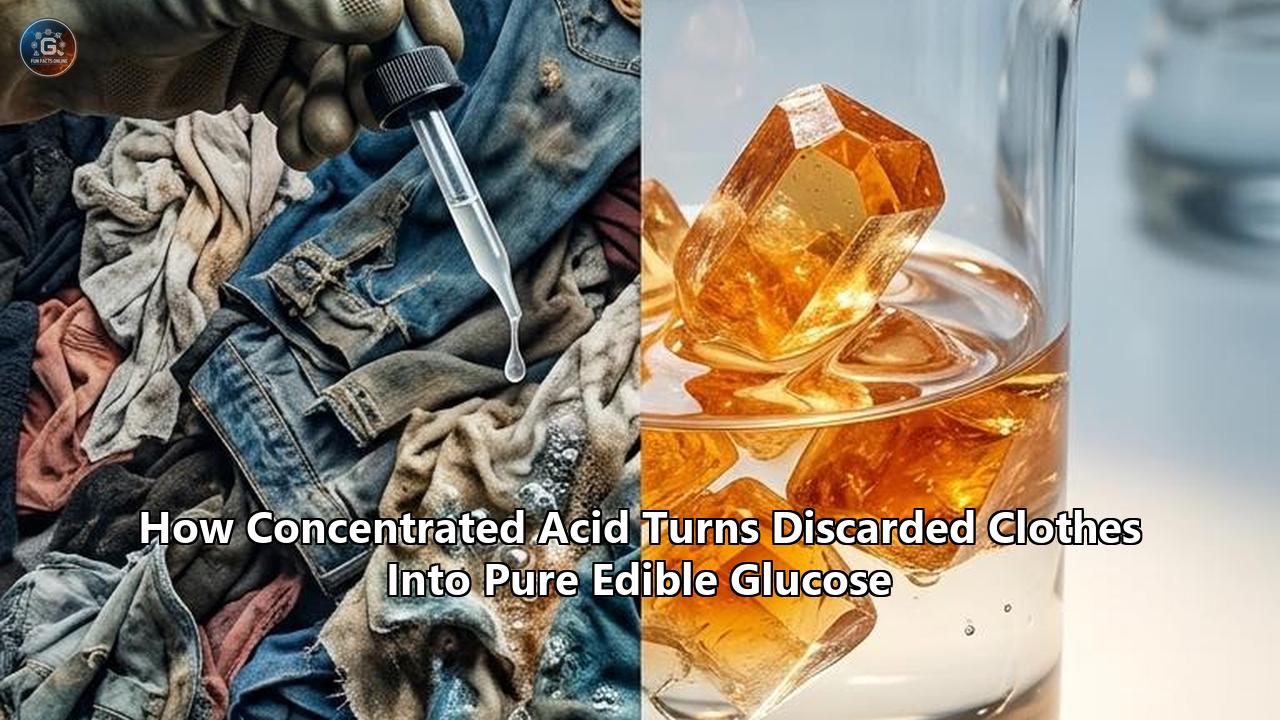
Chemical engineers have crossed a critical frontier in waste reclamation: transforming worn-out cotton garments and blended textiles into pure, crystal-grade D-glucose syrup through high-efficiency concentrated acid hydrolysis. In a series of successful pilot trials conducted at the University of Amsterdam in collaboration with industrial renewable-chemistry firm Avantium, along with parallel developments at Sweden’s Lund University, researchers demonstrated that superconcentrated mineral acids can rapidly disassemble the molecular chains of cotton waste into simple sugars at room temperature.
The resulting hydrolysate, once stripped of industrial dyes, heavy metals, and residual acid catalysts, yields a sugar solution chemically identical to the glucose produced from corn starch or sugarcane.
Published in Nature Communications and Waste Management, the research proves that tertiary chemical processing can depolymerize the cellulose in discarded apparel with molar yields between 75% and 90%, all while leaving non-cotton synthetic fractions such as polyester entirely undamaged for subsequent fiber recycling.
"Being able to recover glucose from the cotton in textile waste is a crucial contribution to the transition away from petrochemicals," explains Gert-Jan Gruter, Professor of Industrial Sustainable Chemistry at the University of Amsterdam and Chief Technology Officer at Avantium. "Currently, industrial glucose is produced from food crops like corn and wheat. If the world is to manufacture bio-based plastics, chemicals, and fermentation products on a multi-million-ton scale without competing with the human food supply, we need vast sources of non-food glucose".
+---------------------------------------------------------------------------------------+
|                                TEXTILE-TO-GLUCOSE CASCADE                             |
+---------------------------------------------------------------------------------------+
|                                                                                       |
|   [ Post-Consumer Apparel ] ---> [ Mechanical Shredding & Metal Removal ]            |
|                                                     |                                 |
|                                                     v                                 |
|   [ Intact Polyester Fibers ] <--- [ Concentrated Acid Hydrolysis (HCl / H2SO4) ]     |
|      (To Fiber Recycling)                           |                                 |
|                                                     v                                 |
|                                    [ Acid Recovery System (>98% Recycled) ]           |
|                                                     |                                 |
|                                                     v                                 |
|   [ Toxins, Dyes & Heavy Metals ] <--- [ Multi-Stage Decontamination ]                |
|      (Adsorption & Nanofiltration)                  |                                 |
|                                                     v                                 |
|                                      [ Pure D-Glucose Hydrolysate ]                   |
|                                                     |                                 |
|                         +---------------------------+---------------------------+     |
|                         |                                                       |     |
|                         v                                                       v     |
|             [ Industrial Fermentation ]                             [ High-Purity Food/ ]     |
|            (Bio-Plastics, Nylon, Solvents)                          [ Pharma Feedstock  ]     |
|                                                                                       |
+---------------------------------------------------------------------------------------+
Transforming old fabric into a molecule humans or microbial organisms can safely metabolize bridges two separate planetary challenges: a staggering mountain of discarded clothing and an accelerating demand for fermentable, non-fossil sugar feedstocks.
The Scale of the Crisis: Fast Fashion’s Waste Mountain
Global textile mills manufacture upwards of 110 million metric tons of fiber annually, a figure projected to approach 150 million tons within the decade. More than 70% of this material ends up in municipal landfills or is fed into waste-to-energy incinerators. Less than 1% of discarded clothing is ever recycled into new apparel.
The fundamental obstacle to circularity in the apparel sector lies in material complexity. Modern garments rarely consist of pure, single-origin fibers. Instead, manufacturers rely heavily on "polycotton"—intimate mechanical blends of natural cotton and synthetic polyethylene terephthalate (PET polyester). This blend gives clothing durability, wrinkle resistance, and breathability at low production costs, but it forms an intractable composite that defeats conventional mechanical recycling.
========================================================================================
                          GLOBAL TEXTILE FIBER FLOW DYNAMICS
========================================================================================
  ANNUAL GLOBAL PRODUCTION:  ~113,000,000 Metric Tons
  ------------------------------------------------------------------------------------
  Synthetic Fibers (PET, Polyamide, Spandex):  ~64%
  Natural Cellulosic (Cotton, Linen, Hemp):    ~28%
  Man-Made Cellulosic (Viscose, Lyocell):       ~6%
  Animal Fibers (Wool, Silk):                   ~2%
  ------------------------------------------------------------------------------------
  END-OF-LIFE DISPOSITION:
  * Landfilled or Open Dumps:                  ~65%
  * Municipal Mass-Burn Incineration:          ~24%
  * Downcycled (Rags, Insulation, Carpet Pad): ~10%
  * Closed-Loop Fiber-to-Fiber Recycled:        <1%
========================================================================================
When mechanical recyclers attempt to tear apart polycotton garments, high-speed garneting teeth shred the cotton fibers, shortening their staple length below the threshold required to spin high-tenacity yarn. Mechanical recycling inevitably degrades the product, resulting in low-value downcycling into acoustic insulation, carpet backing, or wiper rags that eventually hit landfills anyway.
Chemical recycling routes offer an alternative by targeting individual polymer bonds. Because cotton is nearly pure cellulose (the most abundant organic polymer on the planet), its chemical backbone is constructed of repeating D-glucose units linked by oxygen atoms. The core chemical challenge has been cleaving those specific linkages without turning the resulting sugars into charred degradation products or destroying the accompanying polyester fibers.
The Molecular Chemistry: Cellulose Versus Edible Sugar
To understand how cotton turns into sugar, one must look at carbohydrate chemistry at the molecular scale. Cotton fiber is not merely plant matter; mature cotton lint consists of roughly 90% to 95% pure cellulose—a structural polysaccharide far purer than the wood pulp or agricultural straw traditionally fed into industrial biorefineries.
  CELLULOSE MATRIX (Insoluble, Structural):

        OH                    OH                    OH
        |                     |                     |
   +----+----+           +----+----+           +----+----+
   |  C6 H11 O5 \       /  C6 H11 O5 \       /  C6 H11 O5 \
 --+             O-----+             O-----+             O-- ...
                  \                   \                   \
                   \                   \                   \
            [ beta-1,4-glycosidic bond: Straight, rigid, crystalline ]


  FREE D-GLUCOSE MONOMER (Soluble, Edible Sugar):

               CH2OH
               |
             --C---O
           /   |   \  H
       HO-C    H    C--OH
          |  \   /  |
          H    C----C
               |    |
               OH   H

            [ Monosaccharide: Readily metabolized by cells & yeast ]
Cellulose is a linear homopolymer composed of repeating units of cellobiose, which itself consists of two D-anhydroglucopyranose molecules linked through $\beta\text{-1,4-glycosidic}$ bonds. Starch—the primary carbohydrate found in potatoes, corn, and wheat—is also a polymer of glucose, but its units are joined by $\alpha\text{-1,4-glycosidic}$ bonds.
This single stereochemical orientation difference dictates how biological systems process the material:
- $\alpha\text{-1,4-Linkages}$ (Starch): The oxygen atoms point in an orientation that creates a helical, open coil. Human salivary and pancreatic enzymes (such as $\alpha\text{-amylase}$) easily fit into the coil to cleave the polymer into free glucose for energy.
- $\beta\text{-1,4-Linkages}$ (Cellulose): Every alternate glucose ring is flipped 180 degrees relative to its neighbor. This alternating geometry allows the linear polymer chains to pack flat against one another.
Within a cotton fiber, individual cellulose chains align in parallel bundles called microfibrils. Extensive intra- and intermolecular hydrogen bonding between adjacent hydroxyl ($-\text{OH}$) groups locks these chains into a tight, water-repellent crystalline lattice known as Cellulose I.
+---------------------------------------------------------------------------------------+
|                         CELLULOSE I HYDROGEN-BONDING MATRIX                           |
+---------------------------------------------------------------------------------------+
|                                                                                       |
|   Chain A:  [-Glc-]--O--[-Glc-]--O--[-Glc-]--O--[-Glc-]--O--[-Glc-]                   |
|               :           :           :           :           :                       |
|          (Intense Interchain Hydrogen Bonds & Hydrophobic Van der Waals Forces)       |
|               :           :           :           :           :                       |
|   Chain B:  [-Glc-]--O--[-Glc-]--O--[-Glc-]--O--[-Glc-]--O--[-Glc-]                   |
|               :           :           :           :           :                       |
|          (Intermolecular Cross-linking Excludes Water & Solvents)                     |
|               :           :           :           :           :                       |
|   Chain C:  [-Glc-]--O--[-Glc-]--O--[-Glc-]--O--[-Glc-]--O--[-Glc-]                   |
|                                                                                       |
+---------------------------------------------------------------------------------------+
Water molecules cannot penetrate this tightly locked crystal lattice under ambient conditions, preventing the glycosidic bonds inside from dissolving. The human digestive tract lacks the cellulase enzymes needed to break $\beta\text{-1,4}$ bonds, meaning that raw cotton passes through the body completely unabsorbed as dietary fiber.
However, if an external chemical agent can break the interchain hydrogen bonds and insert water across every $\beta\text{-1,4}$ bridge, the crystalline cotton fiber disassembles into monomeric D-glucose ($\text{C}_6\text{H}_{12}\text{O}_6$). This resulting monosaccharide is chemically and biologically identical to the glucose that circulates in human blood, sweetens confectionery syrups, and fuels fermentation tanks.
The Acid Hydrolysis Mechanism: How Acids Cut the Glycosidic Bond
To systematically convert clothing to glucose, chemical engineers must perform cellulolysis: an acid-catalyzed cleavage reaction.
                                      H+ (Acid Catalyst)
      (C6H10O5)n   +   n H2O   ----------------------------->   n C6H12O6
       Cellulose        Water                                    D-Glucose
      (Insoluble)                                                (Soluble)
The reaction proceeds across three distinct mechanical phases:
+---------------------------------------------------------------------------------------+
|                          ACID HYDROLYSIS REACTION PATHWAY                             |
+---------------------------------------------------------------------------------------+
|                                                                                       |
|   Phase 1: Protonation                                                                |
|   Cellulose-O-Cellulose  +  H3O+  <=======>  Cellulose-O+(H)-Cellulose  +  H2O       |
|                                                                                       |
|   Phase 2: Carbon-Oxygen Cleavage & Carbocation Intermediate                          |
|   Cellulose-O+(H)-Cellulose       -------->  [Cellulose]+  +  HO-Cellulose            |
|                                              (Cyclic Oxocarbenium Ion)                |
|                                                                                       |
|   Phase 3: Nucleophilic Attack by Water & Catalyst Regeneration                       |
|   [Cellulose]+  +  2 H2O          -------->  Glucose  +  H3O+                         |
|                                                                                       |
+---------------------------------------------------------------------------------------+- Protonation: A hydronium ion ($\text{H}_3\text{O}^+$) originating from the concentrated acid attacks the glycosidic oxygen atom bridging two glucose rings, creating an unstable, protonated intermediate complex.
- Bond Scission: The carbon-oxygen ($\text{C}1\text{--O}$) bond cleaves. The leaving sugar fragment departs with a free hydroxyl group, while the remaining terminal glucosyl ring forms a high-energy cyclic oxocarbenium cation.
- Nucleophilic Attack: A water molecule quickly attacks the planar oxocarbenium ion, regenerating the catalytic hydronium ion and leaving a stable $\alpha$- or $\beta$-D-glucopyranose monomer.
The Pitfall of Dilute Acid: Unwanted Side Reactions
Historically, biomass processing used dilute acids (between 0.5% and 5% acid by weight) operated at high temperatures ($160^\circ\text{C}$ to $240^\circ\text{C}$) under intense pressures. Under dilute conditions, hydronium ions cannot penetrate the crystalline zones of the cotton fibers on their own. High thermal energy is required to force water into the lattice.
  THE OVER-HYDROLYSIS CASCADE (Under High Temperature & Dilute Acid):

   [ Cellulose ] ---> [ D-Glucose ] ---> [ 5-HMF ] ---> [ Levulinic Acid + Formic Acid ] ---> [ Insoluble Humins ]
                         (Target)     (Degradation)           (Acid Byproducts)              (Char / Sludge)
These severe operating conditions trigger a rapid chain of unwanted side reactions. As soon as a glucose molecule is liberated, the intense heat and residual acidity dehydrate it into 5-hydroxymethylfurfural (5-HMF). Continued exposure degrades 5-HMF further into levulinic acid, formic acid, and dark, insoluble carbonaceous polymers known as humins.
As a result, dilute acid systems typically stall out at low glucose yields (rarely exceeding 50%), consume large amounts of thermal energy, and generate a cocktail of metabolic inhibitors that ruin fermentation yeasts and make the product unfit for food applications.
========================================================================================
             DILUTE ACID VS. CONCENTRATED ACID HYDROLYSIS METRICS
========================================================================================
  Parameter                   Dilute Acid Hydrolysis      Concentrated Acid Hydrolysis
  ------------------------------------------------------------------------------------
  Acid Reagent Concentration  0.5% - 5.0% wt (H2SO4/HCl)   40% - 43% HCl or 70%-80% H2SO4
  Operating Temperature       160°C - 240°C               20°C - 50°C
  Operating Pressure          15 - 35 bar (Autogenous)    1 bar (Atmospheric)
  Decrystallization Mechanism Purely Thermal Disruption   Direct Chemical Solvation
  Max Glucose Yield           45% - 55%                   75% - 94%
  Sugar Degradation Products  Heavy (5-HMF, Levulinic)    Near Zero (<2%)
  Polyester (PET) Co-stream   Severely Degraded/Hydrolyzed Retained 100% Intact
========================================================================================
The Breakthrough: Room-Temperature Solvation and Selective Digestion
The modern push relies on concentrated acid hydrolysis. By utilizing superconcentrated hydrochloric acid ($\ge 40\text{--}43\text{ wt}\%$) or concentrated sulfuric acid ($70\text{--}80\text{ wt}\%$) at low temperatures ($20^\circ\text{C}$ to $50^\circ\text{C}$), the acid acts as both a powerful solvent and a catalyst.
At these high acid concentrations, water molecules are completely absorbed in hydrating the acid ions, creating an aggressive chemical environment. The acid rapidly disrupts the dense network of interchain hydrogen bonds holding the cellulose together.
                                Concentrated Acid (43% HCl / 72% H2SO4)
   Crystalline Cellulose I   --------------------------------------------->   Amorphous Solvated Cellulose
   (Dense, Inpenetrable)                 Room Temperature (20-30°C)           (Open, Hydrated Gel)
The cotton fibers swell and dissolve into an amorphous gel within minutes. Once the crystalline shield drops, every glycosidic bond becomes immediately accessible to catalytic scission.
Because the reactor operates near ambient temperatures, the thermal activation threshold required to turn glucose into 5-HMF and levulinic acid is never reached. The reaction halts cleanly at the monosaccharide stage, producing a clear, amber hydrolysate packed with intact D-glucose.
+---------------------------------------------------------------------------------------+
|                    POLYCOTTON FRACTIONATION SELECTIVITY                               |
+---------------------------------------------------------------------------------------+
|                                                                                       |
|   Post-Consumer Polycotton Blend (50% Cotton / 50% PET)                               |
|                     |                                                                 |
|                     v  [ Exposed to 43 wt% HCl at 25°C for 4 hours ]                  |
|                                                                                       |
|   COTTON FRACTION:                                                                    |
|   * Hydrogen bonds disrupted by high Cl- and H3O+ activity                            |
|   * Cellulose dissolves into liquid phase                                             |
|   * Glycosidic bonds cleave to yield soluble D-glucose monomers (Yield: >75%)         |
|                                                                                       |
|   POLYESTER (PET) FRACTION:                                                           |
|   * Aromatic ester linkages require high heat to hydrolyze in acid                    |
|   * Polymer chains remain completely inert at 25°C                                    |
|   * Solid fibers retain mechanical integrity (Mass recovery: >98%)                    |
|                                                                                       |
+---------------------------------------------------------------------------------------+
A major operational victory of this low-temperature concentrated route is its selectivity. While cotton dissolves and hydrolyzes rapidly, synthetic polymers like polyester (PET) remain completely unreacted.
Polyester's ester linkages resist cold acid degradation, allowing chemical recyclers to screen out pure, undamaged PET fiber cakes from the liquid glucose hydrolysate. The remaining polyester can then be washed, melted into virgin-quality synthetic yarn, or chemically depolymerized via glycolysis into bis(2-hydroxyethyl) terephthalate (BHET).
Step-by-Step: The Industrial Process Flowsheet
Scaling this chemistry from a benchtop beaker to continuous commercial operations requires a sequence of unit operations designed to manage materials, reclaim expensive chemicals, and eliminate industrial contaminants.
+---------------------------------------------------------------------------------------+
|                      COMPLETE INDUSTRIAL CONVERSION FLOWSHEET                         |
+---------------------------------------------------------------------------------------+
|                                                                                       |
|  [ Mixed Garments ]                                                                   |
|         |                                                                             |
|         v                                                                             |
|  [ 1. Feedstock Prep ] ----> Shredding, De-buttoning, NIR Fiber Sorting               |
|         |                                                                             |
|         v                                                                             |
|  [ 2. Pre-Hydrolysis ] ----> Acid Solvation (72% H2SO4 or 43% HCl @ 25-30°C)         |
|         |                    * Cellulose decrystallizes into fluid gel                |
|         v                                                                             |
|  [ 3. Phase Separation] ---> Filter Press / Centrifugal Decanter                      |
|         |                                 |                                           |
|         | (Liquid Hydrolysate)            +-----> [ Solid PET Fibers ] (To Spinning)  |
|         v                                                                             |
|  [ 4. Post-Hydrolysis ] ---> Mild Dilution (to 5-10% Acid @ 90-100°C, 15 min)         |
|         |                    * Oligomers cleave into monomeric D-Glucose              |
|         v                                                                             |
|  [ 5. Acid Separation ] ---> Simulated Moving Bed (SMB) / Vacuum Evaporation          |
|         |                                 |                                           |
|         | (De-acidified Sugar)            +-----> [ Reclaimed Acid ] (Recycled, >98%) |
|         v                                                                             |
|  [ 6. Deep Refining ]   ---> Activated Carbon + Cation/Anion Exchange Resins          |
|         |                    * Dyes, PFAS, finishes, metal ions captured              |
|         v                                                                             |
|  [ 7. Evaporative Polish]--> Concentration to 70 Brix Standard High-Fructose Syrup    |
|                                                                                       |
+---------------------------------------------------------------------------------------+
1. Mechanical Pretreatment and Fiber Sorting
Post-consumer textile bales arrive at the chemical plant containing a wide range of colors, fabric structures, and trim materials.
- Mechanical Sorting: Optical near-infrared (NIR) sorters categorize garments by fiber content (pure cotton, polycotton blends, high-synthetic content).
- De-Trimming: Garments pass through mechanical shredders, magnetic separators, and optical sorting screens to strip out non-textile components: copper zippers, nickel rivets, polyacetal buttons, and polyurethane elastic bands.
- Milling: The cleaned fabric is ground into a fine flock with a consistent bulk density, optimizing surface contact for the acid reactors.
+---------------------------------------------------------------------------------------+
|                     FEEDSTOCK PURIFICATION: REMOVAL OF NON-TEXTILES                   |
+---------------------------------------------------------------------------------------+
|  Input Waste Garments ---> Rotary Knife Mill (Flock Size: 2-5 mm)                     |
|                                  |                                                    |
|                                  v                                                    |
|                   Overhead Rare-Earth Magnets (Iron, Steel, Zippers)                  |
|                                  |                                                    |
|                                  v                                                    |
|                   Eddy-Current Non-Ferrous Sorters (Brass, Aluminum, Copper)          |
|                                  |                                                    |
|                                  v                                                    |
|                   Air Classification Cyclones (Dust, Heavy Buttons, Elastomer Bits)   |
|                                  |                                                    |
|                                  v                                                    |
|                   Processed Cellulosic Textile Feedstock (Ready for Digestion)        |
+---------------------------------------------------------------------------------------+
2. Acid Digestion (Pre-Hydrolysis)
Milled cotton flock is pneumatically fed into corrosion-resistant, glass-lined, or Hastelloy-C reactors.
- Hydrochloric Route: Superconcentrated hydrochloric acid (43 wt%) is mixed with the shredded textile at a solid-to-liquid ratio of roughly 1:5 at $20^\circ\text{C}$ to $25^\circ\text{C}$.
- Sulfuric Route: Concentrated sulfuric acid (70% to 80% wt) is blended with the textile at a strict ratio (typically 0.74 grams of dry textile per gram of concentrated acid).
Within 30 to 90 minutes, the white or dyed cotton flock loses its physical structure, breaking down into a viscous, homogeneous liquid phase.
3. Solid-Liquid Phase Separation
For polycotton blends, the reaction slurry undergoes pressurized solid-liquid filtration via a continuous horizontal belt filter or centrifugal decanter.
The intact synthetic fraction (PET, polyamide, elastane) is separated out as an insoluble solid filter cake. This cake is routed to a counter-current water wash to recover clinging acid, leaving pure, de-cottoned polyester fibers ready for chemical or mechanical fiber-to-fiber spinning mills. The acidic filtrate contains dissolved cellulose oligomers and monomeric sugars.
 Slurry Inflow ---> [ Rotary Vacuum Filter / Press ]
                           |
            +--------------+--------------+
            |                             |
            v                             v
     [ Liquid Filtrate ]          [ Solid Cake ]
     (Acid + Dissolved Sugars)    (Polyester / Synthetics)
            |                             |
            |                             v
            |                      [ Water Wash Loop ] ---> Clean PET to Polymer Recycling
            v
     [ Post-Hydrolysis Reactor ]
4. Post-Hydrolysis (Oligomer Cleavage)
While pre-hydrolysis dissolves and breaks down the cellulose structure, the liquid contains a mix of short-chain oligosaccharides (cellobiose, cellotriose) alongside free glucose.
To achieve complete monomer conversion, the solution undergoes post-hydrolysis:
- Water is added to dilute the acid concentration down to 5% to 10%.
- The temperature is raised to $90^\circ\text{C}\text{--}100^\circ\text{C}$ for 10 to 30 minutes.
- This brief thermal polish cleaves every remaining oligosaccharide bond, boosting the final D-glucose monomer yield to over 90% while avoiding the degradation common in dilute-acid systems.
5. Acid Recovery (The Economic Heart)
No chemical recycling technology can survive commercially if it consumes concentrated mineral acids as a disposable reagent. Acid reclamation must operate above a 98% continuous recovery rate:
+---------------------------------------------------------------------------------------+
|                    ACID RECOVERY UNIT OPERATIONS (SELECTIVE ROUTES)                   |
+---------------------------------------------------------------------------------------+
|                                                                                       |
|   HYDROCHLORIC ACID (HCl Route):                                                      |
|   * High Volatility System                                                            |
|   * Flash Evaporation / Vacuum Distillation strips dry HCl gas                        |
|   * HCl gas is reabsorbed into chilled water to regenerate 43 wt% acid                |
|   * Condensate bottoms leave concentrated sugar syrup                                 |
|                                                                                       |
|   SULFURIC ACID (H2SO4 Route):                                                        |
|   * Non-Volatile System                                                               |
|   * Simulated Moving Bed (SMB) Ion-Exclusion Chromatography                           |
|   * Strong acid cation resins retard glucose while allowing H2SO4 to pass             |
|   * Electrodialysis with Bipolar Membranes (EDBM) splits salts back to acid           |
|                                                                                       |
+---------------------------------------------------------------------------------------+- For Hydrochloric Acid Systems: Because HCl is a volatile gas dissolved in water, it can be stripped by gentle vacuum evaporation and flash distillation. Avantium’s Dawn Technology pilot plant in Delfzijl uses this property: the hydrolysate is warmed under vacuum, driving off HCl gas, which is captured in chilled absorption towers to recreate 43 wt% acid for the next incoming batch.
- For Sulfuric Acid Systems: Because $\text{H}_2\text{SO}_4$ is non-volatile, it cannot be distilled without scorching the sugars. Instead, chemical engineers rely on Ion-Exclusion Chromatography in Simulated Moving Bed (SMB) column systems. The polymeric resin retards non-ionic glucose molecules while allowing charged sulfate and hydronium ions to pass through unhindered, cleanly separating the acid stream from the sugar stream without requiring neutralizing lime.
 CHROMATOGRAPHIC SEPARATION OF SULFURIC ACID AND GLUCOSE:

                  +-----------------------------------+
  Hydrolysate --> |  Continuous SMB Chromatography    |
  (Sugar + H2SO4) |  (Sulfonated Polystyrene Resins)  |
                  +-----------------------------------+
                                    |
                     +--------------+--------------+
                     |                             |
                     v                             v
           [ Retarded Stream ]            [ Excluded Stream ]
           (Neutral D-Glucose)            (Concentrated H2SO4)
                     |                             |
                     v                             v
           Downstream Purification         Recycled to Digestion
Decontamination: Stripping Dyes, Finishing Resins, and Toxins
A major challenge in processing post-consumer clothing into high-value feedstocks is removing the vast inventory of auxiliary chemicals added during textile manufacturing.
========================================================================================
             POST-CONSUMER TEXTILE CONTAMINANTS AND REMOVAL MECHANISMS
========================================================================================
  Chemical Class           Typical Compounds Used          Removal Unit Operation
  ------------------------------------------------------------------------------------
  Reactive & Azo Dyes      Sulfonated mono/diazo rings,    Macro-porous Activated Carbon
                           triazine couplers, aniline      Adsorption Columns
  Heavy Metal Mordants     Chromium (VI), Copper, Cobalt,  Chelating Cation Exchange
                           Antimony trioxide (PET catalyst) Resins (Iminodiacetic acid)
  Crease-Resist Finishes   Dimethyloldihydroxyethyleneurea Acid Hydrolysis cleavage +
                           (DMDHEU), free formaldehydes    Degassing & Carbon Scrubbing
  Water/Stain Repellents   Per- and Polyfluoroalkyl        Granular Carbon Beds & Dense
                           Substances (PFAS, C6/C8 chains) Nanofiltration (NF) Membranes
  Softeners & Surfactants  Alkylphenol ethoxylates (APEO), Foam Fractionation & Strong
                           Quaternary ammonium surfactants Anion Exchange Beds
========================================================================================
During textile manufacturing, fabrics are subjected to hundreds of wet-chemical finishing processes. To produce industrial- or food-grade glucose, the acid-free hydrolysate must pass through a multi-stage decontamination train:
  De-acidified Hydrolysate
            |
            v
  [ 1. Macro-Porous Activated Carbon Beds ] ---> Strips color bodies, aromatic azo dyes,
            |                                    dissolved PFAS, and large surfactants
            v
  [ 2. Chelating Cation Exchange Resins ]   ---> Captures heavy metal mordants (Cr, Cu, Co, Sb)
            |
            v
  [ 3. Strong Base Anion Exchange Resins ]  ---> Pulls out residual acid anions, sulfate, chloride
            |
            v
  [ 4. Crossflow Nanofiltration Membrane ]  ---> 200–400 Da cut-off rejects traces of micropollutants
            |
            v
Pure, Clear Monomeric D-Glucose Solution (99.8% Chemical Purity)- Macro-Porous Activated Carbon Columns: The hydrolysate passes through granular activated carbon beds. The massive internal surface area ($>1,000\text{ m}^2/\text{g}$) captures large conjugated organic dye molecules (azo, anthraquinone, and phthalocyanine chromophores), along with hydrophobic PFAS compounds and textile softeners.
- Chelating Ion-Exchange Resins: Heavy metals used as dye mordants (such as chromium, copper, and cobalt) or residual polymerization catalysts like antimony trioxide are stripped down to sub-part-per-billion levels using iminodiacetic acid or aminophosphonic chelating resins.
- Crossflow Nanofiltration: A final membrane barrier with a molecular weight cut-off (MWCO) between 200 and 400 Daltons lets water and glucose pass through while blocking any remaining micro-impurities, oligomers, or microplastic particles.
The output of this purification sequence is a crystal-clear, water-white D-glucose syrup matching the chemical analytical profile of top-grade commercial dextrose syrups.
========================================================================================
                 CHEMICAL COMPOSITION: CLOTH-DERIVED VS. CORN DEXTROSE
========================================================================================
  Quality Parameter           Textile-Derived Glucose     Standard Commercial Dextrose
  ------------------------------------------------------------------------------------
  D-Glucose Purity (% Solids) >99.2%                      >99.5%
  Residual Ash / Salts        <0.05%                      <0.10%
  Heavy Metals (Pb, As, Cr)   <0.1 ppm                    <0.1 ppm
  5-HMF Degradation Byproduct <0.02%                      <0.05%
  Azo Dye / Color Residue     Non-Detectable (<0.01 Hazen) Non-Detectable (<10 APHA)
  Microplastic Content        0.00 particles/L (Post-NF)   0.00 particles/L
========================================================================================
Processing Metrics Across Textile Recycling Pathways
The operational requirements to convert clothing to glucose differ substantially depending on the chosen chemical pathway. The table below details the performance, energy demands, and processing timelines across the primary cellulosic recycling routes:
=========================================================================================================================================
                                        COMPARATIVE TEXTILE HYDROLYSIS TECHNOLOGIES
=========================================================================================================================================
Method                Reagents Used            Temp (°C)  Retention Time  Glucose Yield  PET Integrity  Scale Status
-----------------------------------------------------------------------------------------------------------------------------------------
Concentrated HCl      40-43 wt% Hydrochloric   20-25°C    2-4 Hours       75-85%         100% Intact    Pilot Validated (Avantium 230L)

Two-Stage H2SO4       72% Pre / 5% Post-Acid   25-100°C   1.5 Hours       85-94%         100% Intact    Lab/Scale Bench (Lund Univ)

Dilute Acid           1-3 wt% Sulfuric Acid    190-230°C  3-8 Minutes     40-52%         Decomposed     Demonstration Historical

Enzymatic Route       Cellulase / Endoglucanase 45-50°C    48-96 Hours     70-98%         100% Intact    Commercial (Circ, BlockTexx)

Hydrothermal Fluid    Subcritical Pure Water   280-340°C  30-90 Seconds   30-45%         Molten/Degraded Laboratory Research

=========================================================================================================================================
Concentrated acid processing delivers a distinct advantage over enzymatic digestion: reaction speed. While enzymes require 48 to 96 hours inside large, sterile bioreactors to slowly nibble away at crystalline cellulose, concentrated mineral acids dissolve and depolymerize the same fiber load in under four hours.
Furthermore, concentrated acid systems operate without expensive sterile fermentation suites and bypass the recurring cost of single-use industrial enzymes, relying instead on closed-loop chemical reclamation.
Edibility, Food Safety, and the Regulatory Gauntlet
The idea of transforming worn textiles into edible sugar raises a clear question: Can humans actually eat sugar made from old clothing?
+---------------------------------------------------------------------------------------+
|                    THE DUAL OUTLET REALITY FOR TEXTILE SUGARS                         |
+---------------------------------------------------------------------------------------+
|                                                                                       |
|   OUTLET A: Food & Direct Human Consumption (Highest Regulatory Burden)               |
|   * Chemically indistinguishable from commercial corn/beet dextrose                   |
|   * Must secure FDA GRAS status & EU Novel Food approval                              |
|   * Requires zero-tolerance testing for legacy toxins, PFAS, and dye metabolites      |
|   * Consumer psychology hurdle: "Garment-derived sweetening"                          |
|                                                                                       |
|   OUTLET B: Industrial Precision Fermentation (Immediate Market Reality)              |
|   * Feedstock for engineered yeasts, bacteria, and fungal cultures     |
|   * Microbes consume pure D-glucose to produce:                                        |
|     - Single-cell proteins & precision-brewed dairy fats                              |
|     - Bio-PEF plastic monomers (FDCA)                                  |
|     - Bio-based nylon, spandex, and elastomer precursors               |
|                                                                                       |
+---------------------------------------------------------------------------------------+
The Biochemical Reality vs. The "Yuck Factor"
At the molecular level, pure D-glucose derived from cotton cellulose is identical to D-glucose derived from non-GMO sweet corn: it features the same six carbon atoms, twelve hydrogen atoms, and six oxygen atoms arranged in the same pyranose ring geometry. The human body’s cellular metabolic machinery—glycolysis, the Krebs cycle, and ATP synthesis—processes the molecule identically regardless of whether its origin was a cornfield or a discarded pair of jeans.
  CORN DEXTROSE:             HO-CH2-[C5H9O4]-OH  ===>  Identical Molecular Mass (180.16 g/mol)
  TEXTILE-DERIVED GLUCOSE:   HO-CH2-[C5H9O4]-OH  ===>  Identical Metabolic Fate (4 kcal/gram)
However, public perception and regulatory approvals present distinct challenges.
Regulatory agencies, including the US Food and Drug Administration (FDA) and the European Food Safety Authority (EFSA), enforce strict origin controls on substances entering the human food supply.
Under the US Federal Food, Drug, and Cosmetic Act, any novel production process for an existing food substance must establish that the final material is Generally Recognized as Safe (GRAS). For textile-derived sugar, this demands rigorous, third-party analytical proof showing that every potential chemical finish, trace dye residue, optical brightener, and residual solvent has been removed below limits of toxicological concern.
+---------------------------------------------------------------------------------------+
|                 REGULATORY PURIFICATION ASSAY PROTOCOL FOR FOOD GRADE                 |
+---------------------------------------------------------------------------------------+
|                                                                                       |
|  1. High-Performance Liquid Chromatography (HPLC): Sugar purity, lack of 5-HMF/levulinic|
|  2. Inductively Coupled Plasma Mass Spectrometry (ICP-MS): Heavy metals < 10 ppb      |
|  3. Gas Chromatography-Mass Spectrometry (GC-MS): Residual volatile finishing agents   |
|  4. LC-MS/MS Target Screening: Banned azo amines, chlorinated carriers, alkylphenols  |
|  5. Targeted PFAS Extraction & Total Fluorine Combustion: 0.000 ug/kg detection floor |
|  6. Endotoxin & Microbial Bioburden Testing: Ensuring sterile, pyrogen-free syrup     |
|                                                                                       |
+---------------------------------------------------------------------------------------+
The Immediate Path: Industrial Fermentation and Feedstocks
Because securing direct food-contact approvals takes years of toxicological and animal feeding studies, the immediate market rollout does not rely on human tabletop sweeteners.
Instead, the glucose hydrolysate targets industrial biotechnology:
- Precision Fermentation: Engineered microbes, fungal mycelium, and microalgae consume this textile-derived sugar to grow single-cell proteins, animal-free fats, and nutritional yeasts. The microbes process the sugar internally, acting as an additional biological purification barrier that yields clean food-grade biomass.
- Bio-Based Plastics: Companies like Avantium are directing this cotton-derived glucose into catalytic conversion platforms to manufacture 2,5-furandicarboxylic acid (FDCA). FDCA is the critical raw material for polyethylene furanoate (PEF)—a 100% recyclable, plant-based polymer designed to replace fossil PET bottles and packaging films.
- Next-Generation Synthetics: The sugar solution can also be fermented into 1,4-butanediol (BDO) or caprolactam—the primary chemical precursors required to synthesize bio-spandex and bio-nylon. This creates a circular production loop where an old cotton shirt is disassembled into chemical building blocks to spin the next generation of activewear.
The Economics and Life Cycle Realities
For any chemical recycling process to gain traction across global manufacturing hubs, its unit economics must compete with established agricultural supply chains.
+---------------------------------------------------------------------------------------+
|                    TECHNO-ECONOMIC TRADEOFF MATRIX (PER TON D-GLUCOSE)                |
+---------------------------------------------------------------------------------------+
|                                                                                       |
|   CONVENTIONAL CORN STARCH ROUTE:                                                     |
|   * Feedstock Cost (Corn): $220 - $300 / metric ton                                   |
|   * Land / Water Footprint: High (Fertilizers, arable acreage, irrigation)            |
|   * Processing Energy: Moderate (Wet milling, enzyme saccharification)                |
|   * Market Vulnerability: Agricultural commodity droughts & food supply competition   |
|                                                                                       |
|   CONCENTRATED ACID TEXTILE ROUTE:                                                    |
|   * Feedstock Cost (Post-Consumer Apparel Bales): $50 - $120 / metric ton     |
|   * Land / Water Footprint: Minimal (Utilizes post-consumer solid waste streams)|
|   * Processing Energy: Low-to-Moderate (Low temperature, acid recovery loop) |
|   * Co-Product Revenue: High-value recovered polyester fiber co-stream |
|                                                                                       |
+---------------------------------------------------------------------------------------+
Traditional glucose refining from corn wet-milling requires massive agricultural footprints, fertilizer inputs, freshwater irrigation, and transportation logistics.
In contrast, chemical facilities built to convert clothing to glucose tap into an urban waste stream that municipalities currently pay tipping fees to incinerate or bury.
========================================================================================
             MASS-ENERGY BALANCE OF A 100,000-TON TEXTILE REFINERY
========================================================================================
  MASS INFLOWS (Annual Basis):
  * Post-Consumer Polycotton Apparel Bales (50/50 Blend):         100,000 Metric Tons
  * Make-Up Acid Catalyst (HCl / H2SO4 to replace 1.5% loss):       2,200 Metric Tons
  * Process Demineralized Water:                                  140,000 Metric Tons
  * Water Treatment / Neutralization Reagents:                      1,800 Metric Tons
  ------------------------------------------------------------------------------------
  MASS OUTFLOWS & PRODUCTS:
  * High-Purity D-Glucose Syrup (Dry Weight Basis, >80% yield):    42,500 Metric Tons
  * Virgin-Grade Intact Polyester Fiber Residue:                   48,000 Metric Tons
  * Trapped Sludge, Heavy Dyes, Solid Trims (To disposal):          8,500 Metric Tons
  * Recovered Internal Process Water Recycled:                   >125,000 Metric Tons
  ------------------------------------------------------------------------------------
  EMISSIONS & SUSTAINABILITY DELTAS:
  * Avoided Landfill Mass:                                        100,000 Metric Tons
  * Net GHG Reduction vs. Incineration + Virgin PET:            -168,000 MT CO2-equiv
========================================================================================
The process economics are reinforced by the valuable polyester co-stream. A chemical facility taking in 100,000 tons of polycotton garments yields roughly 42,500 tons of high-grade glucose alongside 48,000 tons of undamaged polyester fiber. Selling this recovered synthetic fiber back into the yarn manufacturing supply chain subsidizes the overall operation, helping make the unit production cost of textile-derived glucose competitive with conventional corn syrup.
Policy Mandates and the Scaling Roadmap
The push to transition these chemical processes from regional pilot facilities to full-scale commercial refineries is accelerated by regulatory pressure on the fashion industry.
+---------------------------------------------------------------------------------------+
|                    GLOBAL TEXTILE POLICY & REGULATORY DRIVERS                         |
+---------------------------------------------------------------------------------------+
|                                                                                       |
|   EUROPEAN UNION:                                                                     |
|   * Mandatory Separate Textile Collection (Enforced across EU Member States)          |
|   * EU Waste Framework Directive: Extended Producer Responsibility (EPR) fees on      |
|     fashion brands based on garment recyclability and circular end-of-life options    |
|   * Ecodesign for Sustainable Products Regulation (ESPR): Minimum recycled content    |
|                                                                                       |
|   UNITED STATES & ASIA:                                                               |
|   * California SB 707 (Responsible Textile Recovery Act): Producer responsibility     |
|   * Landfill apparel disposal bans across major industrial municipalities             |
|   * National bioeconomy mandates prioritizing non-food sugar fermentation platforms   |
|                                                                                       |
+---------------------------------------------------------------------------------------+
These environmental policies make linear business models expensive for fashion brands. Extended Producer Responsibility (EPR) regulations charge apparel manufacturers penalty fees for every ton of garments that end up in incinerators or landfills. This dynamic shifts chemical textile recycling from a purely green initiative into an essential compliance pathway for fashion conglomerates.
  TRADITIONAL LINEAR SUPPLY CHAIN (High Regulatory Penalties):

  [ Petrochemicals / Virgin Cotton ] ---> [ Apparel ] ---> [ Consumer ] ---> [ Incinerator / Landfill ] ($$$ EPR Penalties)


  CIRCULAR CHEMICAL RECYCLING CASCADE (EPR Compliant):

  +-> [ Apparel Manufacturing ] ---> [ Consumer ] ---> [ Chemical Deconstruction Plant ] -+
  |                                                                                       |
  |                                        +----------------------------------------------+
  |                                        |
  |                                        v
  +- [ New Recycled PET Yarn ] <--- [ Pure Intact PET ]
  |
  +--[ Bio-Nylon / Bio-PEF ]   <--- [ Pure D-Glucose ] ---> [ Precision Fermentation ] (Proteins/Fats)
Several pilot-to-commercial facilities are demonstrating the viability of this approach:
- Avantium’s continuous test platforms in Delfzijl continue to process post-consumer polycotton textiles using concentrated hydrochloric acid, scaling up data for future commercial licensing.
- Chemical engineering spin-outs from Lund University are working with Nordic textile aggregators to commercialize two-stage sulfuric acid hydrolysis systems capable of handling low-grade institutional linens and workwear.
- Engineering consortia across Western Europe are drafting blueprints for commercial processing hubs strategically co-located near municipal textile-sorting centers and industrial chemical parks.
Engineering Horizons: What to Watch Next
As chemical engineers and industrial partners transition concentrated acid textile hydrolysis to multi-thousand-ton facilities, three technical developments will determine the speed and success of commercial deployment:
+---------------------------------------------------------------------------------------+
|                       UPCOMING TECHNICAL & COMMERCIAL MILESTONES                      |
+---------------------------------------------------------------------------------------+
|                                                                                       |
|   1. Ultra-Low-Energy Acid Separation Arrays:                                         |
|      Deploying new fluoropolymer nanofiltration membranes to separate cold acids      |
|      from sugars without thermal evaporation, cutting energy consumption by 40%.      |
|                                                                                       |
|   2. Universal Mixed-Elastomer Digesters:                                             |
|      Refining chemical pre-treatments to handle tricky 3–8% spandex (elastane) blends |
|      without gumming up industrial pumps or fouling chromatography resins.            |
|                                                                                       |
|   3. Regulatory Toxicology Filings:                                                   |
|      Publishing comprehensive animal-feeding and cellular toxicology dossiers for     |
|      sugar streams to unlock formal Novel Food approvals from the FDA and EFSA.       |
|                                                                                       |
|   4. Commercial Scale-Up Milestones:                                                  |
|      Commissioning first-wave 50,000-ton-per-year commercial textile hydrolysis hubs  |
|      co-located near major metropolitan waste-sorting infrastructure.                 |
|                                                                                       |
+---------------------------------------------------------------------------------------+
Disassembling the planetary pile of discarded clothing down to its foundational molecules transforms an environmental burden into a sustainable asset. By leveraging low-temperature concentrated acid chemistry to selectively cleave cellulose, researchers have unlocked a scalable path to convert clothing to glucose.
The resulting sugar syrup—clean, versatile, and decoupled from agricultural land use—stands ready to supply the microbial fermentation systems, green polymer industries, and circular materials that will shape industrial production for decades to come.
Reference:
- https://www.sciencedaily.com/releases/2025/01/250129115502.htm
- https://www.mdpi.com/2313-4321/7/4/57
- https://www.lunduniversity.lu.se/article/watch-recycled-cotton-becomes-new-fabric
- https://technology.inquirer.net/108217/old-clothes-transformed-into-sugar-by-swedish-researchers
- https://www.just-style.com/news/new-cellulose-based-material-aims-to-lessen-textile-dye-pollution/
- https://www.lunduniversity.lu.se/publication/8ede8b63-e38b-4bbb-bbcb-9aa15dbd4cc7
- https://pmc.ncbi.nlm.nih.gov/articles/PMC11779930/
- https://newsroom.avantium.com/avantium-finds-important-solution-for-polycotton-textile-waste-recycling/
- https://www.yarnsandfibers.com/news/textile-news/lund-university-scientists-uncover-a-method-to-give-new-life-to-discarded-cotton-textiles/amp/
- https://pmc.ncbi.nlm.nih.gov/articles/PMC11991193/
- https://www.polyestertime.com/recycling-innovation/
- https://www.researchgate.net/publication/281587148_Dilute-acid_Hydrolysis_of_Cellulose_to_Glucose_from_Sugarcane_Bagasse
- https://rucforsk.ruc.dk/ws/files/63711310/BP1_Enzymatichydrolysis.pdf
- https://www.celignis.com/bioprocess-dilute-acid.php
- https://pmc.ncbi.nlm.nih.gov/articles/PMC8071283/
- https://www.colorfuldyes.com/news/the-effect-of-acids-on-cotton-fibers-85146464.html
- https://pubs.rsc.org/su/article/3/9/3863/913347/Towards-polycotton-waste-valorisation
- https://pmc.ncbi.nlm.nih.gov/articles/PMC5928260/
- https://patents.google.com/patent/US4174976A/en
- https://www.proquest.com/openview/e02ae05d53ef591fdf6d366ca6297c8a/1?pq-origsite=gscholar&cbl=5046862
- https://www.lunduniversity.lu.se/publication/9018398
- https://www.mdpi.com/2227-9717/13/4/1165
- https://www.sciopen.com/article/10.11882/j.issn.0254-5071.2022.04.002
- https://www.sciencedaily.com/releases/2025/01/250129115502.htm
- https://pmc.ncbi.nlm.nih.gov/articles/PMC9918418/
- https://www.mdpi.com/2227-9717/13/4/1165
- https://encyclopedia.pub/entry/29139
- https://researchdiscovery.drexel.edu/esploro/outputs/journalArticle/Functionalized-Cellulose-for-Textile-Organic-Pollutant/991022202116504721
- https://www.mdpi.com/2297-8739/12/3/72
- https://www.sysav.se/media/5chlhufm/examensarbete-rapport-edvin-ruuth.pdf
- https://www.amsterdamsciencepark.nl/news/avantium-and-uva-develop-groundbreaking-technology-for-textile-waste-recycling/