The offices of the Institute for Theoretical Physics at Goethe University Frankfurt are usually quiet, filled with the low hum of computer cooling fans and the gentle scrape of chalk on blackboards. But in June 2026, the quiet was punctured by the release of a paper that challenged one of the most deep-seated assumptions in modern astrophysics.
For over a century, the final fate of the universe's most massive stars has been considered an open-and-shut case. When a star with dozens of times the mass of our Sun runs out of nuclear fuel, it can no longer generate the outward radiation pressure needed to fight its own immense gravitational pull. Gravity wins, catastrophically. According to Albert Einstein’s General Theory of Relativity, the star's matter collapses inward indefinitely, crushing itself into a point of infinite density—a singularity—surrounded by an inescapable boundary known as an event horizon. A black hole is born.
But what if this bleak, physics-defying endpoint is an illusion?
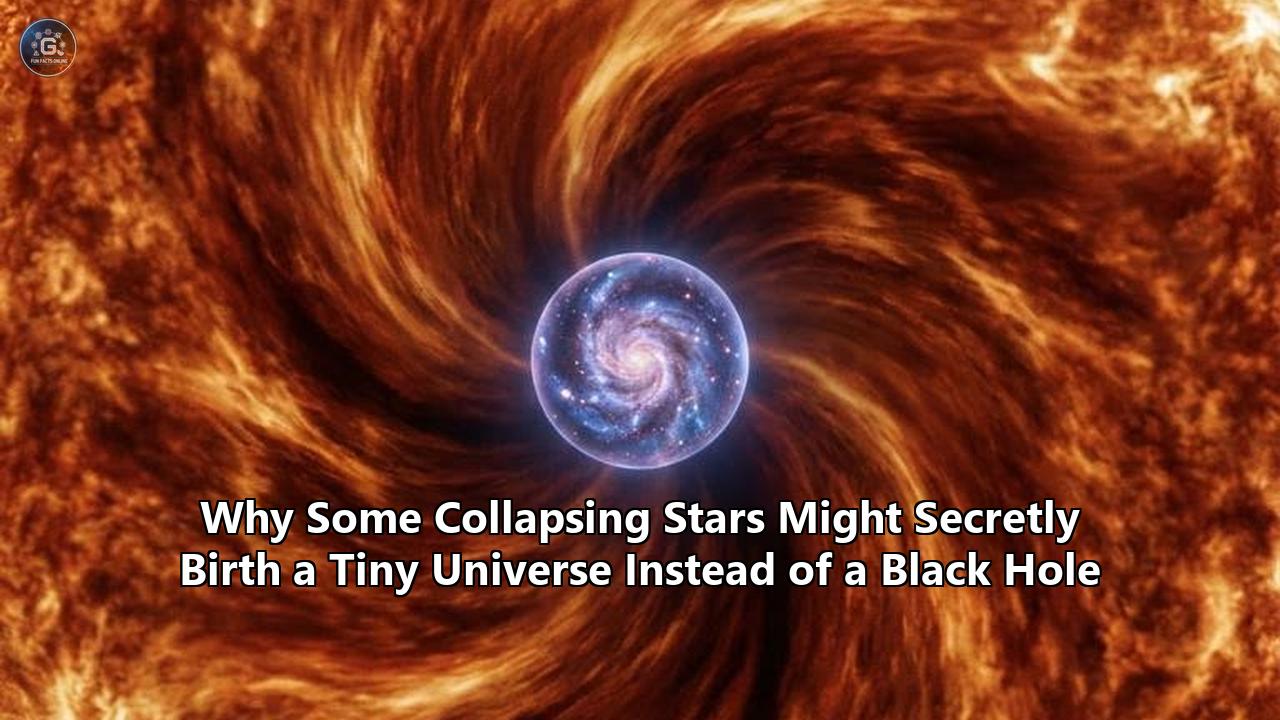
In a study published in Physical Review D, theoretical physicists Daniel Jampolski and Professor Luciano Rezzolla have presented a mathematical alternative. Using classical general relativity, they demonstrated that under precise conditions, a collapsing star does not have to end in a singularity. Instead, the sheer violence of the collapse can trigger a second Big Bang deep within the dying star's core, birthing a tiny, expanding miniature universe driven by dark energy.
This internal expansion pushes back against the collapsing matter, permanently halting the formation of a black hole and freezing the system into a stable, ultra-compact object known as a "gravastar".
"The Big Bang of the emerging universe can unfold once the star has already collapsed almost to the point of becoming a black hole," Daniel Jampolski explained, tracing the mathematical steps of his discovery. "At that extreme stage, when matter is compressed to an extraordinary degree, we enter a realm where entirely new physical effects can occur".
This is not a wild science-fiction speculation; it is a rigorous, dynamical solution to Einstein's field equations. For the first time, physicists have mapped out a concrete, step-by-step pathway showing how a common cosmic event—the death of a giant star—could secretly be a mechanism for cosmic reproduction.
The Mathematics of the Unthinkable: Why Singularities Break Physics
To understand why the Jampolski-Rezzolla solution is causing such a stir, one must first understand the deep, long-standing discomfort that physicists have with classic black holes.
When Karl Schwarzschild first solved Einstein’s equations in 1915—while serving on the Russian front during World War I—he revealed a disturbing mathematical truth. If you pack enough mass into a small enough space, gravity becomes so strong that spacetime curves infinitely.
For decades, this was treated as a mathematical quirk rather than a physical reality. But by the late 20th century, observational astronomy had confirmed that the cosmos is teeming with objects that behave exactly like Schwarzschild’s black holes. Today, we have mapped their gravitational waves and even photographed their dark silhouettes against glowing accretion disks.
Yet, the core of these objects remains an intellectual emergency.
"Singularities are basically where the laws of physics throw up their hands and say, 'We don't know what happens here,'" says Dr. Emil Mottola, a retired theoretical physicist from Los Alamos National Laboratory, who was not involved in the Frankfurt study but has spent decades researching black hole alternatives. "In classical physics, an infinity is a warning sign. It means your theory has been pushed past its limits. Spacetime cannot be infinitely curved, and billions of solar masses cannot reside in a mathematical point of zero volume".
Beyond the singularity lies the infamous Black Hole Information Paradox. In quantum mechanics, information can never be destroyed. But if a black hole possesses a true event horizon—a absolute point of no return—and eventually evaporates via Hawking radiation, all the detailed quantum information of the matter that fell into it is seemingly wiped from the universe forever. This creates a fundamental conflict between general relativity and quantum mechanics, the two pillars of modern physics.
For years, the search has been on for "regular" black holes or horizonless alternatives that mimic the external appearance of a black hole but lack its physics-destroying interior.
In 2001, Mottola and his colleague Pawel Mazur proposed a radical candidate: the Gravitational Vacuum Condensate Star, or "gravastar".
Instead of a singularity, Mazur and Mottola envisioned an object with a three-layer structure:
- An Interior: A region of pure vacuum energy (or de Sitter space), which exerts a negative pressure, pushing outward like dark energy.
- A Shell: An ultra-thin, ultra-dense layer of ordinary, highly compressed matter that acts as a physical boundary.
- An Exterior: The empty vacuum of space (Schwarzschild spacetime), making it look identical to a black hole from a distance.
The gravastar was an elegant concept. It resolved the information paradox because it had no event horizon and no singularity. It was stable. But it had a massive, seemingly insurmountable flaw.
For 25 years, nobody could explain how a gravastar could actually form in the real universe. It was a static, mathematical model—a picture of an object that was already complete. Theoretical physicists could write down the equations for a stable gravastar, but they could not show the dynamic transition. How does a cloud of ordinary gas, collapsing under its own weight, suddenly stop its inward fall and rewrite its interior into a bubble of expanding dark energy?
Without a dynamical pathway, gravastars remained a theoretical curiosity—a clever "what if" relegated to the sidelines of astrophysics.
Shattering the 25-Year Deadlock: How Gravastars Actually Form
This is where Jampolski and Rezzolla’s June 2026 paper changes the conversation. Working at Goethe University, the pair set out to see if they could construct a dynamic model of a collapsing star that naturally transitions into a gravastar using nothing but the classical equations of general relativity—no exotic, unproven quantum gravity modifications required.
"We wanted to see if we could bridge the gap," says Professor Luciano Rezzolla. "Could we start with the most standard, widely accepted model of stellar collapse and find a natural fork in the road that leads to a gravastar instead of a black hole?"
They began with the Oppenheimer-Snyder collapse, a classic model formulated in 1939 by J. Robert Oppenheimer and Hartland Snyder. This model describes a uniform, pressureless sphere of dust collapsing under its own gravity. In the classical version of this scenario, the dust falls continuously until it shrinks past its own Schwarzschild radius, forming an event horizon and eventually crashing into a central singularity.
Classic Oppenheimer-Snyder Collapse:
[Collapsing Dust Sphere] ---> [Event Horizon Forms] ---> [Singularity (Math Breaks Down)]

Jampolski-Rezzolla Dynamic Solution:
[Collapsing Dust Sphere] ---> [de Sitter Bubble Nucleates] ---> [Expanding Mini-Universe Meets Collapsing Shell] ---> [Stable Gravastar]
Jampolski and Rezzolla introduced a crucial modification. They allowed for the possibility that as the dust density reaches extreme, near-Planckian values at the very center of the collapsing sphere, a phase transition occurs. This phase transition nucleates a tiny bubble of de Sitter space—a region of positive vacuum energy, identical in properties to the dark energy driving the expansion of our own universe.
Crucially, they did not just assume this bubble existed; they calculated how it would behave when surrounded by a massive, falling shell of stellar matter.
The math yielded a startling result. The newly formed de Sitter bubble behaves like a miniature, rapidly expanding universe. Driven by its internal dark energy, it begins to blow outward, pushing back against the inward-crushing weight of the star's collapsing outer layers.
As the mini-universe expands, its outward pressure eventually matches the inward gravitational pull of the falling dust. The two forces enter a state of perfect, permanent equilibrium. The collapsing matter is halted, forming a stable shell that wraps around the expanding bubble of dark energy.
Spacetime is not torn apart into a singularity. The event horizon never has the chance to snap shut. Instead, the star has rewritten its internal architecture, transitioning into a stable gravastar.
The Anatomy of a Cryptic Cosmos: Inside the Dynamic Solution
The mathematics of this new dynamic solution are surprisingly elegant, relying on a three-part division of spacetime. To map the birth of this internal universe, Jampolski and Rezzolla utilized three distinct mathematical coordinate systems, matching them smoothly at their respective boundaries:
- Region I (The Interior): This is defined by a Friedmann-Lemaître-Robertson-Walker (FLRW) metric with positive curvature, describing a de Sitter space. It is, for all intents and purposes, a baby universe. It is expanding, filled with a uniform energy density that behaves like a cosmological constant.
- Region II (The Intermediary Shell): This is modeled as a contracting FLRW dust solution. This is the actual substance of the dying star, falling inward.
- Region III (The Exterior): This is a classic, static Schwarzschild vacuum. To any observer in the outside universe, this region is dominated by an immense gravitational pull, mimicking the gravitational signature of a standard black hole.
The magic of the Jampolski-Rezzolla paper lies in how these three regions interact dynamically.
When the de Sitter bubble first nucleates at the center of the collapsing star, it has an initial radius of zero. But because it is filled with negative pressure (the defining characteristic of dark energy), it immediately begins to inflate.
Normally, an expanding bubble of spacetime would simply swallow everything or blow itself apart. But here, the bubble is trapped inside a collapsing star of massive proportions. The inward-falling dust of Region II acts as a giant, gravitational corset.
As the de Sitter bubble expands, it pushes the boundary of Region II outward. But as that boundary approaches the Schwarzschild radius of the system, a relativistic phenomenon occurs: the expansion of the de Sitter bubble naturally begins to slow down.
At the exact same time, the falling dust of the outer star is decelerated by the mounting outward pressure. The two boundaries meet and "freeze" into a static state, forming an ultra-thin, stable shell of matter.
This process represents a profound shift in how we think about stellar death. In the physics of collapsing stars, universe formation is no longer a detached metaphysical concept; it is a mechanical stabilizer, a safety valve that nature uses to prevent the destruction of spacetime itself.
The Speed Limit of Creation: Why the 3/8 Compactness Bound Rules Spacetime
However, Jampolski and Rezzolla’s paper comes with a major, fascinating catch. A collapsing star cannot simply choose this "exit route" under any and all circumstances. The mathematics dictate a strict, unforgiving boundary condition.
Through their calculations, the Frankfurt physicists discovered that a gravastar can only form if the star’s initial compactness ($\mathcal{C}$) remains below a very sharp mathematical threshold:
$$\mathcal{C} \leq \frac{3}{8} \quad (\text{or } 0.375)$$
In general relativity, compactness is a dimensionless measure of how much mass ($M$) is packed into a given radius ($R$), expressed as $\mathcal{C} = M/R$ (using geometric units where the speed of light and the gravitational constant are set to 1). For reference, a black hole has a compactness of $0.5$ at its event horizon.
If a collapsing star’s initial compactness is greater than $3/8$ before the de Sitter bubble has a chance to nucleate, the collapse to a black hole is mathematically inevitable.
Stellar Compactness Spectrum:
[Low Compactness: Normal Stars] ---> [C = 3/8: The Gravastar Threshold] ---> [C = 0.5: Black Hole Horizon]
                                    |                                    |
                                    +--- Safe Zone for Baby Universes ---+--- Inevitable Black Hole Collapse --->
The reason for this limit is rooted in one of the most fundamental laws of the universe: causality.
Because no physical signal can travel faster than the speed of light, the expansion of the internal de Sitter bubble has a cosmic speed limit. If the star is already too compact when the collapse begins, the inward fall of the outer stellar matter is simply too fast and too violent. The de Sitter bubble does not have enough "causal time" to expand and meet the falling dust shell before an event horizon snaps shut around the entire system.
"It is a beautiful demonstration of general relativity's self-consistency," says Dr. Mottola. "If you try to compress the star too quickly, the system is causally overwhelmed. The de Sitter bubble is trapped, it cannot communicate its outward pressure to the outer layers in time, and the whole thing plunges into a classical black hole. But if the collapse is gradual enough, the system has time to causally reorganize itself into a stable gravastar."
This means that Jampolski and Rezzolla have not "disproven" black holes. Instead, they have revealed a fork in the road of cosmic evolution. Some collapsing stars will cross the $3/8$ threshold and inevitably become classic black holes with singularities. Others, staying below the limit, will take the alternative route, dodging the singularity and birthing a mini-universe within.
The Clash of the Unseen: Gravastars vs. Planck Stars and Fuzzballs
The Frankfurt study is the latest salvo in a long-running, friendly war among theoretical physicists over how to resolve the singularity crisis. Several rival camps have proposed their own "singularity-dodging" mechanisms, each reflecting a different philosophy of fundamental physics.
The Loop Quantum Gravity Camp: Planck Stars
Led by pioneer Carlo Rovelli and Francesca Vidotto, proponents of Loop Quantum Gravity (LQG) suggest that space and time are not continuous fabrics, but are instead woven out of tiny, discrete, indivisible loops of Planckian scale ($10^{-35}$ meters).
In LQG, when a star collapses, its density cannot become infinite. When the core reaches the "Planck density" (about $10^{96}$ kilograms per cubic meter), a quantum gravitational pressure arises from Heisenberg's uncertainty principle. This repulsive force acts like a compressed spring.
Instead of forming a singularity, the collapsing star reaches a minimum size—forming what is called a Planck Star—and then undergoes a "quantum bounce," slowly exploding outward.
However, because of the extreme gravitational time dilation near the core, this bounce, which takes only milliseconds in local proper time, takes billions of years to unfold from the perspective of an external observer. To us, they look like stable black holes; in reality, they are slow-motion explosions.
The String Theory Camp: Fuzzballs
In string theory, elementary particles are not zero-dimensional points, but tiny, vibrating one-dimensional strings. Samir Mathur of Ohio State University proposed that when a star collapses, the individual strings of the matter do not crush into a singularity. Instead, they tangle together, creating a massive, macroscopic ball of fundamental strings—a Fuzzball.
A fuzzball has no empty space inside, no singularity, and no true event horizon. The "horizon" is simply the physical surface of this highly complex, stringy state.
The Classical Elegance of the Gravastar
When compared to Planck stars and fuzzballs, Jampolski and Rezzolla's dynamic gravastar solution possesses a unique and powerful advantage: it does not require a brand-new, unverified theory of quantum gravity.
"Loop quantum gravity and string theory are mathematically fascinating, but we still do not have a single shred of experimental evidence that they are correct," says Professor Rezzolla. "Our solution is built entirely within the framework of Albert Einstein's classical general relativity. We didn't have to invoke higher-derivative corrections or exotic quantum loop variables. We showed that classical gravity itself, when paired with a de Sitter phase transition, is perfectly capable of saving spacetime from its own self-destruction".
This simplicity is what makes the Frankfurt solution so compelling—and so provocative. It suggests that the universe may have a built-in mechanism to prevent singularities without needing to rewrite the very nature of space and time.
Deciphering the Cosmic Ringdown: How to Hunt a Gravastar
Of course, a beautiful mathematical model is only as good as its observational proof. If a gravastar looks almost identical to a black hole from the outside, how can astronomers possibly tell them apart?
The answer lies in the subtle differences in how these two objects handle disturbances.
When two black holes merge, they form a single, highly distorted, peanut-shaped black hole. This newly formed object vibrates violently, emitting gravitational waves as it settles into a perfect, quiet sphere. This process is known as the ringdown—very similar to how a struck bell vibrates, emitting sound waves that slowly decay in intensity.
Because a classical black hole has an event horizon—a perfect one-way boundary—any gravitational waves traveling inward are swallowed forever. The ringdown signal is clean, simple, and decays exponentially.
But a gravastar has a physical, ultra-dense shell of matter instead of an event horizon.
"This is the key to detecting them," explains Dr. Laura Cadonati, a gravitational-wave astrophysicist at Georgia Tech, who was not involved in the study. "If you strike a solid object, the sound waves can reflect off the interior boundaries. In a gravastar, some of the gravitational waves generated during a merger will pass through the outer shell, travel through the internal de Sitter baby universe, reflect off the opposite side, and escape back into the cosmos."
This would produce what physicists call gravitational wave echoes.
Black Hole Ringdown:
[Initial Merger Signal] ---> [Rapid, Clean Decay to Silence]

Gravastar Ringdown with Echoes:
[Initial Merger Signal] ---> [Faint Echo 1] ---> [Faint Echo 2] ---> [Faint Echo 3]
An observer on Earth, analyzing the data from a gravitational wave observatory, would see the primary ringdown signal, followed by a series of smaller, delayed, periodic "echoes" as the waves bounce back and forth inside the gravastar.
Currently, our ground-based detectors—like LIGO in the United States, Virgo in Italy, and KAGRA in Japan—are just beginning to reach the sensitivity required to look for these incredibly faint echoes. But the next generation of gravitational wave observatories will be game-changers:
- LISA (Laser Interferometer Space Antenna): A space-based gravitational wave detector scheduled for launch in the mid-2030s. Operating in the quiet vacuum of space, LISA will detect the mergers of supermassive objects with unprecedented precision, making it the premier tool for hunting gravastar echoes.
- The Einstein Telescope & Cosmic Explorer: Planned next-generation ground-based detectors that will be ten times more sensitive than current facilities, allowing us to peer deep into the ringdown phase of stellar-mass mergers.
If these future instruments detect even a single delayed echo following a merger, it would immediately disprove the existence of classical black holes for that object, confirming that instead of a bottomless pit, we are looking at an object containing a hidden, expanding cosmos.
The Russian Doll Universe: Are We the Offspring of a Dying Star?
If Jampolski and Rezzolla’s dynamic model is correct, the cosmological implications are dizzying.
If every collapsing star that stays below the $3/8$ compactness limit births a miniature, expanding de Sitter universe inside itself, it raises an inevitable, self-reflective question: Could our own universe be the interior of a gravastar?
This idea, known as Black Hole Cosmology (or the "Fecund Universes" hypothesis), was first proposed in detail by theoretical physicist Lee Smolin in the 1990s as a theory of Cosmological Natural Selection.
Smolin suggested that if collapsing stars can trigger the birth of new universes, then universes would undergo a form of evolutionary reproduction. A universe that has physical constants optimized for producing massive stars (which require carbon, oxygen, and stable gravity) will produce more black holes—or gravastars—and therefore produce more "offspring" universes. These baby universes would inherit the physical laws and constants of their parents, perhaps with minor quantum mutations.
Over vast stretches of the multiverse, the dominant universes would be those that are highly efficient at making stars. And because star formation requires the exact same chemistry and physical constants that allow for the emergence of life, our own existence would not be a freak, highly tuned coincidence. Instead, it would be a natural byproduct of a multiverse optimized for cosmic reproduction.
Jampolski and Rezzolla’s work provides, for the very first time, a concrete, mathematically sound mechanism for this exact process.
"It is a very appealing philosophical picture," says Jampolski. "Our own universe is expanding, and that expansion is driven by a mysterious dark energy that we do not fully understand. Our model shows that the interior of a gravastar is also an expanding space driven by dark energy. It is entirely possible that our Big Bang was simply the interior phase transition of a collapsing star in some higher-dimensional parent universe".
In this "Russian doll" cosmology, the universe is not a singular, finite event that started from nothing. It is part of an infinite, branching family tree of worlds, nesting inside one another, with stellar death serving as the ultimate engine of birth.
The Horizon of a New Physics
The publication of Jampolski and Rezzolla's paper in Physical Review D is not the end of the journey; it is the beginning of a highly anticipated debate that will shape the next decade of theoretical physics.
The model, while mathematically complete, is still simplified. It describes a non-rotating, spherically symmetric star. But real stars in the universe rotate, often at breakneck speeds.
How does rotation affect this process? Will the centrifugal forces of a spinning star disrupt the delicate causal balance needed to nucleate the de Sitter bubble, or will they make it easier?
Rezzolla’s team in Frankfurt is already working on expanding their equations to account for rotation—mapping the transition of spinning stars into Kerr-like gravastars.
"Looking for alternatives to black holes should not suggest a skepticism towards black holes, which still represent the most natural and simplest solution to the fate of gravitational collapse," Rezzolla noted, maintaining the careful, self-critical stance of a seasoned researcher. "However, as theoretical physicists, it is essential to maintain an unbiased approach towards what we do not know, and hence explore both the accepted wisdom and the more exotic interpretations. History teaches us that it is not unusual for the latter to become the former".
The mathematical door has been opened. Whether we look out into the night sky and see cold, dead gravity graves, or vibrant, hidden nurseries of new worlds, the next era of observational astronomy is poised to give us our answer. And in doing so, it may just reveal that our own existence is part of a grand, endless cycle of stellar rebirth.
Summary of Key Structural Differences
| Feature | Classical Black Hole | LQG Planck Star | Jampolski-Rezzolla Gravastar |
|---|---|---|---|
| Core Structure | Singularity (Infinite Density) | Planck-density "core" that bounces | Expanding de Sitter mini-universe |
| Event Horizon | Yes (Absolute boundary) | Apparent horizon (temporary) | No (Replaced by physical matter shell) |
| Required Physics | Standard General Relativity | Loop Quantum Gravity (unproven) | Classical General Relativity |
| Observational Signature | Clean gravitational wave ringdown | Delayed explosion/emission | Gravitational wave echoes |
Reference:
- https://www.sciencedaily.com/releases/2026/06/260614011846.htm
- https://www.eurekalert.org/news-releases/1131800
- https://scienceblog.com/a-big-bang-inside-a-dying-star-could-stop-black-holes-from-ever-forming/
- https://www.thenews.com.pk/latest/1405944-scientists-reveal-dying-star-could-create-whole-new-universe
- https://universemagazine.com/en/black-hole-paradox-a-mini-universe-with-a-big-bang-may-exist-inside-stars/
- https://www.researchgate.net/publication/406961324_Formation_of_gravastars
- https://quantumzeitgeist.com/gravastar-dark-energy-filled-counters/
- https://www.thebrighterside.news/post/collapsing-stars-could-form-gravastars-instead-of-black-holes/
- https://www.space.com/astronomy/black-holes/strange-spacetime-crystals-could-give-birth-to-tiny-black-holes
- https://www.skyatnightmagazine.com/news/gravastar-mini-universe
- https://medium.com/@varshithadiris/gravastars-and-the-cosmological-paradox-are-we-living-inside-a-stillborn-universe-9095c491468c
- https://en.wikipedia.org/wiki/Planck_star
- https://arxiv.org/html/2509.15302v2
- https://www.researchgate.net/figure/Limit-on-the-compactness-of-the-gravastar-with-the-thickness-of-the-shell-d-This_fig1_1893888
- https://arxiv.org/pdf/2509.15302
- https://cienciaxxi.es/blog/miniversos-estrellas-moribundas-gravastars/
- https://www.researchgate.net/publication/378239684_Nested_solutions_of_gravitational_condensate_stars
- https://arxiv.org/abs/2509.15302
- https://arxiv.org/html/2407.09584v2
- https://physics.stackexchange.com/questions/173392/black-hole-singularity-in-loop-quantum-gravity
- https://www.quora.com/What-exactly-is-a-Planck-star-and-why-does-it-bounce-back-from-a-black-hole-after-gravitational-collapse
- https://www.skyatnightmagazine.com/news/gravastar-mini-universe
- https://www.mdpi.com/2218-1997/4/9/92