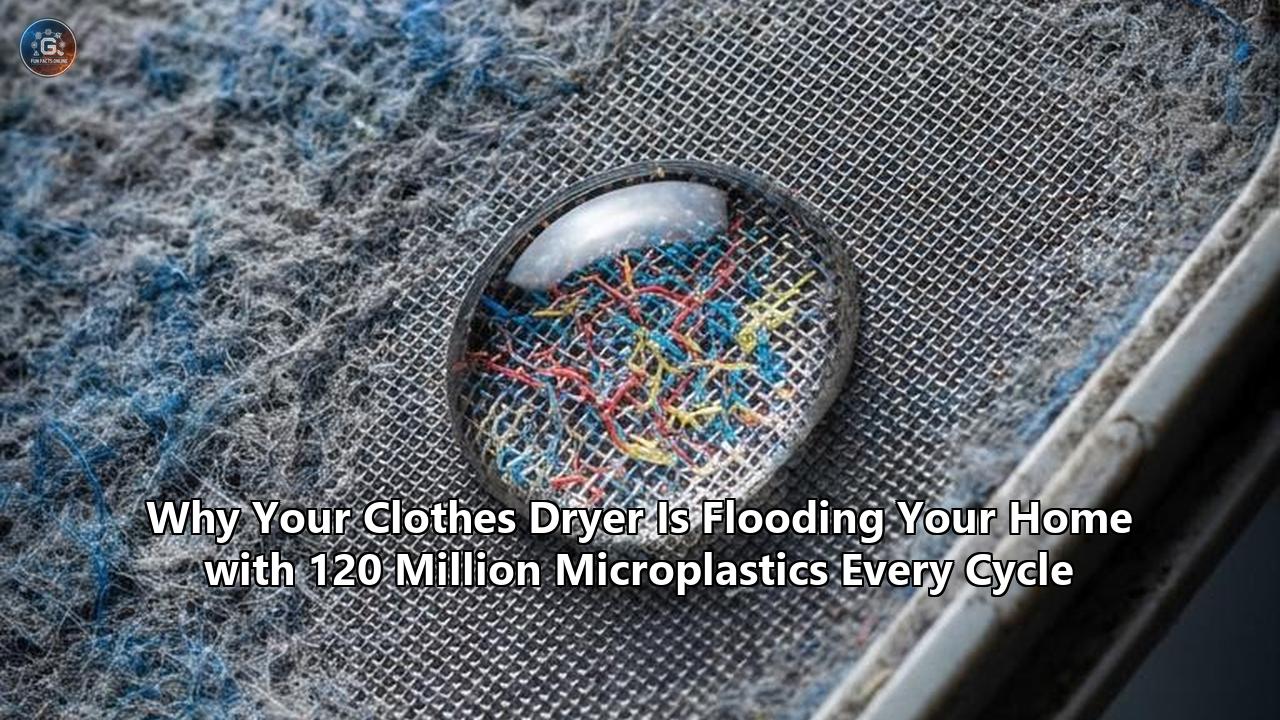
In late November 2025, a team of environmental toxicologists and microplastic researchers published a pair of companion studies that completely upended our understanding of domestic air pollution. For over a decade, the global campaign against synthetic fiber pollution had targeted wastewater. Eco-conscious consumers bought specialized laundry bags, installed under-sink water filters, and pressured appliance companies to redesign washing machines. But as the researchers from the 5 Gyres Institute and Ocean Wise revealed, a massive, highly pressurized atmospheric cannon sitting in laundry rooms had been completely ignored: the clothes dryer.
According to their landmark papers, a single domestic tumble dryer can spew between 90 million and 120 million microscopic plastic shards into the air every single year. When scaled up, a single commercial laundromat can release up to 7.2 trillion microfibers annually. This translates to a staggering 1.1 quadrillion plastic microfibers blanketed across a single major city like San Francisco each year.
These fibers do not just float harmlessly into the upper atmosphere. They settle on living room rugs, contaminate kitchen counters, and are inhaled directly into human lungs. Microfibers are now the single most common type of microplastic found in human lung tissue, and recent autopsies have mapped their journey through the nasal passages directly into the olfactory bulb of the human brain.
This massive atmospheric pollution source escaped public scrutiny for years. Tracing the timeline of this discovery reveals a long-standing scientific blindspot, culminating in a modern public health crisis unfolding inside our very homes.
Phase 1 (2011–2019): The Great Washing Machine Blindspot
The story of laundry-related microplastics began in 2011 with a seminal study by ecologist Mark Browne. Browne sampled shorelines around the world and made an alarming discovery: synthetic fibers like polyester and acrylic made up the vast majority of plastic debris on beaches. He traced these fibers back to municipal sewage outflows, establishing a direct link between synthetic apparel and aquatic pollution. Browne proved that a single garment could shed thousands of fibers during a single wash cycle.
This discovery catalyzed a massive wave of research, but it was almost entirely aquatic. Because washing machines use water as a transport medium, scientists naturally followed the drainpipes. For nearly a decade, the academic and public consensus on laundry pollution was strictly waterborne.
Organizations, governments, and NGOs poured resources into studying wastewater treatment plants, trying to understand how many microfibers bypassed filtration systems to enter rivers, lakes, and oceans. The solutions developed during this era reflected this aquatic bias:
- Washing machine filters: Aftermarket devices like the Filtrol or the Cora Ball were designed to catch fibers in the wash tub or discharge line.
- Microfiber laundry bags: Products like the Guppyfriend bag aimed to trap fibers during the wet agitation phase of washing.
- Wastewater upgrades: Municipalities invested in advanced membrane bioreactors to capture microplastics before they reached open waters.
Throughout this period, clothes dryers were completely ignored. They were viewed as dry, closed-loop systems that posed no threat to waterways. Scientists did not consider air as a primary vector of microfiber pollution, despite warnings from atmospheric researchers who had begun finding synthetic fibers in remote mountain lakes and Arctic snow. The "wet vs. dry" binary dominated scientific thinking, leaving a massive gap in environmental policy and appliance design.
Phase 2 (2020): Painting the Snow Pink
The first major turning point occurred in October 2020. Kirsten Miller and Rachael Z. Kapp of the University of Maine published a pioneering study in the journal PLOS ONE. They wanted to know where the fibers went when a clothes dryer vented to the outdoors. Rather than relying on complex atmospheric chambers, the researchers used a simple, brilliant natural proxy: freshly fallen snow.
[Dryer Vent Exhaust]
       │
       ├─► (0 to 5 Feet) ──► Heavy accumulation of bright pink fibers
       │
       ├─► (5 to 30 Feet) ─► Dispersed airborne drift settling on snow
       │
       └─► (Beyond 30 Feet) ► Fine microfibers carried away by local winds
Miller and Kapp washed and dried bright pink polyester fleece blankets in household dryers, then sampled the pristine snow around the exterior dryer vents. The results were undeniable. Bright pink synthetic fibers were found in a 30-foot radius around the dryer exhaust, with the highest concentrations located within five feet of the vent.
This study proved that dryers were painting the outdoor environment with plastic. The researchers also noted that the standard lint traps built into household dryers were highly inefficient, letting masses of fiber escape directly through the exhaust pipe. Despite these findings, the study was widely regarded as a localized curiosity rather than a systematic global threat. The appliance industry remained quiet, and consumers continued to run their dryers without a second thought.
Phase 3 (2022): The Detached Vent and the 120-Million Milestone
The true awakening came in January 2022. Professor Kenneth Leung, Director of the State Key Laboratory of Marine Pollution at the City University of Hong Kong, experienced a personal domestic mishap. While he was out shopping, his home dryer’s flexible exhaust hose detached from the window, venting directly into his kitchen. He returned to find his kitchen coated in a fine, fuzzy layer of plastic dust.
Leung did not just clean up the mess; he took samples back to his laboratory. Along with PhD student Danyang Tao, Leung designed a controlled study to quantify what was coming out of that vent.
Published in Environmental Science & Technology Letters in January 2022, Leung’s study changed the conversation. The team dried polyester and cotton clothing in separate 15-minute cycles, measuring the airborne particles that exited the vent.
| Textile Material | Microfibers Released per 15-Min Cycle | Annual Estimated Release (per household) |
|---|---|---|
| Polyester (Synthetic) | ~561,810 fibers | 90 to 120 Million fibers |
| Cotton (Natural) | ~400,000 fibers | ~80 Million fibers |
The study revealed that dryers release up to 561,810 microfibers in just 15 minutes of use. For synthetic materials, this was 1.4 to 40 times higher than the emissions from washing machines for the same volume of clothing. Leung estimated that the average household dryer dumps between 90 million and 120 million microfibers into the air every single year.
The mechanical stress of tumble-drying is fundamentally different from washing. This difference is why the concentration of microplastics in dryer lint is incredibly high, yet standard mesh screens are unable to contain it. While washing machines use water as a lubricant to reduce friction, dryers rely on dry heat, high-speed tumbling, and intense mechanical friction. This combination causes synthetic yarns to disintegrate, sending a constant stream of microplastics directly into the dryer exhaust.
Phase 4 (2023–2024): The Chemistry of Shattering Polymers and the Invasion of the Brain
By 2023 and 2024, scientists began digging into the chemical physics of why synthetics behave this way in the dryer, and what it means for human health.
Why Cotton Clumps and Polyester Shatters
To understand why standard filters fail, it helps to look at the structural differences between natural and synthetic fibers under thermal stress:
- Cotton (Hydrophilic Cellulose): Cotton is a curly, irregular natural fiber. When exposed to moisture and heat, it swells and contracts. Because of their rough, twisted structure, cotton fibers naturally tangle and cling to one another. When they break, they form larger, heavier clumps of lint that are easily caught by the standard dryer screen.
- Polyester (Hydrophobic Thermoplastic): Polyester is made of polyethylene terephthalate (PET), a smooth, straight plastic extruded through spinnerets. It does not absorb water, meaning it remains dimensionally stable but dry and highly static during a dryer cycle. Without moisture to lubricate the fibers, they rub against each other at temperatures exceeding 60°C (140°F). Under this intense dry friction, the smooth plastic filaments repel each other due to static electricity, fracturing into razor-thin, microscopic fragments.
Instead of catching all fibers, the standard filter allows microplastics in dryer lint to slip directly through its millimeter-wide mesh.
Standard Lint Screen Mesh (~1.0 mm holes)
========================= [   ] =========================
   ▼         ▼         ▼         ▼         ▼         ▼
  ░░░       ░░░       ░░░       ░░░       ░░░       ░░░  <-- Cotton lint clumps (Trapped)
─────────────────────────────────────────────────────────
  │ │       │ │       │ │       │ │       │ │       │ │
  ▼         ▼         ▼         ▼         ▼         ▼    <-- Microscopic Polyester Shards (Escape)
The Discovery of PET Oligomer Clusters
In February 2024, a study from the Swiss Federal Laboratories for Materials Science and Technology (EMPA), led by Dr. Bernd Nowack, added a toxicological twist to this mechanical process. Nowack's team analyzed the submicron particles released from polyester textiles during laundering.
They discovered that up to 90% of the tiny particles released were not actually microplastics in the traditional sense, but clusters of PET oligomers. Oligomers are medium-sized polymer molecules consisting of relatively few repeating monomer units—effectively chemical precursors to fully formed plastics.
These oligomers are water-insoluble, highly mobile, and coated with chemical finishes, including:
- Antimony catalysts: Heavy metals used in polyester manufacturing.
- Endocrine-disrupting phthalates: Used to make synthetic fibers more flexible.
- Fluorinated "forever chemicals" (PFAS): Applied to garments for water and stain repellency.
- Synthetic dyes and flame retardants: Added during textile manufacturing to meet safety and aesthetic standards.
The Biological Pathway to the Human Brain
As these microscopic shards and chemical-heavy oligomers escape dryers, they become a major indoor air hazard. In September 2024, a team led by Dr. Luís Fernando Amato-Lourenço of the Free University of Berlin published a study in JAMA Network Open that shocked the medical community.
The researchers performed autopsies on 15 deceased individuals in São Paulo, Brazil, who had been long-term residents of the city. They analyzed the olfactory bulbs—the region of the brain located directly above the nasal cavity that processes smells.
               [Inhaled Airborne Microplastics]
                             │
                             ▼
                       [Nasal Cavity]
                             │
                             ▼
                    [Cribriform Plate]
                             │
                             ▼
                    [Olfactory Bulb] ──► Direct entry to Brain Tissue
The team found microplastics in the olfactory bulbs of 8 out of the 15 brains. The identified polymers included polypropylene, nylon, and polyester. Because the olfactory pathway bypasses the blood-brain barrier, it serves as a direct highway for inhaled airborne microplastics to enter the central nervous system.
Then, in February 2025, a study in Nature Medicine confirmed that the concentration of microplastics in human brain tissue rose by nearly 50% between 2016 and 2024. The study also revealed that patients diagnosed with progressive dementia had three to five times more microplastics in their brains than age-matched controls with healthy brains.
The primary source of these inhaled synthetic fibers is the indoor dust we breathe daily, fueled by clothes dryers that vent indoors or leak air through their back panels.
Phase 5 (Late 2025–2026): The Escalation to 'Plastic Smog' and the Simple Filter Solution
By late 2025, the scientific community had established that household and commercial dryers were major contributors to airborne microfiber pollution. The narrative shifted from defining the problem to measuring its scale and finding solutions.
The Laundromat Study: Trillions of Fibers
In November 2025, researchers at the 5 Gyres Institute published a study in Environmental Research Communications focusing on commercial laundromats in San Francisco. Led by Dr. Lisa Erdle, researchers placed sticky tape samplers upwind and downwind of ten commercial laundromats and analyzed the lint in their large-capacity dryer exhausts.
                     [Commercial Laundromat]
                        (No filtration)
                               │
               ┌───────────────┴───────────────┐
               ▼                               ▼
       [Single Laundromat]            [City-Wide Scale]
   7.2 Trillion microfibers/year    1.1 Quadrillion microfibers/year
The scale of the emissions was unprecedented. A single laundromat can release up to 7.2 trillion microfibers into the air every year. Dr. Erdle termed this phenomenon "plastic smog," an invisible, airborne layer of synthetic particulate matter that settles over urban environments.
While most of the fibers collected were cellulose, chemical fingerprinting confirmed that the most common plastic microfibers in the samples were polyester, polyurethane, and acrylic—the exact synthetic polymers that dominate modern fast fashion.
Vetting the Solution: Secondary Filtration
At the same time, a companion study published in Environmental Toxicology and Chemistry by Dr. Victoria Fulfer, in collaboration with Ocean Wise, offered a solution. The researchers tested three commercially available secondary dryer filtration systems in a controlled laboratory setting.
                                [Dryer Drum]
                                     │
                             [Built-In Lint Trap]
                                     │
                             (Escaping Fibers)
                                     │
                         [Secondary Dryer Filter]
                                     │
               ┌─────────────────────┴─────────────────────┐
               ▼                                           ▼
       [Duct Filter]                              [Indoor Filter]
   Captures ~44% of count             Captures 70% to 81% of count
These aftermarket filters, which cost between $23 and $60, were installed inline on the dryer vent duct or at the indoor exhaust point. The findings were highly encouraging:
- The Duct Filter: Captured an average of 44% of escaping microfibers by count.
- Indoor Filter 1: Captured 81% of escaping microfibers by count.
- Indoor Filter 2: Captured 70% of escaping microfibers by count.
Installing an aftermarket filter effectively collects microplastics in dryer lint at the source, preventing them from entering the home's air or venting outside. Dr. Fulfer’s study estimated that if every household in Canada used the most effective filter, it would prevent up to 96 million microfibers per home from escaping into the environment annually. Globally, this simple intervention could capture over 570 trillion plastic fragments every year.
Looking Ahead: Legislative Pressure and the Future of Appliances
The rapid escalation of this research has sparked a policy fight. While early legislative efforts focused on washing machines, the data on clothes dryers has forced policymakers to broaden their scope.
The Policy Battleground
In 2025, Senator Jeff Merkley of Oregon and Representative Mike Levin of California championed federal efforts to curb plastic microfiber pollution from laundry. Bills like the Microplastics Safety Act aim to fund research into the health risks of microplastics and mandate that appliance manufacturers integrate high-efficiency filtration systems directly into new washers and dryers.
At the state level, California has taken the lead. The state is considering legislation that would ban toxic plastic microbeads in household cleaning products and set strict emission standards for residential and commercial clothes dryers.
However, the appliance industry has pushed back. Manufacturers argue that integrating fine-mesh secondary filters directly into dryers could restrict airflow, creating a severe fire hazard if consumers fail to clean them regularly.
       [High Friction + Heat] ──────► Sheds synthetic fibers
                 │
                 ▼
       [Inadequate Lint Trap] ─────► Standard screen lets particles escape
                 │
                 ▼
       [Inhalation/Ingestion] ────► Microplastics found in human lungs & brain
The Transition to Closed-Loop Heat Pump Dryers
The long-term solution to the dryer pollution crisis may lie in a fundamental redesign of drying technology: the heat pump dryer.
Traditional vented dryers draw cool air from the room, heat it, tumble it through the clothes, and vent the hot, moisture-laden air outside. This open-loop design is highly inefficient and drives the outward transport of microplastics.
In contrast, heat pump dryers operate on a closed-loop system. They recycle the same air continuously, heating it to dry the clothes, then cooling it to condense and drain away the moisture. Because they do not vent air to the outdoors, they naturally prevent the release of airborne microplastics into the wider environment.
However, they still require internal filtration to protect their delicate heat exchangers from buildup. The accumulation of microplastics in dryer lint remains a challenge in these systems, requiring high-efficiency internal filters that consumers must clean safely without releasing fibers back into the indoor air.
Actionable Steps for Consumers
While the appliance and textile industries work to develop long-term solutions, consumers can take several practical steps to reduce microfiber emissions from their laundry:
- Install a Secondary Filter: Adding an aftermarket indoor or duct filter to your dryer can capture up to 81% of escaping microfibers. These filters are inexpensive and easy to install.
- Dispose of Lint Safely: How we handle microplastics in dryer lint plays a key role in where they end up. Peeling lint off the dryer screen releases an invisible cloud of microfibers into the air. To minimize exposure, clean the lint screen with a damp paper towel and place the lint directly into a sealed bag before throwing it in the trash.
- Wash and Dry Less Often: Spot-clean garments when possible, and only run full loads. Full loads reduce friction between clothes, which significantly cuts down on fiber shedding.
- Choose Cold Water and Short Cycles: Washing clothes in cold water on shorter cycles reduces fiber damage before they even reach the dryer.
- Switch to Heat Pump Dryers: If you are shopping for a new dryer, consider a heat-pump model. They are highly energy-efficient and operate on a closed loop, eliminating outdoor emissions.
As more research links airborne microplastics to human health concerns, clothes dryers are emerging as a major contributor to indoor air pollution. Transitioning from unregulated venting to efficient filtration is a necessary step toward cleaner air and healthier homes.
Key Studies Cited
- Browne, M. A., et al. (2011). "Accumulation of Microplastic on Shorelines Woldwide: Sources and Sinks." Environmental Science & Technology.
- Miller, K., & Kapp, R. Z. (2020). "Electric clothes dryers: An underestimated source of microfiber pollution." PLOS ONE.
- Tao, D., & Leung, K. M. (2022). "Microfibers Released from Clothes Dryers: A Major Source of Airborne Microplastics." Environmental Science & Technology Letters.
- Amato-Lourenço, L. F., et al. (2024). "Microplastics in the Olfactory Bulb of the Human Brain." JAMA Network Open.
- Nowack, B., et al. (2024). "Characterization of submicrometre particles released during washing of polyester textiles." Nature Water.
- Erdle, L. M., et al. (2025). "Commercial clothes dryers: a source of microfiber emissions to air." Environmental Research Communications.
- Fulfer, V. M., et al. (2025). "Airborne microfiber capture: secondary filtration a solution to filter microfiber emissions from clothing dryers." Environmental Toxicology and Chemistry.
Reference:
- https://www.anthropocenemagazine.org/2025/12/what-escapes-the-lint-trap-dryers-emerge-as-overlooked-microfiber-polluters-with-a-simple-fix/
- https://ocean.org/blog/dryer-filter-research/
- https://static1.squarespace.com/static/6537fd1a80e60f606d49aaff/t/690a5a18576fee59cd07aff8/1762286104634/Plastic+Air+I+Press+Release.pdf
- https://ocean.org/blog/dryer-filter-research/
- https://www.smithsonianmag.com/smart-news/scientists-find-microplastics-in-human-brain-tissue-above-the-nose-180985100/
- https://journals.plos.org/plosone/article?id=10.1371/journal.pone.0239165
- https://pmc.ncbi.nlm.nih.gov/articles/PMC7540867/
- https://www.theguardian.com/environment/2022/jan/12/tumble-dryers-leading-source-microfibre-air-pollution-hong-kong-plastics
- https://croucher.org.hk/en/news/understanding-the-impact-of-microplastics
- https://www.cityu.edu.hk/research/stories/2022/04/08/cityus-research-found-clothes-dryers-are-overlooked-source-airborne-microfibers
- https://www.snexplores.org/article/clothes-dryers-may-be-major-source-airborne-microplastics
- https://pmc.ncbi.nlm.nih.gov/articles/PMC10421144/
- https://www.researchgate.net/figure/Drying-procedures-with-different-fabric-types_tbl1_338539418
- https://szoneierfabrics.com/cotton-or-polyester-which-one-shrinks-less-in-commercial-laundry-cycles/
- https://eureka.patsnap.com/report-compare-polyester-fiber-and-cotton-for-moisture-wicking-efficiency
- https://www.technologynetworks.com/applied-sciences/news/washing-clothes-releases-more-than-just-microplastics-384150
- https://www.reddit.com/r/PlasticFreeLiving/comments/1pf1em1/laundry_is_the_1_source_of_microplastics_and_were/
- https://www.researchgate.net/publication/378067079_Oligomers_are_a_major_fraction_of_the_released_submicrometre_particles_during_washing_of_polyester_textiles
- https://www.reddit.com/r/PlasticFreeLiving/comments/1pf1em1/laundry_is_the_1_source_of_microplastics_and_were/
- https://www.ewg.org/news-insights/news/2025/12/does-your-laundry-shed-microplastics
- https://www.medpagetoday.com/neurology/generalneurology/111985
- https://www.auntminnie.com/clinical-news/molecular-imaging/article/15684323/microplastics-reach-the-olfactory-bulb-in-the-human-brain
- https://www.medicalnewstoday.com/articles/discover-microplastics-brain-olfactory-bulbs-first-time
- https://medium.com/@erofeev.yury/microplastics-found-in-olfactory-bulbs-of-the-brain-9ad4e5c8bf75
- https://www.news-medical.net/news/20240917/Microplastics-found-in-the-human-brain-via-the-olfactory-pathway.aspx
- https://www.anthropocenemagazine.org/2025/12/what-escapes-the-lint-trap-dryers-emerge-as-overlooked-microfiber-polluters-with-a-simple-fix/
- https://www.5gyres.org/science
- https://www.5gyres.org/microfibers
- https://pubmed.ncbi.nlm.nih.gov/41143535/
- https://www.5gyres.org/plasticair
- https://www.5gyres.org/microplasticfreeus
- https://www.5gyres.org/press