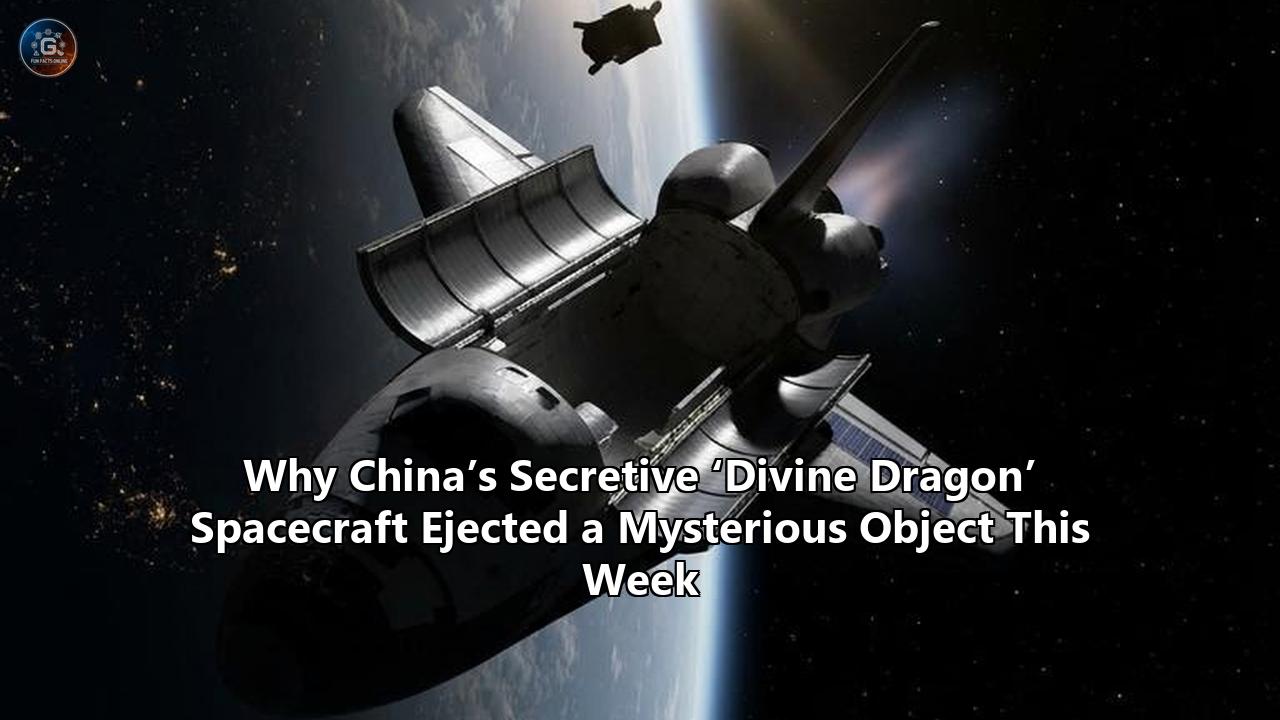
A quiet morning in the Southern Hemisphere recently turned into a focal point for global space intelligence agencies when a radar station in New Zealand flagged an unexpected anomaly. At 02:30 UTC on Monday, June 22, 2026, the Kiwi Space Radar—operated by the commercial space tracking firm LeoLabs—detected a brand-new, uncataloged object gliding through Low Earth Orbit (LEO).
The object had not been launched from any known pad on Earth. Instead, subsequent telemetry analysis revealed that it had been deployed directly from one of the most secretive military assets currently circling the globe: China’s experimental, reusable robotic spaceplane, known as Shenlong, or the "Divine Dragon".
"Following additional observations across our global network and analysis via LeoLabs Delta, we have independently cataloged this object and assessed with high confidence that it was released from the Chinese spaceplane," LeoLabs announced in a public statement. Within hours, the U.S. Space Force's tracking systems confirmed the detection, officially entering the mysterious payload into the military's orbital registry.
The China Divine Dragon spacecraft is currently on its fourth orbital mission, having launched on February 7, 2026, aboard a Long March 2F rocket from the remote Jiuquan Satellite Launch Center in the Gobi Desert. As with its three previous multi-month flights, Beijing has remained completely silent regarding the spacecraft’s flight path, its mechanical capabilities, or the payload nestled inside its cargo bay.
This latest orbital ejection is not an isolated event. It represents a highly deliberate, repetitive pattern of behavior that has left Western military strategists, astrophysicists, and commercial space-tracking firms scrambling to understand the technical and strategic objectives behind China’s clandestine space program.
To grasp why this deployment matters, it is necessary to unpack the sophisticated orbital mechanics of space ejections, the design of modern robotic spaceplanes, and the high-stakes chess game currently unfolding in the outer limits of Earth’s atmosphere.
Anatomy of the "Divine Dragon"
To understand what was ejected, one must first understand the vehicle that released it. In the realm of spaceflight, there is a fundamental structural difference between traditional capsule-based spacecraft and lifting-body spaceplanes.
Standard spacecraft, such as SpaceX’s Dragon or Russia's Soyuz, are blunt-body capsules. They launch vertically on rockets, descend through the atmosphere protected by a bottom-facing heat shield, and rely on parachutes to make rough landings in oceans or remote desert plains. They have virtually no aerodynamic maneuverability during their descent.
The China Divine Dragon spacecraft operates on a entirely different design philosophy. It is a winged, uncrewed lifting-body vehicle. It is launched vertically inside the protective fairing of a heavy-duty carrier rocket, but upon completing its mission, it deorbits, re-enters the atmosphere at hypersonic speeds, glides aerodynamically through supersonic and subsonic regimes, and lands horizontally on a conventional airport runway.
+-----------------------------------------------------------------+
|                    REUSABLE ORBITAL SPACEPLANE                  |
|                                                                 |
|   [Launch: Vertical] ---> [Orbit: Autonomous] ---> [Landing: Horizontal]
|      (On a Rocket)          (RPO & Deployments)       (On a Runway)     |
+-----------------------------------------------------------------+
Because China’s space agency, the CNSA, and the People’s Liberation Army (PLA) keep the physical vehicle under strict wraps, no official, high-resolution photographs of the operational spacecraft exist. However, a combination of academic papers, historical subscale drop tests, and ground-based astronomical photography allows experts to estimate its dimensions:
- Length: Approximately 8.5 to 10 meters (28 to 33 feet).
- Wingspan: Roughly 6 to 8 meters (20 to 26 feet).
- Weight: Estimated between 8 and 10 metric tons, aligning with the Low Earth Orbit payload capacity limits of its workhorse launcher, the Long March 2F.
- Power Source: Equipped with retractable solar arrays. In August 2024, during the vehicle's third mission, Austrian amateur astronomer Felix Schöfbänker captured telescope images of a bright appendage extending from the rear of the craft, which experts identified as a solar panel designed to harvest sunlight for long-duration operations.
By eliminating the heavy life-support systems, cockpit displays, and safety margins required for human crews, China has engineered a highly persistent robotic platform. The spacecraft is built for endurance, capable of spending hundreds of days in orbit executing pre-programmed maneuvers and receiving encrypted instructions from ground stations.
The Physics of an Orbital Ejection
In popular science fiction, when a spacecraft ejects an object, it is often depicted as dropping straight down toward Earth or drifting away like a stone thrown into water. In the actual physics of orbital mechanics, the reality is far more complex and counterintuitive.
The China Divine Dragon spacecraft operates in Low Earth Orbit at an altitude of approximately 600 kilometers (373 miles). At this altitude, the spaceplane is traveling at a speed of roughly 28,000 kilometers per hour (17,400 mph) to counteract Earth's gravitational pull. Every single object inside the vehicle's cargo bay shares this exact velocity vector.
When the spaceplane ejects an object, the mechanical force of the separation—whether pushed by a spring, a pneumatic piston, or a small explosive bolt—adds a tiny amount of relative velocity to the ejected object. This change in velocity is known in aerospace engineering as $\Delta v$ (delta-v).
                     [Ejection Direction (delta-v)]
                                 ^
                                 |
   [Spaceplane (28,000 km/h)] -------> [Ejected Object (28,000 km/h + delta-v)]
If the object is ejected forward (in the direction of travel), it gains energy. According to Keplerian orbital mechanics, this extra energy pushes the object into a higher, more elliptical orbit, causing it to actually slow down relative to the ground over the course of a full orbit.
Conversely, if the object is pushed backward, it loses energy, drops into a lower orbit, and speeds up relative to the ground.
If the object is ejected sideways or vertically, it enters a slightly tilted orbital plane that will periodically cross the spaceplane’s path twice per orbit.
Because of these delicate orbital dynamics, tracking companies like LeoLabs do not just look for visual movements; they use highly sensitive phased-array radars to detect minuscule, millimeter-per-second variations in orbital speed.
When the Kiwi Space Radar pinged the Shenlong spacecraft on June 22, it noticed a secondary radar return that was not there during previous passes. The object had a slightly different velocity vector, proving it had recently experienced a mechanical separation from the parent vehicle.
Three Theories Behind the Mystery Object
Since the deployment was confirmed, aerospace analysts and intelligence agencies have focused on three primary scientific and operational explanations for why the spaceplane released this uncataloged object.
Theory 1: Rendezvous and Proximity Operations (RPO)
The most widely supported explanation among orbital dynamics experts is that the ejected object is a companion "sub-satellite" designed to test Rendezvous and Proximity Operations (RPO).
RPOs refer to the deliberate maneuvers required to bring a spacecraft close to another orbital body, maintain a stable relative distance, and potentially make physical contact. This requires extraordinarily precise thruster firings, real-time relative navigation sensors (such as LiDAR and optical cameras), and complex guidance algorithms.
During Shenlong's previous three flights, ground-based radar networks watched the vehicle execute what can only be described as a celestial shadow dance:
- Deployment: The spaceplane would eject a small satellite.
- Drift: The spaceplane would back away, letting the relative distance grow to several kilometers.
- Formation Flying: The vehicle would adjust its orbit to fly alongside the sub-satellite, matching its speed and path perfectly.
- Re-approach: Shenlong would fire its thrusters to close the gap, moving back to within meters of the object.
- Docking/Capture: On at least two occasions during its second and third missions, analysts observed the spaceplane perform proximity operations that strongly indicated it successfully re-docked with or physically recaptured the object it had previously released.
Testing RPOs using an object the spaceplane brought with it is the safest way to refine these guidance systems. If a mistake is made during a docking attempt with an active, multi-billion-dollar operational satellite, a collision could create a catastrophic cloud of space debris.
By using a small, disposable dummy target, Chinese engineers can push the limits of their autonomous navigation software with zero external risk.
Theory 2: Exterior Inspection and Thermal Shield Monitoring
The second possibility is that the mystery object is an "inspector satellite".
When a reusable spaceplane prepares to return to Earth, it must survive the brutal heat of atmospheric re-entry. Temperatures on the nose cone, wings, and underbelly can reach upwards of 1,650 degrees Celsius (3,000 degrees Fahrenheit) due to atmospheric compression and friction. To survive this, the vehicle’s exterior is lined with thousands of delicate thermal protection tiles.
During NASA’s Space Shuttle era, damage to these tiles was a constant, life-threatening concern. Following the tragic loss of the Space Shuttle Columbia in 2003—which was destroyed during re-entry because a piece of foam insulation had damaged its wing’s thermal shield during launch—NASA spent years developing robotic arms and camera systems to inspect the Shuttle's exterior while in space.
Because the Shenlong spaceplane is fully robotic and lacks a crewed cockpit, it cannot use astronauts to look out a window or perform a spacewalk to check its heat shield.
An elegant, highly automated solution is to eject a tiny, camera-equipped inspector satellite. This micro-satellite would back away from the spaceplane, point its high-resolution cameras back at the mothership, and transmit a complete 360-degree visual scan of the vehicle’s thermal tiles and solar arrays to ground control. Once the integrity of the heat shield is verified, the spaceplane can safely proceed with its deorbit burn.
Theory 3: Disposal of a Service or Propulsion Module
The third, more mundane explanation is that the object is a discarded service module or an auxiliary propulsion pack.
Lifting-body spaceplanes are highly aerodynamic, but their sleek wings and control surfaces leave very little internal room for large propellant tanks, orbital maneuvering engines, or specialized payloads. To maximize their operational life in orbit, spaceplanes are often fitted with an external service module attached to their rear.
+-----------------------------------+
|            SHENLONG               | ===> [Ejected Service Module]
| (Winged Lifting-Body Spaceplane)  |      (Discarded prior to re-entry)
+-----------------------------------+
This service module can house additional fuel, power systems, and orbital thrusters. However, because the module is not aerodynamically shaped and lacks a thermal protection shield, it cannot survive atmospheric re-entry.
Before the spaceplane fires its main engines to drop out of orbit and glide back to its runway in the Gobi Desert, it must detach and eject this service module, leaving it behind to burn up harmlessly in the atmosphere weeks or months later.
While this is a common practice in spaceflight, the fact that the ejected object has stayed in close, controlled proximity to the spaceplane—and that previous missions featured active maneuvering around these dropped objects—suggests that this was not a simple act of trash disposal. The systematic "orbital dance" indicates a far more complex set of activities.
The Strategic Dimension: Dual-Use Capabilities
The reason the international community watches these orbital ejections with such intense scrutiny is because of a concept known in geopolitical defense circles as dual-use technology. In the vacuum of space, the line between a peaceful scientific experiment and a highly advanced weapon system is razor-thin.
                      DUAL-USE TECHNOLOGY SPECTRUM

      Peaceful Civil Application           Offensive Military Application
  <--------------------------------------------------------------------->
    - Refueling civilian satellites      - Disabling adversary hardware
    - Repairing solar arrays             - Severing communications
    - Debris clearing / removal          - Intercepting data streams
    - Structural inspection              - Kinetic co-orbital destruction
The exact same technologies required to perform a peaceful, cooperative orbital repair or refueling mission are identical to those required to execute a hostile co-orbital attack:
- Satellite Servicing vs. Satellite Sabotage: If a robotic vehicle has the sensor suite and thruster precision to approach a friendly satellite, deploy a robotic arm, and refuel its gas tanks, it possesses the exact capability needed to approach an adversary's multi-billion-dollar military reconnaissance satellite, reach out, and bend its high-gain antenna, snap off its solar panels, or spray paint over its optical lenses.
- Debris Clearing vs. Kinetic Interception: A spacecraft capable of tracking, catching, and deorbiting a piece of dead space junk can easily do the same to an active GPS, communications, or early-warning satellite during a geopolitical conflict.
- Signals Intelligence: An inspector satellite designed to check a spaceplane’s tiles could be maneuvered next to an opponent’s highly classified military satellite to take close-up photos, mapping its internal hardware, sensor placements, and electronic emissions.
"It's almost at the point now where, if you want to have space superiority, you need to be able to conduct RPOs," notes Victoria Samson, chief director of space security and stability for the Secure World Foundation.
Because Shenlong’s missions are controlled directly by the Chinese military, Western analysts view these continuous RPO tests as a mechanism for the PLA to practice orbital interception, space-based spying, and potential anti-satellite operations without ever having to fire a kinetic missile.
How the World Watches the "Divine Dragon"
The secrecy surrounding the Shenlong program is immense. China has never released a launch schedule, mission duration, orbital parameters, or payload details for any of the spaceplane’s flights. Yet, because of the laws of physics, hiding an object in Low Earth Orbit is almost impossible.
Tracking a classified asset traveling at hyper-velocities in the pitch-black of space requires a sophisticated, global network of sensors. This field is known as Space Situational Awareness (SSA) or Space Domain Awareness (SDA). Today, monitoring is split between state-run military networks and a rapidly growing ecosystem of commercial space-tracking firms:
Military Networks
The U.S. Space Force operates the Space Surveillance Network (SSN), a global web of ground-based optical telescopes, radar systems, and space-based tracking satellites. The SSN tracks more than 45,000 objects in orbit, ranging from active space stations to flecks of paint.
Whenever a classified Chinese or Russian satellite maneuvers, the SSN detects the shift in its orbit, calculates its new path, and updates its master catalog.
Commercial Providers
In recent years, private companies have revolutionized orbital monitoring. Firms like LeoLabs use highly advanced phased-array radar systems. Unlike traditional dish-shaped radars that must mechanically slew and point at a specific spot in the sky, phased-array radars utilize thousands of tiny, stationary antenna elements that electronically steer radar beams across the sky in microseconds.
This allows them to scan the entire sky continuously, tracking hundreds of satellites simultaneously as they cross the horizon.
                     TRACKING NETWORK INTERACTION

  [Ground Radar (LeoLabs)] --- (Phased Array Beam) ---> [Shenlong Spaceplane]
                                                               |
  [Ground Telescope (Amateur)] <--- (Optical Reflection) -------+---> [Mystery Object]
The Amateur Astronomer Network
A dedicated global community of amateur astrophotographers and satellite trackers plays a vital role in identifying classified space movements.
Using high-end consumer telescopes, sensitive CCD cameras, and motorized mounts that automatically track satellite coordinates, these visual observers capture incredibly detailed images.
It was this amateur network that first calculated that Shenlong always lands on a massive, isolated military runway near the Lop Nur nuclear test site in Xinjiang, China.
The Great Spaceplane Duopoly: Shenlong vs. X-37B
The geopolitical context of the China Divine Dragon spacecraft cannot be understood without examining its direct American counterpart: the Boeing X-37B Orbital Test Vehicle (OTV).
+-----------------------------------------------------------------------------+
|                         THE ORBITAL TESTING DUOPOLY                        |
+------------------------------+----------------------------------------------+
|   CHINA'S SHENLONG           |   UNITED STATES' X-37B                       |
+------------------------------+----------------------------------------------+
| - Robotic lifting-body       | - Robotic lifting-body                       |
| - Approx 8.5 to 10m long     | - Approx 8.9m long                           |
| - Vertical launch (LM-2F)    | - Vertical launch (Falcon 9 / Atlas V)       |
| - Horizontal runway landing  | - Horizontal runway landing                  |
| - Active RPO focus           | - High-altitude & material exposure focus    |
| - Highly classified          | - Moderately classified (basic goals public) |
+------------------------------+----------------------------------------------+
The X-37B is a reusable, uncrewed robotic spaceplane operated by the U.S. Space Force. First launched in 2010, the U.S. military has built at least two operational vehicles, which have collectively spent more than 4,200 days in orbit.
The X-37B is currently on its eighth classified mission (OTV-8), which launched on August 21, 2025, atop a SpaceX Falcon Heavy rocket, pushing the vehicle into a highly elliptical, high-altitude orbit.
While the mechanical dimensions and glide-landing capabilities of the two spaceplanes are highly similar, their observed orbital behaviors differ significantly:
- Operational Behaviors: Historically, the U.S. Space Force's X-37B has focused heavily on long-duration endurance flights, testing advanced materials, and exposing NASA scientific payloads to intense radiation environments. While it is highly likely that the X-37B also tests classified sensor hardware, it has not demonstrated the same frequent, aggressive Rendezvous and Proximity Operations (RPOs) that ground-based trackers have observed from the China Divine Dragon spacecraft.
- Transparency Levels: While both programs are highly classified, the U.S. military remains somewhat more forthcoming. The Space Force regularly releases basic mission parameters, lists some of the non-classified civilian research payloads on board, and publishes photos of the vehicle on the runway after landing. In contrast, China’s government has never released a single official photo of the Shenlong spacecraft, nor has it ever acknowledged the deployment of the nine payloads cataloged by Western sensors since 2022.
This dynamic has created what military analysts view as a quiet, highly competitive spaceplane duopoly. Both nations are racing to master the art of long-duration, reusable orbital flight, recognizing that the country that controls the most versatile, maneuvering robotic platforms will have a distinct tactical advantage in any future conflict.
The Historical Blueprint of Shenlong's Missions
The June 22 deployment is part of a deliberate, step-by-step technological roadmap that has unfolded over the last six years. By looking at the chronology of the Shenlong program, we can see how Chinese aerospace engineers have systematically scaled up the complexity of their tests:
Flight 1 (September 2020)
- Duration: 2 days
- Activity: A short, proof-of-concept orbital flight. The primary goal was to verify that the vehicle could survive rocket launch acoustic forces, deploy its wings, perform basic orbital insertions, and execute an autonomous runway landing back in the Gobi Desert.
Flight 2 (August 2022 – May 2023)
- Duration: 276 days
- Activity: China demonstrated a massive leap in orbital persistence. Shortly after launch, the spaceplane ejected its first payload (labeled Object J by the U.S. military). Ground radars watched the spacecraft back away, execute multiple orbit-raising maneuvers (boosting from an altitude of 346 km to a nearly circular 597 km orbit), and perform repeated RPOs, including docking, deployment, and formation flying with the ejected object.
Flight 3 (December 2023 – September 2024)
- Duration: 268 days
- Activity: Launched on December 14, 2023. During this flight, trackers identified seven separate objects ejected from the spaceplane. While some were determined to be rocket stage debris from the initial launch, others were confirmed as active sub-satellites. One of these payloads (Object G) was monitored emitting unique VHF radio signals back to Earth, suggesting it was testing space-to-ground communications or orbital jamming systems. The spaceplane conducted several high-precision close-approach maneuvers with Object G before landing.
Flight 4 (February 2026 – Present)
- Duration: Ongoing
- Activity: Launched on February 7, 2026. After maintaining a highly stable orbit at an altitude of approximately 594 kilometers for several months, the spaceplane executed its first major orbital deployment of this mission on June 22, releasing the uncataloged object over New Zealand.
This historical trajectory proves that the China Divine Dragon spacecraft is not a scientific novelty; it is a highly active, iteratively tested orbital workhorse.
Understanding the Economics of Reusable Spaceplanes
While the military and tactical implications of Shenlong dominate headlines, there is also a profound economic driver behind China's investment in lifting-body spaceplanes.
Traditional space flight is incredibly expensive because it is built on a disposable economic model. Multimillion-dollar rockets and cargo capsules are built, launched once, and then left to burn up in the atmosphere or sink to the bottom of the ocean.
                          ORBITAL LOGISTICS REUSE CYCLE

  [Build Shuttle] ---> [Launch on Rocket] ---> [Perform Mission in Orbit]
         ^                                                 |
         |                                                 v
  [Refurbish & Maintain] <--- [Land on Runway] <--- [Atmospheric Re-entry]
A fully reusable spaceplane changes the financial calculus of orbital logistics:
- Lower Turnaround Costs: By landing on a runway, the spacecraft's primary structure, onboard computers, guidance systems, and propulsion systems are entirely preserved. After a thorough safety check and thermal tile replacement, the vehicle can be mounted onto another rocket and launched again, drastically reducing the cost per flight.
- Soft Re-entry Environment: Winged spaceplanes experience significantly lower peak deceleration forces (G-forces) during re-entry compared to steep, ballistic capsule descents. This gentle ride allows the spacecraft to safely bring fragile scientific experiments, advanced hardware prototypes, or manufactured orbital goods back to Earth completely intact.
- Cross-Range Maneuverability: Standard capsules are bound to highly specific landing zones dictated entirely by where they perform their deorbit burn. A winged spaceplane, however, has aerodynamic "cross-range" capability. It can use its wings to steer hundreds of miles left or right of its orbital path during descent, allowing it to land at a variety of airports or military installations even if its primary runway is blocked by bad weather.
China's commitment to this economic model was made glaringly clear in late 2024 when the state-owned Aviation Industry Corporation of China (AVIC) unveiled a second, distinct spaceplane project at the Zhuhai Airshow: the Haolong cargo shuttle.
+-----------------------------------------------------------------------------+
|                       CHINA'S TWO-PRONGED SPACEPLANE STRATEGY                |
+-----------------------------------------------------------------------------+
|                                                                             |
|      [ SHENLONG / DIVINE DRAGON ]             [ HAOLONG CARGO SHUTTLE ]     |
|     - Highly Secretive                       - Publicly Unveiled            |
|     - Military & PLA Operated                - Manned Space Agency (CMSA)   |
|     - Focus: RPOs, Inspection, Surveillance  - Focus: Commercial Cargo      |
|                                                                             |
+-----------------------------------------------------------------------------+
Developed by the Chengdu Aircraft Design and Research Institute, the Haolong is a winged, reusable commercial shuttle designed specifically to transport up to 1.8 tons of cargo to and from China’s Tiangong Space Station.
By running a two-pronged spaceplane program—the military, highly secretive Shenlong for advanced tactical testing, and the civilian Haolong for low-cost commercial cargo logistics—China is systematically building a dominant, highly versatile presence in Earth orbit.
What Happens Next?
With the mystery object now cataloged and tracked by both civilian radars and the U.S. Space Force, the space intelligence community is settled into a watchful waiting phase.
The critical milestone to watch for next is whether the Shenlong spaceplane begins to adjust its orbit to initiate proximity maneuvers with this newly deployed object.
If the spaceplane backs away and then begins a slow, methodical approach to redock with or inspect the object, it will confirm that China is continuing to refine its autonomous close-quarters space docking capabilities.
If the spaceplane begins a steep deorbit burn in the coming weeks, leaving the object behind to slowly decay in LEO, it will point toward the "service module disposal" or "thermal tile inspection" theories.
Either way, this week’s sudden ejection is a vivid reminder that the orbital space above our heads is no longer just a static highway for communication satellites. It has transformed into a dynamic, highly active arena where the world's major superpowers are testing the boundaries of autonomous robotics, military surveillance, and orbital maneuverability.
As the China Divine Dragon spacecraft continues its silent journey around the Earth, the eyes of the world's most powerful radar systems will remain firmly locked on its path, waiting for its next move.
Reference:
- https://www.youtube.com/watch?v=O5Fx3O6cvjo
- https://geekspin.co/shenlong-drops-mystery-object-in-orbit/
- https://www.space.com/space-exploration/launches-spacecraft/chinas-space-plane-appears-to-have-released-a-mystery-object-in-orbit
- https://dailygalaxy.com/2026/06/chinas-space-plane-unknown-object-in-orbit/
- https://gizmodo.com/chinas-mysterious-spaceplane-releases-unidentified-object-in-orbit-2000776103
- https://www.youtube.com/watch?v=8G1R6_wbwi8
- https://www.livescience.com/space/space-exploration/chinas-top-secret-dragon-space-plane-just-released-another-unidentified-object-over-earth
- https://www.youtube.com/watch?v=vVrPBxQE2nc
- https://cdn.prod.website-files.com/66dcc6872f6ed23bce1db235/684ae4a13ce2f8fd4faead94_Fact%20Sheet%202025_Shenlong%20Orbital%20Test%20Vehicle.pdf
- https://en.wikipedia.org/wiki/Shenlong_(spacecraft))
- https://www.leonarddavid.com/china-space-plane-whats-up-with-its-fourth-mission/
- https://orbitaltoday.com/2025/02/08/chinas-secret-space-plane-how-shenlong-could-change-the-space-race/
- https://gizmodo.com/chinas-mysterious-spaceplane-releases-unidentified-object-in-orbit-2000776103
- https://www.rusi.org/explore-our-research/publications/commentary/you-cant-hide-space-anymore-chinas-shenlong-spaceplane
- https://www.space.com/space-exploration/launches-spacecraft/chinas-mysterious-shenlong-space-plane-recently-launched-on-its-4th-mission-what-is-it-doing-up-there
- https://www.express.co.uk/news/world/2221875/chinas-secret-space-project-mystery
- https://universemagazine.com/en/secret-shenlong-spaceplane-launched-a-mysterious-object-into-space/
- https://www.livescience.com/space/space-exploration/chinas-top-secret-dragon-space-plane-just-released-another-unidentified-object-over-earth
- https://cdn.prod.website-files.com/66dcc6872f6ed23bce1db235/684ad7d04ea35e5ae4c3ca56_Fact%20Sheet%202025_Chinese%20Military%20and%20Intelligence%20RPO.pdf
- https://www.leonarddavid.com/china-details-cargo-toting-space-plane/
- https://www.globaltimes.cn/page/202411/1322848.shtml
- http://en.people.cn/n3/2024/1030/c90000-20235512.html
- https://www.universetoday.com/articles/chinas-proposed-cargo-shuttle-the-haolong-has-entered-development