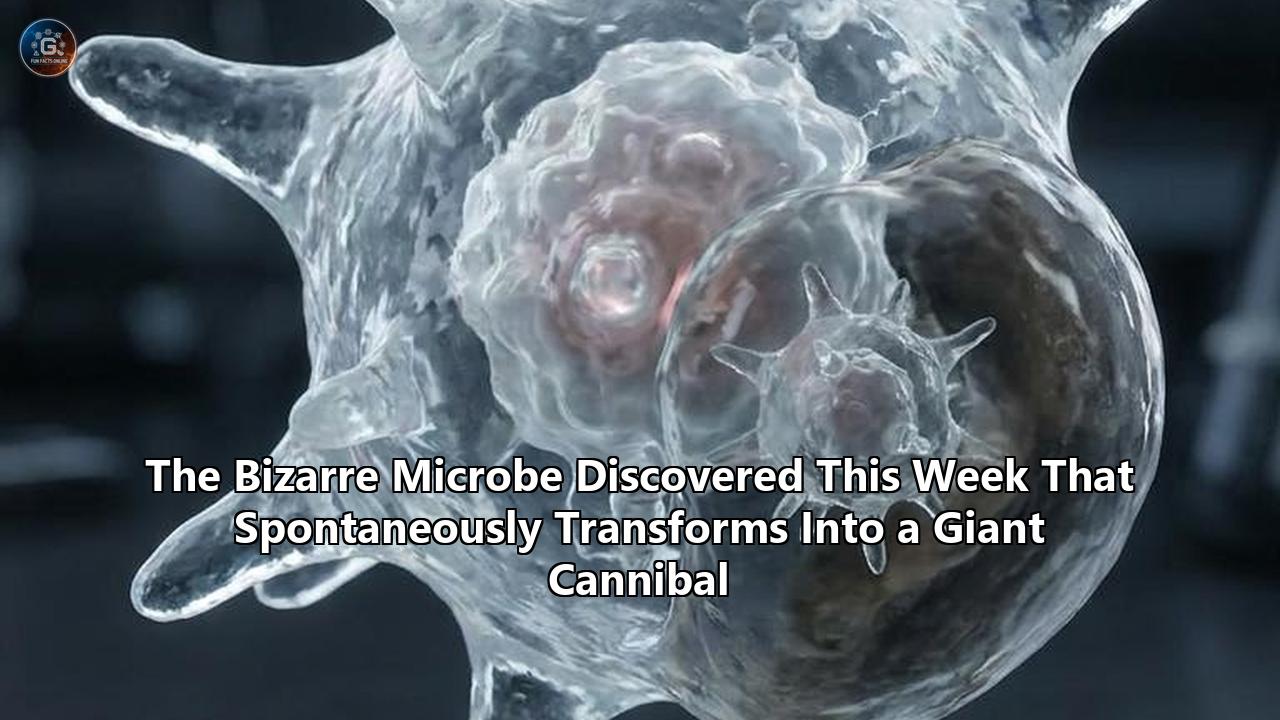
On June 2, 2026, the scientific community was introduced to a microscopic resident of the Caribbean that behaves more like a science-fiction terror than a standard single-celled organism. In a landmark study published on the cover of the Proceedings of the National Academy of Sciences (PNAS), researchers revealed the discovery of Euplotes gigatrox, a newly identified species of marine ciliate. Found in a saltwater filtration system on the island of Curaçao, this single-celled organism possesses a startling ability: when conditions change, it spontaneously reorganizes its entire cellular structure, doubling in size and transforming from a peaceful bacterivore into a giant, raptorial cannibal that hunts and swallows its own genetically identical clones whole.
Led by Dr. Ben T. Larson, an assistant professor of biological sciences at Rensselaer Polytechnic Institute (RPI), along with an international team of biophysicists and cellular biologists, the research has upended several long-held dogmas in biology. Traditionally, scientists believed that complex, highly regulated developmental stages—where an organism undergoes dramatic physical and behavioral metamorphosis—were the exclusive domain of multicellular animals and plants.
This striking microbe cannibalism discovery proves that a single, isolated eukaryotic cell, operating without a nervous system, tissues, or organs, is capable of orchestrating a total phenotypic transformation. The organism shifts its entire gene expression profile, restructures its specialized locomotion appendages, and alters its behavioral algorithms to target and consume its own kin.
The story of how this bizarre microbe was found, analyzed, and understood is a masterclass in modern biophysics, tracing a path from an accidental environmental sample to a complete molecular dissection of unicellular hunting behavior.
Phase I: The Caribbean Isolation (Late 2024 to Mid-2025)
The trajectory of this discovery began not in a high-tech genomics laboratory, but in the near-shore waters of Curaçao. While conducting a routine survey of eukaryotic microbial diversity in the Caribbean, researchers collected water samples from a specialized seawater filtration system. This system, which draws directly from the island’s coastal marine environment, was designed to exclude larger debris and organisms while allowing free-living protists to pass through.
Timeline of the Curaçao Discovery:
├── Late 2024: Collection of raw seawater samples from Curaçao filtration system
├── Early 2025: Isolation of single Euplotes cells in RPI laboratory
├── Late 2025: First observation of the "supergiant" morph during population crashes
├── Early 2026: Single-cell transcriptomics reveals the molecular transition
└── June 2026: Official publication of Euplotes gigatrox in PNAS
When Dr. Larson’s co-authors first isolated the samples, they noted a variety of microscopic life, including diverse bacteria, small flagellates, and various ciliates. Among them were small, flattened, disc-shaped organisms covered in hair-like structures. Under a light microscope, these cells were identified as members of the genus Euplotes.
Euplotes is a well-known genus of ciliates, famous among microscopists for having an exceptionally complex "body plan" for a single cell. Instead of being covered uniformly in simple cilia, Euplotes cells pack their cilia into dense, coordinated bundles called cirri on their ventral (bottom) side. These cirri act essentially as microscopic legs, allowing the cell to crawl along sand grains, debris, and laboratory culture dishes. On their dorsal (top) side, they are protected by a rigid, armor-like pellicle. At their anterior end, they possess a specialized array of fused cilia called membranelles, which beat in unison to generate water currents that suck suspended bacteria into a funnel-shaped mouth, the oral apparatus.The newly isolated cells, initially co-isolated with their naturally occurring prey bacteria, were manually picked out of the raw seawater using glass micro-pipettes. Dr. Larson’s team transferred individual cells to nutrient-supplemented artificial seawater to establish clonal cultures—populations in which every single cell is descended from a single ancestor, ensuring they all share an identical genetic blueprint.
At first, the cultures behaved predictably. The cells, measuring roughly 50 to 60 micrometers in length, scurried across the plastic of the petri dishes, filter-feeding on the provided bacteria and dividing by binary fission. There was no outward sign that these seemingly ordinary organisms harbored a dormant genetic program for monstrous transformation.
Phase II: The Lab Phenotype Anomaly (Late 2025)
The turning point occurred as the clonal cultures matured and entered what microbiologists call the stationary phase. In a typical growth cycle, cells divide exponentially as long as food is abundant. Once the bacteria are depleted, the population growth stalls.
It was during these periods of localized starvation and crowding that researchers observed an anomalies in their culture wells. Alongside the thousands of standard, 60-micrometer Euplotes cells, a few massive individuals began to appear.
[Normal Cell: ~60 µm]  ──(Starvation/Crowding Trigger)──>  [Supergiant Cannibal: >120 µm]
- Helical swimming trajectory                             - Circular crawling trajectory
- Filter-feeds on bacteria                                - Active hunter (raptorial)
- Standard oral groove                                    - Massive, widened mouth
These oversized cells were not merely slightly larger; they were giants. Measuring well over 120 micrometers—more than double the length and several times the total volume of their normal-sized siblings—these "supergiants" possessed a dramatically different morphology. Their bodies were highly widened, lateral margins were flared, and their oral apparatus was vastly expanded. The narrow, funnel-like mouth of the normal cell had been replaced by a gaping, cavernous vestibule.
The team initially wondered if their cultures had become contaminated with another species of predatory ciliate. However, genetic sequencing of the ribosomal RNA genes from both the normal cells and the giants confirmed they were identical. They were looking at a single, clonal population of a brand-new species, which they formally named Euplotes gigatrox—the species name reflecting its ability to transform into a giant, ravenous predator.
The researchers set up continuous high-resolution time-lapse imaging to observe how these giants formed. They discovered that the transformation is a rapid, active process. When triggered by environmental stress, a normal cell undergoes a massive wave of cellular remodeling. Over the course of several hours, the cell does not divide. Instead, it synthesizes vast amounts of new protein, expands its cell membrane, rearranges its internal cytoskeleton, and selectively enlarges its oral membranelles, effectively rebuilding its mouth from the inside out.
This was not a pathological swelling or a random mutation, but a highly coordinated, intentional developmental pathway triggered in a subset of the population.
Phase III: The Descent into Predation (Early 2026)
As the giants fully formed, their behavior shifted in a manner that can only be described as terrifying on a microscopic scale.
Normal Euplotes gigatrox cells are highly mobile but peaceful grazers. They walk along surfaces using their cirri in linear trajectories, occasionally launching into the water column to swim in elegant, helical (corkscrew) paths. This helical swimming is highly optimized for dispersing through water and encountering suspended bacteria, which they draw into their mouths with steady water currents.
The supergiant cells completely abandoned this lifestyle. The biophysical analysis conducted by Dr. Larson’s lab revealed that the physical transformation comes with a severe locomotor tradeoff. Because of their massive, flattened bodies and rearranged cirri, the supergiants are terrible swimmers. If displaced into open water, they tumble clumsily, unable to maintain a stable trajectory.
Locomotor and Behavioral Tradeoffs in Euplotes gigatrox:

┌───────────────────────────────────────┬───────────────────────────────────────┐
│ Normal Morph (Bacterivore)            │ Supergiant Morph (Predatory Cannibal) │
├───────────────────────────────────────┼───────────────────────────────────────┤
│ • Size: ~60 micrometers               │ • Size: >120 micrometers              │
│ • Diet: Plentiful bacteria            │ • Diet: Clonal sister cells           │
│ • Locomotion: Helical swimming        │ • Locomotion: Clumsy swimming         │
│ • Walking pattern: Linear/Dispersive  │ • Walking pattern: Tight circular     │
│ • Feeding: Passive filter-feeding     │ • Feeding: Active raptorial hunting   │
└───────────────────────────────────────┴───────────────────────────────────────┘
However, on solid surfaces, the supergiants become apex predators. Instead of walking in straight lines, they walk in tight, relentless circular paths. This circular trajectory keeps them anchored to the bottom of the culture dish, where the highest density of normal-sized cells are crawling.
This shift in locomotion is paired with a transition from passive filter-feeding to active, raptorial hunting. The supergiant does not wait for food to drift by. It cruises along the surface like a microscopic tank, running over smaller cells. When its massive oral groove collides with a normal-sized clonal sibling, the giant’s specialized, powerful membranelles flare outward, grabbing the prey cell and shoving it into its gaping mouth.
The prey cell, which is genetically identical to its captor, is swallowed whole. High-speed video captured by the research team shows that the victim remains alive and swimming inside the giant’s massive food vacuole for several minutes, frantically circling inside its membrane-bound prison before the giant secretes digestive enzymes to dissolve it.
This is not a rare, accidental event. The researchers measured the predation rates of these supergiant cells and found them to be extraordinarily efficient hunters, consuming their smaller clones at a rate of roughly one prey cell every ten minutes.
This shocking microbe cannibalism discovery revealed an evolutionary strategy that is both brutal and highly effective: when the primary bacterial food source disappears, a small percentage of the population transitions into giants, utilizing their own siblings as a rich, highly concentrated nutrient reservoir to survive the famine.
Phase IV: Deciphering the Single-Cell Transcriptome (Spring 2026)
Understanding how a single cell can completely alter its body, behavior, and ecological niche without a change in its genome required the team to delve deep into the molecular mechanics of Euplotes gigatrox. In the spring of 2026, the RPI researchers leveraged advanced single-cell RNA sequencing (transcriptomics) to profile individual cells at different stages of the lifecycle.
The team isolated and sequenced the transcriptomes of 41 individual Euplotes gigatrox cells, representing normal bacterivores, fully developed supergiants, and cells that were in the process of transitioning or reverting back to their original state.
The genetic data was clear and unambiguous: the supergiants are a completely distinct, transcriptionally regulated developmental stage. The molecular shift between a normal cell and a supergiant involves a massive, coordinated reorganization of gene expression.
Normal Cell Profile                  Supergiant Cell Profile
(High expression of)                 (High expression of)
├── Bacterial digestion genes        ├── Cytoskeletal remodeling genes
├── Standard ciliary beating genes   ├── Specialized membrane synthesis genes
└── Exponential cell-cycle genes     └── Raptor-specific proteinases
In the supergiant state, hundreds of genes are drastically upregulated or downregulated. The researchers identified several key functional classes of genes that drive this metamorphosis:
- Cytoskeletal Remodeling: Genes responsible for synthesizing tubulin and other microtubule-associated proteins are highly active. This allows the cell to build the massive arrays of specialized cilia required for its widened mouth and modified walking appendages.
- Membrane Synthesis: To double its length and increase its surface area, the supergiant must quickly generate massive amounts of lipid membrane. Genes involved in lipid metabolism and vesicle trafficking are heavily upregulated.
- Cell Cycle Arrest: Interestingly, the transcriptomic profile revealed that supergiants halt their standard cell-division machinery. Instead of dividing, they divert all cellular energy into somatic growth and physical maintenance, allowing them to remain in the giant state indefinitely as long as prey is available.
- Proteolytic Enzymes: Genes encoding specialized, highly aggressive lysosomal enzymes and acidic proteinases are upregulated, designed to rapidly digest the complex proteins and cellular machinery of their consumed sisters.
Dr. Larson’s team also discovered that the trigger for this genetic cascade is dual-controlled. It requires both an external environmental signal (such as a drop in bacterial density or a high concentration of chemical cues leaked by crowded Euplotes cells) and a specific internal physiological state (such as cellular hunger). If a cell is well-fed, it will not transform, even in the presence of crowding signals.
This prevents the population from prematurely descending into cannibalistic self-destruction when food is still plentiful.
Phase V: Cellular Memory and Epigenetic Hysteresis (May 2026)
Just weeks before the PNAS paper was published, the research took an even stranger turn. The team sought to understand what happens to the supergiant cannibals when the environmental crisis ends.
They designed an experiment where they isolated active supergiants and placed them back into fresh, clean seawater teeming with their favorite food: non-pathogenic bacteria.
As the bacteria multiplied, the supergiant cells stopped hunting their siblings. Over the course of 24 to 48 hours, they underwent a reverse transformation. They shrank, remodeled their mouthparts back to the standard narrow funnel, and regained their ability to swim in elegant helical spirals. To the naked eye, they had reverted to completely normal cells.
However, when the researchers sequenced the transcriptomes of these recently reverted cells, they discovered a stunning molecular signature. Even though they looked and behaved like normal bacterivores, their gene expression profiles were vastly different from cells that had never undergone the transition.
The reverted cells carried a persistent "molecular memory" of their time as cannibals. Key regulatory pathways that drive the supergiant transformation were actively suppressed, and a unique suite of genes—which the researchers dubbed the "reversion signature"—remained active.
Transformation Hysteresis Cycle:
[Normal Cell] ──(Famine/Stress)──> [Supergiant Cannibal]
      ▲                                   │
      │ (Bacteria Restored)               │ (Digestion of Kin)
      │                                   ▼
[Reverted Cell] <───────────────── [Satiated Giant]
  *Molecular memory active:
   Suppresses rapid re-transformation
This molecular memory has a profound biological consequence. When the researchers subjected these reverted populations to a second round of starvation, they expected them to quickly transform back into giants. Instead, the opposite happened.
The populations derived from recently reverted cells were significantly slower to produce new supergiants, and did so at a much lower frequency than populations that had never transformed.
This phenomenon, known in physics and biology as hysteresis, suggests that Euplotes gigatrox possesses a form of epigenetic memory. The cell "remembers" its prior state and uses this memory to pace its developmental decisions.
This prevents the organism from rapidly fluctuating back and forth between states in an unstable environment, which would be energetically disastrous.
The Ecology of "Bet-Hedging"
Why would a single-celled species evolve such a bizarre, terrifying survival mechanism? The answer lies in a classic evolutionary concept known as bet-hedging.
In any given population of Euplotes gigatrox, even under severe starvation, the supergiants never make up more than about 5% of the total population. The remaining 95% continue to crawl around as normal, hungry bacterivores.
This ratio is crucial. If the entire population transformed into giant cannibals, they would quickly consume each other until only a single, giant cell remained, leading to localized extinction. By keeping the proportion of giants low, the species ensures a delicate ecological balance.
          ┌─────────────────────────────────────────────────────────┐
          │                    ENVIRONMENTAL STATUS                 │
          └────────────────────────────────────────────┬────────────┘
                                                       │
                           ┌───────────────────────────┴───────────────────────────┐
                           ▼                                                       ▼
                [Bacterial Prey Plentiful]                              [Bacterial Famine]
                           │                                                       │
                           ▼                                                       ▼
                [99% Normal Morph, 1% Giant]                            [95% Normal, 5% Supergiants]
             - High swimming and dispersion                          - Giants hunt normal clones
             - Rapid population growth                               - Giants act as nutrient vaults
             - Low energetic overhead                                - Normal morphs search for bacteria
The 5% of supergiants act as evolutionary "lifeboats". They exploit a completely different trophic niche (their own brothers and sisters) to gather enough energy to survive the famine.
Meanwhile, the 95% of normal cells continue to search for rare, localized patches of bacteria. If the bacteria return, the normal cells quickly multiply, and the supergiants revert, preserving the overall genetic lineage.
If the famine persists, the supergiants, packed with nutrients from their cannibalistic feasts, can survive long enough to eventually divide and seed a new generation of normal cells once the environment stabilizes.
This microbe cannibalism discovery highlights a level of population-level coordination and strategic diversity that was once thought to require a multicellular brain or a complex endocrine system. Here, it is achieved entirely within a single plasma membrane, regulated by a network of molecular feedback loops.
Shifting Paradigms: What This Means for Biology
The implications of Dr. Larson’s work extend far beyond the narrow field of marine microbiology. It challenges some of the most fundamental concepts in developmental biology, ecology, and evolutionary science.
1. Redefining Developmental Biology
For over a century, the textbook definition of "development" has been synonymous with multicellularity. We study how a stem cell differentiates into a neuron or a muscle cell, or how a caterpillar transforms into a butterfly, by looking at how different cells communicate and specialize within a larger organism.
Euplotes gigatrox proves that all the hallmarks of complex animal development—morphological restructuring, behavioral rewiring, and permanent (but reversible) transcriptional reprogramming—can occur within the boundaries of a single, microscopic cell."This is a single cell doing something we usually associate with the development of animals," Dr. Larson noted during the press release for the study. "It expands our picture of what single-celled organisms are capable of, and gives us a new system for asking questions about how cells control their form and function."
2. The Unicellular Origins of Metazoan Programs
How did complex multicellular animals evolve in the first place? One of the leading theories is that the genetic toolkits for animal development—the genes that control cell shape, cell-to-cell adhesion, and cell differentiation—did not appear out of nowhere. Instead, they were co-opted from single-celled ancestors that used them to navigate fluctuating environments.
The single-cell transcriptomics of Euplotes gigatrox provide a literal window into this evolutionary transition. Many of the gene families upregulated during the supergiant transformation are highly homologous to genes used by multicellular animals to control tissue development, wound healing, and cell-fate decisions.
By studying how this ciliate regulates its internal structural changes, scientists are gaining a clearer picture of how the first multicellular organisms began to organize their own cells.
What to Watch for Next
As the scientific community processes this extraordinary microbe cannibalism discovery, several critical, unresolved questions have emerged, pointing toward the next milestones in this research:
- The Chemical Trigger: Scientists are racing to identify the precise chemical compound that signals Euplotes gigatrox to begin its transformation. If this "giant-inducing pheromone" can be isolated, it could allow researchers to induce or halt cellular metamorphosis at will, providing a powerful new tool for study.
- The Physical Mechanism of Memory: How does a single cell, after dividing and shrinking back to normal size, "remember" its past life as a giant cannibal? Researchers are looking into epigenetic modifications—such as DNA methylation or histone modifications—that might lock the "reversion signature" in place without changing the underlying DNA sequence.
- The Prevalence in the Wild: Is Euplotes gigatrox unique, or are oceans, rivers, and soils filled with other undiscovered single-celled shape-shifters? The discovery has prompted marine biologists to re-examine existing ciliate collections and environmental DNA (eDNA) datasets to see if other "supergiants" have been misidentified as entirely separate species in the past.
The discovery of Euplotes gigatrox is a humbling reminder of the sheer, unrecognized complexity of the microscopic world. Within a single drop of Curaçao seawater, inside a simple filtration system, a tiny organism has spent millions of years executing a sophisticated, double-agent survival strategy—living as a peaceful grazer until the lights go out, and then transforming into a monstrous, cannibalistic giant.
As biophysics and single-cell genomics continue to advance, we must prepare to find that the simplest cells on Earth are far more complex, resourceful, and dramatic than we ever dared to imagine.
References
- [1.1] "Cannibalism and Gigantism in Blepharisma." Transactions of the American Microscopical Society.
- [1.2] "When Food Runs Short, This Single-Celled Organism Turns into Giant Cannibal to Survive." Sci.News, June 3, 2026.
- [1.3] "Meet Euplotes gigatrox, a single-celled organism discovered on a Caribbean island that temporarily transforms into a predator..." Discover Magazine, June 3, 2026.
- [2.1] "Regulated development of cannibalistic supergiant cells in the ciliate Euplotes gigatrox." PNAS, Vol. 123, No. 20.
- [2.2] Larson, B. T., et al. "Regulated development of cannibalistic supergiant cells." bioRxiv / PNAS preprint.
Reference:
- https://www.discovermagazine.com/this-single-celled-organism-turns-into-a-cannibalistic-predator-swallowing-its-own-relatives-whole-49199
- https://news.rpi.edu/2026/06/02/rpi-researcher-discovers-single-celled-organism-transforms-cannibalistic-supergiant
- https://www.sci.news/biology/euplotes-gigatrox-14815.html
- https://news.rpi.edu/2026/06/02/rpi-researcher-discovers-single-celled-organism-transforms-cannibalistic-supergiant
- https://pubmed.ncbi.nlm.nih.gov/42133806/
- https://www.ocafezinho.com/2026/06/02/cientistas-descobrem-organismo-unicelular-que-se-transforma-em-supergigante-canibal-e-devora-clones/amp/
- https://www.pnas.org/doi/10.1073/pnas.2606891123
- https://www.biorxiv.org/content/10.1101/2025.08.19.671124v1.full-text
- https://www.youtube.com/watch?v=N6mqpIifiDY
- https://faculty.rpi.edu/ben-larson
- https://scholarworks.smith.edu/theses/2011/
- https://en.wikipedia.org/wiki/Blepharisma
- https://pmc.ncbi.nlm.nih.gov/articles/PMC10229871/
- https://www.miragenews.com/starving-bacteria-turn-cannibal-devour-neighbors-1477185/
- https://www.sci.news/
- https://scholar.google.com/citations?user=oCQbOfMAAAAJ&hl=en