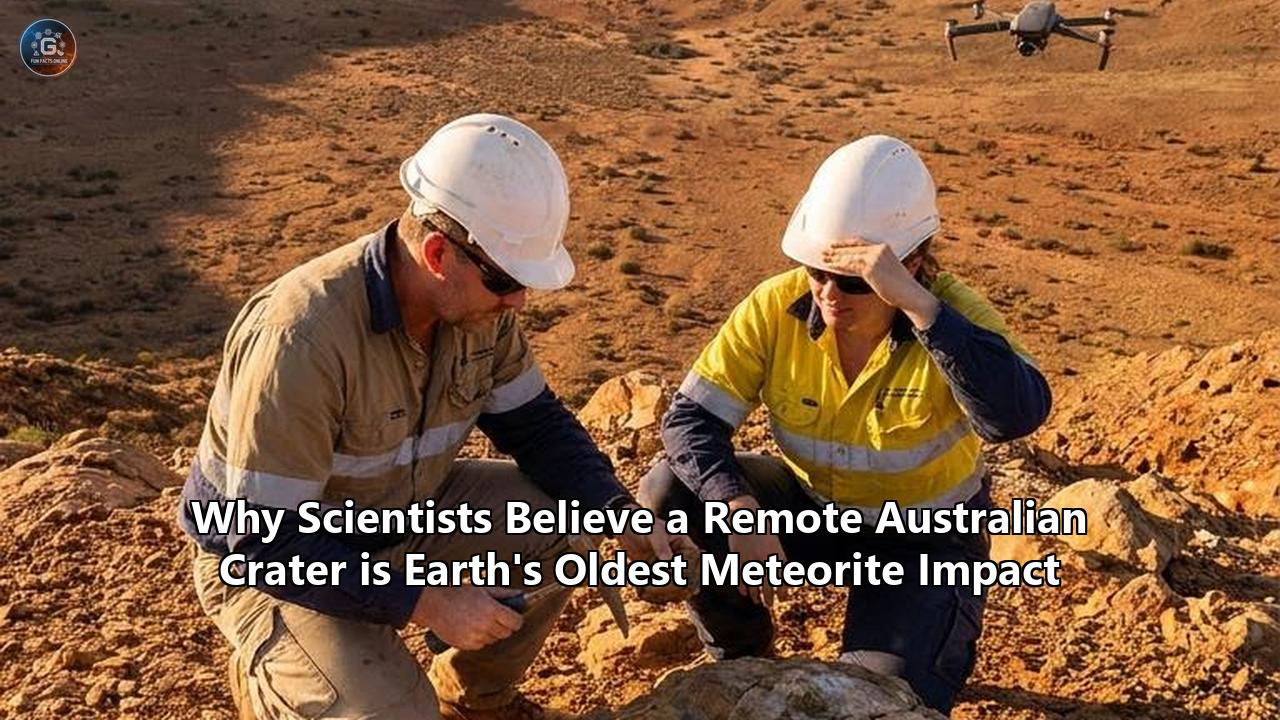
In the remote, sun-bleached expanse of Western Australia’s Pilbara region, the earth is a bruised rust-red. The landscape here is famously hostile—scoured by hot winds, choked with spinifex grass, and baked under a relentless desert sun. But to geologists, this is the closest thing Earth has to a time machine.
On June 23, 2026, a team of geoscientists published a study in the journal Geology that turned this quiet desert into the center of a profound scientific debate. By analyzing microscopic crystals extracted from a bizarre, dome-like rock formation known as the North Pole Dome, researchers from Curtin University announced they had successfully dated a massive, long-eroded cosmic scar. The date they returned was mind-boggling: 3.024 billion years old.
This revelation officially marks the North Pole Dome—also known as the Miralga impact structure—as the oldest meteorite impact site on Earth. It shatters the previous record held by the Yarrabubba crater, another Western Australian site located some 500 miles to the south, which was dated to 2.229 billion years.
For the first time, scientists have found physical, in-situ evidence of a major asteroid strike dating back to the Archean Eon—a chaotic, alien epoch of Earth's deep history when the first continents were barely forming and early single-celled life was just beginning to take a fragile hold in the oceans.
But the path to this discovery was not straightforward. It is a story of a fierce academic rivalry, a geological detective hunt involving "crystalline clocks," and a search for clues that were nearly erased by three billion years of tectonic violence and erosion.
The Cradle of Deep Time
To understand why the discovery of the oldest meteorite impact site is such a rare feat, one must understand how aggressively our planet destroys its own history.
Unlike the Moon, Mars, or Mercury, which are heavily cratered because they lack active geology, Earth is an incredibly efficient recycling machine. Plate tectonics constantly subducts oceanic crust back into the mantle, folding mountains, melting rocks, and recycling the surface. Rain, wind, and ice erode towering crater rims down to flat plains over millions of years.
Of the nearly 200 confirmed impact craters on Earth, the vast majority are relatively young, dating back less than 500 million years. Famous structures like the Chicxulub crater in Mexico (which wiped out the non-avian dinosaurs 66 million years ago) or the Barringer Crater in Arizona (just 50,000 years old) are, in geological terms, yesterday’s news. The truly ancient craters, like South Africa's Vredefort (2.02 billion years old) and Western Australia's Yarrabubba (2.229 billion years old), are so heavily eroded that they can no longer be seen from the ground as craters at all. They are detected only through geophysical anomalies and subtle structural changes in the bedrock.
EARTH'S METEORITE IMPACT TIMELINE (Select Sites)
+------------------------------------+------------------------+
| Site / Structure                   | Confirmed Age          |
+------------------------------------+------------------------+
| Chicxulub (Mexico)                 | ~66 Million Years      |
| Vredefort (South Africa)           | ~2.02 Billion Years    |
| Yarrabubba (Western Australia)     | ~2.23 Billion Years    |
| North Pole Dome / Miralga (WA)     | ~3.02 Billion Years    |  <-- NEW RECORD
+------------------------------------+------------------------+
Western Australia's Pilbara Craton is one of only two places on Earth (the other being the Kaapvaal Craton in South Africa) that has remained stable and largely unaltered for over three billion years. Here, the ancient "basement" rocks of the planet have escaped the destructive cycle of tectonic subduction.
“The Pilbara preserves some of the least disturbed Archean rocks on Earth,” explains Professor Chris Kirkland, a geologist from Curtin University’s Timescales of Minerals Systems Group and the lead author of the recent study. “There are very few places that are these deep time capsules that let us peer into the formative processes of our planet. That’s why they’re quite special.”
Yet, even in the Pilbara, finding an ancient crater is an extraordinary challenge. The crater rim, the bowl-shaped depression, and the ejected debris blankets of the North Pole Dome impact were scoured away billions of years ago. What remains is a deeply eroded root system of the impact zone—a geological crime scene where the only evidence of a cosmic collision is written in the atomic structure of microscopic minerals.
The 3.47-Billion-Year Illusion
The investigation into the North Pole Dome began with a stunning announcement in March 2025. Kirkland and his team had been surveying a sequence of ancient sedimentary and volcanic rocks in the center of the East Pilbara Terrane. There, they discovered a dense field of shatter cones.
Shatter cones are rare, highly distinct, cone-shaped rock fractures that form exclusively under the extreme, high-pressure shockwaves generated by hypervelocity impacts (or underground nuclear detonations). They feature delicate, radiating ridges that flare out from the apex of the cone, resembling a fossilized horsetail. They represent the definitive, macroscopic "smoking gun" of a meteorite strike.
     SHATTER CONE SHOCKWAVE PROPAGATION

               [ Meteorite Impact ]
                       │
                       ▼  (Shockwave: 2 to 30 GPa)
                     /   \
                    /  ▲  \
                   /  / \  \   <-- Striated fracture lines
                  /  /   \  \      point upward toward
                 /  /     \  \     "Ground Zero"
In their initial 2025 paper, Kirkland’s team mapped these shatter cones within a thin chert layer called the Antarctic Creek Member, sandwiched between thick, ancient volcanic basalts. Based on the age of these surrounding volcanic strata, the team calculated that the impact must have occurred approximately 3.47 billion years ago. They theorized that the impactor was a massive asteroid that blasted a crater more than 62 miles (100 kilometers) wide.
It was a staggering claim. If true, it meant they had found an impact structure that dated to the early Archean Eon—almost the exact same age as the oldest known fossils on Earth. The scientific community was ecstatic. Geologists began theorizing that this colossal impact might have actually triggered the formation of the Pilbara’s earliest continental crust, or perhaps altered the young planet’s climate to favor early microbial life.
But the celebration was short-lived.
The Yale Post-Doc and the Law of Cross-Cutting Relationships
Just months after Kirkland’s 2025 announcement, a young geologist named Alec Brenner, then working at Harvard University and later a postdoctoral researcher at Yale, threw a wrench into the theory.
Brenner had been mapping the North Pole Dome area in 2023. Driving down a dusty desert track, he stopped to show his field assistants some unusual volcanic outcrops. Walking up to the rocks, he noticed the classic, unmistakable horsetail fractures of shatter cones pointing like compass needles toward a central point overhead.
“It’s kind of like those goofy pirate movies where one of the pirates has a compass that always points toward the treasure,” Brenner later recalled in an interview with Harvard University. “Eventually, we followed the arrows to what we called ‘ground zero.’”
Brenner, alongside Curtin University impact specialist Aaron Cavosie and other colleagues, embarked on a meticulous, two-year mapping project of the area, which they provisionally named the Miralga impact structure, honoring the local Indigenous Nyamal family and a nearby creek.
In July 2025, Brenner’s team published their findings in Science Advances. They had discovered a critical flaw in the 3.47-billion-year theory.
While Kirkland’s team had focused on shatter cones in the ancient 3.47-billion-year-old chert, Brenner and his crew found shatter cones extending upward into younger basalt layers—specifically, the Mount Roe Basalt, which erupted 2.77 billion years ago. Furthermore, they noticed that the radiating patterns of the shatter cones were completely undisturbed by regional geological faults known to have cracked the landscape around 2.71 billion years ago.
In geology, the Law of Cross-Cutting Relationships is absolute: an event that deforms a rock must be younger than the rock itself. You cannot shock-fracture a basalt layer that has not yet erupted.
THE GEOLOGICAL PARADOX:
+--------------------------------------------------------+
| 3.47 Billion Years Ago: Basalt & Chert layers form      |
+--------------------------------------------------------+
| 2.77 Billion Years Ago: Mount Roe Basalt erupts        | <--- Brenner finds shatter
|                                                        |      cones here.
+--------------------------------------------------------+
| 2.71 Billion Years Ago: Fault lines cut the landscape  | <--- Shatter cones are NOT
|                                                        |      distorted by faults.
+--------------------------------------------------------+
| CONCLUSION: The meteorite must have struck AFTER 2.77 billion years ago,
| but BEFORE the faults formed at 2.71 billion years ago.
+--------------------------------------------------------+
Brenner’s team concluded that the impact could not have happened 3.47 billion years ago. Instead, they bracketed the age of the impact to some time after 2.71 billion years ago. Based on paleomagnetic signatures—the alignment of magnetic minerals locked in the shocked basalt—Brenner suggested the impact might have actually occurred much later, perhaps between 1.2 and 1.8 billion years ago.
Additionally, by mathematically modeling the orientation of the shatter cones, Brenner's team calculated that the original crater was not 100 kilometers wide, but a much more modest 16 kilometers (10 miles) wide.
The "oldest meteorite impact site on Earth" had seemingly been demoted. It was still highly unique, but it was no longer an Archean relic, and it was certainly younger than the Yarrabubba crater.
The geological community was locked in a classic academic stalemate. One team argued for 3.47 billion years based on the stratigraphy of the oldest shocked rocks; the other argued for less than 2.7 billion years based on the younger shocked basalt.
To break the deadlock, scientists needed a new way to look at the rocks. They needed to find a direct, unarguable physical link between the shockwave itself and the precise moment of its occurrence.
Unlocking the Twin Mineral Clocks
Faced with this challenge, Chris Kirkland and his team returned to the Pilbara scrubland to gather new samples. They realized that tracing rock layers across a highly deformed, three-billion-year-old landscape was a recipe for endless debate.
"Ancient impact craters are incredibly difficult to date because over billions of years, rocks are altered by heat, pressure, and fluids, which can obscure or reset the original impact signals," Kirkland says. "What we’ve been able to do here is separate the moment of impact from its long geological history."
To do that, the team decided to stop looking at the macroscopic structures of the rock layers and instead focus on the atomic clocks ticking inside the shocked minerals themselves. They targeted two distinct minerals: zircon and apatite.
Clock One: The Lunar Zircons
Zircon ($ZrSiO_4$) is the undisputed king of geochronology. It is an exceptionally durable mineral—almost indestructible—capable of surviving multiple cycles of erosion, volcanic heat, and tectonic squeezing. Zircon crystals incorporate small amounts of radioactive uranium when they form, but completely reject lead. Because uranium decays into lead at a highly precise, unchanging rate, measuring the ratio of uranium to lead inside a zircon crystal provides a highly accurate isotopic clock.
Under normal geological conditions, a zircon crystal preserves its age indefinitely. But a hypervelocity meteorite impact is not normal.
When an asteroid slams into the crust, it releases a burst of energy equivalent to millions of nuclear weapons detonating at once. The temperature at the point of impact surges past several thousand degrees Celsius, while pressure waves exceed 30 gigapascals. Under these extreme conditions, the outer layers of existing zircon crystals melt, recrystallize, or regrow in highly unusual patterns.
Kirkland’s team isolated microscopic zircons from a metadolerite rock that bore clear shatter-cone damage. When they examined these zircons under a scanning electron microscope, they discovered something extraordinary: some of the grains displayed bizarre, branching, skeletal structures.
       TYPICAL ZIRCON VS. IMPACT-SHOCKED SKELETAL ZIRCON

       [ Typical Zircon ]            [ Shocked Skeletal Zircon ]
          ┌─────────┐                     _/\/\_/\_
          │ ┌─────┐ │                    /         \
          │ │     │ │                   <   /\_/\   >  <-- Branching, skeletal
          │ └─────┘ │                    \         /       structures from
          └─────────┘                     ~\/\_/\/~        rapid shock regrowth
       (Prismatic, layered)             (Amorphous, moon-like pattern)
"Some zircons at North Pole Dome have unusual branching, skeletal shapes," Kirkland explains. "We interpret these as impact-modified crystals, formed when older zircon was disrupted, partly recrystallized, and in places regrown during the intense heating caused by the impact."
These skeletal zircons are incredibly rare on Earth, but they are common in lunar rock samples brought back by the Apollo missions, where the Moon’s airless surface has preserved a pristine record of ancient cosmic bombardment.
Using an Australian-designed instrument called the Sensitive High-Resolution Ion MicroProbe (SHRIMP)—which fires a beam of primary ions at the crystal to sputter off secondary ions for mass spectrometry—the team dated these skeletal zones. The uranium-lead clock inside the recrystallized zircon zones had been reset to "time zero" by the heat of the impact.
The date returned was 3.024 billion years ago, plus or minus 7 million years.
Clock Two: The Hydrothermal Apatite
In science, a single piece of evidence is rarely enough, especially when contesting a high-profile geological record. Kirkland’s team knew they needed independent verification.
To confirm the zircon age, they targeted a second, completely different mineral system: apatite, a calcium phosphate mineral.
When a large meteorite strikes a water-rich environment, it fractured the basaltic bedrock and generated massive, subterranean hydrothermal systems—essentially, colossal underground hot springs heated by the residual energy of the collision. As boiling, mineral-rich fluids circulated through the shattered, shock-damaged basalt, new crystals of apatite grew inside the open fractures.
Using a different isotopic dating method, the researchers measured the age of the apatite crystals found within the fractured metabasalt.
The apatite yielded an age of 3.019 billion years ago.
"The agreement between two entirely different mineral systems gives us confidence that we are seeing the signature of a single major event—a meteorite impact," says Kirkland.
The twin atomic clocks had spoken. The answer was a surprising middle ground between the two contested dates. It was not the 3.47 billion years of the initial Curtin study, nor was it the younger post-2.7 billion-year age proposed by the Harvard-Yale team.
At exactly 3.024 billion years old, this 3-billion-year-old scar officially claims the title of the oldest meteorite impact site on Earth.
Anatomy of an Archean Apocalypse
With the age of the North Pole Dome impact precisely pinned to 3.02 billion years, scientists can finally begin to reconstruct what occurred on that violent day during the Middle Archean.
The Earth of 3.02 billion years ago was not the blue-and-white marble we recognize. It was a hostile, alien water world.
The atmosphere was a thick, toxic blanket of nitrogen, carbon dioxide, and methane, lacking any free oxygen. The sky likely hung with a permanent, orange-brown organic haze, similar to the modern atmosphere of Saturn's moon Titan. Because the Sun was about 20 to 30 percent dimmer than it is now, the planet relied on greenhouse gases to keep its global oceans from freezing solid.
       ARTIST'S CONCEPTION OF THE ARCHEAN IMPACT (3.02 Ga)

              [ Dim, Orange Methane Sky ]
                \                      /
                 \    [ Dim Sun ]     /
                  \                  /
       ~~~~~~~~~~~~~~\~~~~~~~~~~~~~~/~~~~~~~~~~~~~~~~~  <-- Massive Tidal Waves
                      \   *Asteroid* /                      from a closer Moon
       ~~~~~~~~~~~~~~~~\~~~~~▼~~~~~~/~~~~~~~~~~~~~~~~~
                        ███████████
                       █           █
                      █   CRUST     █
                     █ (Volcanic Is.)█                  <-- Stromatolite mats
                     ~~~~~~~~~~~~~~~~~                      buried in shallow
                                                            coastal waters
There were no massive continents, only scattered chains of volcanic islands poking through a vast, global ocean. Because the Moon was much closer to Earth than it is today, massive, powerful tides swept across the globe every few hours.
Yet, life was already there. In the shallow, sunlit waters surrounding these volcanic islands, primitive, single-celled photosynthetic bacteria were flourishing. Over millions of years, these microbes built up layer upon layer of mineralized sediment, forming dome-like structures called stromatolites. The oldest well-preserved fossilized stromatolites on Earth—dating to 3.48 billion years old—are found in the Dresser Formation, just a few miles away from the North Pole Dome impact site.
On a day 3.02 billion years ago, this primitive biosphere was violently disrupted.
A solid-rock asteroid, estimated to be between 1 and 2 kilometers (up to 1.2 miles) wide, screamed through the methane-rich atmosphere at speeds exceeding 22,000 miles per hour. It slammed into a shallow, basaltic volcanic plateau with a force equivalent to millions of megatons of TNT.
The immediate consequences were apocalyptic:
- The Blast: A blinding flash of light, followed by a shockwave that would have circled the globe multiple times, shattering rocks for miles around and creating the telltale shatter cones deep in the crust.
- The Tsunami: In a world dominated by oceans, the displacement of water would have triggered monster tsunamis, hundreds of feet high, which would have ripped across the global ocean, scouring the shores of the young volcanic islands.
- The Greenhouse Effect: The impact vaporized immense volumes of seawater and basaltic crust, injecting trillions of kilograms of water vapor and greenhouse gases into the upper atmosphere. This likely triggered a period of rapid, global warming.
- Hydrothermal Sanctuaries: Below ground, the energy of the impact created a sprawling network of hot springs. For early microbes, these boiling, mineral-rich environments may have acted as cozy, protective nurseries, shielding them from the harsh solar radiation of the young, ozone-free Earth.
Why the Scientific Turf War is Far From Over
Despite the elegance of Kirkland's "twin mineral clocks" study, the geological community is rarely quick to declare a case closed.
Alec Brenner, now at Yale, remains cautious about accepting the 3.02-billion-year date as the final answer. While he acknowledges the precision of the Curtin team's mineral dating, he raises a critical concern regarding the connection between the dated minerals and the actual impact.
“We’ve already documented shatter cones in nearby 2.77-billion-year-old rocks,” Brenner told the Australian Broadcasting Corporation in June 2026. “That alone requires the impact happened after 2.77 billion years ago.”
Brenner suggests a different interpretation of the 3.02-billion-year-old skeletal zircons and hydrothermal apatite: instead of recording the meteorite strike, they might be recording a major, regional hydrothermal event—an ancient, underground volcanic hot spring system that arose 3.02 billion years ago, completely unrelated to any asteroid. Under this scenario, the impact occurred much later (perhaps <2.7 billion years ago), shocking rocks that already contained these older, hydrothermal minerals.
“I’d suggest they’ve dated an undocumented hydrothermal episode in the area,” Brenner argues.
THE TWO COMPETING THEORIES:
┌────────────────────────────────────────────────────────┐
│ THEORY A (Kirkland et al., 2026):                     │
│ Meteorite impacts at 3.02 Ga. The shock directly       │
│ recrystallizes zircons & drives hydrothermal fluids    │
│ that grow apatite. Later folding and complex faulting  │
│ misaligns some younger rock layers.                    │
└────────────────────────────────────────────────────────┘
                           VS.
┌────────────────────────────────────────────────────────┐
│ THEORY B (Brenner et al., 2025):                       │
│ An underground volcanic fluid event occurs at 3.02 Ga, │
│ growing zircons/apatite. Much later (<2.7 Ga), a       │
│ meteorite strikes, shocking everything, including the │
│ older 3.02 Ga minerals.                                │
└────────────────────────────────────────────────────────┘
Kirkland stands firmly by his team's interpretation, pointing out that the specific "skeletal" morphology of the zircons is a highly unique signature of rapid, shock-induced thermal recrystallization—not the slow, steady growth typically associated with volcanic hydrothermal systems. Furthermore, no regional, high-grade volcanic or metamorphic event is known to have occurred in the Pilbara between 3.4 and 3.0 billion years ago that could account for such widespread zircon recrystallization.
The debate highlights just how difficult it is to interpret geological evidence that has been sitting in the ground for three-sevenths of the age of the universe. In the Pilbara, rocks are not neatly stacked like pages in a textbook; they have been tilted, folded, squeezed, faulted, and weathered into a complex, three-dimensional puzzle. One geologist's clear sequence of volcanic layers is another geologist's structurally complex fault zone.
A Portal to Ancient Mars
The quest to identify the oldest meteorite impact site on Earth is not just about geological bragging rights or rewriting history books. It has profound implications for our understanding of the solar system—and the search for extraterrestrial life.
At the same time that the Miralga asteroid was screaming toward Western Australia 3.02 billion years ago, Mars was undergoing a dramatic transition. The Red Planet was shifting from a wetter, warmer world with an active magnetic field to the frozen, dry desert we see today.
Because Mars lacks plate tectonics, its ancient, basaltic, cratered crust is beautifully preserved, offering a pristine record of the early solar system. However, we cannot yet walk the surface of Mars to study these ancient rocks up close.
               THE MIRALGA - MARS ANALOGY
  [ Western Australia: Miralga ]      [ Ancient Mars (3.0 Ga) ]
  • Basaltic, water-weathered crust   • Basaltic, water-weathered crust
  • Hammered by heavy impacts         • Hammered by heavy impacts
  • Teeming with early microbial life • Potential habitat for early life
  • Preserved biosignatures (chert)   • Target chert layers (Jezero Crater)
The Miralga impact structure at the North Pole Dome is perhaps the single best physical analog for Mars on Earth.
Both sites feature ancient, basaltic volcanic crust that was altered by liquid water and then subjected to intense asteroid bombardment. Crucially, because the North Pole Dome lies in immediate proximity to Earth's oldest fossilized biosignatures (the stromatolites), it provides astrobiologists with a real-world laboratory to study how organic matter and microfossils behave when subjected to the extreme heat and pressure of an impact.
“This is a unique opportunity,” says Aaron Cavosie, an impact geologist at Curtin University. “This is an easily accessible proving ground for Mars exploration instruments and imagery, right here on Earth.”
If we can understand exactly how shock metamorphism alters or preserves biosignatures in the basaltic rocks of Western Australia, we will know exactly what to look for when robotic rovers—and eventually human explorers—analyze the ancient, cratered lakebeds of Mars.
What to Watch for Next
As the dust settles on the June 2026 study, the scientific community is already preparing for the next phase of the investigation.
To resolve the lingering skepticism, multiple international research teams are planning new field expeditions to the North Pole Dome.
The immediate scientific goals are clear:
- High-Resolution 3D Mapping: Researchers will use drone-mounted LiDAR and high-resolution aerial photography to construct detailed 3D structural maps of the shatter-cone fields. This will help determine once and for all if the shocked rocks cross-cut the 2.71-billion-year-old fault lines, or if they are structurally isolated.
- Searching for Shocked Quartz: While zircons and apatites are powerful clocks, the discovery of shocked quartz (which features distinct, microscopic planar deformation features, or PDFs) would provide another layer of definitive shock-pressure evidence.
- Drilling into Deep Basalt: To get past the weathered, oxidized surface of the desert, geologists are hoping to secure funding for a deep-coring scientific drilling project. Retrieving pristine, unweathered core samples from the heart of the North Pole Dome would allow for even more precise isotopic and paleomagnetic analyses.
Whether the North Pole Dome's age holds firm at 3.024 billion years, or whether future studies push it even further into the deep, dark corners of Earth's formative history, one thing is certain: this remote patch of the Australian outback remains our most valuable portal to the dawn of our world. It is a stark reminder that the history of Earth has been written not just by the slow, steady grind of our planet's tectonic plates, but by sudden, violent encounters with wandering rocks from deep space.
Reference:
- https://www.sbs.com.au/news/article/oldest-asteroid-impact-australia-pilbara-north-pole-dome/oltfnw6qt
- https://www.theguardian.com/environment/2026/jun/24/worlds-oldest-meteorite-strike-pilbara-western-australia
- https://www.smithsonianmag.com/smart-news/scientists-double-down-on-age-of-earths-oldest-meteorite-impact-crater-dating-it-again-at-more-than-three-billion-years-old-180989023/
- https://www.sci.news/geology/north-pole-dome-crater-14870.html
- https://www.curtin.edu.au/news/media-release/oldest-known-asteroid-impact-on-earth-precisely-dated-to-3-billion-years/
- https://www.universetoday.com/articles/crystalline-clocks-confirm-earths-oldest-crater
- https://pubs.geoscienceworld.org/gsa/geology/article/doi/10.1130/G54866.1/732076/How-old-is-the-North-Pole-Dome-impact-Western
- https://www.space.com/astronomy/asteroids/3-billion-years-old-this-australian-crater-is-the-oldest-known-asteroid-impact-site-on-earth
- https://en.wikipedia.org/wiki/Miralga_impact_structure
- https://en.wikipedia.org/wiki/Yarrabubba_impact_structure
- https://www.youtube.com/watch?v=4ccwT1jvVxc
- https://www.sciencealert.com/worlds-oldest-known-asteroid-crater-is-3-billion-years-old-study-confirms
- https://www.geographyrealm.com/australias-yarrabubba-is-the-oldest-impact-crater-on-earth/
- https://www.sciencenews.org/article/ancient-earth-impact-martian-life
- https://www.sciencealert.com/worlds-oldest-known-asteroid-crater-is-3-billion-years-old-study-confirms
- https://www.space.com/astronomy/asteroids/3-billion-years-old-this-australian-crater-is-the-oldest-known-asteroid-impact-site-on-earth
- https://news.harvard.edu/gazette/story/2025/07/hot-dispute-over-impact/
- https://www.theguardian.com/environment/2026/jun/24/worlds-oldest-meteorite-strike-pilbara-western-australia
- https://gsameetings.secure-platform.com/connects25/gallery/rounds/82002/details/14459
- https://www.researchgate.net/figure/Field-photographs-of-rocks-on-the-flanks-on-the-North-Pole-Dome-a-b-Shatter-cones-within_fig2_389633044
- https://www.independent.co.uk/news/science/archaeology/meteorite-impact-crater-miralga-australia-oldest-b2786425.html
- https://karmaka.de/?p=38720
- https://www.researchgate.net/profile/Alec-Brenner-2
- https://www.universetoday.com/articles/crystalline-clocks-confirm-earths-oldest-crater
- https://www.sci.news/geology/north-pole-dome-crater-14870.html
- https://orbitaltoday.com/2026/06/25/the-oldest-crater-on-earth-scientists-uncover-a-lost-cosmic-collision/
- https://astrobiology.com/2025/08/18/geology-and-mars-analog-potential-of-the-2-7-billion-year-old-miralga-impact-structure-north-pole-dome-pilbara-craton-australia/
- https://www.forbes.com/sites/davidbressan/2025/07/14/earths-oldest-impact-crater-may-be-far-younger-than-thought/