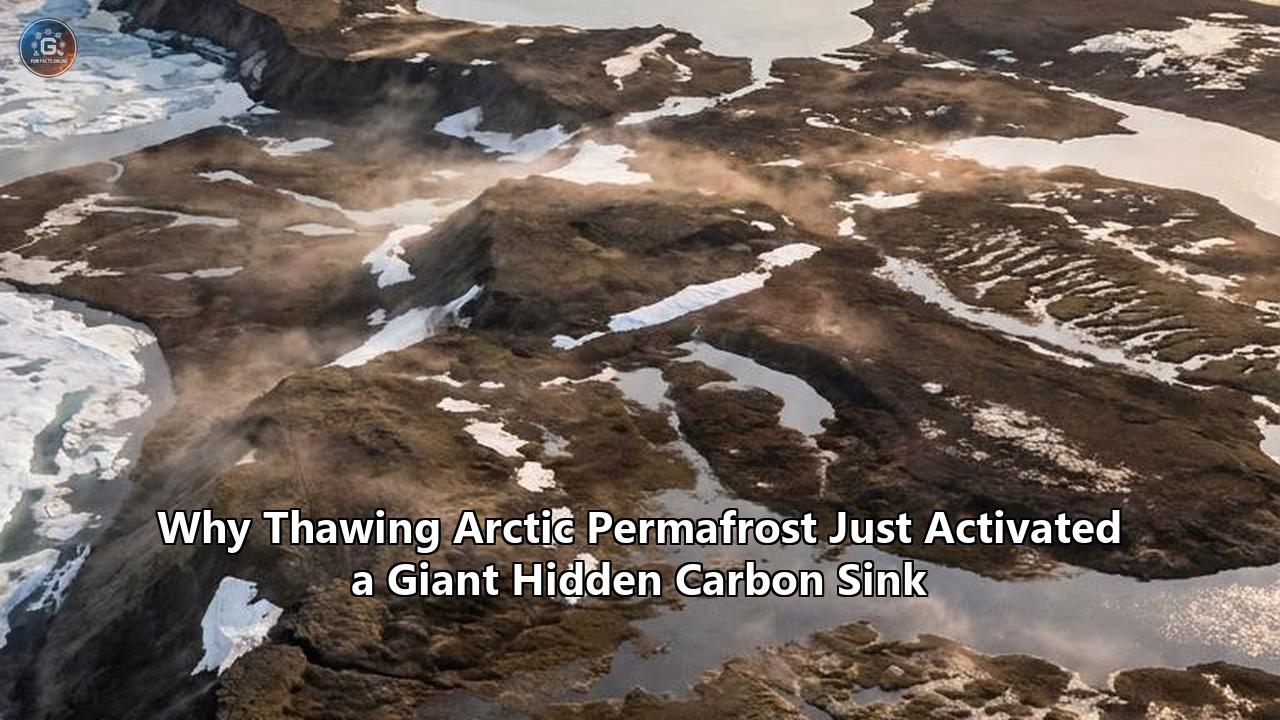
On June 17, 2026, a study published in the journal Nature fundamentally disrupted the prevailing scientific consensus on the fate of global permafrost. For decades, the millions of square kilometers of frozen ground wrapping around the northern hemisphere have been described in increasingly dire terms: a ticking climate time bomb, a massive carbon liability, and a runaway positive feedback loop poised to accelerate global warming beyond human control.
However, the international research team—led by Dr. Liwei Zhang, a biogeochemist at East China Normal University, and Dr. Aaron Bufe, a sedimentologist at the Ludwig Maximilian University of Munich—unveiled an entirely unexpected planetary defense mechanism. As temperatures rise and the frozen ground degrades, it does not merely release greenhouse gases; it also activates a giant, hidden geological carbon sink.
By investigating 50 major river systems across the Qinghai-Tibet Plateau—the world’s largest high-altitude cryosphere—the researchers discovered that thawing permafrost triggers a rapid, regional-scale acceleration of chemical rock weathering. As the ice retreats, it exposes freshly crushed, highly reactive mineral surfaces that have been locked away from water and air for thousands of years.
When rain and meltwater interact with these exposed rocks, they spark chemical reactions that actively absorb carbon dioxide ($CO_2$) from the water before it can escape into the sky. In some of the river catchments studied, this natural, geological carbon uptake was so potent that it offset between 15% and 100%—averaging 78%—of the $CO_2$ emitted by the rivers. In areas where the permafrost had degraded into highly fragmented, "patchy" zones, the rock weathering actually absorbed more carbon than the biological system released, turning the local landscape into a net carbon sink.
This revelation introduces a profound complexity to our understanding of the high-latitude carbon cycle. It pits a biological source (microbes digesting thawing organic matter) against a geological sink (exposed minerals dissolving and capturing $CO_2$).
To understand the scale of this newly recognized arctic permafrost carbon sink dynamics, we must examine the competing mechanisms at play, compare natural geological processes with human-engineered carbon-capture technologies, and analyze the radically different ecological approaches proposed to manage the rapidly changing northern landscapes.
The Biogeochemical Tug-of-War: Biological Source vs. Geological Sink
To appreciate why this geological sink went unnoticed for so long, it is necessary to contrast it with the well-documented biological carbon cycle of the far north.
                                 [ CLIMATE WARMING ]
                                          │
                   ┌──────────────────────┴──────────────────────┐
                   ▼                                             ▼
       [ PERMAFROST THAWING ]                          [ PERMAFROST THAWING ]
                   │                                             │
                   ▼                                             ▼
       [ Microbial Activation ]                       [ Mineral Exposure ]
                   │                                             │
                   ▼                                             ▼
       [ Organic Decomposition ]                      [ Water-Rock Interaction ]
                   │                                             │
                   ▼                                             ▼
      [ Release of CO2 & CH4 ]                      [ Chemical Weathering (DIC) ]
                   │                                             │
                   ▼                                             ▼
        BIOLOGICAL SOURCE (Fast)                     GEOLOGICAL SINK (Durable)
The Biological Engine (Organic Carbon Feedback)
The traditional "carbon time bomb" model is driven entirely by biology. For millennia, the freezing temperatures of the Arctic and high-altitude tundra have acted as a planetary freezer, halting the decomposition of dead plants, roots, and animal matter. This has locked up an estimated 1,400 to 1,600 gigatons of organic carbon in the soil—roughly double the amount of carbon currently residing in Earth’s entire atmosphere.
As the climate warms, this freezer door is left open. Soil temperatures rise, activating dormant microbes. These organisms feast on the newly thawed organic matter, converting it into gaseous carbon dioxide ($CO_2$) in dry soils, or methane ($CH_4$) in waterlogged wetlands and thermokarst lakes.
The scale of this biological source is immense. A major synthesis published in Nature Climate Change in early 2025 demonstrated that roughly 30% to 40% of the Arctic tundra and boreal forest region has already transitioned into a net source of carbon emissions. These biological emissions are fast-acting, highly responsive to incremental increases in summer temperature, and feed directly back into atmospheric warming.
The Geological Shield (Inorganic Carbon Weathering)
The June 2026 Nature study shifts the focus from organic biological material to inorganic minerals. When permafrost thaws, the physical structure of the ground often collapses, leading to slumping, landslides, and accelerated soil erosion. This physical degradation behaves like a massive, natural milling machine, exposing fresh bedrock, glacial till, and sub-surface sediments to the elements.
When rain falls or ice melts, the water absorbs atmospheric $CO_2$ to form a weak acid known as carbonic acid ($H_2CO_3$):
$$\text{CO}_2 + \text{H}_2\text{O} \rightleftharpoons \text{H}_2\text{CO}_3$$
As this mildly acidic water trickles over the newly exposed, unweathered mineral surfaces, it initiates chemical weathering. The acid dissolves alkaline minerals—such as calcium and magnesium silicates—and chemically binds the dissolved carbon. This reaction transforms the gaseous $CO_2$ into dissolved inorganic carbon (DIC), primarily in the form of stable bicarbonate ions ($HCO_3^-$):
$$\text{H}_2\text{CO}_3 + \text{CaSiO}_3 \text{ (Silicate Mineral)} \rightarrow \text{Ca}^{2+} + 2\text{HCO}_3^- + \text{SiO}_2$$
These bicarbonate ions are highly stable. Instead of venting back into the atmosphere as a greenhouse gas, they remain dissolved in groundwater and river systems, eventually flowing into the global oceans where they can be durably stored for tens of thousands of years.
The Coupled Feedback Loop
What makes this situation unique is that the biological and geological pathways are not operating in isolation; they are chemically coupled.
When soil microbes decompose organic carbon, they release high concentrations of $CO_2$ directly into the soil pore waters. This biological activity dramatically lowers the pH of the water, making it far more acidic than normal rainwater. This highly acidic water, in turn, accelerates the chemical dissolution of the surrounding minerals, driving rock weathering at rates far exceeding what would occur on a barren, abiotic rock surface.
In essence, the very biological decay that threatens to warm the planet supplies the chemical fuel required for the geological sink to neutralize it. This biogeochemical coupling represents a self-regulating negative feedback mechanism that helps dampen the severity of the permafrost carbon release.
Silicates vs. Sulfides: The Mineralogical Trapdoor
While the discovery of this natural geological sink offers a glimmer of climate hope, the researchers behind the Nature study are quick to emphasize that rock weathering is not a uniform planetary cure-all. The efficiency of the arctic permafrost carbon sink depends entirely on a high-stakes mineralogical lottery: the specific type of rock buried beneath the ice.
The chemical weathering of rocks generally follows one of two primary pathways, each yielding completely opposite results for the global climate system.
1. Silicate Weathering (The Carbon Sink)
When water-rock interactions involve silicate-rich minerals—such as feldspars, albite, or olivine—the chemical reaction results in a net, long-term removal of carbon dioxide from the atmosphere. Because silicate rocks do not contain carbon or sulfur within their crystal lattices, the chemical reactions rely solely on the carbonic acid derived from the atmosphere.
Every mole of silicate rock weathered effectively sequesters atmospheric carbon, converting it into ocean alkalinity. This is the ideal geological scenario. Across the western and northern expanses of the Qinghai-Tibet Plateau, silicate-rich rocks dominate the landscape. In these areas, the degradation of permafrost consistently drove a highly efficient carbon sink, offsetting the biological river emissions almost entirely.
2. Sulfide and Carbonate Weathering (The Carbon Source)
The geological math turns dark when the thawing permafrost contains sulfide-bearing minerals, most notably pyrite ($FeS_2$), commonly known as "fool's gold".
When pyrite is exposed to water and atmospheric oxygen, it oxidizes. This reaction does not require acid; instead, it produces one of the strongest acids known: sulfuric acid ($H_2SO_4$):
$$4\text{FeS}_2 + 15\text{O}_2 + 14\text{H}_2\text{O} \rightarrow 4\text{Fe(OH)}_3 + 8\text{H}_2\text{SO}_4$$
If this highly corrosive sulfuric acid encounters carbonate rocks—such as limestone ($CaCO_3$) or dolomite ($CaMg(CO_3)_2$), which are frequently co-located with sulfide deposits—it dissolves them. Unlike silicate weathering, which consumes atmospheric carbon, sulfuric acid weathering of carbonates actively releases carbon dioxide into the surrounding water and atmosphere:
$$\text{H}_2\text{SO}_4 + 2\text{CaCO}_3 \rightarrow 2\text{Ca}^{2+} + 2\text{HCO}_3^- + \text{SO}_4^{2-}$$
Under highly acidic conditions, the reaction can bypass the bicarbonate stage entirely, venting $CO_2$ gas directly into the air:
$$\text{H}_2\text{SO}_4 + \text{CaCO}_3 \rightarrow \text{Ca}^{2+} + \text{SO}_4^{2-} + \text{H}_2\text{O} + \text{CO}_2 \uparrow$$
This means that in pyrite-rich catchments, thawing permafrost actually accelerates geological carbon emissions, compounding the biological feedback loop.
| Geochemical Metric | Silicate Weathering Pathway | Sulfide-Carbonate Weathering Pathway |
|---|---|---|
| Primary Acid Involved | Carbonic Acid ($H_2CO_3$) | Sulfuric Acid ($H_2SO_4$) |
| Typical Minerals | Albite, Olivine, Quartz, Feldspars | Pyite ($FeS_2$), Calcite, Limestone |
| Atmospheric $CO_2$ Impact | Net Drawdown (Sink) | Net Release (Source) |
| Storage Medium | Dissolved marine bicarbonate ($HCO_3^-$) | Gaseous $CO_2$ venting / Sulfate ions |
| Dominant Region Example | Western Qinghai-Tibet Plateau | Peel Plateau, Northwest Territories, Canada |
This geological duality was observed in the southeastern portion of the studied plateau. In these catchments, sulfide-rich formations are common. The researchers found that instead of acting as a carbon sink, the rock weathering in these areas acted as an additional carbon source, neutralizing the buffering capacity of the surrounding silicate rocks.
A similar, highly problematic dynamic has been observed on the Peel Plateau in the Canadian Northwest Territories. There, massive, retrogressive thaw slumps are unearthing deep, unweathered glacial tills rich in both carbonate minerals and pyrite. The resultant runoff is heavily loaded with sulfuric acid and sulfate ions, generating an abiotic source of $CO_2$ that further exacerbates the local climate feedback loop.
Natural Weathering vs. Enhanced Rock Weathering (ERW)
The discovery that natural, thaw-induced weathering can serve as a massive carbon sink inevitably invites comparison to one of the most prominent human-engineered carbon dioxide removal (CDR) technologies: Enhanced Rock Weathering (ERW).
Both approaches rely on the same fundamental chemical principles—the dissolution of alkaline silicate rocks to convert atmospheric $CO_2$ into stable bicarbonate ions. However, the operational tradeoffs, energetic costs, geographic limitations, and ecological risks of these two pathways are starkly different.
1. Energetic Footprints and Carbon Payback Ratios
The primary structural challenge of human-engineered ERW is its massive energy requirement. To execute ERW at a scale capable of impacting global climate, humans must actively mine silicate rocks (such as basalt or olivine), grind them into an ultra-fine powder to maximize surface area, transport the heavy material over long distances, and spread it across millions of hectares of agricultural soils.
This entire supply chain relies heavily on mechanical infrastructure, much of which is currently powered by fossil fuels. If the energy used to mine, grind, and transport the rock exceeds the carbon subsequently sequestered by chemical weathering, the technology becomes counterproductive.
In contrast, natural permafrost weathering has an energetic cost of absolute zero. The mechanical force required to expose and "grind" the minerals is provided entirely by natural, geomorphological processes: thermal expansion, frost wedging, glacial scouring, and retrogressive land slumping. The transport mechanism is gravity and flowing meltwater. From a thermodynamic and carbon-accounting perspective, natural permafrost weathering has an infinite carbon payback ratio, making it an incredibly efficient, passive carbon-sink mechanism.
2. Kinetics: Temperature vs. Surface Area
A major criticism of relying on natural weathering in polar and alpine permafrost regions is the kinetic limitation of temperature. Chemical reactions, including mineral dissolution, are temperature-dependent; they occur significantly faster in warm, humid tropical environments than in the freezing, dry conditions of the Arctic or the Tibetan Plateau. Human-engineered ERW exploits this kinetic advantage by deliberately targeting agricultural lands in tropical or temperate zones, where high soil temperatures and consistent rainfall accelerate the weathering rate.
However, the natural arctic permafrost carbon sink compensates for the cold polar climate through a different physical variable: extreme mineral reactivity and surface area.
The minerals trapped in and beneath permafrost have been preserved in a highly pristine state, shielded from chemical alteration for thousands of years. Furthermore, many of these sediments are composed of glacial flour—extremely fine dust generated by the grinding weight of ancient glaciers. This ultra-fine material possesses an incredibly high surface-area-to-volume ratio, allowing chemical reactions to proceed rapidly despite the low ambient water temperatures.
When temperature rises just enough to melt the surrounding ice, the sudden contact between water and these highly reactive, fine-grained minerals triggers a chemical burst that rivals the weathering rates of temperate soils.
3. Risk Management and Mineralogical Control
The most significant advantage of human-engineered ERW over natural permafrost weathering is control. In an engineered ERW deployment, scientists can carefully select the rock feedstock. By utilizing pure, high-quality basalt or olivine, operators can ensure that they are deploying rocks with optimal silicate concentrations while avoiding minerals that contain pyrite, heavy metals, or asbestos-like fibers.
Natural permafrost weathering offers no such control. It is entirely dependent on the geographical randomness of the local geology. If a thawing landscape happens to sit atop a sulfide-rich or carbonate-rich deposit, the natural weathering will proceed unguided, potentially releasing massive volumes of $CO_2$ or leaching toxic heavy metals—such as nickel, chromium, and arsenic—directly into fragile Arctic aquatic ecosystems.
| Operational Metric | Natural Permafrost Weathering | Enhanced Rock Weathering (ERW) |
|---|---|---|
| Energetic Cost | Zero (Driven by gravity, thermal thaw, and geomorphology) | High (Mining, industrial milling, and truck transportation) |
| Mineral Control | None (Dependent on local subsoil geology) | Complete (Engineered feedstock selection, e.g., basalt) |
| Reaction Kinetics | Slowed by cold temperatures, but accelerated by high-reactivity glacial sediments | Optimized by targeting warm, wet tropical and temperate agricultural zones |
| Ecological Risks | Acid rock drainage, heavy metal leaching, unplanned $CO_2$ venting | Soil pH alteration, trace element accumulation in crops |
| Scalability | Self-scaling as global temperatures rise | Limited by mining capacity, farming participation, and supply chains |
Rewilding, Greening, or Weathering? Competing Visions for the Far North
The realization that the high latitudes are undergoing rapid, systemic geochemical transformation has intensified a fierce debate among climatologists, ecologists, and policymakers. How should humanity respond to the warming north?
There are currently three competing paradigms, each proposing a fundamentally different approach to managing, leveraging, or mitigating the carbon dynamics of the thawing cryosphere.
       [ ECOLOGICAL PARADIGMS FOR THE FAR NORTH ]
                          │
       ┌──────────────────┼──────────────────┐
       ▼                  ▼                  ▼
 [ PRESERVATION ]  [ BIOLOGICAL CO2 ]  [ GEOCHEMICAL ]
  (Rewilding)         (Greening)        (Buffering)
       │                  │                  │
  Pleistocene         Tundra & Boreal       Rock Weathering
     Park            Plant Growth       Passive Mitigation
       │                  │                  │
  Keep Carbon       Store Carbon in     Convert Carbon
    Frozen               Biomass         to Bicarbonate
Paradigm 1: Active Ecological Preservation (The Rewilding Approach)
The most radical, hands-on biological intervention is the rewilding approach, epitomized by the Pleistocene Park project in northeastern Siberia. Pioneered by Russian scientists Sergey and Nikita Zimov, this initiative argues that the key to stabilizing the high-latitude carbon cycle is not to let the permafrost thaw and hope for geological buffering, but to actively prevent the thaw from happening in the first place.
                     [ INTRODUCE LARGE HERBIVORES ]
                       (Bison, Horses, Musk Oxen)
                                   │
                   ┌───────────────┴───────────────┐
                   ▼                               ▼
         [ Winter Trampling ]            [ Vegetation Shift ]
                   │                               │
                   ▼                               ▼
         [ Compaction of Snow ]          [ Forest to Grassland ]
                   │                               │
                   ▼                               ▼
        [ Deeper Winter Freeze ]         [ Increased Albedo ]
                   │                               │
                   └───────────────┬───────────────┘
                                   ▼
                       [ PREVENT PERMAFROST THAW ]
The Zimovs’ strategy revolves around restoring the highly productive "mammoth steppe" ecosystem that dominated the Arctic during the late Pleistocene. By introducing high densities of large, cold-adapted herbivores—such as Yakutian horses, bison, yaks, and musk oxen—the project aims to trigger a cascade of biophysical feedbacks:
- Snow Trampling: In the Arctic winter, a thick, fluffy blanket of snow acts as an insulating duvet, trapping summer heat in the ground and preventing the extreme winter cold from deeply freezing the soil. When herds of heavy herbivores trample and compact the snow in search of forage, they destroy this insulating layer. This allows ground temperatures to plummet from a relatively mild -5°C to a deep, stabilizing -30°C when air temperatures are -40°C, significantly delaying or halting permafrost thaw.
- Albedo Modification: The current Arctic is undergoing transition as shrubification and the expansion of dark boreal forests replace reflective snow and light-colored grasses. Dark trees and shrubs absorb solar radiation, warming the regional microclimate. Large herbivores systematically knock down trees and shrubs, replacing them with highly reflective grasslands that bounce solar energy back into space, cooling the region.
- Deep Root Sequestration: Unlike slow-growing mosses and woody shrubs, grasses develop deep, dense, fast-growing root networks that actively draw $CO_2$ from the atmosphere and deposit stable organic carbon deep into the cold, protective soil.
While Pleistocene Park has successfully demonstrated local cooling effects, scaling this approach to a circumpolar level presents monumental challenges. It requires importing, breeding, and maintaining hundreds of millions of large animals across vast, trackless wildernesses spanning Canada, Alaska, and Russia. The logistical, geopolitical, and financial costs are astronomical, and the timeline required to convert millions of square kilometers of boreal forest back into steppe grassland is likely too slow to counteract the immediate pressures of global warming.
Paradigm 2: Passive Biological Sequestration (The Arctic Greening View)
A second, more passive biological paradigm suggests that nature is already self-correcting through a process known as "Arctic greening". Proponents of this view point to the rapid northward migration of shrubs, plants, and trees as temperatures rise.
As the growing season lengthens and atmospheric $CO_2$ concentrations rise, plants photosynthesize more rapidly, absorbing more carbon and storing it as new biomass and organic soil matter. Some global climate models have historically predicted that this biological greening would act as a massive carbon sink, largely offsetting the emissions from thawing soils.
The Tradeoffs of Greening:Recent empirical evidence has severely undermined this optimistic biological narrative. The early 2025 Nature Climate Change study led by Dr. Anna Virkkala revealed that despite the dramatic greening of the Arctic, only 12% of these greening areas are actually taking up more net carbon than they release.
The reasons are twofold:
- Water Stress and Wildfires: Rising temperatures do not just stimulate plant growth; they also dry out the soil, inducing severe water stress that stunts vegetation growth. Furthermore, the massive accumulation of dry, woody shrubs and trees provides a continuous fuel source for catastrophic wildfires. These fires burn through the organic layer of the soil, instantly releasing decades of accumulated biological carbon back into the atmosphere and exposing the underlying permafrost to rapid, deep thermal degradation.
- The Winter Offset: Plants only photosynthesize and absorb carbon during the brief, 2-to-3-month Arctic summer. However, the soil microbes do not sleep during the winter. Recent winter-flux measurements show that soil respiration continues throughout the long, dark polar cold season, releasing enough carbon to completely wipe out any summer biological gains.
Paradigm 3: Geochemical Buffering (The Inorganic Realism)
The newly emerged third paradigm—rooted in the June 2026 Nature discovery—is geochemical buffering. This approach takes a highly realistic, physics-first stance. It acknowledges that humanity is highly unlikely to stop permafrost thaw through rewilding, and that biological greening is a volatile, transient sink easily erased by wildfires and winter respiration.
Instead, this paradigm focuses on the massive, unavoidable, and durable geochemical reactions occurring beneath the surface. Unlike biological carbon sinks (biomass, roots, and organic soil), which are highly vulnerable to fire, decay, and environmental changes, the geological sink converts carbon into dissolved bicarbonate ions. Once dissolved in water and carried to the ocean, this carbon is locked away for geological timescales—completely immune to wildfires, microbial decay, or temperature fluctuations.
The Tradeoffs of Geochemical Buffering:The principal limitation of geochemical buffering is that it is entirely passive and geologically constrained. Humanity cannot easily intervene to speed up silicate weathering in the remote, roadless wildernesses of the far north without incurring the massive energetic and environmental costs associated with industrial ERW.
Furthermore, as established, if the local geology is rich in sulfides rather than silicates, this passive process backfires, acting as a powerful abiotic carbon source.
Rewriting the IPCC Climate Models
The immediate, most consequential impact of the June 2026 Nature study is not a physical intervention, but a mathematical one. It exposes a massive, systemic blind spot in the Earth System Models (ESMs) used by the Intergovernmental Panel on Climate Change (IPCC) to project future global warming trajectories.
The Model Gap
Historically, global climate models have treated the thawing permafrost as a simple, one-way biological highway: warmth goes in, microbes wake up, and carbon dioxide and methane come out. The complex geological interactions occurring in river networks have been largely omitted.
This is primarily because representing riverine geochemistry requires coupling hydrological, biological, and geological modules—a task that is computationally expensive and historically suffered from a severe lack of high-latitude field data.
By failing to account for rock weathering, current models are almost certainly overestimating the net riverine carbon emissions of thawing permafrost in silicate-dominated catchments.
For example, if a model projects that a specific region will emit 10 million tons of carbon from river systems, but fails to account for a weathering-driven offset of 78%, its projections will be off by a massive margin. This overestimation can lead to inaccurate carbon budgets, distorted climate mitigation targets, and flawed policy decisions.
┌────────────────────────────────────────────────────────┐
│               CURRENT IPCC CLIMATE MODELS              │
├────────────────────────────────────────────────────────┤
│  Permafrost Thaw ──► Microbial Decay ──► Net CO2/CH4    │
│  (Treats permafrost as a simple, one-way source)       │
└──────────────────────────┬─────────────────────────────┘
                           │  Missing: Geochemistry
                           ▼
┌────────────────────────────────────────────────────────┐
│            POST-2026 COUPLED BIOGEOCHEMICAL MODELS      │
├────────────────────────────────────────────────────────┤
│                         ┌──► Microbial Decay ──► Source│
│                         │                              │
│  Permafrost Thaw ───────┼──► Silicate Rock   ──► Sink  │
│                         │    Weathering                │
│                         │                              │
│                         └──► Sulfide-Pyrite  ──► Source│
│                              Weathering                │
└────────────────────────────────────────────────────────┘
The Challenge of Spatial Heterogeneity
To fix these models, scientists face a monumental hurdle: mapping the sub-surface mineralogy of the entire northern hemisphere.
Unlike forest cover or surface greening, which can be easily monitored via satellite remote sensing, the minerals buried beneath meters of frozen soil and peat cannot be read from space. Geologists must rely on painstaking, ground-based sampling, geochemical modeling, and river water chemistry analyses to infer the underlying geology.
Because the Arctic landscape is incredibly heterogeneous—with a silicate-rich valley sitting right next to a sulfide-rich mountain range—the climate models cannot apply a single, uniform weathering rate to the entire region.
Modelers must develop highly localized, high-resolution geological maps that can tell them exactly where thawing permafrost will activate a life-saving silicate carbon sink, and where it will open a toxic, sulfide-driven carbon source.
Looking Ahead: The Polar Frontiers
The discovery of the thaw-activated carbon sink on the Tibetan Plateau marks the beginning, not the end, of a major scientific frontier. As researchers digest these findings, attention is rapidly shifting to the circum-polar Arctic—the vast, low-lying tundra and boreal zones of Siberia, Alaska, and northern Canada.
Does the Tibetan Model Apply to the Arctic?
A critical unresolved question is whether the massive weathering rates observed on the Qinghai-Tibet Plateau can be replicated in the flat, low-energy landscapes of the high Arctic.
The Tibetan Plateau is a tectonically active, high-altitude alpine environment. It features steep slopes, high rates of physical erosion, and rapid river flow, all of which naturally accelerate water-rock interactions and physical rock crushing.
In contrast, much of the Arctic tundra consists of flat, wet, organic-rich lowlands where water moves slowly through deep peat blankets. In these environments, water may not easily come into contact with the underlying mineral bedrock, potentially limiting the scale of the geological weathering sink.
However, early data from major Arctic river deltas—such as the Mackenzie Delta in Canada and the Lena River in Siberia—suggest that the geological sink is still highly active, albeit through different mechanisms.
As the sea ice retreats, rising sea levels and warming river waters are driving massive coastal erosion and deltaic slumping. These physical collapses dump billions of tons of pristine sediment directly into turbulent river channels and coastal lagoons, creating highly dynamic zones of water-mineral interaction that could trigger a localized, powerful Arctic weathering sink.
The Ultimate Fate of Polar Bicarbonate
Another key milestone that scientists are watching is the long-term chemical stability of the dissolved bicarbonate as it travels from tundra rivers into the polar oceans.
While bicarbonate is highly stable, the Arctic Ocean is currently undergoing rapid acidification, driven by the absorption of atmospheric $CO_2$ and the loss of protective sea ice. As these cold, acidic ocean waters receive massive influxes of alkaline, bicarbonate-rich river water, a complex chemical balancing act occurs.
If the river-derived alkalinity can effectively buffer the local ocean acidification, it could provide a double benefit: permanently sequestering atmospheric carbon while simultaneously shielding fragile marine calcifiers—such as pteropods and bivalves—from the corrosive effects of acidifying seas.
However, if the mixing dynamics are highly turbulent, or if the water encounters high concentrations of dissolved organic acids from decaying peat, some of that bicarbonate could theoretically decompose, venting $CO_2$ back into the polar atmosphere before permanent marine storage is achieved.
Upcoming Research Initiatives
Over the next several years, a series of international, multi-disciplinary research campaigns are set to launch to resolve these critical uncertainties:
- The Polar Rock Project (2026–2029): An international collaborative effort aiming to drill thousands of shallow core samples across the Siberian and North American Arctic to map sub-permafrost mineralogy.
- The Arctic River Geochemistry Network (ARGN): A newly proposed real-time sensor network designed to monitor dissolved inorganic carbon (DIC), pH, and isotopic tracers in major polar rivers, allowing scientists to track weathering rates in real-time as the seasons change.
- Next-Generation ESM Integration: Software development teams at major climate modeling centers—including the National Center for Atmospheric Research (NCAR) and the European Centre for Medium-Range Weather Forecasts (ECMWF)—are already working to code the first coupled biogeochemical-weathering modules into their global forecasting models.
Ultimately, the discovery of the thaw-activated carbon sink does not let humanity off the hook. As Dr. Aaron Bufe soberly noted, "Human activity emits around 100 times more $CO_2$ each year than silicate weathering removes from the atmosphere. Even if permafrost thaw causes a slight increase in weathering rates, the effect will remain far too small. The only real solution is to drastically cut our emissions".
What this discovery does provide, however, is a profound lesson in planetary physics. It reveals that the Earth is not a passive victim of warming, but a highly complex, interconnected biogeochemical system. As we force the planet’s biological systems to their breaking points, the underlying geology is waking up—using the very decay of the old world to slowly, quietly forge the chemical stabilizers of the new.
References
Umeå University. (2026-06-17). "Thawing permafrost may trigger overlooked carbon sink in rivers." umu.se.
Ecoticias. (2026-06-19). "Arctic river deltas hold massive carbon stockpile." ecoticias.com.
SFLOrg. (2026-06-17). "Rock weathering can counteract river carbon dioxide emissions as permafrost degrades." sflorg.com.
MyScience. (2026-06-18). "EPFL study: Permafrost thaw triggers processes that remove carbon from the atmosphere." myscience.ch.
Earth.com. (2026-06-20). "Exposed rock pulls carbon back as permafrost retreats." earth.com.
National Snow and Ice Data Center (NSIDC). (2020). "Carbon cycle and permafrost feedback." nsidc.org.
National Oceanic and Atmospheric Administration (NOAA). (2019). "Arctic Report Card: Permafrost carbon." noaa.gov.
Ludwig Maximilian University of Munich (LMU). (2026-06-18). "Biogeochemical patterns in the Qinghai-Tibet Plateau shed new light." lmu.de.
ResearchGate. (2026-06-19). "Rock weathering can counteract river CO2 emissions induced by permafrost thaw." Nature. researchgate.net.
Frontiers in Earth Science. (2020-05-21). "Thermokarst, weathering, and carbon cycling on the Peel Plateau." frontiersin.org.
California Institute of Technology (Caltech). (2023). "Sulfide oxidation responds to permafrost thaw with a timescale-dependent feedback." caltech.edu.
Pleistocene Park Foundation. (2022). "Permafrost carbon preservation through rewilding." pleistocenepark.ru.
Harvard University. (2023). "Pleistocene Park: Restoring grazing ecosystems to stabilize permafrost." harvard.edu.
Frontiers in Environmental Science. (2022-08-24). "Rewilding impacts on Arctic permafrost landscapes." frontiersin.org.
The Guardian. (2025-01-21). "A third of Arctic’s tundra, forests, and wetlands are now carbon sources." theguardian.com.
Earthwise Radio. (2025-04-16). "Arctic greening vs. carbon sources: The new balance." earthwiseradio.org.
Isometric. (2025-03-13). "How Enhanced Weathering works." isometric.com.
Massachusetts Institute of Technology (MIT). (2023-11-09). "Enhanced rock weathering as a carbon removal strategy." mit.edu.
Yale Center for Natural Carbon Capture (YCNCC). (2026). "Enhanced Weathering research update." yale.edu.
Reference:
- https://www.umu.se/en/news/thawing-permafrost-may-trigger-overlooked-carbon-sink-in-rivers_12177096/
- https://www.ecoticias.com/en/researchers-warn-of-a-climate-time-bomb-in-the-arctic-involving-roughly-63-4-billion-tons-of-carbon-that-could-amplify-warming-faster-than-expected/33499/
- https://nsidc.org/learn/parts-cryosphere/frozen-ground-permafrost/why-frozen-ground-matters
- https://www.sciencedaily.com/releases/2026/06/260619101343.htm
- https://www.earth.com/news/thawing-permafrost-reveals-how-rivers-can-capture-carbon/
- https://www.sflorg.com/2026/06/es06172602.html
- https://arctic.noaa.gov/report-card/report-card-2019/permafrost-and-the-global-carbon-cycle/
- https://www.theguardian.com/environment/2025/jan/21/third-of-arctic-carbon-sink-now-a-source-of-emissions-study
- https://earthwiseradio.org/podcast/the-warmer-greener-arctic-and-greenhouse-gas/
- https://en.wikipedia.org/wiki/Permafrost_carbon_cycle
- https://www.frontiersin.org/journals/earth-science/articles/10.3389/feart.2020.00152/pdf
- https://isometric.com/writing-articles/enhanced-weathering-explained
- https://climate.mit.edu/explainers/enhanced-rock-weathering
- https://www.researchgate.net/publication/407223598_Rock_weathering_can_counteract_river_CO2_emissions_induced_by_permafrost_thaw?_tp=eyJjb250ZXh0Ijp7InBhZ2UiOiJzY2llbnRpZmljQ29udHJpYnV0aW9ucyIsInByZXZpb3VzUGFnZSI6bnVsbCwic3ViUGFnZSI6bnVsbH19
- https://eos.org/research-spotlights/source-or-sink-a-review-of-permafrosts-role-in-the-carbon-cycle
- https://www.lmu.de/en/newsroom/news-overview/news/rock-weathering-may-counteract-carbon-dioxide-emissions-from-thawing-permafrost-6f235f39.html
- https://en.wikipedia.org/wiki/Enhanced_weathering
- https://lamb.caltech.edu/documents/34121/Arctic-Permafrost-Thawing-Enhances-Sulfide-Oxidation.pdf
- https://naturalcarboncapture.yale.edu/research/geological-ocean-capture/enhanced-weathering
- https://www.gsd.harvard.edu/project/pleistocene-park/
- https://pleistocenepark.ru/science/
- https://www.grasslandgroupies.org/the-best-biome/pleistocene-park/
- https://www.frontiersin.org/journals/environmental-science/articles/10.3389/fenvs.2022.893478/full
- https://en.wikipedia.org/wiki/Pleistocene_Park
- https://nsidc.org/learn/parts-cryosphere/frozen-ground-permafrost/why-frozen-ground-matters
- https://arctic.noaa.gov/report-card/report-card-2019/permafrost-and-the-global-carbon-cycle/
- https://www.eurekalert.org/news-releases/1132049