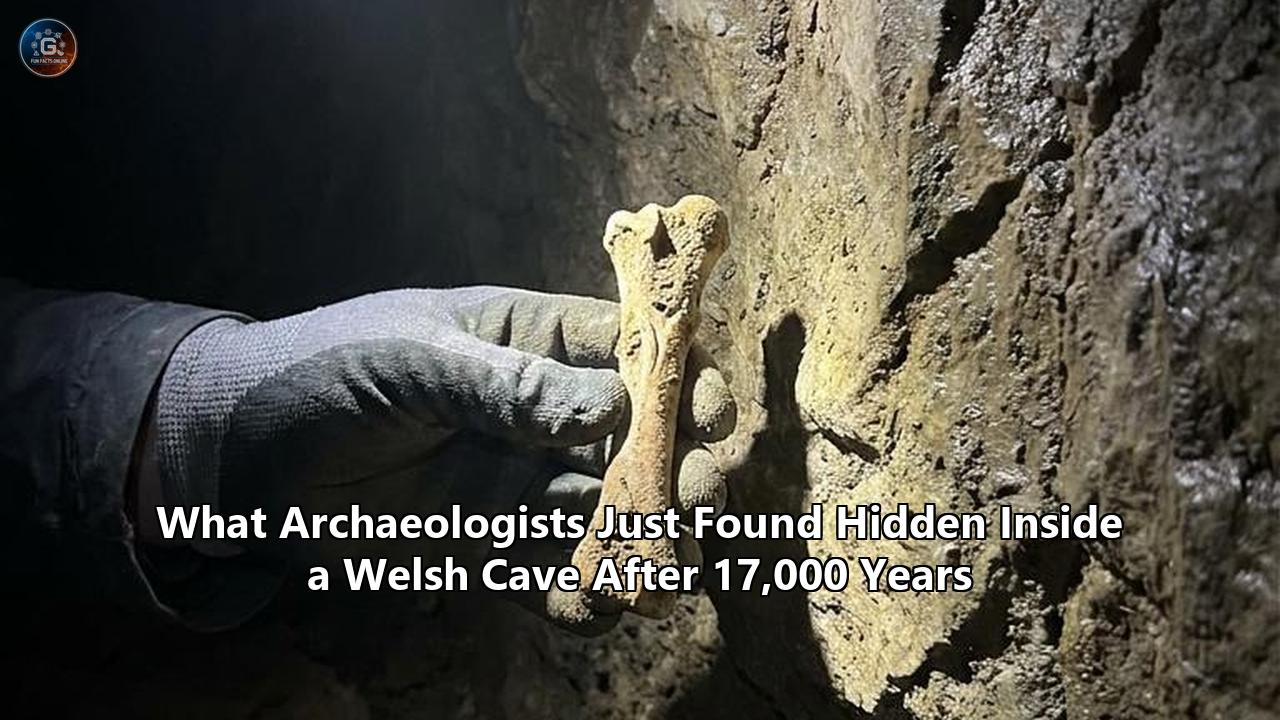
At the wind-swept, wave-battered edge of the Gower Peninsula in South Wales, a geological sentinel known as Bacon Hole overlooks the grey expanse of the Bristol Channel. For more than a century, a series of ten parallel red stripes painted onto the limestone walls of a dark, narrow side chamber within this cave was dismissed as nothing more than natural staining—the accidental byproduct of iron-rich mineral seepage.
That consensus has been completely overturned.
An international, multidisciplinary team of archaeologists and geoscientists has officially confirmed that these red markings are genuine Upper Paleolithic cave paintings created by human fingers approximately 17,100 years ago. This revelation officially establishes the Bacon Hole markings as the oldest known rock art in the United Kingdom and northwestern Europe, pushing back the regional timeline of human artistic expression by more than 1,500 years.
The announcement, coordinated through National Trust Cymru (the custodians of the site) and published in the journal Quaternary, has sent shockwaves through the global archaeological community. By utilizing cutting-edge radiometric dating and chemical analysis, the research team has solved a 114-year-old scientific mystery, vindicating the turn-of-the-century pioneers who first identified the art, only to be ridiculed and ignored for nearly a century.
"This is the earliest prehistoric art we have in Britain," says Dr. George Nash, an associate professor at the Geosciences Centre of Coimbra University in Portugal and an honorary research fellow at the University of Liverpool, who led the international team. "To discover that the oldest cave art in Britain lies here in Wales is very exciting. To imagine people standing in this cave over 17,000 years ago, making their marks on the rock and transforming the places they lived through art, is profoundly moving."
This discovery is not merely a triumph of modern scientific dating; it is a transformative event that fundamentally reshapes our understanding of the social, ritual, and cognitive lives of Britain's earliest ancestors. Through a systematic impact analysis, we can explore how this single discovery reverberates across the academic community, changes our perception of Ice Age Europe, dictates immediate conservation strategies, and establishes a new baseline for future archaeological discoveries in Wales.
The Gower Peninsula's Subterranean Sanctuary
To comprehend the sheer magnitude of the Bacon Hole discovery, one must first understand the landscape in which it is situated. The Gower Peninsula, a limestone finger jutting into the Bristol Channel near Swansea, is renowned for its dramatic cliffs, rugged bays, and complex karstic cave systems. It is a landscape saturated with deep time.
Bacon Hole is a large, southwest-facing cave carved into the Carboniferous limestone, with an entrance measuring approximately 18 meters wide and 6 meters high. Positioned roughly 9 meters above the modern high-water mark, the cave has served as an exceptional repository of prehistoric archives. Over the past two centuries, various excavations within its main gallery have unearthed a rich sequence of Pleistocene faunal remains, documenting the dramatic environmental transitions of the last Ice Age.
+-----------------------------------------------------------------+
|                    BACON HOLE CAVE STRUCTURE                    |
|                                                                 |
|   ===================== [Entrance] =====================       |
|    (18m wide, 6m high, 9m above modern sea level)              |
|                                                                 |
|                               |                                 |
|                               | (Main Gallery: 36m deep)        |
|                               v                                 |
|                                                                 |
|                      [Central Chamber]                          |
|                               |                                 |
|          +--------------------+--------------------+            |
|          | (NE Passage)                            |            |
|          v                                         v            |
|   [Side Chamber]                            [Main Gallery       |
|   (3m wide, 7.5m long)                       Extension]         |
|          |                                                      |
|   [The Painted Panel]                                           |
|   (10 Red Finger-Stripes)                                       |
|   (At least 17,100 Years Old)                                   |
+-----------------------------------------------------------------+
But while the main gallery of Bacon Hole was long celebrated for its fossilized bones of bison, mammoths, and hyenas, its most valuable cultural treasure lay hidden in a much darker, quieter recess: a narrow side chamber extending to the northeast of the main cave, measuring just 3 meters wide and 7.5 meters long.
It was within this secluded, shadow-drenched gallery that an Ice Age human stepped away from the light of the cave entrance, mixed a precise recipe of iron-rich mineral pigment, and pressed their pigment-coated fingers against the cold limestone wall. For millennia, these marks remained untouched, slowly sealed beneath a protective, translucent skin of calcium carbonate deposited by the steady, quiet drip of subterranean water.
A Century of Skepticism: The 1912 Controversy
The journey to authenticating the Bacon Hole cave art is a cautionary tale of scientific skepticism, academic bias, and the limitations of early 20th-century archaeology.
In October 1912, the prominent British geologist Professor William Sollas of Oxford University and the legendary French archaeologist Abbé Henri Breuil—famed for his pioneering work on the Paleolithic cave art of Lascaux and Altamira—conducted a survey of the caves of South Wales. Upon entering the eastern side chamber of Bacon Hole, they identified a panel of parallel horizontal lines drawn in a vibrant red pigment.
Sollas and Breuil immediately recognized the markings as anthropogenic. They proclaimed the find to be the very first specimen of Paleolithic cave painting ever discovered in the British Isles. The announcement sparked a sensation, generating headline news across the globe, with reports featured prominently in The New York Times, The Guardian, and The Manchester Guardian.
1912: Sollas and Breuil discover the red stripes; declare them Paleolithic cave art.
  │
  v
1928: Skeptics dismiss the art as natural iron oxide stains; site is academically abandoned.
  │
  v
1984: Extensive faunal excavations by the Natural History Museum ignore the side chamber.
  │
  v
2022: Dr. George Nash and team rediscover the panel; launch multi-year investigation.
  │
  v
2026: Uranium-Thorium dating and Raman spectroscopy confirm the art is 17,100 years old.
However, the scientific establishment of the era was deeply conservative and highly skeptical of British prehistory. Unlike the deep, cavernous galleries of southern France and northern Spain, Britain was widely viewed as a peripheral, artistically barren tundra during the Ice Age, sparsely populated by transient hunters who lacked the symbolic sophistication of their continental peers.
By 1928, prominent archaeologists, including Sir Mortimer Wheeler and local researcher John Fletcher Rutter, formally challenged the authenticity of the Bacon Hole paintings. They argued that the ten red lines were not the work of human hands, but rather "natural mineral seeps"—accidental bands of iron oxide (haematite) that had leached out of the limestone strata and run down the damp walls of the cave.
Unable to provide empirical, absolute dating to prove their theory, Breuil and Sollas's claims were dismissed. The Guardian published a retraction, stating:
"It was later established that the red streaks… turned out to be red oxide mineral seeping through the rock and not prehistoric art."
For nearly a century, this verdict stood as unchallenged academic orthodoxy. The red panel of Bacon Hole was cataloged as a natural phenomenon, largely ignored by subsequent generations of researchers, and left to the mercies of natural decay, modern graffiti, and obscurity.
The 2022 Rediscovery and the "First Art" Intervention
The turning point came in September 2022 during a filming project for a television documentary. Dr. George Nash, alongside researcher Dr. Barbara Oosterwijk, entered the side chamber of Bacon Hole. The exact location of the panel had been lost to time, as the early 20th-century investigators had failed to record precise coordinates or spatial maps of the side chamber.
Peering through the gloom, Oosterwijk spotted the faint, crimson bands beneath a thick layer of calcite. Unlike the skeptics of 1928, Nash and his colleagues were armed with a suite of non-destructive, high-resolution technologies that could look through the mineral crusts and analyze the underlying chemistry of the pigment.
Recognizing the immense potential of the site, Nash mobilized the "First Art" team—an international consortium of prehistoric art specialists based at the Geosciences Centre of the University of Coimbra in Portugal. Working in close collaboration with dating specialists from the University of Southampton, Swansea University, and Nanjing Normal University in China, the team initiated two highly targeted fieldwork campaigns in April 2023 and May 2024.
+-------------------------------------------------------------------------+
|                  THE MULTIDISCIPLINARY SCIENTIFIC TEAM                  |
|                                                                         |
|  * Lead Institution: Geosciences Centre, University of Coimbra (PT)     |
|  * Radiometric Dating: University of Southampton (UK)                  |
|  * Pigment Analysis: Nanjing Normal University (CN)                     |
|  * Regional Context: Swansea University (UK)                            |
|  * Academic Oversight: University of Liverpool (UK)                     |
|  * Conservation & Custodianship: National Trust Cymru                   |
|  * Financial Support: The Bradshaw Foundation                          |
+-------------------------------------------------------------------------+
To finally resolve the debate over human versus natural agency, the scientific team constructed a rigorous, dual-pronged methodology focused on absolute chronometric dating and detailed archaeometric pigment analysis.
The Science: How We Know It is 17,100 Years Old
The primary weapon used to break the century-old academic deadlock was Uranium-Thorium (U-Th) dating. Unlike radiocarbon dating, which requires organic carbon and can damage delicate pigments, U-Th dating is a radiometric technique that measures the radioactive decay of uranium isotopes into thorium within the inorganic calcite flowstone that has grown over the paintings.
When groundwater seeps through limestone, it dissolves calcium carbonate along with trace amounts of naturally occurring, soluble uranium ($^{234}\text{U}$). However, thorium ($^{230}\text{Th}$) is highly insoluble in water and is left behind. Once the calcite precipitates out of the water onto a cave wall, forming a flowstone or stalactite, it contains trace uranium but zero thorium. Over time, the uranium locked within the calcite crystal lattice decays into thorium-230 at an incredibly precise, known rate.
By extracting micro-samples of the calcite overlying the red pigment and measuring the ratio of $^{234}\text{U}$ to $^{230}\text{Th}$ using mass spectrometry, scientists can determine exactly when the calcite layer formed. Because the calcite sits on top of the paint, the age of the calcite provides an absolute "minimum age" (terminus ante quem) for the underlying art.
               [LIMESTONE CAVE WALL]
                        │
                        ├─► [Pigment Layer (Haematite + Clay)] ◄─ Finger-painted
                        │   (Applied ~17,100 Years Ago)
                        │
                        ├─► [Calcite Flowstone Layer] ◄─ Micro-sampled for U-Th
                        │   (Formed *after* the pigment was applied)
                        │
                        ▼
            [Groundwater Seepage / Air]
During the 2023 and 2024 campaigns, researchers carefully extracted twelve micro-samples of calcite crust directly overlying the red paint. The laboratory results yielded a minimum age range of 17,100 years before present (with some outer bounds of the confidence interval stretching between 15,700 and 18,300 years ago). This places the creation of the art firmly within the Late Upper Paleolithic, during the coldest extreme of the Pleistocene epoch.
Demolishing the "Natural Seep" Theory: Archaeometric Evidence
While the U-Th dating proved the antiquity of the cave wall's surface, the team still had to disprove the 1928 theory that the red bands were merely natural geological mineral stains. To do this, they conducted Raman spectroscopy and energy-dispersive X-ray fluorescence (EDXRF) to analyze the micro-chemical composition of the red lines.
The results were definitive:
- The Pigment Recipe: The red marks were not formed by pure mineralized groundwater. Instead, the analysis revealed a deliberate, artificial "pigment recipe". The red paint consists of high-purity haematite (red iron oxide) deliberately mixed with clay residues and microscopic mineral extenders. This specific recipe matches Upper Paleolithic pigment formulations found in deep caves across continental Europe, designed to enhance the adhesive quality and longevity of the paint on damp rock surfaces.
- Equidistant Structure: High-resolution digital photogrammetry and D-Stretch software (an image-enhancement tool used to bring out faded pigments) demonstrated that the ten red lines are remarkably uniform, measuring a consistent width and arranged horizontally in an equidistant, parallel pattern. This level of geometric symmetry is physically impossible for natural water-born mineral seeps, which follow gravity along erratic vertical fractures and joint planes in the limestone.
- Finger Application: Close-up microscopic examination of the pigment boundaries revealed distinct "scuff marks" and pressure ridges, proving that the paint was applied using human fingers. The artist dipped their fingers into the wet pigment mix and dragged them systematically across the limestone face, leaving red dots and small pigment splashes adjacent to the main panel.
Reconstructing the 17,100-Year-Old Welsh Landscape
To understand who painted the Bacon Hole panel, we must reconstruct the environmental reality of Wales during the Late Upper Paleolithic. At 17,100 years before present, the British Isles were emerging from the absolute freezing peak of the Last Glacial Maximum (LGM), known locally as the Devensian glaciation.
The landscape was vastly, almost unthinkably different from the lush, green Wales of today.
+-------------------------------------------------------------------------+
|                  THE GOWER PENINSULA: THEN VS. NOW                      |
|                                                                         |
| FEATURE               17,100 YEARS AGO            TODAY                 |
| ─────────────────────────────────────────────────────────────────────── |
| Climate               Periglacial, Sub-Arctic     Temperate, Maritime   |
| Landscape             Treeless Tundra / Steppe    Green Fields, Forests |
| Coastal Line          Bristol Channel Dry Land    Sea Water Estuary     |
| Distance to Sea       Tens of Miles               Immediate Cliff Edge  |
| Megafauna             Mammoth, Rhino, Reindeer    Domestic Livestock    |
| Human Lifestyle       Mobile Hunter-Gatherers     Sedentary Urban       |
+-------------------------------------------------------------------------+
As the massive ice sheets that had covered northern and central Wales began their slow, halting retreat, the Gower Peninsula remained a periglacial tundra. It was a cold, dry, wind-swept, and entirely treeless environment, dominated by hardy steppe grasses, dwarf shrubs, mosses, and lichens.
Because so much of the Earth's water remained locked up in massive continental glaciers, global sea levels were roughly 120 meters lower than they are today. This meant that the modern Bristol Channel—which Bacon Hole now overlooks from its steep cliffs—did not exist.
Instead, the area was a vast, fertile, low-lying alluvial valley. This great plain connected South Wales directly to South-West England and extended out toward the Atlantic. The valley floor was carved by a massive, braided river system (the prehistoric precursor to the Severn) and served as a crucial, high-energy migration corridor for Ice Age megafauna.
During the short, intensely productive summer months, herds of woolly mammoths, woolly rhinoceroses, giant Irish elk, bison, wild horses, and reindeer migrated through this corridor, grazing on the highly nutritious steppe grasses.
               [THE PREHISTORIC BRISTOL VALLEY]

           [Gower Cliffs]                       [Exmoor Hills]
            Bacon Hole                           (SW England)
                 │                                    │
                 ▼                                    ▼
       ┌───────────────────┐                         ┌───
       │  (Tundra / Cave)  │                         │
       │                   └─────────────────────────┘
       │                      Fertile Plains / Valley
       │                 (Mammoth, Bison, Reindeer Herds)
       └─────────────────────────────────────────────────────
These herds drew small, highly mobile bands of Paleolithic hunter-gatherers. These humans did not live in permanent settlements; they followed the seasonal movements of the game, setting up temporary camps and utilizing the south-facing caves along the Gower cliffs as warm, strategic base camps.
From the wide entrance of Bacon Hole, hunters had an unobstructed, panoramic view across the vast river valley below, allowing them to spot game herds miles away while remaining protected from the bitter northern winds.
SYSTEMATIC IMPACT ANALYSIS: WHO IS AFFECTED?
Now that the authenticity and age of the Bacon Hole paintings have been established beyond scientific doubt, we can analyze the far-reaching consequences of this discovery. By utilizing an impact analysis framework, we examine who is affected by this development.
1. The Academic and Scientific Community
The verification of 17,100-year-old rock art in Wales has completely disrupted the established narrative of Upper Paleolithic art in northwestern Europe.
+--------------------------------------------------------------------------+
|                  EUROPE'S AGE OF PALEOLITHIC ROCK ART                    |
|                                                                          |
| SITE                 LOCATION          ART TYPE        CONFIRMED AGE     |
| ──────────────────────────────────────────────────────────────────────── |
| Chauvet Cave         France            Figurative      ~36,000 Years BP  |
| Altamira Cave        Spain             Figurative      ~35,000 Years BP  |
| Lascaux Cave         France            Figurative      ~20,000 Years BP  |
| Bacon Hole Cave      South Wales       Geometric       ~17,100 Years BP  |
| Creswell Crags       England           Engravings      ~13,000 Years BP  |
| Cathole Cave         South Wales       Engravings      ~14,000 Years BP  |
+--------------------------------------------------------------------------+
For decades, the geographic center of gravity for Ice Age art was the Franco-Cantabrian region (southern France and northern Spain). The British Isles were routinely treated as an artistic vacuum, too cold and isolated to support the complex symbolic cultures of the Continent.
The Bacon Hole discovery proves that the cognitive, symbolic, and artistic traditions of the Upper Paleolithic were fully active at the absolute northwestern periphery of the inhabited world. This shifts the focus of European Pleistocene research northward.
Furthermore, the vindication of William Sollas and Henri Breuil has forced a retrospective re-evaluation of early archaeological skepticism. It highlights how cultural biases and rigid academic preconceptions can blind researchers to genuine data, causing invaluable historic resources to be neglected for generations.
2. Landowners, Conservation Bodies, and National Trust Cymru
As the legal owners and conservation stewards of the Gower coastline, National Trust Cymru is immediately impacted by this discovery.
The trust, which manages over 90,000 archaeological sites across the UK, suddenly finds itself responsible for a site of international significance. They must balance three competing and often conflicting mandates:
- Scientific Research: Facilitating ongoing archaeological investigations by international teams without compromising the cave's delicate environment.
- Conservation and Preservation: Protecting the fragile red pigments, which are susceptible to changes in humidity, carbon dioxide levels, and temperature, and are highly vulnerable to vandalism.
- Public Engagement: Fulfilling the massive public demand to learn about and connect with this ancient Welsh heritage, despite the physical cave being highly dangerous and inaccessible.
                [National Trust Cymru Mandate]
                              │
         ┌────────────────────┼────────────────────┐
         ▼                    ▼                    ▼
   [Conservation]       [Public Access]      [Scientific Study]
  - Microclimate        - Digital Twins      - U-Th Dating
  - Bat Protection      - Virtual Reality    - Sediment Analysis
  - Steel Grilles       - Museum Exhibits    - Excavation
3. Local Welsh Communities and Cultural Identity
For the people of Swansea, the Gower, and Wales as a whole, this discovery has deep cultural resonance.
The realization that the earliest verified human artwork in the British Isles was created on a cliffside in South Wales provides a profound anchor for national identity. It reframes Wales not just as a land of medieval castles, industrial coal mining, and Celtic myth, but as an ancient cradle of human artistic expression dating back to the depths of the last Ice Age.
This has immediate potential to boost cultural pride and stimulate local heritage-based economies, even if the cave itself remains closed to physical tourism.
SYSTEMATIC IMPACT ANALYSIS: WHAT CHANGES?
To fully grasp the aftermath of this discovery, we must look at the structural changes it introduces to the fields of prehistory, archaeological methodology, and local conservation policy.
1. Pushing Back the Horizon of British Prehistoric Art
Prior to the 2026 confirmation of the Bacon Hole dating, the earliest recognized rock art in Britain was the 14,000-to-14,500-year-old engraving of a reindeer found in 2010 by Dr. George Nash at Cathole Cave, located just 2.5 miles away from Bacon Hole on the Gower. Further north, the famous animal engravings at Creswell Crags on the Derbyshire-Nottinghamshire border date to roughly 13,000 years ago.
                                  [Cathole Cave]
                               (Reindeer Engraving)
                                (~14,000 Years Old)
                                         │
                                         ▼
[Creswell Crags] ◄───────────────────────┼───────────────────────► [Bacon Hole]
(Animal Engravings)                                                  (Red Stripes)
(~13,000 Years Old)                                               (~17,100 Years Old)
The Bacon Hole paintings push this artistic horizon back by more than three millennia. This means that humans were executing complex, structured, and symbolic visual markings on the rocks of Wales long before the established dates of hunter-gatherer resettlement following the retreat of the main Devensian glaciers. It suggests a continuous, or at least highly resilient, tradition of regional symbolic behavior during periods of extreme climatic stress.
2. A Paradigm Shift in Archaeological Methodology
For over a century, the primary tool for verifying cave art was visual stylistics—comparing drawings with known, dated objects (such as decorated bones). This visual-centric approach was inherently subjective, leaving sites like Bacon Hole vulnerable to dismissal by authoritative skeptics.
The Bacon Hole breakthrough cements archaeometric absolute dating and spectroscopic analysis as the absolute standards for rock art verification.
+--------------------------------------------------------------------------+
|                 THE MODERN VERIFICATION TOOLKIT                           |
|                                                                          |
| TECHNIQUE                   PURPOSE                                      |
| ──────────────────────────────────────────────────────────────────────── |
| Uranium-Thorium Dating      Measures radioactive decay in overlying      |
|                             calcite to establish minimum ages.   |
|                                                                          |
| Raman Spectroscopy          Analyzes chemical composition of pigment     |
|                             to identify "recipes" (haematite/clay).|
|                                                                          |
| D-Stretch Photogrammetry    Digital enhancement of faded pigments,       |
|                             revealing hidden details.            |
|                                                                          |
| 3D Laser Scanning           Creates sub-millimeter spatial maps of the   |
|                             cave chambers and panels.            |
+--------------------------------------------------------------------------+
By proving that visual skepticism can be decisively corrected by quantitative, hard-science techniques, this project sets a new benchmark. It sends a clear message to heritage agencies worldwide: visual assessments made in the 19th or 20th centuries can no longer be trusted as final verdicts.
3. Redefining "Art" vs. "Communication System"
The design of the Bacon Hole painting—a series of parallel, equidistant horizontal lines—challenges modern, Eurocentric definitions of "art."
Unlike the magnificent, figurative representations of horses and bison found at Lascaux, the Bacon Hole markings are purely abstract, geometric, and non-representational. To modern eyes, they may look simple, but to Paleolithic hunter-gatherers, they likely served a highly sophisticated, practical, or symbolic function.
Dr. George Nash and other experts suggest that these ten lines could represent an ancient, non-linguistic communication system. They could have been used for:
- Temporal Tracking: Recording astronomical cycles, lunar phases, or the arrival of seasonal migrations.
- Spatial Mapping: Representing topographic features, river pathways, or hunting boundaries in the plain below.
- Tribe/Clan Identity: Marking a specific group's ritual relationship to the cave sanctuary.
- Ritual Transition: Representing the passage from the external, profane world of survival into the dark, sacred, and acoustic domain of the deep cave.
                     [Abstract Geometric Lines]
                                 │
         ┌───────────────────────┼───────────────────────┐
         ▼                       ▼                       ▼
 [Temporal Tracking]     [Boundary Markers]      [Ritual Transition]
 - Lunar Cycles          - Valley Territory      - Light to Dark
 - Migratory Logs        - Tribal Identity       - Acoustic Resonance
COMPARATIVE CONTEXT: OTHER ARCHAEOLOGICAL DISCOVERIES IN WALES
To appreciate how the Bacon Hole paintings rewrite history, we must view them within the broader context of other key archaeological discoveries in Wales. Over the past two decades, Wales has emerged as a premier theater of European Pleistocene archaeology, with several key sites painting a complex picture of ancient human survival, migration, and extinction.
┌────────────────────────────────────────────────────────────────────────┐
|                   MAP OF KEY PREHISTORIC SITES IN WALES                |
|                                                                        |
|                                                                        |
|                            [Wogan Cavern]                              |
|                          (Pembroke Castle)                             |
|                        * 120,000-year-old animal bones                 |
|                        * Neanderthal & Homo sapiens tools              |
|                                     \                                  |
|                                      \                                 |
|                                       \                                 |
|                                     [Gower Peninsula]                  |
|                                    /        |        \                 |
|                                   /         |         \                |
|               [Bacon Hole Cave]       [Cathole Cave]   [Paviland Cave] |
|              * 17,100-year-old art   * 14,000-year-old * 33,000-year-old|
|                                        reindeer carve    Red Lady burial|
└────────────────────────────────────────────────────────────────────────┘
1. Paviland Cave (Goat's Hole): The Red Lady of Paviland
Located just a few miles west of Bacon Hole along the same Gower cliffs, Paviland Cave is the site of one of the most famous archaeological discoveries in Wales. In 1823, William Buckland discovered a partial human skeleton stained with red ochre, buried alongside ivory ornaments and flint tools.
Initially misidentified as a Roman-era prostitute (hence the name "The Red Lady"), modern radiocarbon dating has confirmed that the skeleton is actually that of a young Upper Paleolithic male who died approximately 33,000 years ago during the Aurignacian period.
The "Red Lady of Paviland" represents the oldest formal ceremonial burial ever discovered in Western Europe. When we connect Paviland with the newly authenticated art at Bacon Hole, we see a long, deeply entrenched regional tradition of utilizing red mineral pigments (ochre and haematite) for highly symbolic, ritual, and ceremonial purposes spanning tens of thousands of years.
2. Cathole Cave: The Reindeer Engraving
In 2010, Dr. George Nash discovered a stylized engraving of a reindeer on a limestone wall in Cathole Cave, located in a wooded valley near Parkmill on the Gower.
Dating to between 14,000 and 14,500 years ago, this engraving was carved during the Creswellian culture (the final phase of the Paleolithic in Britain). The reindeer is depicted with its head lowered, carved into a vertical rock face near a natural fissure.
+--------------------------------------------------------------------------+
|                    GOWER'S ICE AGE RIVALRY: A COMPARISON                 |
|                                                                          |
| SITE                 BACON HOLE CAVE             CATHOLE CAVE            |
| ──────────────────────────────────────────────────────────────────────── |
| Location             Coastal Cliffside   Inland Wooded Valley    |
| Medium               Painted (Haematite) Carved (Engraving)      |
| Style                Abstract / Geometric Figurative (Reindeer)  |
| Confirmed Age        ~17,100 Years Old   ~14,000 Years Old       |
| Discoverer           Sollas & Breuil (1912)      Dr. George Nash (2010)  |
+--------------------------------------------------------------------------+
While the Cathole Cave reindeer represents a figurative, representational style of art, Bacon Hole represents an older, abstract geometric style. Together, these two sites demonstrate that the Gower Peninsula was a dynamic focus of prehistoric artistic innovation, showcasing a transition from abstract symbolism to figurative representation as the Ice Age drew to a close.
3. Wogan Cavern: Under Pembroke Castle
Further west, beneath the towering medieval stone walls of Pembroke Castle in Pembrokeshire, lies Wogan Cavern. Long dismissed as a hollowed-out medieval cellar that had been emptied of all its archaeological value by Victorian treasure hunters, recent excavations led by Dr. Rob Dinnis and the University of Aberdeen have revealed an extraordinary, untouched prehistoric archive.
Excavations conducted between 2021 and 2024 have unearthed pristine sediment layers containing:
- 120,000-Year-Old Hippo Bones: Revealing a warm, interglacial phase (the Ipswichian) when wild hippopotamuses roamed the rivers of South Wales.
- Extinct Megafauna: Teeth and bones of woolly mammoths, woolly rhinoceroses, and reindeer, some showing butchery marks from prehistoric tools.
- Early Homo Sapiens Tools: Stone tools crafted by the very first modern humans to arrive in Britain, dating to between 35,000 and 45,000 years ago.
- Neanderthal Occupations: Distinctive stone tools indicating that Neanderthals occupied the cave deep in prehistory, long before modern humans arrived.
                 [WOGAN CAVERN STRATIGRAPHY]

 ┌────────────────────────────────────────────────────────┐
 │  [Medieval Layer] - Castles, Storehouses, Cast-offs    │
 ├────────────────────────────────────────────────────────┤
 │  [Roman/Iron Age] - Pins, Brooches, Ceramics           │
 ├────────────────────────────────────────────────────────┤
 │  [Upper Paleolithic] - Early Homo Sapiens Tools        │  (~45k - 35k BP)
 ├────────────────────────────────────────────────────────┤
 │  [Middle Paleolithic] - Neanderthal Occupations        │  (Pre-45k BP)
 ├────────────────────────────────────────────────────────┤
 │  [Ipswichian Interglacial] - Hippopotamus Bones        │  (~120k BP)
 └────────────────────────────────────────────────────────┘
The scale of these discoveries in Wales demonstrates that the nation's cave systems are not merely local geological curiosities. They are among the most important prehistoric repositories in Europe, containing a contiguous, long-sequence archive of human survival, climate change, and cognitive development stretching across more than 100,000 years.
SYSTEMATIC IMPACT ANALYSIS: SHORT-TERM CONSEQUENCES
The validation of the Bacon Hole art has triggered an immediate set of practical, legal, and operational challenges that must be addressed in the short term.
1. The Battle for "Scheduled Monument" Status
Despite being designated as a Site of Special Scientific Interest (SSSI) due to its unique marine and terrestrial geological deposits, Bacon Hole Cave currently lacks formal legal protection as a "Scheduled Monument" under British law. This is a glaring omission for a site hosting the oldest cave art in northwestern Europe.
                  [Bacon Hole Protection Status]
                                │
         ┌──────────────────────┴──────────────────────┐
         ▼                                             ▼
 [Current Protections]                         [Urgent Goals]
 - National Trust Care                         - Scheduled Monument
 - SSSI Designation                            - CADW Historic Protection
 - Bat Roosting Closure                        - Area Exclusion Zone
Dr. George Nash, the First Art team, and National Trust Cymru are actively lobbying the Welsh heritage agency Cadw and the UK government to grant Bacon Hole the highest tier of legal protection.
Scheduling the site will make any unauthorized entry, excavation, or interference with the cave a serious criminal offense, carrying heavy fines and potential prison sentences. This legal shield is crucial to deter amateur treasure hunters, urban explorers, and vandals.
2. Immediate Security and Access Restrictions
Because of its precarious location along steep, crumbling coastal limestone cliffs, Bacon Hole is exceptionally dangerous to access. There is no safe public path, and the descent down the cliff face requires specialized climbing gear and training.
Despite these hazards, the news of the discovery has raised fears of a surge in trespassers. In the short term, National Trust Cymru has taken immediate, physical measures to protect the fragile side chamber.
They have installed a heavy, industrial-grade steel grille across the entrance of the northeast passage. This barrier serves a dual purpose:
- Human Deterrence: It completely blocks physical access to the painted panel, ensuring that no one can touch, scratch, or paint over the 17,100-year-old pigments.
- Wildlife Conservation: The grille's bars are spaced precisely to allow the cave's highly protected bat populations—specifically the Greater Horseshoe bats—to fly in and out freely, maintaining their subterranean roosting sanctuary undisturbed.
                     [STEEL GRILLE DESIGN]

             █████████████████████████████████████
             █   |     |     |     |     |   █ <── Solid Steel Frame
             █   |  ▲  |     |  ▲  |     |   █
             █   | / \ |     | / \ |     |   █ <── Spaced to allow
             █   | \_/ |     | \_/ |     |   █     Bat flight
             █   |  |  |     |  |  |     |   █     (Greater Horseshoe Bats)
             █   |     |     |     |     |   █
             █   |     |     |     |     |   █ <── Blocks all human
             █   |     |     |     |     |   █     physical access
             █████████████████████████████████████
3. The "Mineral Stain" Audit: Re-evaluating Dismissed Sites
The confirmation that the Bacon Hole markings are human-made has sparked an immediate review of other cave sites across the UK.
For over a century, local HERs (Historic Environment Records) have documented numerous "natural mineral stains," "unexplained red patches," and "iron leaching" inside caves across Wales, Somerset, Yorkshire, and Scotland. Many of these sites were dismissed by 20th-century archaeologists who assumed Britain had no Paleolithic art.
An immediate short-term consequence of the Bacon Hole discovery is the launch of a systematic "mineral stain audit." Teams of archaeologists are returning to previously dismissed caves armed with D-Stretch software, Raman spectrometers, and U-Th dating kits to determine how many other Paleolithic masterpieces have been hiding in plain sight, falsely categorized as natural rock disfigurements.
SYSTEMATIC IMPACT ANALYSIS: LONG-TERM CONSEQUENCES
In the long term, the Bacon Hole discovery will leave a permanent mark on heritage management, climate science, and public education.
1. The Rise of the "Digital Twin" and Virtual Tourism
Because Bacon Hole is physically inaccessible and far too fragile to support public tourism, the traditional model of building a visitor center at the cave mouth is out of the question.
Instead, the discovery is accelerating a long-term transition toward virtual heritage tourism.
                           [Bacon Hole Cave]
                                   │ (3D Laser Scanning)
                                   ▼
                       [High-Fidelity Virtual Twin]
                                   │
         ┌─────────────────────────┼─────────────────────────┐
         ▼                         ▼                         ▼
   [VR App Store]         [Interactive Kiosks]       [Web Portal]
  - Oculus/Apple Vision   - National Trust Centers  - Open-Access Archive
  - Walk through Cave     - Touch-screen Panels     - Educational Modules
National Trust Cymru, in partnership with Swansea University and digital preservation specialists, is developing an ultra-high-fidelity "digital twin" of Bacon Hole. Using millimeter-accurate lidar scanning, 3D photogrammetry, and hyper-resolution pigment mapping, they will create an immersive virtual reality experience.
In the future, museum-goers in Swansea, Cardiff, and across the globe will be able to don VR headsets and virtually walk down the rocky passages of Bacon Hole, stand inside the narrow northeast chamber, and see the crimson parallel lines glowing in the flicker of a virtual tallow lamp—experiencing the cave exactly as an Ice Age artist did 17,100 years ago.
2. Merging Cultural and Climate Science
Bacon Hole's incredibly deep geomorphological and faunal sequence makes it a critical point of convergence for cultural history and paleoclimatology.
Because the cave's sediment layers are so well-stratified and preserve ancient DNA, microfauna, and pollen, long-term research at the site will provide valuable data on how human symbolic behavior adapted to abrupt climate change.
               [PALEOCLIMATIC SEQUENCE IN SEDIMENTS]

               Temp (°C) ───► Cold (Devensian Glacial)
                  │
                  ├─► [Pollen & Microfauna]
                  │   - Reveals treeless tundra, steppe vegetation
                  │
                  ├─► [Faunal Assemblages]
                  │   - Transition from temperate forest species to cold
                  │     adapted species (mammoth, reindeer)
                  │
                  └─► [Human Cultural Layers]
                      - Strategic use of cave during specific climatic
                        thresholds (hunting base camp in warm summer phases)
By linking the timing of the cave art (17,100 BP) to specific microclimatic data points recovered from the sediment cores, scientists can reconstruct the exact environmental threshold that allowed Upper Paleolithic humans to venture so far north. This interdisciplinary approach will help climate modelers understand the long-term resilience of human societies facing radical changes in their local ecosystems.
3. The Re-evaluation of Pre-Historic Human Cognitive Capacity
The abstract nature of the Bacon Hole paintings will continue to fuel intense debates regarding the development of human language and symbolic systems.
For decades, the dominant theory of cognitive evolution assumed that figurative art (drawing what you see, like a horse or a mammoth) was the pinnacle of Paleolithic intellect, while geometric markings were primitive precursors or simple doodles.
The deliberate, symmetrical, and equidistant execution of the Bacon Hole stripes suggests the opposite: that highly structured abstract art is a sophisticated symbolic tool. It is a visual language that operates through conceptual codification rather than direct mimicry.
In the long run, this discovery will push evolutionary cognitive scientists to re-evaluate the transition from visual representational systems to early written language, with the Welsh Gower Peninsula standing as a key geographic reference point for this monumental cognitive leap.
THE UNRESOLVED MYSTERIES: WHAT TO WATCH FOR NEXT
While the authentication of the 17,100-year-old rock art is a historic milestone, the story of Bacon Hole is far from over. Several highly intriguing, unresolved questions remain, offering exciting avenues for future research and discovery.
1. Peering Beneath the Fisherman's Graffiti
One of the greatest challenges facing the research team is that the side chamber of Bacon Hole was heavily defaced in the 19th century. In 1894, a local Welsh fisherman named Jonny Bates painted his own graffiti on the walls of the cave, directly adjacent to the prehistoric panel. Over the years, other historic and modern visitors added their names, soot from torches, and crude drawings.
                [THE BACON HOLE WALL LAYERS]

 ┌────────────────────────────────────────────────────────┐
 │ [Layer 3: Late Modern (1894 - Present)]               │
 │ - Jonny Bates Fisherman Graffiti                       │
 │ - Soot, modern pencil marks, charcoal                  │
 ├────────────────────────────────────────────────────────┤
 │ [Layer 2: Calcite Crust (Slow accumulation over time)] │
 │ - 2,570 to 15,000 Years old                            │
 ├────────────────────────────────────────────────────────┤
 │ [Layer 1: Paleolithic Art (17,100 Years BP)]           │
 │ - Ten parallel red stripes                             │
 │ - Hidden drawings, dots, and potential figures         │
 └────────────────────────────────────────────────────────┘
Archaeologists suspect that more prehistoric art is hidden beneath these modern layers of paint and carbon soot.
Using advanced multi-spectral imaging, thermal infrared thermography, and X-ray fluorescence scanning, researchers plan to peer through the 1894 fisherman's paint. There is a very real possibility that they will discover more drawings, perhaps even figurative representations of Ice Age animals, preserved underneath the modern graffiti.
2. The Search for the "Lost" Habitation Site
Curiously, while the cave art in the side chamber has been dated to 17,100 years ago, archaeologists have not yet recovered any Upper Paleolithic stone tools (lithics) or butchered bones of the same age from the cave's floor deposits. The existing archaeological sequence shows episodic occupation across a wide range of later eras, from the Iron Age through the Roman-British period, and even a medieval bone flute, but a clear Paleolithic living floor remains elusive.
This raises an intriguing question: Where did the artists sleep?
Because global sea levels have risen since the Ice Age, the original living spaces and open-air camps of the people who painted Bacon Hole may now lie submerged beneath the sands of the Bristol Channel. Future marine-archaeological surveys utilizing high-resolution sub-bottom profiling in the shallow waters just off the Gower coast may locate these drowned Paleolithic campsites.
3. The Search for Ancient DNA
One of the most exciting future milestones is the extraction of sedimentary ancient DNA (sedaDNA) from the undisturbed layers of the side chamber floor.
Because the microclimate of the side chamber has remained highly stable, cold, and protected from environmental weathering, pilot studies have shown that prehistoric DNA is remarkably well-preserved within the clay sediments.
[Soil Core Extraction] ──► [sedaDNA Sequencing]
                                 │
         ┌───────────────────────┼───────────────────────┐
         ▼                       ▼                       ▼
 [Human DNA Profiles]     [Megafauna DNA]        [Vegetation DNA]
 - Who painted the art?   - Bison, Mammoths      - Tundra plants
 - Genetic lineages       - Reindeer, Predators  - Steppe grass varieties
In the coming years, geneticists hope to isolate and sequence the DNA of the very humans who occupied the cave. This could reveal their physical characteristics, genetic lineages, and regional origins, providing a direct, physical link to the Ice Age artists who decorated the walls of Bacon Hole.
Red Stripe Vindication
The red parallel lines of Bacon Hole, long dismissed as mere water stains, stand as a testament to the endurance of human creativity. Vindicated after a century of academic skepticism, these simple markings serve as a bridge across 17,100 years, connecting our modern, hyper-technological world with the hunter-gatherers who walked the icy plains of a very different Wales.
As researchers peel back the layers of calcite, soot, and graffiti, they are not just uncovering ancient paint; they are recovering a lost chapter of our collective human story. The Gower Peninsula's subterranean sanctuary has finally claimed its rightful place in history as one of the most important prehistoric sites in Europe, proving that the roots of British art and ritual run far deeper into the cold, ancient earth of Wales than we ever dared to imagine.
Reference:
- https://www.walesonline.co.uk/news/wales-news/uks-oldest-cave-art-painted-34073558
- https://www.anthropology.net/p/eleven-lines-in-a-welsh-cave
- https://greekreporter.com/2026/06/04/cave-wales-rewrite-britain-ancient-history/
- https://www.heritagedaily.com/2026/06/ancient-cave-markings-long-overlooked-confirmed-as-britains-earliest-prehistoric-art/158237
- https://www.ancient-origins.net/news-history-archaeology/red-stripes-welsh-cave-reclassified-uks-oldest-cave-art-00102833
- https://static.nationaltrust.org.uk/waf/waf.html?_event_transid=e81e2bf1d3fad2dbd998e6ded7dcd09a0e76c275db1bd697ba423b5293c7147d
- https://impactful.ninja/17000-year-old-cave-art-confirmed-as-britains-oldest/
- https://allthatsinteresting.com/wales-oldest-cave-art
- https://www.theguardian.com/science/2026/jun/01/striped-rock-dismissed-as-natural-reclassified-uk-oldest-cave-art-mumbles-south-wales
- https://gizmodo.com/researchers-confirm-oldest-cave-art-in-britain-a-century-after-it-was-dismissed-as-a-mineral-deposit-2000765937
- https://www.archaeologyuk.org/get-involved/events-and-activities/event-calendar/this-is-archaeology-finding-bacon-in-bacon-hole-the-gower-peninsula-south-wales.html
- https://heritagerecords.nationaltrust.org.uk/HBSMR/MonRecord.aspx?uid=MNA133251
- https://www.mdpi.com/2571-550X/9/3/43
- https://geoguide.scottishgeologytrust.org/page/15
- https://www.smithsonianmag.com/smart-news/a-century-after-causing-controversy-red-cave-markings-in-wales-are-classified-again-as-britains-oldest-rock-art-180988879/
- https://www.researchgate.net/publication/405276208_2026_-_Nash_et_al_-_Rediscovered_Late_Upper_Palaeolithic_Painted_Imagery_at_Bacon_Hole
- https://www.heritagedaily.com/2026/06/ancient-cave-markings-long-overlooked-confirmed-as-britains-earliest-prehistoric-art/158237
- https://www.discovermagazine.com/hidden-cave-in-britain-reveals-prehistoric-hippos-ice-age-animals-and-evidence-of-early-humans-spanning-over-100-000-years-48978
- https://www.cbsnews.com/news/prehistoric-cave-hippo-bones-pembroke-castle-once-in-a-lifetime-discovery/
- https://www.popularmechanics.com/science/archaeology/a71097302/welsh-castle-neanderthals/
- https://www.dailypost.co.uk/news/uk-world-news/truly-remarkable-discovery-made-cave-33781137
- https://timesofindia.indiatimes.com/world/rest-of-world/prehistoric-cave-hidden-beneath-pembroke-castle-reveals-120000-years-of-human-and-animal-history/articleshow/130417405.cms
- https://www.dailysabah.com/life/history/prehistoric-hidden-cave-discovered-beneath-welsh-castle
- https://www.independent.co.uk/news/science/archaeology/wogan-cavern-pembroke-castle-hippo-b2959061.html
- https://parade.com/news/cave-hidden-under-historic-reveals-prehistoric-past
- https://pembrokecastle.co.uk/wogan-cavern/