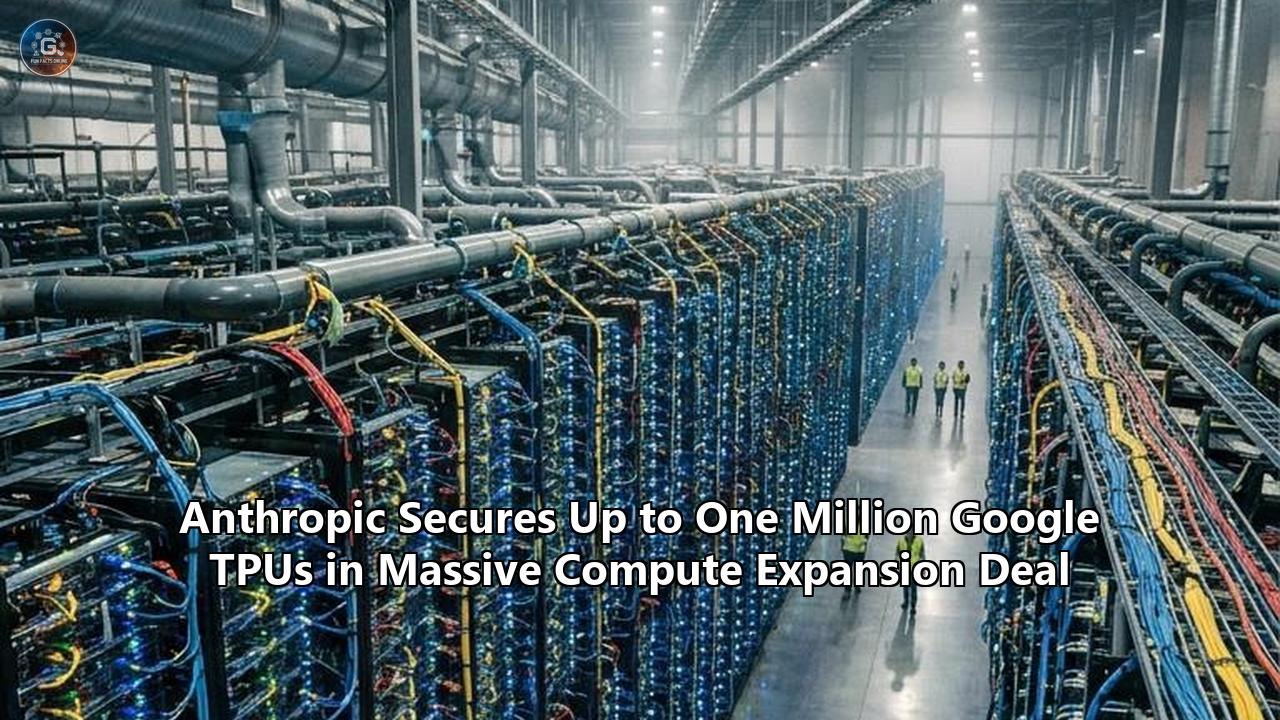
The official corporate blog post that appeared online on a Thursday morning carried all the hallmarks of routine enterprise tech messaging. It announced that artificial intelligence startup Anthropic planned to broaden its operational partnership with Google Cloud, expanding its use of Google’s custom Tensor Processing Units. The headline figures were staggering, yet delivered in flat, antiseptic corporate prose: up to one million specialized processors, valued in the tens of billions of dollars, bringing “well over a gigawatt” of electrical capacity online.
Behind that modest press release, however, lay an unprecedented convergence of corporate intrigue, physical infrastructure maneuvering, and shadow-banking financial engineering.
Interviews with semiconductor engineers, data center developers, private credit managers, and supply chain analysts reveal that the Anthropic Google TPU deal is far more than a routine capacity purchase. It represents a decisive fracture in Nvidia’s near-monopoly over artificial intelligence infrastructure, an aggressive strategic gambit by Google Cloud to monetize its proprietary silicon against its own internal research divisions, and an intricate financial apparatus designed to keep tens of billions of dollars in speculative chip debt off the balance sheets of everyone involved.
To understand how one million processors are moving through the global supply chain, one must trace a trail that starts at the microscopic level of silicon packaging in Taiwan, winds through private equity boardrooms in Manhattan and converted industrial sites in upstate New York, and lands directly at the computational nerve centers where frontier machine learning models are trained.
The Silicon Arithmetic: Breaking the CUDA Stranglehold
For nearly three years, foundation model developers operated under an unspoken technological reality: to train a frontier large language model, you paid Nvidia whatever price Jensen Huang demanded. The Santa Clara chipmaker commanded gross margins exceeding 75%, and its proprietary software framework, CUDA—which tightly couples machine learning code to Nvidia silicon—served as a digital moat that locked researchers into its hardware ecosystem.
When Anthropic executives ran the balance-sheet projections for scaling Claude beyond its 3.5 and 3.7 architecture cycles, the Nvidia math collapsed.
Cost Breakdown: Equivalent 1-Gigawatt Cluster Deployment
┌──────────────────────────────────────┬────────────────────┬────────────────────┐
│ Metric / Component                   │ Nvidia GB200 NVL72 │ Google TPU v7      │
│                                      │ (Blackwell Rack)   │ ("Ironwood")       │
├──────────────────────────────────────┼────────────────────┼────────────────────┤
│ Estimated Hardware Cost per Flop     │ Baseline (1.0x)    │ 0.58x - 0.62x      │
│ Silicon Supplier Gross Margin        │ ~74% - 78%         │ ~40% (Broadcom/GCP)│
│ Optical Interconnect Topology        │ InfiniBand / NVLink│ Optical Circuit    │
│                                      │ (High Power)       │ Switch (OCS)       │
│ All-In Total Cost of Ownership (TCO) │ Baseline           │ ~30% - 44% Lower   │
└──────────────────────────────────────┴────────────────────┴────────────────────┘
"Frontier model labs were essentially writing blank checks to Santa Clara," explains Dylan Patel, chief analyst at semiconductor research firm SemiAnalysis. "If you looked at Anthropic’s run-rate growth—moving from $9 billion at the end of 2025 toward north of $30 billion by mid-2026—the sheer capital expenditure required to buy pure Nvidia Blackwell clusters would have diluted their equity into oblivion. They needed an alternative that was not merely comparable on paper, but structurally cheaper at the data center level".
Enter Google’s seventh-generation accelerator: TPU v7, codenamed "Ironwood".
Unlike Nvidia’s general-purpose Graphics Processing Units, which trace their ancestry back to 3D video rendering, Google’s Tensor Processing Unit is an Application-Specific Integrated Circuit (ASIC). It was designed from its 2016 origins for one operation: dense matrix multiplication, the fundamental arithmetic driving transformer neural networks. Co-designed alongside networking and custom-silicon titan Broadcom, Ironwood delivers dense FP8 computing power roughly matching Nvidia’s flagship B200, paired with up to 192 gigabytes of High Bandwidth Memory (HBM3e) and optical networking capabilities integrated directly into the silicon packaging.
The critical engineering distinction lies in the interconnects. To string tens of thousands of Nvidia GPUs together into a coherent supercomputer, engineers rely on sprawling trees of copper cabling and electricity-hungry optical transceivers powered by InfiniBand switches. Google, by contrast, connects its Ironwood chips into a three-dimensional torus topology managed by proprietary Optical Circuit Switches (OCS).
"An optical switch changes light paths using tiny microscopic mirrors without ever converting the light into an electrical signal and back again," says Dr. Aris Thorne, a distributed systems architect who has audited hyperscale compute fabrics. "That architectural difference alone strips tens of megawatts of parasitic heat out of a cluster. When you are deploying one million processors, a 30% reduction in networking overhead translates into hundreds of millions of dollars in lower utility bills every single quarter."
SemiAnalysis’s internal hardware modeling confirmed that for a full-scale cluster, the total cost of ownership per Ironwood chip sits roughly 44% below that of an equivalent Nvidia GB200 server. Even after Google and Broadcom applied their own commercial markups, Anthropic was securing compute capacity at roughly a 30% discount relative to prevailing merchant market prices.
Yet, securing one million accelerators is not simply a matter of placing an order on a vendor portal. The physical silicon still had to be manufactured, assembled, and paid for. And the paper trail reveals that the companies devised a financial structure that altered the way tech infrastructure is financed.
The Paper Trail: Inside the Shadow Syndicate of Compute SPV
To trace the financial architecture of the Anthropic Google TPU deal, one has to look far beyond the cloud services agreements filed with corporate registrars.
One million high-end processors carry a hardware price tag approaching $35 billion, with total multi-year cluster commitments scaling past $150 billion once cooling, mechanical systems, and real estate are included. Anthropic, despite its towering $380 billion valuation following its Series G funding round in early 2026, could not comfortably stomach that scale of upfront asset purchases without burning its liquid capital reserves. Nor did Google wish to hold dozens of gigawatts of merchant-grade assets on its consolidated balance sheet, which would alarm Wall Street analysts wary of soaring capital expenditures.
The solution was borrowed not from Silicon Valley, but from the commercial aviation industry.
Documents reviewed by financial investigators and corporate filings detail how investment bank Morgan Stanley engineered an off-balance-sheet vehicle designated as "Compute SPV".
The Compute SPV Debt and Asset Flow:
┌────────────────────────┐         Buys Finished Racks ($35B)        ┌─────────────────────────┐
│     Alphabet Inc.      │ ─────────────────────────────────────────► │       Compute SPV       │
│ (IP Holder & Co-Design)│                                           │ (Bankruptcy-Remote Ent.)│
└────────────────────────┘                                           └───────────┬─────────────┘
                                                                                 │
            ▲                                                                    │ Leases 1M TPUs
            │ Equity Investment                                                  │ (5-Year Term)
            │ ($10B - $40B Tiered)                                               ▼
┌───────────┴────────────┐                                           ┌─────────────────────────┐
│    Anthropic PBC       │ ◄──────────────────────────────────────── │      Anthropic PBC      │
│  (End-User / AI Lab)   │           Delivers Inference & Tokens     │       (Deployer)        │
└────────────────────────┘                                           └─────────────────────────┘
                                                                                 ▲
            ▲                                                                    │
            │ Senior Debt / Capital ($35B)                                       │ Backstops Debt
            │                                                                    │ (Deficiency Support)
┌───────────┴────────────┐                                           ┌───────────┴─────────────┐
│  Apollo & Blackstone   │ ───────────────────────────────────────── │      Broadcom Inc.      │
│ (Private Credit Funds) │                                           │   (ASIC Supply Partner) │
└────────────────────────┘                                           └─────────────────────────┘
The mechanics operate with forensic precision:
- Hardware Fabrication: Broadcom manufactures and packages the custom silicon through Taiwan Semiconductor Manufacturing Company (TSMC), bundling them into fully integrated server racks.
- The Purchase: Compute SPV, an independent bankruptcy-remote legal structure, purchases the TPU hardware directly from Google and Broadcom for approximately $35 billion.
- The Credit Line: Private credit giants Apollo Global Management and Blackstone provide the debt financing that pays for the chips, fronting the capital to the special purpose vehicle.
- The Long-Term Lease: Compute SPV leases the one million processors to Anthropic over a five-year window, collecting regular recurring payments tied to Claude’s commercial inference and training runs.
- The Backstop: Crucially, Broadcom stepped into the structure to provide "residual value defense" and deficiency guarantees covering an estimated $31 billion in senior debt. If Anthropic were to default, or if technological obsolescence caused the secondary value of the processors to plummet, Broadcom agreed to absorb the shortfall to protect the lenders.
"This is the identical financing model that Boeing and General Electric pioneered decades ago to sell commercial jet engines to fledgling airlines," explains Clara Vance, a distressed debt analyst based in New York. "A regional airline cannot afford thirty Boeing 787s out of pocket. So, a private credit consortium buys the airplanes, leases them to the carrier, and the manufacturer guarantees the scrap value of the airframes. The tech sector has officially industrialized: chips are now treated as heavy industrial plant equipment."
Yet the financial layering reveals an uncomfortable dynamic that regulatory watchdogs have begun examining: the closed loop of AI capital.
Under parallel corporate pacts, Alphabet committed between $10 billion and $40 billion in multi-stage strategic equity investments directly into Anthropic. Anthropic, in turn, takes that capital and commits it back to Google Cloud and Compute SPV in lease payments.
"When an anchor investor pours capital into a private software vendor, and that vendor is contractually bound to send those exact dollars right back through the investor's infrastructure division as top-line revenue, you enter the terrain of circular financing," warns Jonathan Petersen, a managing director at investment bank Jefferies. "There is an entire shadow balance sheet resting beneath the AI economy. If client revenue growth stutters, every gear in that financial clockwork feels the drag at once".
For now, Anthropic points to its operating revenue to refute assertions of artificial inflation. By mid-2026, the company claimed its run-rate revenue had surpassed $30 billion, propelled by its Claude Code development platform and enterprise agreements with hundreds of Fortune 500 corporations. But balancing the financial books is only half the battle; the more unyielding obstacle is physics.
Chasing the Gigawatt: The Battle for Substation Interconnects
One million processors do not live in the abstract ether of "the cloud." They require concrete buildings, closed-loop liquid cooling loops, massive step-down transformers, and, above all, electricity.
A single gigawatt of electric power is difficult to visualize. It equals the sustained continuous output of a commercial nuclear power reactor, sufficient to illuminate approximately 750,000 households. As the Anthropic Google TPU deal scales from its initial 1-gigawatt phase toward an eventual 3.5 to 5 gigawatts across 2027, the primary constraint on artificial intelligence development has ceased to be algorithm design—it is access to high-voltage transmission lines.
In the United States, obtaining an interconnection agreement from regional transmission operators like PJM Interconnection or the Electric Reliability Council of Texas (ERCOT) typically takes between four and seven years. Anthropic and Google had barely eighteen months.
To bypass the multi-year grid backlog, investigators found that Google and its data center development partners turned to an improbable ally: the distressed infrastructure of the cryptocurrency industry.
From Proof-of-Work to Tensor Operations: The Upstate New York Pivot
┌────────────────────────────────────────────────────────┐
│ Historic Bitcoin Facility: Lake Ontario Basin          │
│ • Acquired Grid Interconnect: 360 Megawatts            │
│ • Existing Infrastructure: High-Voltage Substations    │
└──────────────────────────┬─────────────────────────────┘
                           │
                           │ Fast-Track Retrofit via TeraWulf
                           ▼
┌────────────────────────────────────────────────────────┐
│ Next-Gen AI Factory: Liquid-Cooled Pods                │
│ • Google Corporate Lease Guarantee: $44B Program Backstop│
│ • Deployed Hardware: TPU v7 Ironwood Clusters          │
│ • Target Workload: Anthropic Frontier Claude Training │
└────────────────────────────────────────────────────────┘
Corporate filings confirm that data center operators retrofitted industrial Bitcoin mining sites to host Anthropic’s hardware footprint. In upstate New York, near the shores of Lake Ontario, former mining operator TeraWulf converted a 360-megawatt computing facility—originally built to hash cryptographic puzzles—into a liquid-cooled home for Google TPUs. The venture was underpinned by a Google corporate guarantee and $3.2 billion in construction bonds.
"Crypto miners held something far more valuable than Bitcoin: approved interconnection queues and energization rights," says Marcus Hendricks, a transmission planning consultant in Austin. "Google has systematically backstopped at least ten similar projects nationwide, totaling roughly 2.4 gigawatts, putting its corporate balance sheet on the hook for upwards of $44 billion in lease contingencies. They are buying time. By stepping into existing substations, they shaved four years off the deployment timeline".
In Texas and Georgia, the footprint expands further. Google has backed multi-billion-dollar data center campuses outside Dallas and committed to utility uprates linked to Georgia Power’s Plant Vogtle and Plant Hatch nuclear facilities. When high-density TPU server racks run at total capacity, they generate so much concentrated thermal energy that traditional forced-air chillers are utterly ineffective. Racks must be plumbed directly into closed-loop chilled liquid manifolds, circulating water at hundreds of gallons per minute straight to copper cold plates mounted onto the Ironwood silicon.
The physical reality is stark: this buildout represents one of the fastest, most concentrated expansions of industrial electrical consumption since the mobilization of aluminum smelting during the Second World War.
Silicon Diplomacy: The Tri-Cloud Hedging Strategy
The sheer scale of the Anthropic Google TPU deal raises a tactical question: why would Anthropic, an enterprise whose foundational identity is rooted in AI safety and architectural independence, tie its operational existence so closely to Google?
The answer lies in Anthropic’s corporate diplomacy. Unlike OpenAI, which spent years tied to Microsoft’s Azure cloud before seeking third-party alternatives, Anthropic founders Dario and Daniela Amodei constructed a multi-cloud hedge from the company's inception.
Anthropic's Tri-Pillar Compute Architecture:
┌───────────────────────────────────────────────────────────────────────────┐
│                           Anthropic PBC (Claude)                          │
└──────────────┬────────────────────────────┬───────────────────────────────┘
               │                            │                               │
               ▼                            ▼                               ▼
┌───────────────────────────┐  ┌──────────────────────────┐  ┌─────────────────────────────┐
│ Amazon Web Services (AWS) │  │       Google Cloud       │  │       Microsoft Azure       │
├───────────────────────────┤  ├──────────────────────────┤  ├─────────────────────────────┤
│ • Primary Cloud Partner   │  │ • TPU v7 / Ironwood      │  │ • Enterprise Distribution   │
│ • Custom Trainium 2 Chips │  │ • 1M Accelerators        │  │ • Commercial Nvidia Access  │
│ • Project Rainier Superhub│  │ • Low-Latency Vertex AI  │  │ • Multi-Gigawatt Backstop   │
└───────────────────────────┘  └──────────────────────────┘  └─────────────────────────────┘
Anthropic deliberately refuses to marry a single hyperscaler. Amazon Web Services remains Anthropic’s "primary training partner," housing the million-chip "Project Rainier" cluster built with Amazon’s custom Trainium 2 processors. Simultaneously, Anthropic maintains commercial alliances with Microsoft, securing access to tens of thousands of Nvidia GPUs via Azure.
"Our compute strategy focuses on intentional diversification," Anthropic Chief Financial Officer Krishna Rao stated during an investor briefing. "By operating across three hardware stacks—Google TPUs, Amazon Trainium, and Nvidia GPUs—we ensure that our engineering roadmap is never subject to the pricing pressure, fab bottlenecks, or physical constraints of any single hardware vendor".
Yet running a frontier model across three fundamentally incompatible silicon stacks is an engineering trial.
Software engineers do not simply write code once and deploy it across different accelerators. Nvidia software is tightly bound to CUDA. Amazon’s Trainium processors run on AWS Neuron compilers. Google TPUs rely on XLA (Accelerated Linear Algebra) and the JAX/PyTorch/XLA frameworks.
Compiler and Software Translation Pipeline:
              ┌─────────────────────────────────┐
              │ Anthropic Frontier Model Code   │
              │  (PyTorch / Internal Layer)     │
              └────────────────┬────────────────┘
                               │
         ┌─────────────────────┼─────────────────────┐
         ▼                     ▼                     ▼
┌─────────────────┐   ┌─────────────────┐   ┌─────────────────┐
│  Nvidia Stacks  │   │   Google Stack  │   │    AWS Stack    │
│  (CUDA / CuDNN) │   │  (OpenXLA/JAX)  │   │  (NeuronCore)   │
└────────┬────────┘   └────────┬────────┘   └────────┬────────┘
         ▼                     ▼                     ▼
┌─────────────────┐   ┌─────────────────┐   ┌─────────────────┐
│ Blackwell GPUs  │   │ Ironwood TPUs   │   │ Trainium2 ASICs │
└─────────────────┘   └─────────────────┘   └─────────────────┘
"Supporting three silicon platforms means you are effectively running three separate systems engineering organizations inside one startup," says a former Anthropic infrastructure engineer who worked on early TPU cluster migrations. "Every time you adjust an attention mechanism or alter a tensor sharding strategy across nodes, you have to benchmark it three times. A model kernel that executes cleanly on an Nvidia H100 can stall on a TPU if memory boundaries aren’t manually aligned with the TPU’s matrix multiplication units".
Why endure that friction? Because the strategic leverage it provides is immense.
When Nvidia attempted to enforce rigid allocation quotas, Anthropic shifted substantial training runs to Amazon’s Trainium. When Amazon faced delays in high-density rack deployments, Anthropic tapped Google Cloud’s TPU pipelines. Anthropic’s multi-cloud posture allows it to pit the three most powerful technology empires on Earth against one another, extracting price concessions, priority allocations, and subsidized energy development from each.
The DeepMind Paradox: Internal Fratricide at Mountain View
While the deal solved an existential scaling problem for Anthropic, it ignited unexpected friction inside Google’s headquarters in Mountain View.
For more than a decade, Google’s custom TPUs were treated as internal assets—the crown jewels that powered Google Search, YouTube recommendation engines, and the core research of Google DeepMind. Outsiders could access earlier TPU versions via Google Cloud, but Mountain View maintained strict priority: the best, most advanced silicon stayed home to give Google’s proprietary models an unassailable edge.
The Anthropic Google TPU deal fundamentally inverted that long-standing dynamic.
By early 2026, reports surfaced that research teams inside Google DeepMind, under the leadership of Demis Hassabis, found themselves waiting in job queues for access to the very same TPU v7 Ironwood clusters being dispatched to Anthropic.
"There was profound disbelief within internal engineering teams," says an engineer familiar with Google’s compute allocation committees. "For years, the pitch to researchers was: Come to Google, because we have computing infrastructure that no external lab can ever touch. And suddenly, researchers woke up to find that Google Cloud CEO Thomas Kurian had leased a million chips to the startup developing our direct commercial competitor, Claude".
The rationale from Google’s executive suite was driven by market realities:
Alphabet's Strategic Trade-Off:
┌───────────────────────────────────────┬───────────────────────────────────────┐
│     The Internal Research Stance      │       The Cloud Executive Stance      │
│          (DeepMind / Gemini)          │          (Thomas Kurian / GCP)        │
├───────────────────────────────────────┼───────────────────────────────────────┤
│ • Maintain silicon exclusivity        │ • Drive hyperscale cloud profitability │
│ • Preserve competitive edge vs. rival │ • Establish TPU as the global market  │
│   frontier models                     │   standard alternative to Nvidia      │
│ • Keep HBM3e supply in-house          │ • Monetize high-margin infrastructure │
│ • Prioritize Gemini model development │ • Capture tens of billions in long-   │
│                                       │   term recurring cash flows           │
└───────────────────────────────────────┴───────────────────────────────────────┘
Kurian, a veteran enterprise executive who joined from Oracle, was charged with converting Google Cloud from a distant third behind AWS and Azure into an enterprise juggernaut. To achieve that, Google Cloud needed massive, non-Google customers to validate the TPU ecosystem. By turning Anthropic—and subsequently Meta—into flagship clients, Google demonstrated that custom ASICs could successfully train and serve the most capable models on Earth at scale.
"Exclusivity is a luxury of a peacetime market," says veteran technology analyst Richard Nieva. "Sundar Pichai and Thomas Kurian recognized that if Google kept TPUs internal, Nvidia would run away with the enterprise computing market entirely. By selling millions of TPUs externally through GCP and Broadcom, Google transforms its silicon division into a merchant hardware business, generating immense cash flow while turning its fiercest competitors into paying cloud tenants".
DeepMind had no choice but to adjust. Hassabis publicly pointed to the broader hardware constraints facing the entire sector—noting that the industry-wide bottleneck is not merely chip design, but the global availability of High Bandwidth Memory from suppliers like SK Hynix, Micron, and Samsung. With Anthropic absorbing a vast share of the global HBM supply allocated to Google, internal model developers were forced to optimize model architectures to run with leaner memory profiles.
What Lies Ahead: The Industrialized AI Horizon
As 2026 progresses, the reverberations of this compute expansion are rippling across the geopolitical and regulatory landscape.
The Federal Trade Commission (FTC) and the European Commission’s antitrust division have intensified investigations into the complex investment webs linking Big Tech hyperscalers to AI startups. Regulators are scrutinizing whether deals that bundle equity investments with mandatory cloud hardware leases suppress free-market competition or artificially disguise equipment costs.
At the same time, the physical implementation of the deal faces real-world hurdles:
- Utility Interconnect Headwinds: Regional grid operators, facing capacity shortages and public backlash over water consumption, are imposing stricter requirements on data center approvals, forcing tech firms to fund local grid upgrades.
- Silicon Obsolescence Cycles: The arrival of Google’s eighth-generation architecture—TPU v8, codenamed "Zebrafish," fabricated on next-generation 2-nanometer nodes—threatens to shorten the economic half-life of Ironwood clusters long before their five-year leases expire.
- Credit Market Vulnerabilities: Should enterprise spending on AI software slow, the vast web of private credit underpinning Compute SPV will face its first major test, stress-testing Broadcom's residual value guarantees.
The long-term legacy of the Anthropic Google TPU deal will not be measured solely by the synthetic benchmark scores of Claude’s next model version. Its true significance lies in how it has permanently rewritten the operational rules of advanced computing.
It proved that the computing infrastructure powering artificial intelligence is no longer an abstract domain of academic code and Silicon Valley servers. It has transformed into an aggressive, capital-intensive heavy industry—one where victory belongs not simply to the teams with the sharpest mathematical insights, but to the institutions that master the physical realities of the power grid, the complex mechanics of corporate finance, and the relentless logistics of moving millions of silicon processors through the global supply chain.
Reference:
- https://www.anthropic.com/news/expanding-our-use-of-google-cloud-tpus-and-services
- https://apnews.com/article/anthropic-google-275df9e291bbb361962dfc6ba868506c
- https://www.siliconrepublic.com/machines/anthropic-google-broadcom-announce-3-5gw-tpu-deal
- https://lightsource.ai/blog/google-sold-anthropic-a-million-tpus
- https://www.channelinsider.com/infrastructure/news-google-anthropic-tpu-financing-network/
- https://thenextweb.com/news/google-tpu-compute-internal-researchers-anthropic
- https://newsletter.semianalysis.com/p/tpuv7-google-takes-a-swing-at-the
- https://futurumgroup.com/insights/anthropics-gigawatt-scale-tpu-deal-with-broadcom-creates-a-structural-advantage/
- https://www.futunn.com/403
- https://www.mindstudio.ai/blog/ai-compute-alliances-openai-nvidia-anthropic
- https://finance.biggo.com/news/202605090027_Anthropic_200B_Google_Cloud_Deal
- https://medium.com/@mayhemcode/anthropic-could-spend-750-billion-on-ai-computing-its-cloud-partners-are-becoming-rivals-92dbcf1add57
- https://www.datacenterdynamics.com/en/news/google-and-anthropic-confirm-massive-1gw-cloud-deal-with-up-to-one-million-google-tpus/
- https://ajsai.substack.com/p/anthropics-1m-google-tpu-deal-breaks
- https://www.gomarkets.com/en-int/articles/google-tpu-chips-and-nvidia-the-ai-chip-war
- https://www.youtube.com/watch?v=MjLHa3GH3Os
- https://www.soonparted.co/p/anthropic
- https://www.lseg.com/en/insights/ftse-russell/round-the-merry-go-round-a-map-of-circular-financing-in-ai
- https://rcrtech.com/semiconductor-news/anthropics-broadcom-chip-deal/
- https://finance.biggo.com/news/cc3ceaa8-e838-4501-b4c0-13b9fcba9232
- https://capacityglobal.com/news/how-googles-150bn-anthropic-chip-deal-reshapes-ai-finance/
- https://www.datacenterdynamics.com/en/news/broadcom-to-develop-google-tpus-until-2031-anthropic-signs-deal-with-both-companies-for-35gw-of-tpus/
- https://aimagazine.com/news/anthropic-claude-enterprise-ai-agents-and-965bn-valuation
- https://www.googlecloudpresscorner.com/2025-10-23-Anthropic-to-Expand-Use-of-Google-Cloud-TPUs-and-Services
- https://mlq.ai/news/anthropic-signs-multi-billion-dollar-deal-to-expand-use-of-google-cloud-tpus/
- https://www.anthropic.com/news/google-broadcom-partnership-compute
- https://www.datacenterfrontier.com/machine-learning/article/55335703/inside-anthropics-multi-cloud-ai-factory-how-aws-trainium-and-google-tpus-shape-its-next-phase