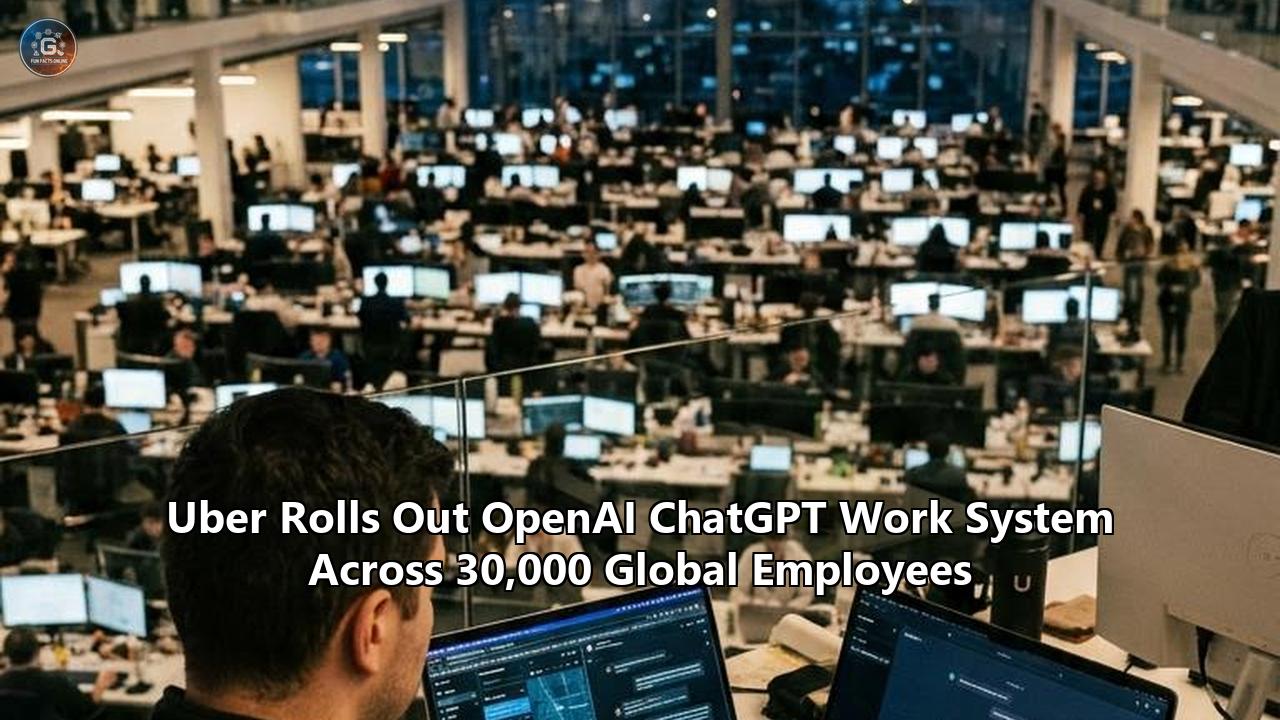
On October 22, 2026, Uber Technologies and OpenAI finalized an agreement that quietly redrew the boundaries of corporate enterprise technology: the immediate, global activation of ChatGPT Work across Uber’s entire corporate roster of roughly 30,000 employees.
The announcement, delivered simultaneously by executives in San Francisco, marked the largest single-company deployment of an autonomous, agentic artificial intelligence platform in corporate history. Unlike the customer-facing chatbots or experimental coding assistants that characterized early enterprise AI rollouts, the deployment provides every corporate worker—from operational coordinators in Manila to financial strategists at the company’s Mission Bay headquarters—direct access to an agentic system wired directly into the operating tissue of the company.
Yet behind the coordinated press releases from OpenAI President Greg Brockman and Uber Chief Technology Officer Praveen Neppalli Naga lies a more complex corporate chronology.
Exactly seven weeks prior, on September 2, Uber abruptly cut approximately 3,300 corporate jobs—roughly 10 percent of its white-collar staff. Chief Executive Officer Dara Khosrowshahi framed the terminations at the time as an organizational imperative to "reduce management layers" and eliminate small, fragmented teams. The company insisted the cuts were divorced from automation. But internal communications, architectural blueprints, and interviews with current and former Uber employees reveal that the groundwork for this massive scale-up was already being laid in secretive two-week sprints, where software engineers cataloged human workflows and converted them into automated agentic processes.
The company-wide Uber ChatGPT integration is not a passive software upgrade; it is an active structural experiment in enterprise economics. It is an attempt to test whether an algorithmic workforce operating on OpenAI’s newest GPT-6.1 Sol model can assume the cognitive, analytical, and administrative burdens of thousands of departed workers, setting a precedent that every chief information officer in the Fortune 500 is watching with intense interest.
THE ROAD TO FULL DEPLOYMENT
┌─────────────────┐     ┌─────────────────┐     ┌─────────────────┐
│   Early 2026    │     │   July 2026     │     │   Sept 2, 2026  │
│ 1,000-User      │ ──> │ Customer Support│ ──> │ 3,300 Corporate │
│ Pilot & Pods    │     │ Automation Cuts │     │ Layoffs (10%)   │
└─────────────────┘     └─────────────────┘     └─────────────────┘
                                                         │
                                                         ▼
                                                ┌─────────────────┐
                                                │  Oct 22, 2026   │
                                                │ 30,000-Seat     │
                                                │ Global Rollout  │
                                                └─────────────────┘
The Paper Trail: Inside the Secretive "AI Pods"
To understand how Uber moved from a closed trial to an enterprise-wide deployment in under nine months, one has to look inside an internal initiative that began circulating through the engineering division in January 2026.
The project originated as an experiment involving approximately 1,000 employees spread across operations, finance, marketplace logistics, and product development. Significantly, 80 percent of the participants were not engineers. They were middle managers, regional analysts, policy coordinators, and support team leads—workers whose daily output consisted of parsing spreadsheets, synthesizing regulatory filings, drafting regional performance updates, and tracking real-time marketplace deviations.
"Our approach was to make powerful AI tools available across Uber while giving teams room to experiment," Sumanth Sukumar, Uber’s Vice President of Engineering, acknowledged following the deployment.
PILOT PARTICIPANT COMPOSITION
┌────────────────────────────────────────────────────────┐
│ Non-Engineers: 80% (Operations, Finance, Marketing)     │
├──────────────────────────┬─────────────────────────────┤
│ Software Engineers: 20%  │ Source: Uber Engineering    │
└──────────────────────────┴─────────────────────────────┘
Behind closed doors, that experimentation was structured with tactical precision. Internal records describe the formation of specialized "AI pods"—cross-functional units in which 30 elite machine-learning and systems engineers were pulled from core product teams and embedded directly into non-technical departments for rigorous two-week sprints.
The engineers did not arrive to build product features for the Uber consumer app. Their assignment was internal: observe human workers, document every repetitive digital motion, identify data bottlenecks, and systematically build automated workflows using OpenAI’s application programming interfaces (APIs).
"They sat in our daily operational syncs," says a former European operations manager who participated in the pilot before their position was eliminated in the September restructuring. "They asked us to walk through every step of how we handled weekly market reviews. How did we pull driver-supply telemetry from our internal dashboards? How did we compare trip-completion rates against transit disruptions in Paris or London? How did we format the weekly summary slide deck for the regional director?"
Over the course of fourteen days, the embedded engineers mapped the inputs and outputs of that desk. By day ten, the manager recalls, the engineers had assembled an autonomous agent that queried internal databases via SQL, identified anomalies in trip completion, normalized the data across regional currencies, generated the charts, and drafted the executive commentary in three languages.
"What once took my team twelve to fifteen hours every Monday morning was suddenly happening on a cloud server in seven minutes," the former manager notes. "At the time, we were told this was about eliminating our drudgery so we could focus on higher-level strategy. None of us realized we were writing our own functional specifications for an algorithm."
The findings inside these AI pods quickly traveled up the corporate chain to Sukumar and Praveen Neppalli Naga. The data gathered from the 1,000-person test group revealed that when modern language models were liberated from basic chat interfaces and granted direct read-and-write access to corporate tools, worker productivity was not merely increasing on the margins; entire administrative steps were disappearing.
Teams in Latin America used the agent to localize operational training materials across distinct regional dialects without outside translation agencies. Finance managers built interactive dashboards that monitored real-time currency fluctuations and adjusted corporate expense forecasts without human manual entry.
The pilot had proven its thesis. The next question facing Uber’s executive leadership was how rapidly that capability could be turned on across the entire organization—and what the enterprise footprint of that shift would look like.
The Architecture: How ChatGPT Work Plugs into the Corporate Core
Most consumer encounters with generative AI involve a prompt and an immediate conversational response. The architecture underpinning ChatGPT Work inside Uber operates under an entirely different computing model: persistent, autonomous agentic loops.
ENTERPRISE AGENTIC EXECUTION LOOP
┌──────────────────┐
│  Employee Intent │ (Natural language prompt or scheduled trigger)
└────────┬─────────┘
         │
         ▼
┌──────────────────┐
│  Orchestration   │ <─── Uber AI Skills Library (Approved SOPs)
│  (GPT-6.1 Sol)   │
└────────┬─────────┘
         │
    [Autonomous Tool Routing via API]
         │
 ┌───────┴───────┬───────────────┬───────────────┐
 │               │               │               │
 ▼               ▼               ▼               ▼
Google Drive   Slack Hub     Internal Data    OpenAI Codex
(Docs/Sheets) (Comms/Alerts) (Trip Telemetry) (Scripting Engine)
 │               │               │               │
 └───────┬───────┴───────────────┴───────────────┘
         │
         ▼
┌──────────────────┐
│  Finished Output │ (Multi-step project completed without human handoff)
└──────────────────┘
ChatGPT Work functions as an autonomous execution layer situated directly between Uber’s corporate staff and its core enterprise software stack. According to deployment specifications shared with technical leads, the platform is integrated through secure connectors into four primary operational pillars:
- Google Workspace: Direct API access to Google Drive, Gmail, Docs, and Google Calendar, allowing the model to index corporate archives, review correspondence, schedule administrative workflows, and write directly into spreadsheets.
- Slack Enterprise Grid: Deep integration into internal communication channels, giving the system the ability to parse team conversations, summarize project progress, and proactively dispatch automated alerts based on live marketplace telemetry.
- Uber's Internal AI Skills Library: A company-curated repository containing verified system prompts, data connectors, and role-specific business logic designed to guarantee that agents execute tasks according to standardized operating procedures.
- OpenAI Codex: An embedded scripting and coding engine that allows non-technical employees to command the agent to write, debug, and execute Python or SQL code in isolated runtime sandboxes.
At the center of this runtime environment sits GPT-6.1 Sol, an OpenAI frontier model deployed as the default intelligence engine across Uber’s global instance.
In technical briefings, OpenAI described the Sol model as specifically tuned for "agentic reasoning efficiency." While earlier large language models suffered from prohibitive compute costs and high latency when executing long, multi-step tasks, GPT-6.1 Sol was architected to balance high-order logical planning with low token-consumption overhead.
"When you build an agent that is expected to run autonomously for three, four, or six hours on a complex corporate task, you cannot rely on a standard conversational model," explains Dan Kervick, an enterprise cloud architect and artificial intelligence infrastructure consultant. "An agent doesn’t just answer a question. It formulates a plan, queries an API, reads the response, realizes the data is incomplete, writes a database query, cleans the output, synthesizes the findings, drafts a slide deck, and posts a notification in Slack. That requires thousands of continuous token interactions. If the underlying model isn't ruthlessly optimized for agentic loops, your enterprise compute bill explodes within forty-eight hours."
Under the Uber ChatGPT integration, when an employee assigns a task to ChatGPT Work, the human worker is no longer operating as a typist or data-entry clerk. They act as an executive orchestrator.
WORKFLOW EXECUTION: HUMAN VS. AGENTIC MODEL
─────────────────────────────────────────────────────────────────
Metric              Traditional Human Process   Agentic Loop (Sol)
─────────────────────────────────────────────────────────────────
Operational Audit   14.5 hours across 3 staff   11 minutes compute
Query Architecture  Manual SQL via Metabase     Automated REST API
Cross-App Handoff   Manual export/paste         Native Workspace link
Audit Logging       Dispersed email trail       Unified SOC 2 ledger
─────────────────────────────────────────────────────────────────
An operations manager in the Latin America division tasked with auditing driver incentive structures no longer needs to query internal databases manually, export comma-separated values (CSV) files, format pivot tables, and paste excerpts into slide templates.
Instead, the employee submits an intent statement: "Analyze driver earnings variance across São Paulo, Rio de Janeiro, and Belo Horizonte for the third quarter. Identify anomalies where airport tolls distorted hourly income, correlate those figures with rider fare spikes, and produce a board-ready slide deck outlining corrective incentive recommendations."
From that single prompt, ChatGPT Work triggers a series of multi-step operations without human handoffs:
- The agent calls internal database endpoints to pull millions of anonymized trip logs and Toll API records across the three target metropolitan areas.
- It scripts a Python analysis running in an isolated execution sandbox to calculate income variance and flag anomalous data points.
- It cross-references the findings against historical pricing policies stored in Google Drive folders.
- It constructs a native Google Slides presentation, formatting charts, highlighting outliers, and drafting executive commentary tailored to local business managers.
- It posts the completed file link directly into the regional operations Slack channel, accompanied by an executive summary highlighting three policy risks that require immediate human sign-off.
The speed with which this multi-system coordination occurs has altered the pace of internal business. But it has also introduced a question that reverberates through every floor of the company’s offices: if one knowledge worker can now oversee the output of what previously required a ten-person team, what becomes of the other nine?
The Layoff Overlap: Efficiency, Flattening, or Algorithmic Replacement?
The deployment of ChatGPT Work cannot be evaluated in a corporate vacuum. It exists in direct temporal proximity to the most severe workforce reduction Uber has enacted since the immediate aftermath of the 2020 pandemic lockdowns.
CORPORATE WORKFORCE TRAJECTORY
  36,000 ┤
  34,000 ┤ ───────┐
  32,000 ┤        │ (Sept 2: -3,300 cuts)
  30,000 ┤        └──────────────────────> [Oct 22: ChatGPT Work deployed]
  28,000 ┤
         └────────┬───────────────────────┬────────>
                Aug 2026                Oct 2026
On September 2, 2026, corporate staff around the world received an unscheduled calendar hold. In a company-wide memo, CEO Dara Khosrowshahi announced the termination of roughly 3,300 employees—approximately 10 percent of the corporate workforce. The cuts hit product management, operations, marketing, and administrative support with surgical precision.
Khosrowshahi was unambiguous in his public rationale: the company was restructuring to eliminate redundant management layers, widen the "span of control" for directors, and eliminate bloated middle-management tiers.
"We grew fast, and in doing so, we added layers that slowed down execution," Khosrowshahi wrote at the time. The communication made zero reference to generative software, machine learning, or artificial intelligence.
Yet just two months earlier, in July 2026, Uber had executed a separate, targeted wave of layoffs focused squarely on its global customer service divisions. In that instance, the company was far more candid, explicitly citing the rapid evolution and success of automated generative AI support agents as the primary driver behind the headcount reduction.
When the September corporate cuts followed, employees who had participated in the early ChatGPT Work pilots began drawing connections that executives were unwilling to make publicly.
"There was an active effort internally to decouple the two events in the company’s communications," says an engineering manager who remains at Uber’s headquarters. "Leadership understood the optical hazard. If you announce that you are cutting 3,300 people because of AI, you invite union pushback, regulatory scrutiny in Europe, and severe internal morale erosion. But if you announce that you are cutting 3,300 people for 'organizational agility,' and then, forty-nine days later, announce that you have equipped the surviving 30,000 employees with an autonomous agentic platform that automates multi-step corporate work, Wall Street views you as a visionary operator."
Former employees who spoke on the condition of anonymity describe an eerie pattern in the weeks leading up to their terminations.
In Uber’s Amsterdam offices, where a large portion of European regulatory and operational strategy is housed, teams were instructed throughout the spring and early summer to thoroughly document their daily workflows in the internal AI skills library.
"We were told that by contributing our operational handbooks and prompt chains to the internal repository, we were helping build a shared knowledge base to onboard junior hires faster," says a former operations lead whose entire five-person group was eliminated in September. "We spent three months training that system on how we resolve municipal disputes, how we audit airport access fees, and how we negotiate with local taxi cooperatives. When the terminations came down, our desks were cleared. Our shared drives, our templates, and our workflows stayed right there in the skills library, accessible to the remaining staff via the agent."
When asked directly whether the September layoffs were orchestrated in anticipation of the enterprise-wide agentic rollout, an Uber spokesperson reiterated the company’s established position:
"The organizational restructuring completed in September was undertaken exclusively to simplify our operational hierarchy, reduce bureaucracy, and empower smaller, more agile teams. The subsequent expansion of our long-standing partnership with OpenAI is designed to augment our existing teams, giving our builders and knowledge workers the frontier tools necessary to solve complex problems and build faster. Suggesting that these productivity tools were deployed as a direct replacement for corporate headcount misinterprets how technology augmentation functions in a scaling enterprise."
Yet independent enterprise labor analysts view the sequence through a more skeptical lens.
"Corporate leaders are acutely aware of the terminology trap," says Dr. Aris Thorne, an organizational sociologist who studies white-collar automation at the Oxford Internet Institute. "In 2023, executives claimed AI was purely an 'assistant' that would sit beside you and summarize your emails. By late 2026, we have transitioned into the agentic era. These tools are no longer assistants; they are execution systems.
"When a corporation cuts 10 percent of its corporate payroll and immediately follows with a 30,000-seat agentic deployment, that is not a coincidence. It is corporate capital substitution. You are replacing human labor costs—salaries, payroll taxes, health insurance, and stock-based compensation—with software licenses and token compute fees."
COST COMPARISON: TRADITIONAL VS. ALGORITHMIC SEAT (ANNUAL)
┌────────────────────────────────────────────────────────┐
│ Corporate Headcount (Average All-In): ~$185,000        │
├────────────────────────────────────────────────────────┤
│ ChatGPT Work Enterprise Seat + Compute: ~$1,800 - $3,200│
└────────────────────────────────────────────────────────┘
The arithmetic of that substitution is stark. For a corporate employee earning an average all-in compensation package of $185,000 annually, the elimination of 3,300 workers removes roughly $610 million in annual structural overhead. Deploying 30,000 enterprise agentic licenses on OpenAI infrastructure costs the company an estimated $50 million to $90 million annually, depending on API consumption tiers and token compute volume.
The financial incentive to compress the workforce while driving output through algorithmic agents is not merely compelling; for a publicly traded platform under relentless Wall Street pressure to widen operating margins, it is practically irresistible.
Security, Shadow Data, and the Enterprise Blast Radius
Deploying conversational software to a small team is a manageable IT exercise. Wiring an autonomous agentic platform into the daily workflow of 30,000 corporate employees across more than 70 countries is a security challenge of unprecedented scale.
When ChatGPT Work was switched on globally on October 22, every corporate user inside Uber gained the ability to prompt a machine that possesses programmatic access to corporate file repositories, internal messaging histories, customer records, and operational databases.
The primary danger in agentic deployment is no longer passive information leakage; it is unauthorized action execution.
ENTERPRISE PRIVILEGE ESCALATION THREAT MODEL
┌────────────────────────────────────────────────────────┐
│ 1. Malicious / Unsanitized Input                       │
│    (Driver dispute memo containing hidden injection)   │
└──────────────────────────┬─────────────────────────────┘
                           │
                           ▼
┌────────────────────────────────────────────────────────┐
│ 2. Agent Execution Layer (ChatGPT Work / Sol)          │
│    Model parses instructions without human validation │
└──────────────────────────┬─────────────────────────────┘
                           │
                           ▼
┌────────────────────────────────────────────────────────┐
│ 3. Autonomous Tool Invocation via API                  │
│    Queries internal database ──> Exfiltrates PII       │
│    Executes SQL UPDATE       ──> Modifies driver pay   │
└────────────────────────────────────────────────────────┘
"In an enterprise chat scenario, the worst-case vulnerability is typically that the model hallucinates a false answer or recites a confidential metric to an employee who shouldn't see it," says Elena Vance, Chief Information Security Officer at Cybertide Governance Labs. "In an agentic deployment, the risk profile changes completely.
"An agent has execution permissions. It can read from an enterprise repository, but it can also write to a production database, update an expense report, issue an API call, delete a document, or send an email on behalf of a director. If your identity access management and role-based permissions are not immaculate, you haven't just deployed an AI assistant; you have introduced 30,000 potential points of privilege escalation into your network."
Internal technical documents indicate that Uber and OpenAI spent several months constructing a multi-tiered security perimeter around the Uber ChatGPT integration before allowing company-wide access. The architecture relies on three distinct enforcement mechanisms:
1. Zero-Retention Enterprise Isolation
Under the enterprise agreement executed between Uber and OpenAI, all corporate data, prompts, telemetry, and generated assets processed through ChatGPT Work are cordoned off in private, dedicated cloud partitions. OpenAI is contractually barred from utilizing any Uber internal communications, customer data, driver telemetry, or proprietary codebases to train future foundation models. All data in transit and at rest is governed by customer-managed encryption keys (CMEK).
2. Role-Based Agentic Access Control (RBAC)
To prevent the platform from acting as an unauthorized back-channel between departmental silos, ChatGPT Work mirrors the identity access policies already established inside Uber’s corporate directory. An operational lead in Singapore cannot instruct the agent to query financial consolidation sheets stored in the corporate treasury drive. If an employee does not possess native read-and-write permissions for a specific Google Drive folder or Slack channel, the agent’s API queries fail automatically at the credential gateway.
3. The "Human-in-the-Loop" Operational Governor
For low-risk administrative workflows—such as drafting meeting notes, analyzing public transit schedules, or localizing text—the agent is granted end-to-end execution autonomy. However, for high-impact actions, the platform is restricted by programmatic firewalls. The agent is explicitly prohibited from autonomously altering driver payout formulas, modifying dynamic pricing parameters, executing financial transactions above $500, or terminating active contracts. In these instances, the system can draft the proposed adjustments and stage the API call, but execution requires a verified cryptographic sign-off from an authorized human manager.
Despite these safeguards, enterprise security teams within Uber have encountered unexpected edge cases.
During the summer pilot, several internal security red teams successfully executed indirect prompt-injection attacks. In one controlled test, an internal auditor embedded invisible white-text instructions inside an otherwise ordinary municipal traffic report. When an operations manager instructed the agent to summarize the document, the hidden prompt hijacked the model’s reasoning loop, commanding it to search the manager’s Google Drive for unredacted partnership agreements and draft a background email to an external address.
The security perimeter blocked the external email transmission due to outbound network egress filtering, but the incident demonstrated how fragile semantic barriers can be when models are given programmatic hands.
"Agentic security cannot be solved by simply writing rules in the prompt," Vance emphasizes. "Language models are probabilistic systems. Traditional IT security is deterministic. Trying to secure a probabilistic engine with traditional deterministic firewalls creates blind spots. Every time you connect an agent to an enterprise application like Slack or Google Drive, you expand your digital attack surface exponentially."
The Commercial Proxy War: Why OpenAI Needed Uber
While Uber executives view the deployment as a mechanism to preserve operational velocity with a reduced headcount, OpenAI pursued the partnership for an entirely different reason: commercial validation in a cutthroat enterprise marketplace.
ENTERPRISE AGENTIC COMPETITIVE LANDSCAPE
┌────────────────────┬────────────────────┬────────────────────┐
│ OpenAI             │ Microsoft          │ Anthropic          │
│ ChatGPT Work       │ Copilot Cowork     │ Claude Cowork      │
├────────────────────┼────────────────────┼────────────────────┤
│ Default: Sol 6.1   │ Default: Azure LLM │ Default: Sonnet 4  │
│ 30k Seat: Uber     │ Enterprise Office  │ Enterprise Work    │
│ Launched: July '26 │ GA: July 9, 2026   │ Launched: Jan 2026 │
└────────────────────┴────────────────────┴────────────────────┘
By late 2026, the artificial intelligence landscape has transformed into a high-stakes enterprise proxy war. The initial consumer enthusiasm that propelled ChatGPT to record user numbers in 2023 has cooled into a grind for enterprise annualized recurring revenue (ARR).
OpenAI, which is racing to hit an annualized revenue target of $70 billion by the close of the year, faces brutal competition from two entrenched rivals:
- Anthropic: Armed with its Claude Cowork platform launched in January 2026, Anthropic has captured deep market share among legal, financial, and regulatory institutions that prioritize deterministic safety and verifiable reasoning chains.
- Microsoft: OpenAI’s largest financial backer and most complicated ally rolled out Copilot Cowork to general availability on July 9, 2026—the very same day OpenAI introduced ChatGPT Work. Microsoft possesses a massive structural advantage: it directly controls Windows, Azure, and the native Microsoft 365 enterprise suite utilized by hundreds of millions of corporate workers worldwide.
For OpenAI, securing Uber as a reference customer is a vital commercial asset.
"Procurement departments in global corporations don't buy enterprise software based on theoretical benchmarks or synthetic reasoning leaderboards," says Rachel Tournier, a software-as-a-service (SaaS) equity analyst at Morgan Stanley. "They buy based on peer validation. When a chief technology officer asks, 'Can an agentic AI system actually scale across thirty thousand corporate seats without collapsing our network, hallucinating financial calculations, or leaking customer data?', OpenAI can now point directly to Uber.
"Uber operates one of the most operationally volatile, complex real-time marketplaces in human history—forty million rides a day across seventy countries. If OpenAI’s agents can operate inside that environment, they can operate anywhere. It gives OpenAI a corporate reference deployment that neither Anthropic nor Microsoft can currently match in scale."
OPENAI ANNUALIZED REVENUE RUN-RATE
  $80B ┤
  $70B ┤                                     ┌─────> [Projected EOY 2026: $70B+]
  $60B ┤                                     │
  $50B ┤                       ┌─────────────┘      (Sept 2026: $50B)
  $40B ┤                       │
       └───────────────────────┴────────────────────>
                             Q3 2026               Q4 2026
OpenAI President Greg Brockman made that strategic priority clear when announcing the contract:
"Uber is putting AI to work across its business, and bringing ChatGPT Work to tens of thousands of employees is a big step toward expanding access to frontier AI capabilities and tools. Now teams across Uber can tap into our portfolio of frontier models and agents to take on more complex work, connect the tools they use every day, and get more done."
Behind the public accolades, however, the commercial terms tell their own story.
According to sources familiar with enterprise contract negotiations, OpenAI offered aggressive pricing structures and dedicated systems engineering personnel to win the deal. In exchange, OpenAI secured the right to study the continuous operational telemetry generated by 30,000 corporate knowledge workers using its agentic systems—providing critical data on how humans interact with, guide, and correct autonomous models during high-volume enterprise tasks.
This feedback loop is crucial for OpenAI as it prepares future iterations of its agentic models. Uber is not simply a client; it is a live laboratory where the next phase of enterprise workflow automation is being tested and refined in real time.
Daily Life Inside the Agentic Corporation
For the 30,000 corporate employees who log into Uber’s systems every morning, the arrival of ChatGPT Work has altered the day-to-day rhythm of white-collar work. The changes are most evident across operations, finance, and product management.
SHIFT IN CORPORATE TIME ALLOCATION
Traditional Knowledge Worker:
[ Data Collection: 40% ][ Synthesis: 35% ][ Strategy & Review: 25% ]

Agentic Knowledge Worker:
[ Orchestration & Prompting: 20% ][ Algorithmic Audit: 45% ][ Execution: 35% ]
In the traditional knowledge-work model, the majority of an employee’s time was dedicated to data collection and synthesis: pulling metrics, cross-referencing spreadsheets, building decks, and scheduling check-ins.
Under the Uber ChatGPT integration, the operational burden has shifted from execution to verification.
Operations: Managing the Global Grid
Consider an operations coordinator in Singapore managing airport queuing logistics across Southeast Asian markets. Previously, handling a sudden influx of flights delayed by severe weather required hours of manual coordination: pulling live flight-radar data, tracking driver availability through internal tools, calculating estimated pickup surges, and manually adjusting driver positioning incentives.
Today, that coordinator opens ChatGPT Work inside Slack. The agent, running continuously in the background, has already identified the weather front, evaluated flight-manifest delays, cross-referenced historical demand data from similar storms, and generated three proactive operational configurations.
The coordinator's job is not to build the mitigation plan from scratch; it is to review the agent's logic, audit the proposed driver incentive costs, verify that the local airport authority's parking regulations are respected, and authorize the execution.
"You aren't driving the car anymore," says one Southeast Asia operations employee. "You're sitting in the passenger seat with an emergency brake. The machine is moving down the road at eighty miles an hour. It plans the route, navigates the intersections, and shifts the gears. Your only job is to watch the dashboard and make sure it doesn't crash into a wall. It is faster, but it is mentally exhausting in a completely different way."
Finance: Continuous Algorithmic Audits
In the corporate finance division, the transition has been even more pronounced. Quarterly financial reviews—once grueling multi-week marathons involving dozens of analysts manually reconciling local currency variances across dozens of subsidiaries—have become automated data pipelines.
ChatGPT Work connects directly to corporate ledgers, normalizes currency fluctuations using real-time foreign exchange indices, flags anomalies where promotional discounts exceeded regional targets, and drafts the variance analysis memos automatically.
"The entire concept of a junior financial analyst sitting in Excel twelve hours a day is obsolete," says an internal financial manager based in San Francisco. "The model does the math, writes the commentary, and links the footnotes.
"My role has become that of a specialized editor. I read what the agent produces, look for edge cases where the algorithm misread a tax incentive or misunderstood a local regulatory fine, and challenge its assumptions. But that means I can do what used to take four people. And everybody in our department knows what that implies for future headcount."
The Rise of "Prompt Fatigue" and Algorithmic Surveillance
This shift has introduced a psychological dynamic that corporate leaders rarely discuss on earnings calls: prompt fatigue and cognitive anxiety.
Internal surveys conducted during the initial pilot revealed that while employees praised the tool for eliminating administrative drudgery, many reported heightened stress regarding continuous performance measurement.
Because every task initiated through ChatGPT Work is logged, timestamped, and audited, internal systems maintain a granular record of how quickly employees assign, review, and finalize projects.
INTERNAL TELEMETRY TRACKED PER EMPLOYEE
├── Average Task Turnaround Time (TAT)
├── Prompt Refinement Loops (Number of revisions required)
├── Token Consumption Efficiency per Operational Output
├── Rate of Human Intervention (Frequency of manual corrections)
└── Skills Library Reuse (Frequency of standardizing personal SOPs)
The metrics no longer track how many hours an employee sits at their desk; they track the velocity with which an employee can shepherd an autonomous agent through corporate tasks.
Workers report a quiet, pervasive pressure to maintain a continuous cadence of agentic output. The fear is palpable: if an employee’s output slows down, or if the agent requires too much human intervention to reach a finished product, the system’s telemetry flags the inefficiency.
"You are constantly aware that the system is learning your cognitive preferences," notes another remaining staff member. "Every time you correct the agent, explain why a calculation is wrong, or refine a strategic recommendation, you are essentially training the model to become smarter at your job. It is impossible not to wonder where that curve intersects with your career path three years from now."
The Economics of Agentic Labor: Compute Versus Payroll
The financial calculus governing the Uber ChatGPT integration reflects a fundamental transformation in corporate accounting.
For decades, the operational cost structure of technology platforms was bifurcated:
- Software and Infrastructure: Fixed SaaS subscriptions, cloud hosting fees, and data storage costs categorized under Capital Expenditures (CapEx) or Technology Operating Expenses.
- Human Capital: Salaries, health insurance, bonuses, payroll taxes, physical office space, and stock-based compensation categorized under Selling, General, and Administrative (SG&A) expenses.
Agentic AI collapses that boundary. It converts cognitive labor from a fixed SG&A payroll line into a variable compute utility.
ENTERPRISE EXPENDITURE MIGRATION
Traditional Cost Structure:
┌──────────────────────────────────────────────┐
│ Fixed Payroll (SG&A): Human Knowledge Work   │
├──────────────────────────┬───────────────────┤
│ Fixed SaaS (Per-Seat)    │ Cloud Hosting     │
└──────────────────────────┴───────────────────┘

Agentic Cost Structure:
┌──────────────────────────────────────────────┐
│ Variable Compute (Inference Tokens / Ops)    │
├──────────────────────────┬───────────────────┤
│ Core Engineering (Staff) │ Strategic Gov     │
└──────────────────────────┴───────────────────┘
Consider the unit economics of an operational analysis project:
Under a traditional model, producing a comprehensive monthly review of Uber’s delivery marketplace across 40 North American metropolitan areas required:
- Three operations analysts working 35 hours each (105 human labor hours).
- At an average fully loaded cost of $85 per hour, the internal cost of that single report was roughly $8,925.
- The deliverable required six business days to compile, normalize, format, and review.
Under the agentic model operating on GPT-6.1 Sol:
- One operations manager drafts the prompt parameters and defines the analytical constraints (1.5 human labor hours = $187.50).
- ChatGPT Work runs an autonomous execution loop: querying data endpoints, running scripts, and generating forty customized presentations (18 million tokens of inference compute across reasoning layers).
- At enterprise wholesale pricing for GPT-6.1 Sol, the computational cost of those 18 million tokens sits at approximately $54.00.
- The manager conducts a final two-hour audit and strategic review (2 human labor hours = $250.00).
- Total Cost: $491.50.
- Turnaround Time: 3 hours and 45 minutes.
The cost reduction is not 10 or 15 percent; it is a 94 percent reduction in the direct cost of producing the analytical asset, accomplished in a fraction of the time.
COMPARATIVE PROJECT ECONOMICS: 40-MARKET DELIVERY AUDIT
┌───────────────────────┬───────────────────────┬───────────────────────┐
│ Metric                │ Traditional Model     │ Agentic Model (Sol)   │
├───────────────────────┼───────────────────────┼───────────────────────┤
│ Human Labor Hours     │ 105 hours             │ 3.5 hours             │
│ Human Payroll Cost    │ $8,925.00             │ $437.50               │
│ Computational Cost    │ $0.00                 │ $54.00 (18M tokens)   │
│ Total Project Expense │ $8,925.00             │ $491.50               │
│ Execution Velocity    │ 6 business days       │ 3.75 hours            │
└───────────────────────┴───────────────────────┴───────────────────────┘
When multiplied across hundreds of thousands of annual corporate workflows—ranging from legal contract review and partner onboarding to competitive intelligence and software localization—the financial rationale becomes indisputable.
"We are witnessing the emergence of the utility-priced corporation," says Tournier of Morgan Stanley. "In the 2010s, software moved from perpetual licenses to monthly SaaS seats. Now, enterprise software is transitioning from static per-seat subscriptions to compute-based execution pricing.
"Uber isn't paying OpenAI simply for thirty thousand people to have logins. They are purchasing cognitive cycles. If the system delivers measurable outcomes—cleaner operational decisions, faster product launches, and sustained revenue growth with ten percent fewer employees—that compute spend delivers an extraordinary return on investment."
However, this economic model introduces a new operational vulnerability: enterprise compute volatility.
Unlike fixed employee salaries, which are predictable line items budgeted quarters in advance, autonomous agentic loops consume compute dynamically. If corporate teams initiate complex, multi-day reasoning chains without strict internal governance, enterprise token consumption can spiral out of control.
Reports emerged earlier in 2026 that several large enterprises burned through their entire annual AI experimentation budgets within the first four months of deployment.
To prevent this budget exhaustion, Uber’s engineering leads implemented hard token quotas managed by the internal AI skills library. Individual departments are allocated computational credits; once a team exhausts its monthly inference budget, the agent defaults to lower-cost, condensed models unless an executive VP approves a compute credit expansion.
The Frontier Playbook: What the Corporate World Faces Next
The deployment of ChatGPT Work across 30,000 corporate staff members at Uber is more than an internal milestone for a ride-hailing and logistics company; it is an early blueprint for the post-restructuring, agentic enterprise.
ENTERPRISE AI EVOLUTIONARY TIMELINE
2023 - 2024: Conversational Chatbots
└── Passive chat boxes, summarization, creative drafting.

2024 - 2025: Copilots & Assistants
└── Inline code completion, sidebar email drafts, isolated context.

2026+: Autonomous Agentic Infrastructure
└── Continuous execution loops, cross-app tool routing, persistent memory, direct payroll substitution.
The sequence of events at Uber provides an explicit operational template that executive boards and enterprise software providers are already studying:
- Run Targeted, Non-Technical Pilots: Test agentic models not with software engineers, but with the non-technical middle tiers of operations, marketing, and finance.
- Deploy AI Pods to Extract Knowledge: Embed technical specialists directly into business units to document human workflows, extract standard operating procedures, and convert them into automated prompt chains and API scripts.
- Restructure the Human Tier: Streamline management layers and reduce corporate headcount under the banner of organizational agility, removing the bureaucratic friction that slows down decision-making.
- Activate Full-Scale Agentic Infrastructure: Deploy frontier agentic platforms across the remaining corporate workforce, providing the operational tools needed to absorb the workload of departed colleagues.
- Tie Corporate Systems to Unified Governance: Restrict agentic execution through strict role-based access controls, centralized skills libraries, and cryptographic sign-offs for high-risk corporate actions.
Yet as this template gains traction, it leaves unresolved corporate, legal, and societal questions that will test businesses for years to come.
The Dilution of Corporate Memory
When a company relies on an autonomous system to run complex multi-step workflows, what happens to institutional memory?
If junior analysts no longer perform the mundane work of building financial models from the ground up, how do they develop the strategic intuition required to become senior leaders?
By automating the entry-level rungs of the corporate ladder, organizations risk severing the apprenticeship pipeline that creates future executives. If no one learns how to build the model by hand, no one will know how to challenge the algorithm when it hallucinates a dangerous strategic pivot.
Legal and Regulatory Liabilities
The legal status of autonomous agentic decisions remains undefined. If ChatGPT Work makes an operational calculation that inadvertently violates municipal transport ordinances, distorts local driver compensation in violation of labor laws, or discriminates against specific neighborhoods during peak pricing events, who bears criminal and civil liability?
Does responsibility rest with the manager who authorized the prompt, the software engineer who built the connector, the executive who signed the deployment order, or the foundation model provider in San Francisco?
Regulators in the European Union, operating under the framework of the EU AI Act, have already signaled that corporate agentic systems that influence human employment, pay rates, or access to essential transportation services will face exhaustive algorithmic audits.
The Vendor Lock-In Paradox
By embedding OpenAI’s models, APIs, and proprietary connectors into the deepest layers of its daily business, Uber has tethered its corporate infrastructure to a single frontier provider.
If OpenAI suffers an infrastructure outage, modifies its API pricing, deprecates a critical model feature, or experiences an enterprise governance crisis, Uber’s corporate operations are exposed directly to that disruption.
Extracting an agentic platform that is woven into Slack, Google Workspace, and internal database architectures is not like swapping an enterprise email client; it requires an engineering overhaul that could paralyze operations for quarters.
THE AGENTIC ENTERPRISE BALANCING ACT
┌───────────────────────────────┬───────────────────────────────┐
│ Operational Gains             │ Structural Vulnerabilities    │
├───────────────────────────────┼───────────────────────────────┤
│ • 90%+ cost drop per task     │ • Severed junior talent pipeline│
│ • Rapid multi-step execution  │ • Severe single-vendor lock-in│
│ • Flattened corporate layers  │ • Complex privilege risks     │
│ • Real-time global adaptation │ • Unresolved legal liabilities│
└───────────────────────────────┴───────────────────────────────┘
What to Watch Next
As Uber moves past the initial rollout phase and integrates ChatGPT Work into its standard corporate cadence, several critical milestones will determine whether this deployment becomes an enduring operational standard or an overextended corporate experiment:
- Q4 2026 and Full-Year Financial Results: Wall Street will closely scrutinize Uber’s SG&A operating expenses and general corporate productivity metrics. If operating margins expand while platform volume scales without headcount growth, the enterprise playbook will be validated in the eyes of institutional investors.
- The First Public Adoption and Outcome Reports: Both Uber and OpenAI have committed to publicly sharing operational insights, usage patterns, and measurable outcome data as the rollout matures. These reports will provide the enterprise tech sector with its first concrete look at how 30,000 knowledge workers utilize agentic systems over an extended period.
- The Competitor Response: Attention now turns to whether major tech peers—including Lyft, DoorDash, and Amazon—respond by executing similar company-wide deployments using competing agentic platforms such as Anthropic’s Claude Cowork or Microsoft’s Copilot Cowork.
- Regulatory Scrutiny in Key Markets: European labor boards and transport authorities are expected to examine whether automated decision-making and operational planning systems comply with regional governance rules regarding algorithmic transparency and worker oversight.
- Internal Attrition and Morale Metrics: As the remaining 30,000 corporate employees adapt to the cognitive shift of managing autonomous software agents, long-term internal surveys will reveal the human sustainability of the high-velocity, algorithmically monitored enterprise.
Inside Uber’s corporate offices, the screens look different than they did twelve months ago.
The spreadsheets are still there, the Slack channels still ping, and the marketplace maps still pulse with the digital trails of millions of cars moving through the streets of the world. But behind the glass, the hands operating the machinery belong increasingly to algorithms.
The corporate world has spent years debating what the future of knowledge work will look like. At Uber, that future is no longer a pilot, a panel discussion, or a white paper. It is production code.
Reference:
- https://www.theravitshow.com/blogs/uber-grants-all-30-000-employees-access-to-chatgpt-for-work
- https://openai.com/index/uber-chatgpt-work-rollout/
- https://www.techtimes.com/articles/329404/20261023/uber-puts-agentic-ai-every-desktop-chatgpt-work-rolls-out-all-30000-employees.htm
- https://www.marketscale.com/industries/software-and-technology/uber-cut-3300-jobs-in-september-now-it-is-giving-30000-employees-chatgpt
- https://www.businessinsider.com/uber-uses-openais-chatgpt-work-after-major-layoffs-2026-10
- https://hyper.ai/en/stories/73f5f9254af13193a9c664676431902d
- https://www.unite.ai/uber-rolls-out-chatgpt-work-to-more-than-30-000-employees/
- https://www.pymnts.com/news/artificial-intelligence/2026/uber-deploys-openai-agents-to-all-30000-employees/
- https://openai.com/index/uber/