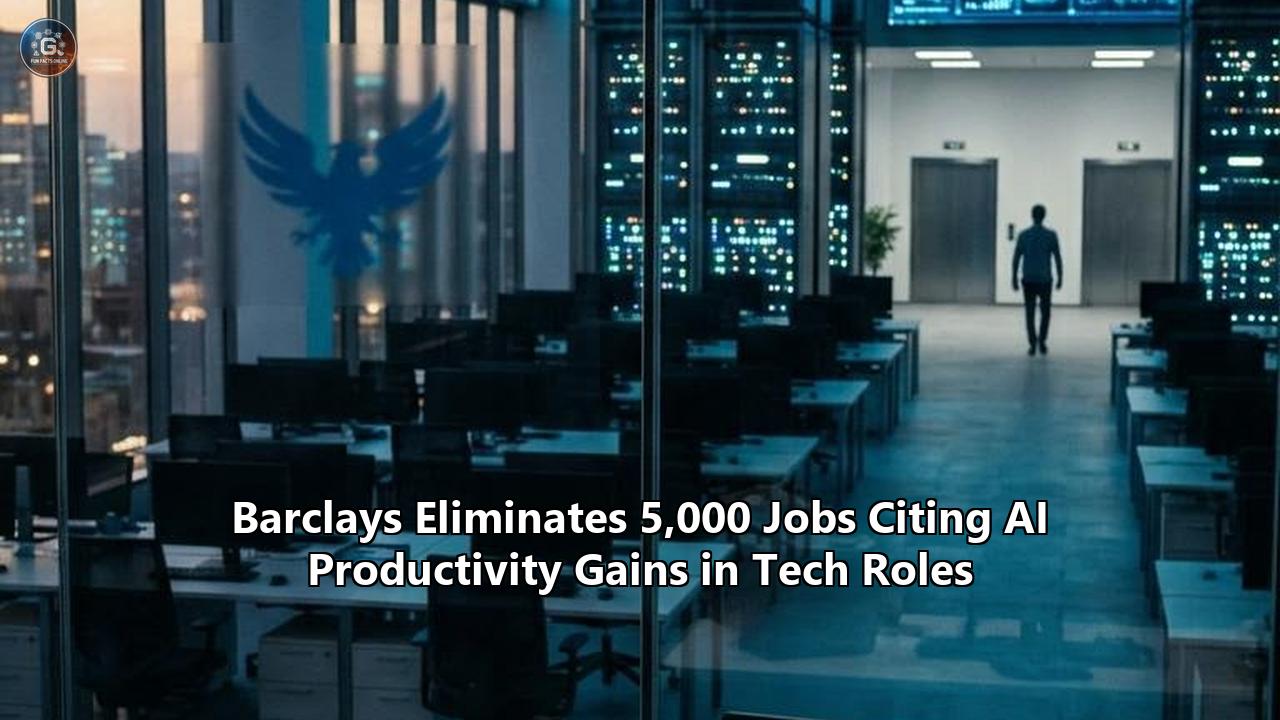
Barclays announced it is eliminating approximately 5,000 jobs—roughly 5% of its 93,000-strong global workforce—with group executives directly linking the reduction to productivity leaps enabled by artificial intelligence. The move, disclosed alongside third-quarter financial results, targets support functions for roughly 60% of the redundancies, specifically citing software engineers whose day-to-day coding throughput has been compressed by automated tooling.
The bank had already trimmed 1,000 roles during the first half of the year, leaving an aggressive window to execute the remaining 4,000 redundancies before December. Group Finance Director Anna Cross delivered the rationale plainly on an earnings call: "These actions involve an expected reduction of circa 5,000 full-time employees. Around 60% of the group actions relate to support functions, including fewer developers, as AI makes our people more productive."
The retrenchment arrived not amid distress, but alongside a 12% rise in third-quarter pre-tax profits to £2.3 billion, driven by a 47% jump in equities division revenue. Simultaneously, the board authorized an additional £500 million share buyback, bringing capital returned to shareholders through distributions and repurchases to £2.8 billion for the year.
┌────────────────────────────────────────────────────────────────────────┐
│                   BARCLAYS WORKFORCE RESTRUCTURING                     │
├────────────────────────┬───────────────────────────────────────────────┤
│ Total Reductions       │ 5,000 roles (5% of 93,000 global headcount)   │
│ Target Realization     │ 1,000 (H1) / 4,000 (Q3–Q4)                    │
│ Target Functional Split│ 60% Support & Tech Functions (3,000 roles)     │
│ Targeted 2027 Savings  │ £1.1 billion annualized run-rate              │
│ Total Restructuring Exp│ £607 million (£307M H1–Q3 + £300M Q4)         │
│ Core Technology Stack  │ Anthropic Claude Code, Colleague Assistant    │
└────────────────────────┴───────────────────────────────────────────────┘
This restructuring represents a significant inflection point in corporate engineering. While Silicon Valley software vendors have trimmed payrolls citing generalized operational discipline or pandemic over-hiring, Barclays is the first global tier-one bank to publicly formalize the link between generative software development and direct headcount elimination. The bank has deployed enterprise-grade coding tools, quantified internal output gains, and used those balance-sheet calculations to justify structural workforce reductions.
This incident serves as a real-world case study for the wider enterprise landscape. Beyond the headline figures, the Barclays job cuts AI strategy exposes how modern financial institutions plan to permanently decouple technology output from developer headcount, replace operational expenditure with algorithmic capital, and navigate the technical and cultural liabilities left behind.
Inside the Barclays Engine: Infrastructure Preceding Automation
Executive leadership framed the cuts as the product of years of foundational engineering rather than a sudden pivot. Group Chief Executive C.S. Venkatakrishnan pushed back on the idea that generative models alone caused the downsizing, characterizing the software layer as an accelerant on top of simplified enterprise architecture.
"AI has an important role to play and may have a more important role to play in the future," Venkatakrishnan said during the earnings presentation. "I've often said that it is the icing on the cake—it's not the cake—because you need to do the infrastructure build to get the benefits of AI."
                       ENTERPRISE AI ADOPTION PIPELINE

   Phase 1: Foundation          Phase 2: Tooling           Phase 3: Realization
 ┌──────────────────────┐    ┌──────────────────────┐    ┌──────────────────────┐
 │ Legacy Refactoring   │    │ Enterprise Licensing │    │ Headcount Correction │
 │ Data Unification     ├───►│ Claude Code Rollout  ├───►│ 60% Support Cuts    │
 │ Pipeline CI/CD       │    │ Mail/Chat Agents     │    │ £1.1B Cost Reduction │
 └──────────────────────┘    └──────────────────────┘    └──────────────────────┘
That infrastructure foundation materialized across Barclays' technical estate over an 18-month deployment sprint:
- Engineering Tooling: The bank integrated Anthropic’s Claude Code across its core developer workstations. Current internal roadmaps mandate that half of all Barclays software engineers actively develop with generative coding agents before the close of the year, with ubiquitous enterprise-wide adoption slated for 2027.
- Operational Knowledge Retrieval: More than 16,000 Barclays UK customer-facing and back-office staff were onboarded to the Colleague Knowledge Assistant, an internal intelligence layer running retrieval-augmented generation (RAG) across proprietary policy documents, compliance playbooks, and procedural guidelines.
- High-Volume Ingestion: In the Global Markets division, custom-trained natural language pipelines ingest, classify, and parse roughly 120,000 daily unstructured client emails, routing trade instructions and documentation without human intermediary triage.
- Executive Stewardship: Barclays named Anita Tanna—previously head of high-touch equity sales—as the bank’s first Chief AI Officer, signaling a deliberate shift in reporting authority from purely speculative research units to direct revenue-and-cost drivers.
This phased rollout exposes a fundamental rule of enterprise modernization: AI productivity is a downstream artifact of systems hygiene. Organizations that maintain fragmented data silos and disconnected legacy repositories struggle to realize measurable labor savings through language models. Barclays systematically rebuilt its repositories, continuous integration pipelines, and documentation standards to enable automated agents to query enterprise codebases.
The resulting efficiency did not yield higher software output targets; instead, it triggered payroll reductions. The bank absorbed £307 million in restructuring costs through the first nine months of the year and committed another £300 million for the final quarter, pricing the immediate capital outlay required to eliminate human overhead at £607 million.
Case Lens: Reversing the Jevons Paradox in Regulated Software
The central theoretical problem raised by the Barclays retrenchment is the sudden failure of the Jevons Paradox within enterprise technology. Historically, efficiency gains in computing have increased demand for compute and builders. When the introduction of high-level programming languages replaced assembly, firms did not fire programmers; they wrote exponentially more software, sparking decade-long hiring booms.
The Barclays job cuts AI initiative demonstrates why banking technology behaves differently. Within tier-one banking environments, software production capacity is bounded by non-negotiable regulatory, operational, and architectural ceilings:
TRADITIONAL TECH ENVIRONMENT            ENTERPRISE BANKING ENVIRONMENT
(Jevons Paradox Holds)                 (Jevons Paradox Inverts)

Efficiency Gains In Production         Efficiency Gains In Production
          │                                      │
          ▼                                      ▼
Lower Unit Cost of Code                Lower Unit Cost of Code
          │                                      │
          ▼                                      ▼
Expanded Feature Backlogs              Strict Change-Management Budgets
Unlimited Production Appetite          Regulatory Constraints & Audits
          │                                      │
          ▼                                      ▼
Net Result: Headcount Expands          Net Result: Headcount Compresses
The Capacity Ceiling
Banks do not have unlimited appetites for software deployment. Production releases are governed by strict change-management windows, compliance reviews, stress-testing constraints, and capital-adequacy regulations. A development team producing three times as many pull requests per sprint runs directly into regulatory limits, internal change advisory boards, and operational stability mandates.
Because the institution cannot safely deploy three times as much software into core settlement, clearing, or credit assessment networks, excess engineering throughput cannot be absorbed through infinite output expansion.
The Compositional Shift
Generative code tools excel at routine scaffolding: drafting boilerplate code, generating unit test fixtures, refactoring syntactic patterns, and writing standard API connectors. Traditionally, large financial institutions sustained fleets of junior and mid-level engineers to manage this maintenance burden.
 HISTORICAL STAFFING PYRAMID                SYNTHETIC SQUEEZE MODEL

          ┌───┐                                      ┌───┐
          │S/A│  Staff / Architects                  │S/A│  Staff / Architects
         ┌┴───┴┐                                    ┌┴───┴┐
         │ Mid │ Mid-Level Devs                     │ Mid │ (Compressed)
        ┌┴─────┴┐                                  ┌┴─────┴┐
        │Junior │ Entry-Level / QA                 │  AI   │ Synthetic Layer
        └───────┘                                  └───────┘ (Replaces Base)
With models like Claude Code generating context-aware unit tests and converting functional requirements into deployable code within minutes, the ratio of developers required per project shifts dramatically. One senior systems engineer, operating alongside an enterprise-connected agent, replicates the gross output formerly delivered by a full scrum unit of four junior developers and a dedicated tester.
When engineering throughput increases while deployment velocity remains capped by risk budgets, developer capacity shifts from a constraint to an expensive surplus. Barclays opted to monetize that surplus as cost savings, projecting £1.1 billion in annualized savings by 2027 by eliminating the human baseline responsible for procedural code generation.
The Geography of Rationalization: Where Support Functions Break
While corporate communications often characterize layoffs with terms like "support functions" or "organizational simplification," an empirical review of Barclays' operational footprint reveals where the cuts fall hardest.
The primary exposure sits inside regional operational campuses rather than executive headquarters in Canary Wharf. Barclays’ Northampton campus, established in the late 1960s as the backbone for credit card processing, merchant services, fraud analytics, and mid-tier software engineering, faces the steepest exposure.
┌────────────────────────────────────────────────────────────────────────┐
│             FUNCTIONAL EXPOSURE PROFILE: SUPPORT OPERATIONS            │
├──────────────────────────┬───────────────────────┬─────────────────────┤
│ Functional Role Group    │ Primary Tool Deployed │ Automation Vector   │
├──────────────────────────┼───────────────────────┼─────────────────────┤
│ KYC & Sanctions Analysts │ Retrieval RAG Agents  │ Verification Engine │
│ Routine Code Maintenance │ Claude Code IDE Tools │ Automated Refactor  │
│ Fraud & Dispute Review   │ Predictive LLM Triage │ Evidence Summaries  │
│ Change-Management QA     │ Synthetic Test Suites │ Auto-Test Execution │
│ Client Service Ops       │ Markets Parser Agents │ Unstructured Triage │
└──────────────────────────┴───────────────────────┴─────────────────────┘
These operational nodes historically acted as white-collar engines for non-metropolitan economies. The profiles targeted across Northampton, Glasgow, and offshore support centers in India handle transactional knowledge work:
- Software Engineering & Testing: Developers writing operational interfaces, updating legacy payment gateways, refactoring database layers, and generating functional QA tests.
- Financial Crime & Compliance: Operational analysts conducting repetitive Know-Your-Customer (KYC) identity checks, cross-referencing screening documents against sanctions registries, and writing anti-money laundering (AML) suspicious activity reports.
- Dispute & Payment Operations: Back-office support teams handling chargebacks, payment exceptions, and manual transaction repair.
The structural vulnerability across these roles stems from a shared characteristic: they process structured and semi-structured text under strict rules. A retrieval engine paired with a reasoning model can evaluate an identity profile against a compliance matrix, synthesize transaction records, and draft a regulatory-compliant report in seconds.
This displacement mechanism creates an immediate local impact. Employees within these operational centers report swift dismissal processes without internal transfer opportunities. While CEO Venkatakrishnan indicated the bank would seek to retain and retrain talent for new responsibilities during an internal town hall, regional job markets tell a different story. Displaced compliance analysts, test automation engineers, and legacy developers often enter regional labor markets already saturated with redundant knowledge workers.
The Capital Replacement Playbook: An Economic Dissection
The financial mechanics driving the Barclays workforce reduction illustrate a broader shift in balance-sheet management across global banking. The bank’s earnings report outlines a simple economic exchange: human operational expenditure (OpEx) is retired to fund capitalized technology outlays, data center leases, model API fees, and direct equity repurchases.
                     BALANCE SHEET VALUE EXTRACTION

 HUMAN-CENTRIC BASELINE                 SYNTHETIC CAPITAL BASELINE
 ┌─────────────────────────┐            ┌─────────────────────────┐
 │ Human Salaries          │            │ Model API Licensing     │
 │ Pension Liabilities     │            │ Cloud GPU Infrastructure│
 │ Health Insurance        │            │ Clean Modernized Core   │
 │ Office Real Estate      │            │ High-Margin Buybacks    │
 └─────────────────────────┘            └─────────────────────────┘
      (High, Fixed OpEx)                     (Scalable Capital Asset)
               │                                      │
               └───► Replaced by £607M Program ───────┘
The Cost-Income Equation
European banks trade at persistent valuation discounts compared to their American peers, largely due to stubbornly high cost-to-income ratios and modest returns on tangible equity (RoTE). Investors have historically penalized European institutions for bloated operational structures and sticky regional labor agreements.
By eliminating 5,000 positions and targeting £1.1 billion in savings by 2027, Barclays is targeting its structural cost line. The £607 million restructuring charges absorbed across 2026 represent a short-term hit designed to structurally shift the bank's return profile.
                                 FINANCIAL SUMMARY
 ┌───────────────────────────────────┬───────────────────────────────────┐
 │ Total Restructuring Exp. (2026)   │ £607 Million (£307M + £300M)      │
 │ Projected 2027 Structural Savings │ £1.1 Billion                      │
 │ Capital Returned to Shareholders  │ £2.8 Billion YTD (Inc. £500M Buy) │
 │ Q3 Pre-Tax Profit Performance     │ £2.3 Billion (Up 12% YoY)         │
 └───────────────────────────────────┴───────────────────────────────────┘
Decoupling Scaling Costs from Headcount
Historically, when a bank scaled its corporate customer base, trade-processing volumes, or credit card origination, it had to expand its support operations proportionally. Adding 100,000 cardholder accounts required adding customer support agents, fraud analysts, reconciliation accountants, and platform engineers.
Machine intelligence breaks this linear relationship. Software agents, API tokens, and cloud infrastructure scale at near-zero marginal cost. A cluster of language models parsing credit applications or running code security scans can handle a 50% spike in workload with minor infrastructure costs, whereas human teams require recruitment, onboarding, equipment, real estate, and management layers.
Capital Allocation Realignment
The financial pairing in Barclays’ third-quarter disclosure is telling: 5,000 workers were eliminated as the bank authorized a £500 million share buyback and distributed £2.8 billion year-to-date. Sharon Graham, general secretary of the Unite union, condemned this allocation strategy:
"The company is using AI as an excuse to discard its loyal and long-suffering workforce," Graham said following the announcement. "Employers should be focused on upgrading employees' skills so that they remain employed as new technology changes the workplace. Instead, Barclays is guilty of taking a short-term, knee-jerk approach."
From a corporate finance perspective, this dynamic highlights how modern automation works: the economic surplus captured by replacing knowledge workers is not primarily reinvested into experimental staff reskilling. Instead, it is directed to institutional investors through equity retirements and capital returns, bolstering share prices while permanently lowering operating costs.
Global Banking Cascades: The Competitive Imperative
Barclays is an early mover in public transparency, but it is operating within an aggressive industry-wide trend. Financial institutions share similar cost pressures, regulatory environments, and legacy software architectures. When one major clearer demonstrates that support functions can be trimmed using modern tooling, its competitors quickly face pressure to produce similar margins.
                           INDUSTRY COMPARATIVE
 ┌────────────────────┬────────────────────┬─────────────────────────────┐
 │ Institution        │ Reductions Target  │ Stated Focus Area           │
 ├────────────────────┼────────────────────┼─────────────────────────────┤
 │ Barclays           │ 5,000 roles (5%)   │ Developers, Support Ops     │
 │ Standard Chartered │ 7,800 roles        │ Corporate Back-Office Functions│
 │ HSBC               │ Up to 20,000 roles │ Mid/Back-Office, Wealth (70%)│
 │ Wall Street Peers  │ Headcount caps     │ Junior Tech & Analyst Intake│
 └────────────────────┴────────────────────┴─────────────────────────────┘
The scale of this shift is visible across peer institutions:
- Standard Chartered: Chief Executive Bill Winters laid out a roadmap to eliminate over 7,800 corporate-functions jobs by 2030, citing enterprise automation. The strategy prompted criticism when Winters described the restructuring as "replacing, in some cases, lower-value human capital with the financial capital and the investment capital we’re putting in," a statement for which he later apologized.
- HSBC: The bank announced plans to eliminate half of its specialist and management roles within wealth management, alongside cutting roughly 70% of human financial advisers in targeted units, replacing manual advisory workflows with automated wealth engines. Reports also revealed HSBC is weighing operational reductions that could reach 20,000 middle- and back-office roles over the next five years. Michael Roberts, head of HSBC's investment bank, recently noted that autonomous trading agents could displace human floor execution within years.
- Wall Street: JPMorgan Chase chief executive Jamie Dimon has repeatedly cautioned that algorithmic systems will reduce specific operational headcounts, shifting the bank's hiring focus toward artificial intelligence researchers, data scientists, and infrastructure engineers over traditional analysts. Goldman Sachs initiated comparable structural constraints, keeping headcount growth flat despite expanding trading and underwriting desks.
Sector analysts estimate that global banking networks may shed as many as 200,000 technical, operational, and administrative positions over the next three to five years. The Barclays job cuts AI announcement provides the working template: describe the tools as productivity aids for human workers, run the parallel internal efficiency metrics, and then cut the redundant roles through support functions at the next quarterly earnings window.
The Hidden Vulnerabilities of the Automated Enterprise
While public markets welcome margin improvements, replacing human developers with generative tools introduces distinct operational and technical risks. The widespread adoption of synthetic code inside complex, highly regulated core banking environments creates four significant structural vulnerabilities:
┌────────────────────────────────────────────────────────────────────────┐
│                      SYSTEMIC RESILIENCE HAZARDS                       │
├─────────────────────────┬──────────────────────────────────────────────┤
│ Hazard Class            │ Root Cause Mechanism                         │
├─────────────────────────┼──────────────────────────────────────────────┤
│ Junior Pipeline Drying  │ Slashing base-tier developer and analyst roles│
│ Synthetic Bloat         │ Accelerated check-ins of unoptimized code    │
│ Hallucinated Security   │ Subtle, context-blind logic errors in escrow │
│ Regulatory Liability    │ Algorithmic opacity violating DORA mandates  │
└─────────────────────────┴──────────────────────────────────────────────┘
1. The Breakdown of the Senior Talent Pipeline
Senior software architects are not hired off the street; they are forged over decades of fixing junior-level bugs, writing unit tests, maintaining documentation, and navigating production outages.
When a financial institution cuts its entry-level and junior developer roles, it severs its talent pipeline. If AI generates the bulk of foundational code, the organization no longer trains junior engineers to evaluate architectural edge cases, respond to unexpected production anomalies, or question broken abstractions. Within five to seven years, institutions that cut their foundational engineering base risk facing an acute shortage of senior engineers capable of debugging mission-critical systems.
2. Synthetic Code Bloat and Technical Debt
AI coding assistants produce functional code, but they do not intuitively optimize for simplicity or maintainability. Developer environments integrated with generative tools frequently see significant increases in total lines of committed code.
Developers review and accept pull requests at speeds that outpace their ability to deeply audit architectural logic. Over time, enterprise codebases risk becoming larger, more fragmented, and harder to refactor. The short-term productivity dividend of rapid feature delivery can quickly transform into long-term architectural gridlock, requiring expensive refactoring programs down the road.
3. Latent Security and Logic Flaws
Models trained on vast repositories of public code inherit known software patterns, common vulnerabilities, and deprecated practices. In banking, software bugs do not merely crash apps; they lead to transaction balance mismatches, ledger inconsistencies, and payment failures.
A synthetic tool might produce clean, working code for a credit-scoring gateway or payment router while introducing subtle edge-case errors that evade automated test suites. If human developer teams are reduced by 60%, the institutional capacity to rigorously audit synthetic logic drops significantly, leaving fewer engineers to catch critical flaws before deployment.
4. Regulatory Resistance and Systemic Opacity
The operational assumptions underpinning this shift will inevitably face European and British regulatory scrutiny. Under the European Union’s Digital Operational Resilience Act (DORA) and the UK Financial Conduct Authority’s (FCA) operational resilience frameworks, tier-one banks must demonstrate complete oversight of their technological supply chains, automated systems, and algorithmic decisions.
When code governing risk assessment, compliance screening, or trade confirmation is generated by deep language models, the audit trail blurs. If an algorithmic deployment error triggers an erroneous run on liquidity or corrupts cross-border payment records, executive boards cannot cite algorithmic efficiency as an excuse. Regulators demand personal executive accountability. Downsizing internal engineering teams while expanding automated deployments increases compliance and operational risk across the entire technical estate.
Strategic Principles for the Post-Redundancy Enterprise
The decisions made at Barclays reveal essential operational lessons for enterprise leaders navigating automation and workforce planning. Managing through these shifts requires balancing economic reality with organizational durability:
                  ENTERPRISE TRANSFORMATION FRAMEWORK

  Traditional Playbook                  Adaptive Playbook
┌───────────────────────────────┐     ┌───────────────────────────────┐
│ • Buy generic AI seat licenses│     │ • Standardize architectures   │
│ • Measure gross code volume   │     │ • Track verified deployments  │
│ • Cut junior talent pipelines │     │ • Retrain juniors as verifiers│
│ • Shift budget from tech to   │     │ • Build institutional logic   │
│   shareholder buybacks        │     │   audit architectures         │
└───────────────────────────────┘     └───────────────────────────────┘
Lesson 1: Infrastructure Must Precede Efficiency
Firms cannot extract meaningful structural savings simply by purchasing software licenses for unstandardized legacy systems. Barclays saw clear efficiency gains only because it had previously unified its internal codebases, built CI/CD pipelines, and systematically indexed enterprise documentation into accessible vector environments. Automation tools amplify underlying software architecture; they cannot fix broken systems.
Lesson 2: Redefine the Engineering Role from Author to Auditor
Organizations deploying tools like Claude Code must fundamentally update how they evaluate developers. The value of a software engineer no longer lies in how quickly they can type syntax or write routine methods.
Instead, the modern developer's value rests on systemic judgment: verifying safety, validating edge cases, checking architectural fit, and ensuring security compliance. Engineering departments must evolve into code auditing bodies. Firms that cut developer headcount without training their remaining staff in rigorous verification techniques risk exposing their environments to critical failures.
┌────────────────────────────────────────────────────────────────────────┐
│                   THE SHIFTING ROLE OF THE DEVELOPER                   │
├──────────────────────────┬─────────────────────────────────────────────┤
│ Legacy Focus: Code Author│ Modern Focus: Code Auditor & System Reviewer│
├──────────────────────────┼─────────────────────────────────────────────┤
│ • Typing syntax          │ • Auditing edge-case logic                  │
│ • Writing unit tests     │ • Validating architectural fit              │
│ • Manual scaffolding     │ • Verifying data privacy & security         │
│ • Routine API management │ • Overseeing automated deployments          │
└──────────────────────────┴─────────────────────────────────────────────┘
Lesson 3: Plan for Generational Talent Gaps
Treating junior engineers as immediate cost burdens is short-sighted. Organizations need to rebuild their apprenticeship pipelines.
If generative tools handle the basic tasks that junior staff used to learn on, companies must design alternative training tracks. Junior engineers should be paired directly with system architects to shadow structural design reviews, participate in chaos engineering simulations, and lead red-team audits of generated code. Abandoning entry-level hiring entirely saves money today at the expense of technical leadership tomorrow.
Lesson 4: Account for Technical Debt in ROI Calculations
When calculating cost savings from workforce reductions, leadership teams must factor in the total cost of ownership. The immediate operational savings gained by cutting engineering jobs must be weighed against future expenses: model licensing fees, infrastructure costs, external audit overhead, and the resources required to refactor synthetically generated code. A cost-reduction program that degrades codebase stability will see paper savings swallowed by future remediation projects.
Indicators to Watch: The Real Impact Over the Next 12–24 Months
The broader viability of the Barclays job cuts AI playbook will become clear as the bank attempts to execute the bulk of its 5,000 workforce reductions while trying to maintain operational stability:
                               UPCOMING MILESTONES

  Q4 2026                 H1 2027                 FY 2027
 ┌──────────────────────┐┌──────────────────────┐┌──────────────────────┐
 │ Execute remaining    ││ Monitor core banking ││ Audit £1.1B run-rate │
 │ 4,000 cuts; record   ││ reliability metrics; ││ structural savings   │
 │ £300M charge         ││ evaluate code churn  ││ real impact          │
 └──────────────────────┘└──────────────────────┘└──────────────────────┘
            │                       │                       │
            ▼                       ▼                       ▼
Execution Milestones Technical Integrity Economic Realization- Q4 2026 Execution and Departure Velocity: With 1,000 redundancies accounted for in the first half of the year, Barclays must process roughly 4,000 departures by the close of the year. Watch for disruptions in routine customer support, payment exception management, and card services centered around regional hubs like Northampton.
- Platform Reliability and Code Churn Metrics: Independent tracking of software release frequency, patch rollbacks, and unexpected service interruptions across retail and investment banking platforms will show how effectively smaller engineering teams manage growing software estates.
- Regulatory Feedback and Governance Audits: Watch for guidance or formal reviews from the Bank of England's Prudential Regulation Authority (PRA) and the FCA regarding institutional dependence on generative code generation, algorithmic resilience, and operational risk controls.
- Realization of the £1.1 Billion 2027 Savings Target: Financial performance updates over the coming quarters will confirm whether these cuts generate lasting margin improvements, or whether rising model licensing costs, cloud infrastructure fees, and external contractor rates erode projected savings.
- Union Mobilization and Workplace Friction: With Unite the Union vocally opposing the cuts, track whether rising employee dissatisfaction affects retention among senior engineers and architects—the exact talent required to oversee automated systems.
The developments at Barclays mark the end of the speculative phase of enterprise automation. The narrative has moved beyond theoretical white papers and experimental pilots into quarterly balance-sheet restructuring.
By publicly tying 5,000 layoffs directly to the productivity gains of software agents, Barclays has broken corporate ground. Whether this strategy delivers an agile, cost-effective financial institution or leaves behind a fragile, technically indebted organization will serve as an instructive lesson for global enterprises navigating the modern economy.
Reference:
- https://www.computerweekly.com/news/366652509/Barclays-to-cut-5000-jobs-and-employ-more-artificial-intelligence
- https://www.theguardian.com/business/2026/oct/22/barclays-profits-up-as-uk-banks-brace-for-tax-increase-in-budget
- https://www.businessinsider.com/barclays-job-cuts-ai-push-layoffs-2026-10
- https://japantoday.com/category/business/barclays-bank-to-cut-about-5-000-jobs-amid-ai-drive
- https://www.bankingdive.com/news/barclays-cut-5000-employees-ai-q3-earnings-venkat/833747/
- https://www.techtimes.com/articles/329430/20261023/barclays-cuts-5000-jobs-after-its-own-ai-research-flagged-developer-roles.htm
- https://www.pymnts.com/personnel/2026/barclays-plans-5000-job-cuts-as-ai-push-reshapes-operations/
- https://www.efinancialcareers.com/news/barclays-ai-job-cuts