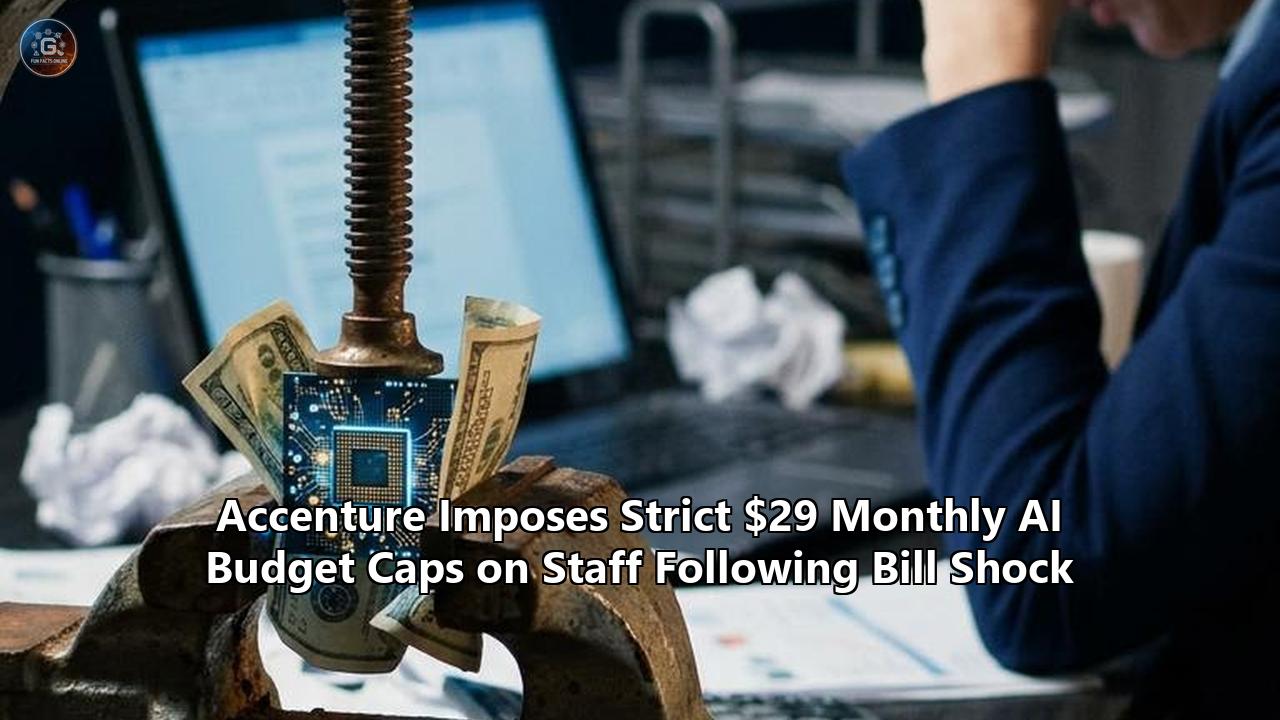
A leaked internal directive at Accenture has laid bare the mounting financial tensions beneath corporate generative software deployment. The Dublin-headquartered professional services giant, which employs more than 750,000 people globally and sells billions of dollars in artificial intelligence consulting, has quietly introduced a rigid central funding ceiling on Anthropic’s Claude Enterprise. Effective October 1, 2026, the firm will subsidize only $29 per employee per month from central IT reserves for Claude usage, requiring any spending beyond that micro-budget to be charged back directly to individual client engagements or team accounts.
The directive, outlined in an internal communication titled “Claude Enterprise Users: Important Updates to Licensing and Usage Costs” and first reported by 404 Media, arrived after internal billing reviews revealed severe operational spending spikes. Prior to the restriction, software engineers, solution architects, and consultants building automated workflows were frequently burning between $500 and $1,000 per month in Claude API and interface tokens. In several delivery centers, individual token consumption had scaled so rapidly that corporate IT faced unforecasted multi-million-dollar monthly overruns.
The implementation of strict accenture ai budget caps signals a decisive end to the era of friction-free, centrally subsidized generative experimentation. Across the enterprise software sector, the unmonitored provision of large language models is colliding with the cold calculus of operational accounting. While enterprise software historically scaled on predictable per-seat, per-year software-as-a-service (SaaS) licenses, advanced reasoning models and autonomous coding agents operate on fluid, consumption-based compute metrics. By imposing a $29 ceiling, Accenture is not merely reigning in an operational line item; it is forcibly shifting the financial risk of runaway token consumption away from central corporate overhead and directly onto the profit-and-loss (P&L) statements of client-facing project managers.
                     CENTRAL IT OVERHEAD
                              │
                    [ $29 / month allowance ]
                              │
       ┌──────────────────────┴──────────────────────┐
       ▼                                             ▼
[ Within $29 Cap ]                          [ Exceeds $29 Cap ]
       │                                             │
• Basic summarization                       • Heavy Claude Code runs
• Routine email drafting                    • Multi-agent workflows
• Light drafting tasks                      • Iterative code refactoring
       │                                             │
Fully Subsidized                            Requires WBS Project Code
                                                     │
                                            ┌────────┴────────┐
                                            ▼                 ▼
                                    Fixed-Price       Time & Materials
                                    (Firm Margin      (Client Invoiced
                                     Compression)      or Disputed)
Accenture has publicly pushed back against the severity of the headlines. A company spokesperson maintained that characterizing the policy as an outright limit on employee capability is inaccurate. "Reporting that suggests that we have put a firm limit on our people's access to AI tools each month is incorrect," the spokesperson stated. "The figure was used to demonstrate one part of the funding approach. Claude is a specialized AI tool and critical to how we deliver work for our clients and within our organization. We invest in Claude and deploy to our teams where it can have the greatest impact."
Behind the corporate messaging, however, internal records, engineering discussions, and leaked administrative memos paint an entirely different picture. For hundreds of frontline developers who had re-architected their delivery pipelines around autonomous agents, the $29 allowance amounts to roughly two or three days of active development work before their tools lock up, demanding a client billing code to resume operation.
The WBS Trap: How Chargebacks Threaten Consulting Margins
To understand why the policy sent shockwaves through Accenture’s delivery units, one must look at how professional services accounting functions. The internal memo instructs staff that once an employee exhausts the $29 central allotment, all surplus costs must be billed to a Work Breakdown Structure (WBS) code. In consulting firms, the WBS code is the master billing identifier that tracks every billable hour, travel expense, software seat, and compute charge accrued during a client engagement.
Under standard time-and-materials contracts, shifting a software expense to a client code is relatively straightforward, provided the client has agreed to absorb technology infrastructure surcharges. But Accenture’s commercial profile makes that approach perilous: over 65% of the firm's total commercial bookings are negotiated as fixed-price contracts.
In a fixed-price engagement, the client pays a predetermined, non-negotiable lump sum for a defined deliverable—such as migrating an enterprise resource planning (ERP) system, building a custom data lake, or deploying a customer portal. Every dollar spent on delivering that engagement eats directly into the engagement's gross margin.
When a project manager bids on an eight-month fixed-price contract, the budget is calculated using tightly modeled labor rates and fixed software overhead. No historical margin model accounted for twenty software engineers burning through $800 each month in raw API tokens. Over a 40-person engineering team, unexpected token expenditure can quietly siphon away $32,000 every month—more than a quarter of a million dollars across an eight-month delivery cycle.
Fixed-Price Engagement Margin Erosion Scenario
────────────────────────────────────────────────────────────────────────
Assumed Delivery Team:          20 Senior Software Engineers
Project Duration:               8 Months
Contract Value (Fixed Fee):     $3,200,000
Baseline Target Gross Margin:   35.0% ($1,120,000 target profit)
────────────────────────────────────────────────────────────────────────
Central IT Absorption Model ($29/month cap bypassed):
  Average Token Spend:          $850 / developer / month
  Total Token Expenditure:      $136,000 over 8 months
  Chargeback Direct to WBS:     -$136,000 from engagement budget
────────────────────────────────────────────────────────────────────────
Realized Engagement Margin:     30.75% ($984,000 realized profit)
Net Margin Degradation:         425 basis points (Contract Underperformance)
────────────────────────────────────────────────────────────────────────
Project Managing Directors (MDs), whose compensation, performance bonuses, and career trajectories depend on hitting strict gross margin targets, are suddenly confronted with an operational dilemma. If they approve the WBS charge for Anthropic tokens, their project margin drops, dragging down their financial scorecard. If they reject the charge, their developers lose access to the very tools deployed to accelerate the contract's delivery schedule.
The memo also revealed an administrative clawback provision: providing an active WBS code does not protect a worker's access. The memo bluntly cautioned staff: "Providing a WBS and obtaining a license does not guarantee indefinite or ongoing access to Claude. License allocations are reviewed periodically, and access may be reassessed based on business priorities, role requirements, usage patterns, and evolving workforce needs."
For numerous developers, reassessment arrived swiftly. Within days of the policy going live on October 1, employees on client deployments reported automated access revocations. Notification prompts stated plainly: "Based on a review by your business leadership, it has been determined that your current role does not require a Claude license."
The Technical Anatomy of Token Bleed: Why Agentic Loops Break IT Budgets
The root cause of the crisis does not stem from employees playing with conversational chatbots during working hours. Rather, it is a consequence of how modern agentic programming systems interact with underlying transformer models.
Traditional conversational AI workflows—such as asking a web model to draft an executive summary, edit a proposal, or write a regular expression—rely on episodic, single-turn interactions. A user submits a query containing 400 input tokens, and the model responds with 600 output tokens. Under contemporary inference rates, an entire conversational interaction costs a fraction of a cent. Even if a consultant conducts thirty such exchanges in a day, their monthly consumption struggles to breach $15 to $20. The $29 central budget was engineered specifically around this chat-centric profile.
Episodic Chat Interaction (Linear Cost Profile)
User Prompt (400 tokens) ──► Model Inference ──► Assistant Response (600 tokens)
Total Footprint: ~1,000 tokens ($0.003 - $0.008)

─────────────────────────────────────────────────────────────────────────────────

Agentic Coding Loop (Exponential Compounding Cost Profile)
User Command ("Refactor service & verify tests")
 │
 ├──► Loop 1: Ingest Repo Context (120k tokens) + Tool Use Instructions
 │     └── Execution: Run Bash shell command / Read file tree
 │
 ├──► Loop 2: Ingest Prior State (128k tokens) + Read source files (35k tokens)
 │     └── Execution: Execute code modification in local environment
 │
 ├──► Loop 3: Ingest Entire History (172k tokens) + Read compilation error output
 │     └── Execution: Attempt bug fix in implementation file
 │
 ├──► Loop 4: Ingest Entire History (185k tokens) + Run test suite
 │     └── Execution: Parse failing integration test traces
 │
 └──► Loop N: Continued context re-ingestion until convergence or token exhaustion
Total Footprint: 2,500,000+ tokens ($12.00 - $35.00+ per single task execution)
The financial baseline collapsed when Accenture engineers moved toward tools like Claude Code, Anthropic’s command-line interface (CLI) agent designed to automate complex programming tasks directly in the local development environment.
Claude Code does not operate as an autocomplete mechanism; it operates as an iterative agentic loop. When an engineer issues a multi-step instruction—such as "integrate this legacy service with our new microservice architecture and ensure all unit tests pass"—the agent executes an autonomous execution cycle:
- Context Harvesting: The agent crawls the local repository directory structure, reading file contents, package manifests, and dependency trees into its prompt buffer.
- Model Call: The engine sends a comprehensive API request comprising the instructions, repository context, and available Model Context Protocol (MCP) tool schemas.
- Tool Execution: The model parses the codebase, decides to execute a bash shell script, generates code modifications, or queries an internal testing database.
- Observation and Re-Prompting: The terminal executes the tool action, captures standard output, standard error, and compiler logs, and transmits the entire updated session history back to the model for the next step.
- Iterative Refinement: The cycle repeats continuously until the test suite runs clean or the process reaches a recursion safety limit.
This architecture causes an exponential compounding of input tokens. Published token telemetry reveals that in an active agentic coding session, output tokens (the actual code written) account for less than 5% of the total volume. Over 95% of the tokens billed on enterprise invoices are input tokens, driven by the persistent re-ingestion of the entire conversational context, tool outputs, and file contents with every iteration.
Token Consumption Metrics in Agentic Workflows
┌─────────────────────────────────┬─────────────────┬───────────────────┐
│ Token Component                 │ Typical Volume  │ Share of Activity │
├─────────────────────────────────┼─────────────────┼───────────────────┤
│ Cached Context Reads            │ 940,000 tokens  │ ~91.2%            │
│ Uncached Context / File Reads   │ 50,000 tokens   │ ~4.8%             │
│ Tool Definition & Schemas       │ 18,000 tokens   │ ~1.7%             │
│ Reasoning / Scratchpad Tokens   │ 15,000 tokens   │ ~1.5%             │
│ Final Output Code Generated     │ 8,000 tokens    │ ~0.8%             │
└─────────────────────────────────┴─────────────────┴───────────────────┘
Anthropic pioneered prompt caching mechanisms to help alleviate this compounding cost, pricing cache hits at roughly 10% of standard input token rates (and down to 5% on premier models like Sonnet 3.5 and 4.0). However, prompt caches rely on strict, contiguous byte-level parity across consecutive calls and feature an ephemeral five-minute Time-To-Live (TTL) window.
If an engineer pauses for six minutes to read a terminal error, or if an automated process modifies a base file and busts the prefix cache, the next agent iteration must rewrite the entire prompt cache from scratch at 1.25 times the standard input rate.
In an intensive six-hour development shift, a software consultant running automated refactoring tasks, executing unit tests, and debugging dependencies via agentic commands can consume 5 to 15 million input tokens. Under Anthropic’s enterprise pricing for frontier reasoning models, that level of consumption translates to an operational cost of $20 to $45 per engineer per day.
At that burn rate, an employee burns through the entire $29 central monthly allowance by lunchtime on their second working day. Once monthly consumption crossed $800 per head across thousands of engineering seats, Accenture's central finance office faced an existential line item.
The Public Narrative Versus Enterprise Delivery Realities
The internal rationing stands in stark contrast to Accenture’s high-profile marketing campaigns. Over the preceding eighteen months, Accenture Chief Executive Julie Sweet positioned the consultancy as the premier global architect of enterprise generative transformations.
The firm committed to pouring $3 billion into its AI and Data practice, vowing to double its specialized AI workforce to 80,000 professionals, a number that later expanded past 110,000 across its wider delivery operations. Its partnership with Anthropic was announced with considerable fanfare: Accenture pledged to train approximately 30,000 consultants on Anthropic’s Claude models and deploy Claude Code to tens of thousands of internal software practitioners. The core pitch to Fortune 500 enterprise boards was simple: adopting agentic AI accelerates developer velocity by 30% to 50%, modernizes legacy mainframes at fractions of historical costs, and unlocks massive organizational efficiency.
Yet internally, the financial engineering needed to sustain those tools proved unmanageable under standard overhead allocations. The implementation of accenture ai budget caps reveals that the productivity dividend promised to corporate clients comes with a hidden structural tax: massive inference costs that traditional corporate balance sheets were never structured to absorb.
The Enterprise Software Billing Divide
─────────────────────────────────────────────────────────────────────────────
METRIC              TRADITIONAL ENTERPRISE SAAS    CONSUMPTION-BASED AGENTS
─────────────────────────────────────────────────────────────────────────────
Cost Driver         Per Head / User Seat           Raw Compute / Tokens Consumed
Predictability      Fixed Annual / Monthly Fees    Uncapped Variable Fluctuations
Budget Authority    Central IT Overhead / CIO      Project Level / End Developer
Margin Impact       Spread Uniformly               Directly Hits Delivery Gross Margin
Usage Incentive     Maximize Seat Utilization      Ration Model Queries to Save Margin
Failure Mode        Underutilized Licences         Runaway Autonomous Loops
─────────────────────────────────────────────────────────────────────────────
The friction within the firm's ranks quickly filtered into internal communication channels. In one message obtained during the initial reporting of the memo, an engineer working on proprietary client deployment systems vented their frustration: "Honestly, this is disappointing. I use Claude Code extensively to build and test an AI accelerator that is actively deployed across multiple client accounts. My usage regularly runs between $500 and $1,000 a month. Without this tool, the development cycle on this accelerator will slow to a crawl."
Another employee raised the issue of operational hurdles: "How can I speed up the upgrade to a premium account? The upgrade appears to be blocked on the internal support page. This change obviously has a significant impact on our project delivery costs, and project leadership does not know how to budget for it."
Accenture’s internal tiers distinguish between General users—who are limited to the baseline central subsidy of $29 per month—and Premium accounts, which provide up to $250 per week in token allowances ($1,000 monthly). But upgrading to a Premium account requires explicit business sponsor justification, director-level sign-offs, and an active, charge-bearing WBS code. For consultants assigned to non-billable strategic initiatives, internal intellectual property creation, or pre-sales client demonstrations, securing an active billing code proved functionally impossible.
Tokenmaxxing and Runaway Agents: An Industry-Wide Panic
Accenture is far from the only technology powerhouse blindsided by the variable costs of generative AI tools. Across the technology and enterprise services sectors, the transition from basic autocomplete to autonomous agent execution has caught enterprise finance departments unprepared.
The industry's first major public tremor surfaced at Microsoft in mid-2026. Jay Parikh, Executive Vice President at Microsoft, distributed a memo to engineering staff warning that developers were excessively consuming compute resources without driving clear business ROI. Parikh coined an engineering buzzword that quickly swept the industry:
"As we accelerate our use of GitHub Copilot to deliver on our goals, we all need to be aware of how we consume tokens. Tokenmaxxing is not what we are optimizing for. I want all of us focused on maximizing outcomes that move the needle for our customers and our business. As such, we are updating our internal guidance and managing token spend with the same discipline we apply to every other critical resource."
Microsoft took swift operational measures: it introduced division-level token spending caps, replaced default internal models with the cheaper GPT-5.6 variant, and stripped Anthropic’s Claude Code access from its Experiences and Devices division, directing thousands of engineers back toward GitHub Copilot CLI to keep compute costs within internal Azure infrastructure.
Recent Corporate AI Expenditure Interventions
┌──────────────┬────────────────────────┬───────────────────────────────────────────┐
│ Company      │ Intervention Date      │ Primary Policy Change / Action            │
├──────────────┼────────────────────────┼───────────────────────────────────────────┤
│ Microsoft    │ July - August 2026     │ Introduced division token caps; pushed    │
│              │                        │ cheaper GPT-5.6; revoked Claude Code in   │
│              │                        │ Experiences & Devices division.           │
├──────────────┼────────────────────────┼───────────────────────────────────────────┤
│ Amazon       │ July 2026              │ Audited LLM projects after internal tool  │
│              │                        │ overran budget by 860% ($1.8M total).     │
├──────────────┼────────────────────────┼───────────────────────────────────────────┤
│ Uber         │ May 2026               │ Capped developers at $1,500/month after   │
│              │                        │ burning through annual AI budget in 4 mo. │
├──────────────┼────────────────────────┼───────────────────────────────────────────┤
│ Accenture    │ October 2026           │ Capped central funding at $29/mo; shifted │
│              │                        │ excess token spend directly to WBS codes. │
└──────────────┴────────────────────────┴───────────────────────────────────────────┘
The financial stakes grew clearer after an incident inside Amazon was brought to light. A small engineering group deploying Claude Sonnet on an internal classification tool designed to match author names with retail catalog listings accidentally racked up a $1.8 million token bill.
The agentic pipeline had encountered unexpected data anomalies, triggering an unchecked retry loop that silently processed and re-processed massive catalogs against Anthropic’s APIs for nearly five consecutive months without human oversight. The project exceeded its initial development budget by 860% before enterprise FinOps dashboards caught the anomaly. The tool never even made it to production.
Similarly, ride-hailing giant Uber suffered a major budgeting setback after provisioning Claude Code access to 5,000 software engineers in late 2025. Developer adoption exceeded 90% within months, with average per-developer token costs settling between $600 and $1,800 monthly.
By April 2026—just four months into the calendar year—Uber had completely exhausted its entire annual corporate AI budget, compelling engineering leadership to install a hard $1,500 monthly cap per engineer across all coding tools.
What separates Accenture’s situation from Microsoft, Amazon, or Uber, however, is its fundamental operating model. Big Tech firms enjoy massive balance sheets, own hyperscale cloud environments, or possess structural venture partnerships that offer deep API discounts. Accenture, by contrast, operates on the economics of billable human hours and project margins. It pays market rates for external vendor APIs while bearing the fixed cost of hundreds of thousands of salaried consultants. The implementation of strict accenture ai budget caps was an inevitable financial defense mechanism.
The FinOps Reality Gap: How Enterprise Procurement Broke Down
The unfolding crisis highlights a foundational disconnect between how traditional enterprise procurement operates and how generative AI models bill for infrastructure.
For thirty years, corporate IT procurement departments operated within the boundaries of seat licensing. When a company rolled out Microsoft Office, Salesforce CRM, or Slack, the commercial model was predictable: the enterprise negotiated an Enterprise Agreement (EA), paid a fixed rate per user per year (e.g., $35 per seat per month), and accounted for the expenditure as a stable, forecastable operational expense. Whether an employee wrote one email a day or ten thousand, the software invoice remained identical.
Traditional Cloud/SaaS FinOps vs. Generative AI Tokenomics
┌───────────────────────────────┬───────────────────────────────┐
│ Cloud Infrastructure (IaaS)   │ Generative AI Agents          │
├───────────────────────────────┼───────────────────────────────┤
│ • Billed per provisioned VM   │ • Billed per token processed  │
│   hour / storage gigabyte.    │   (input and output).         │
│ • Deterministic scaling based │ • Non-deterministic runtime   │
│   on user traffic.            │   and execution loops.        │
│ • Automated scaling groups    │ • Recursive loops trigger     │
│   bound by CPU/RAM caps.      │   unpredictable prompt calls. │
│ • Infrastructure shutdown on  │ • Silent failure: code loops  │
│   runtime crashes.            │   continue accumulating bills.│
│ • Well-established FinOps     │ • Immature observability; few │
│   cost attribution tags.      │   pre-execution guardrails.   │
└───────────────────────────────┴───────────────────────────────┘
Generative AI invalidates this framework entirely. Enterprise AI pricing is fundamentally non-deterministic: the cost of a user’s interaction is tied to runtime logic, prompt length, recursive agent loops, and variable tool calls.
Traditional software crashes when it hits a catastrophic logical bug. An autonomous AI agent, however, does not crash when it encounters a bug; instead, it catches the error, reflects on its failure, rewrites its internal instructions, re-ingests hundreds of thousands of tokens of context, and retries the task. In the agentic world, runtime failures manifest as massive financial line items rather than standard software exceptions.
Traditional Failure Mode:
[ Bug Encountered ] ──► [ Process Throws Exception ] ──► [ Execution Halts ] (Cost: $0.00)

Agentic Failure Mode:
[ Bug Encountered ] ──► [ Ingest Full Traceback ] ──► [ Re-read Repository Context ]
         ▲                                                           │
         │                                                           ▼
[ Repeat Loop (x30) ] ◄── [ Parse Execution Output ] ◄── [ Attempt New Code Patch ]
(Accumulated Inference Invoice: $18.50 - $45.00 per hour, runs indefinitely until capped)
The challenge for IT teams is that enterprise cloud billing systems were never designed to track these sub-second, user-level API variations. In a standard cloud architecture, teams track spending via infrastructure tags tied to persistent virtual machines, Amazon S3 buckets, or Kubernetes clusters.
Enterprise AI, however, is often routed through pooled corporate API gateways or third-party web portals. Invoices arrive at the end of the month as a monolithic, aggregated total: $4.2 million for Anthropic Claude, $6.1 million for Azure OpenAI, with virtually zero automated mapping back to specific client project codes, development branches, or individual user IDs.
Faced with these opaque invoices, central corporate finance responded with the only tool at its immediate disposal: blunt, top-down usage caps.
Frontline Workarounds and the Growth of Shadow AI
Whenever corporate IT restricts technical tooling, frontline workers inevitably seek alternative paths to maintain their velocity. The imposition of the $29 ceiling at Accenture has already sparked informal workarounds across distributed engineering units.
Interviews with software engineers and leaks from internal forums show that team leads are increasingly turning to alternative—and often ungoverned—methods to keep their projects running on schedule:
- Shadow Expense Accounts: Senior consultants and managers with discretionary credit card limits are bypassing the official enterprise procurement gateway entirely. Instead of requesting a Premium enterprise license, they purchase standalone commercial subscriptions directly through Anthropic or third-party API aggregators and expense the charges under generic line items like "Team Research Software" or "Client Workshop Materials."
- Personal Developer Subscriptions: Numerous junior developers, fearful of falling behind on strict project deadlines, have quietly begun using personal Claude Pro or Max accounts funded out of their own pockets. This practice poses major compliance hazards for an enterprise firm: pasting proprietary client code or unpublished business logic into consumer-grade, non-enterprise accounts bypasses Accenture’s enterprise data privacy, data loss prevention (DLP), and zero-data-retention agreements.
- Open-Source Model Substitution: To avoid token billing entirely, some engineering clusters have begun experimenting with locally hosted open-source coding models. Teams are configuring open-weight models like DeepSeek-Coder, Qwen-2.5-Coder, and Meta's Llama variants on internal developer laptops or existing cloud development environments. While this approach eliminates external per-token vendor bills, it introduces substantial friction: open-weight models running on local hardware frequently exhibit higher latency, demand specialized engineering maintenance, and lag behind premier frontier models on complex architectural reasoning tasks.
- Prompt Slicing and Token Hoarding: Developers who remain on the centrally funded General tier have adopted defensive engineering habits. Rather than letting an agent read wide repository contexts to understand cross-service dependencies, engineers manually copy and paste tiny snippets of code into basic web interfaces. This eliminates the autonomous power of agentic tools, transforming what was sold as an automated software lifecycle back into a manual copy-paste exercise.
The broader operational consequence of accenture ai budget caps is the sudden fragmentation of internal tooling. A delivery process that executive leadership hoped to standardize across hundreds of thousands of staff is instead splintering into ad-hoc configurations based on which project managers are willing to subsidize their developers' compute usage.
The Emergence of AI FinOps: From Usage Tracking to Unit Economics
The friction surrounding Accenture’s memo highlights the emergence of a new engineering discipline: AI FinOps.
Just as the migration from on-premise data centers to AWS and Azure in the 2010s gave birth to cloud cost optimization teams, the transition to agentic workflows is forcing enterprises to build specialized token management frameworks. Organizations can no longer rely on simple monthly allowances or retrospective budget reviews.
The AI FinOps Operating Maturity Model
┌───────────────────┬────────────────────────────────────────────────────────┐
│ Maturity Stage    │ Characteristics & Operational Posture                  │
├───────────────────┼────────────────────────────────────────────────────────┤
│ Level 1: Chaos    │ Uncapped corporate API access; zero cost attribution; │
│                   │ monthly bill shock; unmanaged agentic loops.          │
├───────────────────┼────────────────────────────────────────────────────────┤
│ Level 2: Panic    │ Arbitrary top-down spending caps (e.g., $29/mo limits);│
│                   │ blunt license revocations; spread of Shadow AI.        │
├───────────────────┼────────────────────────────────────────────────────────┤
│ Level 3: Control  │ Dynamic proxy routing (LiteLLM); real-time rate        │
│                   │ limits; project-based WBS tagging at the gateway level.│
├───────────────────┼────────────────────────────────────────────────────────┤
│ Level 4: Unit     │ Tracking cost per business outcome (e.g., cost per PR  │
│    Economics      │ merged, cost per defect resolved); model right-sizing. │
└───────────────────┴────────────────────────────────────────────────────────┘
The FinOps Foundation, along with the Linux Foundation’s newly launched Tokenomics Foundation, has begun standardizing how enterprises should meter and govern AI workloads. According to their frameworks, organizations that succeed in deploying generative technology at scale rely on four technical mechanisms rather than blunt usage caps:
- Programmable API Gateways: Deploying enterprise proxy gateways (such as LiteLLM, Cloudflare AI Gateway, or Kong) that sit between developer terminals and provider endpoints. These gateways intercept every model call, read the developer’s active project billing tag, and enforce automated rate limits before the request reaches Anthropic or OpenAI.
- Dynamic Semantic Routing: Automatically inspecting incoming prompts and routing them to the most cost-effective model capable of handling the request. If an engineer asks an agent to generate simple unit tests or format documentation, the proxy routes the request to a micro-model like Claude Haiku or GPT-4o-mini. The system reserves expensive frontier reasoning models like Claude Sonnet or Opus exclusively for complex system design and deep debugging tasks.
- Execution Guardrails for Autonomous Agents: Modern development environments must enforce strict recursion limits. If an autonomous coding agent attempts to run more than five consecutive self-correction loops without generating passing test cases, the system halts execution, pages a human developer, and prevents the tool from running runaway token iterations in background terminals.
- Transition to Unit Economics: Leading engineering organizations are moving away from measuring raw token consumption or Weekly Active Users (WAU). Instead, FinOps teams track unit cost metrics: cost per resolved GitHub issue, cost per merged pull request (PR), or cost per customer inquiry completed. If a senior software engineer consumes $600 in monthly tokens but completes software refactoring tasks that would otherwise require $8,000 in billable subcontracted engineering hours, the expenditure represents high-yield capital deployment. When finance teams impose blanket allowances without tracking business impact, they risk defunding their most productive engineering teams.
What Lies Ahead: Contract Restructuring and the Provider Squeeze
The policy changes rolling through Accenture, Microsoft, and Amazon represent an early stage in a deeper structural realignment across the technology services ecosystem. The shock waves from these token caps will trigger major shifts in how software development is bought, sold, and delivered over the coming quarters.
                     MARKET REALIGNMENT PATHWAY
                                 │
           ┌─────────────────────┴─────────────────────┐
           ▼                                           ▼
[ Consulting Business Model ]                [ AI Provider Pricing ]
           │                                           │
• End of pure fixed-price coding             • Shift away from pure token billing
• Client contracts add "Token Pass-Through"   • Hybrid per-seat + capped consumption
• Compute clauses become standard            • Edge-hosted distillation appliances
           │                                           │
           └─────────────────────┬─────────────────────┘
                                 ▼
                 Enterprise Standard Operating State:
              Total convergence of FinOps, Procurement,
                     and Developer Observability
First, enterprise consulting agreements will require structural overhauls. Major systems integrators will no longer be able to absorb unbounded generative compute within traditional fixed-price contracts. In upcoming contract negotiations, clients should expect to see specialized contractual riders: "AI Inference and Compute Allowances" structured identically to cloud hosting surcharges. If a corporate client demands that an IT vendor deliver a core digital transformation using autonomous agent fleets, the contract will explicitly detail who pays for the millions of input tokens needed to power those agents.
Second, the commercial pressure will shift upward to the frontier AI foundation model vendors. Providers like Anthropic, OpenAI, and Google face enterprise buyers who are increasingly resistant to volatile, uncapped, consumption-only billing models.
To prevent corporate IT leaders from pulling back on enterprise deployments, model providers will likely be forced to offer hybrid commercial structures: bundled enterprise licenses that combine fixed per-seat access with guaranteed, high-volume prompt caching and predictable usage envelopes.
The developments at Accenture mark the end of corporate AI's experimental honeymoon. The vision of unrestricted, autonomous software generation running friction-free across global enterprise workforces has officially slammed into the corporate balance sheet. As organizations replace enthusiastic rhetoric with strict operational discipline, one lesson is clear: in enterprise technology, compute has a real cost, every prompt carries a price, and even the world’s largest consulting firm will meter every token until it knows precisely who is paying the bill.
Reference:
- https://thenextweb.com/news/accenture-claude-29-a-month-cap
- https://www.techradar.com/pro/accenture-employees-given-usd29-claude-spend-per-month-after-some-employees-spent-thousands
- https://timesofindia.indiatimes.com/technology/tech-news/some-accenture-employees-spent-1000-a-month-on-anthropics-claude-ai-the-company-will-now-pay-only-29-memo-warns-all-costs-are-/articleshow/134989749.cms
- https://aiweekly.co/alerts/accenture-caps-monthly-claude-funding-at-29-per-employee
- https://www.forbes.com/sites/ronschmelzer/2026/10/16/accenture-bets-big-on-claude-then-limits-ai-spending/
- https://www.hrgrapevine.com/us/content/article/2026-10-19-accenture-disputes-ai-spending-cap-claim-amid-reports-of-1000-employee-bills
- https://superpowerdaily.com/posts/accenture-limits-central-claude-funding-to-29-a-month-shifting-excess-costs-to-teams
- https://247wallst.com/investing/2026/10/16/accenture-just-capped-employees-claude-spending-at-29-a-month-some-were-spending-1000/
- https://axify.io/blog/claude-code-token-usage
- https://note.com/l_mrk/n/ne4380f96a912?hl=en
- https://www.augmentcode.com/guides/ai-coding-cost-analysis-agent-token-spend
- https://felloai.com/claude-code-pricing/
- https://www.practicallogix.com/the-ai-token-bill-comes-due-inside-the-2026-enterprise-finops-crisis/
- https://daily.dev/posts/microsoft-tells-employees-to-stop-tokenmaxxing-sets-division-level-ai-budgets-xw4sk8fpc
- https://thenextweb.com/news/microsoft-tokenmaxxing-ai-spending-limits
- https://redmondmag.com/blogs/generationai/2026/08/microsoft-moves-to-rein-in-ai-token-spending-by-its-engineers.aspx?admgarea=BDNA
- https://www.techradar.com/pro/tokenmaxxing-is-not-what-we-are-optimizing-for-microsoft-tells-engineer-to-calm-down-on-ai-usage
- https://www.techradar.com/pro/amazon-admits-it-accidentally-shelled-out-usd1-8-million-for-claude-to-finish-menial-coding-tasks
- https://aiweekly.co/alerts/amazon-claude-job-billed-18m-and-blew-860-over-budget
- https://www.instagram.com/p/Dbe4aKHiLrO/
- https://www.wwt.com/blog/finops-for-ai-cost-discipline-part-i-of-iv
- https://www.ciodive.com/news/ai-billing-spikes-threaten-businesses-operational-strain/833397/
- https://blog.isostech.com/control-enterprise-ai-spend-announcing-finops-for-ai?hs_amp=true
- https://www.reddit.com/r/ClaudeAI/comments/1x9itd3/accenture_just_capped_claude_spend_at_29person/
- https://fireworks.ai/blog/claude-code-pricing
- https://www.skyxops.com/blog-ai-token-economics