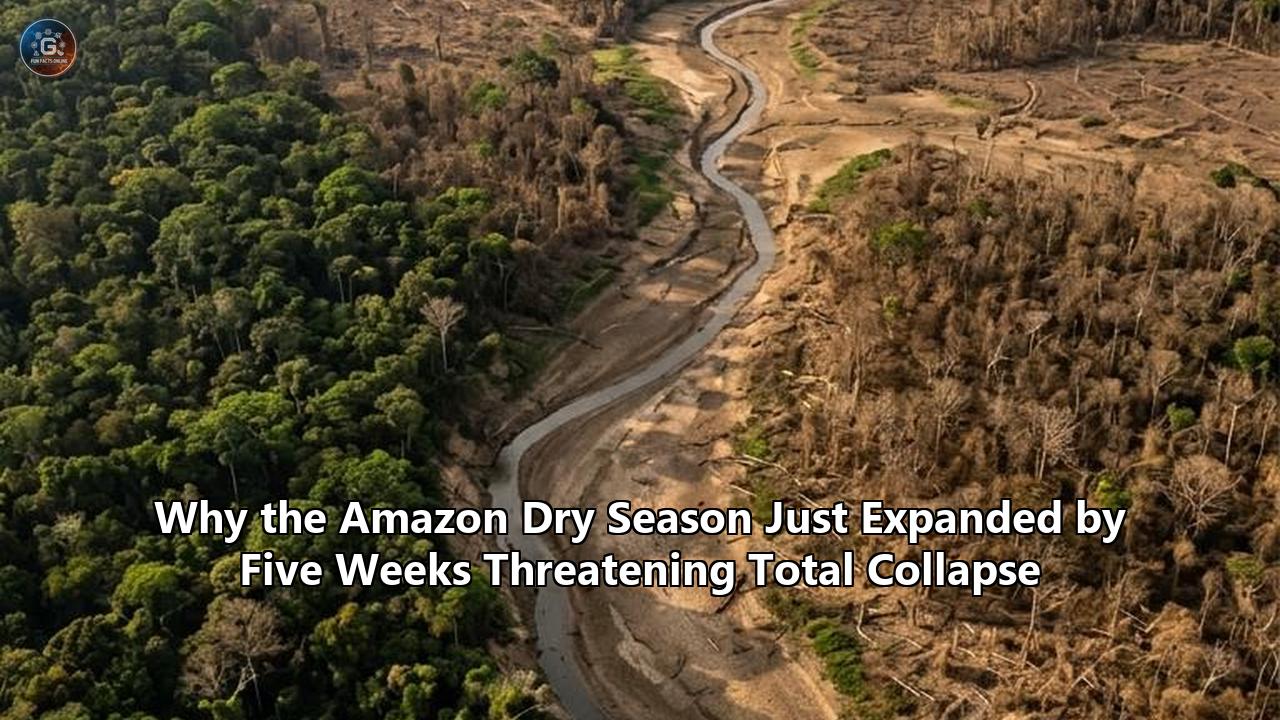
Satellite observations and basin-wide climate monitoring networks have confirmed a systemic disruption across South America: the dry season across southern and eastern Amazonia has expanded by approximately five weeks over the past four decades. The annual window of severe water deficit—which historically lasted between three and four months—now routinely persists for five to six months across millions of square kilometers. This rapid climatological shift has pushed Earth's largest tropical biome toward an irreversible ecological tipping point decades ahead of projections.
The data, synthesized from satellite reanalysis, ground-based meteorological stations, and hydrological tracking by institutions including Brazil’s National Institute for Space Research (INPE) and the National Center for Monitoring and Early Warning of Natural Disasters (CEMADEN), reveals that the lengthening is not a localized anomaly. It is an expanding structural feature of the basin's regional climate. In the southern and southeastern sectors—encompassing northern Mato Grosso, Rondônia, and southern Pará—the dry period is expanding at an average rate of roughly seven to ten days per decade.
This protracted desiccation exerts unsustainable physiological stress on tree species that evolved over millions of years under perennially humid conditions. When soil moisture reserves are exhausted and atmospheric water demand surges, the forest loses its capacity to self-regulate. Canopy dieback accelerates, tree mortality escalates, and the biome begins transitioning from a closed, high-biomass wet forest into a degraded, open-canopy shrubland or dry savanna. Climatologists and ecologists warn that an extended Amazon rainforest dry season directly undermines the continental moisture pump, triggering self-amplifying feedback loops that threaten the structural collapse of the entire ecosystem.
             DRY SEASON LENGTHENING: 1980 vs. PRESENT
 ┌─────────────────────────────────────────────────────────────┐
 │ 1980s Baseline: ~3.5 to 4 Months (Jun - Aug/Sep)            │
 │ [████████████████████████]░░░░░░░░░░░░░░░░░░░░░░░░░░░░░░░░  │
 │                                                             │
 │ Present Day: ~5 to 6 Months (Extended by ~35 Days)          │
 │ [███████████████████████████████████████]░░░░░░░░░░░░░░░░░  │
 └─────────────────────────────────────────────────────────────┘
  Impacts:
  • Delayed South American Monsoon onset (15–20 days)
  • Earlier rain cessation in late austral autumn (10–15 days)
  • Soil water deficits crossing the lethal -150 mm threshold
Anatomy of a 35-Day Expansion
The lengthening of the dry period is driven by two distinct shifts: an earlier cessation of wet-season rains in late austral autumn (May) and a substantial delay in the onset of the spring rainy season (October to November). Historical climatology defined the dry season in southern Amazonia as the period when monthly precipitation fell below 100 millimeters—the basic physiological threshold required to offset tropical tree evapotranspiration. For decades, this low-precipitation window reliably concluded by late September, when seasonal shifts in atmospheric circulation pulled equatorial moisture inland to initiate the South American Monsoon System (SAMS).
That timeline has unraveled. Decadal atmospheric observations indicate that the onset of the wet season has been pushed back by 15 to 20 days, while the previous wet season is cutting off 10 to 15 days earlier.
  TRADITIONAL CLIMATE CYCLE (Pre-1980s)
  Jan   Feb   Mar   Apr   May   Jun   Jul   Aug   Sep   Oct   Nov   Dec
  [════════ Wet Season ════════] [═══ Dry Season ═══] [═══ Wet Season ══]
                                 (June to Mid-Sept)

  CURRENT DISRUPTED CYCLE (Present)
  Jan   Feb   Mar   Apr   May   Jun   Jul   Aug   Sep   Oct   Nov   Dec
  [═══════ Wet ═══════] [════════ EXPANDED DRY SEASON ════════] [═ Wet ═]
                        (May to Late October / November)
The primary meteorological mechanism behind this autumn-spring divergence is the destabilization of thermodynamic convection over the South American continent. To initiate deep convective clouds that trigger monsoon rainfall, the atmospheric boundary layer requires high surface humidity, largely provided by forest evapotranspiration.
As vast tracts of primary forest along the southern perimeter have been cleared for cattle pastures and monoculture agriculture, the biological engine driving that humidity has weakened. Cleared pasture lands cannot access deep ground moisture during transitional months. The surface becomes hotter and drier, raising the condensation level in the troposphere.
Instead of moisture-laden air condensing into storm clouds, the heated, dry air forms an inversion layer that suppresses convective rainfall. The monsoon is systematically stalled, leaving the land baking under clear skies for weeks after the rains should have arrived.
This local atmospheric suppression is amplified by large-scale oceanic oscillations. Warming sea surface temperatures in the Tropical North Atlantic and equatorial Pacific generate anomalous atmospheric subsidence—descending dry air masses—over central and eastern Amazonia. This descending air caps cloud formation, exacerbates surface heating, and extends rainless conditions deep into the final months of the year.
The Broken Moisture Pump: How "Flying Rivers" Run Dry
The structural integrity of the Amazon basin depends on its ability to recycle its own water. Unlike mid-latitude forests, where precipitation depends on external marine weather systems, the Amazon operates as a self-sustaining continental moisture pump.
A single mature canopy tree, with a crown diameter of 20 meters and deep root networks descending up to 10 to 15 meters, can pump more than 1,000 liters of water vapor into the atmosphere every single day through transpirational cooling. Across 5.5 million square kilometers, hundreds of billions of trees pump an estimated 20 billion metric tons of water into the atmosphere daily—a volume exceeding the daily discharge of the Amazon River into the Atlantic Ocean.
                  THE AERIAL MOISTURE CONVEYOR (FLYING RIVERS)

   Atlantic Ocean            Central Basin                 Andes Mountains
         │                         │                              │
         ▼                         ▼                              ▼
  [Trade Winds] ───────► [Forest Evapotranspiration] ──────► [Orographic Barrier]
                           (Water recycled 5-6 times)             │
                                                                  ▼
                                                       Moisture diverted south:
                                                       Powers agriculture in
                                                       Mato Grosso, São Paulo,
                                                       and the La Plata Basin
This moisture forms colossal aerial currents known as "flying rivers" (rios voadores). Prevailing trade winds carry moist oceanic air westward from the Atlantic into the basin interior. As this air moves across thousands of miles of unbroken forest canopy, it is repeatedly enriched:
- Rain falls onto the trees.
- Roots absorb the water from deep soil layers.
- Foliage transpires the water back into the atmosphere as pure vapor.
- The moisture condenses into new cloud formations downwind.
A single water molecule is recycled through this biological loop five to six times as it travels across the continent until the air mass strikes the wall of the Andes Mountains, where it is deflected southward toward southern Brazil, Paraguay, Uruguay, and northern Argentina.
When the dry period expands by five weeks, this transpirational cycle collapses. As shallow soils dry out, trees close their stomata—microscopic pores on the underside of leaves—to prevent lethal water loss.
Transpiration plummets. Without the daily injection of biological vapor, the relative humidity in the air column drops, cloud development ceases, and downwind regions are deprived of the moisture needed to sustain their own rainfall.
The disruption cascades from east to west and north to south: forest degradation in Pará and Mato Grosso directly starves the inland forests of Acre, Peru, and northern Bolivia of rainfall, creating a compounding hydrological deficit that lengthens the drought across the entire basin.
Tree Hydraulics and Canopy Collapse
Inside the forest, the five-week expansion is driving an unprecedented biological crisis: systemic hydraulic failure. Tropical rainforest trees are fine-tuned hydraulic systems designed to pull continuous water columns from deep soil through microscopic xylem tubes up to heights exceeding 40 or 50 meters. This vertical transport relies on negative pressure (tension) generated by leaf evaporation.
When the Amazon rainforest dry season extends beyond normal thresholds, soil water potential drops to extreme negative values while atmospheric Vapor Pressure Deficit (VPD)—the drying power of the air—surges.
  HYDRAULIC CAVITATION IN CANOPY TREES UNDER EXTENDED DROUGHT

  Healthy Transpiration             Severe Dry-Season Stress
  ┌───────────────────────┐         ┌───────────────────────┐
  │ Continuous water pull │         │ Extreme negative pull │
  │   ▲                   │         │   ▲                   │
  │   │  [Xylem Conduit]  │         │   │   [AIR BUBBLE]    │
  │   │  (Liquid Column)  │         │   X   ◄── Embolism    │
  │   │                   │         │                       │
  │ Soil: Moist           │         │ Soil: Parched         │
  └───────────────────────┘         └───────────────────────┘
  Outcome: Normal growth            Outcome: Vascular blockage,
                                             leaf drop, mortality
When the tension within the xylem exceeds physical thresholds, the water columns snap, drawing air bubbles into the conduits—a lethal phenomenon known as cavitation or hydraulic embolism. Once cavitated, a vessel can no longer transport water.
If enough vessels embolize, branches dry out, foliage dies, and the tree suffers irreversible systemic shutdown. The forest canopy thins, permitting sunlight to reach the dark, damp understory, which further bakes the forest floor and raises surface temperatures by up to 3°C to 5°C.
Field research from long-term monitoring plots (such as RAINFOR and the Amazon FACE experiments) demonstrates that tree mortality is not evenly distributed across species:
  VULNERABILITY SPECTRUM OF AMAZONIAN VEGETATION
 ┌──────────────────────────────────────┬──────────────────────────────────────┐
 │ Wet-Adapted Canopy Specialists       │ Resilient / Opportunistic Taxa       │
 │ (High Vulnerability to Expansion)    │ (Tolerant to Extended Drought)       │
 ├──────────────────────────────────────┼──────────────────────────────────────┤
 │ • Genus: Eschweilera (Lecythidaceae) │ • Fast-growing pioneer species       │
 │ • Genus: Virola (Myristicaceae)      │ • Cecropia spp.                      │
 │ • Genus: Pouteria (Sapotaceae)       │ • Deep-rooted taproot leguminous spp │
 │ • Large emergent canopy dominants    │ • Low-biomass shrubs, open-canopy    │
 │ • High wood density, slow growth     │   scrubland vegetation               │
 └──────────────────────────────────────┴──────────────────────────────────────┘
The preferential death of large, mature canopy trees permanently changes the forest's architecture. These emergent giants contain the vast majority of the forest's aboveground living carbon biomass. When they die, they are replaced by secondary shrubs, lianas, and invasive grasses that store only a small fraction of the carbon and lack the deep root systems required to maintain atmospheric transpiration during extended dry intervals.
The Carbon Inversion: Sinks Turning into Emitters
For decades, the Amazon rainforest served as one of the planet's primary terrestrial carbon sinks, absorbing approximately 1.5 to 2.0 billion metric tons of atmospheric carbon dioxide annually and buffering the global climate system against industrial emissions.
That vital buffer is now breaking down. Atmospheric profiling conducted over a decade by the Greenhouse Gas Laboratory at INPE, led by senior researcher Dr. Luciana Gatti, provides conclusive physical evidence: large portions of the eastern and southern Amazon have transitioned into net sources of carbon to the atmosphere.
                CARBON BALANCE SHIFT IN THE AMAZON BASIN

  HISTORICAL EQUILIBRIUM (Past Decades)
  Photosynthesis (C Inflow)  >>>  Respiration + Decomposition (C Outflow)
  ───────────────────────────────────────────────────────────────────────
  Net Result: SINK (Removing ~1.5 - 2.0 Gt CO₂ / year)

  CURRENT INVERSION (Southern & Eastern Sectors)
  Photosynthesis (Suppressed) <   Decomposition + Fire + Dieback (Accelerated)
  ───────────────────────────────────────────────────────────────────────
  Net Result: SOURCE (Emitting billions of tons of CO₂ directly)
The biological mechanism driving this inversion is directly tied to the prolonged dry season. Forest carbon balance is the net difference between photosynthetic carbon assimilation and total respiration (autotrophic respiration by trees plus heterotrophic respiration by soil microbes and decomposing dead biomass).
During an expanded dry season:
- Photosynthesis declines sharply as trees close their stomata to conserve water.
- High temperatures increase metabolic stress and autotrophic respiration costs.
- Thousands of square kilometers of dead wood generated by prolonged water stress decay, releasing vast quantities of carbon dioxide.
- Severe drought conditions facilitate the spread of anthropogenic and accidental wildfires deep into the forest interior, instantly converting centuries of stored carbon into atmospheric smoke plumes.
In the southeastern Amazon—where deforestation exceeds 25% to 30% and the dry season has lengthened the most—the carbon balance is deeply negative.
Dr. Gatti's research flights, which measure vertical profiles of carbon monoxide and carbon dioxide from aircraft flying from 15,000 feet down to canopy level, indicate that the southeastern Amazon now emits roughly 0.3 to 0.5 billion tons of carbon per year directly into the global atmosphere. The forest is consuming its own biomass to survive the dry intervals, turning a vital planetary cooling mechanism into an active driver of global warming.
Megadroughts and the Understory Fire Nexus
A primary rainforest in its undisturbed state is naturally fireproof. The dense, multi-tiered canopy maintains high interior humidity (regularly exceeding 85%), suppresses wind speeds, and prevents the forest floor litter—fallen leaves, twigs, and branches—from drying out.
Even during normal dry seasons, an open flame dropped on undisturbed primary forest litter typically sputters and self-extinguishes within minutes.
The five-week extension of the dry season has destroyed this natural fire defense. When relative humidity drops below 50% for weeks at a time and ambient temperatures cross 38°C (100.4°F), the dead leaf litter layer on the forest floor desiccates completely, turning into a continuous bed of dry fuel.
  PRIMARY RAINFOREST                      DEGRADED / EXPANDED DRY SEASON FOREST
  ┌─────────────────────────────────┐     ┌─────────────────────────────────┐
  │ • Closed Canopy (80-90% cover)  │     │ • Broken Canopy (30-50% lost)   │
  │ • High RH (>85%)                │     │ • Low RH (<50%)                 │
  │ • Damp Leaf Litter Layer        │     │ • Desiccated Fuel Bed           │
  │ • Fire Ingress: IMPOSSIBLE      │     │ • Fire Ingress: RUNAWAY RISK    │
  └─────────────────────────────────┘     └─────────────────────────────────┘
The ignition sources are ubiquitous: agricultural fires set along pasture boundaries, slash-and-burn operations for land speculation, and infrastructure development along major highway corridors like the BR-163 and BR-319.
Under normal historical timelines, these agricultural fires would burn within pasture borders and halt at the damp forest margin. Today, they jump across boundaries and burn into the primary forest understory as slow-moving, low-intensity ground fires.
                  THE RECURRENT FIRE DEGRADATION CYCLE

  [ Extended Dry Season ] ────► [ Forest Floor Desiccates ]
            ▲                               │
            │                               ▼
  [ Drier Microclimate ]        [ Understory Fire Ingress ]
            │                               │
            ▼                               ▼
  [ Canopy Openings Form ] ◄─── [ 40-50% Tree Mortality ]
These understory fires are ecologically devastating precisely because they do not look like temperate crown fires. They creep along the ground with flames merely 20 to 50 centimeters high, but they burn for days:
- Tropical trees have thin bark (often less than 10 mm thick) that provides zero insulation against heat, as they never co-evolved with fire regimes.
- The low-intensity heat cooks the vascular cambium at the base of the trunk.
- A single understory burn kills between 40% and 50% of all trees in an affected stand within 12 to 24 months.
- The dead trees collapse, creating large canopy openings that expose the forest interior to sunlight and wind, drying the understory even further.
- When the next extended Amazon rainforest dry season arrives, the fuel load has quadrupled.
A secondary fire in the same stand burns with five times greater intensity, destroying up to 80% to 90% of all remaining plant biomass and converting the forest stand into an unrecognizable, degraded landscape dominated by invasive bracken ferns and bamboo.
Tipping Point Dynamics: Crossing the 20% to 25% Threshold
The expansion of the dry season is the clearest early warning indicator that the Amazon basin is approaching a systemic climate tipping point. This threshold was first formulated theoretically in the late 1990s by Brazilian climatologist Dr. Carlos Nobre and American conservation biologist Dr. Thomas Lovejoy. They hypothesized that if regional deforestation crossed 20% to 25% across the basin, combined with a 2°C to 2.5°C rise in global average temperatures, the regional hydrologic cycle would destabilize beyond the point of self-recovery.
Today, the Amazon stands directly on the edge of that threshold. Basin-wide clear-cut deforestation has reached roughly 17% to 18%, while an additional 17% of the remaining forest is heavily degraded by logging, selective burning, and edge effects.
A major study published in Nature by an international consortium led by Dr. Bernardo Flores of the Federal University of Santa Catarina evaluated five critical environmental drivers:
- Global warming thresholds.
- Annual precipitation amounts (the 1,000–1,500 mm/year threshold).
- Rainfall seasonality intensity.
- Total accumulated deforestation.
- Dry season length (the critical 4-to-5-month threshold).
  AMAZON BASIN TIPPING POINT EXPOSURE BY 2050

  [████████████████████░░░░░░░░░░░░░░░░░░░░]
  10% to 47% of Remaining Forest Under Severe Biome Transition Stress

  STRESSORS:
  ├── Rising Surface Temperature (>2.0°C regional)
  ├── Prolonged Dry Season (>5 Months)
  ├── Annual Rainfall Dropping Below 1,500 mm
  └── Cumulative Forest Clearance Approaching 20-25% Threshold
The Nature analysis concluded that by the year 2050, between 10% and 47% of the remaining Amazonian forests will be exposed to combined compound disturbances capable of triggering large-scale transitions.
The transition is non-linear. In ecological tipping dynamics, an ecosystem does not degrade at a smooth, predictable rate. Instead, it maintains apparent structural stability through physiological resistance until a critical stress threshold is breached, at which point it undergoes an abrupt, self-reinforcing regime shift.
Once transpirational feedback falls below the level required to generate monsoon rains, the forest cannot regenerate even if human clear-cutting ceases overnight. The new climate regime simply becomes too arid to support dense, broadleaf closed-canopy vegetation.
                         THE DIEBACK CASCADING FEEDBACK

    Deforestation + Climate Warming
                 │
                 ▼
     Lengthened Dry Season (+5 Weeks)
                 │
                 ▼
       Soil Moisture Depletion
                 │
                 ▼
       Elevated Tree Mortality & Cavitation
                 │
                 ▼
   Reduced Transpiration ("Flying Rivers" Weaken)
                 │
                 ▼
    Further Rainfall Loss & Monsoon Delay
                 │
                 ▼
   IRREVERSIBLE BIOME COLLAPSE / SAVANNIZATION
Regional and Continental Economic Shockwaves
The five-week expansion of the dry season is not just an ecological crisis; it is an immediate economic threat across South America. The paradox of Amazonian deforestation is that the agribusiness expansion driving forest clearing is destroying the rainfall regime that agricultural productivity depends on.
  CONTINENTAL IMPACT VECTORS
 ┌───────────────────────────┬───────────────────────────┬───────────────────────────┐
 │ Agriculture & Crops       │ Hydroelectric Power       │ Transportation & Supply   │
 ├───────────────────────────┼───────────────────────────┼───────────────────────────┤
 │ • Loss of double-cropping │ • Turbine shutdowns at    │ • Disruption of riverway  │
 │   capacity (soja-milho)   │   Belo Monte and Jirau    │   transit (Madeira,       │
 │ • Est. $1B+ annual losses │ • Grid stability failures │   Solimões, Tapajós)      │
 │   for Cerrado soy belt    │ • Surging fossil thermal  │ • Complete isolation of   │
 │ • Declining pasture feed  │   generation costs        │   remote riverside towns  │
 └───────────────────────────┴───────────────────────────┴───────────────────────────┘
In Mato Grosso—Brazil’s premier grain-producing state, responsible for a massive share of the world's soy and corn exports—farmers rely on a "double-cropping" (safrinha) system. They plant soy at the initial onset of the rains in September and harvest in January, immediately planting a second crop of corn or cotton before the wet season concludes in May.
As the dry season extends, this window has narrowed dramatically. Rains that once arrived in late September now regularly delay until late October or November.
Farmers are forced to delay soy planting, which pushes the harvest deep into February. This compresses or entirely eliminates the second planting window, destroying safrinha yields and causing agricultural losses projected to exceed $1 billion annually.
The energy sector is facing a parallel crisis. Brazil generates over 60% of its national electrical grid capacity from hydroelectric dams. Flagship run-of-the-river mega-installations in the Amazon basin—including the massive 11,233-megawatt Belo Monte complex on the Xingu River, as well as the Jirau and Santo Antônio dams on the Madeira River—rely on sustained seasonal river discharge.
When the dry season lasts five to six months, river levels drop below generation thresholds. During recent extreme drought phases, Belo Monte's electricity generation plummeted by more than 85%, producing less than 1,000 megawatts of power and forcing the federal government to activate expensive, highly polluting fossil-fuel thermoelectric power plants to keep lights on in São Paulo and Rio de Janeiro.
  HYDROELECTRIC GENERATION PROFILE (BELO MONTE DAM)

  Peak Wet Season (Normal Flow)
  [████████████████████████████████████████████] ~11,000 MW Capacity

  Extended Dry Season (Current Flow Anomaly)
  [████] Less than 1,000 MW (Over 85% Drop in Generation)
For human communities living along the rivers, the consequences are life-threatening. The Amazon's major waterways—the Solimões, Negro, Madeira, and Tapajós—serve as the only transport arteries for hundreds of thousands of riverside (ribeirinho) and Indigenous populations.
During prolonged dry seasons, these rivers drop to unprecedented lows. Entire tributaries turn into vast mud flats and sandbanks, stranding commercial barges, severing supply lines for fuel and medical necessities, and isolating dozens of municipal districts from the electrical grid and global commerce.
Global Climatological Consequences of Amazon Collapse
The collapse of the Amazon hydrological engine does not stop at South America’s borders. The vast atmospheric heat engine powered by tropical convection over the Amazon Basin is a fundamental driver of global atmospheric circulation.
                 TELECONNECTION PATHWAYS OF AMAZON COLLAPSE

                [ Amazon Biome Moisture & Heat Engine ]
                                  │
         ┌────────────────────────┼────────────────────────┐
         ▼                        ▼                        ▼
  Disruption of Hadley     Destabilization of      Reduction of Rainfall
   & Walker Circulation     Pacific Jet Stream      in US Grain Belt &
  (Alters global wind belts (Pushes winter storms   Western North America
     and equatorial rain)    off track in N. Am.)    (Reduces crop yields)
When tropical convection is suppressed by an expanded Amazon rainforest dry season, the altered energy balance triggers teleconnection waves across the planetary atmosphere:
- Disruption of the Hadley and Walker Circulations: The weakening of deep vertical convection over equatorial South America shifts atmospheric ascending and descending branches, altering precipitation regimes across Central America, the Caribbean, and sub-Saharan Africa.
- North American Weather Anomalies: Coupled ocean-atmosphere models run by NOAA and the National Center for Atmospheric Research (NCAR) indicate that large-scale Amazon forest loss and persistent drought generate atmospheric Rossby waves that propagate poleward. These waves disrupt the Pacific-North American pattern, altering the trajectory of the mid-latitude jet stream.
- Western US and Mid-Latitude Drying: Reduced tropical heating over South America is projected to reduce winter snowpack across the Sierra Nevada and Rocky Mountains and decrease spring precipitation across the agricultural heartland of the US Midwest, complicating global food supply chains.
- Global Carbon Budget Failure: The permanent loss of the Amazon forest sink—and the subsequent release of 150 to 200 billion tons of carbon stored in its soils and vegetation—would consume nearly the entire remaining global carbon budget required to limit planetary heating to 1.5°C or 2.0°C above pre-industrial levels, making international climate stabilization practically impossible.
The Path to Stabilization: Stopping the Tipping Point
Preventing the permanent savannization of the Amazon requires immediate, synchronized intervention on both regional and global fronts. Scientific consensus emphasizes that while global greenhouse gas mitigation is necessary to prevent runaway atmospheric heating, basin-scale land management provides the only immediate leverage to restore the regional water pump.
  STRATEGIC RESTORATION PRIORITIES

  1. ZERO DEFORESTATION & ZERO DEGRADATION ENFORCEMENT
     Enforce full moratoriums on all native vegetation clearance across
     the entire biome, pairing satellite radar tracking (SAR) with rapid-
     response ground interventions to stop illegal frontier penetration.

  2. THE "ARC OF RESTORATION" INITIATIVE
     Reforest 200,000+ square kilometers of degraded lands across the
     southern and eastern frontiers (Mato Grosso, Pará, Rondônia) using
     deep-root native species to restore boundary-layer humidity.

  3. WATERWAY & MICROCLIMATE PROTECTION CORRIDORS
     Establish wide riparian forest buffers (Permanent Preservation Areas)
     along all first- and second-order river channels to protect baseflows
     and reduce forest interior exposure to desiccating winds.

  4. ADVANCEMENT OF THE BIOECONOMY OF STANDING FORESTS
     Replace destructive land conversion models with high-value native
     agroforestry systems (açai, cacau, cupuaçu, rubber, and nuts) that
     preserve closed canopy structures while generating local wealth.
The concept of the Arc of Restoration, championed by Brazilian scientific institutions, envisions transforming the active "Arc of Deforestation" along the southern and eastern edges of the basin back into a biological moisture buffer.
By planting millions of hectares of native, drought-tolerant, and deep-root tree species across abandoned and degraded cattle pasture lands, the project aims to re-establish the boundary-layer humidity required to trigger convective cloud formation. Rebuilding this continuous forest belt is the only viable physical mechanism to draw the South American Monsoon inland on its historical schedule and shrink the dry season back within its safe, pre-industrial boundaries.
Indicators to Monitor
The window of intervention to prevent the functional collapse of the Amazon hydrological system is closing rapidly. As satellite monitoring platforms and meteorological arrays track real-time changes across the basin, several critical thresholds will determine whether the ecosystem stabilizes or crosses into irreversible biome degradation:
- Monsoon Onset Timing: Whether the annual delay in wet-season rains in southern Pará and Mato Grosso stabilizes or continues its ten-day-per-decade expansion deeper into November.
- Soil Water Deficit Extremes: The frequency with which soil water deficits in the southern basin exceed the lethal -150 mm boundary for multiple consecutive months.
- Canopy Embolism Rates: Field measurements of xylem cavitation and emergent tree mortality rates in intact primary forests across the central and western core.
- Dry Season Boundary-Layer Vapor Deficits: Atmospheric tracking of Vapor Pressure Deficits (VPD) across interior forest tracts during the June–October transition.
- Carbon Flux Aircraft Transects: Routine atmospheric profile monitoring to determine whether the carbon source footprint expands from the southeastern quadrant into the central and western Amazon biomes.
The expansion of the Amazon rainforest dry season by five weeks is a structural reorganization of South America's hydrologic reality. The biological engine that stabilizes the continent’s climate is faltering. The trajectory of the remaining forest—and the stability of the global climate system it supports—will be determined by whether the world and regional governments halt forest loss and restore the Amazon's self-sustaining water pump before the dry season claims the entire biome.
Reference:
- https://www.frontiersin.org/journals/earth-science/articles/10.3389/feart.2018.00228/full
- https://www.theguardian.com/world/2023/nov/06/aggressive-deforestation-has-led-to-one-of-the-amazons-worst-droughts
- https://www.weforum.org/stories/forum-institutional/the-amazon-is-near-a-tipping-point-the-urgent-need-for-nature-based-solutions-wef24/
- https://www.thecooldown.com/green-tech/brazil-amazon-dry-season-concerns-ecosystem/
- https://amazonfrontlines.org/chronicles/the-tipping-point-is-the-amazon-rainforest-approaching-a-point-of-no-return/
- https://pmc.ncbi.nlm.nih.gov/articles/PMC11319773/
- https://pubmed.ncbi.nlm.nih.gov/42487517/
- https://pmc.ncbi.nlm.nih.gov/articles/PMC13392597/
- https://www.carbonbrief.org/drying-in-the-amazon-rainforest-what-could-it-mean-for-climate-change
- https://www.pik-potsdam.de/en/news/latest-news/amazon-rainforest-at-the-threshold-loss-of-forest-worsens-climate-change
- https://sites.bu.edu/cliveg/files/2013/10/Fu-et-al-Amazon-Drought-PNAS-2013.pdf
- https://www.carbonbrief.org/drying-of-amazon-could-be-early-warning-of-tipping-point-for-the-rainforest
- https://news.mongabay.com/2025/09/more-deforestation-leads-to-a-drier-dry-season-amazon-study-finds/
- https://www.sciencefocus.com/news/amazon-drying-out
- https://www.context.news/nature/tipping-point-the-amazon-rainforests-vital-signs