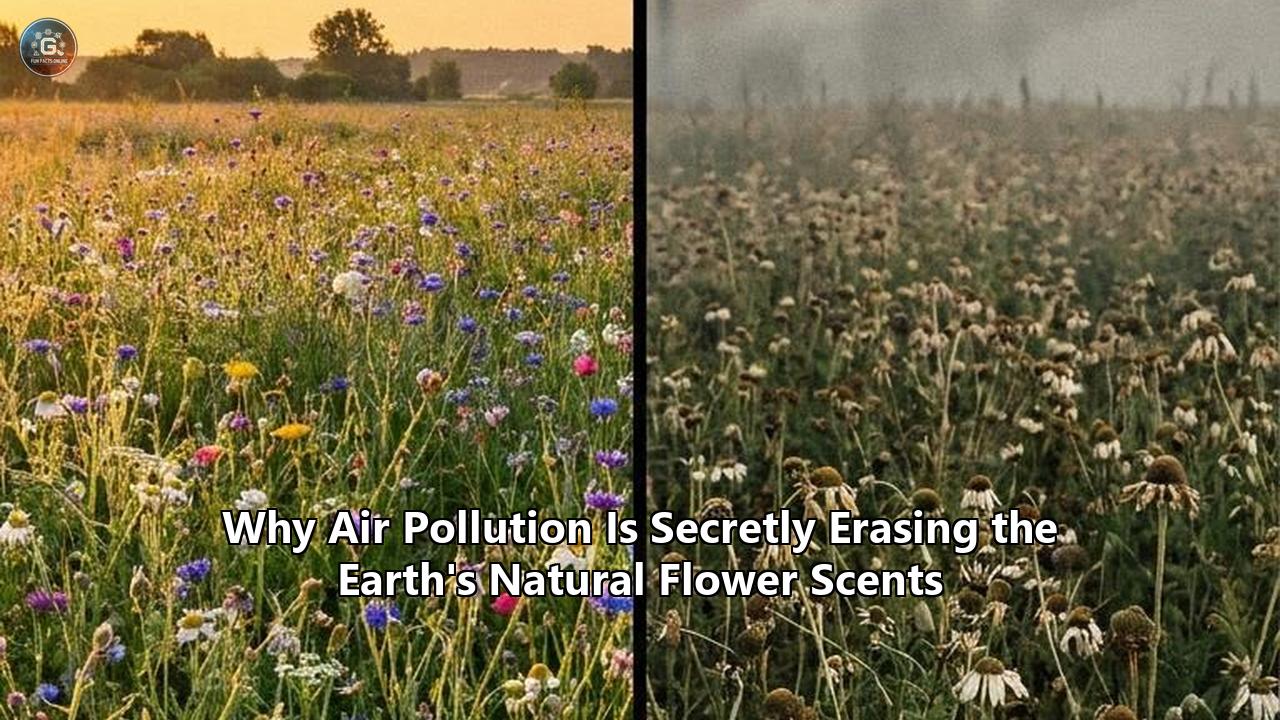
In February 2024, a team of atmospheric chemists and biologists at the University of Washington published a study in Science that transformed our understanding of ecological breakdown. For the first time, researchers quantified a silent catastrophe occurring right beneath our noses: the chemical destruction of floral odors by anthropogenic air pollution.
By analyzing the nighttime interactions between the pale evening primrose (Oenothera pallida) and its primary pollinators—including the tobacco hawkmoth (Manduca sexta) and the white-lined sphinx moth (Hyles lineata)—the scientists documented a staggering 70% collapse in pollinator visitation rates when floral scents were exposed to common levels of nighttime air pollution. This sensory disruption translated directly to a projected 28% reduction in the plant's reproductive success, as measured by seed-set rates.
This is not an isolated local phenomenon. Around the globe, a growing body of quantitative research is revealing that ground-level ozone ($O_3$) and nitrate radicals ($NO_3$) are systematically dismantling the chemical communication channels that have bound plants and insects together for over 100 million years.
The scale of this threat is massive. Approximately 75% of the world's leading food crops and nearly 90% of wild flowering plants rely to some degree on animal pollination. With global agricultural economics hanging in the balance—pollinator-dependent crops are valued at between $235 billion and $577 billion annually—the degradation of air pollution flower scents represents an unpriced, unmapped risk to global food security.
                     [ VEHICULAR & INDUSTRIAL EMISSIONS ]
                                  |
                                  | (NOx, VOCs, Sunlight)
                                  v
                       [ ATMOSPHERIC OXIDANTS ]
                            (O3 & NO3)
                                  |
        +-------------------------+-------------------------+
        |                                                   |
        v                                                   v
 [ SCENT PLUME DEGRADATION ]                        [ POLLINATOR DISORIENTATION ]
 - Monoterpene double bonds cracked                 - Odor recognition drops up to 90%
 - Plume reach compressed by 60-90%                 - Foraging times increase by 40%
        |                                                   |
        +-------------------------+-------------------------+
                                  |
                                  v
                     [ ECOLOGICAL & ECONOMIC CRASH ]
                     - 70% fewer pollinator visits
                     - 28% drop in plant seed-set
                     - Threat to $577B in annual crops
The Chemistry of Erasure: Cracking the Carbon-Carbon Double Bond
To understand why air pollution flower scents are being erased, one must first look at the chemical composition of a floral fragrance. A flower’s scent is not a single, monolithic gas; it is a highly complex, volatile atmospheric recipe. This bouquet typically consists of a precise ratio of 20 to over 100 distinct volatile organic compounds (VOCs), spanning several chemical classes:
- Monoterpenes (such as linalool, limonene, $\beta$-ocimene, and $\alpha$-pinene)
- Sesquiterpenes (such as $\beta$-caryophyllene)
- Benzenoids/Phenylpropanoids (such as methyl salicylate and 2-phenylethanol)
- Fatty acid derivatives
These chemical compounds are characterized by their low boiling points and high vapor pressures, which allow them to readily evaporate from petal surfaces and drift through the air, creating a scent plume.
However, many of these volatile compounds—particularly monoterpenes and sesquiterpenes—are highly unsaturated molecules containing one or more carbon-carbon double bonds ($C=C$). These double bonds are rich in electrons, making them highly reactive targets for atmospheric oxidants like ground-level ozone ($O_3$) and nitrate radicals ($NO_3$).
  H   H
   \ /
    C = C       +    O3 (Ozone)    --->    [ Ozonolysis Reaction ]    --->    Carbonyls & Carboxylic Acids
   / \                                                                        (Unrecognizable to insects)
  R   R'
[Reactive Double Bond]
When ozone collides with a volatile terpene, it undergoes a classic ozonolysis reaction. The ozone molecule adds across the carbon-carbon double bond to form an unstable primary ozonide, which rapidly decomposes into highly oxidized, polar, and non-volatile fragments such as carbonyls (aldehydes and ketones), carboxylic acids, and secondary organic aerosols (SOAs).
A molecule of $\beta$-caryophyllene, which under clean pre-industrial conditions could persist in the atmosphere for hours, has an atmospheric lifetime of just a few minutes in a moderate ozone environment of 80 parts per billion (ppb).
This selective oxidation completely scrambles the chemical "recipe" of the flower. Because different volatile compounds react with ozone and nitrate radicals at wildly different rates, the original ratio of the floral bouquet is lost within meters of leaving the petal.
For example, while some monoterpenes are destroyed almost instantly, more stable compounds like certain benzenoids remain untouched. The resulting mixture no longer resembles the signal the pollinator has evolved to recognize.
In research settings, this chemical distortion has been observed to turn the sweet, distinctive scent of lavender sour, while eucalyptus scent plumes are degraded to the point where they mimic entirely different species, creating an ecological bait-and-switch that leaves foraging insects utterly disoriented.
The Nocturnal Erasure: Nitrate Radicals and the Blunting of Night-Blooming Scents
While ground-level ozone is the primary driver of daytime floral scent degradation, nighttime pollination faces an even more aggressive chemical threat: the nitrate radical ($NO_3$).
The nitrate radical is formed in the atmosphere through a two-step reaction starting with nitrogen dioxide ($NO_2$), a common byproduct of fossil fuel combustion from vehicular exhaust, coal plants, and natural gas facilities:
$$\text{NO}_2 + \text{O}_3 \rightarrow \text{NO}_3 + \text{O}_2$$
During daylight hours, the nitrate radical is highly unstable; solar radiation rapidly photolyzes it back into nitrogen oxide ($NO$) and oxygen, or $NO_2$ and an oxygen atom. Consequently, its daytime lifetime is less than five seconds, keeping daytime concentrations near zero.
At night, however, the chemistry shifts dramatically. Lacking sunlight to drive photolysis, $NO_3$ rapidly accumulates in the dark planetary boundary layer, especially in urban peripheries and agricultural zones downwind of major highways.
Daytime Scent Plume (Sunlight Photolyzes NO3):
[Flower] ~~~~~~~~~~~~~~~~~~~~~~~~~~~~~~~~~~~~~~~~~~~~~~~~~~~~~~~~~~~~~~> [Pollinator Can Detect Scent]
(Scent travels far, minimal degradation from NO3)

Nighttime Scent Plume in Polluted Air (NO3 Accumulates & Oxidizes VOCs):
[Flower] ~~~X [Scent Destroyed Within Meters]
(Scent is oxidized, turns into non-volatile aerosols, pollinator is blinded)
The night-blooming pale evening primrose (Oenothera pallida) emits a highly fragrant bouquet rich in monoterpenes—such as linalool and $\beta$-ocimene—specifically designed to travel long distances through stable, cool night air.
At night, the air is typically less turbulent, allowing these scents to form long, coherent chemical highways that hawkmoths can trace back to their source from over a kilometer away.
However, the University of Washington team found that when $NO_3$ radicals encounter these specific monoterpenes, they react at rates that are orders of magnitude faster than daytime ozone reactions. The $NO_3$ radical adds to the double bonds of linalool and ocimene, destroying them in a matter of seconds.
The researchers discovered that under typical urban-adjacent nighttime air conditions, with $NO_3$ concentrations of just a few tens of parts per trillion (ppt), the floral scent's "reach"—the physical distance at which the scent plume remains recognizable to a hawkmoth—was compressed by more than 75%.
The sweet, bright aroma of the primrose was blunted into an odorless, chemically neutral vapor almost immediately upon release.
The Wind Tunnel Trials: Quantifying the Limits of Honeybee Navigation
To map the exact spatial dynamics of how air pollution flower scents degradation affects insect navigation, researchers at the UK Centre for Ecology & Hydrology (UKCEH) and the University of Birmingham conducted controlled experiments using a specialized 30-meter wind tunnel.
This state-of-the-art facility allowed scientists to release precise, simulated floral scent plumes into a controlled airstream, inject varying concentrations of ground-level ozone, and measure the rate of chemical decay across both temporal and spatial scales.
=================================== 30-Meter Wind Tunnel Experiment ===================================
[Scent Source] ----> (Turbulent Mixing) ----> [6 Meters] --------------------> [12 Meters]
                                              O3: 140 ppb                    O3: 140 ppb
                                              Honeybee Recognition: 52%      Honeybee Recognition: 38%
                                              Plume Edge: 32%                Plume Edge: 10%
=======================================================================================================
The research team focused on a model scent containing four primary floral VOCs:
- $\alpha$-terpinene
- $\beta$-caryophyllene
- 6-methyl-5-hepten-2-one
- Linalool
They introduced ozone at a concentration of 140 ppb—a level frequently observed during hot, sunny summer days in polluted agricultural valleys, such as California's Central Valley or the Po Valley in Italy.
The wind tunnel sensors revealed that the physical shape of the scent plume was fundamentally altered by the pollutant. Scent plumes naturally behave like cigarette smoke, curling and twisting through the air in thin, highly concentrated filaments called "tendrils".
Insects do not navigate by sensing a smooth, continuous gradient of smell; instead, they fly in a zig-zag pattern, constantly casting back and forth across the wind to catch successive wisps of these high-concentration filaments.
Ozone not only reduced the chemical concentration of the VOCs, but it also physically narrowed the plume. The chemical degradation was fastest at the turbulent edges of the plume, where the floral volatiles mixed most efficiently with the surrounding ozone-rich air.
Inside the core of the plume, reaction rates were reduced by 8% to 10% in the first two meters due to a lack of immediate mixing, but as the plume drifted further downwind and dispersion increased, the ozone devoured the scent from the outside in.
The behavioral consequences for honeybees (Apis mellifera) were severe:
| Scent Condition | Distance from Source | Honeybee Scent Recognition Rate |
|---|---|---|
| Control (Clean Air) | N/A (Standard baseline) | ~95% |
| Ozone-Polluted Plume Core (140 ppb) | 6 meters | 52% |
| Ozone-Polluted Plume Core (140 ppb) | 12 meters | 38% |
| Ozone-Polluted Plume Edge | 6 meters | 32% |
| Ozone-Polluted Plume Edge | 12 meters | 10% |
In clean air, honeybees trained to associate the scent with a sugar reward recognized the target almost 100% of the time.
However, when presented with the scent bouquet that had traveled just 12 meters through a 140 ppb ozone environment, only 38% of the bees could identify the flower.
At the turbulent edge of the plume at 12 meters, the recognition rate fell to a catastrophic 10%.
For 90% of the foraging bees, the chemical signal of the flower had been rendered completely invisible from just 12 meters away.
Modeling the Sensory Dead Zones: Shrunk to a Fraction of a Meter
To understand the global scale of this sensory breakdown, the University of Washington researchers integrated their chemical kinetic data with planetary boundary layer dynamics and global chemical transport models, specifically GEOS-Chem.
This allowed them to calculate the "scent detection distance" for pollinators under varying levels of air pollution across different regions of the Earth.
Under pre-industrial conditions, when background ozone levels hovered around 10 to 15 ppb, the scent of a large patch of evening primroses could remain coherent and detectable to a hawkmoth for a distance of over 1,000 meters (1 kilometer).
In today's atmospheric conditions, where urban and agricultural areas routinely experience daytime ozone levels between 60 and 120 ppb, and nighttime $NO_3$ levels are highly elevated, this detection distance has contracted severely.
Scent Detection Distance (Meters):
Pre-Industrial (10-15 ppb O3):  =============================================================> 1,000m+
Modern Rural (40 ppb O3):        ==============> 150m
Modern Polluted (80-120 ppb O3): ==> 10-30m
In urban peripheries and intensive agricultural belts downwind of cities, the model showed that the distance at which a moth or bee can detect a flower's scent has shrunk from hundreds of meters down to just 10 to 30 meters. This represents a 90% to 98% reduction in the physical range of floral communication.
In effect, the atmosphere has become a series of "sensory dead zones."
Within these zones, the chemical signals of plants are neutralized so quickly that they cannot form the long-range concentration gradients required to guide insects.
Instead of being drawn to flowers from afar, pollinators must happen upon them almost entirely by chance, or rely strictly on visual cues, which are only effective at extremely close ranges, typically under one meter.
The Agricultural Audit: What a $577 Billion Pollination Tax Looks Like
The ecological consequences of a shortened scent range are not confined to wild ecosystems; they threaten the bedrock of global agricultural economics.
Of the 115 leading global crop species, 87 rely on animal pollination to produce fruits, vegetables, nuts, and seeds. These pollinator-dependent crops are estimated to contribute between $235 billion and $577 billion annually to global agricultural markets.
                     [ GLOBAL CROP VALUE AT RISK ]
                              ($577 Billion)
                                    |
        +---------------------------+---------------------------+
        |                                                       |
        v                                                       v
  [ POLLINATOR-DEPENDENT ]                                  [ SELF-POLLINATING ]
  - 5x more valuable than self-pollinating                  - Grains, corn, rice
  - Fruits, vegetables, nuts, seed oils                     - Highly resilient to sensory shifts
  - High micronutrient profile (Vit A, C, Lipids)           - Lower market value per acre
Pollinator-dependent crops are, on average, five times more valuable per unit of mass than crops that self-pollinate or are pollinated by the wind (such as wheat, corn, and rice).
Furthermore, these insect-pollinated crops are the primary source of essential human micronutrients, including Vitamin A, Vitamin C, lipids, calcium, and iron.
A systemic decline in pollination efficiency would not only trigger multi-billion-dollar losses for farmers but would also exacerbate nutritional deficits and food insecurity in developing nations.
To measure this impact in a real-world agricultural setting, researchers conducted a field study in 2025 using plots of black mustard (Brassica nigra), a crop that relies heavily on insect pollination.
The experimental setup used a free-air enrichment system to release controlled levels of ozone and diesel exhaust over the crop plots.
Field Experiment: Pollinator Visits to Black Mustard Plots (Brassica nigra)
---------------------------------------------------------------------------
Control Plots (Clean Air):              ==================================== (100% baseline)
Ozone-Only Plots (Elevated):            ====================== (37% Reduction)
Ozone + Diesel Exhaust (Realistic Road): =================== (49% Reduction)
The results were stark:
- Plots exposed to elevated levels of ozone alone saw a 37% reduction in visits from beneficial pollinators (bees, hoverflies, and butterflies) compared to unpolluted control plots.
- When the researchers combined ozone with diesel exhaust (high in $NO_x$) to simulate realistic roadside agricultural conditions, pollinator visitation rates crashed by 49%—nearly a clean half.
When insect visits drop by half, the agricultural yield suffers immediately.
For cross-pollinated crops like apples, cherries, almonds, and oilseed rape, a 50% drop in pollinator visits leads to a severe decrease in fruit-set and seed-set, often resulting in misshapen, unmarketable produce or total crop failure.
In the case of the pale evening primrose, the $NO_3$-driven reduction in moth visitation caused a 28% drop in viable seed production.
If replicated across commercial agricultural landscapes, this sensory interference functions as an invisible, human-made "pollination tax" that drives down yields while driving up food prices.
The Foraging Tax: Energy Budgets and the Insect Survival Deficit
The degradation of air pollution flower scents does not just starve plants of pollen; it starves insects of essential energy.
Foraging is a high-stakes thermodynamic game for a wild bee or moth. Flying requires an immense expenditure of metabolic energy.
To survive and feed their offspring, insects must maintain a positive energy balance: the caloric value of the nectar and pollen they harvest must exceed the caloric cost of the flight required to find it.
       [ CLEAN AIR ENERGY BUDGET ]                     [ POLLUTED AIR ENERGY BUDGET ]
  =====================================             =====================================
  [ Nectar Harvested: 100 Calories ]                [ Nectar Harvested: 100 Calories ]
  [ Flight & Search Cost: 20 Calories ]             [ Flight & Search Cost: 60 Calories ] (Up 40%)
  -------------------------------------             -------------------------------------
  [ NET ENERGY GAIN: +80 Calories ]                 [ NET ENERGY GAIN: +40 Calories ] (Slashed by 50%)
In an unpolluted landscape, a honeybee can quickly and efficiently locate flower patches by locking onto stable, long-range scent plumes.
Because the scent plume is broad and coherent, the bee spends minimal time in "random search" mode.
But in an atmosphere thick with ozone or nitrate radicals, the long-range scent highway is broken.
The insect is forced to fly longer distances, engage in highly inefficient search patterns, and rely on visual scouting.
Biologists tracking bee foraging paths in polluted environments have documented a dramatic "foraging tax":
- Foraging time expansion: Bees in polluted areas spend up to 40% more time on the wing searching for flowers.
- Net caloric drop: The increased flight time dramatically inflates their metabolic expenditure, slicing the net energetic reward of each foraging trip by up to 50%.
- Colony-level impact: For solitary wild bees, which constitute roughly 90% of native bee species, this energy deficit is often fatal. A female solitary bee must forage, build, and provision individual nests entirely on her own. When her foraging efficiency is halved, she can provision fewer larvae, leading to a direct downward spiral in the next generation’s population.
                              [ ATMOSPHERIC POLLUTION ]
                                         |
                                         v
                            [ SCENT PLUME FRAGMENTED ]
                                         |
         +-------------------------------+-------------------------------+
         |                                                               |
         v                                                               v
 [ FLIGHT SEARCH TIME +40% ]                                    [ CALORIC GAIN -50% ]
 - More energy spent on wing                                    - Less nectar brought to nest
 - High metabolic strain                                        - Larvae under-provisioned
         |                                                               |
         +-------------------------------+-------------------------------+
                                         |
                                         v
                            [ WILD BEE POPULATION DECLINE ]
                            (Down 25% since the 1990s)
This thermodynamic stressor is a major contributor to the wider insect crisis.
Wild and native bee populations have already plummeted by approximately 25% since the 1990s.
While habitat fragmentation, pesticide exposure, and climate shifts are well-known drivers of this decline, sensory pollution from air pollution acts as a powerful, invisible multiplier that exacerbates every other environmental stressor.
The Associative Memory Breakdown: Why Evolution Cannot Keep Up
It is tempting to assume that insects, with their highly sophisticated sensory systems, can simply adapt to these chemical changes.
Insects are indeed capable of olfactory learning; they can learn to associate new, modified scent blends with nectar rewards.
However, laboratory and field trials show that this cognitive flexibility is failing under the onslaught of modern air pollution.
Olfactory Learning in Clean Air:
[Flower Scent: A-B-C-D] === (Stable Blend) ===> [Honeybee Learns Recipe] ===> [Consistent Success]

Olfactory Learning in Polluted Air:
[Flower Scent: A-B-C-D] === (O3 Reaction) ===> [At 2m: A-B-C'] ===> [At 6m: A-C'] ===> [At 12m: C'']
(Recipe changes continuously; bee cannot form a stable associative memory)
The core issue is that the chemical modification of scent plumes is not static; it is highly dynamic and unpredictable.
A flower's scent profile changes continuously as it drifts away from the source.
At 2 meters, a honeybee might encounter a scent blend where only the highly reactive $\alpha$-terpinene has degraded.
At 6 meters, both the terpinene and the $\beta$-caryophyllene are gone, and new oxidation products have entered the mix.
At 12 meters, the scent is unrecognizable.
Because the "scent recipe" changes constantly with distance, wind speed, temperature, and local pollutant concentrations, an insect cannot form a stable, reliable associative memory of the flower.
The chemical target is moving too fast.
A bee might learn to recognize a degraded floral blend at 6 meters, but that memory is useless when it flies to 12 meters, or when the wind shifts and brings in a different concentration of ozone.
This represents a profound evolutionary mismatch. Over millions of years, plants and pollinators co-evolved around incredibly stable, highly conserved chemical communication channels.
A hawkmoth's antennae and brain are hardwired to detect and respond to specific monoterpenes like linalool.
The rapid rise of industrial air pollution over the past 150 years—representing less than an evolutionary blink of an eye—has completely decoupled these signals.
Insects are physically unable to adapt their receptor proteins and neural wiring fast enough to keep pace with the rapid, volatile transformations occurring in our polluted atmosphere.
Global Hotspots: Where the Scent Channels Have Collapsed
The threat of air pollution flower scents degradation is not uniform across the globe.
It is concentrated in specific geographic regions where high densities of vehicular traffic, coal-fired power plants, and intensive agriculture create a perfect storm of atmospheric oxidants.
       [ SENSORY POLLUTION HOTSPOTS ]

 1. Central Valley, California, USA
    - High UV index + stagnant air basins
    - High agricultural pesticide & NOx emissions
    - Severe ozone-driven sensory dead zones

 2. Indo-Gangetic Plain, India
    - Massive coal combustion + high vehicular traffic
    - Dense rural-urban agricultural interfaces
    - Extreme daytime ozone & nighttime NO3 pollution

 3. Yangtze River Delta, China
    - Concentrated industrial manufacturing
    - High background NOx and VOC emissions
    - Complete erasure of natural scent gradients
Using atmospheric modeling, scientists have identified several critical global hotspots where plant-pollinator communication has essentially collapsed:
1. The Central Valley of California, USA
As one of the most productive agricultural regions in the world, the Central Valley produces over half of the fruits, vegetables, and nuts grown in the United States.
However, the valley’s unique topography—a long, flat basin hemmed in by mountain ranges—traps air pollutants.
With intense summer sunlight, high temperatures, and heavy traffic along the Interstate 5 corridor, ground-level ozone routinely spikes above 100 ppb.
In this region, the scent plumes of massive almond orchards and fruit tree plantations are rapidly shredded, forcing commercial beekeepers to rely on increasingly artificial methods to maintain hive health and pollination rates.
2. The Indo-Gangetic Plain, India
Home to over 400 million people, this massive basin experiences some of the worst air pollution in the world.
The combination of coal-fired power plants, industrial emissions, vehicular exhaust, and agricultural burning creates a thick, persistent blanket of smog.
During the winter and spring cropping seasons, daytime ozone levels frequently exceed 80 ppb, and nighttime $NO_3$ radicals are highly elevated.
This sensory interference directly threatens the yields of vital local crops, such as mustard, oilseeds, and pulses, which are essential to the regional food supply and local agricultural economies.
3. The Yangtze River Delta, China
This highly industrialized region is characterized by high background levels of both nitrogen oxides ($NO_x$) and volatile organic compounds (VOCs).
The dense interface between urban centers and surrounding agricultural lands means that crop flowers are constantly bathed in a chemical soup of oxidants.
Models indicate that the scent-detection range for insect pollinators in this region has been compressed by over 90%, leaving wild ecosystems almost entirely dependent on self-pollinating weeds or wind-pollinated crops.
Restoring the Scent Channels: Environmental Engineering and Policy Solutions
The erasure of the Earth's natural flower scents is a major ecological crisis, but it is not irreversible.
Because the chemical reactions that destroy volatile floral compounds occur in the open atmosphere, any policy or technology that reduces precursor emissions will have an immediate, measurable benefit for plant-pollinator communication.
                     [ RESTORING THE SCENT CHANNELS ]
                                    |
        +---------------------------+---------------------------+
        |                           |                           |
        v                           v                           v
 [ TARGET NIGHTTIME NOx ]     [ AGROFORESTRY BUFFERS ]    [ TRANSITION TO EVs ]
 - Stricter power plant     - Plant dense windbreaks    - Eliminates tailpipe NOx
   emissions after dark       to filter O3 and PM       - Restores long-range
 - Low-emission shipping    - Lowers local wind speed     scent plumes within
   and trucking fleets        for stable plumes           days of implementation
1. Stricter Nitrogen Oxide ($NO_x$) Controls
Because $NO_x$ is the primary precursor for both daytime ground-level ozone and nighttime nitrate radicals, reducing emissions from internal combustion engines and coal-fired power plants is the single most effective way to restore floral scents.
The transition to electric vehicles (EVs) and the installation of advanced selective catalytic reduction (SCR) systems in industrial facilities will directly lower atmospheric $NO_x$ concentrations.
Studies show that even a 30% reduction in regional $NO_x$ levels can increase the effective range of floral scent plumes by over 150%, immediately expanding the foraging territory of wild bees.
2. Targeting Nocturnal Freight and Industrial Emissions
Since the highly destructive nitrate radical ($NO_3$) is exclusively a nighttime threat, targeted regulations on nocturnal emissions could yield massive benefits for nighttime pollinators.
Implementing strict emissions standards for heavy-duty freight trucks that operate during overnight shipping windows, or restricting the operations of high-$NO_x$-emitting industrial processes during the late evening, would drastically lower nighttime $NO_3$ spikes, allowing night-blooming wildflowers like the evening primrose to rebuild their chemical bridges with hawkmoths.
3. Agroforestry and Clean Air Buffers
In agricultural landscapes, farmers can deploy environmental engineering solutions to shield crops from atmospheric oxidants.
Planting dense, multi-layered windbreaks of non-reactive, particulate-filtering trees (such as conifers or specific deciduous species that do not emit high levels of reactive monoterpenes) around orchards and high-value crop fields can create localized "clean air buffers."
These physical barriers help filter out ozone, $NO_x$, and particulate matter from nearby roads, while simultaneously reducing wind speed.
Lower wind speed allows scent plumes to remain more coherent and stable, making it significantly easier for pollinators to navigate to the crops.
4. Real-Time Scent Monitoring Systems
To better manage agricultural zones, researchers are advocating for the deployment of real-time volatile organic compound (VOC) monitoring systems.
Using Proton-Transfer-Reaction Time-of-Flight Mass Spectrometry (PTR-TOF-MS), agricultural stations can monitor the chemical integrity of floral scent plumes in real-time, mapping when and where ozone concentrations are actively destroying crop signals.
This data can guide precision conservation efforts, indicating where to plant supplementary wildflower reserves or install clean air barriers to maximize regional pollination efficiency.
What to Watch: The Next Frontiers in Sensory Ecology
As atmospheric chemists and sensory ecologists deepen their research, several key milestones and unresolved questions will shape the battle to protect the Earth's natural scents:
- Long-Term Multi-Species Field Studies: Much of the existing research has focused on model species like honeybees and hawkmoths. Over the next few years, watch for large-scale, field-based studies examining how air pollution impacts highly specialized, solitary bee species and other understudied pollinators, such as hoverflies, beetles, and wasps, which may have completely different olfactory thresholds and behavioral responses.
- The Impact of Particulate Matter (PM2.5): While ozone and $NO_3$ are gaseous threats, researchers are beginning to investigate how fine particulate matter (PM2.5) interacts with floral scents. Early evidence suggests that heavy metals and microplastics bound to airborne dust can physically coat flower petals, blocking scent glands and absorbing volatile molecules before they can even enter the atmosphere.
- The Evolutionary Cost of Scent Modification: Are plants under high-ozone stress changing their scent profiles to survive? Future research will determine if plants are actively shifting their carbon allocation away from nectar production to synthesize antioxidant defenses, and whether this "scent mutation" is causing a long-term decline in the nutritional quality of floral rewards.
- Global Policy Integration: Will atmospheric scent degradation be integrated into international biodiversity frameworks? As the economic costs of pollination failure become clearer, watch for whether regulatory bodies like the EPA and the European Environment Agency begin setting air quality standards based not just on human health, but on the preservation of ecological communication and agricultural security.
The erasure of the Earth's natural flower scents is a stark reminder that human activities can disrupt the natural world in ways that are completely invisible to our eyes.
By continuing to flood our atmosphere with reactive chemical pollutants, we are not just warming the climate and damaging our own lungs; we are slowly and silently blinding the insect world, leaving the natural systems that feed us adrift in a scentless, silent void.
Restoring the air is not just a matter of public health—it is the only way to preserve the fragile, fragrant links that keep our planet alive.
Reference:
- https://pubmed.ncbi.nlm.nih.gov/38330103/
- https://pmc.ncbi.nlm.nih.gov/articles/PMC12704221/
- https://www.sciencedaily.com/releases/2024/02/240208142453.htm
- https://www.motherjones.com/environment/2026/06/nature-smells-olfactory-sensory-smellscape-animals-plants-insects-pollinators/
- https://www.opb.org/article/2024/02/24/pollution-causing-problems-for-nighttime-pollinators/
- https://www.weforum.org/stories/2024/02/air-pollution-pollinators-find-food/
- https://www.researchgate.net/figure/Potential-effects-of-atmospheric-pollutants-APs-on-volatile-organic-compound_fig2_388109021
- https://www.reading.ac.uk/news/2023/Research-News/Air-pollution-prevents-pollinators-finding-flowers
- https://www.docsity.com/en/docs/summary-of-bee-populations/17454181/
- https://pubs.acs.org/doi/10.1021/acscentsci.5c00779
- https://www.researchgate.net/publication/378162404_Ozone_alters_the_chemical_signal_required_for_plant_-_insect_pollination_The_case_of_the_Mediterranean_fig_tree_and_its_specific_pollinator
- https://www.researchgate.net/publication/281622835_Ozone_degrades_floral_scent_and_reduces_pollinator_attraction_to_flowers
- https://www.researchgate.net/publication/373174797_Mapping_the_effects_of_ozone_pollution_and_mixing_on_floral_odour_plumes_and_their_impact_on_plant-pollinator_interactions
- https://www.researchgate.net/publication/373174797_Mapping_the_effects_of_ozone_pollution_and_mixing_on_floral_odour_plumes_and_their_impact_on_plant-pollinator_interactions
- https://insideclimatenews.org/news/02032024/car-and-power-plant-emissions-can-hinder-insects-search-for-plants-they-pollinate/
- https://www.earth.com/news/ozone-pollution-makes-it-difficult-for-bees-to-find-flowers/
- https://gtr.ukri.org/projects?ref=NE%2FP002404%2F1
- https://www.researchgate.net/publication/396462145_Air_pollution_and_its_multifaceted_effects_on_insect_pollinators_A_review
- https://www.researchgate.net/publication/399258054_Effect_of_Plant_Volatile_Components_on_Honey_Bee_Flower_Visitation_A_Review