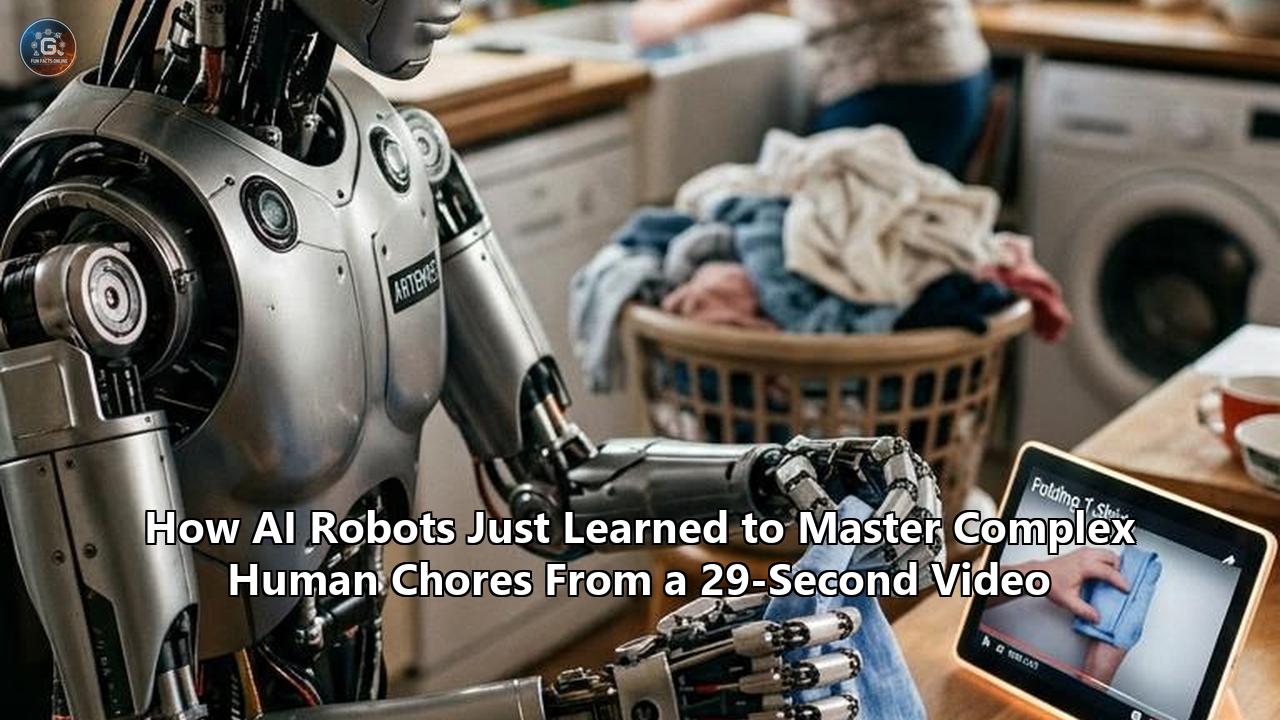
A robotic manipulator positioned over a kitchen counter watches a 29-second video of a human folding a hand towel, smoothing out wrinkles, and stacking it neatly into a storage bin. The robot has never touched that specific fabric, never practiced that folding sequence, and its neural network has received zero fine-tuning or software updates for the task. Within seconds of processing the clip, the robot reaches forward, grasps the corners of the towel, executes the folds in precise sequence, and deposits the fabric into the bin.
This capability stems from an open-source embodied artificial intelligence framework known as HOST (Human-to-robot One-Shot Skill AcquisiTion), unveiled by researchers from the Beijing Institute of Technology in collaboration with embodied AI developer X Square Robot. The system allows general-purpose robots to acquire entirely novel manipulation skills on the fly from a single, casual video demonstration recorded on a smartphone.
Across benchmark testing on 50 previously unseen household and workshop tasks—ranging from clearing table debris and sorting cutlery to folding garments and unscrewing container caps—the framework achieved a 62% average task success rate on its first attempt. That figure exceeds standard zero-shot baselines by 45 percentage points and outperforms prior visual imitation architectures by 43 percentage points. Crucially, the entire acquisition cycle takes an average of 29 seconds, making skill acquisition roughly 507 times faster than traditional supervised fine-tuning pipelines while bypassing the need to collect dozens of expensive human teleoperation trajectories.
The engineering breakthrough behind HOST challenges a foundational assumption in robotics: that teaching a machine a new physical skill requires hours of teleoperation, millions of simulation steps, or compute-heavy gradient updates. By treating short video demonstrations as real-time visual prompts rather than static training datasets, researchers have demonstrated a practical path toward truly adaptive home robotics.
+-----------------------------------------------------------------------------+
|                      TRADITIONAL ROBOT LEARNING vs. HOST                    |
+-----------------------------------------------------------------------------+
|                                                                             |
|  TRADITIONAL PIPELINE:                                                      |
|  [Collect 50-100 Teleop Traces] -> [GPU Fine-Tuning (4-12 hrs)] -> [Deploy] |
|   * High human labor ($100+/demonstration)                                  |
|   * Risk of catastrophic forgetting on prior skills                         |
|                                                                             |
|  HOST INFERENCE-TIME PIPELINE:                                              |
|  [29s Casual Human Video] -> [Progress Manifold Alignment]                  |
|                                      |                                      |
|                                      v                                      |
|                            [Visual Future Simulation]                       |
|                                      |                                      |
|                                      v                                      |
|                             [Direct Action Chunking]                        |
|                                      |                                      |
|                                      v                                      |
|                          [Immediate Execution (62% First-Try)]              |
|   * Zero model parameter updates (Weights remain frozen)                    |
|   * 507x faster acquisition cycle                                           |
|   * Full skill retention across diverse tasks                               |
+-----------------------------------------------------------------------------+
The Physical Manipulation Bottleneck
For decades, industrial automation has excelled at deterministic, high-speed execution. Automotive assembly lines employ robotic arms that weld car frames and mount windshields with sub-millimeter precision millions of times without deviation. However, placing that same high-precision robotic arm in a standard suburban kitchen exposes the fragility of classical control theory.
In robotics, this challenge is formalized by Moravec's paradox: complex cognitive tasks that require adult human intellect, such as playing chess or solving calculus, demand relatively little computational power, whereas simple sensorimotor skills mastered by a two-year-old—such as navigating an uneven room, picking up a crumpled sock, or holding an egg without crushing it—require enormous computational resources and sensory processing.
Household chores present several distinct engineering challenges that industrial factories deliberately eliminate:
- Deformable and Non-Rigid Objects: Towels, shirts, and plastic bags warp, wrinkle, and shift their center of mass continuously during handling. Stiff kinematic paths cannot predict how a fabric fold will fall.
- Severe Visual Occlusions and Variable Lighting: Kitchens and living rooms experience direct sunlight, moving shadows, and semi-opaque glassware. Objects placed inside deep drawers or underneath sinks are frequently blocked from view during manipulation.
- Unstructured Spatial Layouts: Unlike factory fixtures where every bolt arrives at an exact coordinate $(x, y, z)$, household items are scattered randomly with arbitrary orientations, varying friction coefficients, and unpredictable clutter.
- Continuous Tactile Variation: Lifting a porcelain coffee mug requires a completely different grip force and contact-patch distribution than lifting an empty foam cup or a wet sponge.
Historically, teaching robots to navigate these complexities required imitation learning via human teleoperation. Engineers strapped on virtual reality headsets, grasped haptic controllers, and manually piloted robotic arms through 50 to 100 demonstrations per task.
                               THE DATA COLLECTION CHASM
  +-----------------------------------------------------------------------------------+
  | Digital AI (LLMs, Vision):                                                        |
  | [Trillions of Web Tokens / Video Frames] ---> [Massive Self-Supervised Foundation]|
  +-----------------------------------------------------------------------------------+
                                           vs.
  +-----------------------------------------------------------------------------------+
  | Physical AI (Robotics):                                                           |
  | [Manual Human Teleoperation Farms] ---------> [Scattered, Low-Sample Datasets]     |
  | (Cost: ~$100 / demo; 100+ demos per chore)                                        |
  +-----------------------------------------------------------------------------------+
This teleoperation framework creates an economic bottleneck. Collecting high-quality trajectory data costs upward of $100 per demonstration when factoring in equipment maintenance, operator labor, and data curation. Fine-tuning a policy network on that new demonstration data takes anywhere from four to twelve hours of GPU cluster compute. If a homeowner buys a robot and wants it to clean an unusual espresso machine or fold an uncommon style of cardigan, the robot cannot pause its routine for half a day while an offsite data center updates its neural weights.
The goal of one-shot visual imitation is to eliminate this teleoperation overhead entirely, allowing AI robots learning chores to watch a human perform a physical action once and immediately translate those optical pixels into motor voltages.
The Core Technical Barriers of Video Imitation
Translating a video of a human clearing plates into robotic motor commands involves solving two core physics and computer vision dilemmas: temporal misalignment and morphology mismatch.
1. The Temporal Misalignment Problem
Humans do not move like machines. A human clearing dishes might pause to glance across the room, adjust their grip midway through a reach, or accelerate their arm abruptly. Conversely, a robotic arm operates under strict acceleration profiles, torque limits, and trajectory smoothers.
If a robot attempts a direct frame-by-frame mimicry of human video timestamps—trying to match video frame $t = 120$ at execution second 4.0—the system quickly drifts out of phase. If the robot takes an extra half-second to maneuver around an unexpected kitchen obstacle, a naive temporal tracking algorithm will continue playing the human video sequence, instructing the gripper to close before it has reached the targeted dishware.
2. The Morphology Gap (Cross-Embodiment Discrepancy)
The human hand is a biomechanical marvel featuring 27 degrees of freedom, hundreds of mechanoreceptors per square centimeter of skin, and flexible friction pads that deform under load. In contrast, standard commercial robotic end-effectors range from simple two-finger parallel jaw grippers to five-finger hands with 6 to 16 motorized degrees of freedom and rigid silicone fingertips.
       HUMAN DEMONSTRATION                          ROBOT EXECUTION
  +---------------------------+               +--------------------------+
  | - 27 Degrees of Freedom   |               | - 2 to 7 Actuated Joints |
  | - Fleshy Friction Pads    |   MISMATCH    | - Rigid Silicone Grippers|
  | - Variable Human Velocity | =============>| - Fixed Torque Envelopes |
  | - Casual Body Dynamics    |               | - Egocentric Calibration |
  +---------------------------+               +--------------------------+
When a human picks up a bowl, their fingers slide across the rim, adapting passively to its geometry. If a machine tries to match the precise joint angles of the human hand, the attempt fails because the robot's physical links do not share the human's kinematic length, torque distribution, or skin friction. Direct joint-to-joint mapping causes catastrophic physical failures, resulting in dropped glassware, collisions, and broken motors.
How HOST Decouples Task Planning from Mechanical Hardware
The HOST framework resolves these fundamental discrepancies through a paradigm known as inference-time in-context learning. Rather than altering the underlying neural network weights to internalize a new chore, HOST keeps the primary model parameters completely frozen. It treats the 29-second video demonstration as an external visual prompt, mapping the demonstration into a latent task progression space and deploying a causal cascade of predictive experts.
+---------------------------------------------------------------------------------------+
|                              THE HOST SYSTEM PIPELINE                                 |
+---------------------------------------------------------------------------------------+
|                                                                                       |
|  [29-Second Human Video Prompt]          [Real-Time Robot Camera Feed]                |
|               |                                        |                              |
|               +-------------------+--------------------+                              |
|                                   |                                                   |
|                                   v                                                   |
|                +------------------------------------+                                 |
|                |    Task Progress Alignment Module   |                                |
|                |     - Qwen3-VL-Embedding-8B        |                                 |
|                |     - Smooth Dynamic Time Warping  |                                 |
|                +------------------------------------+                                 |
|                                   |                                                   |
|                                   v [Coupled Progress State: p_t]                     |
|                +------------------------------------+                                 |
|                |   Causal Cascade Prediction Engine |                                 |
|                +------------------------------------+                                 |
|                                   |                                                   |
|         +-------------------------+-------------------------+                         |
|         |                                                   |                         |
|         v                                                   v                         |
|  [Video Expert: Wan2.2-TI2V-5B]                 [Action Expert: Diffusion Policy]     |
|  (Predicts Robot's Future Pixels)               (Generates Motor Joint Trajectories)  |
|         |                                                   |                         |
|         +-------------------------+-------------------------+                         |
|                                   |                                                   |
|                                   v                                                   |
|                   [Shared-Attention Latent Fusion]                                    |
|                                   |                                                   |
|                                   v                                                   |
|                  [Low-Level Actuator Motor Commands]                                  |
|                                                                                       |
+---------------------------------------------------------------------------------------+
The Progress Manifold and Smooth Dynamic Time Warping
To eliminate the temporal misalignment problem, the framework abstracts clock time into task progress ($p_t \in [0, 1]$). Both the human demonstration video and the robot's real-time sensory observation stream are processed through a vision-language foundation backbone based on Qwen3-VL-Embedding-8B.
This visual encoder projects raw camera frames into an invariant semantic representation space where human hands and robotic grippers doing the same sub-task occupy adjacent coordinates.
To synchronize these representations dynamically, HOST relies on Smooth Dynamic Time Warping (SDTW) paired with a Temporal Cycle-Consistency (TCC) objective. Rather than matching frame indices based on clock time, the alignment module calculates a pairwise similarity matrix across the temporal dimension:
$$\mathcal{D}(i, j) = 1 - \frac{\phi(I^{\text{human}}_i) \cdot \phi(I^{\text{robot}}_j)}{\|\phi(I^{\text{human}}_i)\| \|\phi(I^{\text{robot}}_j)\|}$$
Where $\phi(I)$ represents the high-dimensional visual embedding of a given frame.
Using differentiable dynamic programming, the system continuously discovers the optimal monotonic warp path between the video demonstration and the live execution trace. If the robot encounters mechanical resistance or takes longer to orient its wrist, the alignment pointer pauses on the human video progress curve. As soon as the physical condition is met, the alignment pointer advances. This dynamic coupling ensures the robot remains synchronized with the demonstration sequence regardless of physical speed variations.
Inside the Dual-Expert Mixture-of-Transformers Architecture
The operational core of the HOST framework is a dual-expert Mixture-of-Transformers (MoT) architecture built on a continuous diffusion backbone. Instead of attempting a direct leap from human hand pixels to motor torques, the architecture executes a three-stage causal prediction cascade rooted in cognitive simulation theory:
+-----------------------------------------------------------------------------+
|                          THE THREE-STAGE CAUSAL CASCADE                     |
+-----------------------------------------------------------------------------+
|                                                                             |
|  STAGE 1: PROGRESS LOCALIZATION                                             |
|  "Where am I relative to the goal?"                                         |
|  Matches current visual state to demonstration progress manifold (p_t).     |
|                                                                             |
|  STAGE 2: VISUAL GOAL SIMULATION (Video Expert)                             |
|  "What should the physical environment look like next?"                     |
|  Generates a high-fidelity visual prediction of the robot's future scene.  |
|                                                                             |
|  STAGE 3: ACTION INVERSION (Action Expert)                                  |
|  "What motor joint trajectories produce that physical outcome?"             |
|  Synthesizes multi-joint continuous trajectory chunks via diffusion.        |
|                                                                             |
+-----------------------------------------------------------------------------+
Stage 1: Progress Localization
The model observes its recent visual history $o_{r, t-K:t}$ alongside a sliding window of human demonstration frames $W$. It computes its exact progress scalar $p_t$, determining precisely which phase of the physical task must be executed next.
Stage 2: Visual Goal Simulation (The Video Expert)
Instead of forcing the robotic gripper to mimic human finger kinematics, HOST asks: What should the physical objects in the environment look like over the next fraction of a second?
This stage is driven by a generative video foundation model initialized from Wan2.2-TI2V-5B. Conditioned on the robot's current camera perspective and the target task state derived from the human clip, the video expert synthesizes the predicted future visual state of the workspace—showing the towel folding over or the dish settling onto the drying rack from the robot's own egocentric viewpoint.
Stage 3: Action Inversion (The Action Expert)
Once the future visual goal is generated in latent space, the action expert uses a diffusion policy to derive the low-level kinematic trajectory chunks required to achieve that visual transformation.
Because the diffusion process is grounded in the predicted state of the physical object rather than the shape of the human hand, morphology mismatch is entirely bypassed. The robot achieves the same physical outcome using whatever mechanical kinematics, joint limits, and finger configurations it natively possesses.
+-----------------------------------------------------------------------------+
|                      SHARED-ATTENTION LATENT COUPLING                       |
+-----------------------------------------------------------------------------+
|                                                                             |
|   Video Expert Layers (Wan2.2)               Action Expert Layers           |
|  +---------------------------+              +---------------------------+   |
|  | [Visual Future Tokens]    | <----------> | [Joint Trajectory Tokens] |   |
|  | Context: Object & Scene   |   Cross-     | Context: Motor Dynamics,  |   |
|  | Transformations           |   Attention  | Torques, Joint Limits     |   |
|  +---------------------------+              +---------------------------+   |
|                                                                             |
+-----------------------------------------------------------------------------+
Communication between the video prediction expert and the motor execution expert occurs through cross-attention mechanisms across intermediate transformer layers. The action expert samples directly from the visual expert's latent spatio-temporal features, ensuring that the generated motor outputs continuously drive the physical environment toward the simulated goal state.
Mitigating Catastrophic Forgetting
In machine learning, catastrophic forgetting refers to the phenomenon where a neural network abruptly loses previously learned knowledge upon being fine-tuned on new data.
When a standard Vision-Language-Action (VLA) model undergoes parameter updates to learn a new task—such as operating a specific can opener—the backpropagation adjustments shift the weights throughout the neural layers. Consequently, the model's performance on previously learned skills (like loading a dishwasher or folding napkins) rapidly degrades unless old datasets are continually re-mixed into costly joint training runs.
       TASK RETENTION COMPARISON AFTER NEW SKILL ACQUISITION
  +-----------------------------------------------------------------+
  | Standard Supervised Fine-Tuning (SFT):                          |
  | Prior Task Competence:  [■■■■■■■■■■■■□□□□□□□□] (41% Retained)   |
  | (Weights overwritten during training loop)                      |
  +-----------------------------------------------------------------+
  | HOST Inference-Time Framework:                                  |
  | Prior Task Competence:  [■■■■■■■■■■■■■■■■■■■■] (100% Retained)  |
  | (Weights remain frozen; skills fed via in-context video prompt) |
  +-----------------------------------------------------------------+
Because HOST executes skill acquisition entirely at inference time, the underlying model parameters remain completely static. The demonstration video serves exclusively as an external contextual conditioning prompt within the model's context window, analogous to providing reference examples to a large language model.
Experimental benchmarks confirm that while standard fine-tuning architectures suffered a 59% drop in baseline performance across their prior skill catalog after adapting to novel tasks, HOST preserved 100% of its base manipulation performance. A robot utilizing this framework can execute hundreds of distinct chores across an operating day without eroding its foundational motor competencies.
Experimental Benchmark Results
To validate the framework under rigorous empirical conditions, researchers evaluated HOST across 50 manipulation tasks spanning real-world household and light-industrial environments. Each chore was evaluated over 20 randomized physical trials, testing the robot against varying object placements, visual clutter, ambient illumination, and external physical disturbances.
+-----------------------------------------------------------------------------+
|                 BENCHMARK PERFORMANCE ON NOVEL PHYSICAL TASKS               |
+-----------------------------------------------------------------------------+
|  Model Framework             | Success Rate | Demos Needed | Acquisition Time|
+------------------------------+--------------+--------------+----------------+
|  Zero-Shot VLA Baseline      |     17%      |      0       |       N/A      |
|  Standard Visual Imitation   |     19%      |   1 video    |      35 sec    |
|  Supervised Fine-Tuning (SFT)|     56%      |   50 teleop  |    ~4 hours    |
|  HOST (Frozen Weights)       |     62%      |   1 video    |     29 sec     |
+-----------------------------------------------------------------------------+
Key Quantitative Findings:
- First-Trial Success Rate: On completely novel tasks with unseen objects, HOST attained a 62% average task success rate from a single 29-second demonstration video. This outperformed zero-shot language-conditioned baselines by 45% and single-shot visual baselines by 43%.
- Superiority Over Teleoperated Fine-Tuning: HOST surpassed the performance of baseline models trained on 50 teleoperated robotic demonstrations (which achieved 56% success) despite utilizing 50 times fewer demonstrations and zero physical robot data collection time.
- Acquisition Velocity: The total time required to ingest, align, and prepare a new skill for execution averaged 29 seconds, compared to four hours of data collection and fine-tuning computation required by classical pipelines—representing a 507-fold increase in operational deployment speed.
- Robustness to Environmental Interference: In stress tests where researchers introduced sudden lighting shifts, moved objects midway through manipulation, or swapped out target items for variants with different colors and textures, the dynamic time-warping feedback loop allowed the robot to recover and complete the task in over 50% of disturbed trials without manual resets.
The Economics of Embodied Data
The economics of embodied artificial intelligence differ fundamentally from traditional software-based AI. Large Language Models (LLMs) scaled rapidly because they trained on trillions of tokens harvested automatically from public digital text repositories. Robotics developers enjoy no equivalent source of pre-existing, motor-aligned physical interaction data.
Every hour of physical robot teleoperation requires human labor, hardware wear-and-tear, maintenance technicians, and strict safety oversight. This dynamic has historically capped robotics training datasets at tens of thousands of trajectory hours, compared to the millions of GPU hours utilized to train frontier language and vision models.
+-----------------------------------------------------------------------------+
|                      THE EMBODIED DATA VALUE EQUATION                       |
+-----------------------------------------------------------------------------+
|                                                                             |
|  CONVENTIONAL TELEOPERATION PARADIGM:                                       |
|  Cost per Skill = (N_demos * Operator_Wage * Time) + GPU_Finetuning_Cost    |
|                 = (50 * $25/hr * 0.1hr) + ($50 Compute)                     |
|                 ≈ $175 per specific task implementation                     |
|                                                                             |
|  ONE-SHOT VIDEO INFERENCE PARADIGM:                                         |
|  Cost per Skill = (1_demo * Smartphone_Capture_Time) + Real-time Inference  |
|                 = (1 * $0.00 * 0.008hr) + ($0.02 Edge Compute)              |
|                 ≈ $0.02 per specific task implementation                    |
|                                                                             |
+-----------------------------------------------------------------------------+
By establishing that a general-purpose model can achieve a 62% baseline success rate purely from casual human video demonstrations, HOST alters the unit economics of deploying AI robots learning chores.
Instead of deploying specialized data collection teams to configure robots for individual consumer homes or industrial facilities, end users can record a single 30-second video of an arbitrary task on a mobile phone and upload it directly to the robot's local runtime.
Furthermore, this framework establishes a pipeline to tap into billions of existing instructional videos across the open internet. If an embodied foundation model can systematically decouple human morphology from object state transitions, platforms like YouTube Shorts and instructional cooking channels effectively transform into massive, zero-cost training corpora for physical artificial intelligence.
Dissecting the 38% Failure Rate: Real-World Messiness
While a 62% first-attempt success rate represents a major scientific advance over previous zero-shot baselines, deploying autonomous robotics into home environments demands operational reliability exceeding 95% to 99%. A robotic dishwasher loader that drops and shatters four plates out of every ten is commercially unusable.
Analyzing the 38% failure envelope in the HOST experimental data reveals the structural boundaries of vision-only imitation learning:
+-----------------------------------------------------------------------------+
|                         ANALYSIS OF EXECUTION FAILURES                      |
+-----------------------------------------------------------------------------+
|                                                                             |
|  [■■■■■■■■■■■■■■■■■■■■■■■■■■■■■■■■■■■■■■■■] 62% Success                    |
|  [----------------------------------------]                                 |
|  [■■■■■■■■■■■■] 14% Spatial Precision & Grip Slippage                       |
|  [■■■■■■■■■]     9% Severe Visual Occlusion & Blindspots                    |
|  [■■■■■■■]       8% Non-Linear Deformable Physics Anomalies                 |
|  [■■■■■■■]       7% Force-Torque Misalignment (Tactile Blindness)           |
|                                                                             |
+-----------------------------------------------------------------------------+
1. Tactile Blindness and Force Misalignment
Visual cameras capture surface geometry and kinematics but cannot directly measure normal forces, shear stress, or friction coefficients. When a human peels tape or scrapes burnt food from a pan, motor control is governed primarily by closed-loop haptic feedback rather than vision. A robot relying solely on optical observation often fails to apply adequate downward pressure or applies excessive torque, causing motor stalls or structural damage.
2. Multi-Layer Deformable Chaos
While HOST successfully folded simple hand towels and socks, performance dropped sharply when interacting with complex, multi-layered garments like hooded sweatshirts or dress shirts with interior linings. Fabric exhibits complex non-linear physics: a single fold can introduce internal stress that shifts the entire garment unpredictably. Without high-frequency tactile recalibration, open-loop visual predictions diverge rapidly from reality.
3. Visual Occlusions in Confined Enclosures
When a robot reaches deep inside a dark cupboard, microwave, or dishwasher cavity, its wrist-mounted and head-mounted cameras frequently lose line-of-sight to the target object. In traditional teleoperation, human operators compensate using spatial memory and tactile feel. In contrast, HOST's vision-guided causal cascade experiences degraded performance when the visual observation stream is obstructed for more than 1.5 seconds.
4. Generalization Across Vastly Dissimilar Environments
The experimental trials were conducted in lab and mock-home settings with controlled acoustic and lighting envelopes. Transferring the policy to an uncalibrated domestic kitchen—featuring highly polished marble countertops that produce strong specular reflections, steam from boiling water, and moving household pets—introduces high-dimensional sensory noise that can degrade the confidence of the dynamic time-warping alignment module.
The Broader Physical AI Landscape
The HOST framework is part of a broader architectural shift occurring across global robotics institutions. The historical division between discrete high-level cognitive planners (Large Language Models) and low-level continuous motor controllers (Proportional-Integral-Derivative loops) is rapidly consolidating into end-to-end multi-modal policies.
+-----------------------------------------------------------------------------+
|                      COMPARING LEADING EMBODIED AI APPROACHES               |
+-----------------------------------------------------------------------------+
|  Approach         | Lead Organizations     | Core Strengths  | Bottlenecks   |
+-------------------+------------------------+-----------------+---------------+
|  Flow-Matching /  | Physical Intelligence  | High dexterity, | Requires large|
|  Action Chunking  | (π0), Stanford         | multi-frequency | teleop datasets|
|                   | (Mobile ALOHA)         | motor control   | per skill     |
+-------------------+------------------------+-----------------+---------------+
|  Internet-Scale   | Google DeepMind        | Broad semantic  | High compute, |
|  VLA Models       | (RT-2, Gemini Robot)   | reasoning,      | low-frequency |
|                   |                        | generalization  | latency       |
+-------------------+------------------------+-----------------+---------------+
|  End-to-End Video | Tesla                  | Direct optical  | Black-box,    |
|  Foundation Models| (Optimus Gen-2)        | control, runs on| unexplainable |
|                   |                        | vehicle stack   | edge cases    |
+-------------------+------------------------+-----------------+---------------+
|  In-Context Video | BIT / X Square Robot   | Zero-retrain,   | 62% baseline  |
|  Prompting (HOST) | (Open-Source)          | single-shot,    | success rate; |
|                   |                        | no forgetting   | needs tactile |
+-------------------+------------------------+-----------------+---------------+- Physical Intelligence ($\pi_0$): Focuses on flow matching and unified multi-task foundation models capable of folding laundry, bussing tables, and assembling electronics by training on massive, diverse datasets of teleoperated robot trajectories across varied hardware embodiments.
- Google DeepMind (RT-2, Gemini Robotics): Leverages web-scale vision-language models to translate internet knowledge into spatial tokens, excelling at high-level reasoning and semantic tool use, but historically limited in high-frequency, contact-rich manipulation dexterity.
- Stanford Robotics Projects (Mobile ALOHA, HumanPlus, WHIRL): Pioneers open-source bimanual teleoperation hardware and visual imitation algorithms, exploring how low-cost mechanical systems can rapidly acquire complex household chores.
- Tesla Optimus: Employs end-to-end neural network policies trained directly from human motion capture and on-robot video streams, utilizing custom high-density actuator hardware and onboard FSD-derived compute chips.
HOST introduces a complementary paradigm: transforming video from static offline training data into an active, real-time context prompt. This bridges the gap between massive pre-trained foundation models and the immediate need for localized physical task adaptation.
Hardware Integration: Beyond Pure Vision
Executing complex chores requires tight synchronization between high-level neural inference and low-level physical actuation. The intelligence driving the robot cannot succeed without specialized mechanical and sensory hardware.
+-----------------------------------------------------------------------------+
|                      THE COMPLETE PHYSICAL SYSTEM STACK                     |
+-----------------------------------------------------------------------------+
|                                                                             |
|  [SENSORY LAYER]                                                            |
|  - High-Resolution RGB-D Cameras (30-60 Hz)                                 |
|  - GelSight / High-Density Elastomeric Optical Tactile Skins                |
|  - 6-Axis Wrist Force-Torque Sensors                                        |
|                                                                             |
|  [NEURAL INFERENCE LAYER]                                                   |
|  - Onboard Edge Compute (NVIDIA Jetson Thor / Custom Neuromorphic Silicon)  |
|  - Real-Time Progress Warping (HOST Alignment Engine)                       |
|  - Dual-Expert Video/Action Diffusion Architecture                          |
|                                                                             |
|  [ACTUATION & SAFETY LAYER]                                                 |
|  - Quasi-Direct Drive (QDD) / High-Torque Brushless Actuators               |
|  - Variable Impedance & Active Compliance Control Loops (500 Hz - 1 kHz)    |
|  - Physical Reflex Envelopes & Bounding Box Collision Kill-Switches         |
|                                                                             |
+-----------------------------------------------------------------------------+
Compliant Actuation vs. Rigid Industrial Positioning
Traditional industrial robots use high-gear-ratio harmonic drives that are physically stiff. If an industrial robot miscalculates the height of a porcelain tabletop by three millimeters, its motors will drive the arm through the tabletop, shattering the plate and stripping its internal gears.
Domestic robots rely on Quasi-Direct Drive (QDD) electric actuators or Series Elastic Actuators (SEAs) governed by impedance control. Impedance control allows the robot's limbs to act like programmable virtual springs. When the robot wipes a table or sweeps with a broom, it does not track absolute positions; instead, it commands a constant contact force while allowing its joints to yield smoothly to physical contours.
Tactile Skins and Elastomeric Sensors
To elevate the 62% success rate into commercial territory, visual imitation frameworks are integrating elastomeric optical tactile sensors, such as GelSight or DIGIT. These sensors employ an internal camera that tracks the microscopic deformation of a soft silicone membrane when contacting an object.
By measuring the real-time displacement of markers embedded within the silicone, the robot calculates contact geometry, slip vectors, and localized force distribution at kilohertz frequencies. Fusing this tactile stream into the action expert ensures that when AI robots learning chores pick up fragile or slippery glassware, grip stabilization occurs automatically at the hardware level before visual latency can cause a drop.
Safety, Privacy, and Household Autonomy
Placing autonomous, multi-joint physical manipulators into domestic spaces occupied by children, elderly individuals, and pets introduces complex safety and privacy constraints.
       AUTONOMOUS WORKSPACE RUNTIME SAFETY BOUNDARIES
  +-------------------------------------------------------------+
  |  [ OUTER BUFFER: Vision Tracking Zone ]                     |
  |  - Tracks human/pet entry using overhead & depth cameras.   |
  |  - Reduces global execution speed by 50% on proximity.      |
  |                                                             |
  |    [ INNER SPHERE: Dynamic Virtual Safety Envelope ]        |
  |    - Motor torques capped at non-injurious thresholds.      |
  |    - Impedance loops instantly yield on unexpected contact. |
  |                                                             |
  |      [ CORE INTERACTION ZONE: The Active Workspace ]        |
  |      - Hardware torque sensors detect collisions in < 5ms.  |
  |      - Hardware kill-switch halts power on anomaly.         |
  +-------------------------------------------------------------+
1. Physical Safety Envelopes
In text-based generative models, a hallucination produces a grammatically incorrect sentence or a false factual statement. In embodied physical AI, a hallucination translates into unexpected joint acceleration that can knock over a boiling kettle or strike a bystander.
To prevent catastrophic execution errors, modern embodied architectures incorporate deterministic safety filters between the neural policy and the physical motor drivers:
- Torque and Velocity Clamping: Maximum joint speeds and actuator torques are hard-capped in the low-level firmware. Even if the neural network outputs an erratic full-voltage command, the motor controller refuses to exceed safe kinematic thresholds.
- Real-Time Collision Avoidance: Depth sensors create a dynamic virtual bounding box around the robot's workspace. If a human hand or pet enters the active manipulation zone, the robot's low-level execution loop halts instantly, holding position until the workspace clears.
2. Edge Processing and Data Privacy
Domestic spaces represent intimate private domains. A system that continuously streams high-resolution video of bedroom and living room spaces to centralized cloud servers introduces unacceptable privacy risks.
Frameworks like HOST are intentionally designed to run entirely on local edge hardware—such as integrated onboard compute modules. Because skill acquisition occurs at inference time without requiring massive distributed cluster training, raw human video footage can be processed in localized RAM, converted into transient latent embeddings, and deleted without transmitting private household imagery over external networks.
The Path to Commercial Household Autonomy
Achieving reliable household robotics requires closing the remaining reliability gap between a 62% research baseline and commercial-grade autonomous execution. Over the next 18 to 36 months, several critical engineering milestones will dictate the progression of one-shot physical AI.
+-----------------------------------------------------------------------------+
|                     THE ROADMAP TO AUTONOMOUS DOMESTIC ROBOTS               |
+-----------------------------------------------------------------------------+
|                                                                             |
|  MILESTONE 1: CLOSED-LOOP RETRY & SELF-CORRECTION (Current Frontier)        |
|  - Detecting execution failure states in real time.                         |
|  - Autonomous backtracking to re-attempt failed grasps or misaligned folds. |
|  - Target: Elevating single-task baseline reliability from 62% to 85%+.     |
|                                                                             |
|  MILESTONE 2: MULTI-MODAL FORCE & TACTILE FUSION (12-18 Months)             |
|  - Integrating high-density tactile sensors directly into action experts.   |
|  - Enabling contact-rich chores (scrubbing dishes, peeling, slicing).       |
|                                                                             |
|  MILESTONE 3: LONG-HORIZON HIERARCHICAL CHORE CHAINING (24-36 Months)       |
|  - Chaining dozens of discrete sub-skills into complex macro-routines.      |
|  - Example: Clearing a dinner table -> loading dishwasher -> adding soap    |
|             -> selecting wash cycle -> wiping the countertop.               |
|                                                                             |
+-----------------------------------------------------------------------------+
Self-Correcting Closed-Loop Recovery
The current version of HOST executes an open-loop rollout conditioned on continuous temporal alignment. If an attempt to grasp a mug fails and the mug slides across the table, the robot attempts to continue the sequence rather than resetting its reach.
The next architectural evolution involves integrating visual value functions that assess task success after each sub-step. If a grasp fails, the system pauses execution, shifts the alignment pointer back along the task progression manifold, and re-executes the approach until the target object is successfully secured. This self-correcting retry loop alone is projected to push overall task completion rates past 85%.
Long-Horizon Chore Chaining
Real household labor consists of long-horizon composite tasks. "Doing the dishes" is not a single 30-second skill; it is an interconnected chain of 20 distinct sub-tasks: scraping food into the waste bin, rinsing the dish, opening the dishwasher door, pulling out the rack, slotting the plate between the tines, and closing the door.
Future implementations will leverage hierarchical orchestration models. High-level vision-language planners will break down complex natural-language user requests ("Please clean up the dining room") into structured sequences of sub-skills. The robot will then dynamically query its internal library of video-conditioned policies—or prompt the user for a quick 20-second video demo if it encounters a novel appliance—executing each sub-task seamlessly in sequence.
The demonstration that machines can acquire dexterous manipulation skills from a single 29-second video marks a definitive break from the data-starved, teleoperation-heavy paradigms of the past. By shifting skill acquisition from offline training clusters to real-time inference, physical artificial intelligence is moving steadily out of controlled laboratory fixtures and into the unstructured realities of everyday human spaces.
Reference:
- https://www.alphaxiv.org/abs/2607.20033
- https://universeodon.com/@china
- https://www.openai-hub.com/news/1382/
- https://pandaily.com/x-square-robot-host-29-second-skill-learning-video-aug2026
- https://pandaily.com/x-square-robot-host-29-second-skill-learning-video-aug2026
- https://gagadget.com/en/722101-a-robot-learns-a-new-skill-from-a-29-second-video-no-retraining-required/
- https://github.com/CGuangyan-BIT/HOST
- https://www.alphaxiv.org/abs/2607.20033
- https://arxiv.org/html/2607.20033v1
- https://www.facebook.com/TechxploreCom/posts/a-robot-learned-new-manipulation-skills-from-a-single-human-video-in-an-average-/1691178523011391/
- https://www.facebook.com/DigitalTrends/posts/weave-robotics-has-unveiled-isaac-1-a-7999-home-robot-designed-to-take-on-everyd/1381431463839455/
- https://www.facebook.com/TheIndependentOnline/videos/footage-of-teslas-humanoid-robot-optimus-carrying-out-household-chores-has-gone-/1040868764136490/
- https://www.facebook.com/etnow/videos/teslas-robots-can-fold-your-shirts/724868959890405/