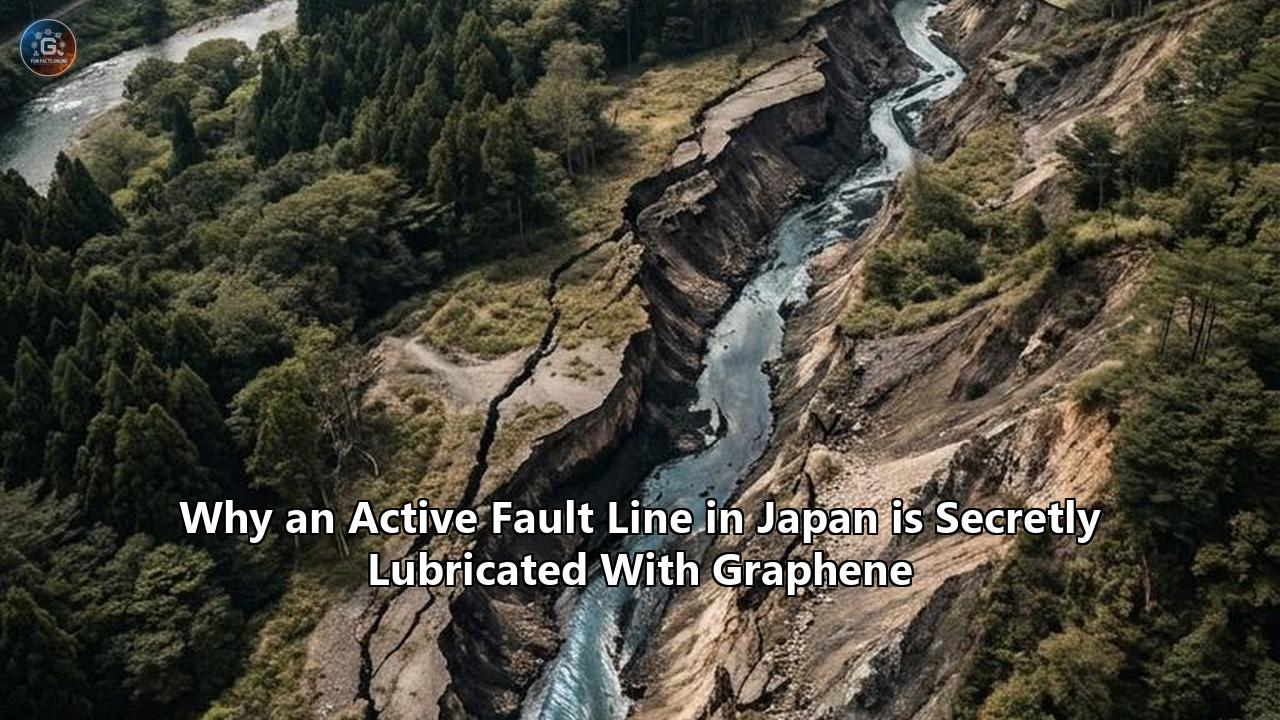
An active fault line in Japan has been found to operate on a principle that seems borrowed from advanced aerospace engineering: it is secretly lubricated by naturally occurring graphene oxide.
In a study published in Nature Communications, a research team led by Tomoya Shimada and Professor Hiroyuki Nagahama of Tohoku University documented the first-ever discovery of naturally formed graphene oxide within the slip zone of a creeping active fault. Located in the Mozumi-Sukenobe Fault, a sub-parallel branch of the major Atotsugawa Fault System in central Japan, this microscopic carbon sheet acts as an ultra-low-friction lubricant.
The discovery provides an elegant, molecular-scale explanation for a mystery that has baffled geophysicists for decades: why a major, tectonically active fault system capable of producing devastating earthquakes remains almost completely silent along its shallowest sections.
More importantly, this discovery serves as a remarkable case study at the intersection of structural geology, materials science, and nanotribology. It forces a reassessment of how faults are mapped, how seismic hazards are calculated, and how the physical laws of friction behave under the extreme pressures of the Earth’s crust. The existence of graphene in fault lines demonstrates that the planet behaves as a massive, self-regulating chemical reactor, synthesizing its own nanomaterials to ease the grinding forces of tectonic plates.
The Paradox of the Silent Giant: Japan's Creeping Atotsugawa Fault
The Atotsugawa Fault System is a major geological scar threading through the mountainous Hida Highland of central Japan. Spanning roughly 60 kilometers with a strike of North-60-East and a near-vertical dip, the system is a classic right-lateral strike-slip fault. It is one of the primary lateral structures accommodating the intense tectonic squeeze of the Niigata-Kobe Tectonic Zone.
In terms of raw potential, the Atotsugawa is a sleeping giant. In 1858, it ruptured violently, producing the magnitude 7.0 Hietsu earthquake, which triggered devastating landslides, destroyed villages, and reshaped the local topography. By all traditional metrics of seismology, a fault of this magnitude, wedged between converging plate boundaries, should be a hotbed of regular, small-scale seismic activity as stress re-accumulates.
Yet, for over a century and a half, the central section of the Atotsugawa system has remained quiet.
[Atotsugawa Fault System Profiling]
Surface Trace: ~60 km strike-slip system (Central Japan)
Historical Benchmark: 1858 Hietsu Earthquake (M 7.0)
The Seismic Enigma: Stable, aseismic creep down to 7-8 km depth
Traditional Explanation: Graphite lubrication (Friction Coefficient μ ~ 0.1)
The 2026 Discovery: Graphene oxide lubrication (Friction Coefficient μ ~ 0.01)
Seismic monitoring networks deployed across Japan reveal almost zero earthquake activity along the central portion of the fault down to a depth of roughly five miles (7 to 8 kilometers). Instead of locking up, building stress, and snapping in a sequence of minor tremors, the fault moves slowly, smoothly, and continuously.
Geologists call this phenomenon aseismic creep. While the edges of the fault system are locked and seismically active, the core section glides silently, releasing tectonic strain without generating the ground-shaking shockwaves of an earthquake.
For years, the leading explanation for this quiet behavior focused on graphite. Graphite is a well-known solid lubricant composed of stacked sheets of carbon atoms bound together by weak van der Waals forces. Previous drilling and field excavations had shown that the fault gouge—the ground-up, clay-like rock paste that lines the interior of a active fault zone—contained concentrations of graphite of up to 12% by weight.
In mineral physics, graphite is considered slippery, with a friction coefficient ($\mu$) of approximately 0.1. According to classical rock mechanics, this is low enough to weaken a fault zone significantly.
However, the graphite hypothesis had a major flaw. When researchers ran laboratory simulation tests, the friction values of natural graphite-bearing rock mixtures never fully aligned with the extreme, near-frictionless gliding observed along the Atotsugawa's shallow creep zone. Graphite helped, but it was not slick enough to keep a major fault system completely silent under megapascal loads.
There had to be a hidden variable.
The Atomic-Scale Discovery: Methods and Minerals
To solve this mystery, Shimada and his colleagues from Tohoku University, Tohoku Gakuin University, and the University of Tokyo targeted the Mozumi-Sukenobe Fault. This fault is exposed within a deep active research tunnel that cuts directly through the fault zone, allowing scientists to collect fresh, unweathered samples of the active fault gouge.
[Mozumi-Sukenobe Fault Core]
      _________________________________
     /     Wall Rock (Sandstone/Clay)  \
    /___________________________________\
   ||   \ \ \  Fault Gouge Zone  / / /   ||
   ||  =================================  || <-- High Shear Zone
   ||  [ Graphene Oxide Nanosheets (GO) ] || <-- Microcracks (3-10 nm sheets)
   ||  =================================  ||
   ||   / / /  Fault Gouge Zone  \ \ \   ||
    \___________________________________/
     \     Wall Rock (Conglomerate)    /
      \_______________________________/
Rather than relying on macroscopic mineral identification, the team subjected the dark, clayey fault gouge to three state-of-the-art diagnostic testing methods designed to analyze materials at the atomic level:
- Raman Spectroscopy: A non-destructive chemical analysis technique that relies on laser light scattering to probe the vibrational, rotational, and other low-frequency modes of molecular systems. It is the gold standard for fingerprinting different structural forms of carbon, allowing researchers to distinguish between amorphous carbon, graphite, carbon nanotubes, and graphene.
- X-ray Photoelectron Spectroscopy (XPS): A surface-sensitive quantitative spectroscopic technique that measures the elemental composition, chemical formula, and electronic state of the elements within a material. XPS was essential for mapping the exact oxidation states of the carbon atoms in the gouge.
- Transmission Electron Microscopy (TEM): An imaging technique in which a beam of electrons is transmitted through an ultra-thin specimen to form an image. TEM allowed the team to directly view the structural layers of the material at a resolution of less than a nanometer.
The analytical results were unprecedented for a geological sample. Tucked inside the microcracks of the fault gouge—the exact localized pathways where the rock undergoes shear deformation—the team discovered single-layer sheets of graphene oxide.
Unlike graphite, which is a bulk three-dimensional mineral, the detected graphene oxide was composed of isolated, two-dimensional nanosheets just one carbon atom thick and measuring a mere 3 to 10 nanometers in lateral width. The XPS data confirmed that these carbon sheets were highly functionalized with oxygen-containing groups, specifically hydroxyl (–OH), epoxy (–O–), carbonyl (C=O), and carboxyl (–COOH) groups.
The structural and chemical composition of the material matched laboratory-synthesized graphene oxide. Synthesized graphene oxide is an engineered nanomaterial prized in high-tech industries for its application in next-generation lithium-ion batteries, water purification membranes, and industrial dry-film lubricants.
Its discovery inside an active tectonic fault marked the first time this high-performance nanomaterial had ever been observed forming naturally within the Earth's crust.
Nanotribology and the Mechanics of Superlubricity
To appreciate why the discovery of graphene in fault lines changes our understanding of earthquake physics, one must look at the sliding mechanics of two-dimensional carbon structures.
Under normal geological conditions, dry rock-on-rock contact is governed by Byerlee’s Law. This empirical rule states that almost all common rock types (granite, sandstone, shale, limestone) exhibit a coefficient of static friction ($\mu$) between 0.6 and 0.8. When a fault is lined with typical minerals, it requires immense shear stress to initiate movement. Because the rock faces are rough and locked together at microscopic contact points called asperities, they resist sliding until the accumulated tectonic stress exceeds their strength. At that moment, the asperities shear off violently, and the fault slips in milliseconds, generating a classic earthquake.
[Friction Coefficient Comparison (μ)]
Byerlee's Law (Standard Crustal Rocks)  |======================| 0.6 - 0.8
Graphite-rich Fault Gouge               |===| 0.1
Graphene Oxide (GO) in Fault Gouge      |=| 0.01 (Superlubricity Threshold)
Graphite reduces this friction coefficient to about 0.1 because its layered sheets can easily slide past one another. But graphene oxide takes this lubrication effect to an entirely different physical regime.
When functionalized with oxygen groups, graphene oxide exhibits a friction coefficient of approximately 0.01. This places it within the regime of superlubricity—a physical state where friction virtually vanishes.
The superlubricity of graphene in fault lines is driven by two distinct, reinforcing nanoscale mechanisms:
1. The Nanoscale Water Film (Chemical Lubrication)
The oxygen-containing functional groups (hydroxyl and carboxyl) protruding from the carbon lattices of graphene oxide are highly hydrophilic. They act as molecular anchors, attracting and binding ambient water molecules present within the deep hydrothermal fluids of the fault zone.
Rather than letting the water drain away or escape under tectonic pressure, the graphene oxide sheets hold the water tightly, creating a stable, thin, structured water film that is only a few molecules thick. When the fault experiences shear stress, the sliding occurs not on rock-to-rock or carbon-to-carbon contact points, but along this ultra-slick, hydrous interface.
   [Quartz / Mineral Grain]
   =================================================
   ~~~~~~~~ Structured Water Molecules ~~~~~~~~~~~~~ [Nanoscale Water Film]
   -------------------------------------------------
     O-H      O      O-H      O-H      O      O-H     [Hydrophilic Groups]
    /   \    / \    /   \    /   \    / \    /   \
   C=====C==C===C==C=====C==C=====C==C===C==C=====C  [Graphene Oxide Sheet]
   =================================================
   ~~~~~~~~ Structured Water Molecules ~~~~~~~~~~~~~ [Nanoscale Water Film]
   =================================================
   [Quartz / Mineral Grain]
2. Incommensurate Sliding (Structural Lubricity)
The physical structure of graphene oxide sheets allows them to act as atomic-scale protective barriers. As these 2D nanosheets disperse throughout the microcracks of the fault gouge, they line the surfaces of dominant abrasive minerals like quartz and clay.
Because the hexagonal atomic lattice of graphene oxide is highly mismatched with the crystalline lattice of surrounding silicate minerals, the atomic "hills and valleys" of the sliding surfaces do not line up. This crystalline mismatch—known as incommensurability—prevents the atoms of the sliding surfaces from locking into stable energy wells. The result is structural lubricity, allowing the nanosheets to slide past host minerals with almost zero mechanical resistance.
The Self-Generating Slick: Tribochemical Feedback Loops
One of the most profound aspects of the research team's discovery is that the graphene in fault lines is not a static geologic deposit. Instead, the fault zone operates as an active, self-regulating chemical factory.
How does highly structured, atom-thin graphene oxide form deep inside a messy, chaotic mass of crushed rock without human laboratory equipment? The answer lies in a phenomenon known as tribochemistry—chemical reactions that are triggered and accelerated by mechanical friction, shear deformation, and localized heating.
                 +--------------------------------+
                 |  Tectonic Stress & Fault Slip  |
                 +---------------+----------------+
                                 |
                                 v
                 +--------------------------------+
                 |  Shear Stress & Flash Heating  |
                 |         at Asperities          |
                 +---------------+----------------+
                                 |
                                 v
                 +--------------------------------+
                 |   Exfoliation of Graphite to   |
                 |     Graphene Nanosheets        |
                 +---------------+----------------+
                                 |
                                 v
                 +--------------------------------+
                 | Tribochemical Oxidation of GO  |
                 |  via Hydrothermal Water Fluid  |
                 +---------------+----------------+
                                 |
                                 v
                 +--------------------------------+
                 | Friction Drops (μ ~ 0.01) and  |
                 |     Aseismic Creep Resumes     |
                 +--------------------------------+
This tectonic reactor operates via a continuous feedback loop:
- Step 1: Mechanical Exfoliation. The fault gouge contains pre-existing, older graphite deposits derived from ancient organic carbonaceous materials buried deep within sedimentary rocks. When tectonic forces push the fault faces past each other, the resulting intense shear stress acts as a natural mechanical exfoliation process, peeling away individual layers of carbon from the larger graphite crystals, much like pulling apart layers of adhesive tape.
- Step 2: Flash Heating and Bond Breaking. At the microscopic contact points where mineral asperities rub together, localized friction creates brief, intense temperature spikes called flash temperatures. These micro-hotspots break the carbon-carbon bonds at the edges of the newly exfoliated graphene sheets, leaving highly reactive, open carbon bonds.
- Step 3: Tribochemical Oxidation. Because the fault zone is saturated with deep, pressurized geothermal water, these highly reactive carbon edges immediately react with the surrounding water molecules ($H_2O$). This reaction oxidizes the carbon lattice, grafting hydroxyl, epoxy, and carboxyl groups onto the sheets to synthesize graphene oxide in-situ.
- Step 4: Self-Lubrication. As more graphene oxide is synthesized, the coefficient of friction drops instantly. The fault slips more easily, requiring less shear force to move.
"We believe that when faults move, they trigger chemical reactions that create graphene oxide," explained Professor Hiroyuki Nagahama. "In other words, the more a fault slips, the more it generates its own 'nano-lubricant,' which helps the fault move even more easily."
This feedback loop represents a natural geological equivalent to engineered smart materials. The fault heals its own frictional resistance. The very act of tectonic friction synthesizes the physical agent required to destroy that friction, allowing the fault to transition from a dangerous, locked state into a safe, continuous, and silent creep.
The Thermal Firebreak: Why Creep Ends at Eight Kilometers
If this self-lubricating system is so effective, why doesn't the entire fault creep smoothly forever? Why does the Atotsugawa Fault System still retain the capacity for violent magnitude 7.0 earthquakes, like the one in 1858?
The limits of this geological silence are governed by thermodynamics and chemistry. Graphene oxide is an incredibly slick material, but it possesses a critical chemical vulnerability: it is thermally unstable.
                 FAULT ZONE TEMPERATURE PROFILE
  Depth (km)   Temp (°C)   GO State & Slip Behavior
  -----------  ----------- --------------------------------------------
       0 km --   15°C ---- GO Stable / Active Creep (μ ~ 0.01) [Safe]
              |           |
       4 km --  100°C ---- GO Stable / Active Creep (μ ~ 0.01) [Safe]
              |           |
     7-8 km --  198°C ---- THERMAL BREAK: GO decomposes into Graphite
              |           | (Oxygen-hydrogen bonds break apart)
              |           |
      10 km --  250°C ---- No GO / Locked Fault Zone (μ ~ 0.6) [Brittle]
                          | (Strain accumulates -> Seismogenic Zone)
When pushed to temperatures above approximately 198°C (390°F), the oxygen-hydrogen bonds on the graphene oxide sheets begin to break down. The hydroxyl and carboxyl functional groups dissociate, releasing water and carbon dioxide gases.
Without these oxygen groups, the material loses its hydrophilic properties. It can no longer bind water molecules to create a structured lubricating film, and the structural superlubricity collapses. The graphene oxide reverts to standard graphite, which has a friction coefficient ten times higher, or is consumed by other hydrothermal mineralization processes.
This thermal breakdown creates a sharp boundary in the fault zone:
- The Superlubric Creep Zone (0 to 7-8 km): Here, the crustal temperature is below the 198°C threshold. Graphene oxide remains chemically stable, and the fault slides quietly and smoothly, neutralizing seismic hazard.
- The Seismogenic Zone (Below 8 km): At depths greater than 8 kilometers, the Earth’s geothermal gradient pushes temperatures well past 198°C. Graphene oxide is destroyed instantly upon formation. Frictional resistance rises rapidly, mineral asperities lock back together, and Byerlee’s Law resumes control. Stress builds up continuously until the crust snaps in a violent, brittle fracture.
In the Atotsugawa Fault System, this thermodynamic transition is documented with striking precision. The quiet, aseismic section of the fault extends down to roughly 7 to 8 kilometers.
Below that depth, the background microseismicity and sudden, regular earthquakes resume. The spatial distribution of earthquakes aligns with the chemical stability zone of the graphene oxide. The moment the geological environment becomes too hot for the nanomaterial to survive, the Earth’s natural slip system breaks down, and the fault becomes dangerous once more.
Geochemical Case Study: Redefining Fault Mechanics
The discovery of graphene in fault lines provides a valuable lens through which we can extract broader geological, physical, and hazard-mitigation principles. It challenges several long-held assumptions in geophysics and structural geology, offering four core lessons.
       FOUR CORE LESSONS FROM THE ATOTSUGAWA STUDY
  +-------------------------------------------------------------+
  | 1. Micro-Chemical Supremacy over Macro-Mechanics            |
  |    Traditional isotropic rock mechanics are overwritten by   |
  |    sub-nanometer chemical phases.                           |
  +-------------------------------------------------------------+
  | 2. Dynamic Solid-State Mineral Phase Changes                |
  |    Minerals are not static; tectonic faults act as active,   |
  |    self-feeding chemical reactors.                          |
  +-------------------------------------------------------------+
  | 3. Re-evaluation of Seismic Silence                         |
  |    A lack of earthquakes does not guarantee safety; we must |
  |    verify if silence is due to creep or lock.               |
  +-------------------------------------------------------------+
  | 4. The Unified Fluid-Carbon Nanoscale System                |
  |    Water and carbon interact at a nano-level to control      |
  |    fault-slip behavior.                                     |
  +-------------------------------------------------------------+
Lesson 1: Micro-Chemical Supremacy over Macro-Mechanics
For decades, structural geology treated fault behavior primarily as a macroscopic, mechanical problem. Geologists built numerical models based on rock strength, pore-fluid pressure, and the geometry of the fault plane.
The Atotsugawa discovery proves that macroscopic tectonic behavior can be dictated by sub-nanometer chemistry. An entire plate-boundary-scale fault zone, accommodating millions of tons of tectonic force, can have its seismic output completely suppressed by a layer of carbon molecules just one atom thick.
When analyzing fault zones, geophysicists can no longer rely solely on bulk mechanical properties. They must study the atomic-scale chemical compositions of the materials coating the microscopic slip surfaces.
Lesson 2: Dynamic Mineral Phase Changes
Traditional fault models often assume that the minerals inside a fault gouge are static products of erosion, weathering, and hydrothermal alteration. The self-generating graphene oxide loop demonstrates that active faults are dynamic chemical reactors.
The physical action of faulting itself drives mechanochemical and tribochemical reactions, producing mineral phases and compounds that do not exist in the surrounding host rocks. The chemistry of a fault is an active variable that evolves in response to strain rate, shear stress, and fluid chemistry.
Lesson 3: The Illusions of Seismic Silence
In seismic hazard mapping, a lack of historical or modern earthquakes along an active fault line has historically been interpreted in two diametrically opposed ways:
- A Dangerous Seismic Gap: The fault is locked, strain is accumulating, and a major earthquake is overdue.
- A Safe, Creeping Fault: The fault is sliding smoothly and harmlessly, releasing strain continuously.
Until now, telling these two states apart required decades of precise GPS and satellite radar (InSAR) geodetic measurements to detect subtle surface movements. The discovery of graphene in fault lines offers a physical diagnostic tool.
By analyzing the mineralogy of fault rocks and seeking the chemical signature of naturally synthesized nanomaterials, geologists can begin predicting which faults are safely sliding due to natural lubricants, and which ones are storing dangerous strain.
Lesson 4: The Unified Fluid-Carbon Nanoscale System
Geologists have long known that fluid pressure weakens faults. When water is trapped under pressure inside a fault zone, it pushes the rock faces apart, reducing the effective normal stress and making it easier for the fault to slip—a process called thermal pressurization.
The graphene oxide discovery reveals a deeper, chemical relationship between water and carbon. Graphene oxide does not simply act as a passive solid barrier, nor does water act merely as a physical pressure agent.
Instead, they form a unified, nanoscale system where carbon structures chemically organize water molecules into highly stable, ultra-low-friction lubricating films. This chemical symbiosis between rock, carbon, and water is far more effective at reducing friction than either solid graphite or liquid water alone.
Implications for Global Seismic Hazard and Predictive Forecasting
If naturally synthesized graphene in fault lines can pacify a major fault system in Japan, could this same mechanism be operating in other tectonically active zones around the world?
[Key Global Fault Targets for Graphene Probing]
  _______________                 _______________
 /               \               /               \
 |  San Andreas  |               |  Nankai Sub.  |
 |  Fault, USA   |               |   Zone, JPN   |
 \_______+_______/               \_______+_______/
         |                               |
         | [Search Targets:              | [Search Targets:
         |  Creeping Segment             |  Slow Slip Zones &
         |  at Hollister]                |  Clay-Carbon Gouges]
         |                               |
  _______v_______                 _______v_______
 /               \               /               \
 |  Alpine Fault |               | East Anatolian|
 |  New Zealand  |               |  Fault, TUR   |
 \_______________/               \_______________/
   [Search Targets:                [Search Targets:
    Hydrothermal Splay              Creeping Gouge
    Fractures]                      Channels]
This discovery opens up a new front in seismology, providing a blueprint for investigating other high-risk fault lines:
The San Andreas Fault (California, USA)
The San Andreas Fault is famous for its distinct segmentation. The northern and southern segments are tightly locked and rupture in catastrophic earthquakes (such as the 1906 San Francisco earthquake), while the central segment, stretching from San Juan Bautista to Cholame, creeps continuously at a rate of nearly an inch per year.
Despite decades of research, including the drilling of the San Andreas Fault Observatory at Depth (SAFOD), the exact reason for this creeping behavior remains debated, with explanations ranging from weak clay minerals (serpentine and talc) to high fluid pressure.
Finding graphene in fault lines within the creeping segment of the San Andreas could resolve this debate. Because many sedimentary formations along the San Andreas are rich in organic carbon and graphite, the mechanical conditions for tribochemical graphene oxide synthesis are highly favorable.
The Nankai Trough (Japan)
Located off the southern coast of Japan, the Nankai Trough is a massive subduction zone capable of generating magnitude 8 to 9 megathrust earthquakes. In recent years, researchers have detected a wide range of slow slip events (SSEs)—gliding movements that release stress over weeks or months instead of seconds.
Because subduction zones carry vast amounts of carbon-rich marine sediment and water down into the trench, the subduction interface could act as a large-scale synthesis site for graphene oxide lubricants, mediating the boundary between locked zones and safe creeping regions.
New Zealand’s Alpine Fault
The Alpine Fault, running the length of New Zealand’s South Island, is nearing the end of its typical 300-year seismic cycle and is expected to rupture in a major event. However, some deep hydrothermal splay faults show signs of stable, creeping behavior.
Analyzing the fault gouge from deep drill cores in New Zealand for atomic-scale carbon structures could help seismologists identify if natural carbon chemistry is mitigating or exacerbating seismic risk along specific segments of this fault.
The East Anatolian Fault System (Turkey)
This highly active strike-slip fault system produced the devastating earthquakes of February 2023. Certain segments of the East Anatolian fault zone, along with the neighboring North Anatolian Fault, exhibit variable creeping behavior.
Understanding the distribution of graphite and graphene oxide along these segments could help geophysicists map where stress is accumulating and where it is being released safely.
Engineering the Earth: Lessons for Advanced Nanotechnology
The discovery of naturally occurring graphene in fault lines does not only impact geophysics; it also offers valuable insights to materials scientists and nanotechnology engineers.
Synthesizing graphene oxide in laboratory settings is traditionally a chemically aggressive, energy-intensive, and environmentally hazardous process. The classic industrial synthesis method—the Hummers' Method—requires treating graphite with concentrated sulfuric acid, sodium nitrate, and potassium permanganate.
This process generates toxic waste, requires precise temperature controls, and consumes significant energy.
  +-------------------------------------------------------------+
  |               GRAPHENE OXIDE SYNTHESIS PATHS                |
  +-------------------------------------------------------------+
  | INDUSTRIAL HUMMERS' METHOD:                                 |
  | Graphite + H2SO4 + NaNO3 + KMnO4 -> Acidic Waste & High Cost |
  +-------------------------------------------------------------+
  | EARTH'S NATURAL TRIBOCHEMICAL METHOD:                       |
  | Graphite + Shear Strain + Geothermal H2O -> Green GO        |
  +-------------------------------------------------------------+
The Earth’s tectonic reactor demonstrates a clean, green, and highly efficient synthesis path:
- Green Mechanochemical Exfoliation: By utilizing simple mechanical shear forces under high confining pressure, the Earth exfoliates graphite down to nanometer-thin sheets without requiring toxic chemical solvents.
- In-situ Hydrothermal Oxidation: Using water as the sole oxidizing agent under sub-critical hydrothermal conditions, the Earth functionalizes the carbon lattice, creating high-quality graphene oxide nanosheets naturally.
This natural process is inspiring materials scientists to develop green tribochemical synthesis methods for industrial lubrication. By designing mechanical systems (like engines, turbines, or drills) with graphite precursors and catalytic metallic surfaces, engineers can create systems that generate their own ultra-low-friction graphene coatings in response to wear.
Rather than continually applying synthetic liquid oils, machinery could operate on a self-healing loop similar to the Atotsugawa Fault, synthesizing a fresh nano-lubricant film at the exact micro-contact points where friction occurs.
A Paradigm Shift in Seismology
The discovery of naturally occurring graphene oxide within the Atotsugawa Fault System marks a major milestone in structural geology and materials science. It reveals that the Earth, far from being a collection of passive rock formations, is an active chemical reactor capable of synthesizing high-performance, two-dimensional nanomaterials under extreme stress.
The implications of this discovery are wide-ranging. For geophysicists, it provides a physical explanation for the creeping behavior of faults and changes how seismic hazards are calculated. For materials scientists, it offers a blueprint for green, self-healing lubrication systems inspired by nature.
As researchers begin searching for graphene in fault lines around the globe, we are likely to discover that the Earth has been using advanced nanotechnology to manage its tectonic stress for hundreds of millions of years. This discovery shifts our perspective on geological faults, showing that the key to understanding massive, landscape-altering earthquakes lies in the behavior of carbon atoms at the nanometer scale.
Key Scientific Contributions and Affiliations
The research paper, "Ultra-low friction graphene oxide in the Atotsugawa Fault System," published on May 12, 2026, in Nature Communications, represents a collaborative effort among several of Japan's leading academic institutions:
- Department of Earth Science, Graduate School of Science, Tohoku University, Sendai, Japan: Lead researcher Tomoya Shimada, Professor Hiroyuki Nagahama, Associate Professor Jun Muto, and Sando Sawa. This group led the geochemical and geomechanical analysis of the fault gouge samples.
- Office of Higher Education Development, Tohoku Gakuin University, Sendai, Japan: Associate Professor Norihiro Nakamura, who assisted with the state-of-the-art Raman spectroscopic mappings.
- Department of Earth and Planetary Science, The University of Tokyo, Tokyo, Japan: Professor Hiroaki Ohfuji, who performed the high-resolution Transmission Electron Microscopy (TEM) imaging.
This study was supported by Grant-in-Aid No. 25KJ0633 from the Japan Society for the Promotion of Science (JSPS) under the Ministry of Education, Culture, Sports, Science and Technology (MEXT).
References
"Ultra-low friction graphene oxide in the Atotsugawa Fault System." Nature Communications, Vol. 17, Article No. 3861 (May 12, 2026). DOI: 10.1038/s41467-026-72239-5.
Earth.com Science News, "A hidden lubricant inside an active fault may explain why some earthquakes never happen" (May 24, 2026).
ResearchGate Article Portal, "We report the first-ever discovery of graphene oxide in a creeping active fault (the Mozumi–Sukenobe Fault)..."
Shimada, T., Nagahama, H., Muto, J., Nakamura, N., Sawa, S., & Ohfuji, H. (2026). "Ultra-low friction graphene oxide in the Atotsugawa Fault System." ResearchGate Preprint Archive.
Tohoku University Research News, "A single layer of graphene oxide found within this active fault may be the key to solving this mystery" (May 13, 2026).
RePEc (Research Papers in Economics), "Tomoya Shimada & Hiroyuki Nagahama & Jun Muto & Norihiro Nakamura & Sando Sawa & Hiroaki Ohfuji, 2026. 'Ultra-low friction graphene oxide in the Atotsugawa Fault System,' Nature Communications."
Wikipedia, "Japan Median Tectonic Line (MTL)" & "Atotsugawa Fault System Geological Structure."
National Institutes of Health (NIH) PubMed Central PMC13168515, Abstract Entry & Funding Identifiers (May 12, 2026).
American Chemical Society (ACS) Applied Materials, "In situ generation of graphene by tribochemical reaction under catalysis of copper" (Jan 26, 2023).
Oohashi, K., Hirose, T., Kobayashi, K., Shimamoto, T. (2012). "The occurrence of graphite-bearing fault rocks in the Atotsugawa fault system, Japan: Origins and implications for fault creep." Journal of Structural Geology, 38, 39-50.
Wikipedia, "Superlubricity" & "Structural Lubricity."
Rice, J. R. (2006). "Heating and weakening of faults during rapid slip." Journal of Geophysical Research: Solid Earth, 111(B5).
Reference:
- https://pubmed.ncbi.nlm.nih.gov/42120371/
- https://www.earth.com/news/a-hidden-lubricant-inside-an-active-fault-may-explain-why-some-earthquakes-never-happen/
- https://ideas.repec.org/a/nat/natcom/v17y2026i1d10.1038_s41467-026-72239-5.html
- https://www.researchgate.net/publication/376346263_Graphene_oxide_in_an_active_fault
- https://www.tohoku.ac.jp/en/press/a_hidden_lubricant_in_creeping_faults_uncovering_the_mysteries_of_aseismic_slip.html
- https://www2.jpgu.org/meeting/2000/pdf/sl/sl-012_e.pdf
- https://www.researchgate.net/publication/404766203_Ultra-low_friction_graphene_oxide_in_the_Atotsugawa_Fault_System
- https://www.earth.com/news/a-hidden-lubricant-inside-an-active-fault-may-explain-why-some-earthquakes-never-happen/
- https://www.researchgate.net/publication/258671264_The_occurrence_of_graphite-bearing_fault_rocks_in_the_Atotsugawa_fault_system_Japan_Origins_and_implications_for_fault_creep
- https://en.wikipedia.org/wiki/Superlubricity
- https://www.graphenea.com/blogs/graphene-news/48832705-graphenea-active-in-japan
- https://homepage.ruhr-uni-bochum.de/Tom.Mitchell/papers/DePaola_etal_Geology_2011.pdf
- https://pmc.ncbi.nlm.nih.gov/articles/PMC10386490/
- https://physicstoday.aip.org/features/superlubricity-frictions-vanishing-act
- https://pubs.acs.org/doi/10.1021/acssuschemeng.2c05639
- https://publications.tno.nl/publication/34640640/lDeL7s/chen-2023-fault.pdf
- https://en.wikipedia.org/wiki/Japan_Median_Tectonic_Line
- https://www.mdpi.com/2079-6439/13/10/132
- https://pubmed.ncbi.nlm.nih.gov/42120371/