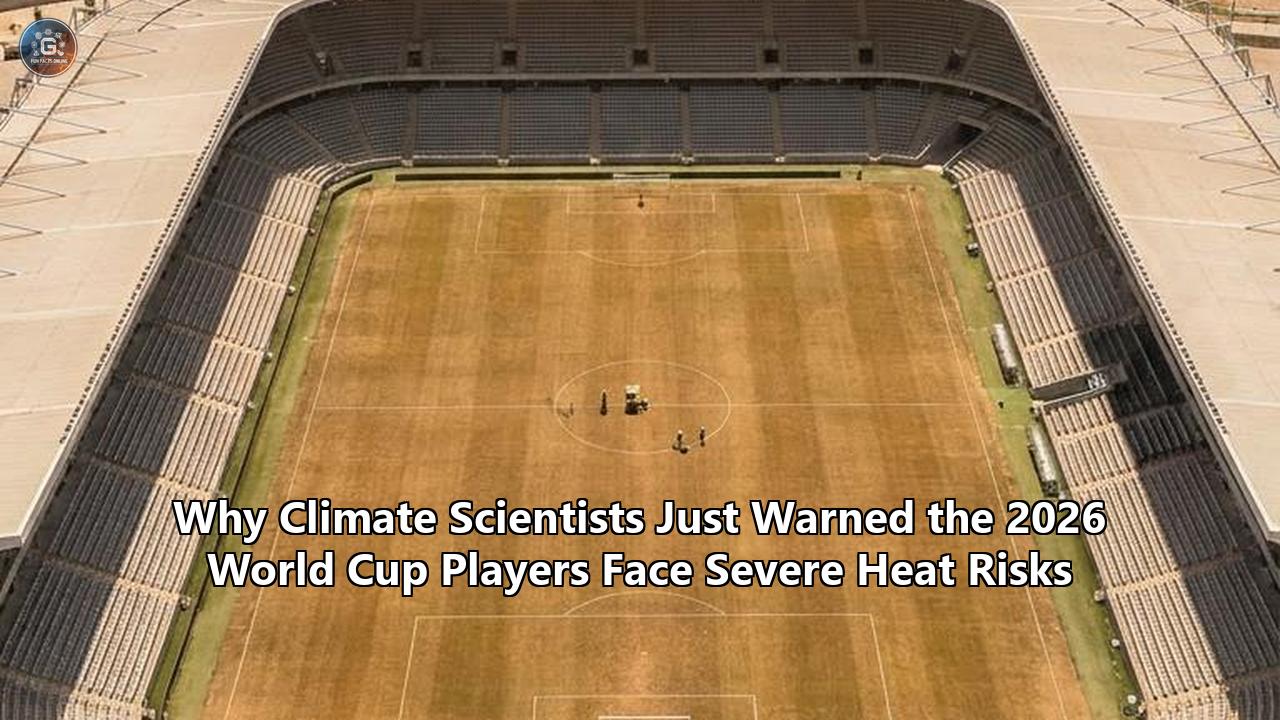
On June 11, 2026, the whistle blew at the Estadio Azteca in Mexico City, marking the kickoff of the first-ever 48-team FIFA World Cup. But as Mexico faced South Africa in the opening match, the most formidable opponent of the tournament was not on the team sheet. Instead, it loomed invisible in the heavy summer air: a compounding crisis of extreme heat, intensified by climate change, that has forced a profound confrontation between athletic performance, spectator safety, and the commercial architecture of global sports.
Just days before the opening match, researchers from the World Weather Attribution (WWA) group and Climate Central issued a stark series of scientific warnings. Their findings reveal that the 2026 World Cup is on track to be the hottest in human history, putting athletes and millions of traveling fans at unprecedented physical risk. According to the WWA analysis, nearly a quarter of the 104 scheduled matches across the United States, Canada, and Mexico are projected to be played in extreme heat conditions that violate safety thresholds established by player unions. Climate Central’s parallel modeling painted an even bleaker picture, projecting that 97 of the 104 matches will face temperatures that impair human athletic performance, slowing down the pace of play and fundamentally altering the tactical landscape of the tournament.
This looming athletic crisis is not merely a matter of comfort; it represents a physiological battleground. The warnings have triggered an intense debate among climate scientists, sports medicine experts, player unions, and FIFA executives. To understand how the tournament arrived at this juncture, it is necessary to examine the competing responses, technologies, and regulatory philosophies currently attempting to manage the 2026 World Cup heat risks. By comparing and contrasting these approaches, we can unpack the structural trade-offs of hosting mega-events on a warming planet.
The Physics of Extreme Heat: Dry-Bulb vs. Wet-Bulb Globe Temperature
To understand why climate scientists are sounding the alarm, one must first understand how heat danger is measured. Historically, sports organizers and the public have relied on standard thermometer readings—known as dry-bulb temperature—to assess whether it is too hot to play. However, climate scientists and sports physiologists are increasingly locked in a debate with traditional sports administrators over the use of more comprehensive metrics, most notably the Wet-Bulb Globe Temperature (WBGT).
The Standard Air Temperature Approach
The traditional approach to weather monitoring in sports relies on dry-bulb temperature, occasionally modified by a basic humidity index. The advantage of this approach is simplicity and familiarity. Fans and broadcasters easily grasp what a 35°C (95°F) afternoon means.
However, standard air temperature fails to account for how the human body actually cools itself. When an athlete runs, up to 75% of the energy produced by their muscles is released as heat. To prevent the core body temperature from rising to lethal levels, the brain triggers vasodilation—sending warm blood to the skin’s surface—and stimulates the sweat glands. The evaporation of this sweat into the surrounding air is the primary mechanism of heat dissipation for an active human.
The Wet-Bulb Globe Temperature (WBGT) Alternative
The WBGT is a composite index that integrates four distinct environmental variables:
- Air temperature (dry-bulb)
- Humidity (wet-bulb, which measures how easily moisture evaporates)
- Radiant heat (black globe, representing direct sunlight and heat radiating from surfaces like stadium turf)
- Wind speed (which assists in convective cooling)
                       [ HUMAN BODY COOLING EFFECTIVENESS ]
                                       │
                ┌──────────────────────┴──────────────────────┐
                ▼                                             ▼
     [ Standard Air Temperature ]                [ Wet-Bulb Globe Temp (WBGT) ]
     • Measures ambient air only                 • Integrates Air Temp + Humidity
     • Ignores humidity and wind                 • Accounts for solar radiation & wind
     • Poor predictor of heat strain             • Accurately measures physiological limit
The difference between these two metrics is a matter of life and death. In dry, breezy conditions, a dry-bulb temperature of 35°C (95°F) might result in a highly manageable WBGT of 22°C (71.6°F) because sweat evaporates rapidly, cooling the player. Conversely, in a humid coastal city like Miami or Houston, a seemingly mild dry-bulb temperature of 29°C (84.2°F) accompanied by 85% humidity and direct sunlight can push the WBGT past 28°C (82.4°F).
At this level, the air is so saturated with moisture that sweat cannot evaporate. The water simply pools on the player's skin, rendering their primary cooling mechanism useless. As a result, heat is trapped inside the body, driving core temperatures toward hyperthermia.
The WWA report, led by researchers such as Dr. Donal Mullan of Queen's University Belfast and Dr. Friederike Otto of Imperial College London, relies strictly on WBGT to map out the 2026 World Cup heat risks. They warn that while standard weather reports might suggest a match day is merely "warm," the high humidity in regions like the U.S. Gulf Coast and Mexico will create extreme, invisible physical strain.
Physiological Strain: How Heat Alters the Game and Endangers Lives
When elite athletes are subjected to high WBGT environments, their bodies undergo severe cardiovascular and metabolic shifts. The trade-offs between athletic performance and physiological survival become starkly apparent on the pitch.
Cardiovascular Drift and Performance Decline
As core temperature rises, the body is forced to split its blood supply between two competing, vital demands: delivering oxygen to the working skeletal muscles and delivering warm blood to the skin to facilitate cooling. This phenomenon, known as cardiovascular drift, results in a progressive decrease in stroke volume (the amount of blood the heart pumps per beat). To maintain cardiac output and oxygen delivery, the heart rate must spike dramatically.
For a footballer, this physiological redirection of resources has immediate, quantifiable impacts on performance:
- Reduced High-Intensity Sprinting: Studies compiled by Climate Central show that when ambient temperatures exceed 28°C (82.4°F), players reduce their high-intensity running and sprinting distances by up to 15% to 20% to self-regulate and prevent heat stroke.
- Tactical Deceleration: The quick-passing, high-pressing tactical styles favored by modern managers become impossible to sustain over 90 minutes. Teams are forced to adopt low-block defensive structures, slowing down the overall tempo of the game and reducing the number of goal-scoring opportunities.
- Cognitive and Technical Impairment: The brain is highly sensitive to elevated core temperatures. As hyperthermia sets in, players experience a decline in spatial awareness, decision-making speed, and pass accuracy. A player under extreme heat stress is far more likely to misjudge a tackle, miss a critical run, or commit a defensive blunder.
The Spectrum of Heat Illness
Beyond the degradation of the sporting spectacle lies a severe medical threat. When vasodilation and sweating fail to keep pace with metabolic heat production, an athlete progresses through the stages of heat illness:
- Heat Cramps: Painful, involuntary muscle spasms caused by large losses of water and sodium through sweat.
- Heat Exhaustion: Characterized by heavy sweating, rapid pulse, dizziness, nausea, headache, and cognitive fog. The core temperature typically rises up to 40°C (104°F).
- Heat Stroke: A catastrophic medical emergency occurring when the core temperature surpasses 40°C (104°F). At this point, the body's thermoregulatory system fails entirely. The brain, kidneys, liver, and skeletal muscle tissues begin to undergo thermal damage. If not treated with immediate, aggressive physical cooling, heat stroke can cause permanent organ failure or death.
[ STAGES OF HEAT ILLNESS IN ELITE ATHLETES ]

   Core Temp: Normal (~37°C / 98.6°F)
         │
         ▼
   [ Heat Cramps ] ────────► Sodium/water loss; localized spasms.
         │
         ▼
   [ Heat Exhaustion ] ────► Core Temp < 40°C (104°F); dizziness, rapid pulse, cognitive fog.
         │
         ▼
   [ Heat Stroke ] ────────► Core Temp > 40°C (104°F); thermoregulatory failure, organ damage.
                             *Requires immediate whole-body ice water immersion*
This danger is not theoretical. Public safety advocates point to the tragic case of Shane Thomas, a healthy 17-year-old soccer player who collapsed and died of hyperthermia during a practice session in California in August 2020 when temperatures reached 43.8°C (111°F). In response to such risks, a group of 20 global experts in health, climate, and sports performance issued an open letter to FIFA on the eve of the 2026 tournament, warning that failing to adapt to these escalating temperatures puts players at direct risk of severe heat-related injuries.
Microclimates and Metropolises: Analyzing Host City Disparities
The 2026 World Cup is unique in its vast geographic layout, spanning three nations and thousands of miles. This massive footprint creates highly diverse local microclimates, which scientists have analyzed to identify where the 2026 World Cup heat risks are concentrated.
┌──────────────────────────────────────────────────────────────────────────┐
│                     2026 WORLD CUP HOST CITY RISK PROFILE                │
├───────────────────┬──────────────────────────────┬───────────────────────┤
│ Risk Level        │ Primary Cities               │ Key Meteorological    │
│                   │                              │ Driver                │
├───────────────────┼──────────────────────────────┼───────────────────────┤
│ Critical Risk     │ Miami, Houston, Dallas,      │ High humidity paired  │
│                   │ Monterrey, Guadalajara       │ with intense solar    │
│                   │                              │ radiation             │
├───────────────────┼──────────────────────────────┼───────────────────────┤
│ Moderate-to-High  │ New York/New Jersey, Kansas  │ Extreme summer heat  │
│                   │ City, Atlanta, Mexico City   │ waves, urban heat     │
│                   │                              │ island effect         │
├───────────────────┼──────────────────────────────┼───────────────────────┤
│ Lower Risk        │ Vancouver, Seattle, Toronto  │ Temperate coastal air │
│                   │                              │ and northern latitudes│
└───────────────────┴──────────────────────────────┴───────────────────────┘
The Critical-Risk Zone: The Gulf and Inland South
The highest threat levels are concentrated in the southern and coastal regions of the United States and Mexico.
- Miami (Hard Rock Stadium): According to Climate Central’s analysis, Miami represents one of the most hazardous environments. Due to climate change, Miami now experiences roughly two additional weeks of extreme June and July heat compared to the 1970s. The combination of intense tropical sunlight and crushing humidity from the Atlantic Ocean means matches scheduled here will frequently push the WBGT to unsafe levels, even during late afternoon kickoffs.
- Houston (NRG Stadium) & Dallas (AT&T Stadium): Both Texas venues are located in regions that experience routine summer days exceeding 38°C (100°F). However, their risk profile is uniquely managed by stadium architecture (enclosed domes), which contrasts sharply with the open-air venues around them.
- Monterrey & Guadalajara: These Mexican host cities face a dual threat of high dry-bulb temperatures and moderate-to-high humidity. The WWA study identified the June 26 match in Guadalajara between Uruguay and Spain as having a 70% chance of performance-impairing heat—a probability that climate change boosted by 37 percentage points.
The Moderate-to-High Zone: Mid-Latitude Heatwaves
Cities in the Midwest and Northeast United States are often assumed to be safer, yet climate change has made them highly vulnerable to sudden, intense summer heatwaves.
- Kansas City (Arrowhead Stadium): Positioned in the American heartland, Kansas City is prone to stagnant high-pressure systems in July that trap hot, humid air from the Gulf of Mexico. The WWA highlights matches here, such as a late-afternoon fixture between the Netherlands and Tunisia, as carrying a high risk of exceeding the dangerous 28°C (82.4°F) WBGT limit.
- New York/New Jersey (MetLife Stadium): Scheduled to host the tournament final on July 19, this region suffers heavily from the urban heat island effect, where asphalt and concrete retain heat overnight. The Imperial College London team calculated a 12.5% chance that the final match will exceed the 26°C (79°F) WBGT mark, and a 3% chance it will reach a highly dangerous 28°C (83°F) WBGT.
The Lower-Risk Zone: The Pacific Northwest and Canada
Conversely, coastal and northern venues offer a cooler refuge.
- Vancouver (BC Place) & Seattle (Lumen Field): Warmed by the Pacific but tempered by cool marine breezes, these cities present significantly lower WBGT risks. However, scientists caution that these regions are increasingly vulnerable to secondary climate threats, such as wildfire smoke from nearby forests, which can severely compromise respiratory health in athletes.
- Toronto (BMO Field): While southern Ontario can experience humid summer days, its northern latitude generally protects it from the sustained, oppressive heat dome conditions seen in the American South.
Engineering vs. Behavioral Mitigation: The Stadium Battleground
The stark difference in local climates across North America has forced organizers to implement completely different mitigation models. We can categorize these into two competing approaches: structural engineering solutions (highly expensive, technological, and localized) and behavioral adaptation models (lower-cost, operational, and flexible).
 ┌────────────────────────────────────────────────────────────────────────┐
 │           MITIGATION COMPARISON: ENGINEERING VS. BEHAVIORAL            │
 ├─────────────────────────┬──────────────────────────────────────────────┤
 │ Parameter               │ Structural Engineering (e.g., Dallas)        │
 ├─────────────────────────┼──────────────────────────────────────────────┤
 │ Mechanism               │ Closed-roof, mechanical HVAC cooling         │
 ├─────────────────────────┼──────────────────────────────────────────────┤
 │ Player/Fan Safety       │ Near-absolute control over WBGT inside       │
 ├─────────────────────────┼──────────────────────────────────────────────┤
 │ Carbon Footprint        │ Massive electrical demand, high emissions    │
 ├─────────────────────────┼──────────────────────────────────────────────┤
 │ Financial Cost          │ Extremely high (hundreds of millions USD)    │
 ├─────────────────────────┼──────────────────────────────────────────────┤
 │ Parameter               │ Behavioral Adaptation (e.g., Miami)          │
 ├─────────────────────────┼──────────────────────────────────────────────┤
 │ Mechanism               │ Hydration breaks, evening kickoffs, misting  │
 ├─────────────────────────┼──────────────────────────────────────────────┤
 │ Player/Fan Safety       │ Partial; highly vulnerable to heatwaves      │
 ├─────────────────────────┼──────────────────────────────────────────────┤
 │ Carbon Footprint        │ Minimal direct emissions from mitigation     │
 ├─────────────────────────┼──────────────────────────────────────────────┤
 │ Financial Cost          │ Low operational and scheduling adjustments   │
 └─────────────────────────┴──────────────────────────────────────────────┘
1. The Structural Engineering Model: Domed, Air-Conditioned Stadiums
The most high-tech response to the 2026 World Cup heat risks is the use of fully enclosed, climate-controlled stadiums.
- AT&T Stadium (Dallas) and NRG Stadium (Houston): These venues feature retractable or permanent roofs and multi-megawatt industrial heating, ventilation, and air conditioning (HVAC) systems. When the roof is closed, these systems can lower the field-level temperature to a stable 21°C to 23°C (70°F to 74°F) and drop the relative humidity to comfortable levels, completely neutralizing the external WBGT threat.
- The Trade-offs: While this approach provides near-perfect protection for players and spectators on-site, it suffers from severe systemic drawbacks. The energy required to cool a massive dome containing over 70,000 spectators on a 40°C day is astronomical, contributing heavily to the tournament’s carbon footprint. Furthermore, maintaining natural grass pitches—which FIFA mandates for all matches—inside closed, air-conditioned environments is a structural nightmare. Grass requires natural sunlight and specific humidity levels to thrive; without it, the turf becomes loose, slippery, and prone to tearing, which dramatically increases the risk of player joint injuries.
2. The Behavioral and Operational Model: Open-Air Venues
For the 11 out of 16 stadiums that are open-air and lack integrated mechanical cooling (such as Miami, Kansas City, and New Jersey), organizers must rely on behavioral and operational interventions.
- Scheduling Shifts: The primary strategy is to schedule matches in high-risk cities exclusively during late afternoon or evening hours to avoid peak solar radiation.
- Misting Tents and Cooling Stations: Stadium concourses are outfitted with high-pressure misting systems, fan zones are shaded, and additional medical staff are deployed to treat heat stroke among spectators.
- On-Field Hydration Breaks: Referees are instructed to enforce mandatory cooling breaks.
- The Trade-offs: This approach is far more environmentally sustainable and financially accessible, but it leaves athletes and fans fundamentally exposed to the whims of extreme weather. An unexpected July heatwave or high-humidity stagnant air mass can overwhelm these localized cooling stations, leading to medical emergencies on the field and in the stands.
Player Safety vs. Commercial Real Estate: FIFA’s Regulatory Gaps
Perhaps the most contentious debate surrounding the 2026 World Cup heat risks is the philosophical and regulatory divide between FIFPRO (the global representative body for professional football players) and FIFA (the sport’s governing body). The two organizations operate under fundamentally different hazard thresholds, illustrating the tension between player welfare and commercial logistics.
  [ REGULATORY WBGT THRESHOLDS & RESPONSES ]

  FIFPRO (Player Union) Guidelines:
  ==============================================================
  26°C (79°F) WBGT ───► Mandatory cooling breaks
  28°C (82°F) WBGT ───► Postponement / Suspension advised

  FIFA (Governing Body) Guidelines:
  ==============================================================
  32°C (90°F) WBGT ───► Postponement considered
The FIFPRO Athlete-Centric Safety Mandates
FIFPRO’s recommendations are grounded in sports medicine literature and occupational safety standards.
- The 26°C WBGT Threshold: FIFPRO advises that once the WBGT hits 26°C (79°F), cooling breaks of at least three to six minutes must be mandatory during each half to allow players' core temperatures to drop and to facilitate hydration.
- The 28°C WBGT Threshold: FIFPRO argues that any match where the WBGT reaches or exceeds 28°C (82°F) is fundamentally unsafe for elite athletic exertion and should be postponed or rescheduled to a cooler time slot or venue. Their position is that exposing players to high-intensity cardiovascular work above this level is an unacceptable medical hazard that risks heat stroke, organ damage, and long-term health complications.
The FIFA Commercial-Logistical Policy
In contrast, FIFA’s official guidelines are far more conservative regarding match disruptions.
- The 32°C WBGT Threshold: FIFA’s regulations state that match postponement should only be considered when the WBGT reaches an extreme 32°C (90°F).
- The Logistical and Commercial Reality: To understand why FIFA maintains such a high threshold, one must look at the immense financial complexity of the tournament. The World Cup is a multi-billion-dollar apparatus driven by rigid television broadcasting schedules, pre-booked corporate sponsorships, and global travel logistics for millions of fans. Postponing a single match cascades throughout the tournament: it disrupts television slots in lucrative European and Asian markets, forces stadium staff to work unplanned shifts, creates scheduling conflicts for subsequent rounds, and forces teams to alter their recovery and travel timelines.
- The Compromise: For the 2026 tournament, FIFA has ordered referees to enforce a three-minute hydration break halfway through each half. However, sports scientists like Dr. Douglas Casa of the Korey Stringer Institute argue that three minutes is clinically insufficient under extreme humidity. He and other experts have pushed for six-minute breaks and active cooling strategies (such as iced towels and misting fans on the sidelines), warning that FIFA's reluctance to lower their postponement threshold below 32°C WBGT is a dangerous gamble.
Active Tech vs. Passive Adjustments: The Toolkit for Survival
Because matches must go on, team medical departments and stadium operators are employing a mixture of active, high-tech interventions and passive, low-tech adjustments to shield players from severe heat.
High-Tech Active Interventions
Rather than relying solely on water and shade, modern sports science has introduced advanced physical and physiological interventions:
1. Ingestible Core Temperature Sensors (Telemetric Pills)
- The Technology: Several national teams are utilizing silicon-coated pill transmitters that players swallow several hours before a match. These pills transit through the gastrointestinal tract, continuously transmitting real-time core temperature data via radio frequency to a receiver held by the medical staff on the sideline.
- The Application: If a player’s core temperature is seen spiking past a critical threshold (e.g., 39.5°C or 103.1°F), the medical team can immediately notify the coach to substitute the player before clinical heat exhaustion or heat stroke occurs.
- The Trade-off: The technology is highly expensive and requires strict medical supervision. Additionally, some players and coaching staff resist its use, citing privacy concerns regarding personal biometric data or fear that coaches will use the data to make tactical substitutions unrelated to safety.
2. Pre-Cooling and Mid-Cooling Protocols
- Ice-Slurry Ingestion: Players are instructed to drink crushed ice slurries immediately prior to warmup and during halftime. Ingesting ice-slurries absorbs internal thermal energy far more rapidly than drinking chilled water, helping to delay the rise of core body temperature.
- Phase-Change Cooling Vests: While on the bench or during warmups, players wear specialized vests lined with phase-change materials (PCM) that maintain a constant, cold temperature (typically around 15°C or 59°F) without freezing the skin or causing shivering, which would counterproductively generate metabolic heat.
- Emergency Whole-Body Ice Baths: Under updated medical directives for the 2026 tournament, every stadium must have cold-water immersion tubs filled with ice water immediately adjacent to the pitch. If a player collapses from heat stroke, medical staff are trained to cool the athlete first on-site before transferring them to a hospital, a protocol known as "cool first, transport second" that has a 100% survival rate for exertional heat stroke when initiated within ten minutes.
                  [ ADVANCED ATHLETE COOLING PROTOCOLS ]
                                    │
       ┌────────────────────────────┼────────────────────────────┐
       ▼                            ▼                            ▼
 [ Ingestible Pills ]       [ Ice-Slurry Drinks ]       [ Emergency Ice Baths ]
 Real-time transmission      Rapid internal thermal      Immediate whole-body
 of core temperature to      energy absorption to        immersion to treat
 sideline medical staff.     delay hyperthermia.         exertional heat stroke.
Low-Tech Passive Interventions
While high-tech tools are effective, they cannot scale to protect every player, referee, and pitch worker. Thus, basic operational changes remain highly critical:
- Extending Halftime: Some experts have proposed extending the halftime interval from 15 minutes to 20 minutes in high-hazard environments to allow players to undergo active cooling in air-conditioned dressing rooms.
- Enforcing Double-Subs: Expanding the maximum number of substitutions from five to six in matches exceeding 28°C WBGT to reduce the cumulative physical load on individual players.
- Aggressive Pitch Shading: Utilizing temporary, lightweight overhead tension membranes to shade the playing surface during midday hours, reducing the radiant heat absorbed by the turf and soil before kickoff.
The Carbon Paradox: Mitigating Heat While Fueling Global Warming
The most striking aspect of the 2026 World Cup heat risks is what climate scientists refer to as the "carbon feedback loop" of the event. The very methods being used to adapt to and mitigate the extreme heat of the tournament are actively contributing to the long-term emissions driving global warming.
                     [ THE WORLD CUP CARBON FEEDBACK LOOP ]

                      ┌────────────────────────────────┐
                      │    9 Million Tons of CO2e      │
                      │    Emitted by 2026 World Cup   │
                      └───────────────┬────────────────┘
                                      ▼
                      ┌────────────────────────────────┐
                      │   Accelerated Global Warming   │
                      │   & More Intense Heatwaves     │
                      └───────────────┬────────────────┘
                                      ▼
                      ┌────────────────────────────────┐
                      │  Dangerous On-Pitch Conditions │
                      │  (Violates Safety Limits)      │
                      └───────────────┬────────────────┘
                                      ▼
                      ┌────────────────────────────────┐
                      │ Energy-Intensive Adaptation    │
                      │ (Massive Stadium HVAC Cooling) │
                      └────────────────┬───────────────┘
                                       │
                                       └────────────────────────────────────────┘
The Scale of the Emissions
Independent studies conducted by Scientists for Global Responsibility, the Environmental Defense Fund (EDF), and the sports initiative Cool Down estimate that the 2026 World Cup will be the most polluting in history. The tournament is projected to emit over 9 million metric tons of carbon dioxide equivalent ($CO_2e$)—roughly double the historical average of the last four World Cups combined, and five times the total footprint of the 2024 Paris Olympic Games.
The primary drivers of this massive footprint include:
- The 48-Team Expansion: Increasing the tournament roster from 32 to 48 teams has expanded the total number of matches from 64 to 104, resulting in a dramatic increase in stadium operations, fan attendance, hotel usage, and waste generation.
- Continental-Scale Air Travel: Because the tournament is spread across the entirety of North America—from Vancouver to Miami, and Toronto to Mexico City—teams, media, and fans are forced to rely heavily on commercial aviation. Aviation alone is estimated to account for at least 7.7 million tons of the tournament's emissions. Some teams must travel staggering distances; for example, if the Algerian team advances through the group stage, they could travel upwards of 4,800 kilometers between matches in Kansas City and San Francisco.
The Adaptation-Mitigation Conflict
To protect players and fans from the immediate dangers of this extreme heat, stadium operators are running massive, energy-intensive HVAC systems.
- The Irony: The electricity required to cool these giant indoor structures is frequently generated by burning fossil fuels, particularly in regions like Texas where coal and natural gas remain major components of the grid.
- The Result: The very actions taken to survive the immediate, local heat waves are pumping more greenhouse gases into the atmosphere, locking in even more severe heatwaves for future sporting events. This creates a highly unsustainable cycle where sport must emit more carbon to protect itself from the carbon it has already emitted.
The Horizon of Athletic Adaptation: Reimagining Global Mega-Events
As the 2026 World Cup progresses, it is serving as a live experiment for the future of global sports in the Anthropocene. The severe heat risks experienced during this tournament are forcing a fundamental reassessment of how, when, and where major sporting events can be hosted.
Several alternative pathways are being debated by sports administrators, urban planners, and climate scientists:
1. The Death of the Summer World Cup in the Northern Hemisphere
The most immediate conclusion drawn by climate researchers like Dr. Friederike Otto is that hosting summer World Cups in the Northern Hemisphere is becoming biologically and logistically unviable.
- The Winter Shift: Future tournaments may have to mimic the model of the 2022 World Cup in Qatar, where the entire tournament was shifted to November and December to take advantage of cooler winter temperatures.
- The Trade-offs: Shifting the World Cup to winter severely disrupts the domestic schedules of major European, South American, and Asian professional leagues. Leagues like the English Premier League, La Liga, and Serie A must pause their seasons for two months, compressing their schedules, increasing player fatigue, and causing major conflicts with television broadcasters who hold rights for winter sports.
2. Decentralized Regional Hubs vs. Massive Geographies
To combat the massive carbon footprint of air travel—which indirectly drives the heat stress—future tournaments may have to abandon the massive, multi-national geographic model.
- The Regional Hub Model: Instead of playing matches across an entire continent, future bids may be restricted to highly compact geographic clusters. For example, a "Pacific Northwest" World Cup could be hosted entirely within Seattle, Vancouver, and Portland, utilizing high-speed rail rather than aviation to transport teams and fans.
- The Trade-offs: Compact tournaments limit the democratization of the event, preventing smaller nations or widely separated cities from sharing in the economic and cultural prestige of hosting. It also concentrates the immense logistical burden of housing, security, and transport on a single metropolitan region.
3. Adapting Urban Infrastructure Beyond the Stadium
Finally, scientists point out that the 2026 World Cup heat risks are not confined within the stadium walls. The hundreds of thousands of fans gathering in uncooled fan zones, street watch parties, and public transport hubs are at an even higher risk of heat stroke, particularly older individuals and those with pre-existing cardiovascular conditions.
- Urban Heat Integration: Host cities are being forced to adapt their municipal infrastructure by creating permanent "cool corridors" featuring high-canopy urban forestry, reflective cool pavements, and accessible public water-hydration networks. These physical upgrades protect fans during the tournament and leave a lasting climate-resilient legacy for local residents long after the final whistle.
As the world watches the drama unfold on the pitches of North America, the true legacy of the 2026 World Cup may not be the goals scored or the trophies raised. Instead, it may be remembered as the moment when the physical realities of a warming planet finally breached the boundaries of the world’s most popular sport, forcing humanity to choose between the preservation of its traditional sporting spectacles and the biological limits of the human body.
Reference:
- https://coveringclimatenow.org/from-us-story/the-hottest-world-cup-in-history/
- https://www.forbes.com/sites/we-dont-have-time/2026/06/11/fifa-world-cup-climate-is-the-loserhighest-impact-ever/
- https://mg.co.za/the-green-guardian/2026-06-11-climate-change-increases-risk-of-extreme-heat-at-nearly-all-2026-world-cup-matches-studies-find/
- https://capitalbnews.org/world-cup-2026-heat-risk-fifa/
- https://www.smartcitiesdive.com/news/world-cup-reveals-cities-growing-heat-risk-nature-conservancy/822364/
- https://www.brusselstimes.com/2131612/scientists-warn-2026-fifa-world-cup-could-be-hit-by-dangerous-heat-levels
- https://www.prnewswire.com/news-releases/climate-change-is-increasing-the-risk-of-slower-games-and-reduced-player-performance-at-nearly-every-2026-world-cup-match-302789927.html
- https://www.motherjones.com/politics/2026/06/2026-world-cup-players-extreme-heat-effects-body-athletes-fifa-postponments-policy/
- https://www.theweathernetwork.com/en/news/climate/causes/historic-world-cup-may-also-come-with-historic-emissions-experts-warn
- https://www.japantimes.co.jp/environment/2026/06/11/climate-change/world-cup-heat-risks/