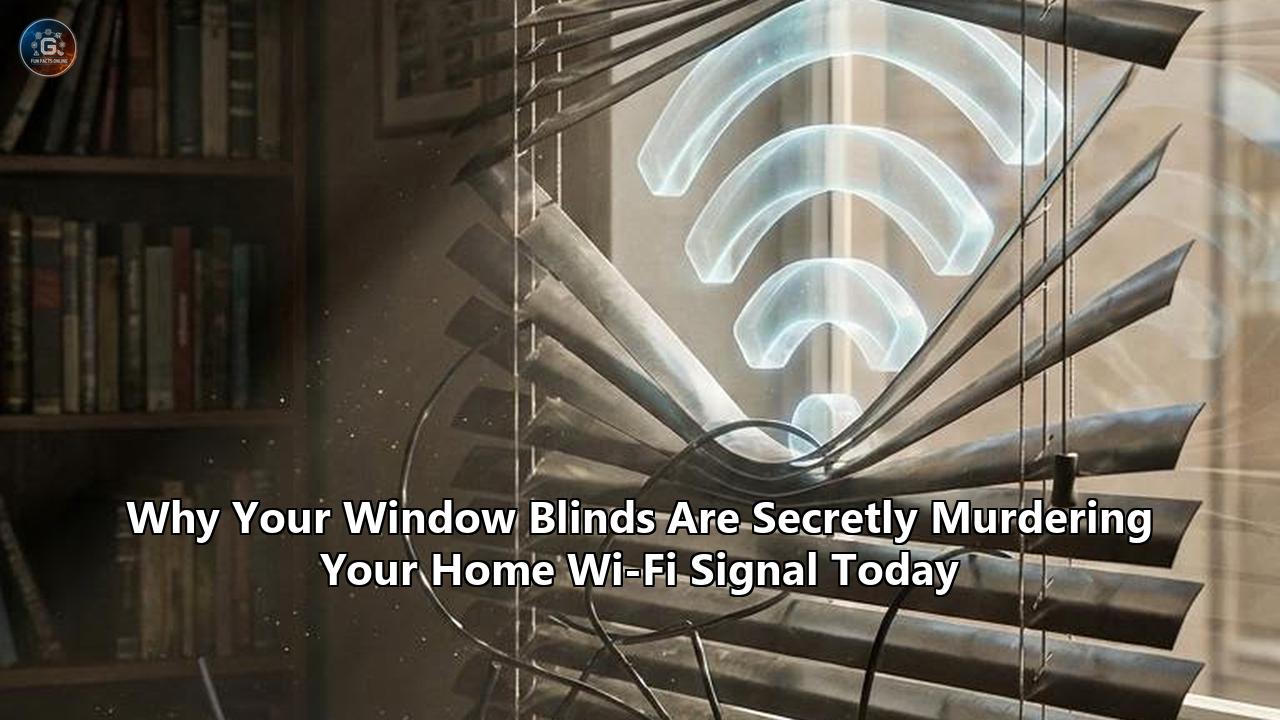
The May 2026 rollout of Wi-Fi 7 (802.11be) was supposed to represent the final victory over residential network latency. With 320 MHz-wide channels, 4K-QAM modulation, and theoretical throughputs exceeding 40 Gbps, internet service providers and networking vendors aggressively pushed gigabit fiber and multi-node mesh systems into the mainstream. Yet, over the last few months, a highly specific and costly pattern of network degradation has emerged in modern homes, luxury condos, and newly constructed residential developments. Technicians dispatching to diagnose severe packet loss and jitter are consistently tracing the failure point not to outdated modems or congested fiber trunks, but directly to the windows.
The motorized, thermal-backed, and precision-engineered aluminum window treatments lining modern residential spaces are quietly executing a multi-layered assault on high-frequency wireless communications. This is not a generalized issue of "interference." It is a precise intersection of radio frequency physics, material science, and the unintended consequences of smart home electrical engineering. The window blinds installed in millions of homes act as perfectly tuned frequency-selective surfaces, aggressive broadband electromagnetic noise emitters, and network-congesting protocol adversaries.
Understanding why this is happening requires looking past the router and analyzing the physical environment through the lens of an RF engineer.
The Mathematics of Interference: Why 6 GHz is Uniquely Vulnerable
The fundamental architecture of Wi-Fi 7 relies heavily on the 6 GHz spectrum, a massive swath of newly available frequencies that promises zero interference from legacy devices. However, the laws of physics dictate a strict, inverse relationship between frequency and wavelength. As frequency increases, the physical length of the radio wave decreases, changing how the energy interacts with physical obstacles.
To understand the scope of the problem, one must calculate the exact geometry of the wireless signal. The speed of light is roughly 300 million meters per second. Operating at a frequency of 6 GHz (6 billion cycles per second), the resulting wavelength is exactly 5 centimeters, or approximately 1.96 inches.
This dimension is not arbitrary. It perfectly matches the most common architectural standard in the window treatment industry: the 2-inch Venetian blind.
When a homeowner installs metal mini-blinds with 2-inch slats, they are not just blocking sunlight; they are accidentally constructing an optical diffraction grating perfectly scaled to the wavelength of 6 GHz Wi-Fi. In physics, when an electromagnetic wave encounters a conductive grid where the spacing between the elements is equal to or slightly less than the wavelength of the signal, the structure ceases to act as a barrier with gaps. Instead, it becomes a continuous Faraday shield, or a waveguide operating beyond its cutoff frequency. The wave cannot pass through the gaps because the physical space is too small to support the oscillation of the electric and magnetic fields.
Wire-Grid Polarization and the Faraday Effect
The geometry of the slats adds an additional layer of signal destruction through polarization. Standard Wi-Fi antennas generate a localized electromagnetic field that travels outward. If the transmitting antenna is vertically oriented, it creates a vertically polarized wave.
Window blinds are constructed as horizontal conductive strips. According to the principles of electromagnetism, when an electric field encounters a conductive object aligned with its polarization, the free electrons in the metal oscillate, absorbing the wave's energy and re-radiating it in a scattered pattern. Because the slats of a blind are horizontal, they act as a wire-grid polarizer.
If a mobile device (like a smartphone held sideways to stream a 4K video, or a laptop with its antennas routed horizontally through the display hinge) transmits a horizontally polarized 6 GHz signal toward a window, the horizontal metal slats of the blinds absorb the energy completely. The electrons in the aluminum oscillate along the length of the slat, inducing a current that generates an opposing magnetic field. This secondary field destructively interferes with the incoming Wi-Fi signal, cancelling it out entirely.
The result is a phenomenon networking professionals refer to as a "WiFi shadow." Devices situated near these windows, or on patios and balconies just outside them, experience total signal collapse. The 6 GHz band, which lacks the wall-penetrating power of legacy 2.4 GHz signals, is completely suffocated by the physical structure of the blinds.
Behind the Fabric: Low-Emissivity Coatings and Sputtered Silver
The problem extends far beyond traditional aluminum hardware. The architectural shift toward aggressive energy efficiency standards, such as LEED certification, has forced the development of highly advanced thermal window fabrics. Modern cellular shades, blackout roller blinds, and solar screens are heavily engineered to prevent solar heat gain in the summer and thermal loss in the winter.
Heat, primarily in the form of infrared radiation, is an electromagnetic wave with a wavelength ranging from 1 to 10 micrometers. To block infrared energy, manufacturers utilize a process called physical vapor deposition (PVD) to coat the synthetic fabrics of the blinds with microscopic layers of titanium dioxide (TiO2) or pure silver (Ag).
Radio frequency signals (Wi-Fi) and infrared radiation exist on the same electromagnetic spectrum. The physical properties that make a material highly reflective to thermal radiation—specifically, high electrical conductivity and a specific dielectric constant—make it equally reflective to microwave frequencies.
When a Wi-Fi signal hits a Low-E (low emissivity) fabric shade, it does not see a piece of cloth. It sees a solid wall of conductive metal. The silver vapor deposition reflects the 5 GHz and 6 GHz RF energy back into the room, creating intense multipath interference. The original signal bounces off the blind and collides with the secondary signals reflecting off the walls, leading to phase cancellation. For the receiver, the data stream becomes an unintelligible blur of overlapping waves, triggering massive packet retransmissions and crippling network throughput.
The Silent Saboteurs: EMI and the Physics of Motorized Shades
While the physical structure of the blinds destroys the wireless signal externally, the internal components of automated smart shades are actively attacking the network from within.
Modern motorized window treatments utilize compact brushed or brushless DC motors hidden inside the tubular housing of the roller. To give homeowners smooth, silent operation—allowing the blinds to open slowly at dawn without a harsh mechanical jerk—these motors rely on Pulse Width Modulation (PWM) driven by highly integrated motor control chips, such as the Texas Instruments DRV8873 or DRV8701.
PWM controls the speed of the motor not by lowering the voltage, but by rapidly switching the full voltage on and off thousands of times per second. This creates a square wave. According to Fourier analysis, a perfect square wave is not a single frequency; it is composed of a fundamental frequency combined with an infinite series of odd harmonics that stretch high into the radio frequency spectrum.
The Slew Rate Dilemma in Brushed-DC Motors
When the metal-oxide semiconductor field-effect transistors (MOSFETs) inside the motor driver switch on and off, the transition time is known as the slew rate. If the slew rate is incredibly fast, the motor is highly efficient and generates very little heat. However, a rapid switching edge generates severe electromagnetic interference (EMI), effectively turning the unshielded power cables of the motor into broadband transmitting antennas.
Because these motors are tightly encased in narrow tubes with poor thermal dissipation, hardware engineers often configure the motor drivers with the fastest possible slew rates to prevent the chips from melting down. They sacrifice electromagnetic shielding to maintain a cool operating temperature.
Consequently, every time the smart blinds activate to adjust to the sunlight, the PWM controllers blast broadband electrical noise across the room. This localized EMI spikes the baseline noise floor of the environment, directly attacking the most advanced feature of Wi-Fi 7: Quadrature Amplitude Modulation.
4K-QAM vs. The Noise Floor
Wi-Fi 7 utilizes 4096-QAM (4K-QAM), a modulation technique that packs 12 bits of data into every single signal symbol by adjusting both the amplitude and the phase of the radio wave. To visualize 4096-QAM, imagine a grid of 64 columns and 64 rows. Each of the 4,096 intersection points represents a unique string of binary data.
For a receiving device to correctly identify which of the 4,096 points the router transmitted, the signal must be surgically precise. The Error Vector Magnitude (EVM)—the acceptable margin of error in decoding the signal—is microscopically small.
When a motorized blind operates and emits EMI, the noise floor in the room elevates. This electrical noise physically shifts the received radio wave slightly out of phase or alters its amplitude. The receiver mistakenly interprets the symbol as landing in the wrong quadrant of the QAM grid. A data error occurs, a Cyclic Redundancy Check (CRC) fails, and the packet is dropped.
Detecting the elevated noise floor, the Wi-Fi 7 router immediately initiates dynamic rate adaptation. It abandons the high-speed 4K-QAM and downshifts to 1024-QAM, 256-QAM, or even lower, attempting to find a modulation scheme robust enough to survive the motor's interference. In a matter of milliseconds, a multi-gigabit network connection is throttled down to a crawl, purely because the living room blinds are rolling up.
The Protocol Bloodbath: 2.4 GHz and the CSMA/CA Traffic Jam
Even when the motors are completely stationary, smart blinds remain one of the most hostile devices on a home network. The push for interconnected, automated homes has led manufacturers to adopt low-power wireless protocols like Zigbee, Bluetooth Low Energy (BLE), and the newer Matter-over-Thread standard. All three of these protocols operate in the universally congested 2.4 GHz Industrial, Scientific, and Medical (ISM) radio band.
The IEEE 802.15.4 standard, which forms the physical layer for Zigbee and Thread, utilizes 16 distinct channels within the 2.4 GHz spectrum. Wi-Fi operates in the exact same spectrum using much wider channels. A single 20 MHz Wi-Fi channel completely engulfs four Zigbee channels.
In a modern smart home equipped with 15 to 20 motorized shades, the blinds form an intricate mesh network. They are constantly communicating—reporting battery percentages, updating routing tables, and synchronizing their absolute positions via sensorless ripple counting to ensure perfectly aligned movement. This creates an uninterrupted stream of low-bandwidth, high-frequency network chatter.
Wi-Fi is a polite protocol. It utilizes a collision avoidance mechanism known as Carrier-Sense Multiple Access with Collision Avoidance (CSMA/CA). Before a Wi-Fi 7 router transmits a frame of data, it listens to the airwaves. If it detects energy on the channel above a specific Clear Channel Assessment (CCA) threshold, it assumes another device is talking. The router initiates a random backoff timer and waits.
When a dozen smart blinds are constantly whispering over the Thread protocol, the Wi-Fi router is forced into a state of perpetual hesitation. The physical airtime is consumed by the window treatments, forcing high-priority traffic—like VoIP calls and competitive gaming data—to wait in a buffer. The end-user does not experience a loss of signal bars on their device; they experience maddening latency and micro-stutters, completely unaware that their router is yielding the right-of-way to the window hardware.
Multi-Link Operation (MLO) to the Rescue?
To combat this exact scenario, the architects of Wi-Fi 7 introduced Multi-Link Operation (MLO), arguably the most significant advancement in the 802.11be standard. Previous generations of Wi-Fi forced a client device to choose a single band: 2.4 GHz, 5 GHz, or 6 GHz. MLO allows a device to establish simultaneous connections across all available bands.
In a theoretical vacuum, MLO solves the smart blind interference problem perfectly. If the 2.4 GHz band is choked by Zigbee chatter and motor EMI, the MLO-equipped router dynamically routes the data packets over the pristine 6 GHz link in real-time, completely bypassing the congestion. Recent hardware demonstrations at CES 2026 highlighted next-generation IoT silicon, such as the Infineon ACW741x, successfully utilizing MLO to seamlessly switch active channels in under 503 microseconds when extreme 2.4 GHz interference was introduced.
However, the physical layout of the home often breaks this failsafe. While MLO attempts to shift traffic to the 6 GHz band to avoid the motor's 2.4 GHz protocol chatter, the physical aluminum slats and Low-E fabrics of the blind are actively blocking the 6 GHz radio waves due to their shorter wavelengths. The router's logic controller is trapped in an impossible loop: the 2.4 GHz band is unusable due to RF noise and protocol congestion, and the 6 GHz band is entirely blocked by Faraday attenuation.
Intentional Shielding: What Consumers Accidentally Inherited from Corporate Espionage
The severity of this signal degradation is not a mystery to the commercial sector. In fact, the very physical properties that are accidentally destroying residential Wi-Fi networks have been intentionally engineered for decades to protect corporate data.
In enterprise environments, government facilities, and defense installations, containing wireless signals within the perimeter of a building is a critical security mandate. If a Wi-Fi signal bleeds through a glass window, an attacker sitting in a parked car across the street can passively capture the encrypted handshake packets, eventually cracking the network via offline brute-force attacks.
To combat this, security agencies mandate the use of Sensitive Compartmented Information Facility (SCIF) standards. Windows in these facilities are treated with specialized Frequency Selective Surfaces (FSS). Commercial products like DAS Shield deploy metallic window films specifically formulated to attenuate RF signals between 700 MHz and 6 GHz by more than 24 decibels, trapping the Wi-Fi footprint securely inside the room.
A 2023 engineering study published in IEEE detailed the precise fabrication of "Frequency Selective Window Blinds for Indoor WLAN Shielding." Researchers designed dual-concentric modified square loops embedded directly into window blind materials. The geometry of the loops was mathematically tuned to resonate exactly at 2.4 GHz and 5 GHz. When installed, these engineered blinds provided an astonishing -45 dB of signal suppression, effectively erasing the wireless network from the outside world while maintaining visual transparency.
Without realizing it, consumer manufacturing has converged with military-grade signal suppression. By scaling down slat widths to 2 inches for aesthetic appeal, and utilizing dense silver vapor layers for thermal efficiency, residential window blind companies are mass-producing passive electromagnetic shielding. Homeowners are paying premium prices to install commercial-grade RF jammers in their living rooms, systematically dismantling their own highly expensive Wi-Fi 7 networks.
Engineering the Solution: How to Actually Improve Home Wi-Fi Signal
Overcoming the architectural hostility of modern window treatments requires abandoning generic network advice and adopting precise, engineering-driven mitigation strategies. Slapping a cheap range extender into a wall outlet will not solve a physics problem. To genuinely improve home wifi signal in environments heavily saturated with automated, metallic, or thermally treated blinds, the network topology must be designed around the obstructions.
Sub-Gigahertz Protocols: The Z-Wave Imperative
The most immediate and impactful change a homeowner or integrator can make is shifting the automated blinds off the 2.4 GHz spectrum entirely. While Matter and Thread have dominated consumer marketing, professional installers consistently rely on the Z-Wave protocol for critical infrastructure.
In North America, Z-Wave operates in the 908.42 MHz ISM band. Moving below the 1 GHz threshold drastically changes the physics of the deployment. The wavelength of a 908 MHz signal is roughly 33 centimeters (13 inches). This wave is far too large to be trapped or diffracted by a 2-inch aluminum slat, allowing it to penetrate metal blinds, Low-E glass, and concrete structures with up to 50% better efficiency than 2.4 GHz protocols.
More importantly, shifting the blinds to Z-Wave immediately evacuates the 2.4 GHz band. The endless stream of mesh routing updates, battery polling, and positional telemetry no longer triggers the CSMA/CA backoff timers on the Wi-Fi router. The network noise floor drops, freeing up massive amounts of airtime for legacy mobile devices and IoT hardware that cannot migrate to higher frequencies.
Leveraging Preamble Puncturing
For users locked into the Wi-Fi 7 ecosystem, mitigating motor EMI requires enabling and optimizing Preamble Puncturing, a highly sophisticated spectral management tool built into the 802.11be standard.
Historically, if a Wi-Fi router was operating on a wide 160 MHz channel and encountered narrow-band interference (such as the harmonic spike from a smart blind motor's PWM driver), the router was forced to abandon the entire wide channel and drop down to a narrow, congestion-free 20 MHz or 40 MHz slice. It was the equivalent of closing an entire eight-lane highway because one car broke down in a single lane.
Preamble Puncturing changes this paradigm. When the smart blind activates and its unshielded motor blasts EMI across a specific 20 MHz segment of the spectrum, the Wi-Fi 7 router uses Preamble Puncturing to dynamically slice out that exact piece of contaminated bandwidth. The router transmits the data around the interference, keeping the remaining 140 MHz of the channel perfectly intact. Ensuring this feature is enabled in the router's administrative console is critical for maintaining gigabit throughput during the morning and evening hours when automated shades are actively moving.
Strategic AP Placement and RF Mapping
To permanently improve home wifi signal, the physical deployment of Access Points (APs) must be radically reconsidered. The outdated methodology of placing a single high-powered router in the center of the home or on a high shelf is fundamentally incompatible with the 6 GHz band.
Because 6 GHz signals suffer extreme attenuation when passing through solid objects, and absolute cancellation when hitting window blinds, line-of-sight is no longer a luxury—it is a mandatory requirement. Network engineers map residential spaces using active spectrum analyzers (like Ekahau or Wi-Spy tools) to visualize the RF shadows cast by the window architecture.
If outdoor coverage is required on a patio or balcony, relying on a signal to blast through the glass is a guaranteed failure. The dense combination of Low-E glass, argon gas layers, and metallic window treatments will drop the signal to unusable levels. The only viable architectural solution is to run CAT 6A shielded ethernet cabling directly to the exterior of the house and mount a dedicated, weather-proof outdoor access point.
Indoors, AP placement must respect the geometry of the blinds. If APs are mounted on the ceiling near exterior walls, their signals are forced to travel at an oblique, diagonal angle through the window treatments to reach devices. This increases the effective thickness of the material the wave must penetrate. The optimal deployment utilizes micro-APs (such as in-wall units) mounted lower to the ground, beneath the window line, ensuring the 6 GHz propagation path remains unimpeded by the overhead fabric.
Furthermore, deploying a wireless mesh backhaul in a room with heavy window treatments is a critical error. The backhaul link—the dedicated channel the mesh nodes use to talk to each other—will be constantly degraded by the reflections off the blinds. To guarantee stability, all mesh nodes must be hardwired via Ethernet (a wired backhaul), ensuring that the backbone of the network is entirely immune to the room's environmental RF hostility.
The Sub-Millimeter Future: What Comes After 7 GHz?
The collision between smart home architecture and network protocols is not a temporary growing pain; it is a preview of an escalating physical conflict. As consumer demands for pervasive augmented reality, zero-latency holographic communication, and uncompressed 8K video streaming increase, the networking industry is already looking past Wi-Fi 7.
The next frontier lies in the upper 7 GHz spectrum and the millimeter-wave (mmWave) frequencies currently utilized by advanced 5G networks. At these ultra-high frequencies, the wavelength shrinks from centimeters down to millimeters. The available bandwidth is gargantuan, but the physical fragility of the signal is absolute.
A millimeter-wave signal cannot penetrate a sheet of paper, let alone a wall or a window. The microscopic weave of standard cotton drapery will act as an impenetrable brick wall to these frequencies. The very concept of "whole-home Wi-Fi" broadcast from a central router will become technologically obsolete.
To support the networks of the 2030s, the physical infrastructure of the home must evolve. Network access points will miniaturize, shifting from standalone desktop appliances to integrated fixtures built directly into light bulbs, ceiling fans, and electrical outlets, ensuring unbroken line-of-sight in every single room.
Simultaneously, the smart home industry will be forced to overhaul its electrical engineering practices. Motor drivers will require heavy, militarized shielding to contain EMI. Window fabrics will need to be re-engineered, replacing conductive silver and titanium vapor depositions with advanced meta-materials that block infrared heat while remaining entirely transparent to radio frequencies.
Until that architectural shift occurs, the home network remains a fragile ecosystem. The multi-gigabit speeds promised by the boxes on retail shelves are entirely at the mercy of the physical environment. By understanding the invisible physics governing these wavelengths, users can stop fighting their hardware, strategically bypass the structural choke points, and finally extract the true performance their technology was designed to deliver.
Reference:
- https://www.researchgate.net/publication/374778304_Frequency_selective_window_blinds_for_indoor_WLAN_shielding
- https://www.signalboosters.com/blog/materials-that-block-wifi-signals/
- https://www.ti.com/lit/ta/sszt357/sszt357.pdf?ts=1779510537609
- https://www.signalinks.com/blogs/network/is-wi-fi-7-worth-the-upgrade-in-2026-a-deep-dive-guide
- https://omniablinds.com/en-us/blogs/guides/smart-blinds-connectivity-matter-thread-guide
- https://velablinds.com/top-protocols-for-smart-blinds-communication-standards-guide-zigbee-z-wave-wifi/
- https://www.cnet.com/home/internet/best-wifi-7-routers/
- https://www.youtube.com/shorts/7nux-aOZmVU
- https://www.bonwyke.co.uk/wp-content/uploads/2023/05/DAS-SHIELD_TechSpec-_2023.pdf
- https://primex.com/what-are-the-downsides-of-wi-fi/
- https://www.derekseaman.com/2024/01/unleashing-the-power-of-6-ghz-wi-fi-re-think-everything.html
- https://www.exam-labs.com/blog/maximizing-your-wifi-coverage-router-placement-versus-using-extenders