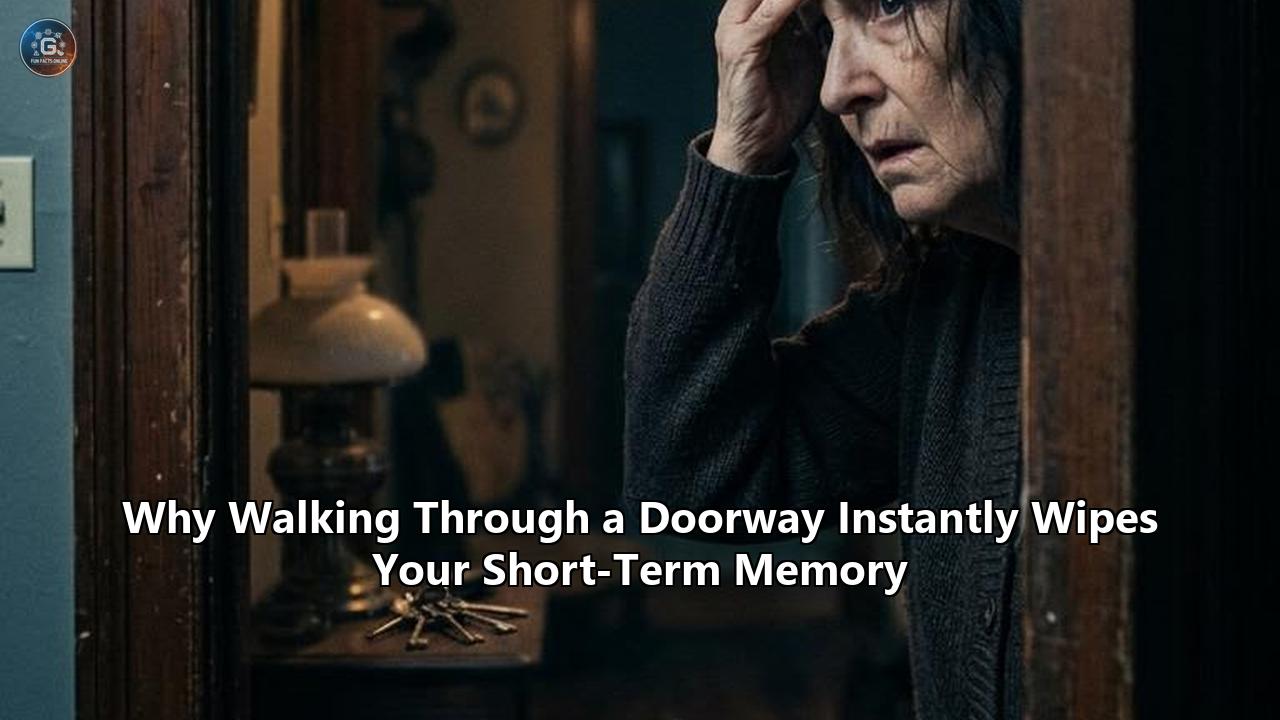
A cognitive reset occurs the instant a person walks through a doorway. Standing in a hallway or kitchen, blinking blankly while attempting to recall a purpose that was crystal clear five seconds earlier, is a universal human experience. Recent cognitive neuroscience studies published in Memory & Cognition and the Journal of Experimental Psychology have isolated the precise mechanisms behind this phenomenon.
What felt for decades like an irritating personal quirk or an early sign of cognitive decline is actually a fundamental feature of human brain architecture. Psychologists refer to this as the doorway memory effect—or the location updating effect—a process driven by the brain's reliance on event segmentation to manage information processing. When a person passes through a threshold, the central nervous system registers a spatial transition, marks the end of a mental "chapter," and purges short-term working memory to make room for incoming stimuli from the new environment.
Recent empirical evaluations from research teams at the University of Notre Dame, Bond University, and University College London demonstrate that doorways do not merely obstruct memory retrieval through passive decay. Instead, physical and virtual thresholds actively force working memory to update, flushing transient goals, intentions, and environmental details.
Understanding why this reset happens requires examining the cognitive, biological, and environmental factors at play, alongside the broad impact this phenomenon has on human productivity, clinical safety, spatial design, and digital user experiences.
The Neural Trigger: How Thresholds Wipe Working Memory
The brain does not record human experience as a continuous, seamless video stream. Processing every millisecond of sensory input as an unbroken sequence would quickly overload the central executive network. Instead, human cognition relies on Event Segmentation Theory (EST). The brain organizes time, space, and sensory information into discrete mental packages known as "event models."
An event model holds all information relevant to an active scenario: the task at hand, spatial surroundings, relevant tools, and immediate goals. As long as an individual remains inside a single environment, the brain maintains that active model in working memory, relying primarily on the dorsolateral prefrontal cortex and the hippocampus.
[ Physical Transition ] ──> [ Hippocampal Event Boundary ] ──> [ Working Memory Purge ] ──> [ New Context Initialization ]
  (Crossing Doorway)         (Retrosplenial Cortex Trigger)    (Transient Goals Dropped)     (Blank Slate Constructed)
Passing through a doorway changes everything. The visual frame shifts rapidly, lighting parameters alter, spatial acoustics adjust, and the physical boundaries of the room enclose a new territory. The retrosplenial cortex and hippocampus identify this spatial transition as an "event boundary".
Upon detecting an event boundary, the brain executes three distinct cognitive steps:
- Closing the Active Model: The current event model is declared complete and archived into episodic memory storage.
- Purging Working Memory Buffers: Transient details stored in short-term working memory—such as holding an intention like "grab the scissors"—are discarded to free up cognitive bandwidth.
- Constructing a New Model: The brain prepares a fresh situational model tailored to the incoming room's geometry, hazards, and potential utilities.
When this automated clearing process completes, the original intention remains trapped inside the previous event model. The individual enters the new room with a clean working memory buffer, staring at the furniture while wondering what brought them there.
The Research Trail: From Virtual Reality to Cognitive Load
The pioneering scientific work behind the doorway memory effect began with Dr. Gabriel Radvansky and his research team at the University of Notre Dame. In landmark experiments, Radvansky’s lab tasked participants with moving objects across tables situated within different rooms.
In one experimental condition, participants walked across a single large room to reach a target table. In another, participants walked the exact same physical distance, but crossed through a doorway into an adjacent room. Memory tests revealed that participants who passed through doorways were significantly more likely to forget the items they were carrying or supposed to pick up compared to those who walked identical distances within a single enclosure.
+-----------------------------------------------------------------------------------+
|                            RADVANSKY MEMORY ACCURACY EXPERIMENT                   |
+-----------------------------------------------------------------------------------+
| Single Large Room (No Threshold):  [==========================] High Recall (~85%) |
| Adjacent Room (Doorway Threshold): [=================] Decreased Recall (~55%)   |
+-----------------------------------------------------------------------------------+
Follow-up trials eliminated potential confounding factors:
- Virtual Space vs. Physical Space: To determine whether physical exertion or sensory depth caused the memory drop, researchers tested participants in computer-simulated 3D environments. The memory wipe occurred in virtual reality just as reliably as in real-world buildings, confirming that the reset is driven by mental segmentation rather than bodily fatigue.
- The Return-to-Room Fallacy: Researchers tested whether returning to the original room restored the lost thought. Participants walked back through the threshold into the starting room, but memory recovery was remarkably inconsistent. The event boundary had already filed the goal away; simply returning to the space did not automatically unarchive the dropped working memory buffer.
Subsequent findings from researchers at Bond University in Australia provided an important caveat: cognitive load dictates the severity of the purge. Led by Dr. Oliver Baumann, researchers demonstrated that passing through doorways connecting highly similar rooms produced minimal forgetting when participants were fully focused on a single task.
However, when working memory was loaded with competing tasks—such as counting backward while walking—crossing a threshold caused immediate memory drops. The doorway acts as a trigger point that exposes an already strained working memory system.
Who Is Most Affected: Susceptibility Across Contexts and Demographics
The doorway memory effect does not strike all individuals equally or under all conditions. Susceptibility depends heavily on cognitive load, age, neurodivergent conditions, and environmental demands.
+-----------------------------------------------------------------------------------+
|                         SUSCEPTIBILITY INDEX BY DEMOGRAPHIC                       |
+-----------------------------------------------------------------------------------+
| Demographics / Group     | Vulnerability Level | Dominant Trigger Factor          |
+--------------------------+---------------------+----------------------------------|
| Multitaskers & Workers   | Extremely High      | High working memory load         |
| Aging Adults (65+)       | High                | Declining executive function     |
| ADHD / Neurodivergent    | High                | Impaired goal maintenance        |
| Clinicians / Healthcare  | High (Critical Risk)| Environmental complexity & stress|
| Single-Tasking Adults    | Low to Moderate     | Focus shields active event model |
+-----------------------------------------------------------------------------------+
1. Chronic Multitaskers and Knowledge Workers
Individuals managing high cognitive loads experience the most intense door-induced memory wipes. Knowledge workers constantly holding multiple threads of attention—such as trying to remember a file name, draft an email reply, and monitor a messaging app while walking across an office—enter a vulnerable cognitive state. The moment they cross a doorway, the brain uses the spatial boundary as an opportunistic reset point, dropping peripheral intent to clear bandwidth.
2. Healthcare Professionals and Emergency Responders
In high-stress medical environments, spatial transitions occur dozens of times per hour. Doctors, nurses, and emergency medical technicians move rapidly between patient rooms, triage suites, supply closets, and operating rooms.
When a nurse leaves a patient's bedside to fetch a specific medication in a storage facility down the hall, passing through multiple doorway thresholds while mentally processing clinical diagnostic updates can trigger the memory effect. In healthcare settings, forgotten intentions do not merely cause annoyance—they introduce systemic friction that can delay treatment or lead to administrative reporting errors.
3. Aging Populations
Older adults frequently express anxiety over threshold-induced forgetting, often misidentifying the event as a warning sign of early-stage dementia or Alzheimer's disease. Cognitive testing confirms that older adults experience the doorway memory effect more frequently than younger adults, but not because their spatial processing is broken.
As executive functioning and working memory capacity naturally taper with age, holding a transient intention becomes more difficult under competing cognitive demands. When older adults cross a physical boundary while mentally managing household chores, the spatial update easily clears the fragile working memory trace.
4. Neurodivergent Individuals (ADHD and Executive Function Deficits)
Individuals with Attention Deficit Hyperactivity Disorder (ADHD) experience pronounced difficulties with working memory maintenance and context switching. Because internal goal-holding mechanisms are already vulnerable to external distraction, passing through an event boundary acts like a hard reboot. The visual and spatial sensory shifts of a new room instantly draw focus toward novel stimuli, leaving the original intent behind.
Structural Mechanics: What Changes Inside the Brain
To understand why the brain handles thresholds so aggressively, one must look at the neural structures involved in spatial navigation, situational modeling, and episodic memory storage.
       [ Prefrontal Cortex ]
     (Working Memory Buffer)
                │
                ▼
   [ Retrosplenial Cortex ]  ──(Senses Spatial Shift)──► [ Event Boundary Trigger ]
                │                                                    │
                ▼                                                    ▼
       [ Hippocampus ]                                      [ Working Memory Flush ]
  (Episodic Memory Archive)                                (Prefrontal Buffer Reset)
Working Memory vs. Long-Term Retrieval
Working memory is the brain's scratchpad, operating with strict limits. It holds between three and five items or goals concurrently for brief windows, typically under 30 seconds, unless actively rehearsed. Long-term memory, handled through hippocampal network consolidation, holds vast reservoirs of structured knowledge.
When an intention is formed—such as "I need to grab the battery charger from the bedroom"—it resides in working memory as an active control variable. It has not yet been consolidated into long-term memory because it is treated as a temporary action plan. When the retrosplenial cortex registers the spatial change of a doorway, it sends an update signal to the hippocampus and prefrontal cortex. The prefrontal cortex flushes its short-term buffer, wiping the temporary action plan before it can be archived.
Event Segmentation Theory and Event Horizons
Psychologist Jeffrey Zacks of Washington University in St. Louis developed Event Segmentation Theory to explain how perception structures continuous life into comprehensible units. The mind builds mental "event models" based on prediction. As long as the environment remains stable, predictions hold true, and the active event model remains open.
+-----------------------------------------------------------------------------------+
|                         EVENT MODEL TRANSITION TIMELINE                           |
+-----------------------------------------------------------------------------------+
| [ Room A: Living Room Model ]                                                     |
| Goal: Fetch phone charger                                                         |
| Surroundings: Couch, TV, Warm Lighting                                            |
+-----------------------------------------------------------------------------------+
                                         │
                         [ Crosses Doorway Boundary ]
                                         │
                                         ▼
+-----------------------------------------------------------------------------------+
| [ Room B: Kitchen Model ]                                                         |
| Goal: UNKNOWN (Purged during event boundary update)                               |
| Surroundings: Refrigerator, Countertops, Fluorescent Lighting                     |
+-----------------------------------------------------------------------------------+
When a person walks through a door, predictions drop sharply. Spatial geometry, ambient lighting, acoustics, and available objects suddenly change. The brain senses this surge in prediction error, closes the existing event model, and opens a new one. This shift creates an "event horizon"—a cognitive wall that makes accessing information from the preceding event model far more difficult.
Context-Dependent Memory Interruption
For decades, classical memory research highlighted "context-dependent memory"—the principle that information learned in one context is easiest to recall when returning to that exact context. It was assumed that returning to the original room would automatically revive a dropped thought.
However, Radvansky’s research revealed a crucial detail: event boundaries override simple context dependency. Because the act of crossing the doorway signals the formal end of an event, the brain archives the original context. Returning to the initial room requires passing through the doorway a second time, triggering another event boundary that updates working memory once again. The user enters the original room with yet another flushed buffer, leaving the lost thought buried inside the archived model.
Short-Term Consequences: Micro-Disruptions and Real-World Friction
The immediate consequences of the doorway effect play out in daily routines, professional performance, and cognitive fatigue. While rarely catastrophic in isolation, these micro-disruptions accumulate over time, creating friction in personal and professional settings.
                                  [ SHORT-TERM IMPACTS ]
                                             │
      ┌──────────────────────────────────────┼──────────────────────────────────────┐
      ▼                                      ▼                                      ▼
[ Task Fragmentation ]             [ Micro-Frustration & Fatigue ]          [ Clinical & Operational Risks ]
  - Lost momentum                    - Cognitive annoyance                    - Delayed medication delivery
  - Backtracking loops               - Cortisol/stress spikes                 - Context-switching errors
  - Unfinished daily chores          - Accumulating mental fatigue            - Documentation gaps
1. Task Fragmentation and Lost Productivity
The primary short-term consequence of the doorway memory effect is task fragmentation. When an intention vanishes at a doorway, an individual enters a loop of trial-and-error retrieval:
- Standing idle in a room trying to reconstruct the thought.
- Backtracking physically through rooms to find sensory triggers.
- Substituting the lost intention with a low-priority task (e.g., opening the refrigerator because it is nearby).
Studies tracking workplace efficiency indicate that knowledge workers lose several minutes during every context-switching interruption. When these lapses occur repeatedly throughout the day, task momentum degrades, forcing workers to spend extra cognitive energy simply re-establishing lost workflows.
2. Micro-Frustration and Cognitive Anxiety
While forgetting a reason for entering a room is biologically normal, its emotional impact is often negative. Individuals experience repeated surges of micro-frustration when their internal goals drop out of reach. Over time, these small lapses accumulate into cognitive anxiety, leading people to doubt their memory capacity or worry about neurodegenerative issues.
3. Occupational Safety and Healthcare Risks
In environments where exact sequences of action are critical, threshold resets present operational risks:
- Surgical and Nursing Environments: A nurse walking into a medication room who experiences a threshold reset may grab incorrect supplies or miss time-sensitive patient care steps.
- Industrial and Lab Settings: Technicians moving between hazard zones or cleanrooms can forget specific calibration targets or safety protocols upon crossing airlocks and containment thresholds.
- Service and Culinary Industries: Chefs and floor managers moving between kitchen doors and dining areas regularly drop real-time inventory updates or table requests as they transition across doors.
Long-Term Consequences: Architecture, Digital Design, and Evolutionary Utility
Beyond immediate task disruptions, the doorway effect shapes how environments are designed, how software interfaces are engineered, and how scientists understand the evolutionary design of human intelligence.
                              [ LONG-TERM SYSTEMIC IMPACTS ]
                                             │
      ┌──────────────────────────────────────┼──────────────────────────────────────┐
      ▼                                      ▼                                      ▼
[ Spatial & interior Design ]       [ Digital UX & Software ]             [ Evolutionary Adaptation ]
  - Rise of open-plan spaces          - Interface context shifts             - Threat management priorities
  - Visual sightline continuity       - Tab / screen transitions             - Efficient memory management
  - Blurred threshold zones           - Modal popups as mental walls         - Contextual adaptive filtering
1. Architectural Evolution: Open-Plan vs. Compartmentalized Spaces
Architectural paradigms directly influence how human brains process physical space. The traditional residential and commercial architecture of the 19th and 20th centuries relied heavily on compartmentalization—small, enclosed rooms separated by distinct door frames and narrow corridors.
The mid-to-late 20th century saw a massive movement toward open-plan residential homes and open offices. While driven by aesthetic and real estate factors, open-plan layouts fundamentally alter cognitive segmentation:
+-----------------------------------------------------------------------------------+
|                         ARCHITECTURAL SPACE & MEMORY RETENTION                    |
+-----------------------------------------------------------------------------------+
| COMPARTMENTALIZED DESIGN:                                                         |
| [ Kitchen ] === Doorway ===> [ Dining Room ] === Doorway ===> [ Living Room ]    |
| Impact: High event segmentation, frequent working memory resets.                  |
+-----------------------------------------------------------------------------------+
| OPEN-PLAN DESIGN:                                                                 |
| [ Kitchen  ~~~~~  Sightline Continuity  ~~~~~  Dining Space  ~~~~~  Living Zone ] |
| Impact: Continuous context, preserved working memory buffers, higher background noise.|
+-----------------------------------------------------------------------------------+
By eliminating interior doorways and wall partitions, open-plan spaces remove physical event boundaries. An individual walking from a kitchen island to a living room couch in an open layout maintains continuous sightlines and environmental lighting.
The brain maintains the active situational model without triggering a complete working memory flush. However, this trade-off comes with costs: open-plan layouts increase visual distractions and ambient noise, trading threshold-induced memory resets for persistent attentional strain.
Modern architectural design increasingly seeks a middle ground known as "broken-plan" living. This approach uses glass partitions, subtle changes in floor height, half-walls, and varying ceiling levels to define functional zones without introducing opaque door frames that act as hard event boundaries.
2. Digital User Experience (UX) and Software Design
The doorway memory effect is not limited to physical spaces; digital environments trigger identical cognitive responses. As human activity shifts onto screens, software engineers and UI/UX designers routinely introduce digital "doorways" that disrupt user memory.
+-----------------------------------------------------------------------------------+
|                      PHYSICAL VS. DIGITAL EVENT BOUNDARIES                        |
+-----------------------------------------------------------------------------------+
| Physical World Trigger            | Digital Interface Equivalent                  |
+-----------------------------------+-----------------------------------------------+
| Walking through a door frame      | Switching browser tabs or app windows         |
| Stepping into a dark hallway      | Sudden modal popups or full-screen overlays   |
| Crossing a threshold into a patio | Transitioning from app workspace to settings  |
+-----------------------------------------------------------------------------------+
When a user switches browser tabs, opens a full-screen app, or navigates to a new page with completely different visual styling, the mind registers an event boundary. A user might open a new browser tab to search for a specific report, but upon seeing the blank search bar and bookmark grid, completely forget what they intended to look up.
UX designers use several strategies to minimize digital event boundaries:
- Contextual Overlays: Presenting new options in partial side drawers or lightboxes rather than navigating away to full-screen pages preserves background context.
- Persistent Breadcrumbs: Keeping primary navigation elements, colors, and search intent visible across screens prevents working memory from flushing active goals.
- Visual Continuity: Using smooth fluid animations that transition elements across screens rather than abrupt hard cuts helps the brain maintain a single continuous event model.
3. Evolutionary Utility: Why the Brain Reset Evolved
Why would natural selection preserve a cognitive mechanism that causes people to forget what they are doing?
From an evolutionary perspective, the doorway effect is an elegant feature, not a bug. For early humans, crossing a physical threshold—leaving a sheltered cave to step out onto an open savanna, or emerging from dense forest onto a riverbank—represented a dramatic change in environmental risk.
[ Ancient Human Threshold Transition ]
  Inside Cave (Low Threat, Domestic Focus)
                │
                ▼
  Crosses Cave Entrance Threshold (Event Boundary Triggered)
                │
                ▼
  Flushes Internal Cave Thoughts ──► Instantiates Savanna Safety Model (High Alert for Predators)
An ancient human emerging from a cave while obsessing over an internal goal—like sharpening a stone scraper—was at a disadvantage. The survival of that individual depended on instantly dropping internal musings to focus entirely on the new environment: scanning for predators, monitoring weather shifts, and evaluating terrain hazards.
The brain evolved to treat spatial boundaries as mandatory focus reset triggers. Clearing working memory upon entering a new territory allowed our ancestors to construct fresh situational models based on immediate survival priorities. In the modern world, where crossing from a home office to a hallway poses zero predatory threat, this once-vital survival mechanism manifests as a mild cognitive nuisance.
Comparative Analysis: Doorway Effect vs. Other Memory Lapses
To clarify how the doorway memory effect operates, it is helpful to compare it with other common short-term memory failures.
+---------------------------------------------------------------------------------------------------+
|                                  MEMORY LAPSE COMPARATIVE MATRIX                                  |
+---------------------------------------------------------------------------------------------------+
| Phenomenon             | Primary Cause                        | Brain Regions Involved            |
+------------------------+--------------------------------------+-----------------------------------+
| Doorway Memory Effect  | Spatial threshold / Event boundary   | Retrosplenial Cortex, Hippocampus |
| Absent-Mindedness      | Lack of initial encoding/attention   | Prefrontal Cortex                 |
| Tip-of-the-Tongue      | Retrieval block of long-term trace   | Temporal Lobe, Inferior Frontal   |
| Prospective Memory Failure| Delay between intent and execution| Frontopolar Cortex                |
+---------------------------------------------------------------------------------------------------+- Absent-Mindedness: Occurs when an item or intention is never properly encoded into working memory due to distraction at the moment of formation (e.g., putting car keys down while talking on the phone). The doorway effect differs because the intention was fully encoded and active until the physical boundary triggered a reset.
- Tip-of-the-Tongue State: Represents a temporary failure to retrieve a well-consolidated long-term memory trace (such as a person's name or a vocabulary word). The doorway effect targets transient short-term intentions, not consolidated long-term facts.
- Prospective Memory Failure: Refers to forgetting to perform an intended action at a future time (e.g., forgetting to buy milk on the drive home). The doorway effect happens on a much tighter timescale, occurring within seconds during real-time movement.
Tactical Mitigations: How to Anchor Memory Across Thresholds
While the brain’s event segmentation system is hardwired, cognitive psychologists have identified reliable strategies to counteract doorway-induced forgetting.
                                  [ TACTICAL MITIGATIONS ]
                                             │
      ┌──────────────────────────────────────┼──────────────────────────────────────┐
      ▼                                      ▼                                      ▼
[ Verbal & Physical Anchoring ]      [ Environmental Continuity ]            [ Mindful Threshold Crossing ]
  - Vocalize intent out loud           - Carry physical target items          - Pause briefly at threshold
  - Tactile grounding (gestures)       - Maintain open sightlines             - Reduce concurrent multitasking
  - Rehearse goal while walking        - Minimize stark lighting shifts       - Focus single goal before moving
1. Verbal and Physical Anchoring
To prevent a transient goal from being wiped during an event boundary update, elevate the goal from short-term working memory into motor-sensory loops.
- Vocalize Intent: Saying "I am walking into the basement to get the lightbulbs" out loud before crossing the threshold engages auditory processing networks, making the memory trace far more resilient to spatial clearing.
- Tactile Object Anchoring: Carrying a related physical object acts as a continuous sensory cue. Holding an empty flashlight casing while walking to the garage ensures that even if working memory resets, visual and tactile feedback immediately reactivates the goal.
2. Reducing Cognitive Load During Transitions
Because the doorway memory effect is far more pronounced when working memory is overloaded, lowering mental strain while moving between rooms significantly protects working memory. Avoid reading text messages, listening to complex podcasts, or running through mental task lists while physically transitioning between spaces. Single-tasking during movement allows the prefrontal cortex to hold onto transient intent.
3. Intentional Pause and Retrosplenial Priming
Pausing for a single second at a door frame before stepping through allows the brain to finish updating its spatial map before you drop your active focus. Pausing creates a clear boundary line, letting you consciously carry the key goal into the incoming room's event model.
The Future Horizon: What to Watch Next
As neuroimaging technology advances and environmental design becomes more data-driven, researchers are pushing beyond the initial findings of event segmentation theory. Several key frontiers are actively reshaping our understanding of the doorway memory effect:
+-----------------------------------------------------------------------------------+
|                            EMERGING RESEARCH FRONTIERS                            |
+-----------------------------------------------------------------------------------+
| REAL-TIME MOBILE EEG   | Tracking hippocampal theta surges during physical threshold |
| & NEUROIMAGING          | transitions in naturalistic real-world environments.        |
+------------------------+----------------------------------------------------------+
| SMART ARCHITECTURE     | Adaptive lighting, soundscapes, and sightlines engineered|
| DESIGN                 | to soften cognitive boundaries in hospitals and offices. |
+------------------------+----------------------------------------------------------+
| NEURODEGENERATIVE      | Using doorway effect variance as an early diagnostic tool|
| DIAGNOSTICS            | to differentiate normal aging from pathologic decay.      |
+------------------------+----------------------------------------------------------+
| SPATIAL COMPUTING & VR | Designing mixed-reality interfaces that prevent user     |
| UX OPTIMIZATION        | disorientation during digital scene shifts.               |
+-----------------------------------------------------------------------------------+
1. High-Density Mobile EEG and Real-World Neuroimaging
Previous studies relied largely on room-bound VR headsets or post-walk memory questionnaires. The deployment of lightweight, high-density mobile EEG rigs and portable functional near-infrared spectroscopy (fNIRS) allows neuroscientists to track brain activity as people move through physical buildings in real time.
Researchers are mapping the exact millisecond-by-millisecond neural communication between the retrosplenial cortex, entorhinal cortex, and prefrontal networks as a person crosses a threshold. These studies aim to reveal why certain visual architectural transitions trigger stronger cognitive purges than others.
2. Cognitive-Aware Architectural Engineering
Spatial designers and healthcare architects are beginning to apply event boundary findings directly to building plans. Medical facilities are testing transition corridors that use gradual lighting ramps, continuous floor patterns, and curved doorways instead of hard right-angle frame doors.
By smoothing the physical transitions between clinical preparation areas and patient rooms, architects aim to reduce cognitive fatigue and working memory resets among healthcare workers.
3. Virtual Reality and Mixed-Reality Spatial Computing
With the rapid growth of spatial computing and virtual reality headsets, digital spatial transitions are becoming a central concern for UX researchers. Passing through virtual portals, switching digital rooms, or zooming between application canvases in mixed-reality environments triggers the doorway memory effect just as powerfully as physical doors.
Current VR interface research focuses on engineering visual anchoring techniques—such as persistent virtual wrists, ambient floating context cues, and smooth focal transitions—that allow users to navigate spatial computing environments without losing their train of thought.
4. Diagnostic Differentiation in Aging
Differentiating normal, age-related cognitive changes from pathological conditions like early-stage Alzheimer's disease remains a critical challenge in clinical neurology. Because the doorway effect is a universal, healthy feature of human event segmentation, researchers are studying how variance in threshold memory performance might serve as a diagnostic tool.
Healthy aging adults show preserved event segmentation structures—they experience the doorway effect because their brains are actively organizing experiences into episodes. In contrast, individuals with early-stage hippocampal degeneration often struggle with event segmentation entirely, failing to erect proper cognitive boundaries between distinct events.
Clinical trials are working to establish standardized spatial navigation tests that use threshold memory dynamics to identify early neurodegenerative markers long before traditional cognitive screening tests detect severe decline.
Summary of Core Mechanisms
Ultimately, walking through a doorway and forgetting why you entered the room is not a sign of a failing mind. It is proof of a sophisticated cognitive system doing exactly what it evolved to do: structuring a chaotic world into organized, manageable episodes.
The brain values situational organization over seamless retention. By treating physical thresholds as event boundaries, the mind archives past scenarios and clears its working memory buffers to prepare for whatever awaits in the next space. The brief inconvenience of stepping into a kitchen and wondering why you are there is simply the small price paid for an adaptable, context-aware human intelligence.
References & Further Reading
- Radvansky, G. A., & Copeland, D. E. (2006). Walking through doorways causes forgetting: Situation models and experienced space. Memory & Cognition, 34(5), 1150–1156.
- Radvansky, G. A., Krawietz, S. A., & Tamplin, A. K. (2011). Walking through doorways causes forgetting: Further investigations. Quarterly Journal of Experimental Psychology, 64(8), 1632–1645.
- McFadyen, J., Nolan, C., Pinocy, E., Lewis, C., & Baumann, O. (2021). Doorways do not always cause forgetting: A investigation into the effect of spatial boundaries and cognitive load on memory. BMC Psychology, 9(1), 1–12.
- Zacks, J. M., Speer, N. K., Swallow, K. M., Braver, T. S., & Reynolds, J. R. (2007). Event perception: A mind-brain perspective. Psychological Bulletin, 133(2), 273–293.
- Pettijohn, K. A., Thompson, A. N., Tamplin, A. K., Krawietz, S. A., & Radvansky, G. A. (2016). Event boundaries and memory improvement. Cognition, 148, 136–144.
Reference:
- https://havenandhold.com/blogs/journal/the-doorway-effect-why-you-forget-what-you-came-for-and-what-it-teaches-us-about-transitions
- https://www.futura-sciences.com/en/why-do-we-sometimes-forget-what-we-wanted-to-do-when-entering-a-room_28795/
- https://cognitivetrain.com/doorway-effect-forgetting-rooms/
- https://medium.com/new-earth-consciousness/the-doorway-effect-why-walking-through-thresholds-resets-your-mind-ef41b8a3a5f4
- https://www.facebook.com/61580156957972/videos/why-you-forget-things-the-moment-you-enter-a-room-the-doorway-effectever-walk-in/1537530457449598/
- https://www.iflscience.com/why-did-i-come-in-here-how-the-doorway-effect-makes-us-forget-what-we-were-doing-77674
- https://economictimes.indiatimes.com/news/international/us/psychology-says-walking-into-a-room-can-make-you-forget-why-you-went-there-heres-why/articleshow/133156415.cms?from=mdr
- https://www.sciencefocus.com/science/psychology-doorway-effect-memory
- https://news.nd.edu/news/walking-through-doorways-causes-forgetting-new-research-shows/
- https://www.psychologytoday.com/us/blog/mental-mishaps/201205/doorways-cause-forgetting
- https://pubmed.ncbi.nlm.nih.gov/17128613/