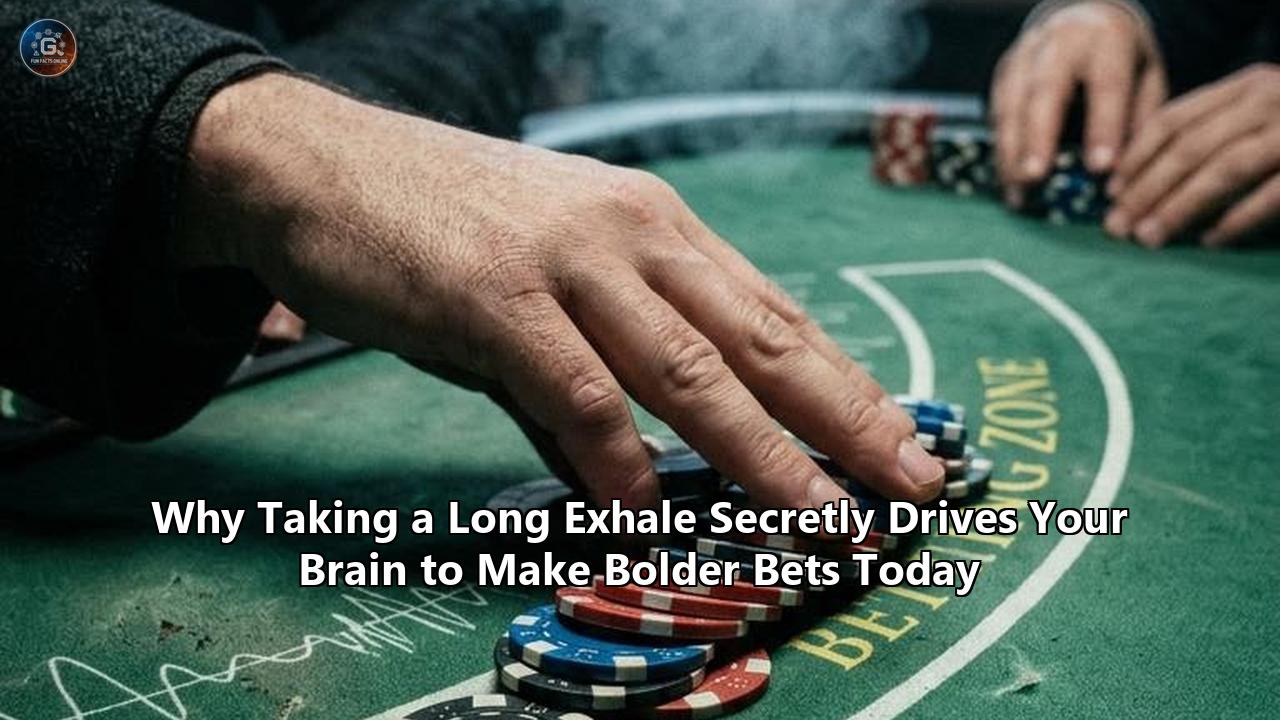
Inside a subterranean neuroimaging suite at Charité – Universitätsmedizin Berlin, forty-one volunteers lay motionless inside the cylindrical bore of a 3-Tesla MRI scanner, holding financial destiny in their hands. On the screen positioned inches above their eyes, numbers flashed in rapid succession: high-stakes gambles, each presenting a 50-50 split between winning a tidy sum of cash or walking away empty-handed.
Tethered to respiratory belts, continuous electrocardiograms, pulse oximeters, and pupillometry sensors, the participants were instructed to navigate these financial minefields under two distinct physiological conditions. In the baseline phase, they breathed naturally. In the test phase, they synchronized their lungs with an on-screen visual pacer that forced an asymmetric rhythm: a brisk two-second inhalation followed by an extended, slow eight-second exhalation.
For decades, clinicians, military trainers, and corporate mindfulness coaches have dispensed the same piece of advice to individuals standing on the edge of high-stress decisions: Take a deep breath and let it out slowly to keep yourself grounded and cautious. The assumption was self-evident—slowing the heart and engaging the biological "rest-and-digest" system serves as a physiological handbrake, preventing reckless moves and restoring sensible restraint.
The data emerging from Berlin revealed the opposite reality.
Published in the journal Neuron, the collaborative study led by neuroscientist Prof. Dr. Soyoung Q. Park of the German Institute of Human Nutrition Potsdam-Rehbrücke and Charité demonstrated that stretching the exhale does not trigger conservative restraint. Instead, it drives human participants to accept riskier financial bets with significantly greater frequency.
The extended exhale did not make participants numb to risk, nor did it cause them to overlook potential disaster. Instead, it altered how the brain computationally weights potential rewards. By triggering a cascade of autonomic signals up the vagus nerve, the long exhale selectively hyper-sensitized reward-evaluation centers in the cortex, making the upside of a risky proposition look far more enticing than it did seconds before.
                     EXTENDED EXHALATION (2:8 Ratio)
                                  │
                                  ▼
                    Increased Intrathoracic Pressure
                                  │
                                  ▼
                     Baroreceptor Firing Surge
                                  │
                                  ▼
                      Vagal Nerve Afferent Volley
                     (Parasympathetic Activation)
                                  │
                                  ▼
                   Nucleus of the Solitary Tract (NTS)
                                  │
                                  ▼
             ┌────────────────────┴────────────────────┐
             ▼                                         ▼
   Locus Coeruleus Suppression               vmPFC & Precuneus
   (Norepinephrine Drop / Calm)           (Reward Valuation Surge)
             │                                         │
             └────────────────────┬────────────────────┘
                                  │
                                  ▼
                     AMPLIFIED REWARD SENSITIVITY
                     (Unchanged Loss Aversion)
                                  │
                                  ▼
                        BOLDER DECISION-MAKING
The Berlin Protocol: Inside the Neuroimaging Run
To understand how bodily mechanics steer complex choices, Park's team stripped away the ambiguity of conventional behavioral surveys. The 41 healthy participants, averaging 25 years of age, were placed in an environment where every physiological variable could be quantified alongside moment-by-moment neural activations.
The economic choice paradigm was modeled around classic prospect theory. In each round, volunteers were presented with a binary choice: take a guaranteed outcome (often zero or a minor baseline) or accept a 50/50 gamble featuring varying magnitudes of potential gains (up to dozens of euros) and potential losses.
                                [ TRIAL ONSET ]
                                       │
                ┌──────────────────────┴──────────────────────┐
                ▼                                             ▼
       Eupnea (Normal Breathing)               Prolonged Exhale (2s In : 8s Out)
                │                                             │
      Baseline Cardiac Rate                       Elevated Heart Rate Variability
                │                                             │
    Balanced Prospect Calculus                   Amplified vmPFC Reward Weighting
                │                                             │
      Standard Risk Profile                      Higher Acceptance of Bold Gambles
During the prolonged exhalation blocks, participants were cued to maintain an exact respiratory ratio: two seconds of nasal inhalation followed by eight seconds of controlled exhalation. This pattern is known in physiological medicine as a 1:4 inspiratory-to-expiratory (I:E) ratio, a configuration engineered to maximally engage the parasympathetic nervous system via the vagal brake.
The behavioral shift was immediate. When operating under the prolonged exhalation protocol, participants demonstrated a marked, statistically significant increase in their propensity to accept risky gambles compared to normal breathing (β = 0.168, p = 0.018).
"When people look at slow-paced breathing, they typically anticipate sedation or hyper-cautiousness," explains Dr. Henrik Kjeldsen, a neurobiologist who examines autonomic integration. "The Berlin data caught people off guard because the subjects weren't pulling back. They were stepping forward and pulling the trigger on gambles they previously declined."
Crucially, the team wanted to know if this was merely random button-pressing caused by respiratory fatigue. The response times refuted that possibility. Participants took roughly the same time to deliberate under both breathing conditions. They did not act haphazardly; their decisions remained systematic, following mathematical models of utility, but the internal weighting of that utility had moved.
| Variable Measured | Normal Breathing (Eupnea) | Prolonged Exhalation (2:8) | Statistical Significance |
|---|---|---|---|
| Gamble Acceptance Rate | Baseline (~48%) | Elevated (~56%) | p = 0.018 (Significant) |
| Reward Sensitivity Parameter ($\beta_{gain}$) | Standard Value | Marked Increase (+17.6%) | p < 0.001 (Highly Significant) |
| Loss Aversion Parameter ($\lambda$) | Stable | Unchanged | p > 0.40 (Non-significant) |
| Heart Rate Variability (SDNN/RMSSD) | Normal Rest | Significant Increase | p < 0.001 (Vagal Dominance) |
| Skin Conductance Response (SCR) | Baseline | Unchanged | Non-significant |
| Pupil Diameter Baseline | Baseline | Unchanged | Non-significant |
Dissecting the Value Matrix: Why the Brain Tilts Toward Reward
Economic decision-making in the human brain is largely an ongoing friction between two computational networks:
- The Appetitive Evaluation System: Centered in the ventromedial prefrontal cortex (vmPFC), the orbitofrontal cortex (OFC), and the ventral striatum, this network encodes the expected value and sheer appeal of positive outcomes.
- The Aversive Risk/Loss Detection Network: Centered in the anterior insula and amygdala, this system tracks uncertainty, computes risk prediction errors, and registers the visceral pain of potential losses.
When an individual decides whether to commit capital to a new venture, double down on a poker hand, or buy a falling stock, these two systems run concurrent evaluations. Loss aversion—the psychological observation that losses hurt roughly twice as much as equivalent gains feel good—is mediated by the anterior insula sounding the alarm.
When researchers examined the fMRI blood-oxygen-level-dependent (BOLD) signals of participants engaged in prolonged exhalations, they anticipated seeing diminished activity in the anterior insula or amygdala. The default hypothesis was that long exhales simply mute the panic of losing.
The imaging told an entirely different story.
Activation in the anterior insula and the amygdala remained virtually identical across both breathing conditions. When a participant was faced with the prospect of losing 20 euros, the brain's alarm network registered the threat just as sharply during an eight-second exhale as it did during normal breathing.
The shift occurred on the appetitive side of the equation. Under the influence of the extended exhale, the ventromedial prefrontal cortex (vmPFC) and the precuneus displayed elevated BOLD responses whenever potential monetary rewards were displayed. The computational modeling confirmed this: the mathematical parameter tracking reward sensitivity jumped significantly (breathing condition × reward interaction: β = 0.176, p < 0.001), while the parameter tracking loss sensitivity was unchanged.
                CONVENTIONAL BELIEF vs. EMPIRICAL NEUROSCIENCE

   Conventional Belief:
   [ Long Exhale ] ──► [ Drops Sympathetic Arousal ] ──► [ Suppresses Fear / Loss Pain ] ──► Caution

   Empirical Finding (Neuron, 2026):
   [ Long Exhale ] ──► [ Vagal Efferent Volley ] ──► [ Preserves Loss Detection ]
                                                └──► [ Sensitizes vmPFC / Precuneus ] ──► Bolder Bets
The physical act of drawing out the exhale did not build a wall against fear; it constructed a magnifying glass for opportunity. The subjective value of the gain expanded. When analyzing the practical benefits of long exhales, neuroscientists must now factor in this asymmetric computational bias: prolonged expiration primes the mind for strategic offense rather than defensive retreat.
The Baroreceptor Relay: The Visceral Hardware of Action
To trace how air moving past the lips alters the neural firing of the prefrontal cortex, one must follow the afferent neural highways connecting the ribcage to the brainstem.
Breathing is the only vital autonomic function that is simultaneously automatic and subject to direct volitional control. Under the hood, the respiratory cycle acts as a primary mechanical regulator of cardiovascular dynamics through a mechanism known as Respiratory Sinus Arrhythmia (RSA).
                     THE CARDIO-RESPIRATORY CYCLE

          INHALATION                             EXHALATION
              │                                      │
              ▼                                      ▼
   Diaphragm Flattens                     Diaphragm Relaxes Upward
              │                                      │
              ▼                                      ▼
   Thoracic Volume Increases              Thoracic Cavity Compresses
              │                                      │
              ▼                                      ▼
   Heart Expands / Venous Fill            Heart Chambers Compress
              │                                      │
              ▼                                      ▼
   Sinoatrial Node Acceleration           Baroreceptors Fire (Aortic/Carotid)
              │                                      │
              ▼                                      ▼
   Heart Rate Temporarily Spikes          Vagus Nerve Discharges Acetylcholine
                                                     │
                                                     ▼
                                          Heart Rate Decelerates
When you inhale, the diaphragm flattens, expanding the thoracic cavity. The heart expands slightly to accommodate venous return, causing intra-cardiac pressure to drop. In response, the brain temporarily eases its parasympathetic brake, allowing the sinoatrial node to fire faster and accelerating the heart rate.
When you exhale, the reverse occurs. The diaphragm relaxes upward, reducing the volume of the chest cavity and increasing intrathoracic pressure. The blood vessels within the chest and carotid sinus are compressed, activating high-pressure stretch receptors called arterial baroreceptors located in the carotid sinuses and the aortic arch.
These baroreceptors fire a rapid series of action potentials along the glossopharyngeal (CN IX) and vagus (CN X) nerves straight into the brainstem's primary relay station: the Nucleus of the Solitary Tract (NTS).
The NTS immediately commands the nucleus ambiguus and the dorsal motor nucleus of the vagus nerve to release acetylcholine onto the heart's sinoatrial node, slowing the heart rate. But the signal does not stop at the heart.
From the NTS, ascending afferent projections travel upward through several critical subcortical junctions:
- The Parabrachial Area: Regulating homeostatic state and visceral arousal.
- The Thalamus: Directing sensory gating to cortical structures.
- The Locus Coeruleus (LC): The brain's exclusive factory for norepinephrine.
- The Ventromedial Prefrontal Cortex (vmPFC): The higher-order hub responsible for assigning subjective value to options during a decision.
When the exhalation is drawn out over eight seconds, this ascending baroreceptor-vagal pathway delivers a sustained, continuous train of inhibitory signals into the brainstem.
The locus coeruleus experiences a sudden drop in tonic firing rates. Norepinephrine, the neurotransmitter of alarm and cognitive distraction, recedes from the synaptic clefts across the frontal cortex.
With the noradrenergic static cleared away and the heart safely decelerating, the central autonomic network signals the prefrontal cortex that the organism is biologically secure. In that window of safety, the vmPFC re-evaluates external options not through the lens of acute survival, but through the lens of potential growth.
The biological consequence is profound: under parasympathetic dominance, the brain shifts its operational calculus from deficit-avoidance to surplus-acquisition.
The Trader's Pulse: Field Evidence from High-Stakes Arenas
The laboratory findings at Charité solve an empirical riddle that has puzzled neuroeconomists on real-world trading desks for over a decade.
In the mid-2010s, a team of researchers led by Dr. John Coates, a former Wall Street derivative trader turned Cambridge University neuroscientist, embedded physiological monitoring systems on traders working at high-frequency desks in the City of London. They measured heart rate variability, cortisol levels, and interoceptive sensitivity—the ability to consciously track internal biological markers like heartbeats without taking a pulse.
Coates' team discovered that the most consistently profitable traders were not cold, unfeeling machines, nor were they frantic adrenaline junkies. Instead, they were individuals with exceptionally high interoceptive awareness and superior autonomic flexibility—the capacity to rapidly deploy parasympathetic tone in the middle of market turmoil.
                              THE AROUSAL CONTINUUM

Hyper-Arousal (Sympathetic Panic)  ◄───  OPTIMAL DECISION ZONE  ───►  Hypo-Arousal (Lethargy/Apathy)
       Rapid, shallow breathing                 Extended Exhalations               Shallow, unpaced breathing
       High noradrenaline, low HRV              High HRV, modulated LC             Depressed neural metabolism
       Defensive paralysis / Errors             Amplified vmPFC reward salience     Missed opportunities
"Traders who survived the longest on high-volatility desks were doing something intuitive with their breathing," notes Marcus Vance, an institutional risk consultant who has analyzed algorithmic trading stress. "When a flash crash or massive breakout occurred, rookies would hold their breath or hyperventilate, driving their nervous systems into sympathetic overdrive. They became risk-averse at precisely the wrong moment, dumping assets at the bottom."
"The veterans," Vance continues, "would instinctively blow out long, slow breaths through pursed lips. They claimed it helped them 'think straight.' What we now realize from the Berlin data is that they weren't just thinking straight—they were actively resetting their neurochemical reward sensitivity so they could execute bold, counter-trend buys while everyone else was running for cover."
This exact biological mechanism plays out across several high-stakes environments:
1. The High-Stakes Poker Tournament
Professional poker players at the final tables of the World Series of Poker face situations where millions of dollars hinge on a single semi-bluff. Under severe stress, players often display visible carotid pulse spikes.
Top players frequently use down-regulated, prolonged exhalations before executing an all-in bet. While spectators assume this is done to disguise tells or calm rapid heart rates, the neurobiology suggests a dual function: the long exhale amplifies the internal valuation of the pot's reward relative to the fear of elimination, providing the neural license to execute an aggressive play.
2. The Trauma Surgical Suite
When an unexpected hemorrhage occurs during an emergency aortic reconstruction, a surgeon must choose within seconds whether to employ a conservative packing strategy or attempt a bold, complex vascular clamp.
Surgeons trained in tactical autonomic regulation utilize extended exhalations to prevent tunnel vision. By dampening locus coeruleus noradrenaline release, the prolonged exhale allows the prefrontal cortex to construct multivariable risk-reward projections, enabling decisive intervention.
3. Venture Capital Pitch Rooms
Founders and investors negotiating term sheets in compressed timeframes experience acute autonomic shifts. The simple cadence of breath during negotiations can shift the balance between settling for conservative protective clauses and pitching an ambitious, aggressive expansion valuation.
The Chemistry of Courage: Norepinephrine vs. Dopamine Dynamics
Why does calming the nervous system make the brain bolder rather than sleepier? The answer lies in the non-linear relationship between autonomic arousal and cognitive function.
The human brain does not operate on a simple binary of "on" or "off." It exists along an inverted-U performance curve, historically known as the Yerkes-Dodson law. At the neurochemical level, this curve is governed by the delicate balance between norepinephrine (released by the locus coeruleus) and dopamine (released by the ventral tegmental area and substantia nigra).
                     THE NEUROCHEMICAL YERKES-DODSON CURVE

    High  │                         [ PEAK BOLD PERFORMANCE ]
          │                         • Optimal LC Tonic Firing
          │                         • High Vagal Tone (Long Exhales)
          │                         • vmPFC Reward Amplification
  COGNITIVE│
  CAPACITY│
   & BOLD │
  DECISIONS│
          │
          │  [ HYPO-AROUSAL ]                               [ HYPER-AROUSAL ]
          │  • Low Dopamine                                 • Noradrenergic Flood
          │  • Cognitive Apathy                             • Insular Panic Response
     Low  └─── • Sluggish Choices ──────────────────────────── • Defensive Paralysis ───
          Low                          AROUSAL LEVEL                         High
When an individual enters a state of acute stress or panic:
- The Noradrenergic Flood: The locus coeruleus fires rapidly and erratically. Norepinephrine drenches the prefrontal cortex, impairing high-level working memory and abstract valuation.
- The Insular Alarm: The anterior insula and amygdala dominate neural processing, signaling intense aversion to uncertainty. The brain defaults to primitive survival patterns: freeze, retreat, or take the surest, lowest-variance option available.
- Loss Overweighting: The subjective cost of any potential loss is magnified by a factor of three or four. The person becomes pathologically risk-averse.
Conversely, consider what happens when a prolonged exhale engages the parasympathetic brake:
- Locus Coeruleus Down-Regulation: The burst of baroreceptor activity acts as a governor on the locus coeruleus, bringing norepinephrine release down into the optimal sweet spot.
- Cortical Noise Reduction: With background noradrenergic interference cleared, the signal-to-noise ratio in the prefrontal cortex sharpens dramatically.
- Dopaminergic Unmasking: The baseline activity of dopaminergic pathways projecting to the vmPFC and striatum is no longer suppressed by panic circuits.
- Appetitive Re-Calibration: The brain evaluates potential gains at full fidelity. Because the physiological threat signal is muted, the anticipated pleasure of the reward takes center stage.
The result is not reckless euphoria, but what neuroeconomists call calculated boldness—the willingness to embrace high-variance, positive-expected-value choices that a panicked brain would automatically reject.
Recognizing the multifaceted benefits of long exhales moves breathwork out of the realm of passive relaxation and repositions it as an active cognitive optimization tool.
The Interoceptive Illusion: Why Self-Help Got Breathing Half-Wrong
For thousands of years, ancient contemplative traditions have emphasized the breath as a gateway to mental control. In modern wellness culture, this ancient wisdom was simplified into a single narrative: Breathing slowly makes you peaceful, calm, and detached.
Popular methodologies have proliferated across corporate wellness programs, digital apps, and athletic training protocols:
- Box Breathing (4-4-4-4): Four seconds in, four seconds hold, four seconds out, four seconds hold. Popularized by tactical teams for general emotional grounding.
- The Physiological Sigh (Double Inhale + Long Exhale): Two rapid inhalations through the nose followed by a full, passive exhalation through the mouth, heavily studied for rapid acute stress reduction.
- Prolonged Expiratory Pacing (1:2, 1:3, or 1:4 ratios): Inhaling for two to three seconds and exhaling for six to twelve seconds.
┌────────────────────────┬───────────────────────────┬──────────────────────────────────────────┐
│ Technique              │ Ratio Pattern             │ Primary Neuro-Behavioral Outcome         │
├────────────────────────┼───────────────────────────┼──────────────────────────────────────────┤
│ Box Breathing          │ 4s In : 4s Hold : 4s Out  │ Autonomic Stabilization; Neutral Focus   │
│ Physiological Sigh     │ 2s In + 1s In : 6s Out    │ Rapid Stress Abatement; Alveolar Opening │
│ Prolonged Exhale (2:8) │ 2s In : 8s Out            │ Vagal Surge; Elevated Reward Sensitivity │
└────────────────────────┴───────────────────────────┴──────────────────────────────────────────┘
The error in modern popular interpretations was the assumption that autonomic calm is synonymous with behavioral passivity.
"The self-help ecosystem conflated physiological relaxation with cognitive inaction," says Dr. Elena Rostova, a behavioral neuroscientist specializing in interoceptive processing. "They assumed that if you lower your heart rate, you lower your ambition in the moment. The neuroimaging shows that the exact opposite occurs. When you quiet the body's emergency sirens, you liberate the brain's reward machinery to hunt for upside."
This distinction reshapes our understanding of the somatic marker hypothesis, famously proposed by neuroscientist Antonio Damasio. Damasio argued that decision-making is continuously shaped by unconscious visceral signals—gut feelings, vascular constriction, respiratory changes—that bias our choices before conscious logic ever formulates an argument.
The latest findings demonstrate that we can deliberately manipulate those somatic markers in real time. By altering the I:E ratio of our respiration, we alter the afferent somatic stream entering the vmPFC. We are not merely soothing our nerves; we are altering our brain's internal currency converter, making every prospective dollar, point, or victory carry more motivational weight.
Translating the Science: A Strategic Decision Protocol
For professionals operating in environments where decision quality dictates success—traders, founders, trial attorneys, negotiators—the findings from Charité provide a practical operational blueprint.
Deploying the benefits of long exhales requires precision. The objective is not to breathe slowly all day long, which can induce lethargy, but to deploy targeted respiratory pacing immediately prior to strategic evaluation windows.
                  THE 90-SECOND PRE-DECISION PROTOCOL

  [ Step 1: Baseline Check ] ──────► Recognize Acute Arousal (Heart racing, loss panic)
               │
               ▼
  [ Step 2: Mechanical Shift ] ────► Initiate 2:8 Nasal Inhale / Extended Exhale Cycle
               │
               ▼
  [ Step 3: Sustained Vagal Load ] ─► Complete 6 to 8 Full Breath Cycles (~60–90 seconds)
               │
               ▼
  [ Step 4: Cognitive Execution ] ──► Evaluate Strategic Options (Re-weighting upside/downside)
Phase 1: Identifying the Arousal Trap (0–15 Seconds)
When faced with an unexpected market movement, a high-stakes counter-offer, or a high-risk dilemma, assess your physiological state. Fast, shallow breathing, neck tension, and an urge to immediately reject risk or accept a mediocre certainty indicate sympathetic dominance and high anterior insula activity.
Phase 2: Engaging the Asymmetric Brake (15–75 Seconds)
Initiate a deliberate 2-second nasal inhalation followed by a smooth, unforced 8-second exhalation through lightly pursed lips.
- Maintain this cadence for six full cycles (exactly one minute).
- The smooth, extended expiration maximizes the duration of baroreceptor firing, flooding the NTS with inhibitory signals and elevating high-frequency heart rate variability (HF-HRV).
Phase 3: Executing the Appraisal (75–90 Seconds)
Re-open the decision matrix. With the vmPFC sensitized and noradrenergic static suppressed, evaluate the risky option.
- Ask: Is my previous reluctance based on mathematical downside, or was it an artifact of physiological panic?
- By separating genuine hazard from bodily alarm, you can capitalize on high-upside opportunities that competitors will shy away from.
Clinical Horizons: From Trading Floors to Therapeutic Frontiers
While the commercial and tactical implications of this research are sweeping, the clinical applications may be even more transformative.
In psychiatry, major depressive disorder (MDD) and generalized anxiety disorder (GAD) sit at opposite ends of an autonomic-computational spectrum:
- Depression and Anhedonia: Characterized by a blunted reward system. Depressed patients exhibit diminished vmPFC activation when presented with positive stimuli; they are computationally incapable of feeling the pull of prospective rewards.
- Anxiety and Panic: Characterized by hyper-sensitized loss networks and depressed parasympathetic tone. Anxious individuals overweight risk and view neutral environments as threatening.
┌─────────────────────────┬───────────────────────────┬────────────────────────────────────────┐
│ Disorder State          │ Underlying Neural Deficit │ Potential Therapeutic Respiration Role │
├─────────────────────────┼───────────────────────────┼────────────────────────────────────────┤
│ Major Depressive (MDD)  │ Blunted vmPFC Reward Bias │ 2:8 Exhale Training to Sensitize vmPFC │
│ Anxiety Disorder (GAD)  │ Hyperactive Loss Salience │ Autonomic Reset to Buffer Panic Alerts │
│ Substance Misuse (SUD)  │ Dysregulated Reward Loops │ Targeted Pacing to Stabilize Craving   │
└─────────────────────────┴───────────────────────────┴────────────────────────────────────────┘
The revelation that a simple 2:8 respiratory pattern can selectively upregulate vmPFC reward sensitivity without triggering manic impulsivity opens a non-pharmacological avenue for treating reward-processing deficits.
"If we can use structured respiratory protocols to selectively sensitize the brain's reward pathways, we have a zero-cost, zero-side-effect behavioral intervention for anhedonia," notes Dr. Kjeldsen. "By teaching patients with blunted affect to practice prolonged exhalations before engaging in social or goal-directed activities, we can artificially prime their prefrontal valuation systems to register the positive aspects of life."
Conversely, in populations struggling with impulse-control disorders or pathological gambling, understanding this respiratory link provides a warning: engaging in prolonged exhalations in environments saturated with predatory risks (such as casinos or high-leverage trading apps) could inadvertently amplify the temptation to make dangerous, oversized bets.
The Next Horizon of Breath-Brain Science
As the findings from Berlin reverberate across neuroscience and behavioral economics, researchers are moving quickly to map the remaining unknowns of the body-brain loop.
Several major research initiatives are already under development:
- Closed-Loop Wearable Biofeedback: Engineers are prototyping smart rings and chest straps capable of detecting real-time shifts in heart rate variability and respiration phase. These systems could alert traders, executives, or military operators when their autonomic state makes them unusually risk-seeking or pathologically risk-averse.
- Phase-Locked Decision Timing: Studies are investigating whether presenting information specifically during the expiratory phase versus the inspiratory phase modulates instantaneous choice architecture, fine-tuning how humans interact with algorithmic interfaces.
- Longitudinal Neural Plasticity: Researchers are examining whether sustained, daily practice of prolonged exhalation induces structural changes in the white-matter tracts connecting the solitary tract, locus coeruleus, and vmPFC.
What the evidence makes unmistakably clear is that human decision-making is not an insulated, purely cognitive process occurring in an ivory tower of pure logic. We do not think in a vacuum; we think in a body.
The rhythm of air flowing through the lungs and the subsequent mechanical compression of the heart send continuous, powerful instructions to the prefrontal circuits that shape our life choices. When you take a moment to draw in a breath and let it out in a long, unbroken stream, you are doing far more than calming down. You are resetting your internal valuation engine, quietening your doubts, and quietly priming your brain to place a bolder bet on the future.
Reference:
- https://menafn.com/1111625493/Can-The-Way-You-Breathe-Affect-Your-Decisions-Study-Finds-Surprising-Link-To-Risk-Taking
- https://www.sciencealert.com/deep-breathing-to-calm-your-nerves-may-actually-increase-risk-taking-behavior
- https://scitechdaily.com/slow-breathing-can-rewire-your-brain-and-change-the-choices-you-make/
- https://www.biorxiv.org/content/10.64898/2026.01.09.698695v1.full
- https://www.somatopia.com/blog/retrain-your-threat-radar-vagus-nerve-hacks-for-anxiety
- https://www.psypost.org/neuroscientists-uncover-a-surprising-link-between-your-breathing-rhythm-and-your-willingness-to-take-risks/
- https://pmc.ncbi.nlm.nih.gov/articles/PMC3384699/
- https://journals.openedition.org/ei/74
- https://pmc.ncbi.nlm.nih.gov/articles/PMC12139582/
- https://pmc.ncbi.nlm.nih.gov/articles/PMC6189422/
- https://pubmed.ncbi.nlm.nih.gov/40343266/
- https://www.relaxmore.net/rsa-english/
- https://pmc.ncbi.nlm.nih.gov/articles/PMC10135951/
- https://www.researchgate.net/publication/324043719_Coupling_of_Respiration_and_Attention_via_the_Locus_Coeruleus_Effects_of_Meditation_and_Pranayama
- https://www.psychologytoday.com/us/blog/the-athletes-way/201609/trust-your-gut-theres-nothing-woo-woo-about-the-vagus-nerve
- https://pmc.ncbi.nlm.nih.gov/articles/PMC3948282/
- https://pmc.ncbi.nlm.nih.gov/articles/PMC6284817/
- https://pmc.ncbi.nlm.nih.gov/articles/PMC11450482/
- https://pubmed.ncbi.nlm.nih.gov/37127727/
- https://www.psychologytoday.com/us/blog/the-athletes-way/201905/longer-exhalations-are-an-easy-way-to-hack-your-vagus-nerve
- https://pmc.ncbi.nlm.nih.gov/articles/PMC12289630/
- https://articlegateway.com/journals/index.php/JAF/article/download/5137/4895
- https://pmc.ncbi.nlm.nih.gov/articles/PMC12240353/
- https://psychologyfanatic.com/neuroeconomics/