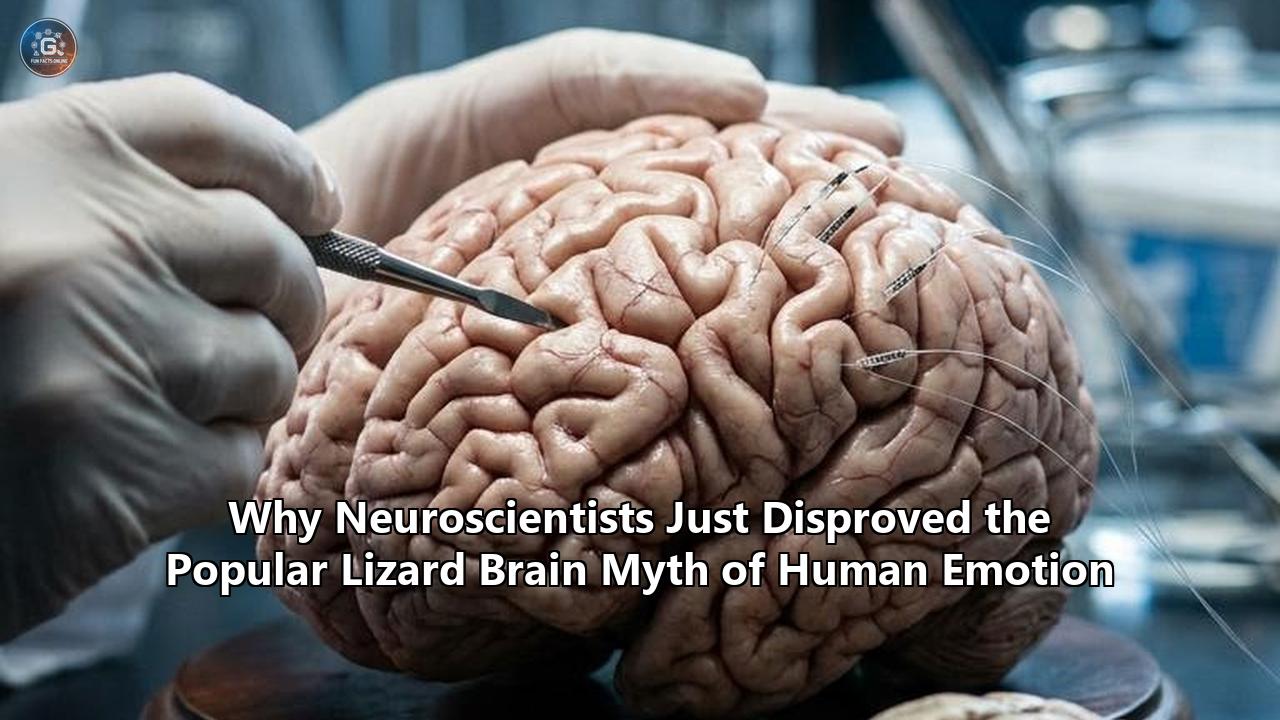
A multi-institution wave of comparative neuroanatomy, single-cell transcriptomics, and computational wiring studies has delivered a definitive empirical verdict: the long-popular concept of an ancient "reptilian core" driving raw human impulses beneath a rational mammalian shell is biologically baseless.
The latest findings, culminating in research published in Science Advances and comparative developmental datasets across vertebrate species in Science, confirm that the human brain did not evolve by piling rational cortical layers on top of a primitive, reflexive base. Instead, evolutionary biologists and computational neuroscientists have demonstrated that all vertebrate brains—from reptiles and birds to rodents and primates—develop from a shared foundational blueprint. The subcortical circuits frequently blamed for impulsive rage, unthinking panic, and primitive aggression do not operate as an autonomous, ancient autopilot, nor does the cerebral cortex act as an enlightened, newly invented executive warden.
The empirical dismantling of the lizard brain myth invalidates decades of widespread pop-psychology literature, corporate management dogmas, and traditional therapeutic analogies. For more than half a century, the idea that human consciousness is locked in a perpetual civil war between an animalistic core and a civilized outer shell provided an intuitive narrative for internal conflict. However, modern neurobiology reveals a reality governed by integrated, whole-brain predictive networks, structural wiring trade-offs, and metabolic regulation.
The consequences of this correction reach far beyond laboratory nomenclature. As researchers retire the layered brain model, the shift is restructuring clinical mental health frameworks, dismantling flawed legal defenses of "emotional hijacking," reorienting artificial intelligence architectures, and rewriting foundational assumptions across behavioral economics.
                       EVOLUTIONARY NEUROANATOMY: A REVISED PARADIGM

       FLAWED "TRIUNE BRAIN" MODEL                  EMPIRICAL VERTEBRATE BLUEPRINT
  ┌────────────────────────────────────┐         ┌────────────────────────────────────┐
  │         Neomammalian Cortex        │         │   Integrated Predictive Networks   │
  │   (Reason, Logic, Language, Math)  │         │  (Cortical-Subcortical Feedback)   │
  ├────────────────────────────────────┤         ├────────────────────────────────────┤
  │       Paleomammalian Limbic        │         │     Shared Vertebrate Pallium      │
  │  (Emotion, Social Bonds, Memory)   │         │ (Conserved Cell Types & Circuits)  │
  ├────────────────────────────────────┤         ├────────────────────────────────────┤
  │         Reptilian Complex          │         │    Shared Subpallium / Brainstem   │
  │ (Instinct, Fight/Flight, Aggression│         │ (Allostatic Budgeting & Regulation)│
  └────────────────────────────────────┘         └────────────────────────────────────┘
         [Sediment Layering Model]                     [Shared Blueprint & Wiring]
The Autopsy of a Century-Old Neuroanatomical Error
To understand why the triune model endured for so long, one must trace its origins to mid-twentieth-century physician and neuroscientist Paul D. MacLean. In the 1960s, MacLean formalized a hypothesis proposing that the human brain is an anatomical sandwich composed of three distinct evolutionary epochs:
- The Reptilian Complex (R-complex): Comprising the basal ganglia and brainstem, presumed to govern instinctual survival drives, territorial aggression, and rigid repetitive behaviors.
- The Paleomammalian Brain (Limbic System): Comprising the amygdala, hippocampus, and cingulate cortex, presumed to introduce emotional feeling, parental nurturing, and social bonding.
- The Neomammalian Brain (Neocortex): The massive, folded outer layer presumed to be uniquely developed in primates and humans, endowing our species with language, abstract reasoning, planning, and inhibitory control.
This triune concept provided an accessible narrative. It mapped cleanly onto Western philosophical dualisms: the Platonic charioteer wrestling with wild horses, Cartesian splits between mind and body, and Freudian friction among the Id, Ego, and Superego. Carl Sagan popularized the framework in his Pulitzer Prize-winning 1977 book The Dragons of Eden, cementing the idea in the public imagination that humanity's dark, violent, and unthinking impulses stem directly from a prehistoric beast lurking beneath the skull.
                     HISTORICAL EVOLUTION OF BRAIN MODELS

  1960s–1970s                 1990s–2000s                 Current Consensus
 ┌───────────────┐           ┌───────────────┐           ┌───────────────────┐
 │ Paul MacLean  │           │ Comparative   │           │ Single-Cell RNA   │
 │ Triune Model  │──────────►│ Neurobiology  │──────────►│ Sequencing and    │
 │ (Layered      │  Cross-   │ (Pallium      │ Metabolic │ Connectomics      │
 │  Sediment)    │  Species  │  Homologies   │ Wiring    │ (Distributed      │
 └───────────────┘  Gaps     │  Identified)  │ Models    │  Prediction)      │
                             └───────────────┘           └───────────────────┘
The scientific foundation beneath MacLean’s hypothesis began fracturing within comparative biology decades ago, yet the popular mythology persisted. Neurobiologists studying non-mammalian vertebrates discovered that reptiles and birds are not unthinking automations driven solely by a basal core. Modern tracing techniques, transcriptomic profiling, and high-field magnetic resonance imaging have verified that reptiles possess an ancestral brain region known as the dorsal pallium—the developmental homolog of the mammalian neocortex.
Reptilian brains contain the same primary neurochemical systems, analogous cortical-like layering, and complex associative networks seen in mammals. Single-cell RNA sequencing conducted on reptilian species such as bearded dragons (Pogona vitticeps) and red-eared sliders (Trachemys scripta) revealed that their dorsal cortex expresses genetic marker profiles directly homologous to mammalian glutamatergic excitatory projection neurons and GABAergic interneurons.
Evolution did not build the human mind by laying new physical floors on top of an archaic basement. Rather, evolution operates like an engineer continuously rewiring, scaling, and adjusting the proportions of a conserved, ancient blueprint.
A critical nail in the triune model’s coffin comes from computational work led by Nabil Imam, an assistant professor of computational science and engineering and faculty member at Georgia Tech’s Institute for Neuroscience, Neurotechnology, and Society. Published in Science Advances, Imam’s research demonstrates that cross-species brain evolution is governed by competitive wiring optimization within strict metabolic constraints, not evolutionary additions of new psychological compartments.
"There was a theory proposed in the '50s that the brain evolved in layers starting with basic bodily functions, to emotions in the reptilian brain, leading up to sophisticated reasoning in humans," Imam explained. "This is not how an evolutionary biologist would think about the problem". Imam’s team established that brain organization across species reflects a developmental tug-of-war between competing wiring strategies—local modular specialization versus long-range associative integration—tailored to specific ecological niches, rather than a hierarchical ascent from animalistic passion to human logic.
The Network Reality: How Human Emotion Actually Operates
The definitive demise of the lizard brain myth exposes a core conceptual flaw: the belief that emotions are discrete, reflexive circuits housed in subcortical structures like the amygdala, constantly threatening to overpower cortical logic.
Pioneered by neuroscientists such as Lisa Feldman Barrett, University Distinguished Professor of Psychology at Northeastern University, and supported by functional imaging meta-analyses, the contemporary paradigm recognizes the brain as a distributed, predictive organ. Emotions are not pre-packaged reflex programs triggered by external events; they are complex mental states constructed on the fly by whole-brain networks balancing the body's internal energy budget—a process known as allostasis.
                     THE PREDICTIVE COMPUTATION LOOP

      Internal Sensory Input              External Environment
     (Heart rate, gut, hormones)          (Sights, sounds, context)
                 │                                    │
                 ▼                                    ▼
       ┌──────────────────┐                 ┌──────────────────┐
       │   Interoceptive   │                 │ Sensory Cortices │
       │     Circuits     │                 │   & Thalamus     │
       └────────┬─────────┘                 └────────┬─────────┘
                │                                    │
                └──────────────┐      ┌──────────────┘
                               ▼      ▼
                   ┌──────────────────────────────┐
                   │ Predictive Modeling Engine   │
                   │ (PFC, Insula, ACC, Amygdala, │
                   │       Basal Ganglia)         │
                   └──────────────┬───────────────┘
                                  │
                                  ▼
               ┌──────────────────────────────────────┐
               │    Unified Conscious Experience:     │
               │   Categorized as Fear, Anger, Joy,   │
               │         or Calculated Action         │
               └──────────────────────────────────────┘
In this predictive processing framework, the brain does not passively wait to receive sensory data and react with an instinctual subcortical outburst. Instead, the brain uses past experiences, encoded across expansive cortical-subcortical loops, to generate continuous, top-down predictions about what sensory inputs mean and what actions are required to maintain physiological equilibrium.
- The Amygdala's True Role: Rather than serving as an isolated "fear center" or a primal alarm bell, the amygdala functions as a general hub for processing novelty, salience, and outcome uncertainty. It signals other brain networks to pay attention and update their predictions when incoming sensory inputs deviate from expectations.
- The Role of the Cortex in Emotion: Cortical regions like the anterior insular cortex, the anterior cingulate cortex (ACC), and the ventromedial prefrontal cortex (vmPFC) are intrinsically involved in generating emotional feelings, not merely suppressing them. They compute interoceptive predictions—estimates of internal bodily states such as heart rate, glucose utilization, immune response, and respiratory demand.
- Integrated Processing: An emotion such as fear is not an ancient reptilian reaction overpowering rational thought. It is a high-level cognitive categorization: the entire brain integrates visceral bodily sensations, environmental context, linguistic concepts, and past memories into a unified experience to guide adaptive behavior.
When a person feels intense stress or panics in a threatening situation, their neocortex has not gone offline while a dormant lizard takes over the wheel. Rather, the entire nervous system—cortex and subcortex in concert—has converged on a high-arousal predictive state that reorganizes metabolic and computational resources toward rapid action.
Who Is Affected by the Correction of the Myth?
The scientific correction of this evolutionary error carries immediate consequences across multiple disciplines that have spent decades treating the triune brain as foundational truth.
                             SECTORS IMPACTED

 ┌───────────────────────┐   ┌───────────────────────┐   ┌───────────────────────┐
 │ Clinical Psychology   │   │ Behavioral Economics  │   │ Legal & Criminal      │
 │ & Psychiatry          │   │ & Market Theory       │   │ Jurisprudence         │
 │ • Dismantling dual-   │   │ • Retiring crude      │   │ • Re-evaluating       │
 │   process models      │   │   System 1/2 splits   │   │   "irresistible       │
 │ • Integrating somatic │   │ • Modeling complex    │   │   impulse" defenses   │
 │   and predictive care │   │   risk architectures  │   │ • Redefining intent   │
 └───────────────────────┘   └───────────────────────┘   └───────────────────────┘
             │                           │                           │
             └───────────────────────────┼───────────────────────────┘
                                         ▼
                             ┌───────────────────────┐
                             │ Machine Learning & AI │
                             │ • Brain-inspired      │
                             │   neuromorphic design │
                             │ • Metabolic wiring vs │
                             │   hierarchical stacks │
                             └───────────────────────┘
1. Clinical Psychology and Psychotherapeutic Frameworks
For decades, popular modalities of Cognitive Behavioral Therapy (CBT), stress-reduction programs, and somatic therapies relied on simplified psychoeducation. Patients struggling with anxiety, post-traumatic stress, or emotional dysregulation were routinely told that their "primitive reptilian brain" was hijacking their "rational human brain".
This framing inadvertently encouraged patients to view their emotional and somatic sensations as pathological, animalistic intrusions that needed to be suppressed, regulated, or conquered through willpower. By shifting to an integrated network model, clinicians are now moving away from an adversarial mindset (Reason versus Emotion) toward collaborative interoceptive awareness.
Therapists must now teach clients that intense emotional experiences are adaptive, whole-brain predictions based on historical patterns and physiological demands, transforming how treatments for trauma and panic disorders are structured.
2. Behavioral Economics, Consumer Research, and Marketing
The field of behavioral economics has frequently mapped Daniel Kahneman’s dual-process model—System 1 (fast, emotional, automatic) and System 2 (slow, rational, deliberative)—directly onto the triune brain framework. Marketers, financial analysts, and corporate strategists regularly designed interventions intended to "target the buyer's lizard brain" through primal fear, status threats, and scarcity cues.
Neuroimaging demonstrates that this mapping is flawed. Fast, automatic decisions are not confined to ancient subcortical structures; the cerebral cortex processes pattern recognition, heuristics, and automatic predictions at millisecond timescales.
Conversely, emotional valuation and affect are deeply embedded within deliberate, complex decision-making. Marketers and economic modelers can no longer treat consumers as split agents navigating between a primal reflex and a cost-benefit calculation.
                  SYSTEM 1 / SYSTEM 2: POPULAR VS. EMPIRICAL

  POPULAR MISCONCEPTION                         EMPIRICAL NEUROBIOLOGY
 ┌──────────────────────────────────────┐     ┌──────────────────────────────────────┐
 │ System 1 = Ancient Subcortical Core  │     │ System 1 = Fast Distributed Networks │
 │ (Emotional, Irrational, Lizard-like) │     │ (Automated Cortical Priors + Subcortex)│
 ├──────────────────────────────────────┤     ├──────────────────────────────────────┤
 │ System 2 = Modern Neocortical Layers │     │ System 2 = Slow Energy-Intensive Loop │
 │ (Logical, Deliberate, Human-Unique)  │     │ (High-Capacity Associative Recalculation)│
 └──────────────────────────────────────┘     └──────────────────────────────────────┘
3. Legal Jurisprudence and Criminology
The legal system frequently encounters arguments invoking "crimes of passion," temporary insanity, or diminished capacity based on neurobiological determinism. Defense attorneys have cited functional neuroimaging to argue that a defendant suffered an "amygdala hijack," rendering their rational prefrontal cortex incapable of restraining violent or impulsive behavior.
As the scientific consensus solidifies around integrated brain function, forensic neuroscientists are testifying that subcortical activation cannot serve as a binary biological excuse for lack of agency. Because the prefrontal cortex, insular cortex, and subcortical nuclei are deeply and continuously interconnected during both planning and emotional arousal, attempts to isolate criminal intent or emotional impulse to a distinct anatomical partition are scientifically unsupportable.
4. Leadership Training and Organizational Design
The corporate executive coaching sector generated a massive industry around mastering the "lizard brain" to prevent workplace burnout, eliminate executive reactivity, and enhance leadership resilience. Management courses regularly trained executives to "quiet their inner reptile" during high-stakes negotiations.
This framing misdiagnosed the true source of executive fatigue and decision failure. By viewing stress through the lens of a rogue subcortical circuit rather than allostatic load and predictive energy depletion, organizations implemented counterproductive strategies focusing solely on cognitive suppression.
Modern organizational psychology is now pivoting toward metabolic load management, physiological recovery cycles, and environmental predictability.
What Changes in Scientific and Practical Applications?
The abandonment of the lizard brain myth requires sweeping revisions in scientific education, clinical protocols, and theoretical models of cognition.
                                SYSTEMIC TRANSFORMATIONS

 ┌──────────────────────────────────────────────┬──────────────────────────────────────────────┐
 │             TRADITIONAL FRAMEWORK            │              REVISED SCIENTIFIC MODEL        │
 ├──────────────────────────────────────────────┼──────────────────────────────────────────────┤
 │ Layered Evolutionary Brain Structure         │ Conserved Core Architecture with Rewired     │
 │ (Reptilian Base -> Limbic -> Neocortex)      │ Scaling and Modulated Wiring Paths           │
 ├──────────────────────────────────────────────┼──────────────────────────────────────────────┤
 │ Localized Emotional Modules                  │ Distributed Predictive Neural Networks       │
 │ (Amygdala = Fear; Striatum = Aggression)     │ (Salience Hubs, Interoceptive Construction)  │
 ├──────────────────────────────────────────────┼──────────────────────────────────────────────┤
 │ Adversarial Mental Architecture              │ Integrated Homeostatic Optimization          │
 │ (Cortical Logic Suppresses Subcortical Id)   │ (Whole-Brain Allostatic Resource Allocation) │
 ├──────────────────────────────────────────────┼──────────────────────────────────────────────┤
 │ Modular Neural Stacking for AI               │ Energy-Constrained Computational Wiring      │
 │ (Reactive reflex units + high-level logic)   │ Optimization (Sparse, Efficient Geometries)  │
 └──────────────────────────────────────────────┴──────────────────────────────────────────────┘
Updating Medical and Psychological Curricula
In a widely cited paper titled "Your Brain Is Not an Onion With a Tiny Reptile Inside," published in Current Directions in Psychological Science, researchers Joseph Cesario, David J. Johnson, and Heather L. Eisthen documented the alarming persistence of the triune brain model within higher education. Their survey revealed that a vast majority of introductory psychology textbooks across the United States and Europe continued to teach MacLean's triune model as established anatomical fact.
"This belief, although widely shared in introductory psychology textbooks, has long been discredited among neurobiologists and stands in contrast to the clear and unanimous agreement on these issues among those studying nervous-system evolution," wrote Cesario and colleagues.
The translation lag in science—where disproven biological theories persist in applied fields for decades—is finally closing. Academic institutions and textbook publishers are actively revising standard curricula, ensuring that the next generation of psychologists, psychiatrists, and neuroscientists is trained on comparative developmental neurobiology rather than outdated mid-century allegories.
                      THE TRANSLATION GAP IN SCIENCE

  1970s–1980s               1990s–2000s                 2020s
 ┌────────────────┐        ┌────────────────┐        ┌────────────────┐
 │ Comparative    │        │ Specialized    │        │ Applied Fields │
 │ Anatomy        │───────►│ Neuroscience   │───────►│ & Education    │
 │ Rejects Triune │ 15-20  │ Synthesizes    │ 15-20  │ Finally Retire │
 │ Model          │ Years  │ Transcriptomics│ Years  │ "Lizard Brain" │
 └────────────────┘        └────────────────┘        └────────────────┘
Reconceptualizing Affective Disorders
In psychiatry, mood disorders such as major depressive disorder, generalized anxiety disorder, and borderline personality disorder are no longer conceptualized as pure failures of top-down cortical inhibition over a hyperactive emotional subcortex.
Instead, psychiatric research is reframing these conditions as systemic disturbances in predictive processing and allostatic budgeting:
- Depression: Often reflects a state where the brain predicts high metabolic expenditure with minimal environmental reward, leading to fatigue, motor slowing, and anhedonia to conserve energy.
- Anxiety: Represents a failure of precise prediction error handling, where the brain remains in a constant state of hyper-vigilance, anticipating unpredictable catastrophic metabolic demands regardless of environmental safety signals.
- PTSD: Involves rigidly locked, hyper-specific predictive models forged during trauma that fail to update when exposed to novel, non-threatening contextual cues.
Short-Term Consequences: Shifting Practices and Public Literacy
Over the next 12 to 36 months, the formal scientific rejection of the triune framework will trigger visible adjustments across clinical protocols, self-regulation training, and public science communication.
                            SHORT-TERM TIMELINE (1–3 YEARS)

  Months 1–12                         Months 12–24                        Months 24–36
 ┌───────────────────────────┐       ┌───────────────────────────┐       ┌───────────────────────────┐
 │ Clinical Terminology      │       │ Textbook & Academic       │       │ Workplace & Public        │
 │ Overhaul                  │──────►│ Curriculum Updates        │──────►│ Literacy Shift            │
 │ • Elimination of "lizard  │       │ • Psychology board exams  │       │ • Retirement of "amygdala │
 │   brain" psychoeducation  │       │   purge triune models     │       │   hijack" metaphors       │
 │ • Integration of allostasis│      │ • Peer-reviewed standards │       │ • Allostatic regulation   │
 │   and predictive tools    │       │   reject layered framing  │       │   adopted in leadership   │
 └───────────────────────────┘       └───────────────────────────┘       └───────────────────────────┘
1. The Discontinuation of "Hijack" Metaphors in Therapy
Mental health practitioners are actively eliminating phrases like "amygdala hijack" from client sessions. In its place, clinicians are deploying therapies grounded in predictive processing and interoception, such as refined Acceptance and Commitment Therapy (ACT) and modernized interoceptive exposure therapies.
Patients are guided to understand that bodily signals—racing pulse, shallow breathing, stomach tightness—are not signs that an internal beast has wrested control from their rational mind. Instead, these sensations are recognized as the brain’s metabolic preparation for action, which can be interpreted, contextualized, and redirected without fear of cognitive collapse.
2. Elimination of Triune Brain Concept from Professional Licensing
Licensing boards and professional psychological associations (including the American Psychological Association and the Association for Psychological Science) are revising examination standards. Questions that evaluate candidates based on hierarchical layering concepts or modular emotional centers are being systematically removed and replaced with modern network neuroscience and evolutionary developmental biology.
3. Transformation of Stress and Burnout Management
In public wellness and corporate environments, the short-term focus is pivoting away from simplistic cognitive control exercises toward systemic physiological recovery. When stress is understood as an allostatic resource deficit rather than an untamed animalistic reflex, solutions shift toward sleep optimization, metabolic balance, social safety cues, and workload predictability, delivering far more sustainable outcomes than willpower-based mental suppression.
Long-Term Consequences: AI Architectures, Philosophy, and Biology
Looking further ahead, the fall of the lizard brain myth will fundamentally reshape computational intelligence, philosophical concepts of human nature, and our understanding of non-human animal consciousness.
                             LONG-TERM IMPLICATIONS

 ┌─────────────────────────────────────────────────────────────────────────────┐
 │                        COMPUTATIONAL INTELLIGENCE                           │
 │ • Neuromorphic AI designed on metabolic and structural wiring constraints   │
 │ • Elimination of artificial "instinct modules" layered under logic engines  │
 ├─────────────────────────────────────────────────────────────────────────────┤
 │                          PHILOSOPHY OF MIND                                 │
 │ • Dissolution of Cartesian and Platonic Reason-versus-Emotion dualisms      │
 │ • Redefining human uniqueness through network scaling, not novel additions  │
 ├─────────────────────────────────────────────────────────────────────────────┤
 │                       ANIMAL COGNITION & ETHICS                             │
 │ • Recognition of complex, pallial-based processing in birds and reptiles   │
 │ • Expansion of ethical protections across non-mammalian vertebrate species  │
 └─────────────────────────────────────────────────────────────────────────────┘
1. Restructuring Artificial Intelligence and Neuromorphic Engineering
For decades, early artificial intelligence research attempted to build artificial general intelligence (AGI) by replicating MacLean's layered architecture: building reactive, rule-based lower levels (mimicking the supposed reptilian base) and attempting to stack deep symbolic reasoning engines on top of them.
The computational work published by Nabil Imam and his colleagues at Georgia Tech demonstrates that this layered approach is inefficient. In biological brains, complex problem-solving and environmental survival are achieved through evolutionary wiring trade-offs that maximize information transfer while minimizing metabolic cost.
                     TRADITIONAL AI VS. BIOMIMETIC WIRING

   TRADITIONAL LAYERED AI                    NEUROMORPHIC NETWORK CO-DESIGN
 ┌───────────────────────────┐             ┌───────────────────────────────┐
 │ High-Level Reasoning / LLM│             │   Globally Integrated Sparse   │
 ├───────────────────────────┤             │      Predictive Topologies    │
 │ Sub-Symbolic Reactive Core│             │  (Shared Plasticity & Dynamic │
 ├───────────────────────────┤             │     Metabolic Constraints)    │
 │ Low-Level Sensor Drivers  │             │                               │
 └───────────────────────────┘             └───────────────────────────────┘
  [High Energy, Brittle Logic]               [Ultra-Low Power, Dynamic Bias]
By understanding that mammalian brains evolved by adjusting the scaling and internal wiring of shared circuits rather than inventing new processing layers, AI researchers are developing neuromorphic hardware that operates with vastly lower power consumption. These systems utilize shared, plastic architectures capable of performing sensory integration, emotional-style salience valuation, and abstract reasoning within the same unified computational substrate.
2. The Collapse of Cartesian Dualism in Philosophy of Mind
Western intellectual history has long maintained an ideological division between pure intellect and corrupting emotion. The triune brain model served as the twentieth century's primary neurobiological defense of this dualism, giving scientific cover to the notion that rationality makes us uniquely human while emotion drags us down into bestial savagery.
With the disproof of the triune framework, this philosophical division loses its empirical footing. Human rationality does not exist in spite of our evolutionary physiology; it exists because of the precise, integrated way our brains predict, model, and regulate our bodily states. Emotion and cognition are not competing combatants in a zero-sum war for behavioral control; they are fundamentally complementary facets of the exact same predictive neural computation.
3. Re-evaluating Non-Human Animal Cognition and Ethics
The belief that reptiles, amphibians, and fish are purely instinctual automatons devoid of subjective experience or cognitive nuance has long informed animal welfare legislation, laboratory testing guidelines, and agricultural practices.
Comparative transcriptomics and behavioral studies reveal that reptiles and birds possess sophisticated pallial circuitry capable of associative learning, complex spatial mapping, social hierarchy comprehension, and nuanced behavioral flexibility.
As the myth of the unthinking reptilian automaton fades, legal, academic, and agricultural institutions will face increasing pressure to modernize animal sentience frameworks and expand ethical protections beyond mammals to include non-avian reptiles and other vertebrates.
Milestones and Unresolved Questions in the New Era
As neuroscience leaves the layered brain model behind, researchers are charting new scientific frontiers to fully decode the vertebrate brain's unified operational architecture.
                       RESEARCH VECTORS TO MONITOR

 ┌──────────────────────────────────────┐     ┌──────────────────────────────────────┐
 │   High-Resolution Cross-Species      │     │  Subcortical-Cortical Recurrent      │
 │          Connectomics                │     │            Dynamics                  │
 │ Mapping precise synaptic connections │     │ Tracking millisecond-level feedback  │
 │ between pallial and subpallial zones │     │ between brainstem nuclei and cortex  │
 └──────────────────┬───────────────────┘     └──────────────────┬───────────────────┘
                    │                                            │
                    └─────────────────────┬──────────────────────┘
                                          ▼
                      ┌───────────────────────────────────────┐
                      │    Allostatic Clinical Biomarkers     │
                      │ Translating whole-brain predictive    │
                      │ models into targeted psychiatric care │
                      └───────────────────────────────────────┘
The primary challenges and milestones to watch include:
- Mapping High-Resolution Cross-Species Connectomes: While single-cell transcriptomics has proven that cell types are conserved across vertebrates, researchers are now racing to build complete synaptic wiring diagrams of reptilian, avian, and mammalian pallial systems to pinpoint exactly how connectivity differences produce divergent behavioral repertoires.
- Real-Time Dynamic Tracking of Predictive Loops: Utilizing ultra-high-field (7-Tesla and 9.4-Tesla) fMRI combined with optogenetic recording, neuroscientists are tracking the millisecond-by-millisecond flow of prediction signals between subcortical structures (like the periaqueductal gray and basal ganglia) and the prefrontal cortex during acute stress and decision-making.
- Validating Predictive Biomarkers for Mental Health: Clinical trials are working to establish whether tracking interoceptive prediction errors can serve as an objective diagnostic biomarker for treatment-resistant depression and anxiety disorders, opening new pathways for personalized neuromodulation and neurofeedback therapies.
A Unified Understanding of Human Nature
The definitive disproof of the lizard brain myth represents a vital maturation in the study of human cognition and evolutionary biology. The human mind is not an uneasy coalition between an ancient prehistoric beast and a civilized modern intellect. We are not broken machines struggling to suppress an internal monster.
Human emotion is an advanced, whole-brain predictive computation—a deeply sophisticated biological process that weaves together visceral physiology, cultural learning, environmental context, and abstract thought to help us navigate an unpredictable world.
By discarding an inaccurate mid-century metaphor, science is finally establishing a unified model of the mind: one where emotion and reason are not adversaries fighting for control, but integrated components of a single, elegantly coordinated biological system.
Reference:
- https://massivesci.com/articles/lizard-people-reptile-brain-human/
- https://www.sciencedaily.com/releases/2026/08/260829235958.htm
- https://english.elpais.com/science-tech/2025-02-13/mammals-birds-and-reptiles-evolved-complex-brains-through-different-paths.html
- https://pmc.ncbi.nlm.nih.gov/articles/PMC4406946/
- https://par.nsf.gov/servlets/purl/10323786
- https://www.psychologytoday.com/us/blog/on-emotions-and-empathy/202607/why-the-lizard-brain-model-and-other-science-myths-persist
- https://en.wikipedia.org/wiki/Triune_brain
- https://personalpsychology.com.au/blog/reptilian-brain-myth
- https://neuro.gatech.edu/myth-lizard-brain-and-real-trade-inside-your-mind
- https://www.reddit.com/r/science/comments/ghzjpm/your_brain_is_not_an_onion_with_a_tiny_reptile/
- https://www.researchgate.net/publication/338154360_Your_Brain_Is_Not_an_Onion_with_a_Tiny_Reptile_Inside
- https://pmc.ncbi.nlm.nih.gov/articles/PMC11098553/