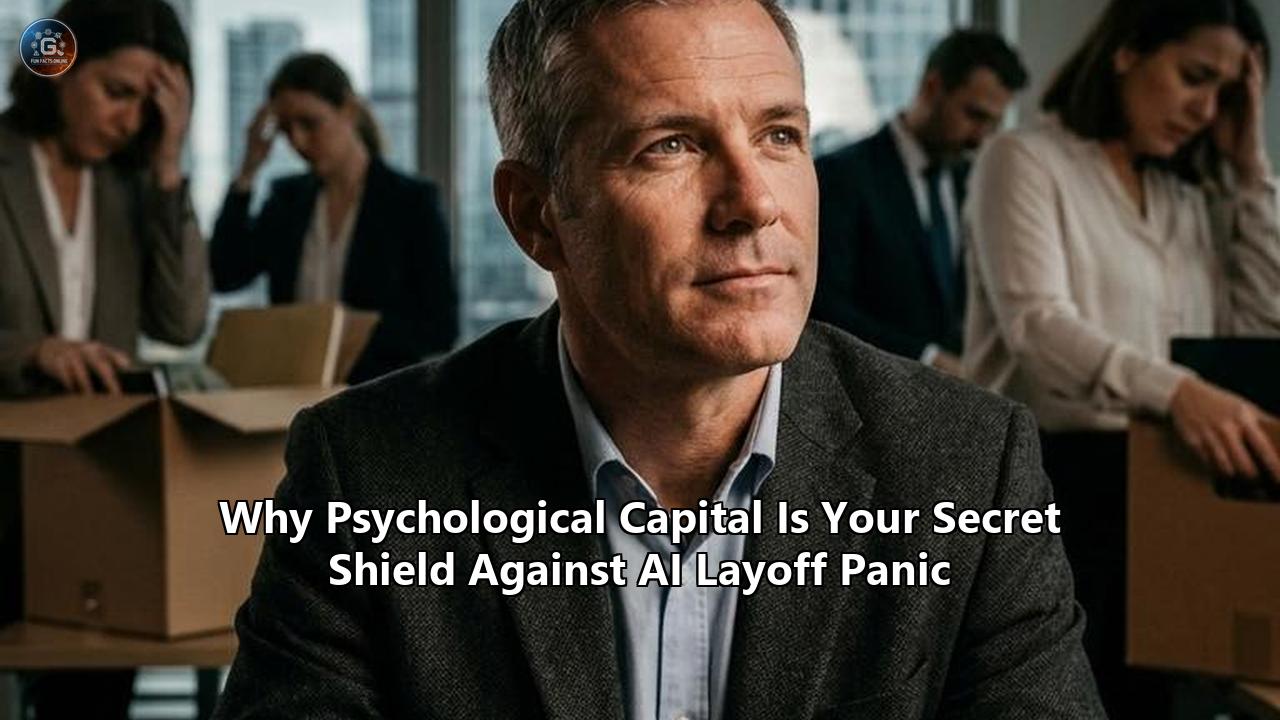
The American Psychological Association’s 2026 Work in America Survey, released on September 22, delivered an unsettling diagnosis of the American workplace: nearly two in five employees (37%) believe their job environment damages their mental health, while 48% fear artificial intelligence will render their professional duties obsolete. The findings arrive alongside grim labor figures. Through August 2026, corporate employers cited artificial intelligence as the direct justification for 116,175 job cuts—roughly 22% of all announced layoffs, according to executive outplacement firm Challenger, Gray & Christmas. In the technology sector alone, restructuring jumped 83% year-over-year.
Yet buried within the APA’s data sits a stark statistical anomaly: a distinct segment of the workforce remains virtually unshakeable.
While 44% of workers with low psychological reserves report active, persistent dread of losing their jobs in the coming weeks or months, only 21% of workers possessing high "Psychological Capital"—known in behavioral science as PsyCap—share that anxiety. Even as generative models automate code generation, contract analysis, technical drafting, and quantitative modeling, workers equipped with this internal cognitive architecture demonstrate half the displacement anxiety, maintain three times greater job stability sentiment, and report significantly higher performance under acute workplace upheaval.
Psychological Capital is neither vague positive thinking nor innate temperament. It is a measurable, developmental state composed of four distinct capacities: Hope, Efficacy, Resilience, and Optimism (HERO). As artificial intelligence restructures white-collar employment at historic speed, understanding the behavioral mechanics of PsyCap explains why technical prowess alone fails to prevent panic, and how cognitive resilience operates as a defense mechanism when coping with ai layoffs.
The Anatomy of Displacement Dread: Why Algorithmic Redundancy Breaks the Human Brain
To understand why automated displacement triggers acute psychological distress, one must understand how algorithmic disruption differs from previous waves of industrial automation.
Mechanization during the 19th and 20th centuries replaced muscle. Assembly line robotics in the 1970s and 1980s substituted for repetitive manual dexterity. Both waves primarily targeted physical execution, leaving human intellectual agency, symbolic reasoning, and creative judgment intact as unique economic territory.
Generative systems, neural workflow engines, and autonomous software agents directly target symbolic processing. They summarize legal precedent in seconds, draft production-ready software architecture, construct predictive financial models, and generate marketing campaigns. Because white-collar professionals built their socioeconomic identity and sense of personal value upon cognitive output, the sudden competence of automated systems strikes at the foundational core of their self-worth.
                     PERCEIVED THREAT OF TECHNOLOGICAL OBSOLESCENCE
                                          │
                  ┌───────────────────────┴───────────────────────┐
                  ▼                                               ▼
         Traditional Layoffs                             Agentic AI Layoffs
  ─────────────────────────────────              ──────────────────────────────────
  • Targeted at physical/manual tasks            • Targets cognition, judgment, language
  • Cyclical/macroeconomic causation             • Structural, permanent replacement
  • "My company hit hard times"                  • "My intellectual output is obsolete"
  • Clear alternative employers                  • Universal cross-industry capability
  • Skills remain economically viable            • Technical skills degrade exponentially
A September 2026 study on vicarious occupational threat published in cognitive psychology literature revealed that workers do not need to receive a pink slip to experience severe cognitive impairment. The mere exposure to demonstrations of autonomous systems performing complex professional tasks triggers what researchers call "anticipatory agency loss". When individuals perceive an external system acting with human-level autonomy, the brain’s amygdala processes the event not as a routine workplace transition, but as a severe survival threat.
This triggers a cascade of neuroendocrine responses: chronic elevations in cortisol, elevated baseline heart rates, and a pronounced reduction in prefrontal cortex activity. The immediate workplace symptoms are severe:
- Attentional tunneling: Employees spend disproportionate working hours monitoring internal corporate communications, tracking executive tone, and consuming catastrophic social media commentary.
- Defensive paralysis: Teams avoid adopting new automated workflows for fear of actively training their automated replacements, paradoxical behavior that accelerates their perceived redundancy.
- Identity collapse: Professionals who spent decades refining specific technical skills—such as manual code writing, visual design, or accounting reconciliations—experience acute grief over the sudden commoditization of their expertise.
The standard corporate response to this anxiety has been to mandate technical upskilling: advising workers to enroll in prompt engineering seminars, data literacy workshops, or machine learning bootcamps. Yet labor data illustrates why that approach frequently falls short. When corporate boards justify head-count reductions by citing autonomous efficiency gains, technical retraining cannot outpace the development curve of the underlying models. The root vulnerability is not technical ignorance; it is psychological depletion.
Deconstructing the HERO Framework: The Four Pillars of Psychological Capital
Psychological Capital was formalized in positive organizational behavior by researchers Fred Luthans, Carolyn M. Youssef-Morgan, and Bruce J. Avolio. Unlike static personality traits governed by genetics (such as introversion or neuroticism) and distinct from fleeting emotional states (such as momentary happiness), PsyCap occupies a specific psychological territory: it is "state-like," meaning it is quantifiable, responsive to targeted environmental interventions, and systematically developable.
The model operates on four interconnected cognitive pillars, forming the acronym HERO:
                           PSYCHOLOGICAL CAPITAL (PsyCap)
                                         │
        ┌───────────────────┬────────────┴───────┬───────────────────┐
        ▼                   ▼                    ▼                   ▼
    [ HOPE ]           [ EFFICACY ]        [ RESILIENCE ]      [ OPTIMISM ]
   Willpower &         Confidence to        Bouncing Back       Objective,
   Waypower to        Master Ambiguous     & Bouncing Beyond    Flexible
   Forge Paths           Challenges          Adversity        Attributions
1. Hope (Snyder’s Waypower and Willpower)
In popular parlance, hope is often dismissed as wishful thinking or passive expectation. Within cognitive psychology, however, hope is operationalized through C.R. Snyder’s Hope Theory as a dynamic two-part mechanism:
- Agency thinking (willpower): The internal resolve and goal-directed energy required to initiate and sustain movement toward an objective.
- Pathways thinking (waypower): The mental capacity to generate alternative, workable routes to an objective when primary avenues are blocked.
A worker lacking PsyCap treats an automated corporate restructuring as an absolute dead end: "The software executes my core task; therefore, my economic viability has vanished."
A worker possessing high Hope approaches the disruption through dynamic waypower: "Generative tools have automated my analytical production; therefore, I must redirect my agency toward high-stakes systems evaluation, synthesis, and inter-organizational negotiation, using three separate career pivots to circumvent automated bottlenecks." Hope generates alternative avenues rather than surrendering to closed roads.
2. Self-Efficacy (Bandura’s Social Cognitive Agency)
Rooted in Albert Bandura’s foundational social cognitive theory, self-efficacy is an individual’s conviction regarding their capability to mobilize the motivation, cognitive resources, and courses of action necessary to successfully execute a specific task within a given context.
In environments rattled by algorithmic disruption, low-efficacy workers suffer from imposter syndrome amplified by computational speed. When an automated system drafts an executive memo or processes complex raw databases in seconds, the low-efficacy employee assumes their personal judgment is inferior.
High-efficacy professionals maintain a clear delineation between raw compute and strategic context:
- They view machine outputs as raw inputs requiring critical human verification, ethical calibration, and context integration.
- They exhibit confidence in their ability to master novel algorithmic tools without feeling diminished by the tool’s processing speed.
- They actively lean into ambiguous, poorly defined organizational problems where machines struggle due to data sparsity or conflicting ethical priorities.
3. Resilience (Masten and Luthans' Dynamic Recovery)
Developmental psychologist Ann Masten described human resilience as "ordinary magic"—the normative, daily capacity of human adaptation systems to survive stress and disturbance. In organizational PsyCap, Luthans expanded this concept beyond merely "snapping back" to an original baseline.
True organizational resilience involves "bouncing beyond": using acute structural disruption as an inflection point to evolve higher operational capacity. When restructuring hits a division, low-resilience individuals enter prolonged cognitive freeze, cataloging losses and experiencing prolonged emotional exhaustion. High-resilience professionals execute rapid operational triage:
- Adversity acceptance: Acknowledging the baseline reality of corporate restructuring without indulging in denial or futile resentment.
- Structural asset mobilization: Activating professional relationships, institutional knowledge, and personal support systems.
- Adaptive reconfiguration: Iterating skill portfolios to match new market realities, treating layoffs not as an indictment of capability, but as a standard event within a volatile economic system.
4. Optimism (Seligman’s Explanatory Framework)
In the PsyCap architecture, optimism has nothing to do with toxic positivity or naive cheerfulness. It is grounded entirely in Martin Seligman’s learned optimism and explanatory attribution theory.
Explanatory style governs how an individual mentally explains the causes of positive and negative life events across three dimensions: Permanence, Pervasiveness, and Personalization.
| Dimension | Low PsyCap (Pessimistic Attribution) | High PsyCap (Flexible Optimistic Attribution) |
|---|---|---|
| Permanence | "AI has permanently destroyed my career field, and I will never find meaningful work again." | "This corporate restructuring reflects an early-stage transition; specific tasks are automated, but new operational niches are opening." |
| Pervasiveness | "My entire professional value has vanished; I am completely incompetent in the modern economy." | "A specific subset of analytical tasks has been commoditized; my judgment, leadership, and contextual problem-solving remain intact." |
| Personalization | "I was selected for this layoff because I am fundamentally flawed and failed to keep up." | "This workforce reduction is a broader capital reallocation driven by market incentives and corporate margin adjustments." |
By attributing the disruption to external, temporary, and situation-specific factors, high-PsyCap individuals prevent negative shocks from inducing clinical learned helplessness.
The Synergistic Core: Why the Whole Outperforms the Parts
PsyCap operates as a higher-order, synergistic construct. The four individual components do not function as isolated silos; they create an integrated psychological compound where each element reinforces the other three.
                  ┌─────────────────────────────────────────┐
                  │                 HOPE                    │
                  │  Generates alternative career pathways  │
                  └────────────────────┬────────────────────┘
                                       │
            ┌──────────────────────────┴──────────────────────────┐
            ▼                                                     ▼
┌───────────────────────┐                             ┌───────────────────────┐
│     SELF-EFFICACY     │◄───────────────────────────►│       OPTIMISM        │
│  Supplies confidence  │      Dynamic Mutual         │ Re-frames setbacks    │
│  to execute pathways  │       Reinforcement         │ as temporary challenges│
└───────────────────────┘                             └───────────────────────┘
            ▲                                                     ▲
            └──────────────────────────┬──────────────────────────┘
                                       │
                  ┌────────────────────┴────────────────────┐
                  │              RESILIENCE                 │
                  │  Absorbs setbacks when initial pathways │
                  │  run into corporate obstacles           │
                  └─────────────────────────────────────────┘
Consider a corporate finance analyst whose division is downsized after the implementation of automated forecasting software:
- Without Hope, the analyst lacks the vision to map a path toward strategic advisory roles.
- Without Self-Efficacy, the analyst lacks the courage to present themselves as capable of handling complex cross-functional operations.
- Without Resilience, the first three job rejections extinguish their job search effort entirely.
- Without Optimism, the analyst attributes the restructuring to personal failure, descending into cyclical depression.
When all four elements operate in unison, they establish what organizational psychologists describe as a "resource caravan." As detailed in Stevan Hobfoll’s Conservation of Resources (COR) theory, psychological resources do not travel alone; they cluster together. An individual with a high baseline of PsyCap possesses internal cognitive reserves that actively shield them from the resource depletion cycles that typify acute workplace crises.
The Science of Psychological Shields: Cognitive Appraisal and Resource Conservation
The stark divide documented by the APA—where low-PsyCap workers are more than twice as likely to experience persistent layoff panic compared to high-PsyCap peers—is explained by classical Cognitive Appraisal Theory, pioneered by Richard Lazarus and Susan Folkman.
Lazarus and Folkman established that psychological stress is not an inherent property of an external event. Stress occurs through a two-stage cognitive appraisal process:
[ External Event: AI Restructuring Announcement ]
                        │
                        ▼
             Primary Cognitive Appraisal
      "Is this event threatening, benign, or irrelevant?"
                        │
       ┌────────────────┴────────────────┐
       ▼                                 ▼
   [ Threat / Loss ]               [ Challenge ]
(Low PsyCap Pathway)           (High PsyCap Pathway)
       │                                 │
       ▼                                 ▼
 Secondary Appraisal              Secondary Appraisal
"Do I have the internal           "I possess sufficient cognitive
and external resources            resilience, adaptive networks,
to cope with this shock?"         and alternate pathways."
       │                                 │
       ▼                                 ▼
 [ Panic, Burnout,                 [ Targeted Adaptation,
Defensive Inaction ]              Exploration, Agency ]
When an enterprise announces automated workforce consolidations, every employee immediately undergoes Primary Appraisal: What does this mean for me?
- Low-PsyCap individuals categorize the development as an existential Threat or an irrecoverable Loss. The amygdala initiates a fight-or-flight response. Because they perceive the automated system as an omnipotent agent possessing greater competence than themselves, their appraisal assumes certain disaster.
- High-PsyCap individuals categorize the exact same corporate communication as a Challenge. The event is appraised not as personal annihilation, but as an external shift in operational rules.
Next occurs Secondary Appraisal: Do I possess the coping resources necessary to handle this?
This is where the psychological capital divide widens into a chasm. Low-PsyCap employees assess their coping capabilities as near zero. They experience what Lazarus termed "coping deficiency," leading directly to acute anxiety, insomnia, psychosomatic illness, and organizational cynicism.
Employees with elevated PsyCap assess their internal resources as fully adequate. They recognize that while they cannot alter corporate macroeconomic decisions, they retain absolute ownership over their cognitive appraisal, tactical skill adaptation, and external market positioning.
A 2026 empirical study published in Frontiers in Psychology examining workplace adaptation discovered that Psychological Capital directly mediates the tension between AI adoption and innovative work behaviors. Workers who viewed autonomous software through a high-PsyCap lens suffered zero decline in psychological well-being; instead, they demonstrated increased creative initiative.
They transformed the software from an existential adversary into a task-level resource, offloading cognitive drudgery to focus on high-touch strategic problem-solving. For knowledge workers actively coping with ai layoffs, this cognitive flip marks the boundary between professional obsolescence and professional elevation.
The Hard Economic Realities: Dissecting the 2026 Labor Landscape
To build an authentic psychological defense, workers must understand the economic and corporate realities driving algorithmic workforce reductions. Blanket statements claiming "AI will replace all humans" or "AI is merely an overhyped novelty" are equally destructive to sound psychological functioning.
Challenger, Gray & Christmas data demonstrates that job eliminations citing artificial intelligence are heavily concentrated. The technology industry leads all sectors, accounting for 149,023 job cuts through July 2026—a 67% increase compared to the same period in 2025. Technology positions make up nearly a third of all national workforce reductions.
                2026 U.S. WORKFORCE DISPLACEMENT BENCHMARKS
─────────────────────────────────────────────────────────────────────────────
Metric                                                Data Point      Source
─────────────────────────────────────────────────────────────────────────────
AI-Attributed Layoffs (Jan-Aug 2026)                  116,175 cuts    Challenger
AI Share of Total Announced Layoffs                   22%             Challenger
Tech Sector Layoffs (Through July 2026)               149,023 cuts    Challenger
YoY Tech Sector Layoff Growth                         +67%            Challenger
Workers Worried Duties Will Become Obsolete           48%             APA
Workers Believing Tech Benefits Employers Over Labor   64%             APA
Immediate Job Loss Panic (Low PsyCap Workers)         44%             APA
Immediate Job Loss Panic (High PsyCap Workers)        21%             APA
─────────────────────────────────────────────────────────────────────────────
However, labor market analysts highlight an essential corporate distinction: "AI-attributed cuts" frequently obscure standard corporate cost management. Corporate executives often frame restructuring around artificial intelligence to signal modern efficiency to institutional investors and public equity markets. In many cases, organizations are executing structural head-count reductions to offset margin pressures from interest rates and post-pandemic overhiring, utilizing algorithmic advancement as an investor-friendly explanation.
Simultaneously, genuine operational substitutions are occurring:
- Mid-level analytical compression: Roles centered entirely around information retrieval, preliminary data synthesis, basic unit testing, and standardized document production are undergoing severe shrinkage.
- Managerial span-of-control expansion: Because autonomous tracking and generative workflow software handle baseline coordination, organizations are flattening management hierarchies, drastically increasing the ratio of direct reports per executive.
- The "Juniorization" of specialized tasks: Senior personnel, augmented by enterprise LLMs, are executing complex production tasks previously assigned to junior analysts, altering historical corporate apprenticeship pipelines.
Understanding this economic landscape allows professionals to engage in objective reality testing. When corporate downsizings occur, the low-PsyCap individual perceives a personal war between humanity and silicon. The high-PsyCap individual perceives a predictable corporate capital reallocation cycle. That intellectual clarity is an indispensable prerequisite for anyone focused on coping with ai layoffs without succumbing to fatalism.
Tactical Protocol: Systematic Methods to Train the HERO Defense
Because Psychological Capital is state-like rather than an immovable personality trait, it can be systematically increased through targeted behavioral practices. Empirical research by Luthans and colleagues demonstrated that even micro-interventions spanning targeted sessions produce statistically significant increases in individual PsyCap scores, directly correlating with decreases in professional burnout and increases in objective job performance.
                 PRACTICAL PROTOCOL TO BUILD PSYCHOLOGICAL CAPITAL
                                         │
        ┌───────────────────┬────────────┴───────┬───────────────────┐
        ▼                   ▼                    ▼                   ▼
    [ HOPE ]           [ EFFICACY ]        [ RESILIENCE ]      [ OPTIMISM ]
Recursive Goal      Algorithmic          Downside Stress-    Explanatory Style
Deconstruction      Micro-Mastery        Testing & Pre-Mortem Re-Engineering
The following protocols provide an empirical framework for developing the four HERO capacities against workplace automation panic:
1. Hope Training: Recursive Goal Deconstruction and "Waypower" Mapping
Hope is strengthened by dismantling macro-objectives into granular operational stepping stones and deliberately designing contingency branches before obstacles emerge.
- Identify the Core Value Vector: Document the underlying economic utility of your role, detached from current tactical software tools. If you are an accountant, your core value is not spreadsheet calculation; it is corporate capital integrity, regulatory navigation, and financial risk mitigation.
- Map Three Autonomous Career Pathways: For every primary career trajectory, construct two distinct contingency pathways.
Pathway A (Deep Integration): Leveraging automated tools to become a 10x operator within your existing organizational domain.
Pathway B (Adjacent Shift): Pivoting your foundational domain expertise into corporate risk management, compliance, model evaluation, or cross-functional strategy.
Pathway C (Radical Repositioning): Identifying underserved, high-touch, human-centric operational gaps within your industry that automated models cannot navigate due to physical constraints or regulatory liabilities.
- Weekly Micro-Waypower Audits: Every Friday, document one corporate roadblock encountered during the week and map out three alternative avenues around it. This rewires the brain’s default response away from defeatist resignation toward proactive path-generation.
2. Self-Efficacy Training: Algorithmic Micro-Mastery and "In-the-Loop" Dominance
Bandura demonstrated that self-efficacy is cultivated most effectively through "mastery experiences"—incremental, concrete successes in overcoming challenging tasks.
- Execute Daily Adversarial Testing: Rather than passively consuming AI output or defensively ignoring new enterprise releases, spend twenty minutes daily testing the boundary failures of the software tools threatening your vertical.
Note where the models hallucinate edge-case legal statutes, miscalculate contextual operational risk, or produce hollow, derivative prose.
Documenting machine failure modes establishes a grounded, empirical understanding of where computational efficiency ends and where necessary human oversight begins.
- Build an Evidence-Based Accomplishment Ledger: Maintain an active record detailing every instance where human intervention, contextual nuance, or institutional knowledge corrected an automated error, saved a client relationship, or executed an ambiguous strategy. Review this ledger when anticipatory displacement anxiety spikes.
3. Resilience Training: Cognitive Pre-Mortems and Asset Audits
Resilience relies on decoupling acute organizational stress from catastrophic emotional spiral.
- Conduct a Personal Corporate Pre-Mortem: Deliberately confront the worst-case scenario. Assume your division is eliminated tomorrow morning in an algorithmic restructuring.
Document precise, chronological operational responses for Days 1 through 30: severance negotiation points, immediate operational budget reductions, health insurance transitions, dynamic portfolio deployments, and direct executive outreach cadences.
Demystifying the acute disruption strips the event of its paralyzing, abstract horror. When a contingency plan exists on paper, the amygdala downregulates emergency threat signaling.
- Inventory Your Non-Depreciable Assets: Compile a strict balance sheet of assets that corporate algorithmic transitions cannot erase:
Established networks of trust across cross-industry colleagues.
Reputation for exceptional ethical judgment and organizational loyalty.
Deep domain wisdom and intuition forged through decades of complex project management.
Foundational psychological agility and emotional discipline.
4. Optimism Training: Explanatory Attribution Re-Engineering
Optimism is trained through conscious, cognitive-behavioral tracking of explanatory attribution habits.
- Deploy the ABCDE Reframing Protocol: Developed by Albert Ellis and refined by Seligman, this technique breaks destructive cognitive attribution cycles:
A (Adversity): Corporate leadership announces a company-wide implementation of autonomous customer routing agents, sparking immediate redundancy rumors.
B (Belief): "My experience is completely worthless now. Our team is going to be wiped out, and our careers are over."
C (Consequence): Feelings of profound dread, avoidance of current assignments, disrupted sleep, and strained peer interactions.
D (Disputation): Actively challenge the belief with factual counter-evidence: "Enterprise transitions take years to execute fully. Automated agents handle routine queries well, but complex, escalated disputes and high-value clients require sophisticated relational navigation. My career is not worthless; its operational focus must simply evolve."
E (Energization): A noticeable restoration of focused energy, calm operational situational awareness, and systematic career self-determination.
Mastering these four components constructs an internal cognitive armor, providing a resilient psychological foundation when coping with ai layoffs.
The Strategic Organizational Mandate: Building Institutional PsyCap
While the individual benefits of Psychological Capital are substantial, the APA’s 2026 data sends an unequivocal warning to executive suites, boardrooms, and People and Culture leaders: psychological depletion is an acute organizational risk with measurable balance sheet consequences.
                     THE CORPORATE PSYCAP FEEDBACK LOOP
                                     │
        ┌────────────────────────────┴────────────────────────────┐
        ▼                                                         ▼
[ PUNITIVE / SURVEILLANCE CULTURE ]              [ HIGH-PSYCAP ERROR-MANAGEMENT CULTURE ]
────────────────────────────────────             ─────────────────────────────────────────
• Algorithmic worker surveillance                 • Psychological safety for tool exploration
• Sudden, opaque layoff announcements             • Transparent roadmaps on automation deployments
• Employees hide machine failures                 • Open reporting of algorithmic edge-case errors
• Widespread disengagement & "Quiet Quitting"     • High retention, creative problem-solving
• Collapse of institutional trust                 • Resilient, adaptive workforce
According to the APA’s survey, workers possessing low PsyCap are more than two-and-a-half times as likely to intend to leave their organizations within the next twelve months compared to those with high PsyCap (51% vs. 19%). Furthermore, 64% of employees now believe technological advancements benefit employers at the expense of workers, up from 52% in 2025.
When leadership implements algorithmic software amid an organizational climate of silence, surveillance, and sudden workforce terminations, they induce systemic employee paralysis. Employees intentionally underutilize automated tools, conceal algorithmic hallucinations to avoid corporate attention, and quietly disengage from discretionary innovation.
To build an organization capable of navigating sustained technological upheaval, enterprise leadership must shift away from treating workforce psychology as a secondary human resources initiative and elevate it to core capital architecture:
1. Institute Error-Management Frameworks Over Punitive Auditing
Research indicates that an organization’s error-management climate significantly strengthens the positive relationship between AI adoption and employee Psychological Capital. In punitive cultures where making an error while navigating automated tools leads to disciplinary action, employees retreat into self-preservation.
In robust error-management cultures:
- Mistakes made while piloting algorithmic systems are treated as institutional learning opportunities.
- Workers are openly encouraged to flag edge-case failures, bias, and structural errors without fear of retribution.
- This psychological safety enables employees to experiment with emerging toolchains, elevating their perceived self-efficacy and mutual trust.
2. Transition from Threat-Based Messaging to Human-Complementary Architectures
Executive communications that frame AI investments around "slashing head counts" or "replacing human operational bottlenecks" routinely backfire. While intended to appease external equity analysts, this messaging immediately destabilizes the organization’s most valuable intellectual talent.
High-performing employees do not wait around to be automated; they proactively exit to forward-thinking competitors. Leadership must explicitly define the strategic boundary between automated processing and human cognitive oversight, proving that algorithmic productivity dividends are reinvested into higher-value business creation.
3. Deploy Structured PsyCap Interventions Across Management Tiers
Organizations must train managers to recognize the subtle behavioral warning signs of acute automated displacement dread: uncharacteristic withdrawal in strategic meetings, passive tool avoidance, and pervasive fatalism.
Integrating structured Psychological Capital Interventions into formal management development provides operational leaders with the behavioral toolsets required to coach their teams through ambiguity, continually deconstruct complex corporate goals, and nurture systemic adaptability.
By cultivating an organizational environment that values internal psychological reserves as deeply as technological infrastructure, enterprises transform their teams from anxious observers into dynamic partners in strategic evolution.
Navigating the Uncharted Frontier of Human Labor
As enterprise software transitions from interactive chat interfaces to fully autonomous, multi-agent algorithmic workflows, the velocity of corporate restructuring will test the global workforce in unprecedented ways. The lines between technical competencies and automated capabilities will continue to blur, rendering static technical skills increasingly perishable.
In this operating environment, technical knowledge serves merely as temporary table stakes. The enduring competitive advantage—the ultimate personal shield protecting an individual from structural panic and professional obsolescence—is Psychological Capital.
The data from behavioral science is clear: markets undergo seismic structural realignments, corporate boards make cold mathematical decisions, and automated models will continue their relentless march toward operational efficiency. But the human capacity to generate dynamic pathways (Hope), to maintain conviction in one’s unique critical agency (Efficacy), to bounce beyond catastrophic structural shocks (Resilience), and to contextualize economic change through objective, constructive appraisal (Optimism) remains distinctly our own.
                     THE EXPANDING HORIZON OF WORKFORCE VALUE
─────────────────────────────────────────────────────────────────────────────
Traditional Focus (Vulnerable to AI)       PsyCap Focus (Resilient to AI)
─────────────────────────────────────────────────────────────────────────────
• Memorizing syntax and routine code       • Systems architecture & strategic framing
• Drafting standard reports & memos        • High-stakes persuasion & negotiation
• Compiling raw historical balance sheets  • Contextual risk & ethical governance
• Passive compliance with rigid workflows   • Proactive problem identification
• Static technical skill accumulation      • Dynamic psychological agility (HERO)
─────────────────────────────────────────────────────────────────────────────
Economic history affirms that those who attempt to defend obsolete task boundaries are eventually overrun by technological advancement. Conversely, those who succumb to dread abandon their professional agency long before their positions are formally eliminated.
The path forward requires building internal mental assets that cannot be commoditized or automated. By deliberately building your Psychological Capital, you construct an internal cognitive fortress. Whatever changes take shape in the corporate landscape, that psychological shield ensures that while technology may rewrite the rules of your industry, it will never dictate the limits of your worth.
Reference:
- https://www.apa.org/pubs/reports/work-in-america/2026
- https://www.apa.org/news/press/releases/2026/09/psychological-capital-work-stress
- https://www.businesstoday.in/technology/story/us-jobs-paradox-ai-exposed-roles-see-46-pay-surge-even-as-ai-linked-layoffs-rise-556730-2026-09-21
- https://www.techtimes.co.uk/ai-job-cuts-rising-demand-ai-skills-1808765
- https://www.hrdive.com/news/tech-layoffs-surge-83percent-h1-2026-challenger-ai-disruption/824320/
- https://pubmed.ncbi.nlm.nih.gov/33339210/
- https://digitalcommons.spu.edu/iop_etd/34/
- https://drjodie.com.au/workplace-anxiety-ai/
- https://www.forbes.com/sites/lanceeliot/2026/09/09/employees-are-psychologically-worried-about-ai-job-replacement-even-when-they-arent-on-the-chopping-block/
- https://www.frontiersin.org/journals/psychology/articles/10.3389/fpsyg.2026.1740508/full
- https://www.challengergray.com/blog/challenger-report-layoffs-fall-hiring-picks-up-ai-leads-for-fifth-straight-month/