Breaking the Locomotion Paradox: Active Filaments Speed Up in Tight Spaces
In classical fluid mechanics and everyday human experience, navigating a narrow, crowded corridor is substantially slower than sprinting across an open field. In statistical physics and polymer chemistry, threading a long, flexible macromolecule—such as genomic DNA—through a microscopic pore imposes an entropic penalty that invariably hinders its translocation.
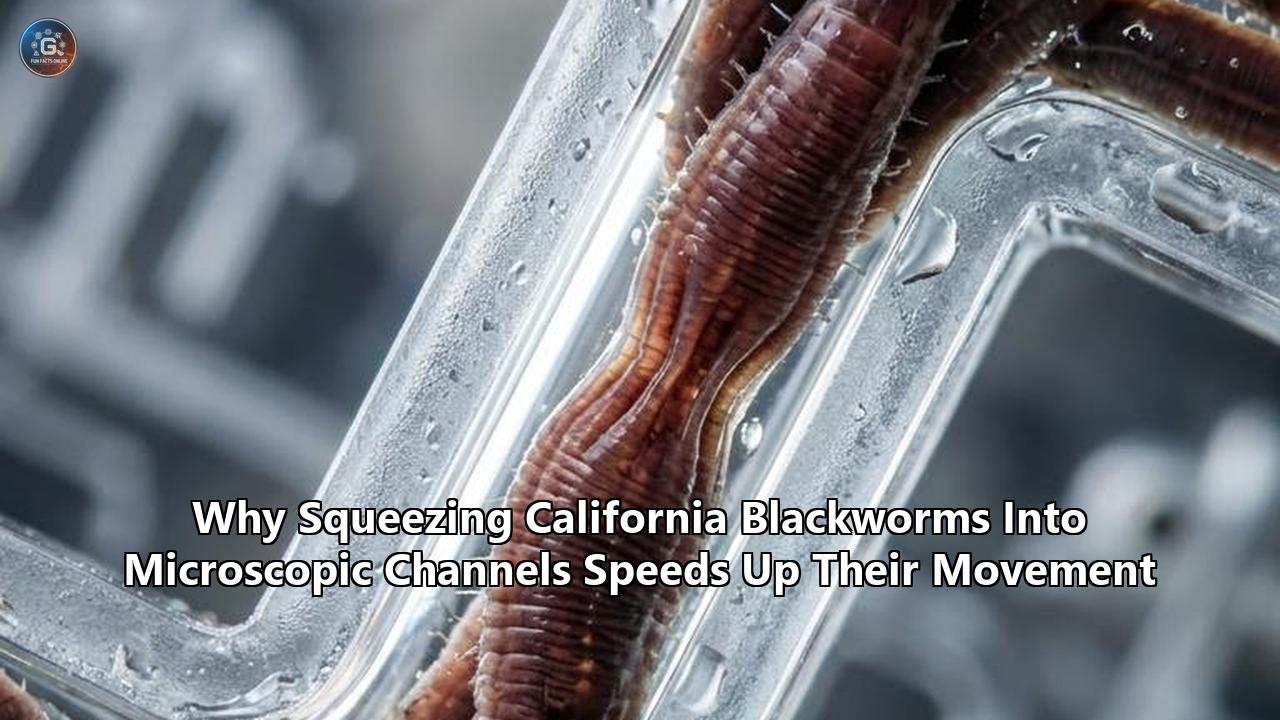
A team of biophysicists and bioengineers from the Georgia Institute of Technology and the University of Colorado Boulder overturned this foundational intuition. Publishing their investigations in Physical Review Letters, the research group revealed that the aquatic California blackworm (Lumbriculus variegatus) moves up to five times faster when squeezed into tight, microscopic channels than when traversing wide, open environments.
When confined within narrow glass capillaries whose internal width is only slightly larger than their body diameter, individual blackworms straighten out, align their internal propulsion axes directly with the channel geometry, and shoot forward like biological projectiles. In contrast, when placed in spacious arenas, the worms execute lateral exploratory bends, form spontaneous loops, and lose forward momentum to lateral hunting cycles.
WIDE CHANNEL (W >> d): High Rotational Entropy, Frequent Reversals
~~~~~~~~~~~~~~~~~~~~~~~~~~~~~~~~~~~~~~~~~~~~~~~~~~~~~~~~~~~~~~~~~
   [Wall] ---------------------------------------------------
            \      /~~~\      /      /\
             \____/     \____/      /  \  <-- Lateral Loops & Delay
   [Wall] ---------------------------------------------------
   Result: High lateral dispersion, low axial velocity (T_escape ~ 3-5x longer)

NARROW CHANNEL (W ~ d): Confinement-Suppressed Buckling
~~~~~~~~~~~~~~~~~~~~~~~~~~~~~~~~~~~~~~~~~~~~~~~~~~~~~~~~~~~~~~~~~
   [Wall] ===================================================
            ===============================================>  <-- Axial Thrust
   [Wall] ===================================================
   Result: Suppression of transverse bending, 100% axial force transmission
"It was much faster in the smallest confinement," explained Dr. K.R. Prathyusha, a theoretical physicist and co-lead author of the investigation. "That is very rare in nature, that if you have less navigation room, things get faster," noted Dr. David Hu, a biomechanist and roboticist at Georgia Tech who was not directly involved with the experiments.
The discovery provides a unified mathematical framework for active polymer translocation and establishes a fresh set of physical rules for autonomous soft robotics, minimally invasive surgical devices, and search-and-rescue systems designed to traverse highly confined, subterranean, or biological mazes.
1990s–2010s: The Classical Benthic Baseline and the Mechanics of Oligochaetes
To understand why this discovery sent ripples through the soft matter and biomechanics communities, one must trace the timeline of blackworm locomotion research back three decades. For decades, Lumbriculus variegatus was primarily regarded as an educational organism and a model system for neurobiological reflex assays.
Measuring roughly 0.5 millimeters in diameter and between 25 to 80 millimeters in length, these freshwater oligochaetes inhabit the shallow sediments of marshes, ponds, and ditch beds throughout North America and Europe. Their benthic lifestyle demands constant survival within dense silt, decaying plant debris, and waterlogged mud.
========================================================================================
CHRONOLOGICAL DEVELOPMENT: FROM BENTHIC ECOLOGY TO ACTIVE MATTER ACCELERATION
========================================================================================
[1999] Drewes establishes classic helical reflex & peristaltic locomotion models.
   │
[2015-2018] Transition to active matter: Worms analyzed as macroscopic polymer analogues.
   │
[2021] Bhamla Lab uncovers collective "worm blob" mechanics and thermotaxis dynamics.
   │
[2023] Patil et al. resolve ultrafast Gordian topological unknotting in milliseconds.
   │
[Late 2024] Computational simulations show unexpected acceleration in tight channels.
   │
[2025-2026] Millifluidic glass experiments confirm 5x speed increase; scaling laws proven.
========================================================================================
In 1999, pioneering work by neurobiologist Charles Drewes mapped the fundamental neuro-muscular circuits governing California blackworms movement. Drewes documented that L. variegatus possesses a dual-propulsion locomotive system:
- Peristaltic Crawling: Driven by alternating contractions of circular and longitudinal muscles operating against an incompressible, coelomic hydrostatic skeleton.
- Helical Undulation: High-speed swimming reflexes triggered by tactile stimulation of the posterior segments, sending rapid action potentials through medial and lateral giant nerve fibers.
       Hydrostatic Coelomic Cavity
       ┌────────────────────────────────────────────────────────┐
       │   Circular Muscles (contract -> elongate segment)      │
====== │ ══════════════════════════════════════════════════════ │ ======
Body   │   [ P   O   R   E   -   F   L   U   I   D ]            │   Axis
Axis   │                                                        │   --->
====== │ ══════════════════════════════════════════════════════ │ ======
       │   Longitudinal Muscles (contract -> widen segment)     │
       └────────────────────────────────────────────────────────┘
       Microscopic Chaetae (retractable frictional anchors)
During this early era, biological locomotion in fluids was interpreted strictly through classical fluid dynamics:
- At microscopic scales, fluid environments are governed by low Reynolds numbers ($Re \ll 1$), where viscous drag overwhelms inertial forces.
- In these regimes, propulsion is described by Resistive Force Theory (RFT) and slender-body hydrodynamic models developed by James Lighthill and Geoffrey Taylor.
- In unbounded fluids or macroscopic open containers, an organism must generate asymmetric drag—producing higher perpendicular drag coefficients ($C_\perp$) relative to parallel drag coefficients ($C_\parallel$)—to transform transverse body undulations into net forward propulsion:
$$\frac{C_\perp}{C_\parallel} \approx 2$$
Under this traditional framework, introducing solid physical walls was expected to impose boundary-layer drag, increase viscous resistance, and introduce geometric hindrance, theoretically slowing the organism down.
For nearly twenty years, researchers assumed that tight physical confinement was an obstacle to be overcome, rather than a mechanical accelerator.
2018–2022: From Individual Crawlers to Collective Active Matter
The turning point that transformed L. variegatus from a simple neurobiology subject into a flagship system for non-equilibrium physics occurred when soft matter physicists began viewing these worms not merely as animals, but as living, self-propelled active polymers.
In 2018, Dr. M. Saad Bhamla established his biophysics laboratory at the Georgia Institute of Technology, focusing on ultra-fast biological mechanics and emergent physical phenomena in low-power biological systems. Bhamla's team began examining the bizarre collective behaviors of California blackworms. When exposed to stressors such as cold, dryness, or light, thousands of individual blackworms spontaneously entangle themselves into cohesive, three-dimensional macroscopic "blobs" that behave simultaneously as solid-like elastic structures and fluid-like viscous droplets.
Individual Worm Dynamics                Collective Worm Tangling
(Active Tangential Motors)              (Entangled Polymer Metamaterial)
      →  →  →  →  →                           ╭────────╮
    (●~●~●~●~●~●~●~●)                        (  ╭──╮   )
    F_active along tangent                   (  ╰──╯ ╭─╮)
                                             (  ╭──╮ ╰─╯)
                                              ╰────────╯
   Individual mechanics:                     Collective mechanics:
   - Self-propelling nodes                   - Dynamic topological crosslinks
   - High aspect ratio (L/d > 50)            - Reversible shear thinning
   - Bending stiffness \kappa                - Collective thermotaxis
Between 2020 and 2022, a series of studies mapped the non-equilibrium physics of these assemblies:
- Hydrodynamic Coordination: Experiments demonstrated that blackworm aggregations could dynamically regulate oxygen uptake by positioning their collective tails at the air-water interface, forming floating respiratory "buoys" stabilized by interfacial surface tension.
- Emergent Thermotaxis: In 2021, collaborative research between Georgia Tech and the University of Colorado Boulder demonstrated that blackworm blobs could crawl across temperature gradients as a singular, unified super-organism. The collective moved through distributed mechanical interactions without centralized neurological control.
- Viscoelastic Metamaterials: Rheological testing revealed that living worm blobs exhibit non-Newtonian shear-thinning properties. When perturbed gently, the blob acts as a self-healing elastic solid; under high shear forces, individual worms slip past one another, allowing the mass to flow like an active liquid.
These collective studies exposed a critical knowledge gap. To truly model how thousands of entangled filaments interact, physicists needed precise, quantitative mathematical laws describing how a single active filament behaves when subjected to physical boundaries, confinement, and external mechanical constraints.
2023–2024: The Gordian Knot, Topological Untangling, and Active Polymers
In early 2023, the scientific narrative escalated with a major discovery regarding the topological mechanics of blackworms. In a study published in Science, a team including Dr. Vishal Patil (then at MIT, later Stanford), Professor Jörn Dunkel (MIT), and Saad Bhamla unraveled how blackworm tangles execute ultrafast escape maneuvers.
When threatened by a sudden stimulus—such as an aversive pulse of ultraviolet light or a predator's touch—a tightly knotted blackworm aggregation comprising tens of thousands of individuals can disintegrate and scatter in mere milliseconds.
                               THE TANGLE ESCAPE CASCADE

  [ Quiescent Tangled State ] ───> [ Threat Detected: UV/Tactile ]
               │                                   │
               ▼                                   ▼
  [ Slow Alternating Helices ]     [ High-Frequency Alternating Waves ]
         (Knotting Gait)                   (Unknotting Gait)
               │                                   │
               ▼                                   ▼
  [ Stable Entangled Matrix ] ───> [ 20 Millisecond Explosive Detangling ]
High-speed tracking and mathematical knot theory revealed that the worms switch their locomotive gaits between two topological regimes:
- The Tangling Phase: Worms generate slow, continuous helical body waves in a single rotational direction, naturally causing adjacent bodies to braid and tie into intricate, self-locking knots.
- The Untangling Phase: Worms instantly switch to an alternating wave gait—executing a clockwise loop immediately followed by an anti-clockwise loop in a dynamic figure-eight motion.
This rapid alternating waveform travels along the body axis, systematically neutralizing the topological braiding index and popping the knots open almost instantaneously.
"You can think of them as having two gears: a slow gear, which allows them to tangle, and a fast gear, which lets them untangle," explained Dunkel.
Because Lumbriculus variegatus operates with a decentralized nervous system containing only a few thousand neurons, this ultrafast detangling is not calculated through complex neurological processing; it is an emergent consequence of physical mechanics and geometry.
This realization led physicists to model the worm as an active flexible rod governed by standard equations of continuum mechanics. In theoretical physics, an active polymer is defined by three fundamental properties:
- Length ($L$) and Diameter ($d$): High aspect ratios ($L/d \gg 1$) that permit extensive bending.
- Bending Rigidity ($\kappa$): The elastic resistance against bending, directly proportional to the persistence length ($\ell_p = \kappa / k_B T$ in thermal systems, or $\ell_p = \kappa / \eta_{eff}$ in active athermal systems).
- Active Tangential Propulsion ($F_a$): A continuous, internal motor force directed along the tangent vector $\mathbf{\hat{t}}(s)$ at every point $s$ along the body contour:
$$\mathbf{F}_{propulsion}(s) = f_0 \mathbf{\hat{t}}(s)$$
With these active polymer equations established, researchers moved to address the next logical question: How does an active polymer behave when it is forced to move through a rigid geometric constraint?
Late 2024–2025: The Computational Surprise — When Less Space Yields More Speed
In late 2024, Georgia Tech Ph.D. student Paulami Sarkar, theoretical physicist Dr. K.R. Prathyusha, and undergraduate researcher Justin Xu set out to investigate active polymer translocation.
In statistical physics, translocation describes the movement of a polymer through a confined pore or channel. When a passive polymer (such as a long chain of DNA or synthetic polystyrene) is forced into a narrow channel, the confinement severely restricts the number of spatial conformations the chain can adopt. This reduction in conformational states represents a sharp drop in entropy ($\Delta S < 0$), creating a large free energy barrier ($\Delta F = -T\Delta S$):
$$\text{Translocation Rate (Passive)} \propto \exp\left(-\frac{\Delta F}{k_B T}\right)$$
Consequently, in the passive world, confinement slows down movement.
========================================================================================
PASSIVE VS. ACTIVE TRANSLOCATION: THE FUNDAMENTAL CONTRAST
========================================================================================

1. PASSIVE POLYMERS (e.g., DNA, RNA, Unforced Synthetic Chains):
   - Open Space: High entropy, unconstrained random coil.
   - Channel Entry: Severe entropic penalty (\Delta S < 0).
   - Mechanism: Brownian diffusion across free energy barrier.
   - Speed Dynamics: HIGH CONFINEMENT = MUCH SLOWER ESCAPE.

2. ACTIVE POLYMERS (e.g., California Blackworms):
   - Open Space: Unconstrained rotation -> looping, wandering, meandering.
   - Channel Entry: Geometric boundary suppresses rotational degrees of freedom.
   - Mechanism: 100% of internal motor thrust projected onto the longitudinal axis.
   - Speed Dynamics: HIGH CONFINEMENT = UP TO 5X FASTER ESCAPE.
========================================================================================
To model active polymers under confinement, Prathyusha and Xu built a computational framework using an active bead-spring model. In this simulation, the blackworm was modeled as a chain of $N$ spherical beads linked by stiff harmonic springs, with elastic bending penalties between adjacent segments. Each bead was equipped with an active force engine that continuously drove it forward along the local body axis, simulating continuous muscle contraction.
Active Bead-Spring Numerical Formulation:
      f_0            f_0            f_0            f_0
      ───►           ───►           ───►           ───►
     ( O ) ======= ( O ) ======= ( O ) ======= ( O )
       │   Spring    │   Spring    │   Spring    │
       └─────┬───────┘   └─────┬───────┘   └─────┬───────┘
       Bending Elasticity \kappa: E_bend = (1/2)\kappa (\theta - \theta_0)^2
The team placed the virtual worm inside two-dimensional simulated channels of length $L_{ch} = 2 L_{worm}$ and varied the channel width $W$.
During the initial simulation runs, Xu and Prathyusha noticed an unexpected anomaly:
- When the simulated channel was wide ($W \gg d$), the active chain meandered laterally, curled into U-turns, struck the lateral walls at perpendicular angles, and stalled.
- When the simulated channel was narrowed down until it was nearly the width of the chain ($W \approx 1.5 d$), the active chain aligned its trajectory with the walls and escaped through the channel exit in a fraction of the time.
Initially suspected to be a numerical artifact or a boundary-condition error in the simulation code, repeated testing with varying bending stiffness, active forces, and damping parameters confirmed the same outcome: the narrower the channel, the faster the active polymer escaped.
2025–2026: Laboratory Verification — Millifluidic Channels Reveal the Acceleration Mechanism
To verify whether living organisms behave like these simulated active filaments, Paulami Sarkar designed an experimental pipeline utilizing precision glass channels filled with artificial pond water.
Experimental Setup: Millifluidic / Capillary Translocation Assay
────────────────────────────────────────────────────────────────────────────────────────
 [High-Speed Overhead Infrared/Optical Camera (100-500 fps)]
                              │
                              ▼
  ════════════════════════════════════════════════════════════════════════════════════
  [ Channel Entrance ]                                            [ Channel Exit ]
  --------------------------------------------------------------------------------
   ( Worm Injected ) ======> [ Width W: 1 mm to 8 mm ] ======> [ Escape Recorded ]
  --------------------------------------------------------------------------------
  [ Length L = 120 mm | Substrate: Ultra-smooth borosilicate glass / water bath ]
  ════════════════════════════════════════════════════════════════════════════════════
The Experimental Parameters
- Test Organism: Healthy adult Lumbriculus variegatus (length $L \approx 40\text{--}60\text{ mm}$, diameter $d \approx 0.5\text{ mm}$).
- Channel Dimensions: Borosilicate glass channels of length $L_{ch} = 120\text{ mm}$ (roughly two to three times the worm's resting body length).
- Channel Widths ($W$): Systematically varied across five distinct regimes:
$W = 1.0\text{ mm}$ (extreme confinement: $W \approx 2d$)
$W = 2.0\text{ mm}$ (moderate confinement: $W \approx 4d$)
$W = 4.0\text{ mm}$ (intermediate confinement: $W \approx 8d$)
$W = 6.0\text{ mm}$ (loose confinement: $W \approx 12d$)
$W = 8.0\text{ mm}$ (quasi-unbounded channel: $W \approx 16d$)
- Imaging & Tracking: High-speed, high-resolution video recording (100–500 frames per second) paired with custom machine-vision kinematic tracking software to extract center-of-mass velocity ($v_{cm}$), body orientation angle ($\psi$), curvature profiles ($\kappa(s,t)$), and total escape time ($T_{esc}$).
========================================================================================
EXPERIMENTAL TRANSLOCATION METRICS ACROSS VARYING CHANNEL WIDTHS
========================================================================================
Channel Width (W)   Relative Confinement (W/d)   Escape Time (T_esc)   Axial Speed (v_x)
----------------------------------------------------------------------------------------
1.0 mm              2x Body Diameter             38.4 ± 4.2 s          ~ 3.1 mm/s
2.0 mm              4x Body Diameter             44.1 ± 5.6 s          ~ 2.7 mm/s
4.0 mm              8x Body Diameter             89.7 ± 11.3 s         ~ 1.3 mm/s
6.0 mm              12x Body Diameter            142.5 ± 18.2 s        ~ 0.8 mm/s
8.0 mm              16x Body Diameter            196.2 ± 24.5 s        ~ 0.6 mm/s
========================================================================================
Key Finding: Worms in 1.0 mm channels reached the exit over 5 times faster than in 8.0 mm channels.
The live biological experiments mirrored the computational predictions:
- In the 1.0 mm channel, a California blackworm entered the conduit, straightened its entire body contour along the glass boundary walls, and propagated steady waves of contraction down its body. It traversed the 120 mm length in under 40 seconds.
- In the 8.0 mm channel, the same blackworm entered the conduit, but without tight lateral boundaries to constrain its head, the anterior segments initiated lateral "searching" motions. The worm repeatedly curled its body, attempted to turn 180 degrees, bumped into side walls at steep angles, and frequently formed tangled coils. Its net axial velocity cratered, taking more than three minutes to escape.
The laboratory data verified that California blackworms movement undergoes a confinement-induced acceleration.
The Mathematical Engine: Dimensional Ratios, Bending Stiffness, and Confinement
To explain the physical mechanism behind this acceleration, the Georgia Tech and CU Boulder researchers established a unified analytical scaling model.
In locomotion physics, a self-propelled slender body balances active muscle thrust against elastic internal resistance and environmental fluid or solid frictional drag.
Active Force Vectors in Wide vs. Narrow Channels:

A. Wide Channel: Decomposed into Axial (v_x) and Transverse (v_y)
   Wall -------------------------------------------------------------
              F_active
                \
                 \───► F_axial = F_active * cos(\psi)
                  │
                  ▼ F_transverse = F_active * sin(\psi)  [Lost to lateral wriggling]
   Wall -------------------------------------------------------------
   Average Net Axial Velocity: <v_x> = v_0 * <cos(\psi)>  --> (Depressed by large \psi)

B. Narrow Channel: Confinement Enforces \psi \approx 0
   Wall =============================================================
          ======================================►  F_axial \approx F_active
   Wall =============================================================
   Average Net Axial Velocity: <v_x> \approx v_0          --> (Maximized Propulsion)
The mathematical dynamics are governed by several key variables:
1. The Active Propulsion Vector
The worm generates an intrinsic tangential self-propulsion velocity $v_0$ along its local centerline. In a two-dimensional coordinate system where $x$ defines the channel's longitudinal axis and $y$ defines the transverse channel width, the instantaneous forward velocity $v_x(t)$ is given by:
$$v_x(t) = v_0 \cos\left(\psi(t)\right)$$
where $\psi(t)$ is the instantaneous angle between the worm's propulsion axis and the channel walls.
- When $\psi = 0^\circ$, $\cos(\psi) = 1$, and 100% of the active force drives forward motion.
- When the worm bends and wanders ($\psi \to 90^\circ$), $\cos(\psi) \to 0$, and forward motion stalls completely as all energy is expended pushing laterally against open fluid.
2. The Persistence Length and Bending Stiffness
The worm’s resistance to lateral buckling is determined by its effective bending stiffness $\kappa$. In active matter, this defines an active persistence length $\ell_p$:
$$\ell_p = \frac{\kappa}{\zeta_{rot}}$$
where $\zeta_{rot}$ represents the active rotational fluctuations generated by the worm's autonomous exploratory searching.
                                  CONFINEMENT SCALING REGIMES

    Bullet-Like State                                            Meandering Loop State
 (Confinement Suppressed)                                      (Confinement Free)
           │                                                               │
           ▼                                                               ▼
  ┌─────────────────┐                                             ┌─────────────────┐
  │ W^2 / \kappa << 1 │ ─────────────────────────────────────────> │ W^2 / \kappa >> 1 │
  └─────────────────┘                                             └─────────────────┘
   • \psi ~ 0                                                      • \psi fluctuates wildly
   • Transverse buckling forbidden                                 • U-turns and coiling
   • Rapid ballistic escape                                        • Diffusive delay
3. The Dimensionless Confinement-Stiffness Ratio
Bhamla and Prathyusha discovered that the transition between slow wandering and rapid translocation collapses onto a single dimensionless parameter, $\Pi_{trans}$:
$$\Pi_{trans} = \frac{W^2}{\ell_p L_{worm}} \quad \text{or} \quad \frac{W^2}{\kappa}$$
This dimensionless ratio balances the physical space available for bending against the worm's structural rigidity:
- The Low-Confinement Ratio ($\Pi_{trans} \gg 1$):
When the channel width $W$ is significantly larger than the worm's persistence scale, the worm possesses the geometric freedom to buckle. Active tangential forces drive transverse flexural instabilities (Euler buckling of active rods). The worm forms localized coils and undergoes frequent spontaneous direction reversals, drastically increasing the mean residence time inside the conduit.
- The High-Confinement Ratio ($\Pi_{trans} \ll 1$):
When $W$ approaches the diameter $d$, the rigid glass walls act as mechanical boundary constraints. Any attempt by the worm's neuromuscular system to initiate a lateral searching wave or U-turn is physically obstructed by the wall. The normal force from the wall ($N_{wall}$) cancels the transverse force component ($F_y$):
$$N_{wall} = - F_{active} \sin(\psi)$$
With transverse degrees of freedom suppressed, the worm's internal active engine is channeled into the axial direction ($x$), maintaining $\psi \approx 0$ and driving steady forward movement.
Overturning the Entropic Barrier: Why Active Filaments Defy Classical Polymer Physics
The discovery that California blackworms movement accelerates under confinement resolves an important theoretical distinction between passive equilibrium thermodynamics and non-equilibrium active matter.
========================================================================================
THERMODYNAMIC COMPARISON: PASSIVE VS. ACTIVE CONFINEMENT
========================================================================================
Parameter                   Passive Polymer (e.g., DNA)       Active Polymer (Blackworm)
----------------------------------------------------------------------------------------
Energy Source               Thermal Bath (k_B T)              Internal Chemical (ATP)
Equilibrium State           Gibbs-Boltzmann Distribution      Non-Equilibrium Steady State
Rotational Diffusion        Thermal Fluctuations              Autonomous Searching Bends
Confinement Effect          Entropy Penalty (\Delta S < 0)    Suppression of Wandering
Translocation Velocity (v)  Decreases with 1/W                Increases with 1/W
Limiting State in Pore      Entropic Trap / Jamming           Ballistic Axial Propulsion
========================================================================================
In standard polymer physics, the translocation of a passive macromolecule through a nanochannel is governed by the de Gennes blob model and the Odijk deflection regime. When a polymer chain is squeezed into a pore smaller than its radius of gyration ($R_g$), its conformational freedom is restricted.
The number of available microstates ($\Omega$) decreases exponentially:
$$S = k_B \ln \Omega \implies \Delta S_{confinement} < 0$$
Because nature minimizes free energy ($F = U - TS$), pushing a passive chain into a tight tube requires positive external thermodynamic work ($W_{ext} > 0$) or a steep driving potential (such as a large voltage gradient in nanopore DNA sequencing). Once inside, thermal Brownian forces cause the passive polymer to diffuse slowly, with frequent backward fluctuations.
In contrast, an active filament operates far from thermodynamic equilibrium. It continuously converts internal chemical energy (from ATP hydrolysis powering muscular cross-bridges) into directed mechanical thrust.
Because the self-propelling force is vector-directed along the body axis, the "entropy" of an active worm in open space does not act as a stabilizing cushion; instead, it acts as a directional disrupter. In an open dish, high directional entropy permits the worm to wander, meander, loop, and waste energy moving in circles.
By squeezing the blackworm into a narrow channel, the experimentalists removed its ability to wander. Confinement acts as a purely physical, geometric filter that eliminates lateral mechanical modes, converting an unpredictable random walk into clean, directed translocation.
Comparative Biomechanics: How Blackworms Contrast With Nematodes and Flagellates
The discovery of confinement-induced acceleration in Lumbriculus variegatus prompted immediate comparisons with other microscopic and macroscopic biological navigators. How does the blackworm's response to tight spaces compare with nematodes, bacteria, and other subterranean burrowers?
LOCOMOTION STRATEGIES UNDER CHANNEL CONFINEMENT:
────────────────────────────────────────────────────────────────────────────────────────
1. Escherichia coli (Flagellated Micro-swimmer):
   • Open Fluid: "Run and tumble" 3D random walk.
   • Confinement: Hydrodynamic wall accumulation; circles clockwise near surfaces due
     to flagellar counter-rotation. Confinement typically traps or redirects cells.

2. Caenorhabditis elegans (Nematode):
   • Open Fluid: Undulatory swimming (low thrust, high slip).
   • Microchannels / Post Arrays: Switches gait to "crawling" (peristalsis-like dorsoventral
     bending). Requires specific pillar spacing to achieve peak speed.

3. Lumbriculus variegatus (California Blackworm):
   • Open Fluid: Meandering loops, searching gaits, low net axial progress.
   • Microscopic Channels: Suppresses transverse buckling, converts 100% of internal
     tangential thrust to axial movement. Squeezing produces immediate 5x acceleration.
────────────────────────────────────────────────────────────────────────────────────────
1. Caenorhabditis elegans vs. Lumbriculus variegatus
The 1-millimeter nematode C. elegans has long been studied in microfluidic environments. When C. elegans transitions from open liquid to a microfluidic channel or a structured micropillar array, it executes a well-documented gait transition:
- In open liquid, C. elegans moves by continuous, high-frequency, C-shaped undulatory thrashing with low propulsive efficiency.
- When it encounters physical microposts matching its wavelength, its nervous system detects physical load via mechanosensory channels, causing it to switch to an S-shaped crawling gait that generates higher thrust against the obstacles.
However, the mechanism in California blackworms is fundamentally different. Blackworms do not require a neurological gait transition to speed up in narrow channels. Their acceleration is an emergent property of their high aspect ratio ($L/d \approx 50\text{--}100$) and continuous tangential propulsion. While C. elegans actively senses and adapts its neurological motor program to external load, the blackworm's acceleration in tight channels occurs purely through the physics of confinement-suppressed lateral bending.
========================================================================================
CROSS-SPECIES COMPARISON OF CONFINED PROPULSION
========================================================================================
Organism                  Length      Diameter    Confinement Gait Mechanism
----------------------------------------------------------------------------------------
E. coli (Bacteria)        2 µm        0.8 µm      Hydrodynamic surface scattering / dipole
C. elegans (Nematode)     1 mm        60 µm       Mechanosensory neurological gait shift
Eisenia fetida (Earthworm)100 mm      4 mm        Pure radial peristalsis / soil crack wedge
L. variegatus (Blackworm) 40 mm       0.5 mm      Active polymer buckling suppression
========================================================================================
2. Earthworms (Eisenia fetida) and Radial Cracking
Terrestrial earthworms navigate soil by generating high radial pressures. An earthworm anchors its posterior segments by expanding its diameter, using its chaetae to brace against the soil walls, while driving its anterior segments forward through peristaltic contractions to crack open compact earth.
Lumbriculus variegatus, living in fluid-saturated, non-cohesive benthic sediments, utilizes dual locomotory modes. When sediment is loosely packed, it uses undulatory strokes; when sediments become packed or channelized, it relies on axial thrust combined with minimal wall friction. The blackworm’s mucus-coated, smooth integument reduces sliding friction ($\mu_{friction} \to 0$) along smooth glass or sediment walls, allowing the worm to glide effortlessly forward once lateral wriggling is mechanically suppressed.
Engineering Implications: From Morphological Computation to Autonomous Soft Robots
The realization that physical confinement can passively accelerate flexible active filaments provides important functional principles for bio-inspired robotics, micro-robotics, and autonomous navigation systems.
                BIOMIMETIC TRANSLATION TO SOFT ROBOTICS

  BIOLOGICAL PRINCIPLE (Blackworm)            ROBOTIC IMPLEMENTATION
  ────────────────────────────────            ──────────────────────────────────────
  • High aspect ratio body                    • Multi-segment continuum soft robot
  • Distributed tangential actuators          • Embedded pneumatic / dielectric cables
  • Passive wall-guided straightening         • Zero-sensor navigation in narrow pipes
  • Buckling-suppressed acceleration          • Autonomous pipeline & disaster search
1. Morphological Computation in Confined Spaces
In conventional robotics, navigating a complex, winding environment (such as a network of subterranean pipes or collapsed building rubble) requires an array of distance sensors, cameras, feedback controllers, and steering motors. Every bend or narrowing in a channel forces the robot's central processor to compute obstacle-avoidance maneuvers, significantly slowing its forward progress.
The blackworm demonstrates the power of morphological computation—where the physical body and its interaction with the environment perform the calculation passively, without requiring active neural control.
By designing soft, snake-like or worm-like continuum robots with continuous tangential propulsion (e.g., via pneumatic artificial muscles, traveling surface waves, or motorized continuous tracks), engineers can build machines that naturally speed up as corridors narrow. When entering a narrow pipe, the physical walls automatically guide the robot's body into an axially aligned, high-speed configuration, removing the need for computationally heavy steering adjustments.
Traditional Pipe-Inspection Robot:
 [Camera] ──> [Sensor Array] ──> [Compute Steering Path] ──> [Motor Adjust] (SLOW)

Blackworm-Inspired Soft Continuum Robot:
 [Constant Tangential Drive] + [Narrow Channel Walls] ──> [Auto-Aligned Boost] (FAST)
2. Applications in Minimally Invasive Medicine
The mathematical scaling laws derived from California blackworms movement offer immediate value for medical device engineering:
- Endovascular Catheters: Navigating micro-catheters through narrow, tortuous cardiovascular networks (such as cerebral blood vessels during stroke interventions) often leads to buckling or vessel trauma when external force is applied from the base. Active filament designs with distributed tangential drive can utilize vessel walls to maintain axial stability without buckling, allowing faster, lower-friction travel through narrow capillaries.
- Endoluminal Micro-Crawlers: Soft robotic capsules designed to inspect the gastrointestinal tract or bronchial pathways can exploit native confinement to accelerate through narrow passages without requiring external steering mechanisms.
3. Pipeline Infrastructure and Disaster Search-and-Rescue
In urban infrastructure maintenance and disaster response, miniature inspection tools must navigate clogged drainage pipes, underground conduits, and tight gaps within collapsed concrete.
Robotic designs leveraging active polymer principles can operate reliably in these unstructured spaces. When encountering loose, open rubble, the robot can engage lateral searching modes; once it enters a tight, highly confined structural void, it automatically accelerates forward through passive geometric alignment.
The Unresolved Frontier: 3D Granular Pores, Viscoelasticity, and Collective Jamming
While the mechanics of a single blackworm in a rigid, two-dimensional glass microchannel are now quantitatively understood, this discovery opens up several new questions at the intersection of biophysics, active matter, and benthic ecology.
========================================================================================
THE NEXT BIOPHYSICAL FRONTIERS: EXTENDING ACTIVE TRANSLOCATION
========================================================================================
Research Area                 Current State                     Next Milestone
----------------------------------------------------------------------------------------
Geometry Complexity           2D Straight Glass Channels        3D Tortuous Porous Mazes
Fluid Rheology                Newtonian Water Baths             Viscoelastic Non-Newtonian Mud
Collective Confinement        Single Active Filaments           Multi-Worm Swarms in Channels
Active Metamaterials          Biological Model System           Synthetic Active Polymers
========================================================================================
Several active research fronts are currently expanding upon the Bhamla and Prathyusha findings:
1. Complex 3D Porous Media and Granular Mazes
Real-world subterranean environments do not consist of smooth, straight borosilicate channels. They are composed of three-dimensional, tortuous networks of interconnected pores, packed sand grains, and organic detritus.
- What happens when the channel width $W$ fluctuates randomly along the path?
- Does an active filament experience geometric "trapping" when transitioning abruptly from a narrow pore into a wider pocket?
Early simulations indicate that when an active filament exits a narrow channel into an open chamber, the sudden loss of lateral support triggers an immediate Euler buckling instability, causing the worm's head to curl and stall at the exit. Researchers are now designing 3D-printed micro-porous matrices to test how blackworms manage these sharp geometric transitions.
       Channel Widening                     Sudden Transverse Buckling
  ═════════════════════                     ═════════════════════
  ====================>                      \
  ====================>                       \  <-- Instability / Stalling
  ═════════════════════                        \
   [Narrow: Fast/Aligned]                   [Pore Expansion: Buckling Trap]
2. Viscoelastic and Non-Newtonian Surrounding Fluids
Natural blackworm habitats contain non-Newtonian, viscoelastic fluids filled with dissolved organic matter, biological mucilage, and colloidal clays.
Viscoelastic fluids exhibit normal stress differences and shear-thinning behaviors that interact dynamically with the moving boundaries of an undulatory swimmer. Biophysicists are actively testing whether the elastic memory of a polymer-rich fluid amplifies or diminishes the confinement-induced acceleration seen in pure water.
3. Multi-Worm Collective Flow in Confined Geometries
A critical unanswered question is how multiple interacting blackworms behave when squeezed simultaneously into a narrow channel.
- Will multiple active filaments align into high-speed parallel bundles?
- Or will mutual friction and physical knotting trigger collective jamming, transforming high-speed individual travelers into a stationary, jammed plug?
Preliminary observations reveal that while single worms accelerate under confinement, multi-worm groups display complex emergent dynamics. Below a critical packing fraction ($\phi_c$), worms slip past one another and boost the collective flow rate; above $\phi_c$, topological braiding takes over, forming a locked knot that can dynamically unjam if an aversive stimulus triggers their untangling reflex.
Low Density in Channel (\phi < \phi_c):       High Density in Channel (\phi > \phi_c):
Aligned Parallel Super-Flow                  Topological Jamming & Active Plugs
════════════════════════════════════         ════════════════════════════════════
  =================================>           ╭──────╮ ╭──────╮ ╭──────╮
  =================================>          ( ╰────╯ ╰────╯ ╰────╯ )  [JAMMED]
  =================================>           ╰──────╮ ╭──────╮ ╭──────╯
════════════════════════════════════         ════════════════════════════════════
4. Synthetic Active Metamaterials
Finally, materials scientists are working to replicate the physics of California blackworms movement in synthetic, non-living systems. By fabricating chains of catalytic platinum-coated Janus micro-particles or light-activated colloidal rollers, researchers aim to create synthetic active polymer solutions.
These active materials could be injected into microfluidic chips, porous rocks, or filtration membranes, exploiting confinement-induced acceleration to rapidly transport chemical payloads, clear clogged pores, or harvest energy from confined spaces.
The Physics of Living Constraints
The investigation into why California blackworms move faster in microscopic channels highlights a fundamental concept in modern biophysics: physical constraints in nature do not always impede movement; when paired with active, self-driven matter, they can serve as mechanical accelerators.
                     SUMMARY OF THE LOCOMOTION DISCOVERY

  1. THE PARADOX:       Narrow channels slow passive particles but accelerate blackworms.
  2. THE MECHANISM:     Confinement mechanically suppresses lateral flexural buckling.
  3. THE MATHEMATICS:   Dimensionless ratio (W^2 / \kappa) dictates the transition.
  4. THE APPLICATION:   Autonomous, zero-sensor soft robotics in complex environments.
By tracing this story from classical benthic biology through active polymer simulations and into millifluidic glass experiments, researchers have demonstrated that Lumbriculus variegatus* is an extraordinary physical engine. Squeezing a blackworm into a tight channel strips away its chaotic, exploratory wandering and channels its total muscular energy along its longitudinal axis, allowing it to shoot forward with remarkable speed.
As soft robotics and active matter physics continue to evolve, the quantitative lessons learned from this humble aquatic worm will inform how engineers design flexible machines capable of traversing the tightest, most complex mazes on Earth and beyond.
Reference:
- https://www.sciencenews.org/article/blackworms-move-faster-tight-tunnels
- https://menafn.com/1111601331/Worms-Navigate-Narrow-Paths-Faster-Than-Wide-Ones-These-Findings-Could-Inform-Robot-Design
- https://www.researchgate.net/publication/396715981_Active_polymers_translocate_faster_in_confinement
- https://arxiv.org/abs/2510.17747
- https://commons.clarku.edu/cgi/viewcontent.cgi?article=1003&context=faculty_physics
- https://www.researchgate.net/figure/Measuring-free-locomotion-of-Lumbriculus-variegatus-A-L-variegatus-are-plated-in_fig2_354045653
- https://arxiv.org/html/2011.13379v1
- https://bhamla.com/project-blog/worm-tangles-and-knots
- https://www.siam.org/publications/siam-news/articles/untangling-topology-with-california-blackworms/
- https://pmc.ncbi.nlm.nih.gov/articles/PMC10495593/
- https://meetings-archive.aps.org/dfd/2021/t04/5
- https://pmc.ncbi.nlm.nih.gov/articles/PMC12082840/
- https://www.frontiersin.org/journals/neurorobotics/articles/10.3389/fnbot.2023.1207374/full
- https://www.researchgate.net/publication/6077269_Channeling_the_worm_Microfluidic_devices_for_nematode_neurobiology
- https://pmc.ncbi.nlm.nih.gov/articles/PMC3107678/