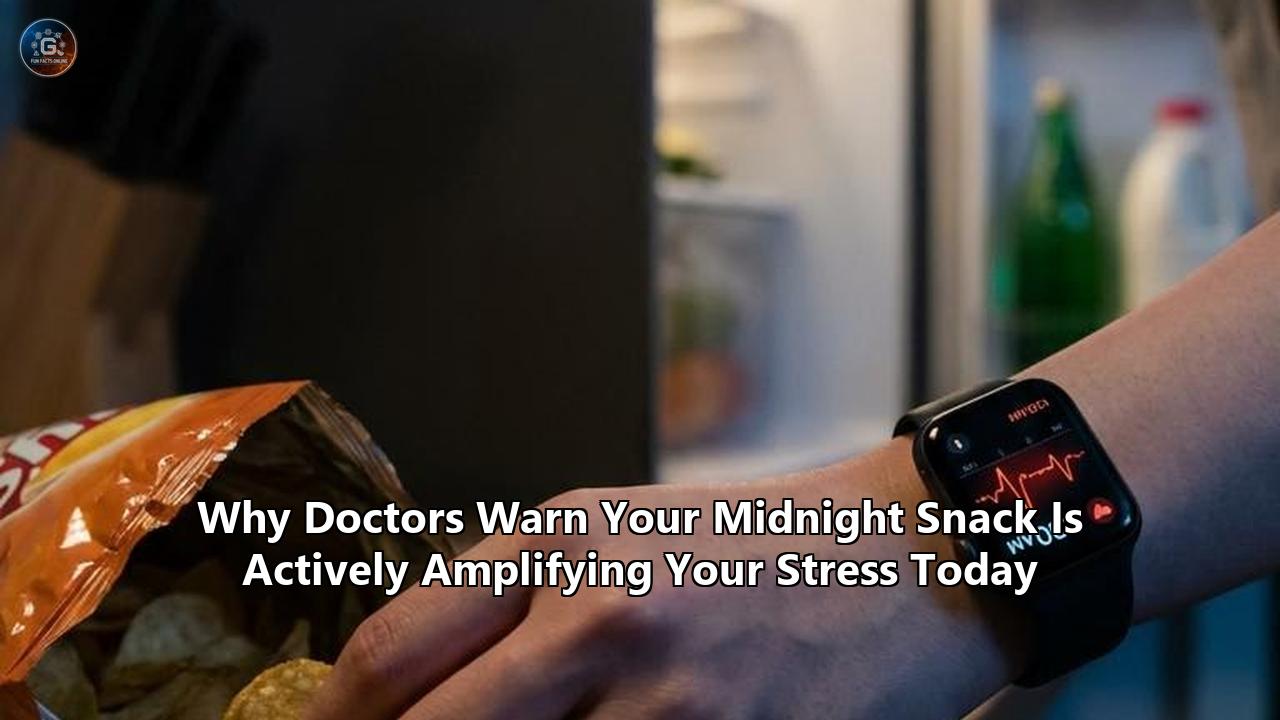
New clinical data presented at Digestive Disease Week 2026 has exposed a severe, compounding physiological threat tied to a common nighttime habit. According to researchers at New York Medical College, consuming food late in the evening does not merely disrupt sleep architecture—it actively multiplies the physiological and psychological damage inflicted by daily anxiety. The findings isolate a direct connection between midnight snacks and stress, revealing that off-hours digestion creates a “double hit” to the body’s gastrointestinal system and microbiome, magnifying emotional exhaustion through the gut-brain axis.
Dr. Harika Dadigiri, the study’s lead author, presented analysis drawn from more than 11,000 participants in the National Health and Nutrition Examination Survey (NHANES) alongside secondary data from over 4,000 subjects in the American Gut Project. The results are stark: individuals burdened with a high "allostatic load"—the medical metric for cumulative physiological wear-and-tear caused by chronic stress—who consume more than 25% of their daily calories after 9:00 p.m. are 1.7 times more likely to experience clinical bowel dysfunction. When researchers cross-referenced high anxiety levels with habitual late-night eating in the American Gut Project cohort, the risk of severe digestive issues spiked to 2.5 times higher than that of individuals with similar stress levels who stopped eating earlier in the day.
"It's not just what you eat, but when you eat it," Dr. Dadigiri stated during the presentation. "And when we're already under stress, that timing may deliver a 'double hit' to gut health".
The research pivots away from older dietary models that viewed the human metabolism as a simple internal furnace burning calories at a static rate. Instead, it forcefully introduces "chrononutrition"—the study of how food intake aligns with the body's internal circadian clock—as a critical pillar of mental and physical health. By forcing the gastrointestinal tract to process food during its biological downtime, late-night eating drastically reduces gut microbiome diversity, triggering systemic inflammation that loops directly back to the brain.
Decoding Allostatic Load and the Late-Night Caloric Threshold
To understand why a late meal triggers such an aggressive internal response, it is necessary to examine the concept of allostatic load. Allostasis is the process by which the body responds to stressors to regain homeostasis. When a person faces chronic pressure—whether from financial strain, a demanding workplace, or personal trauma—the biological systems managing this response become overworked. This cumulative burden is the allostatic load, physically measurable through biomarkers like elevated blood pressure, increased low-density lipoprotein (LDL) cholesterol, high body mass index (BMI), and persistently high baseline cortisol levels.
The NHANES dataset used by Dr. Dadigiri’s team provided an exceptionally large sample size to measure this specific metric against dietary habits. NHANES is highly regarded in the medical community because it combines in-person interviews with rigorous physical examinations, blood draws, and multi-day dietary recalls. By isolating individuals who recorded high allostatic load scores, researchers could track exactly how their bodies handled food at different times of the day.
The critical threshold identified in the data was the consumption of 25% or more of daily caloric intake after 9:00 p.m. For an average adult consuming 2,000 calories a day, this equates to a 500-calorie late dinner or a dense snack right before bed.
When participants crossed this 25% threshold, the physiological consequences were not merely additive; they were multiplicative. The gastrointestinal tract, which relies on a circadian lull to perform cellular repair and flush out metabolic waste, was suddenly forced to divert energy back to active digestion. Because the body’s metabolic organs (the liver, pancreas, and intestines) follow peripheral biological clocks synchronized to daylight, their efficiency drops sharply at night. Insulin sensitivity decreases, and gastric emptying slows down. Forcing these organs to operate under heavy caloric load while simultaneously battling a high allostatic load pushes the entire systemic infrastructure into distress.
The Microbiome Collapse Exposed by the American Gut Project
The secondary dataset analyzed by the New York Medical College team originated from the American Gut Project, a massive crowdfunded citizen-science initiative that sequences the microbial DNA of thousands of individuals. This data provided the molecular "why" behind the clinical symptoms observed in the NHANES cohort.
Participants who exhibited both high psychological stress and routine late-night eating behaviors demonstrated a statistically significant drop in gut microbiome diversity. A diverse microbiome is the cornerstone of immune regulation, nutrient absorption, and neurotransmitter synthesis. When microbial diversity collapses, the gut becomes dysbiotic. Opportunistic, pro-inflammatory bacteria multiply, while beneficial, anti-inflammatory strains die off.
This bacterial die-off is accelerated by the mechanical realities of nighttime digestion. During deep sleep, the gut relies on the migrating motor complex (MMC)—a series of electromechanical sweeps that clean out residual food and bacteria from the stomach and small intestine. Consuming calories late at night halts the MMC. Food sits stagnant in the digestive tract longer, fermenting and feeding pathogenic bacteria.
This localized gut distress does not stay contained in the digestive tract. The localized inflammation degrades the mucosal lining of the intestines, leading to increased intestinal permeability, colloquially known as "leaky gut". Endotoxins, primarily lipopolysaccharides (LPS) from the cell walls of dying bacteria, slip into the bloodstream, triggering an immediate systemic immune response.
How the Gut-Brain Axis Translates Digestion into Anxiety
The link between midnight snacks and stress becomes violently clear when mapping the gut-brain axis. This axis is a bidirectional communication network connecting the enteric nervous system (the millions of neurons governing the gastrointestinal tract) with the central nervous system via the vagus nerve, immune pathways, and biochemical signaling.
When the immune system detects the endotoxins leaking from a dysbiotic gut, it releases pro-inflammatory cytokines, specifically interleukin-6 (IL-6) and tumor necrosis factor-alpha (TNF-α). These cytokines circulate through the blood and cross the blood-brain barrier.
Once inside the brain, this inflammatory cascade fundamentally alters how the mind processes emotion. Elevated inflammatory signaling directly interferes with the metabolism of serotonin—a vital neurotransmitter responsible for mood stabilization, calmness, and well-being. Ordinarily, the essential amino acid tryptophan is converted into serotonin. However, under systemic inflammation caused by circadian misalignment and gut dysbiosis, the brain activates the kynurenine pathway.
The kynurenine pathway essentially hijacks tryptophan, diverting it away from serotonin synthesis and converting it instead into neurotoxic metabolites, such as quinolinic acid. Quinolinic acid is highly excitatory and has been heavily implicated in the pathogenesis of generalized anxiety disorder, major depressive episodes, and acute emotional reactivity.
Because the individual was already experiencing high daytime stress (the allostatic load), their central nervous system was already sensitized. By eating late at night, they triggered a gut-level inflammatory response that traveled to the brain, starved it of stabilizing serotonin, and flooded it with anxiety-inducing neurotoxins. The snack intended to soothe evening anxiety biochemically guarantees that the individual will wake up feeling even more stressed the following day.
Corroborating Evidence: The Brigham and Women’s Hospital Sleep Lab Trials
The findings from Digestive Disease Week 2026 build upon a foundational base of chronobiological research, most notably a rigorous trial conducted by researchers at Brigham and Women’s Hospital (a founding member of the Mass General Brigham healthcare system) and published in the Proceedings of the National Academy of Sciences (PNAS).
Led by Dr. Frank A. J. L. Scheer, Director of the Medical Chronobiology Program, the PNAS study placed 19 participants in a highly controlled, tightly monitored laboratory environment for 14 days to simulate the effects of shift work and circadian misalignment. The researchers divided the participants into two distinct eating schedules. One group ate meals strictly during the biological daytime, even while their sleep-wake cycles were flipped to simulate night work. The other group ate during the biological nighttime, aligning their meals with their awake hours but misaligning them with their internal circadian clocks.
The psychiatric outcomes were immediate and severe. Among the individuals in the nighttime eating group, depressive-like mood levels spiked by 26%, and anxiety-like mood levels rose by 16%. Conversely, the group that consumed all their calories during the daytime experienced zero increase in mood vulnerability, despite undergoing the exact same grueling sleep-shift protocol.
Dr. Scheer’s data proved that the disruption in mood was not caused merely by lack of sleep or altered schedules, but specifically by the timing of the food intake. "Our findings provide evidence for the timing of food intake as a novel strategy to potentially minimize mood vulnerability in individuals experiencing circadian misalignment," Dr. Scheer noted upon the study's publication.
This earlier clinical trial perfectly contextualizes the new 2026 data. Dr. Scheer’s team demonstrated the psychological vulnerability in a pristine lab setting, while Dr. Dadigiri’s team has now shown how that vulnerability manifests on a population level via the degradation of the gut microbiome.
The Hormonal Anatomy of a Midnight Snack
To fully map the destruction, one must examine the specific hormonal imbalances triggered by late eating. The endocrine system operates on a strict 24-hour cycle. Cortisol, widely known as the primary stress hormone, is designed to peak roughly 30 to 45 minutes after waking up—a phenomenon known as the Cortisol Awakening Response (CAR)—and then slowly taper off throughout the afternoon and evening. By midnight, cortisol levels should be at their absolute lowest, allowing the body to achieve deep, restorative slow-wave sleep.
Simultaneously, melatonin, the hormone responsible for initiating and maintaining sleep, begins to rise as ambient light fades, peaking in the middle of the night.
Introducing a surge of glucose, fats, and proteins at 10:30 p.m. aggressively disrupts this delicate hormonal crossover. The act of digestion requires energy and increases core body temperature. Processing a meal elevates heart rate and signals to the adrenal glands that the body is active, prompting a delayed, unnatural spike in nocturnal cortisol.
This delayed cortisol elevation suppresses melatonin production. Without sufficient melatonin, the brain struggles to transition into the deeper stages of non-REM sleep. Sleep becomes fragmented and shallow. The individual may not fully wake up, but their brain is denied the critical cellular repair processes that only occur during slow-wave sleep.
Furthermore, poor sleep architecture directly impairs the prefrontal cortex—the area of the brain responsible for executive function, emotional regulation, and logical reasoning. When the prefrontal cortex is compromised, the amygdala (the brain's primitive fear and threat center) becomes hyperactive. Waking up with a hyperactive amygdala and elevated residual cortisol means the baseline level of stress for the new day starts significantly higher than the day before.
Ghrelin, Leptin, and the Cravings Feedback Loop
Compounding the issue is the specific macronutrient profile of what people typically consume late at night. Very few individuals crave steamed broccoli or plain chicken breast at midnight. The biological drive leans heavily toward hyper-palatable foods: high in refined carbohydrates, saturated fats, and sodium.
This preference is not a failure of willpower; it is a direct symptom of circadian misalignment and stress. Chronic allostatic load blunts the sensitivity of leptin, the anorexigenic hormone released by fat cells that signals satiety to the brain. Simultaneously, stress upregulates the production of ghrelin, the hormone that signals hunger.
Late at night, this hormonal mismatch hits its peak. The brain, exhausted from a high-stress day, actively seeks out a rapid dopamine release to self-soothe. High-sugar, high-fat foods provide an immediate, powerful dopamine hit. But because leptin signaling is impaired, the brain never receives the "full" signal. The individual continues to eat past the point of physical satiation, vastly exceeding the 25% caloric threshold identified in the New York Medical College study.
Once consumed, a high-fat, high-carbohydrate meal causes a rapid spike in blood glucose, followed by a massive release of insulin. Because peripheral insulin sensitivity is naturally lower at night, the body struggles to clear the glucose from the bloodstream efficiently. The pancreas overcompensates, pumping out excess insulin, which eventually drives blood sugar levels down too low—a state of reactive hypoglycemia. This sudden crash in blood sugar occurring at 2:00 or 3:00 a.m. triggers the adrenal glands to release adrenaline and cortisol to stabilize glucose levels, frequently jolting the person awake and permanently ruining the night's sleep cycle.
Night Eating Syndrome (NES) and Clinical Escalation
For a growing segment of the population, these habits evolve past casual snacking and codify into a recognized psychiatric condition: Night Eating Syndrome (NES). Originally identified in 1955 and now categorized under "Other Specified Feeding or Eating Disorders" (OSFED) in the DSM-5, NES is characterized by morning anorexia (skipping breakfast), evening hyperphagia (consuming more than 25% of daily calories after dinner), and frequent nocturnal awakenings accompanied by conscious eating.
Recent epidemiological studies indicate a concerning rise in NES prevalence, particularly among high-stress demographics such as university students, corporate shift workers, and medical professionals. A 2025 cross-sectional study analyzing university populations revealed that students exhibiting high psychological distress were vastly more susceptible to developing NES. The study demonstrated that the most evident psychological variable tethered to the onset of NES was unmanaged stress.
Individuals suffering from NES become trapped in a self-sustaining biological loop. The daytime stress triggers the nighttime binge. The nighttime binge delays melatonin, spikes cortisol, and destroys the gut microbiome, which in turn fuels the kynurenine pathway and increases systemic inflammation. The inflammation degrades serotonin, leading to waking anxiety and depression. The waking anxiety suppresses morning appetite, meaning the individual skips breakfast and fasts through the early part of the day, only to become ravenously hungry—and emotionally depleted—once again when the sun goes down.
Breaking this cycle is notoriously difficult because it requires simultaneously treating the psychiatric distress and the mechanical circadian misalignment.
The Rise of Chrononutrition in Preventative Medicine
The convergence of the American Gut Project data, the Mass General Brigham sleep lab trials, and the New York Medical College findings solidifies "chrononutrition" as a mandatory consideration for modern psychiatric and gastrointestinal treatment. Chrononutrition operates on the premise that human metabolism is four-dimensional; the precise time a nutrient is consumed dictates how it is biologically processed.
The central pacemaker of the human circadian rhythm is the suprachiasmatic nucleus (SCN), a tiny region in the hypothalamus situated directly above the optic chiasm. The SCN receives direct light inputs from the retina, synchronizing the brain to the solar day. However, the SCN is only the master clock. Every major organ system—the liver, the pancreas, the adipose tissue, and the gastrointestinal tract—possesses its own peripheral clock.
While the SCN is primarily entrained by light, these peripheral clocks are entrained entirely by food intake.
When a person views artificial blue light from screens late into the night while simultaneously consuming a heavy midnight snack, they are sending violently conflicting signals to their nervous system. The SCN tells the brain it might still be daytime (due to the screen light), while the influx of food tells the liver and gut that a new metabolic day has just begun. This total decoupling of the master and peripheral clocks is called circadian desynchrony.
Circadian desynchrony is rapidly emerging as a foundational risk factor for a host of modern chronic illnesses, from type 2 diabetes and cardiovascular disease to severe mood disorders. Realigning these clocks is a practical, non-invasive, and highly effective therapeutic intervention.
Clinical Recommendations and Strategies for Resetting the Clock
For patients caught in the feedback loop between midnight snacks and stress, medical chronobiologists and dietitians are moving away from restrictive calorie counting and focusing instead on strict timing parameters.
Time-Restricted Eating (TRE):The most heavily researched intervention is Time-Restricted Eating (TRE), a dietary protocol that confines all caloric intake to a specific window, usually 8 to 10 hours during the biological daytime. By strictly cutting off food intake at 7:00 p.m. or 8:00 p.m., TRE allows the migrating motor complex to effectively sweep the gut clean overnight, preserving microbiome diversity. Clinical data shows that adopting a daytime TRE schedule rapidly lowers nocturnal cortisol levels, reduces systemic inflammation, and improves objective sleep quality within a matter of weeks.
Front-Loading Calories:Epidemiological studies indicate that individuals who consume the majority of their daily calories before 3:00 p.m. exhibit vastly superior metabolic flexibility and report significantly lower baseline anxiety levels. Front-loading calories aligns digestion with the peak hours of insulin sensitivity and pancreatic function. It also ensures that leptin signaling is stable by the time evening arrives, dramatically reducing the physiological drive to binge at midnight.
Optimizing the Final Meal:If eating a later dinner is unavoidable due to work schedules or family obligations, researchers emphasize altering the macronutrient profile to minimize circadian disruption. Late meals should be low in saturated fats and refined sugars, as these require intensive digestive energy and trigger insulin volatility. Instead, focusing on easily digestible lean proteins, cooked vegetables, and complex carbohydrates can mitigate the cortisol spike associated with heavy nighttime digestion. Furthermore, separating fluid intake from the final meal can prevent gastric distension and reduce the likelihood of acid reflux when lying down.
Managing the Psychological Trigger:Because the drive to eat at night is deeply tied to emotional regulation, swapping the behavioral habit is critical. Dr. Dadigiri, reflecting on the difficulty of changing these patterns, noted in her DDW presentation, "I'm not the ice cream police. Everyone should eat their ice cream—maybe preferably earlier in the day". Replacing the dopamine hit of late-night junk food with an alternative, non-caloric soothing ritual—such as a hot shower, somatic stretching, or low-light reading—can help de-escalate the hyperactive amygdala without engaging the gastrointestinal tract.
The Wider Socioeconomic Implications
The mandate to stop eating at night is biologically sound, but implementing it uncovers deep socioeconomic fault lines. As the Mass General Brigham researchers pointed out, shift workers currently constitute roughly 20% of the industrial labor force. These are the individuals staffing emergency rooms, operating logistics hubs, driving long-haul freight, and maintaining municipal infrastructure while the rest of the population sleeps.
For a night-shift nurse or a warehouse logistics worker, eating during the biological night is often a non-negotiable requirement for basic energy and alertness. These essential workers face a 25% to 40% greater baseline risk for depression and anxiety, directly linked to the circadian misalignment forced upon them by their schedules.
The new data connecting midnight snacks and stress forces occupational health policymakers to confront how modern labor practices systematically degrade human biology. If nighttime eating amplifies the effects of stress on the gut and brain by a factor of 1.7 to 2.5, requiring employees to sustain overnight labor without structured, chronobiologically optimized meal protocols is a massive public health failure.
Forward-thinking occupational health programs are beginning to test targeted chrononutrition protocols for shift workers, such as mandating heavy, nutrient-dense meals before the shift begins and limiting intake to strictly water and essential electrolytes during the darkest biological hours (2:00 a.m. to 5:00 a.m.).
Unresolved Questions and the Next Phase of Clinical Trials
While the 2026 data provides a clear warning, researchers acknowledge that the science of chrononutrition is still evolving. The NHANES and American Gut Project analyses presented by Dr. Dadigiri are observational. While they heavily suggest a directional relationship—late eating destroys the microbiome, which amplifies stress—they cannot definitively prove solitary causation without longitudinal, randomized controlled trials tracking exact microbiota changes in real-time.
The next frontier of chronobiological research will involve real-time metabolic monitoring. Future clinical trials are expected to equip participants with continuous glucose monitors (CGMs), wearable vagal nerve stimulators, and daily stool sampling kits to track the exact minute-by-minute biological fallout of a late-night meal. Researchers aim to pinpoint whether certain chronological chronotypes (natural "night owls" vs. "early birds") possess varying degrees of genetic resilience against nighttime eating.
There is also a pressing need to investigate whether repairing the microbiome through targeted probiotic therapies and pre-biotic fiber supplementation can artificially shield an individual from the psychological damage of circadian misalignment, even if their eating schedule remains erratic.
Until those granular clinical mechanisms are mapped, the immediate medical consensus is unequivocal. The human digestive system requires darkness and rest just as desperately as the human brain. Using food to medicate end-of-day anxiety is a biological trap, triggering a cascade of hormonal and microbial failures that actively manufacture tomorrow's stress. Resetting the body’s clock—and defending the gut's overnight fasting window—is no longer viewed as a peripheral wellness trend. It is a fundamental, urgent requirement for preserving mental resilience and metabolic integrity.
Reference:
- https://www.news-medical.net/news/20260423/Late-night-eating-may-amplify-the-effects-of-stress-on-gut-health.aspx
- https://medicaldialogues.in/mdtv/gastroenterology/videos/late-night-eating-may-intensify-stress-impact-on-gut-health-study-169489
- https://scitechdaily.com/eating-at-night-linked-to-depression-and-anxiety-like-moods/
- https://www.forhers.com/blog/is-it-bad-to-eat-late-at-night
- https://consensus.app/search/can-eating-late-at-night-disrupt-sleep/1R6WRqD-TYmrnHMu9IBjLQ/
- https://engoo.com/app/daily-news/article/study-nighttime-eating-may-increase-depression-anxiety/OdS9sMm2Ee27L5dX79ebmQ