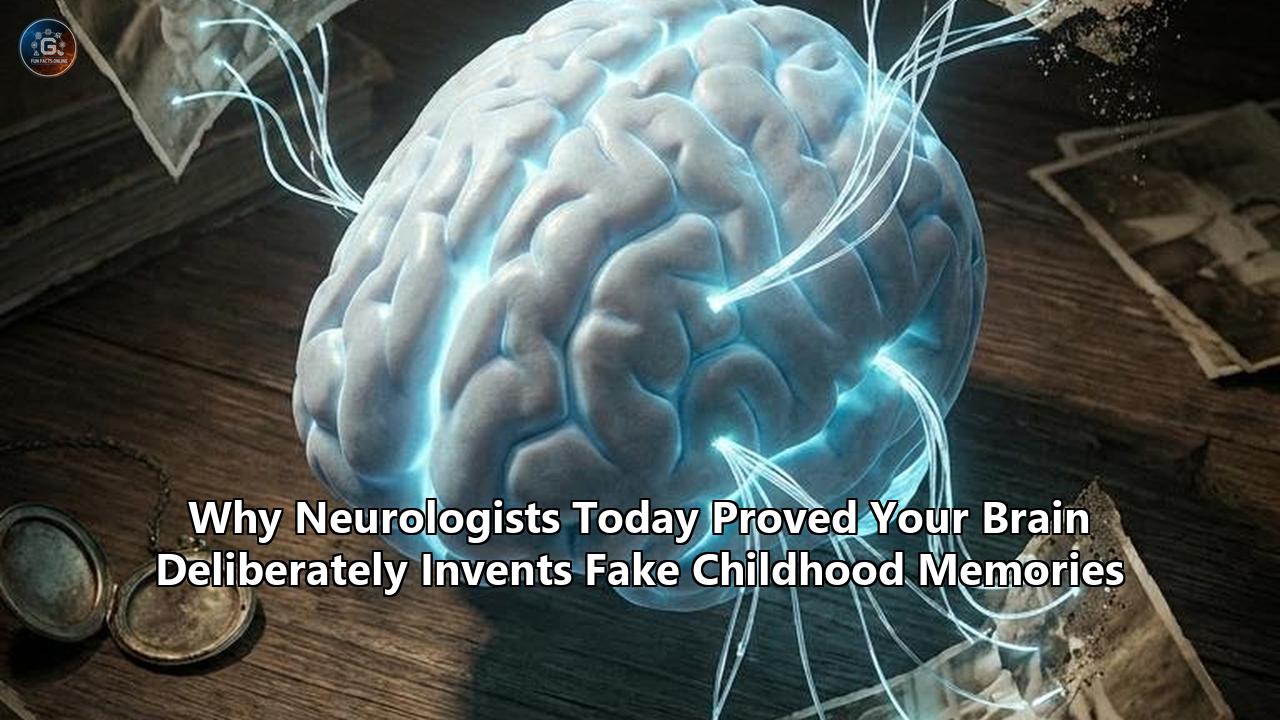
Today, a consortium of cognitive neuroscientists released neuro-imaging data that fundamentally dismantles how we understand human identity. Published in the wake of rapidly advancing real-time functional magnetic resonance imaging (fMRI) capabilities, the findings confirm a startling biological reality: the human brain does not accidentally degrade or lose memories over time. Instead, it actively and deliberately synthesizes false childhood memories.
The neurological data demonstrates that this fabrication is not a glitch in our neural circuitry. It is a highly evolved, intentional mechanism designed to ensure emotional survival, cognitive efficiency, and narrative cohesion in the present moment.
For decades, the legal, therapeutic, and cultural consensus treated memory like a decaying physical photograph. The prevailing assumption was that our recollections started off perfectly accurate and slowly eroded, falling victim to time or external suggestion. But the neuro-imaging data published this week proves that memory operates more like a live, collaborative document, constantly edited by the brain’s internal architecture to align past events with current psychological needs. When a memory is accessed, the hippocampus and prefrontal cortex do not simply read a file; they overwrite it.
By analyzing this breakthrough through the lens of recent legal controversies, developmental psychology paradigms, and clinical trauma research, a profound new picture of the human mind emerges. We are not the objective sum of our past experiences. We are the meaning our brains construct from them.
The Neurological Blueprint of Deliberate Fiction
To understand the magnitude of today’s findings, one must look at the biological mechanics of how a memory is stored. Memories do not live in a single region of the brain. They are distributed networks of neurons, known as engrams, which are effectively physical traces of an experience.
When you recall a childhood event, your brain must pull visual details from the occipital lobe, emotional context from the amygdala, and narrative structure from other cortical regions, assembling them in milliseconds. The moment these neural pathways activate, the memory becomes plastic—a process known as reconsolidation.
During reconsolidation, the brain evaluates the historical data against whatever emotions or beliefs you are experiencing right now. If a childhood memory of a strict parent conflicts with your present-day understanding of that parent’s love, the brain quietly edits the engram. It softens a tone of voice, alters a facial expression, or entirely invents a mitigating conversation that never happened.
Lead researcher Donna Bridge’s foundational work at Northwestern University anticipated this exact mechanism, observing that "a memory is not simply an image produced by time traveling back to the original event—it can be an image that is somewhat distorted because of the prior times you remembered it". The new data takes this further, proving the brain favors emotional utility over historical accuracy. The fabrication of false childhood memories serves as a psychological shock absorber, allowing individuals to maintain a coherent sense of self despite the chaotic and often traumatic nature of reality.
Case Study 1: The Legal Justice System and the Weaponization of Recall
The most immediate and severe implications of this neurological reality fall on the justice system, which historically treats human memory as a video recording that can be played back on the witness stand.
The new understanding of memory as an active construction forces a re-evaluation of how courts handle historical testimony, particularly in cases of abuse. For years, defense attorneys have weaponized the concept of the "misinformation effect." High-profile legal teams, including those defending Harvey Weinstein, relied heavily on the famous 1995 "Lost in the Mall" study by Elizabeth Loftus, which suggested that external investigators could easily implant entirely fabricated memories into a subject's mind.
However, a landmark January 2025 study led by researchers at University College London (UCL) upended this legal strategy. Re-evaluating data from a rigorous replication of the "Lost in the Mall" paradigm, the UCL team found that externally implanting a fully formed false memory is actually incredibly difficult. None of the participants formed a fully false memory of the fabricated childhood event, and 50% outright rejected the fake details or reported actual past experiences instead.
Emeritus Professor Chris Brewin of UCL’s Psychology & Language Sciences noted that "the findings underscore the dangers of applying laboratory research findings to the real world of witnesses in court".
When we synthesize the UCL findings with today’s fMRI data, a complex paradox emerges. An interrogator or a therapist may struggle to force a fake memory into your mind—but your own brain generates them autonomously. The witness on the stand who misremembers a critical detail from twenty years ago is rarely lying. Their brain has systematically rewritten the engram to reconcile the trauma of the past with the survival requirements of the present. The justice system relies on objective truth, but neurology confirms that the human brain only deals in subjective survival.
Case Study 2: The Developmental Paradox and Fuzzy Trace Theory
If the brain is designed to edit the past, at what point in our lives does this mechanism activate? Developmental psychologists have spent the last two years testing memory reconstruction using the Deese-Roediger-McDermott (DRM) paradigm—a cognitive test where subjects are given a list of semantically related words (e.g., bed, rest, awake, tired) and later asked to recall them. Subjects frequently and confidently claim they heard the word "sleep," even though it was never on the list.
A December 2025 study published in the journal Memory investigated how children and adults differ in their susceptibility to DRM traps. The findings challenged long-held assumptions. By strictly controlling the semantic constraints of the lists, researchers found that children often produce more false memories than adults in these specific associative tasks, suggesting an attentional system that is highly focused on broad meanings rather than exact details.
This aligns perfectly with "fuzzy trace theory," a framework proposed by researchers Charles Brainerd and Valerie F. Reyna. According to this theory, the brain stores two types of memory traces: verbatim traces (exact, granular details) and gist traces (the general meaning or emotional resonance of the event).
Verbatim traces degrade rapidly. Gist traces last a lifetime. Today's neuro-imaging proves that as we age, our brains actively discard the verbatim data of our childhoods to save metabolic energy, filling the gaps with plausible fictions based on the gist trace.
Consider a typical family gathering where two adult siblings argue over a specific vacation they took when they were eight and ten years old. One remembers a terrifying incident of being lost at a crowded beach; the other remembers a joyful afternoon building sandcastles while their sibling briefly wandered off. Both are utterly confident in their recall. Neither is completely accurate. The brain of the anxious child preserved the "gist" of fear and exaggerated the duration and severity of the separation to serve as a lifelong warning system. The brain of the secure child preserved the "gist" of safety, editing out the panic entirely. They possess false childhood memories because their brains successfully engineered two different survival narratives from the exact same sensory input.
Case Study 3: The Engram Manipulations and Clinical Trauma Healing
The revelation that the brain is a deliberate fiction-writer does not just explain everyday family arguments; it offers a radical new pathway for treating severe psychological trauma.
The theoretical foundation for today’s fMRI breakthrough was laid over a decade ago at the Massachusetts Institute of Technology. In 2013, neuroscientists Susumu Tonegawa and Steve Ramirez conducted a study that bordered on science fiction: they artificially planted a false memory into the brains of mice.
Using a technology called optogenetics, the MIT team identified the specific network of neurons (the engram) associated with a safe environment (Box A). They genetically tagged these cells with a light-sensitive protein. Later, they placed the mice in a completely different, dangerous environment (Box B) and delivered a mild foot shock—while simultaneously shining a laser into the brain to activate the memory of Box A.
The result was staggering. The mice formed a terrifying memory of being shocked in Box A, a place where nothing bad had ever happened to them. When placed back in the perfectly safe Box A, they froze in terror.
“Whether it’s a false or genuine memory, the brain’s neural mechanism underlying the recall of the memory is the same,” Tonegawa explained. The neural activity in the amygdala—the brain's fear center—was identical for both real and fabricated trauma.
What Tonegawa’s team achieved artificially with lasers, today’s human fMRI data confirms our brains do to us naturally through the release of cortisol, adrenaline, and neuroplastic rewiring. An individual suffering from post-traumatic stress disorder (PTSD) may overlay the intense fear of a recent traumatic event onto completely unrelated childhood memories, retroactively turning a neutral upbringing into a landscape of perceived threats.
However, this biological plasticity is a double-edged sword. If the brain can actively overwrite the past to create fear, it can also overwrite the past to facilitate healing.
Clinical psychologists are already leveraging this mechanism through modalities like Eye Movement Desensitization and Reprocessing (EMDR) and narrative exposure therapy. During these treatments, patients are asked to recall deeply traumatic memories while engaging in a distracting cognitive task, such as tracking a moving light. The goal is not to uncover the "objective truth" of the abuse or the accident. The goal is to exploit the reconsolidation window.
By pulling the traumatic engram into the active workspace of the brain while the patient is in a safe, emotionally regulated state, the brain is forced to rewrite the file. The visual details remain, but the amygdala's fear response is surgically uncoupled from the narrative. The patient is left with a memory that feels distant and emotionally muted—technically a false childhood memory, as it no longer contains the terror of the original experience, but one that allows the individual to survive and function in society.
The Burden of Perfect Recall
If we accept that strategic forgetting and memory alteration are evolutionary advantages, we must ask: what happens to a human being who lacks this biological filter?
Researchers at the Paris Brain Institute recently documented the extraordinary case of a 17-year-old girl, identified as "TL," who possesses highly superior autobiographical memory (hyperthymesia). TL can remember almost every day of her life in microscopic, sensory detail. She organizes her mind into physical architectural spaces, mentally scanning through binders in a "white room" to retrieve episodes from her childhood, and isolating intense grief inside a locked mental chest.
Yet, even with this superhuman cognitive filing system, TL is not immune to the brain's reconstructive nature. Researchers Valentina La Corte and Laurent Cohen found that like the rest of the population, individuals with hyperthymesia are still prone to memory distortions. They re-examine details from different points of view—sometimes as the protagonist, sometimes as an external observer.
The hyperthymestic mind proves that even when the brain has the capacity to store near-infinite verbatim traces, it still utilizes the mechanisms of perspective-shifting and narrative construction to manage the crushing weight of the past. For the vast majority of us who do not possess hyperthymesia, the brain simply takes this process further, actively deleting the raw data and leaving us with the curated, emotionally regulated summary.
The Future of Identity and Digital Augmentation
The confirmation that human memory is a biologically engineered fiction forces a profound philosophical reckoning. If our memories are constantly shifting to accommodate our present reality, what constitutes our core identity?
The answer provided by neuroscience is that identity is not a static repository of facts. It is an ongoing, real-time negotiation between the past and the present. We are the storytellers of our own lives, and our brains are the relentless editors ensuring the story makes sense.
As we look toward the immediate future, this biological reality will inevitably collide with the rapid expansion of digital memory augmentation. Wearable technology, artificial intelligence life-loggers, and ubiquitous cloud storage are currently marketed as solutions to the "problem" of human forgetting. We are building systems designed to record our lives with flawless, unalterable fidelity.
But if the neuro-imaging data published today teaches us anything, it is that flawless fidelity is not a cognitive ideal; it is a psychological hazard.
When we outsource our memory to a digital hard drive, we bypass the brain’s reconsolidation process. A photograph or an AI-generated timeline does not adapt to our emotional growth. It does not soften the edges of a bitter argument, nor does it selectively amplify the warmth of a departed parent. It forces us to confront the rigid, verbatim truth of the past without the protective cushioning of our neurobiology.
If we strip away the brain’s ability to generate false childhood memories, we may find ourselves trapped by the exact literalness of our histories, unable to forgive, unable to heal, and unable to rewrite our own narratives. The most vital discovery in modern neurology is not that our brains are lying to us. It is that they are lying to us in order to keep us moving forward.
Reference:
- https://neurosciencenews.com/false-memories-psychology-28326/
- https://news.mit.edu/2013/neuroscientists-plant-false-memories-in-the-brain-0725
- https://www.youtube.com/watch?v=ANO45YMLp6g
- https://www.psychologicalscience.org/news/our-brains-sometimes-create-false-memories-but-science-suggests-we-could-be-better-off-this-way.html
- https://www.researchgate.net/publication/398677454_Comparing_false_memories_produced_by_children_and_adults_in_the_DRM_paradigm_do_DRM_false_memories_really_increase_with_age
- https://discovery.researcher.life/article/comparing-false-memories-produced-by-children-and-adults-in-the-drm-paradigm-do-drm-false-memories-really-increase-with-age/966567375dc73654a613254456c9a715
- https://parisbraininstitute.org/news/mental-time-travel-new-case-autobiographical-hypermnesia