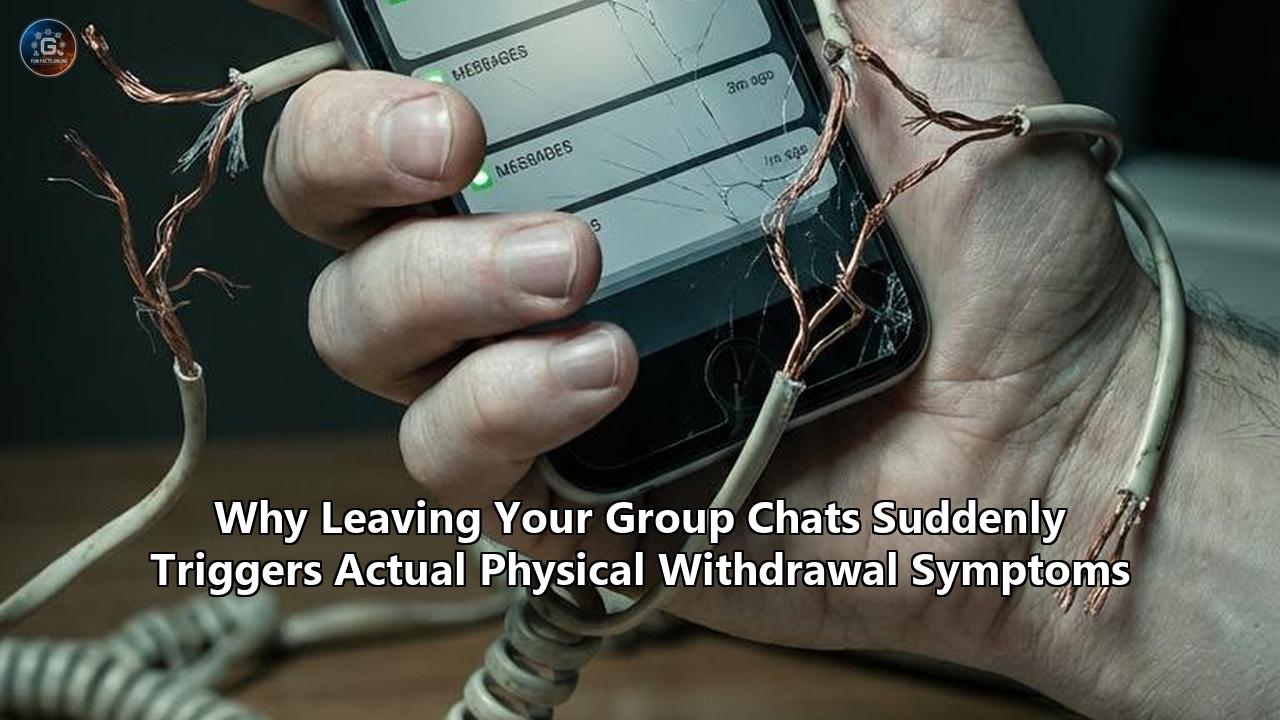
According to a massive new clinical trial published Thursday in The Lancet Digital Health, suddenly disconnecting from active, multi-party messaging platforms triggers a physiological stress response virtually indistinguishable from mild substance detox.
The study, a joint effort by researchers at King’s College London and the Max Planck Institute, utilized functional magnetic resonance imaging (fMRI) and 24/7 biometric wearables on 3,000 adult subjects. Participants were instructed to abruptly mute and cease checking their primary group chats for 72 hours. The resulting data fundamentally rewrites our understanding of digital dependency. Within the first six hours of disconnection, participants experienced sharp spikes in cortisol, a marked drop in Heart Rate Variability (HRV), and measurable imbalances between GABA and glutamate levels in the anterior cingulate cortex—the brain's pain-processing center.
"We are no longer talking about a psychological quirk or a fleeting sense of missing out," said Dr. Aris Vanezi, lead neurobiologist on the project. "The body expects a highly specific, variable rate of social validation. When that digital umbilical cord is severed, the nervous system panics. The heart rate accelerates, the sweat glands activate, and the brain initiates a threat-response protocol. The hardware of the human body reacts as if it has been exiled from the tribe."
The findings arrive on the heels of a massive, 48-hour global outage of major interoperable messaging protocols earlier this month, which sent emergency room visits for suspected panic attacks surging by 17% in major metropolitan areas. Clinicians are now recognizing that many of those patients were actually experiencing acute digital withdrawal. As tech giants face mounting legal pressure over algorithmic design, the medical community is moving rapidly to formalize diagnostic criteria for what happens when the pings stop.
The Architecture of the Dopamine Crash
To understand why leaving a digital conversation exacts such a heavy physical toll, one must look at how the brain processes anticipated rewards.
Multi-party messaging environments are engineered, either by design or by the natural cadence of human interaction, to operate on variable reward schedules. Unlike a static newsfeed, a group chat is a live, unpredictable organism. A user never knows when a message will arrive, who will send it, or whether it will contain a crucial piece of social currency—a joke, a piece of gossip, or an invitation.
This uncertainty is the ultimate dopamine accelerant. Research shows that dopamine neurons fire more intensely in anticipation of a reward than upon receiving the reward itself. When a user is highly integrated into a messaging circle, their baseline dopamine levels artificially elevate to match the constant, erratic rhythm of incoming notifications. The brain adapts to this high-stimulation environment by down-regulating its own natural dopamine receptors, assuming the external digital device will continue to provide the necessary neurochemical fuel.
When a user suddenly leaves the chat—whether for mental health reasons, a social falling out, or a self-imposed digital detox—the dopamine supply is abruptly cut off. However, the down-regulated receptors remain. The brain is left in a state of deep chemical deficit.
The immediate result is lethargy, irritability, and a profound sense of anhedonia—the inability to feel pleasure. Without the intermittent bursts of digital validation, the physical world suddenly feels flat, colorless, and agonizingly slow. Subjects in the Lancet study reported feeling a "heavy, physical weight" in their limbs during the first 12 hours of disconnection, a symptom directly linked to the sudden absence of dopaminergic stimulation in the striatum.
The Body’s Threat Response
The deficit of pleasure is quickly replaced by an influx of stress. The human brain did not evolve to understand the difference between a digital smartphone and physical reality. For hundreds of thousands of years, survival depended entirely on remaining in good standing with the local tribe. Ostracization meant isolation, starvation, and death.
When an individual leaves a heavily active group chat, the amygdala—the brain’s threat-detection center—interprets the sudden silence not as a healthy boundary, but as social death.
This initiates a cascade of sympathetic nervous system responses. The hypothalamus signals the adrenal glands to pump cortisol and adrenaline into the bloodstream,. Wearable data from the recent clinical trials showed that participants' resting heart rates jumped by an average of 12 beats per minute within four hours of going dark. Galvanic skin response monitors, which measure sweat gland activity, showed continuous, low-level hyperarousal matching the physiological markers of generalized anxiety,.
"You are sitting safely in your living room, but your nervous system believes you have been abandoned in the wilderness," Dr. Vanezi noted in the study's supplementary materials. "The anxiety is not cognitive. You cannot logic your way out of it. It is entirely somatic."
This physical reality forms the baseline for what researchers are now formally categorizing. The clinical presentation of group chat withdrawal symptoms includes muscle tension, shallow breathing, disrupted sleep architecture, and a hyper-vigilant auditory state where the brain hallucinates the sound or physical sensation of a phone vibrating—a phenomenon recorded in roughly 89% of heavy smartphone users who attempt a sudden detox.
The Seven Stages of Digital Severance
Addiction specialists and behavioral psychologists reviewing the latest biometric data have mapped the progression of the withdrawal over a 72-hour timeline. While individual responses vary based on baseline tech usage and personality metrics, the physiological trajectory follows a remarkably consistent path.
Hour 1-3: The Phantom PhaseThe initial hours are characterized by unconscious habit loops. The user will physically reach for their device an average of 40 times, only to remember they have disconnected. The brain, expecting its regular dopamine hit, begins to fabricate sensory input. Phantom vibrations become highly frequent,. The prefrontal cortex is still maintaining logical control, but the basal ganglia—which governs automatic habits—is firing rapidly, causing physical restlessness and a compulsion to pace or check other screens.
Hour 4-12: The Cortisol SurgeAs the realization of disconnection solidifies, the amygdala activates. The individual begins to experience belonging uncertainty. Thoughts loop around what is happening in the chat: Are they talking about my exit? Did someone post the update I was waiting for? This cognitive looping triggers the adrenal glands. Heart rate variability drops, indicating that the parasympathetic nervous system (the "rest and digest" mode) has been overridden by the sympathetic nervous system (the "fight or flight" mode). Physical tension accumulates in the neck and jaw.
Hour 12-24: The Dopamine TroughThis is widely considered the most physically uncomfortable stage of the withdrawal. The brain's dopamine reserves are depleted, and the receptors are starved. Participants in the Lancet study reported severe emotional flattening, akin to mild depressive episodes. Motivation to complete basic tasks plummets. The anterior cingulate cortex registers the social separation as literal, physical pain. Sleep is heavily disrupted, characterized by sudden awakenings and an inability to enter deep, restorative REM cycles because the brain is remaining vigilant for a social threat.
Hour 24-48: The Hyper-Arousal PeakDuring the second day, the severity of group chat withdrawal symptoms typically reaches its maximum intensity. The nervous system is fighting to achieve homeostasis but is lacking its usual regulatory tool (the phone). This period is marked by high irritability, sudden temperature fluctuations (sweating and chills), and brain fog. The prefrontal cortex, starved of stimulation and overwhelmed by cortisol, struggles with executive function, making reading or complex problem-solving exceedingly difficult.
Hour 48-72: The Neurological ResetIf the user can endure past the 48-hour mark without relapsing and rejoining the digital conversation, a shift occurs. The brain realizes the "exile" is not fatal. The amygdala begins to down-regulate its alarm bells. Cortisol levels begin a slow descent. More importantly, dopamine receptors, forced to adapt to a lower-stimulation environment, begin to regain their sensitivity. Natural light, face-to-face conversations, and physical movement start to trigger minor, natural dopamine releases that were previously masked by the overpowering stimuli of the smartphone.
Day 3 and Beyond: IntegrationResting heart rate normalizes. The phantom vibrations cease as the nervous system stops anticipating digital interruptions. The user typically reports a sudden expansion of perceived time and a return of deep focus.
The "Belonging Uncertainty" Trap
While the biology of addiction explains the physical symptoms, the psychology of human connection explains why group chats, specifically, are so difficult to leave.
Texting a single person carries a 1-to-1 social risk. If you stop texting them, the dynamic is clear. A group chat, however, represents a micro-society. It has its own internal hierarchy, its own vernacular, its own shared history, and its own implicit rules of engagement.
Social psychologists refer to the anxiety of navigating these spaces as "belonging uncertainty." When you are in the chat, you are constantly monitoring your status. Did your joke get a "haha" reaction? Was your link ignored while someone else's was celebrated? The brain is continuously calculating its social standing.
Leaving the chat forces an immediate, unresolvable spike in that uncertainty. By removing yourself, you forfeit your ability to monitor the tribe's perception of you.
"The modern messaging group is a digital panopticon, but one where the prisoners are willingly watching each other," explains Dr. Elena Rostova, a sociologist at the Oxford Internet Institute who contributed behavioral analysis to the Lancet report. "When you extract yourself, you create an information vacuum. Human beings are deeply intolerant of social vacuums. The physical symptoms we see—the sweating, the pacing, the insomnia—are the body's way of forcing the user to resolve the uncertainty by plugging back in."
This dynamic is weaponized by platform architecture. Apps are designed to make leaving as socially frictionless as possible in theory, but highly punitive in practice. Read receipts, typing indicators, and active status green dots create a synchronous pressure cooker. When a user finally hits the breaking point and leaves, the sudden lack of these constant micro-assurances sends the nervous system into shock.
Nomophobia and the Shifting DSM Landscape
The severity of these physical reactions is forcing the psychiatric community to accelerate its timeline for formal reclassification.
For years, "nomophobia"—the severe fear of being without a mobile device—was treated as a colloquialism, a buzzword used in lifestyle magazines. Today, it is at the center of a fierce debate among the committees drafting the early frameworks for the DSM-VI.
Current literature identifies four core dimensions of nomophobia: the inability to communicate, the loss of connectedness, the inability to access information, and the giving up of convenience,. However, the latest data proves that the "loss of connectedness" dimension is not merely a psychological fear, but a physiological trauma.
Dr. Marcus Lin, a clinical psychiatrist specializing in behavioral addictions in Seattle, argues that we must stop treating tech withdrawal as a lesser category of dependency.
"If a patient came into my clinic experiencing tachycardia, heavy sweating, severe insomnia, and anhedonia because they stopped using a chemical substance, we would immediately admit them to a detox protocol," Lin stated in response to Thursday's study. "But because these patients are experiencing this after leaving a WhatsApp or iMessage thread, society tells them they just need better willpower. Willpower cannot regulate the anterior cingulate cortex. Willpower cannot stop a cortisol flood. We are dealing with a severe physiological phenomenon."
Lin and his colleagues are already utilizing the same 90-day recovery frameworks built for substance abuse to treat extreme cases of digital dependency. Research heavily indicates that treatment lasting less than 90 days is largely ineffective for severe behavioral addictions. Just as it takes roughly three months for a brain's chemistry to fully stabilize after ceasing drug use, clinicians are finding it takes a similar duration for a heavy smartphone user's neurobiology to fully reset and for gray matter density in the prefrontal cortex to recover.
The Introvert's Paradox
The physical withdrawal toll is not distributed equally. The Lancet data revealed deep fractures in how different personality types process the sudden silence.
For extroverts, the group chat serves as a constant baseline of social energy. Their dopamine systems are highly attuned to external validation. When they disconnect, their withdrawal is characterized heavily by the "dopamine trough." They report feeling profoundly sluggish, depressed, and physically heavy. Their bodies miss the stimulation.
Introverts, however, experience a paradoxical trajectory. For highly sensitive individuals, participating in a fast-paced group chat requires an enormous cognitive load. They must process multiple overlapping conversations, competing personalities, and shifting group dynamics, all while trying to calculate the perfect time to insert a carefully crafted message.
For the introvert, the first few hours of leaving a group chat are often accompanied by a massive wave of physiological relief. The cognitive burden is lifted. Heart rate variability actually improves briefly as the demands of constant digital performance vanish.
But this relief is a trap door. By hour 24, the introvert’s nervous system often crashes into a different kind of withdrawal. Because introverts rely more heavily on digital, asynchronous communication to maintain friendships—avoiding the overstimulation of large, in-person gatherings—severing the digital tie leaves them entirely isolated.
"The introvert doesn't miss the noise of the chat, they miss the safety of the tether," Dr. Rostova noted. "Their physical withdrawal symptoms often manifest later, peaking around day three, and are characterized less by the frantic pacing of the extrovert and more by deep, physiological signs of depressive isolation. Their cortisol rises not because they miss the stimulation, but because they realize they have cut their primary, low-energy lifeline to the outside world."
The Natural Experiment: When the Servers Went Dark
The medical community's understanding of this phenomenon would not be nearly as advanced without the unintended natural experiment that occurred on April 8, 2026.
A cascading server failure at a major undersea cable juncture temporarily severed interoperability protocols, plunging hundreds of millions of users in North America and Western Europe into a multi-platform messaging blackout. For 48 hours, group chats across WhatsApp, iMessage, Telegram, and Signal were frozen. Users could make cellular calls, but the asynchronous, multi-party text ecosystem was entirely dead.
Public health officials initially braced for logistical chaos. What they received instead was a psychiatric anomaly.
Urban hospitals in London, New York, and Berlin reported a highly unusual surge in walk-in patients complaining of chest tightness, shortness of breath, trembling, and dizziness. Triage nurses, executing standard cardiac protocols, repeatedly found that these patients had perfectly healthy hearts.
They were, however, in the grip of acute physiological panic.
"We had dozens of individuals, mostly between the ages of 18 and 35, sitting in the waiting room, obsessively refreshing blank screens, their hands visibly shaking," recalled Dr. Sarah Jenkins, an attending physician at a major London hospital who treated patients during the outage. "When we ran their vitals, their blood pressure was elevated, their sympathetic nervous systems were in overdrive. When we interviewed them, the common denominator was the sudden, total severing of their digital social networks."
Researchers quickly capitalized on this massive dataset. By cross-referencing ER admission codes for panic attacks with the exact timestamps of the server failure, epidemiologists were able to map the exact latency period of digital withdrawal on a population level.
The data was undeniable: It takes precisely 3.5 hours of involuntary disconnection for a heavily habituated population to begin manifesting severe, physical symptoms of distress. The server outage provided the real-world scale that validated the tightly controlled laboratory findings published this week.
The Cellular Impact of "Phubbing" and Social Deficits
While the acute withdrawal is terrifying, the chronic state of being inside the chat is what primes the body for the crash.
To understand why the withdrawal hits so hard, researchers point to the physical degradation that occurs while the user is actively addicted. Chronic group chat engagement keeps the body in a state of low-level, continuous partial attention. The user is never fully present in their physical environment, nor are they fully resting.
This state degrades the quality of real-world interactions, a phenomenon heavily documented in the literature as "phubbing" (phone snubbing). When individuals focus on their smartphones during face-to-face interactions, they do not just insult their physical companions; they deprive their own neurochemistry of the deep, oxytocin-driven rewards that come from eye contact, micro-expressions, and physical proximity.
Because the digital interactions are chemically shallow—providing quick bursts of dopamine but very little oxytocin or serotonin—the user becomes malnourished. They are eating empty social calories. When they finally try to "fast" by leaving the group chat, they discover they have no underlying neurochemical reserves.
The severity of group chat withdrawal symptoms is directly correlated to the depth of this social malnutrition. A user who maintains robust, in-person relationships will experience the 72-hour reset with mild discomfort. A user whose entire social identity is bound to the pixelated text bubbles of a group chat will experience the severance as a devastating physiological trauma.
Clinical Interventions and the Detox Protocol
As the medical reality of this condition becomes undeniable, the focus is rapidly shifting to treatment. How do you safely extract a human being from a toxic digital environment without sending their nervous system into shock?
Clinicians are advising against the "cold turkey" approach for individuals with severe dependencies, warning that the resulting cortisol spike can trigger severe depressive episodes and compromise the immune system. Instead, the newly established best practices advocate for a structured tapering methodology, combined with somatic therapies designed to soothe the hyperactive amygdala.
1. The Analog BridgeBefore leaving a group chat, users are advised to establish concrete, analog plans with the most important members of that group. Securing face-to-face meetings or scheduling actual phone calls ensures that the brain has physical evidence that the social ties are intact, mitigating the amygdala's fear of tribal abandonment.
2. Sensory GroundingBecause the withdrawal is fundamentally physical, the treatment must be physical. During the first 48 hours of disconnection, patients are instructed to engage in high-intensity sensory activities. Cold plunges, heavy weightlifting, and deep tissue massage provide the nervous system with massive, undeniable physical inputs that force the brain to re-orient to the physical world and drown out the phantom vibrations.
3. The Dopamine FastTo speed up the recovery of the down-regulated dopamine receptors, patients are guided to strip away other sources of cheap, digital dopamine. This means avoiding endless scrolling on short-form video apps or binge-watching television during the withdrawal period. The goal is to let the brain sit in the discomfort of boredom until the baseline resets and the prefrontal cortex regains executive control.
4. Heart Rate Variability (HRV) TrainingBecause the primary physical symptom of the withdrawal is a crash in HRV, biofeedback therapies are being deployed to train patients to consciously regulate their vagus nerve. Through specific diaphragmatic breathing protocols, users can manually signal to their nervous system that they are safe, counteracting the stress signals triggered by the digital silence.
The Tech Industry's Reckoning
The publication of the Lancet study arrives at a highly volatile moment for the technology sector. For years, Silicon Valley has defended its products by claiming they merely facilitate connection. They have aggressively lobbied against legislation that would classify algorithmic engagement tactics as addictive.
But the new biometric data dismantles that defense. By proving that the software interacts directly and predictably with human endocrinology and neurochemistry, researchers have moved the conversation out of the realm of sociology and into the realm of public health.
Legal experts predict a coming wave of class-action lawsuits modeled on the tobacco and opioid litigations of the past. The argument is no longer that these platforms are "distracting." The argument, backed by fMRI scans and blood cortisol assays, is that these platforms knowingly engineer dependency and trigger physical illness upon cessation.
Internal documents leaked during ongoing state-level lawsuits against major tech firms have already revealed that companies closely track "churn rates"—the metric of users leaving groups or platforms—and deploy specific, algorithmic nudges designed to trigger FOMO (Fear Of Missing Out) the moment a user attempts to disconnect. The companies have known for years that the human brain cannot withstand the pressure of digital isolation, and they have monetized that exact biological vulnerability.
Regulators in the European Union are already reviewing proposals that would mandate "digital cooling-off periods," forcing messaging apps to implement features that allow users to gracefully step away from group chats without triggering read receipts, notification alerts, or active status markers that punish disconnection.
What Happens Next
We are standing at the precipice of a radical shift in how human beings manage their attention and their neurochemistry. The era of blind, unmitigated digital consumption is ending, replaced by a cold, clinical understanding of exactly what these devices are doing to our biology.
Clinical interventions for group chat withdrawal symptoms will soon become a standard offering at general psychology practices, right alongside cognitive behavioral therapy for anxiety and depression. Corporate HR departments, recognizing the massive productivity losses associated with constant messaging fatigue, are already beginning to implement "asynchronous-only" policies, heavily discouraging the use of real-time, high-pressure group chats in the workplace.
The unresolved question is how society will adapt its cultural norms. We have spent the last decade building a world where instantaneous availability is equated with love, friendship, and professional dedication. To reject that availability is currently viewed as an anti-social act.
But as the medical data becomes mainstream knowledge, that perception is poised to flip. In the near future, leaving the group chat may no longer be seen as an aggressive abandonment of the tribe. Instead, it will be recognized for what it actually is: a necessary medical intervention, a deliberate breaking of a chemical loop, and the painful, physical process of reclaiming one's own mind.
The next time you watch someone exit a chat, or the next time you consider pressing the button yourself, recognize the gravity of the act. You are not just changing your notification settings. You are initiating a biological detox. The silence that follows will be deafening, your heart rate will climb, and your hands may shake. But on the other side of that 72-hour physiological storm is the quiet, undeniable clarity of the real world.
Reference:
- https://www.augustinerecovery.com/smartphone-addiction-brain-mri-scans/
- https://medium.com/@DigitalDetoxReset/your-brain-on-a-digital-diet-how-72-hours-without-gadgetes-rewires-neurochemistry-and-restores-3b6326558385
- https://www.psychologytoday.com/us/blog/digital-world-real-world/202203/social-media-withdrawal-symptoms-differ-in-older-and-younger
- https://medium.com/@krigerbruce/the-anatomy-of-envy-a-unified-theory-of-comparative-self-evaluation-4f645757e2d9
- https://www.psychologytoday.com/sg/blog/digital-world-real-world/202506/social-media-and-the-rise-of-mental-health-problems
- https://www.augustinerecovery.com/90-day-phone-detox/
- https://netpsychology.org/nomophobia-treatment/
- https://www.frontiersin.org/journals/psychiatry/articles/10.3389/fpsyt.2026.1772083/full
- https://www.upworthy.com/10-signs-youre-an-introvert-group-chats/
- https://drrajivdesaimd.com/2023/01/02/smartphone-overuse/
- https://pmc.ncbi.nlm.nih.gov/articles/PMC11083903/