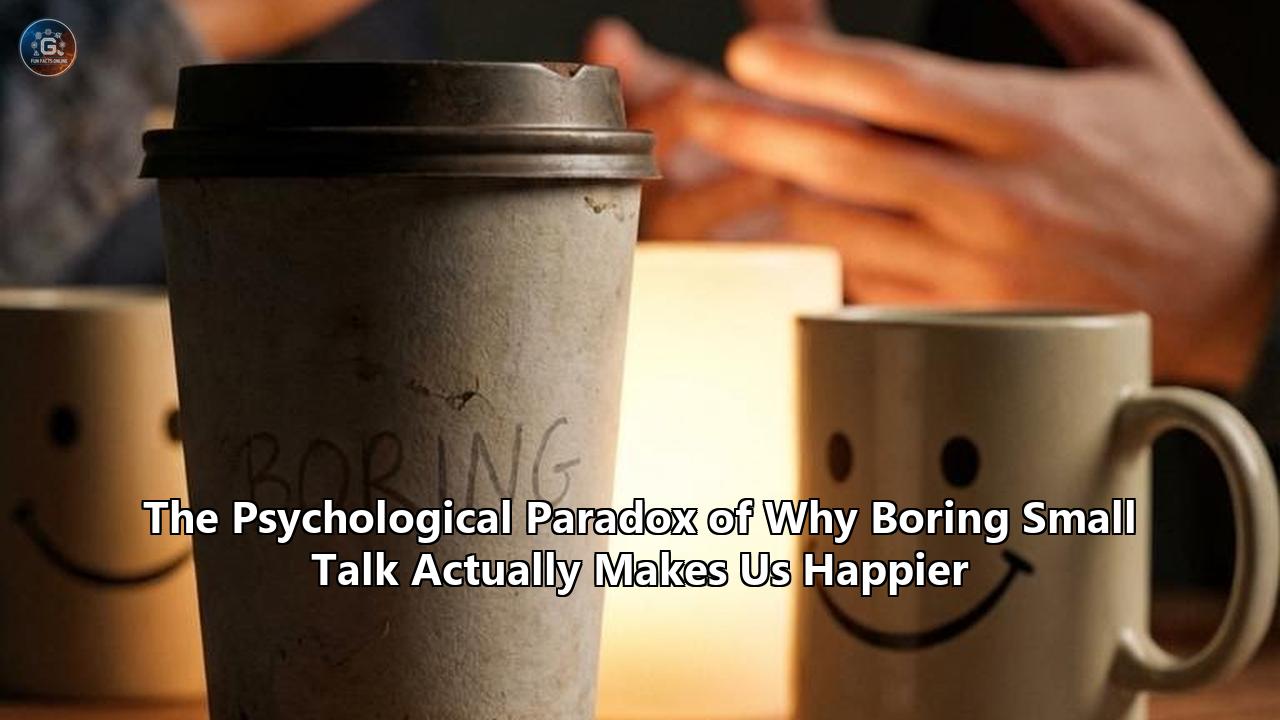
The American Psychological Association recently published a series of findings that directly challenge the prevailing cultural disdain for casual chatter. Released in April 2026 in the Journal of Personality and Social Psychology, the research reveals that people consistently, and drastically, underestimate how much they will enjoy discussing seemingly mundane topics.
Led by Elizabeth Trinh at the University of Michigan, the research team orchestrated nine distinct experiments involving over 1,800 participants. The experimental design forced subjects into conversations about subjects deliberately classified as uninteresting—either by the researchers or the participants themselves. Topics included the stock market, vegan diets, mathematics, and, in one highly specific instance, onions. The data returned a robust and counterintuitive conclusion: participants who engaged in these highly constrained, low-stakes conversations reported significant spikes in mood, feelings of connection, and overall engagement, directly refuting their own negative predictions about the interactions.
Mainstream coverage of this study has largely focused on the upbeat takeaway that people should not fear awkward silences. However, behind the closed doors of behavioral science departments and sociometric labs, this study is being viewed as a critical piece of a much larger puzzle. The mechanics of human interaction are undergoing a rigorous re-examination. By looking at the technical, neurological, and sociological realities of casual conversation, researchers are uncovering the hidden architecture of how human beings signal safety, distribute emotional loads, and construct functional societies.
The Methodology of Mundanity: How Science Measures the Uninteresting
To understand why Trinh’s 2026 study is making waves among behavioral scientists, one must look at the exact mechanics of the experiments. Measuring human interaction in a laboratory setting is notoriously difficult due to the observer effect—participants change their behavior when they know they are being watched.
To bypass this, the researchers utilized a mix-and-match protocol. In some control groups, only one participant was briefed that the topic was considered "boring". In others, both participants were primed with the expectation of a tedious interaction. The researchers also divided the cohorts into established friends and complete strangers to isolate the variable of pre-existing relational density.
The results exposed a massive cognitive blind spot in human predictive modeling. Psychologists refer to this as a "forecasting error." Participants expected the conversations to be draining because they evaluated the interaction purely on the informational utility of the topic. If they did not care about mathematics or onions, they assumed the conversation would yield no value.
What the data proved is that the human brain does not primarily extract value from the semantic content of small talk; it extracts value from the synchrony of the exchange. Trinh noted that what actually drives enjoyment is the underlying engagement—the act of feeling heard, the rhythm of responding, and the micro-discoveries made about another person's communication style. The topic itself is merely a scaffolding. Once the scaffolding is erected, the participants' nervous systems take over, engaging in a highly complex, subconscious dance of vocal tone matching, facial mimicry, and timing alignment.
This is where the true benefits of small talk begin to materialize. The semantic meaning of the words ("It looks like rain today") is entirely secondary to the biological data being transmitted ("I acknowledge your presence, I am engaging with you in a predictable manner, and I am not a threat").
The Neurobiology of the Weather Forecast
To gain insider-level understanding of this phenomenon, we have to look at the autonomic nervous system, specifically through the lens of Polyvagal Theory, developed by Dr. Stephen Porges. The theory posits that our nervous system is constantly scanning our environment for cues of safety or danger—a process called neuroception.
When you walk into a coffee shop, board a train, or enter an elevator, your brain’s amygdala is passively assessing the strangers around you. A room full of silent, disconnected people staring at screens provides zero social data. In the absence of data, the nervous system often defaults to a mild state of hypervigilance.
Lisa Chen, a licensed psychotherapist who analyzes high-achieving, socially guarded demographics, points out that low-stakes interactions directly manipulate this biological scanning process. Brief exchanges with a barista or a co-worker serve as acoustic and visual safety signals. When someone initiates small talk, they are offering a predictable, culturally scripted interaction.
If a stranger says, "Can you believe this heat?" they are extending a micro-bid for connection. When you respond, "It's awful, I'm melting," both parties have successfully completed a social algorithm. The successful completion of this script releases a minor dose of dopamine and oxytocin while simultaneously lowering cortisol levels.
This biochemical reaction is why experts observe that regular engagement in these micro-conversations regulates the nervous system over time. It prevents the body from slipping into the chronic, low-grade fight-or-flight state that often characterizes modern urban isolation. The brain is repeatedly reminded that the immediate environment is populated by cooperative, rather than competitive or hostile, actors.
Weak Ties and the Structural Engineering of Social Networks
The scientific re-evaluation of casual conversation extends far beyond the immediate physiological response. Sociologists divide human relationships into "strong ties" (close friends, family, spouses) and "weak ties" (the mail carrier, the person you see at the dog park, the cashier).
For decades, psychological literature heavily favored strong ties as the primary metric for a person's social health. However, recent data has forced a structural pivot in how experts view community resilience. A landmark 2023 study published in Social Psychological and Personality Science by Esra Ascigil and her colleagues focused specifically on the cumulative effect of weak-tie interactions on overall life satisfaction.
Ascigil’s team faced a common methodological hurdle: causation versus correlation. Do happy people simply talk to strangers more, or does talking to strangers make people happy? To solve this, the researchers employed specialized statistical techniques, including lagged regression models and intensive longitudinal data, to isolate the cause-and-effect relationship.
The findings were unequivocal. The frequency of conversations with weak ties and strangers was independently related to greater levels of well-being, even when controlling for the participant's baseline personality traits (like extroversion) and their number of strong ties.
From a network engineering perspective, strong ties are load-bearing pillars. They handle severe emotional distress and long-term support. Weak ties, however, function as the mortar. They fill the gaps between the pillars, creating a cohesive, resilient structure. When a person's social diet consists only of strong ties, they risk emotional claustrophobia and a severe reduction in novel stimuli. Weak ties provide low-cost, low-risk opportunities to practice social skills, experiment with different facets of one's personality, and anchor oneself to a broader community identity.
Digital Friction: Small Talk in the Remote Work Ecosystem
The mechanics of casual interaction have been severely tested by the shift toward remote and hybrid work models. In a physical office, casual chatter is built into the architecture—the walk from the parking lot, the time spent waiting for a meeting to start, the literal water cooler. In digital environments, this friction is eliminated. Meetings start exactly on the hour; cameras click off the second the agenda concludes.
Researchers Andrew J. Guydish and Jean E. Fox Tree recognized this structural deficit and, in 2025, published a critical study on the impact of casual conversation in videoconferencing settings. They set up task-break conversations where participants either engaged in facilitated small talk via video or waited for the same amount of time with their cameras and microphones disabled.
The technical data derived from the post-break analysis was startling. Dyads (pairs) who were directed to engage in small talk during their breaks were three and a half times more likely to initiate unprompted conversation during a designated free-period at the conclusion of the experiment.
This specific metric—the likelihood of initiating unprompted interaction—is closely watched by organizational psychologists. It is a proxy measurement for "relational chemistry" and psychological safety within a corporate hierarchy. Guydish and Fox Tree noted that these casual exchanges allowed participants to temporarily step outside their rigidly defined professional roles. By discussing a weekend plan or a pet, employees generate a baseline of positive affect that makes subsequent high-stakes negotiations or collaborative tasks significantly smoother. The benefits of small talk in this context act as a cognitive lubricant, reducing the friction of digital collaboration and preventing the transactional coldness that leads to remote-worker burnout.
The Industrial Psychology Angle: Safety, Hazards, and the Dual-Effect of Chatter
While clinical psychologists view casual banter through the lens of mood and loneliness, industrial and occupational psychologists view it through a distinctly different matrix: risk management. The intersection of casual conversation and workplace safety is a highly specialized field of study that reveals the complex trade-offs of human socialization.
Recent data collected from 136 full-time industrial employees in China, analyzing the variables of casual conversation, psychological availability, work absorption, and safety performance, uncovered a fascinating "dual-effect". Grounded in the Conservation of Resources (COR) theory, the research mapped exactly how these interactions operate on the factory floor.
On the positive side of the ledger, the research confirmed that casual conversation functions as a vital social resource. By engaging in a brief chat, employees relieve acute stress and replenish their psychological reserves. This increase in "psychological availability" means the employee returns to their task with a calmer, more composed baseline, which directly promotes higher rates of safety compliance and safety participation.
However, the data also tracked the resource-loss path. Casual conversation consumes time and cognitive bandwidth. If the interaction extends too long, it reduces "work absorption"—the deep, focused state required to monitor dangerous machinery or complex chemical processes. In these instances, the distraction inherently lowers safety performance.
This dual-effect challenges the long-held corporate management view that casual conversation is a uniform metric of unproductivity. Instead, organizational behaviorists now understand it as a dynamic regulatory mechanism. The optimal workplace environment does not eradicate chatter to maximize efficiency; rather, it designs workflows that allow for micro-doses of social interaction to maintain psychological availability without breaking the deep concentration required for high-risk tasks.
Overcoming the "Deep Talk" Bias in Psychological Research
To fully grasp the current scientific consensus, one must look at the historical biases within the field of psychology itself. For much of the 20th and early 21st centuries, psychological research carried an inherent elitism regarding conversational depth.
This bias was seemingly confirmed by a widely cited 2010 study by Dr. Matthias Mehl, which suggested that happiness was positively correlated with deep, substantive conversations, and negatively correlated with "idle" small talk. This finding permeated popular culture, leading to a proliferation of advice urging people to skip the superficial and dive straight into deep, philosophical discussions.
However, science is an iterative process of self-correction. In 2018, Dr. Mehl and postdoctoral researcher Anne Milek revisited this exact premise with a much larger, more diverse sample size of 486 participants (compared to the original 79 college students). Utilizing EAR (Electronically Activated Recorder) technology, which captures ambient snippets of audio throughout a participant's day, they tracked the exact acoustic reality of the subjects' social lives.
The updated findings forced a hard pivot in the academic narrative. The new data confirmed that while deep conversations are indeed linked to greater happiness, casual conversation has no negative correlation with well-being whatsoever. "We do not think anymore that there is an inherent tension between having small talk and having substantive conversations," Mehl stated, entirely reversing the previous assumption.
Furthermore, behavioral scientists now recognize that casual interaction is the necessary prerequisite for substantive interaction. Stanford Graduate School of Business lecturer Matt Abrahams describes it as the "gateway to deeper, richer talk." Demanding deep conversation without the preliminary ritual of casual banter is akin to attempting to run a marathon without warming up the muscles. The superficial chat establishes the baseline trust and rhythmic pacing required to safely navigate into vulnerable emotional territory.
The Attention Economy and the Deficit of Psychological Generosity
If the clinical data proves that these interactions are biologically regulating, structurally necessary, and psychologically beneficial, why are they in steep decline? The answer lies in the aggressive architecture of the modern attention economy.
Linda R. Tropp, a professor of social psychology, notes that public spaces have fundamentally transformed over the last decade. Commuters and pedestrians are no longer just occupying physical space; they are simultaneously existing in highly curated, algorithmically driven digital environments. Headphones and smartphones act as sensory barricades, explicitly signaling a refusal to engage with the immediate physical environment.
Because human attention is a finite resource, people conserve it by tuning out their physical surroundings. While this is a logical defensive mechanism against sensory overload, it creates a systemic crisis of social connection. Tropp frames the willingness to engage in fleeting public interactions as an act of "psychological generosity."
When you make eye contact with a stranger and exchange a brief greeting, you are engaging in a micro-affirmation of their existence. In a society where loneliness has reached epidemic classifications by the U.S. Centers for Disease Control and Prevention, the withholding of these basic social signals has a cumulative destructive effect. When people move through public spaces entirely blocked off by technology, they inadvertently create an environment of ambient rejection. The absence of casual acknowledgment signals to the human brain that one does not matter, eroding the baseline trust required for a functional society.
Historically, historians and sociologists have argued that public eye contact and casual greetings are not merely matters of etiquette; they are fundamental civic duties. They establish a baseline of "innocent until proven guilty" in the realm of social relations, signaling a default willingness to cooperate. Reclaiming this space from the attention economy requires a deliberate, conscious effort to temporarily dismantle our digital barricades.
The Mechanics of Re-Engagement: How to Engineer Better Interactions
Understanding the profound benefits of small talk is only half the equation; the other half is operationalizing this knowledge. For individuals who have spent years optimizing their lives for efficiency and digital curation, re-engaging in physical, spontaneous interactions can feel jarring. Social scientists and communications experts have identified several technical strategies to bypass the awkwardness and maximize the psychological returns of these encounters.
First, experts advise abandoning the pursuit of conversational perfection. The anxiety surrounding casual chatter usually stems from the fear of being uninteresting or saying the wrong thing. As Trinh's 2026 data proved, the topic is largely irrelevant to the success of the interaction. A discussion about onions is just as effective as a discussion about art history. The goal is not intellectual stimulation; the goal is synchrony.
Second, practitioners utilize the technique of "environmental anchoring." Instead of searching for a topic out of thin air, you anchor the interaction to a shared physical reality. Commenting on the length of a line, the temperature of the room, or the music playing in the background establishes immediate, undeniable common ground. It is a low-cognitive-load entry point that allows the other person's nervous system to recognize you as a co-observer of their reality, rather than a unpredictable variable.
Third, acknowledge the role of physical mirroring. The success of a brief exchange is heavily dependent on non-verbal cues. Licensed therapist Rebecca Tenzer notes that positive body language, smiling, and mirroring the stance of the person you are speaking with act as "happiness chemical hacks." These non-verbal signals bypass the prefrontal cortex entirely, speaking directly to the amygdala to confirm safety and establish rapport.
Finally, for those who experience severe social friction, the psychological concept of "exposure therapy" applies. Dr. Gillian Sandstrom's research on casual interactions demonstrates a clear feedback loop: the more frequently individuals engage in fleeting conversations, the more their social confidence compounds, and the less they fear rejection. The skill of casual banter atrophies in isolation and strengthens through repetition.
The Future of Fleeting Interactions
As we look toward the remainder of the decade, the scientific consensus is solidifying: the eradication of casual, unplanned social interaction is a public health hazard. Urban planners are beginning to incorporate "sociometric design" into cityscapes, creating public spaces explicitly engineered to create bottlenecks and slow down pedestrian traffic to encourage spontaneous interactions.
Furthermore, the corporate sector is realizing that hyper-efficient, silent workplaces are actively detrimental to long-term innovation and employee retention. We are likely to see a backlash against the purely transactional nature of remote work, with companies actively attempting to simulate the "water cooler" through randomized digital pairings and mandated, unstructured social time.
The most pressing unresolved question in this field of study revolves around neurodivergence. How do individuals with autism spectrum disorder, ADHD, or severe social anxiety process the biological safety signals of casual conversation? Early hypotheses suggest that the standard scripts of casual chatter may require translation or adaptation for neurodivergent populations, ensuring that the benefits of low-stakes interaction are accessible across the entire spectrum of human cognition.
Ultimately, the science of the mundane proves that human beings are profoundly sensitive instruments. We do not require constant, deep philosophical alignment to feel safe and connected. Sometimes, the most powerful psychological intervention available is simply acknowledging the weather, complaining about the traffic, and allowing our nervous systems to recognize that we are navigating this reality alongside others. The architecture of human happiness is not built solely on grand achievements and profound relationships; it is heavily reinforced by the brief, forgotten moments of shared existence.
By looking past the dismissive labels we assign to everyday chatter, we uncover a highly sophisticated mechanism of survival and cohesion. The next time a stranger offers a seemingly pointless observation about the heat or the weekend, recognize it for what the science reveals it to be: a biological handshake, a structural reinforcement of community, and a vital pulse check of our collective humanity.
Reference:
- https://www.forbes.com/health/mind/small-talk-research-health-benefits-lmandp5/
- https://www.upworthy.com/new-small-talk-study-reveals-why-you-should-never-fear-a-boring-conversation/
- https://www.psychologytoday.com/us/blog/close-encounters/202312/how-daily-small-talk-can-improve-well-being
- https://www.psychologytoday.com/us/blog/why-bad-looks-good/202601/small-talk-is-the-conversation-that-can-create-chemistry
- https://www.frontiersin.org/journals/psychology/articles/10.3389/fpsyg.2025.1622001/full
- https://www.sciencedaily.com/releases/2018/07/180703131432.htm
- https://www.ksl.com/article/51266243/small-talk-is-good-for-your-health-research-finds
- https://world.edu/making-eye-contact-and-small-talk-with-strangers-is-more-than-just-being-polite-%E2%88%92-the-social-benefits-of-psychological-generosity/