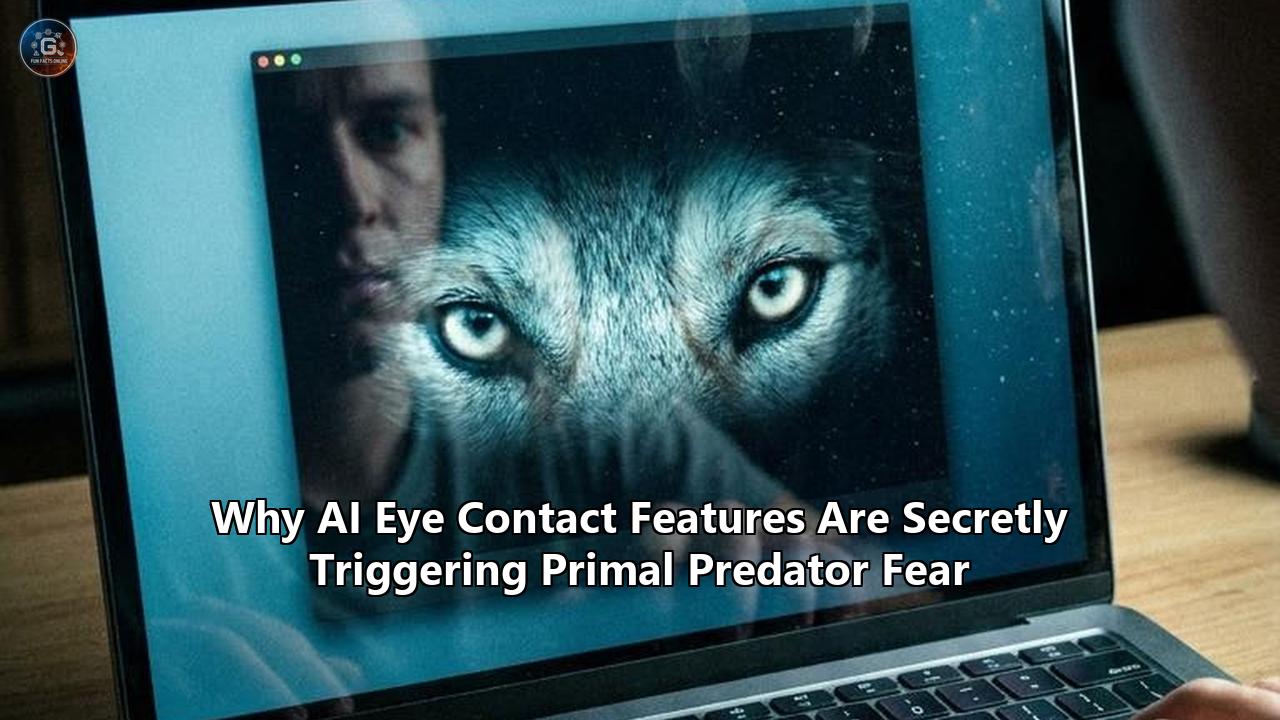
The backlash against artificial video-conferencing engagement has officially moved from corporate annoyance to a documented neurological hazard. Following a massive rollout of default "gaze correction" updates across major enterprise platforms this past April, a newly published neuroimaging study has validated the intense discomfort users are reporting. According to findings released this week in Nature Human Behaviour, the unblinking, digitally manipulated stare produced by modern webcam software is bypassing our higher reasoning centers and directly triggering the amygdala.
The human brain is not processing this software as a polite, attentive coworker. It is processing it as an apex predator preparing to strike.
The study arrives at a moment of peak friction in the remote work landscape. Over the last month, the integration of algorithmic gaze-correction into mainstream enterprise software—building on the foundation laid by Apple’s FaceTime Attention Correction and Nvidia’s Broadcast Eye Contact—has sparked a quiet revolt. Employees are complaining of severe exhaustion, elevated heart rates, and a distinct, lingering unease after routine video calls. Now, functional magnetic resonance imaging (fMRI) data reveals exactly why: the software’s inability to replicate the natural, erratic rhythm of human eye movement is mimicking the biological signals of hostile intent.
This development fundamentally reframes the conversation around digital communication tools. What tech companies marketed as a frictionless solution to the awkwardness of misaligned webcams has inadvertently engineered a direct conduit to our most ancient evolutionary alarms.
The Anatomy of a Digital Stare
To understand why this software provokes such a visceral reaction, one must first look at the mechanics of the illusion. The technology behind gaze redirection relies on sophisticated machine learning models, primarily augmented reality frameworks that map the topography of the human face in real-time.
When a user enables an eye-contact feature, the software does not simply tilt the video feed. It actively tracks the user’s ocular region, effectively "green-screening" their actual eyes. The neural network then generates a synthetic pair of eyeballs, complete with simulated sclera, irises, and pupils, and pastes them over the user's face, angling them directly into the camera lens. The software constantly adjusts the shading, attempts to match natural eye color, and even fakes a blink when the user's real eyelids close.
However, the algorithm operates on a binary mandate: ensure the user appears to be looking directly at the viewer. It fundamentally misunderstands the idiosyncratic nature of human interaction.
In natural conversation, unbroken eye contact is exceedingly rare. Human gaze is a dynamic, complex dance of engagement and aversion. We look into someone's eyes to emphasize a point, gauge an emotional reaction, or establish a connection. But just as crucially, we look away. We avert our gaze to reduce cognitive load while retrieving a memory, to signal submission, to indicate that we are yielding the floor in a conversation, or simply to rest our visual cortex.
When an AI intercepts this feed and overwrites every natural gaze aversion with a locked, forward-facing stare, it strips away the vital micro-expressions that contextualize human intent. The viewer on the other side of the screen is subjected to a continuous, unyielding visual lock. In the natural world, there are only two scenarios where a creature maintains prolonged, unbroken eye contact: intense amorous attraction, or an imminent physical attack.
Inside the Amygdala: The Neurology of Threat Detection
The Nature Human Behaviour study provides a granular look at how the brain processes this synthetic engagement. Researchers subjected participants to video feeds of both natural human interaction and AI-manipulated eye contact, monitoring their brain activity via blood oxygen-level dependent (BOLD) fMRI signals.
The results were stark. When participants viewed the AI-manipulated feeds, researchers observed an immediate and sustained spike in activation within the dorsal amygdala and the substantia innominata—the brain's primary threat-detection circuitry.
The amygdala functions as an early warning system, operating faster than conscious thought. It evaluates visual stimuli for danger within roughly 300 milliseconds. When a participant was subjected to the artificial gaze, the amygdala fired aggressively, completely bypassing the prefrontal cortex where logical processing occurs. Even when participants were explicitly told that the person on screen was using an AI filter, their biological threat response remained highly elevated. Conscious awareness could not override the primal alarm.
Neuroscientists attribute this to the "ambiguity of threat." In human interaction, an angry face with a direct stare is recognized as a clear, immediate threat. But a neutral or smiling face paired with the unrelenting, unblinking intensity of a predatory stare creates a severe cognitive dissonance. The brain detects the autonomic signals of predation—the fixed gaze—but cannot reconcile it with the lack of aggressive facial muscle tension. This mismatch forces the amygdala into a state of hyper-vigilance, frantically trying to resolve the conflicting data.
This neurological phenomenon is at the core of the rising ai eye contact fear. The user's brain is constantly flooded with low-level adrenaline, preparing for a fight-or-flight scenario that never physically materializes. Over the course of a one-hour video conference, this sustained autonomic arousal leads to profound physiological exhaustion.
The Missing Micro-Saccades and Pupil Dissonance
The terror of the AI stare is further compounded by its failure to replicate autonomic eye functions, specifically micro-saccades and pupil dilation.
Micro-saccades are tiny, involuntary, and rapid eye movements that occur even when we are fixated on a single point. They prevent visual fading and refresh the photoreceptors in the retina. While too small to be consciously tracked by an observer, the human brain subliminally registers these movements as markers of biological life. Current AI gaze models render the eye completely static between simulated blinks. The synthetic eye lacks these micro-tremors, resulting in a "dead" quality that plunges the image deep into the uncanny valley.
Furthermore, the software cannot accurately simulate pupil dilation in response to cognitive or emotional shifts. In a real human, pupils dilate during moments of high cognitive demand, emotional arousal, or shifts in ambient light. The AI paints a static pupil size based solely on the lighting of the room. When the viewer's brain scans the AI eyes for emotional validation and finds a perfectly still, unresponsive pupil locked onto them, it triggers the same neural pathways used to identify psychopaths or predators in the wild.
Clinical psychologists studying the "predator stare" note that predators—whether animal or human—utilize intense, static eye contact to freeze their targets. The lack of pupil reactivity and micro-movements are the exact visual signatures of a creature that has muted its empathy to focus entirely on consumption or exploitation. By erasing the erratic, messy reality of the human eye, tech companies have accidentally mass-produced the gaze of a sociopath.
Primatology and the Evolutionary Roots of Gaze
To fully grasp why ai eye contact fear is so deeply ingrained, evolutionary biologists point to our closest genetic relatives. Among non-human primates, eye contact is heavily regulated and highly dangerous.
Primatologists have long documented that among chimpanzees, macaques, and gorillas, a direct, sustained stare is an explicit signal of dominance and a precursor to physical violence. In the rigid social hierarchies of primate troops, subordinates must constantly avert their gaze to appease dominant members. Looking a silverback gorilla directly in the eyes is an invitation to be attacked.
Humans have inherited this underlying primate circuitry. We possess specialized "gaze cells" in the superior temporal sulcus of the brain, dedicated solely to tracking where other creatures are looking. These cells originally evolved to detect predators hiding in the brush. If a pair of eyes is locked onto you, you are the prey.
While human social structures have evolved to tolerate and even require moderate eye contact for bonding and cooperation, the underlying primate fear remains intact. We tolerate eye contact only when it is mediated by a complex system of social rules, micro-expressions, and frequent aversions.
When an employee turns on a gaze-correction filter, they are inadvertently stripping away millions of years of evolutionary diplomacy. They are broadcasting an unyielding, dominant primate threat display directly into the homes of their colleagues.
Dr. Aris Vlahos, an evolutionary psychologist who co-authored the recent study, frames the issue bluntly. "We are asking a brain that evolved on the savannas of Pleistocene Africa to ignore its most basic survival instinct. You cannot sit in a digital room with six people who are staring at you with the unwavering intensity of a hunting leopard and expect your nervous system to remain calm. It is a biological impossibility."
The Cognitive Load of Aversion
The danger of this technology extends beyond the viewer; it also actively degrades the communication abilities of the person using it.
Decades of cognitive psychology research demonstrate that eye aversion is not a sign of disrespect or inattention, but a critical mechanism for cognitive processing. When humans are asked a difficult question, they instinctively look up, down, or away from their conversational partner. This breaks the visual connection, temporarily reducing the massive amount of processing power required to read another person's face, freeing up cognitive bandwidth to access memory, formulate complex thoughts, and construct sentences.
By forcing a permanent state of virtual eye contact, the AI creates a paralyzing environment for the speaker. If an employee knows that the software is projecting a locked stare regardless of where they actually look, the subconscious rhythm of their speech is disrupted.
More insidiously, the widespread adoption of this technology establishes a toxic new baseline for "professionalism." If AI can manufacture perfect, unbroken attention, then natural human behavior—with its necessary pauses, glances away, and moments of visual rest—suddenly appears defective or disengaged.
This creates a terrifying feedback loop. Managers, accustomed to the artificial intensity of the AI stare, may begin to penalize employees who choose to turn the feature off, interpreting their natural eye aversion as a lack of focus or dedication. The software penalizes biological reality, elevating a robotic simulation as the new corporate standard.
The Pushback from the Neurodivergent Community
Nowhere is the backlash against gaze-correction technology more pronounced than within the neurodivergent community. For individuals on the autism spectrum, the enforcement of eye contact has long been a fraught and painful issue.
Many autistic individuals find forced eye contact physically painful or intensely overwhelming, describing it as a sensory overload that scrambles their ability to listen or speak. The neurotypical demand for "look me in the eye when I'm talking to you" forces autistic people into masking—the exhausting process of suppressing their natural behaviors to mimic neurotypical norms to avoid discrimination.
When Nvidia and Apple first announced these features, some tech commentators blindly praised them as "accessibility tools" that would help autistic people "pass" in corporate environments. The actual response from the autistic community has been a fierce, unified rejection.
Advocates point out that the technology does not solve the problem of neurotypical intolerance; it weaponizes it. By providing a tool that automatically fakes eye contact, employers are implicitly validating the discriminatory premise that eye contact is the only acceptable metric of engagement. It shifts the burden of accommodation entirely onto the disabled individual, requiring them to use a digital prosthesis to hide their natural traits, rather than asking society to accept diverse communication styles.
Furthermore, autistic users who have tested the software report a profound sense of dissociation. Seeing their own face on a monitor, hijacked by an algorithm to perform an action they actively avoid in real life, creates a jarring psychological disconnect. It is a form of digital ventriloquism, forcing the user's avatar to perform neurotypical compliance.
The rising ai eye contact fear among neurodivergent professionals is rooted in the very real threat of corporate mandates. If faking eye contact becomes a simple toggle switch, the refusal to use it will increasingly be viewed not as a disability accommodation, but as active insubordination.
The Productivity Paranoia of Remote Work
To comprehend how such a universally unsettling feature was green-lit and pushed to millions of devices, one must examine the corporate culture that funded it. The development of gaze-correction AI was not driven by a desire for deeper human connection. It was driven by productivity paranoia.
Since the massive shift to remote work earlier in the decade, middle management has grappled with a perceived loss of control. Without the physical panopticon of the open-plan office, managers have increasingly turned to digital surveillance to monitor their workforce. The market has been flooded with "bossware"—software that tracks keystrokes, monitors mouse movements, and intermittently photographs the user via their webcam.
Eye contact AI is the logical endpoint of this surveillance architecture. It commodifies attention. In the modern corporate hierarchy, looking at the screen is equated with working, and looking away is equated with slacking. Tech companies recognized a highly lucrative market in easing the anxiety of managers who desperately want proof that their employees are paying attention during hour-long quarterly earnings calls.
By framing the feature as "Attention Correction," Apple overtly linked human gaze to corporate obedience. The technology exists to manufacture the optical illusion of productivity. It allows employees to read emails, scroll through their phones, or entirely zone out, while the algorithm projects a mask of rapt, unwavering subservience to the manager on the other side of the screen.
It is a technological solution to a purely sociological problem: the refusal to trust remote workers. But in attempting to automate trust, the software has completely obliterated authenticity. When every person in a virtual meeting is perfectly, unnervingly focused on the camera, the value of that focus drops to zero. Everyone knows it is fake. The meeting devolves into a theater of the absurd, a grid of digital puppets staring blankly into the void, entirely disconnected from the humans sitting behind the keyboards.
Expert Reactions: "A War on What is Real"
The convergence of biological threat responses and corporate surveillance has alarmed ethicists and neuroscientists alike. The consensus among experts is that manipulating the human face in real-time crosses a dangerous boundary in digital communication.
Dr. Sarah Lin, a bioethicist focusing on augmented reality at Stanford University, argues that altering the eyes compromises the fundamental integrity of human interaction. "We have spent thousands of years evolving a highly calibrated system of facial trust. The eyes are the anchor of that system. When you introduce an algorithm that intercepts the visual feed and overrides the user's actual biological intent, you are severing the trust mechanism. It is no longer a video call; it is a deepfake broadcast in real-time."
The visual effects industry has also weighed in, noting that the technology fundamentally misunderstands the artistry of the human face. Digital animators spend months agonizing over the exact micro-movements of a character's eyes to avoid the uncanny valley. They know that a perfectly steady eye registers as dead or demonic. Tech companies, prioritizing low latency and low processing power, have slapped a crude, automated mask over the most expressive part of the human body.
This has broader implications for our relationship with digital media. If we cannot trust that the person on a live video feed is actually looking at us, what can we trust? The normalization of real-time facial manipulation erodes the baseline reality of remote communication. It prepares the public to accept increasingly aggressive forms of digital alteration, paving the way for full AI avatars that strip away the physical human entirely.
"This is not a feature; it is an escalation in the war on what is real," notes a prominent visual effects supervisor who reviewed the latest software updates. "We are teaching an entire generation of workers that their natural faces are inadequate for professional environments, and that they must rely on machine learning to sanitize their expressions."
The Legal and Ethical Trajectory
As the biological and psychological costs of this technology become irrefutable, the legal landscape is shifting. Labor rights organizations are currently preparing challenges against employers who mandate the use of gaze-correction software, citing hostile work environments and biological distress.
In the European Union, policymakers are already drafting amendments to the AI Act that would classify real-time biometric manipulation in the workplace as a high-risk application. Regulators are questioning whether an employer has the legal right to artificially alter an employee's facial expressions without explicit, per-meeting consent.
The core legal argument hinges on bodily autonomy in digital spaces. If an employee owns their physical likeness, does the company have the right to digitally puppeteer that likeness to enforce a corporate standard of "attention"?
Furthermore, the data privacy implications of gaze-tracking are immense. To generate the fake eyes, the software must continuously map the exact orientation of the user's actual eyes. This data can be heavily weaponized. Marketing firms and tech conglomerates have long salivated over eye-tracking data, as it reveals exactly what a user is looking at, reading, or ignoring on their screen. The widespread adoption of gaze-correction tools quietly normalizes the continuous scanning of the human retina, establishing the infrastructure for a deeply invasive new era of surveillance capitalism.
Overcoming the Uncanny Valley: What Happens Next?
The tech industry is currently at a crossroads. The severe backlash and the damning fMRI data have forced a reevaluation of how AI should intervene in human communication. The realization that ai eye contact fear is a biological reality, not just a software bug, means that simply throwing more processing power at the problem will not solve it.
Engineers cannot make the unblinking stare "better" because the unbroken stare itself is the fundamental flaw.
The next frontier of virtual communication relies on pivoting away from the binary "look at the camera" model, toward what researchers are calling "Intentional Gaze Mapping." Instead of locking the eyes forward, next-generation AI is being trained to analyze the context of the conversation and replicate a natural cadence of eye contact.
Startups in the augmented reality space are developing algorithms that learn a user's unique eye contact patterns—their specific blink rate, the direction they tend to look when thinking, and their specific micro-saccades. Rather than overriding the user's gaze, these advanced models will subtly angle the webcam feed to align the natural gaze with the screen, preserving the actual timing and movement of the user's eyes while correcting for the parallax error of the camera position.
The goal is to move from puppetry to genuine alignment. If a user looks down at their notes, the feed will show them looking down. If they glance away to think, the feed will show them glancing away. The AI will only correct the angle when the user is actively attempting to look the other person in the eye.
However, this technology is still years away from enterprise deployment, requiring massive leaps in real-time rendering and contextual machine learning. Until then, the workforce is trapped in an uncomfortable transitional phase, forced to navigate the creepy, static intensity of version 1.0 software.
A Reckoning with Digital Authenticity
The controversy surrounding artificial eye contact forces a broader cultural reckoning with how we value human presence. For years, the tech industry has operated on the assumption that communication can be endlessly optimized—that the friction of human interaction is a bug to be patched by code.
But the amygdala's violent rejection of the digital stare proves that some biological friction is strictly necessary. The messy, erratic, imperfect nature of human eye contact is not a flaw; it is the very mechanism that allows us to trust one another. It signals vulnerability, cognitive effort, and authentic emotion.
When we allow algorithms to pave over these evolutionary signals in the name of productivity or aesthetic perfection, we do not enhance communication. We destroy it. We isolate ourselves behind digital masks, terrifying our colleagues' nervous systems while convincing ourselves that we are highly engaged.
The physiological exhaustion that workers are experiencing is a vital warning sign. It is the body rebelling against a fundamentally unnatural state of being. As remote work continues to evolve, the challenge will not be how effectively we can fake our attention, but whether we have the courage to show up authentically—looking away, blinking, thinking, and proving to the primal brains on the other side of the screen that we are, in fact, human.
Moving forward, the defining metric of successful video conferencing may not be seamless technological intervention, but rather the strict absence of it. The companies that thrive will be those that recognize the biological limits of their workforce, prioritizing genuine trust over the terrifying, unblinking illusion of compliance.
Reference:
- https://www.pcgamer.com/nvidia-broadcast-eye-contact-out-now/
- https://www.virtualsapiens.co/the-uncanny-valley-of-eye-gaze-redirect-ai/
- https://www.frontiersin.org/10.3389/conf.neuro.09.2009.01.213/event_abstract
- https://www.researchgate.net/publication/10720920_Effects_of_Gaze_on_Amygdala_Sensitivity_to_Anger_and_Fear_Faces
- https://www.frontiersin.org/journals/human-neuroscience/articles/10.3389/fnhum.2010.00056/full
- https://medium.com/@malikmobeen024014/why-narcissists-eyes-seem-to-turn-black-the-neuroscience-of-the-predatory-gaze-pupil-shifts-45c721e7727c
- https://kotaku.com/creepy-eye-contact-stare-ai-nvidia-broadcast-1-4-update-1850025394
- https://www.fastcompany.com/90372724/welcome-to-post-reality-apple-will-now-fake-your-eye-contact-in-facetime
- https://en.wikipedia.org/wiki/Eye_contact
- https://pages.ucsd.edu/~johnson/COGS143/PrimateCom.pdf
- https://www.prisysbiotech.com/news/insight-into-the-sensory-and-behavioral-traits-79499625.html
- https://journals.plos.org/plosone/article?id=10.1371/journal.pone.0311673
- https://www.reddit.com/r/singularity/comments/10izyie/nvidia_just_released_a_new_eye_contact_feature/
- https://www.reddit.com/r/AutisticAdults/comments/10j76c5/a_win_for_autistics_nvidia_just_released_a_new/
- https://www.reddit.com/r/AppleVisionPro/comments/1ggie1y/uncanny_valley/