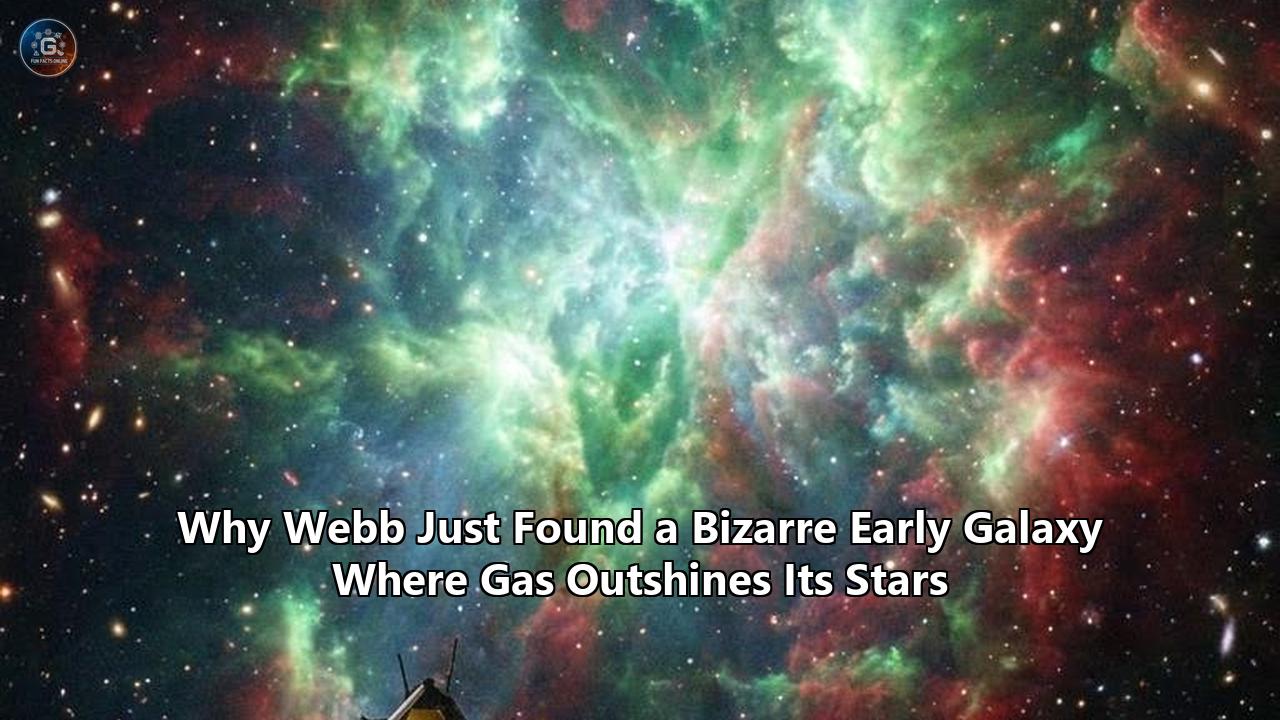
Astronomers utilizing the James Webb Space Telescope have identified an unprecedented cosmic anomaly located approximately one billion years after the Big Bang: a stellar system where clouds of superheated gas shine brighter than the stars themselves. Cataloged as GS-NDG-9422, this bizarre cosmic structure exhibits a light signature never before recorded in the history of observational astronomy. The resulting analysis confirms that the stars within this system are burning at temperatures nearly double those of the hottest stars in our modern universe, emitting such intense radiation that they essentially blind their own host galaxy in a fog of glowing nebular gas.
This discovery establishes a confirmed missing link in galactic evolution. Lead researcher Dr. Alex Cameron of the University of Oxford and theorist Dr. Harley Katz of the University of Chicago determined that the celestial bodies within 9422 reach temperatures exceeding 140,000 degrees Fahrenheit (80,000 degrees Celsius). For context, the most massive, hottest stars in our local galactic neighborhood top out between 70,000 and 90,000 degrees Fahrenheit. The extreme ultraviolet output from these ancient stars bombards the surrounding dense gas clouds, stripping electrons from atoms and causing the gas to fluoresce with overwhelming intensity.
The confirmation of this nebular-dominated system overhauls existing models of early star formation. Researchers initially hypothesized that discovering a Webb telescope early galaxy with such extreme radiation would point directly to Population III stars—the theoretical first generation of stars born entirely of primordial hydrogen and helium. However, spectroscopic data from 9422 reveals distinct chemical complexity, including elements heavier than helium. This indicates the galaxy is instead undergoing a violent, transitional phase of intense star formation that bridges the gap between the universe's absolute first stars and the well-structured galaxies seen later in cosmic history.
The Pre-Webb Consensus: Searching for the First Light
To understand how the discovery of GS-NDG-9422 escalated into a major astronomical event, the timeline must trace back to the theoretical limits established before the James Webb Space Telescope launched. For decades, astronomers operated under a strict chronological model of the universe. Following the Big Bang, the cosmos entered the "Dark Ages," a period filled with neutral hydrogen gas and devoid of light. Eventually, the very first stars ignited, clearing this fog in an era known as the Epoch of Reionization.
Theoretical physicists modeled these initial stars—dubbed Population III—as massive, short-lived, and incredibly hot. Because they formed from pristine gas without the cooling influence of heavier elements (metals), they could theoretically accrue immense mass, perhaps hundreds of times that of our Sun, before their internal radiation pressure halted their growth.
The Hubble Space Telescope pushed the boundaries of deep-space observation, but it hit a hard physical wall. Due to the expansion of the universe, light from the cosmic dawn is stretched into the infrared spectrum by the time it reaches Earth—a phenomenon known as cosmological redshift. Hubble's instruments were primarily optimized for visible and ultraviolet light, rendering the most distant galaxies effectively invisible. The astronomical community needed an infrared observatory capable of peering through cosmic dust and detecting these highly redshifted photons.
The JADES Survey and the Initial Data Flood
The narrative shifted abruptly with the deployment of JWST and the commencement of the JWST Advanced Deep Extragalactic Survey (JADES). Designed specifically to hunt for the earliest luminous objects, JADES utilized Webb’s Near-Infrared Camera (NIRCam) and Near-Infrared Spectrograph (NIRSpec) to stare deeply into seemingly empty patches of the sky, including the Fornax constellation.
The initial months of JWST data delivery threw cosmology into a state of intense debate. The telescope immediately began spotting galaxies that appeared too massive, too bright, and too mature for their chronological age in the universe. While researchers scrambled to adjust their models of dark matter halos and galaxy assembly rates, the automated pipelines were churning through thousands of distant light sources, cataloging them for follow-up spectroscopic analysis.
During this massive data influx, GS-NDG-9422 was captured as a faint, unassuming smudge. On early NIRCam images, it appeared as nothing more than a hazy white dot edged in orange, with faint blue projections extending opposite each other at the 11 o'clock and 5 o'clock positions. To the unassisted eye, it was just one of countless high-redshift candidates. The true escalation of this discovery remained hidden within the light itself.
The Spectroscopic Anomaly: "That's Weird"
The turning point in the timeline occurred when Dr. Alex Cameron began examining the spectroscopic data from JWST’s NIRSpec instrument. Spectroscopy is the process of breaking down light into its component wavelengths to reveal the chemical fingerprints and physical properties of the light source.
When observing a typical galaxy, astronomers expect to see a continuous spectrum of light dominated by the combined glow of billions of stars, punctuated by specific absorption lines where cooler gas in the stellar atmospheres absorbs certain wavelengths. When Cameron pulled the spectrum for this specific Webb telescope early galaxy, the expected pattern was entirely absent.
Instead of a smooth stellar continuum, the data displayed massive, spiky emission lines indicative of highly ionized gas. The light signature did not look like a collection of stars; it looked like a colossal, galaxy-sized nebula.
Cameron summarized his initial reaction to the raw data: "My first thought in looking at the galaxy's spectrum was, 'that's weird,' which is exactly what the Webb telescope was designed to reveal: totally new phenomena in the early universe that will help us understand how the cosmic story began."
The spectrum showed intense hydrogen and helium emission lines, alongside traces of other elements, suggesting that the overwhelming majority of the photons reaching the telescope's mirrors were not emitted directly from stellar photospheres. The stars were hidden, completely outshone by the gas surrounding them.
Running the Models: The Theoretical Escalation
Faced with a data set that defied standard galactic templates, Cameron escalated the investigation by partnering with Dr. Harley Katz, a theoretical astrophysicist with expertise in early universe computer modeling. The research team needed to reverse-engineer the physical conditions capable of producing such an extreme nebular glow.
They began running complex astrophysical simulations, tweaking the parameters of star formation, gas density, and stellar temperatures. The physics of nebular emission dictate that gas only glows when it is bombarded by high-energy ionizing radiation, typically extreme ultraviolet (EUV) photons. When an EUV photon strikes a hydrogen atom in the gas cloud, it ejects the electron. As electrons eventually recombine with the protons, they release energy in the form of specific wavelengths of light.
To produce the blinding intensity seen in GS-NDG-9422, the gas clouds required an astronomical volume of ionizing photons. Katz's models demonstrated that normal stellar populations—even the hot O-type and B-type stars found in the Milky Way—simply could not output enough EUV radiation.
The realization arrived when the team increased the simulated stellar temperatures to unprecedented levels. When the computer models generated stars burning at 80,000 degrees Celsius, the simulated spectrum nearly perfectly matched the empirical JWST data.
"It looks like these stars must be much hotter and more massive than what we see in the local universe," Katz explained. "Which makes sense because the early universe was a very different environment."
The Population III Paradox
With the confirmation of hyper-hot stars and blinding nebular gas, the scientific timeline reached a critical juncture. The conditions observed in 9422 perfectly matched theoretical predictions for environments containing Population III stars. The intense heat, the massive ionizing photon budget, and the nebular domination were the exact hallmarks astronomers had spent decades searching for.
However, the spectroscopic data delivered a swift complication. While the gas was overwhelmingly bright, NIRSpec is sensitive enough to detect the specific elemental composition of that gas. If 9422 contained the universe's first stars, the gas should have been pristine—exclusively hydrogen and helium forged in the Big Bang.
The Webb data showed unmistakable chemical complexity. The researchers detected signatures of elements heavier than helium within the glowing nebula. These heavy elements (metals, in astronomical parlance) can only be produced within the cores of previous generations of stars and distributed through supernova explosions.
"We know that this galaxy does not have Population III stars, because the Webb data shows too much chemical complexity," Katz noted.
This realization fundamentally shifted the nature of the discovery. Rather than finding the starting line of the universe, they had found the bridge. Galaxy 9422 represents a previously unknown, missing-link phase of galactic evolution. It is a transitional environment where the stars are far more exotic and massive than modern stars, yet not entirely primordial.
The Physics of a Nebular-Dominated Galaxy
To fully grasp why this specific Webb telescope early galaxy is so unusual, one must delve into the mechanical differences between a standard galaxy and a nebular-dominated one.
In a typical local galaxy like the Milky Way, star formation occurs in relatively localized, dense pockets of molecular gas—such as the Orion Nebula. The stars form, their radiation lights up the immediate surrounding gas, and eventually, stellar winds and supernovae blow the gas away, leaving a visible star cluster. The overall light of the galaxy remains overwhelmingly stellar.
In GS-NDG-9422, this process is occurring on a catastrophic, galaxy-wide scale. The researchers theorize that 9422 is undergoing a phase of intense, unified star formation inside an immensely dense cosmic cocoon. The stars being born are heavily skewed toward the upper limits of mass. Because the universe was denser one billion years after the Big Bang, and the gas was still relatively poor in cooling metals compared to today, the stellar initial mass function (IMF) was radically different.
Instead of forming thousands of small, cool red dwarfs for every massive blue giant, this environment favored the creation of colossal cosmic furnaces. These stars burn through their nuclear fuel at terrifying speeds. Their surface temperatures exceed 140,000 degrees Fahrenheit, pumping out continuous ionizing radiation. The surrounding gas is so thick and pervasive that very few stellar photons escape directly into space. Instead, the gas acts as a massive fluorescent transformer, absorbing the harsh ultraviolet energy and re-emitting it as the bright nebular lines captured by Webb.
Cosmic Implications: Supermassive Black Hole Seeds
The discovery of 9422's extreme stellar population immediately sparked secondary escalations in related fields of astrophysics, particularly concerning the origins of supermassive black holes.
One of the most persistent mysteries in modern cosmology is the existence of quasars containing billion-solar-mass black holes just a few hundred million years after the Big Bang. Traditional models of black hole growth, which rely on the slow accretion of matter over billions of years, cannot explain how these objects grew so large, so fast.
The hyper-massive, 80,000-degree stars modeled in galaxy 9422 offer a highly compelling mechanism. Stars of this magnitude live incredibly short lives—perhaps only a few million years—before collapsing. Because of their sheer mass, they bypass the standard supernova phase and collapse directly into intermediate-mass black holes, weighing hundreds or thousands of times the mass of the Sun.
By documenting a phase of galactic evolution dominated by these titanic stars, the JWST data provides observational backing for the "heavy seed" black hole model. A galaxy churning out these massive stars would quickly litter its core with heavy black holes, which could then rapidly merge in the dense early universe environment to form the supermassive behemoths seen powering ancient quasars. The swirling, highly ionized gas observed in the spectra of 9422 already hints at rapid accretion dynamics in its central region.
The Search Expands: A New Taxonomic Classification
The confirmation of this phenomenon has actively altered observational strategies. Rather than treating 9422 as an isolated anomaly, astronomers have recognized it as a distinct taxonomic class: the Nebular Dominated Galaxy (NDG).
This structural change in how astronomers interpret high-redshift data means archival JWST observations are currently being re-evaluated. If the light from early galaxies is frequently dominated by gas rather than stars, previous estimates regarding the stellar mass and age of these ancient galaxies may require recalibration.
When astronomers look at a distant galaxy and measure its brightness, standard practice assumes that brightness correlates directly to the number of stars. If a significant portion of the universe's early galaxies are actually NDGs, their brightness is being artificially inflated by fluorescing gas. This could resolve the early JWST crisis where galaxies appeared impossibly massive; they might not have as many stars as initially thought, but rather a smaller number of hyper-luminous, gas-illuminating behemoths.
The research team's immediate directive is to secure more observation time to find a larger sample size of these missing-link galaxies. Identifying a single Webb telescope early galaxy with these traits proves the mechanism exists; identifying a dozen would prove it was a standard developmental phase for all galaxies, potentially including the early Milky Way.
Advancing the Multi-Wavelength Front
While the James Webb Space Telescope operates purely in the infrared spectrum, verifying the full physical properties of nebular-dominated galaxies requires a multi-wavelength approach. The timeline of this investigation is currently expanding to incorporate data from ground-based observatories, most notably the Atacama Large Millimeter/submillimeter Array (ALMA) in Chile.
ALMA observes the universe in radio and submillimeter wavelengths, making it the perfect tool to measure the cold dust and molecular gas that JWST cannot see. By combining Webb's data on the superheated ionized gas with ALMA's data on the cold fuel supply, researchers can map the complete life cycle of star formation in these early environments. They can determine exactly how much raw material remains in 9422, how fast the hyper-massive stars are blowing that material away, and how long this bizarre nebular-dominated phase actually lasts before the galaxy clears its gas and transitions into a standard stellar-dominated structure.
What to Watch for Next
The unfolding narrative of GS-NDG-9422 is actively driving the next cycle of cosmological research. Several critical milestones remain on the immediate horizon for the astronomical community.
First is the ongoing hunt for true Population III stars. If 9422 is the transitional bridge, the primordial progenitors must exist slightly earlier in the cosmic timeline, in regions of space with even lower metallicity. Astronomers are refining their spectroscopic filters to search specifically for a Webb telescope early galaxy that completely lacks the chemical signatures found in 9422.
Second is the resolution of the stellar initial mass function for the early universe. Upcoming theoretical modeling will use the 80,000-degree temperature baseline to calculate exactly how large these transitional stars could grow. If the data suggests stars consistently exceeding 1,000 solar masses, it will force a rewrite of fundamental stellar astrophysics, testing the absolute limits of how bright a star can be before internal radiation pressure blows it apart.
Finally, the continuous monitoring of this specific cosmic region will aim to detect transient events, such as hypernovae or tidal disruption events, which could offer direct observational proof of the massive black holes theorized to be forming within these extreme cores.
The discovery of a galaxy where gas outshines its stars is not the conclusion of the JWST's early universe mission, but rather the opening of a new investigative avenue. The telescope has successfully identified a phase of cosmic evolution that was purely hypothetical just years ago. As data pipelines continue to process the deep-field surveys, the astronomical community remains on standby, waiting for the next spectral anomaly that defies the established rules of the cosmos.
Reference:
- https://scienceblog.com/webb-telescope-unveils-unprecedented-weird-galaxy-from-early-universe/
- https://en.wikipedia.org/wiki/GS-NDG-9422
- https://knowridge.com/2024/09/webb-telescope-finds-weird-galaxy-where-gas-outshines-stars/
- https://mashable.com/article/james-webb-space-telescope-early-galaxy-gas-outshines-stars
- https://www.skyatnightmagazine.com/news/james-webb-space-telescope-galaxy-9422
- https://ground.news/article/webb-telescope-detects-evidence-of-supermassive-stars_723ab7
- https://www.earth.com/news/odd-galaxy-may-hold-clues-to-the-first-stars-of-the-universe/
- https://science.nasa.gov/asset/webb/galaxy-gs-ndg-9422-nircam-image/
- https://www.esa.int/ESA_Multimedia/Images/2024/09/Galaxy_GS-NDG-9422
- https://www.space.com/james-webb-space-telescope-weird-galaxy-brighter-than-its-own-stars
- https://english.tachyonbeam.com/2024/09/27/primordial-galaxy-discovered-in-which-nebular-gas-outshines-stars/