Astronomers have just identified 27 unconfirmed planets orbiting twin stars, more than doubling the known catalogue of circumbinary worlds in a single sweep. The findings, published in the Monthly Notices of the Royal Astronomical Society in early May 2026, detail a targeted search using data from NASA’s Transiting Exoplanet Survey Satellite (TESS).
Instead of searching for the traditional shadows these planets cast when they pass in front of their host stars, a research team at the University of New South Wales (UNSW) tracked minute gravitational wobbles in 1,590 binary star systems. By looking for anomalies in the timing of stellar eclipses, the scientists flagged 36 systems acting strangely. Twenty-seven of those feature gravitational disturbances matching the mass profile of planets.
The candidate worlds are scattered across the Milky Way, located anywhere from 650 to 18,000 light-years away from Earth. Their estimated sizes range from the mass of Neptune up to ten times the mass of Jupiter. If confirmed, these new planets with two shadows will dramatically rewrite the census of planetary formation, proving that complex, multi-star systems can harbor planets just as reliably as single-star systems like our own.
This discovery comes at a critical time for astrophysics. While the global catalogue of confirmed exoplanets has recently surpassed 6,000, only about 18 of those were known to orbit two stars. This severe discrepancy has long troubled researchers. Because more than half of all stars in the universe exist in binary or multiple-star systems, the statistical likelihood of planets forming around twin suns should be high. The lack of detection pointed directly to a flaw in our observational methods, not a lack of planets.
“Most of our current knowledge on planets is biased, based on how we’ve looked for them,” said Margo Thornton, the UNSW astronomer and PhD candidate who led the study. “We’ve mostly found the easiest ones to detect.”
The Geometry of a Cosmic Blind Spot
To understand why astronomers missed these worlds for decades, you have to look at the primary tool used to hunt exoplanets: the transit method.
When a planet crosses directly between a telescope and a host star, it blocks a tiny fraction of the star's light. This creates a temporary dip in brightness—a miniature eclipse. By measuring the frequency and depth of that dip, astronomers can calculate the planet's size and orbital period. Kepler, TESS, and ground-based observatories have used this exact method to catalogue thousands of planets.
But the transit method demands perfect geometric alignment. The planet’s orbital plane must be oriented exactly edge-on to Earth. In a single-star system, this alignment is relatively stable. In a binary system, the gravitational dynamics are vastly more chaotic. Planets orbiting two stars often have irregular, shifting, or highly inclined orbits. They might transit their host stars from our perspective once, and then, due to orbital wobble, fail to transit again for decades.
Associate Professor Ben Montet, the study’s senior author, described the difficulty of finding these systems through traditional means. “Planets are hard to find. It’s like trying to see a candle right next to a big street light," Montet explained. When the planet fails to perfectly align with our line of sight, the transit method is entirely useless.
The UNSW team needed a detection method that did not rely on perfect alignment. They needed to find the invisible footprint the planets were leaving on the stars themselves.
Leveraging Apsidal Precession
The investigators turned to a phenomenon known as apsidal precession. While this mechanism has been used historically to study the internal structure of binary stars, it had never been deployed in a large-scale, automated search for exoplanets.
In a binary system, two stars orbit a common center of mass (the barycenter). If their orbit is elliptical, the point at which they come closest together is called the periapsis. According to Keplerian orbital mechanics, this elliptical path should remain fixed in space. However, due to several factors—including general relativity, tidal forces, and the stars' own oblateness (bulging at their equators)—the entire elliptical orbit gradually rotates over time. This slow rotation of the orbital path is apsidal precession.
When the two stars in a binary system orbit one another edge-on to Earth, they periodically eclipse each other. These stellar eclipses occur on a highly predictable, mathematically precise schedule. The UNSW team theorized that if a third body—such as a planet—was orbiting outside the binary pair, its gravitational pull would tug on the stars, subtly accelerating or decelerating the rate of apsidal precession.
This external gravitational perturbation would manifest as a tiny, yet measurable, variation in the timing of the stellar eclipses. The stars would eclipse each other just a fraction of a second too early, or a fraction of a second too late.
“If we monitor the exact timing of these eclipses … that can tell us that there's something else going on in the system,” Thornton noted.
The Data Trail: Sifting 1,590 Systems
Executing this search required an immense dataset with continuous, high-cadence photometric observations over a long baseline. The researchers utilized data from the Gaia DR3 catalogue of eclipsing binary candidates and cross-referenced it with light curves gathered by TESS. Launched in 2018, TESS stares at massive patches of the sky for nearly a month at a time, recording the brightness of millions of stars every few minutes.
The investigation proceeded layer by layer:
- The Initial Net: The team selected 1,590 eclipsing binary systems that showed clear, measurable apsidal precession.
- Filtering the Noise: Apsidal precession can be caused entirely by the physical properties of the stars themselves. The researchers had to mathematically model and subtract the precession caused by general relativity (the same effect that causes Mercury's orbit to precess around our Sun). They also had to calculate and remove the effects of tidal interactions and the rotational bulging of the stars.
- Isolating the Anomalies: After eliminating the natural stellar and relativistic effects, the team identified 71 systems where the rate of precession was still unexplained. The eclipses were shifting in ways that the two stars alone could not account for.
- Ruling Out False Positives: The team investigated these 71 anomalies further, looking for evidence of starspots, instrumental errors in the TESS cameras, or background light contamination. This rigorous elimination left 36 binary systems exhibiting distinct dynamical signatures of a third gravitational perturber.
- Categorizing the Perturbers: Based on the magnitude of the timing shifts, the researchers estimated the mass of the unseen third bodies. In nine cases, the gravitational pull was too immense to be a planet, suggesting the presence of a third, smaller star or a massive brown dwarf. But for the remaining 27 systems, the mass profile fit squarely into the planetary regime.
“We found 27 planet candidates out of 1,590 binary star systems, which is an almost 2% rate of binary systems that could potentially host planets,” Montet said regarding the initial pilot study. “I wasn’t expecting to find 27 already at this point from the pilot study. Now we get to start the really fun project of figuring out which ones are real planets.”
The Physical Reality of Circumbinary Worlds
The confirmation of these new planets with two shadows forces astrophysicists to model environments radically different from anything in our solar system. The architecture of a circumbinary system dictates unique and often violent planetary conditions.
Planets in these systems orbit in what is known as a P-type (planetary) orbit. Instead of orbiting just one star while the second star remains distant (an S-type orbit), a P-type planet orbits the barycenter of both stars. From the surface of such a planet, an observer would see two distinct suns in the sky, sometimes close together, sometimes drifting apart, depending on the stars' orbital period around each other.
The lighting and thermal dynamics of these environments are highly complex. Because the two stars are constantly moving in relation to the planet, the amount of solar radiation striking the planet's atmosphere fluctuates wildly. A planet might experience overlapping summers when both stars are visible at peak intensity, followed by a sudden plunge in temperature when one star eclipses the other, cutting off a portion of the incoming heat.
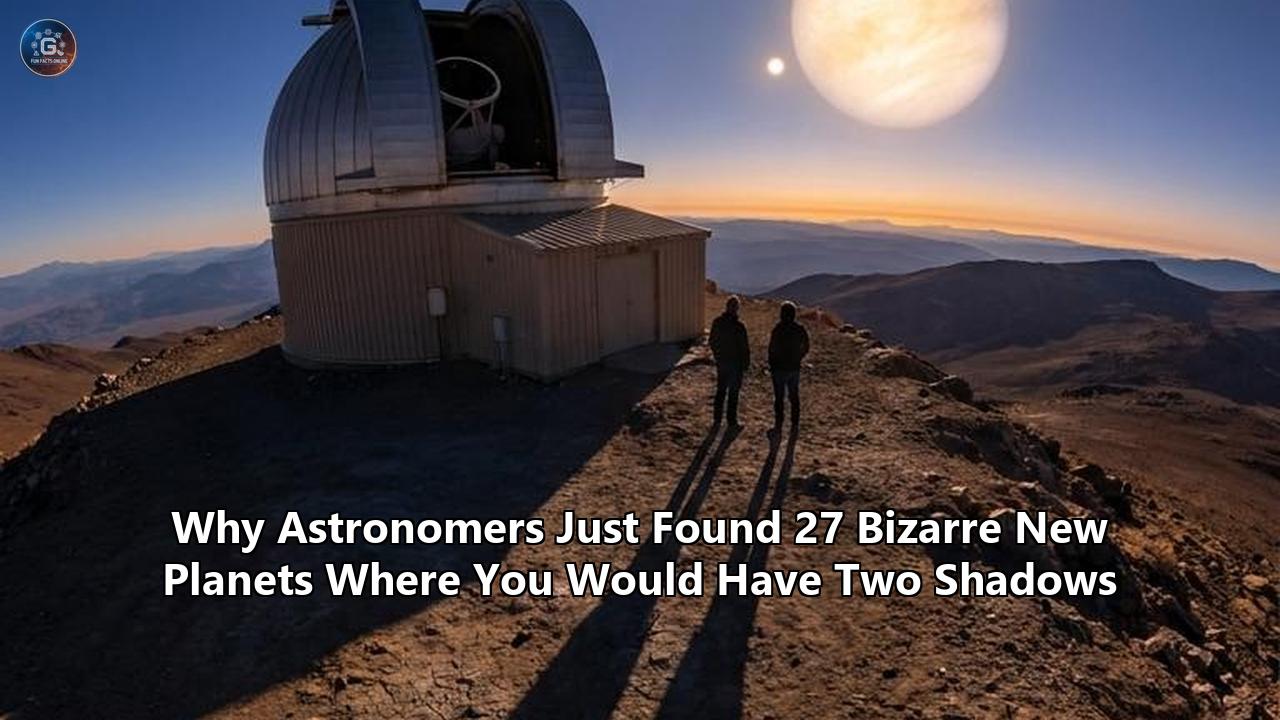
Furthermore, standing on the surface would literally result in multiple, distinct silhouettes. If you stood on one of these new planets with two shadows, the angle, length, and intensity of your shadows would shift continuously throughout the day as the two stellar light sources moved independently across the sky.
Sara Webb, an astrophysicist at the Swinburne University of Technology who was not involved in the UNSW study, pointed out the severity of these conditions. She noted that circumbinary planets would likely possess “very extreme environments” entirely unlike anything we experience in our local cosmic neighborhood.
The Orbital Survival Problem
Finding 27 planetary candidates in these environments raises a severe dynamical question: How do these planets survive without being ripped apart or thrown into the void?
Binary star systems are gravitationally chaotic. The shifting gravitational fields of two massive bodies constantly perturb the orbits of anything nearby. In an earlier study published in the Astrophysical Journal Letters, researchers at the University of California, Berkeley, modeled the long-term stability of circumbinary planets.
Mohammad Farhat, an astronomer at UC Berkeley who co-authored the stability study, explained the grim reality facing planets forming around twin stars. “Two things can happen: Either the planet gets very, very close to the binary, suffering tidal disruption, or being engulfed by one of the stars, or its orbit gets significantly perturbed by the binary to be eventually ejected from the system,” Farhat stated.
To survive, a circumbinary planet must maintain a safe distance. Astrophysicists define a critical boundary around binary stars known as the dynamical stability limit. If a planet forms or migrates inside this limit, the chaotic gravitational resonances of the two stars will quickly destabilize its orbit. The planet will either be consumed by the stellar fire or slingshotted out into interstellar space as a rogue planet.
The 27 candidates discovered by the UNSW team appear to have survived this gravitational gauntlet. In many of the identified cases, the potential planets are orbiting just beyond this critical stability region. They sit in the closest possible safe orbits, where the combined gravitational pull of the two stars acts more like a single point of mass, allowing the planet to maintain a somewhat regular, albeit perturbed, elliptical path.
Astrobiology in a Twin-Star System
The realization that planets can maintain stable orbits around binary pairs forces astrobiologists to recalculate the odds of extraterrestrial life. When researchers hunt for habitable zones—the orbital band where liquid water can exist on a planet's surface—they typically base their models on single-star systems.
Calculating the habitable zone in a circumbinary system is mathematically arduous. The zone isn't a static ring; it flexes, expands, and contracts as the two stars orbit each other and emit varying levels of radiation. If a planet's orbit is even slightly eccentric, it might plunge in and out of the habitable zone several times during its local year.
Most of the 27 candidates identified by Thornton and Montet are likely gas giants, ranging from Neptune's mass to ten times the mass of Jupiter. These specific bodies are not candidates for terrestrial life as we understand it. Gas giants lack a solid surface, and the immense atmospheric pressures would crush biological structures.
However, the presence of gas giants in these systems heavily implies the existence of smaller, rocky planets. In our own solar system, Jupiter and Saturn act as gravitational anchors, shaping the orbits of the inner terrestrial planets. If circumbinary gas giants can survive the gravitational chaos of two stars, rocky terrestrial worlds might also exist within those systems, potentially possessing massive exomoons capable of supporting life.
The confirmation of these new planets with two shadows would indicate that stable planetary formation is a common byproduct of binary star evolution, exponentially increasing the number of potential habitats in the galaxy.
The Mass Degeneracy Challenge
While the apsidal precession method has successfully flagged these 27 systems, the investigation is far from over. The researchers are completely transparent about a major limitation in their current data: mass degeneracy.
Because the team is observing the gravitational effect of a body rather than the body itself, they can only calculate a minimum mass based on an assumed orbital distance. The dynamical signature of a small planet orbiting very close to the binary stars looks mathematically identical to the dynamical signature of a massive brown dwarf orbiting much farther away.
“It's just a matter of: what is the mass of it? Is it a planet? Is it a brown dwarf? Is it a star?” Thornton explained regarding the unconfirmed nature of the candidates.
A brown dwarf is an object too massive to be considered a planet, but not massive enough to ignite sustained nuclear fusion in its core. If the unseen perturbers in these systems are situated on wide, distant orbits (spanning several astronomical units), their mass must be significantly higher to exert the observed timing shifts on the eclipsing binary stars.
To break this mass degeneracy and confirm the true nature of the objects, the astronomical community must gather secondary evidence.
The Next Phase: Spectroscopy and Radial Velocity
The UNSW team has laid the groundwork; the next step requires targeted follow-up observations using different astronomical techniques. The two primary methods that will be deployed to confirm these 27 candidates are radial velocity measurements and spectroscopic analysis.
Radial Velocity:Also known as the Doppler spectroscopy method, this technique looks for the spectral shift in the light emitted by the stars. As the unseen planet orbits the binary pair, its gravity pulls back on the stars. This causes the stars to wobble slightly toward and away from Earth. When the stars move toward us, their light waves are compressed, shifting toward the blue end of the spectrum. When they move away, the light stretches toward the red end.
By measuring the exact amplitude of this red-shift and blue-shift, astronomers can calculate the precise mass of the unseen perturber. If the mass falls below 13 Jupiter masses, the object is definitively a planet. If it falls between 13 and 80 Jupiter masses, it is a brown dwarf.
Obtaining radial velocity measurements for binary stars is notoriously difficult. The spectral lines of two stars constantly orbiting and eclipsing each other create a tangled, messy dataset. Disentangling the tiny Doppler shift caused by a planet from the massive Doppler shifts caused by the two stars orbiting each other requires high-resolution spectrographs and intense computational processing. Ground-based observatories like the Keck Observatory in Hawaii or the Very Large Telescope in Chile will likely be tasked with this follow-up work.
Spectroscopic Emission Analysis:Thornton also noted that analyzing the light emitted directly from the systems could help formally confirm the planets. If the third body is a small star or a brown dwarf, it will emit its own faint infrared light. If it is a planet, it will only reflect the light of the host stars. By using space-based infrared observatories, such as the James Webb Space Telescope (JWST), researchers could look for the specific heat signatures that separate high-mass planets from low-mass stellar objects.
Expanding the Search Parameters
The UNSW pilot study is actively reshaping how space agencies view existing data. The 27 candidates were found by analyzing just 1,590 systems. The TESS database currently holds high-quality light curves for tens of thousands of eclipsing binary systems.
Webb emphasized the utility of the UNSW methodology. She indicated that the team’s “very clever techniques” could be unleashed on the entirety of the TESS archive to find hundreds, if not thousands, of additional planet candidates.
Because the apsidal precession method does not require edge-on alignment from Earth, it bypasses the massive transit bias that has skewed exoplanet statistics for the last two decades. Astronomers no longer have to wait for the planet to pass directly in front of the streetlight; they can simply watch how the streetlight wobbles.
This methodology is not limited to TESS data. The European Space Agency’s Gaia mission, which provided the baseline catalogue of eclipsing binaries used in the study, continues to map the positions and motions of over a billion stars in the Milky Way. As Gaia releases new data over the coming years, the baseline of eclipsing timing variations will grow longer, allowing astronomers to detect the gravitational tugs of planets on wider, longer orbits.
Furthermore, the upcoming PLATO (Planetary Transits and Oscillations of stars) mission, spearheaded by the European Space Agency and scheduled for launch in late 2026, will provide even higher-precision photometry than TESS. PLATO is specifically designed to find rocky planets in the habitable zones of solar-type stars. By applying the apsidal precession search algorithms to PLATO data, astronomers could soon identify terrestrial, Earth-sized new planets with two shadows.
Rethinking Planetary Formation Models
The sudden influx of 27 potential circumbinary worlds provides a vital data dump for theorists studying planetary formation. For decades, the standard model of planetary genesis—core accretion—was tuned primarily for single stars.
In the core accretion model, a star forms from a collapsing cloud of gas and dust. The leftover material flattens into a spinning protoplanetary disk. Over millions of years, dust particles collide and stick together, forming pebbles, then boulders, and eventually planetesimals. These planetesimals generate enough gravity to sweep up the remaining gas, forming gas giants like Jupiter, or they remain rocky, forming planets like Earth.
In a binary star system, the protoplanetary disk is violently disturbed. The two stars act like massive cosmic eggbeaters, stirring the gas and dust. Their overlapping gravitational fields create turbulence, increasing the velocity of the dust particles. When particles collide at high speeds, they tend to shatter rather than stick together, halting the core accretion process entirely.
The fact that planets are seemingly abundant in these systems forces astrophysicists to amend these models. Theories now suggest that circumbinary disks must be incredibly massive and viscous to dampen the orbital velocities of the dust particles, allowing them to stick together despite the gravitational chaos.
Alternatively, the planets might not form near the stars at all. They could coalesce in the quiet, frigid outer reaches of the protoplanetary disk, far away from the binary's gravitational turbulence, and then slowly migrate inward over millions of years until they hit the dynamical stability limit. The exact masses and orbital eccentricities of the 27 candidates identified by Thornton and Montet will serve as test cases to prove or disprove these migration theories.
The Path Forward
The astronomical community is now mobilizing to verify the UNSW findings. If even half of the 27 candidates are confirmed as planetary mass objects, it will signify a massive shift in exoplanetary demographics. It proves that binary star systems—which make up more than 50% of the stellar population—are not sterile environments hostile to planetary formation.
The investigation initiated by Thornton, Montet, and their colleagues demonstrates that the limits of our cosmic maps are often defined by the tools we use to draw them. By abandoning the requirement for perfect visual alignment and relying instead on the rigid mathematics of orbital precession, astronomers have accessed a previously hidden population of worlds.
In the coming months, observing proposals will be submitted to the world's largest ground-based telescopes. Spectrographs will break apart the light of these 27 systems, hunting for the telltale Doppler shifts that will confirm the masses of the unseen perturbers. The pilot study has effectively proven the methodology; the next phase requires scaling the software pipeline to sift through the millions of remaining light curves in the TESS and Gaia archives.
We are entering a phase of exoplanet discovery where the unseen gravitational footprints of planets matter just as much as their shadows. The search for worlds orbiting twin suns is no longer constrained by the lucky geometry of a transit. As the data processing pipeline matures, the discovery of new planets with two shadows will likely transition from an astronomical rarity to a regular occurrence, fundamentally altering our understanding of where, and how, planets survive in the Milky Way.
Reference:
- https://www.theguardian.com/science/2026/may/04/scientists-discover-27-potential-new-planets
- https://www.smithsonianmag.com/smart-news/astronomers-discover-27-potential-planets-each-orbiting-two-stars-just-like-the-fictional-tatooine-in-star-wars-180988667/
- https://www.youtube.com/watch?v=hnpuv2vKqYA
- https://qazinform.com/news/scientists-spot-27-tatooine-like-planets-orbiting-two-suns-a15733
- https://www.popsci.com/science/two-star-planets-tatooine-star-wars/
- https://www.vice.com/en/article/astronomers-just-found-27-possible-planets-orbiting-two-suns-what-happens-next/
- https://academic.oup.com/mnras/article/548/3/stag515/8524019
- https://astrobiology.com/2026/05/tatooine-class-planet-discovered-orbiting-two-suns.html