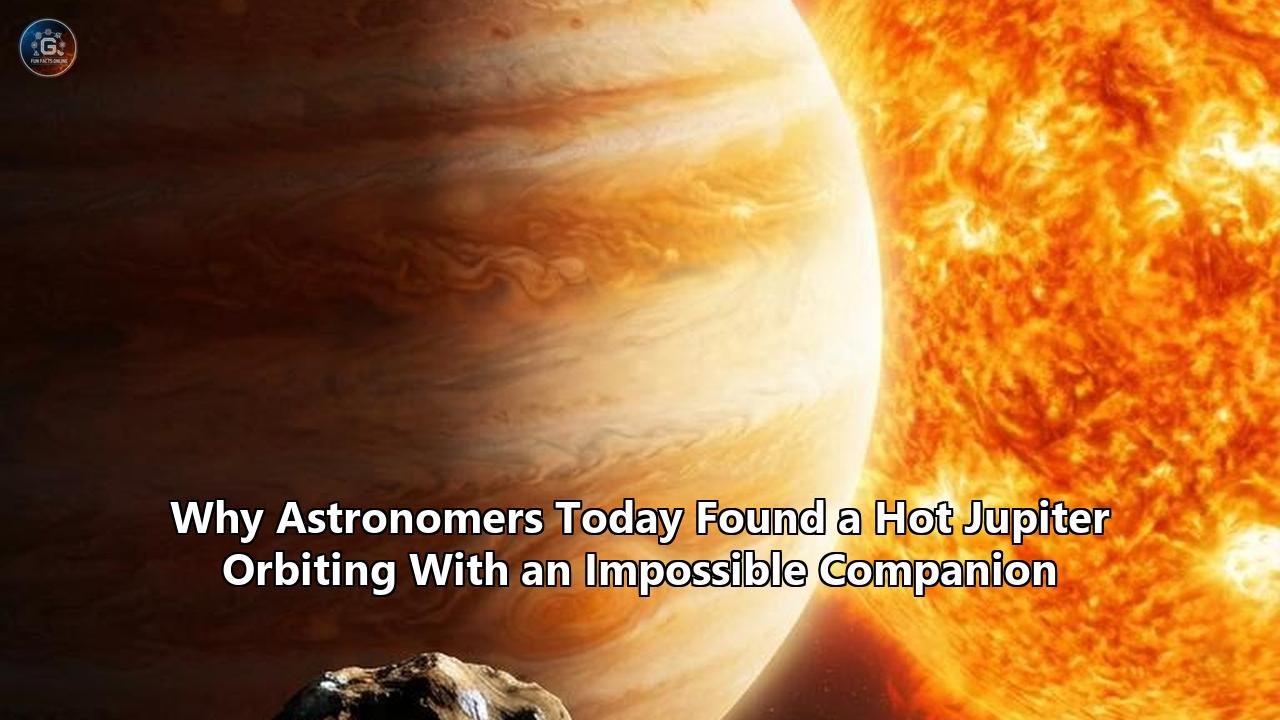
One hundred and ninety light-years from Earth, an impossible planetary arrangement has just forced astrophysicists to rewrite the rules of orbital dynamics. In a study published this week in Astrophysical Journal Letters, an international team of astronomers led by MIT’s Saugata Barat announced the detection of a dense, heavy-molecule atmosphere surrounding a mini-Neptune that orbits directly inside the path of a massive gas giant. The system, cataloged as TOI-1130, features a Neptune-like world enduring temperatures of 1,025 degrees Fahrenheit (550 degrees Celsius) just 4.2 million miles from its host star, while a Jupiter-sized behemoth circles immediately outside it.
The new data, captured by the James Webb Space Telescope (JWST), reveals that the inner planet’s atmosphere is heavily enriched with water vapor, carbon dioxide, sulfur dioxide, and traces of methane. This chemical cocktail provides absolute confirmation that the smaller planet could not have formed in its current, blistering location. Instead, both the giant and its smaller companion formed billions of miles away in the freezing outer reaches of their star system, migrating inward together over millions of years.
This discovery shatters a foundational assumption in planetary science. Gas giants that orbit extremely close to their stars are known to possess immense gravitational influence, acting as orbital bulldozers that either swallow inner planets or slingshot them into deep space. The survival of an inner companion like TOI-1130b was thought to be a physical impossibility. By proving that a massive gas giant can safely escort a smaller world across a stellar system, astronomers have unlocked a completely new mechanism for planetary formation.
1995–2019: Establishing the Law of Planetary IsolationTo understand why the TOI-1130 system is so disruptive to modern astrophysics, one must trace the timeline back to the dawn of exoplanetary science. When Michel Mayor and Didier Queloz discovered 51 Pegasi b in 1995, they identified a gas giant with roughly half the mass of Jupiter completing an orbit in just 4.2 days. The existence of the planet defied the established models of the time. Gas giants require vast amounts of solid ice and gas to assemble their massive cores, meaning they must initially form beyond a star’s "frost line"—the distant boundary in a protoplanetary disk where temperatures drop low enough for volatile compounds like water and ammonia to freeze into solid grains.
Because they must form far away, theorists concluded that these giant worlds subsequently migrate inward toward their stars. Over the next two decades, astrophysicists developed two primary models to explain this migration. The first, Type II disk migration, suggests that a massive planet clears a physical gap in the gas disk and slowly spirals inward as the disk itself accretes onto the central star. The second, high-eccentricity migration, relies on violent gravitational perturbations. In this scenario, mechanisms like planet-planet scattering or Kozai-Lidov oscillations—where a distant companion star perturbs the planet's orbit—force the gas giant into a highly elliptical, plunging trajectory. As the planet grazes the host star, intense tidal friction bleeds away its orbital energy, circularizing its path into a tight, scorching orbit over hundreds of millions of years.
Both of these mechanisms are highly destructive to local architecture. A migrating Jupiter-mass planet packs enough angular momentum to utterly destabilize the inner system. Any smaller rocky or gaseous planets situated in its path would inevitably experience chaotic gravitational encounters, resulting in planetary collisions or ejection from the star system entirely. For decades, astronomers believed that hot jupiter exoplanets operated as the solitary apex predators of their star systems. The observational data supported this theory flawlessly: out of hundreds of close-in gas giants discovered by early surveys like Kepler, almost none possessed nearby planetary companions. The golden rule of exoplanet demographics was established: hot Jupiters are strictly lonely.
April 2020: A Glitch in the PhotometryThe first fracture in the isolation theory appeared in the spring of 2020. Chelsea Huang, a researcher then at the Massachusetts Institute of Technology (now faculty at the University of South Queensland), was sifting through photometric data beamed back by NASA's Transiting Exoplanet Survey Satellite (TESS). TESS detects exoplanets using the transit method, constantly monitoring wide swaths of the sky to measure the minute, periodic dips in stellar brightness that occur when an object crosses the face of a host star.
While analyzing the light curve of a K-type star designated TOI-1130, Huang noted a distinct and deep transit signature. A massive object, mathematically confirmed through subsequent radial velocity measurements to be 0.974 times the mass of Jupiter, was completing an orbit every 8.4 days. This was a classic, textbook gas giant.
However, the TESS photometry revealed a second, much shallower dip buried in the starlight. A smaller object, approximately 3.5 times the diameter of Earth, was transiting the exact same star every 4.1 days.
This secondary signal corresponded to TOI-1130b, a mini-Neptune positioned at a distance of just 0.0453 astronomical units (AU) from the star—placing it directly inside the orbit of the massive gas giant. The physics of the system appeared completely contradictory. If the outer giant had migrated violently through the system, the mini-Neptune should have been annihilated. If it had migrated smoothly via disk drag, it still should have pushed the smaller world into the stellar surface.
"This was a one-of-a-kind system," Huang stated regarding the initial TESS discovery. "Hot Jupiters are 'lonely', meaning that they don't have companion planets inside their orbits. They are so massive and their gravity so strong, that whatever is inside their orbit just gets scattered away." The astronomical community initially viewed the system with deep skepticism, treating TOI-1130 as a bizarre glitch in planetary dynamics that threatened to upend a quarter-century of established migration theory.
2021–2024: The Theoretical Scramble and the Resonance LifelineThe validation of TOI-1130b initiated a fierce, multi-year debate among dynamicists and planetary theorists. How did the inner companion survive the gravitational gauntlet of a migrating giant?
Some researchers proposed an "in-situ" formation model to explain the anomaly. Under this hypothesis, the hot Jupiter migrated through the system first, forcefully clearing out the primordial inner disk. After the giant settled into its 8.4-day orbit, the mini-Neptune slowly accreted from the leftover orbital debris closer to the star. The fatal flaw in this theory was mass limitation: fluid dynamics models indicated that the inner regions of a depleted protoplanetary disk simply lacked the requisite solid material to assemble a planet 3.5 times the size of Earth.
When evaluating the orbital histories of hot jupiter exoplanets, astrophysicists historically favored chaotic, violent migration pathways over synchronized decay. But the exact orbital periods of the TOI-1130 system offered a crucial mathematical clue. The inner mini-Neptune orbits every 4.1 days, while the outer gas giant orbits every 8.4 days. This specific timing places the two worlds in a near 2:1 mean motion resonance.
Orbital resonance acts as a powerful gravitational shock absorber. Every time the gas giant completes one precise orbit, the mini-Neptune completes roughly two. This orbital choreography ensures that the two planets always experience their closest approaches at the exact same relative points in their trajectories. Rather than exerting random, chaotic gravitational tugs that lead to ejection, the planets impart periodic, stable tugs on one another. Theorists hypothesized a "co-migration" scenario: rather than the giant migrating alone, the two planets formed far out in the disk and drifted inward together, safely locked in this protective resonance. However, proving this elegant theoretical model required hard physical evidence that could only be found inside the mini-Neptune’s atmosphere.
Late 2025: Catching the Transit with JWSTTo definitively prove the co-migration theory, astronomers needed to determine the origin point of TOI-1130b. If the planet formed in-situ near the star, its atmosphere would be heavily depleted of volatile compounds, consisting mostly of lighter gases or the outgassed remnants of a scorched rocky mantle. If it formed far away and migrated inward, its atmosphere would be saturated with heavy, icy molecules.
To read the chemical fingerprint of a world 190 light-years away, Saugata Barat and his international team secured highly competitive observation time on the James Webb Space Telescope in late 2025.
Executing the observation required exceptional logistical precision. The team had to compile years of prior TESS photometry and ground-based radial velocity data to predict the precise, fleeting moments when the mini-Neptune would pass in front of its star at an angle perfectly aligned with JWST’s mirrors.
The team utilized transmission spectroscopy, one of the most complex observational techniques in modern astrophysics. As the K-type star's light passed through the thin atmospheric limb—the terminator line separating the planet's day and night sides—the molecules suspended in the alien atmosphere absorbed specific wavelengths of near-infrared light. The vibrational and rotational modes of molecular bonds absorb photons at exact, predictable frequencies. By capturing the filtered starlight, JWST's spectrographs could read the resulting absorption lines like a dark barcode across the infrared spectrum. A mistimed observation window or a miscalibrated instrument would yield nothing but raw stellar noise, but JWST’s near-infrared instruments locked onto the system flawlessly, initiating a months-long data reduction process to isolate the planetary signal.
The Breaking Moment: Tracing Molecules to the Frost LineThe results of that rigorous observational campaign were released this week, providing definitive, irrefutable proof of the co-migration theory.
JWST’s transmission spectra revealed that TOI-1130b possesses an atmosphere astonishingly dense and rich in heavy molecules. The spectrographic barcode confirmed high concentrations of water vapor, carbon dioxide, sulfur dioxide, and traces of methane.
In the field of planetary chemistry, these specific compounds serve as the ultimate smoking gun for deep-space formation. In a young stellar system, the intense ambient heat of the central protostar vaporizes these molecules in the inner disk, leaving only dry silicates and iron to form rocky planets. Water and carbon dioxide can only condense into solid "icy pebbles" far beyond the system's frost line.
Because TOI-1130b's atmosphere is choked with these volatile compounds, it is physically impossible for the planet to have accreted its massive envelope near its current orbit. It had to form in the freezing, dark outer reaches of the solar system, right alongside the massive gas giant.
This data paints a vivid picture of the system's history. Over a span of roughly 10 million years, the two newly formed planets interacted with the viscous gas and dust of their primordial protoplanetary disk. The resulting aerodynamic drag sapped their orbital momentum, pulling them steadily inward. Rather than acting as a destructive bulldozer, the gas giant’s gravity caught the smaller world. The two planets locked into their 2:1 gravitational resonance, effectively acting as an anchor for one another. They safely "held hands" as they crossed the entire breadth of their solar system, maintaining their thick, icy atmospheres all the way down to their current scorching orbits.
The findings released this week fundamentally rewrite the demographic assumptions surrounding hot jupiter exoplanets and their capacity to tolerate nearby planetary companions. The violent, scattering models of migration are no longer the exclusive rule; synchronized, gentle orbital decay is now a proven physical reality.
The Next Decade of Orbital ForensicsThe confirmed survival mechanism of TOI-1130b triggers an immediate and massive pivot in exoplanetary research. The long-held assumption that close-in gas giants exist in total isolation is officially obsolete, and the astronomical community is already scrambling to re-examine archival data.
This paradigm shift is rapidly being corroborated by parallel observations across the galaxy. Astronomers are now recognizing a distinct, stable architectural class of multi-planetary systems that defy old models. For example, recent analyses of the WASP-132 system revealed a super-Earth tucked just interior to a massive gas giant, while a distant icy giant orbits on the outskirts—proving that entire planetary families can survive the migration of a massive world. What was once dismissed as a statistical rounding error or a false positive in early transit surveys is now becoming a primary target for orbital dynamicists.
Instead of assuming a solitary existence, future surveys will systematically scan the interior orbits of known hot jupiter exoplanets to search for hidden, low-mass companions that early-generation telescopes missed. Upcoming instruments, such as the European Space Agency's PLATO mission and the next generation of extreme-precision radial velocity spectrographs, will specifically target these massive worlds to detect the minute, resonant gravitational tugs of hidden mini-Neptunes. Furthermore, initiatives like the ExoEcho project are currently utilizing high-cadence transit timing variations to search for co-orbital "exotrojans"—massive companions sharing the exact same orbit as a gas giant.
The universe, it appears, heavily favors complex gravitational choreography over pure destruction. As astronomers push their instruments closer to the blinding glare of distant stars, they are finding that the galaxy's most massive planetary bullies are occasionally capable of an impossibly gentle planetary escort. The fundamental question for the next decade of astrophysics shifts from how these binary pairs survive, to just how many giant worlds are secretly shielding companions in the stellar glare.
Reference:
- http://www.sciencedaily.com/releases/2026/05/260506225132.htm
- https://www.space.com/astronomy/exoplanets/how-an-exoplanet-odd-couple-survived-by-traveling-in-from-the-cold-together
- https://www.techexplorist.com/spaces-oddest-couple-astronomers-finally-reveal-their-origins/102944/
- https://astrobites.org/2020/04/01/youve-got-a-friend-in-me-a-hot-jupiter-with-a-unique-companion/
- https://arxiv.org/abs/2205.02501
- https://nccr-planets.ch/blog/2025/01/20/not-all-hot-jupiters-orbit-solo/
- https://www.aanda.org/articles/aa/full_html/2026/05/aa57704-25/aa57704-25.html