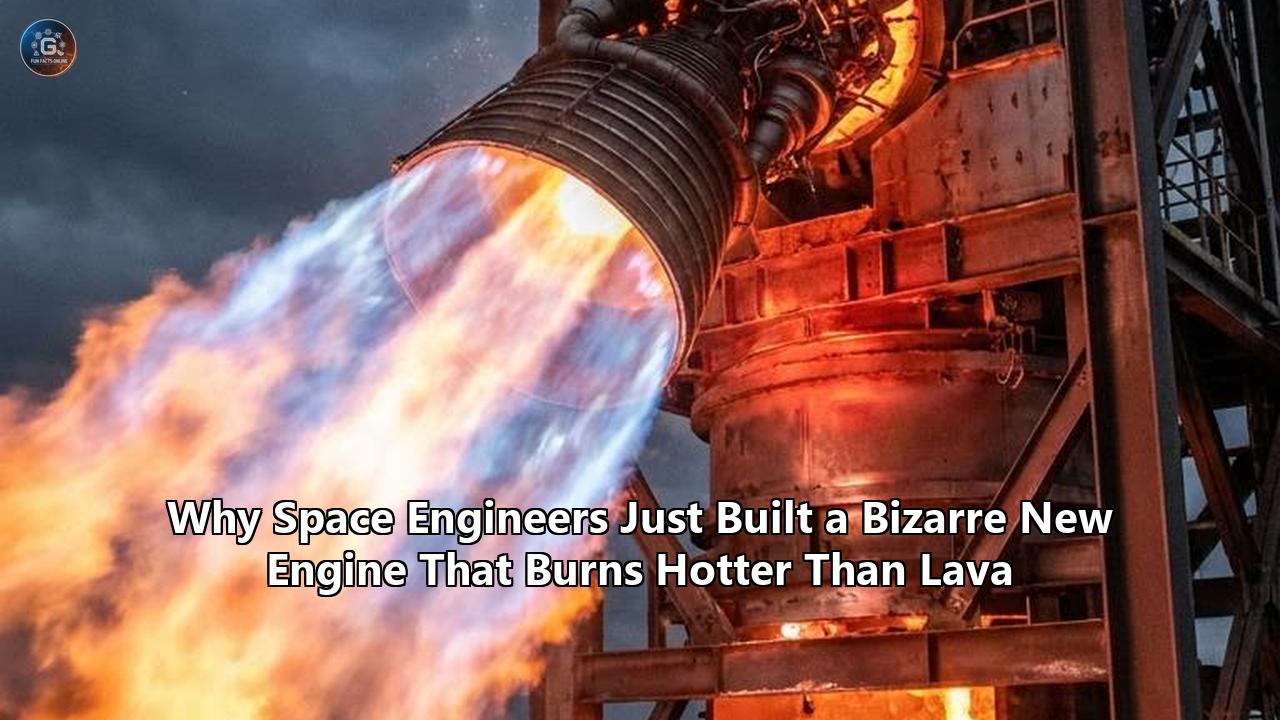
On February 24, 2026, inside a 26-foot water-cooled vacuum chamber in Southern California, engineers at NASA’s Jet Propulsion Laboratory (JPL) triggered an ignition sequence that immediately tested the absolute limits of modern material science. The system in question was a prototype magnetoplasmadynamic (MPD) thruster fueled by metallic lithium vapor. During five consecutive firing cycles, the thruster’s central tungsten electrode reached temperatures exceeding 5,000 degrees Fahrenheit (2,800 degrees Celsius).
At these temperatures, the engine was operating at more than double the heat of molten basaltic lava. The tungsten core glowed a blinding, incandescent white, while the nozzle-shaped outer electrode expelled a violent, hyper-velocity red plume of lithium plasma into the vacuum chamber.
This was not a small-scale proof of concept. The prototype successfully sustained 120 kilowatts of power—more than 25 times the output of the electric thrusters currently powering NASA’s Psyche spacecraft, making it the highest-power electric propulsion system ever operated in the United States.
"At NASA, we work on many things at once, and we haven't lost sight of Mars," NASA Administrator Jared Isaacman stated following the test's declassification. "The successful performance of our thruster in this test demonstrates real progress toward sending an American astronaut to set foot on the Red Planet. This marks the first time in the United States that an electric propulsion system has operated at power levels this high, reaching up to 120 kilowatts. We will continue to make strategic investments that will propel that next giant leap".
This specific test, coupled with parallel breakthroughs in detonative combustion occurring at NASA's Marshall Space Flight Center, serves as a highly visible indicator of a broader structural pivot in aerospace engineering. For the first six decades of spaceflight, engineers optimized propulsion by actively avoiding extreme thermodynamic environments, building heavy, complex cooling systems to mitigate heat. Now, the methodology has inverted. To achieve the thrust and efficiency required for crewed deep-space transit, engineers are intentionally designing architectures that operate on the absolute edge of material vaporization.
By analyzing the mechanics, metallurgical dependencies, and strategic objectives of the JPL lithium test and its chemical counterparts, we can extract the exact principles dictating the next generation of interplanetary transit.
The Physics of Magnetoplasmadynamic Propulsion
To understand why the JPL test represents a distinct departure from existing hardware, one must look at how current spacecraft maneuver in a vacuum. Most conventional satellites and deep-space probes rely on chemical propulsion (combusting a fuel and oxidizer) or low-power electric propulsion, such as Hall-effect thrusters or ion drives.
NASA’s Psyche mission, for example, utilizes solar-electric Hall thrusters. These engines trap electrons in a magnetic field, use them to ionize a noble gas like xenon, and then use an electric field to accelerate those ions out the back. The process is highly efficient but produces an incredibly gentle thrust—roughly equivalent to the weight of a few pieces of paper resting on a human hand. It works through continuous, months-long operation, slowly building up speeds that eventually exceed 124,000 miles per hour.
The magnetoplasmadynamic (MPD) thruster tested at JPL operates on a much more aggressive scale. Instead of merely using an electric field to pull ions, an MPD thruster relies on the Lorentz force. An immense electrical current is driven directly through the propellant plasma, flowing from the central cathode (the tungsten core) to the outer anode (the nozzle). This current interacts with a magnetic field—either generated by the current itself or applied externally—to create a massive electromagnetic force that violently ejects the plasma.
Because the acceleration is driven by the interaction of the plasma’s own current and the magnetic field, MPD thrusters do not suffer from the same space-charge limitations that bottleneck Hall-effect thrusters. They can process vast amounts of power per unit of cross-sectional area. The raw numbers emerging from this new space engine technology immediately illustrate the divide: where conventional ion thrusters max out around 5 to 15 kilowatts, the JPL prototype just validated 120 kilowatts, with a direct scaling pathway to 1 megawatt per thruster.
Why Lithium? The Propellant of the Future
Xenon and argon have long been the default propellants for electric propulsion because they are chemically inert, relatively easy to ionize, and can be stored as pressurized gases or supercritical fluids. However, as engineers push into the hundreds of kilowatts, noble gases reveal severe limitations. High-power ionization of xenon can cause rapid erosion of the engine's internal components, effectively destroying the thruster long before it reaches its destination.
Lithium metal vapor solves several extreme-environment physics problems simultaneously.
- Low Ionization Energy: Lithium requires very little energy to strip away an electron, making the transition to a plasma state highly efficient.
- Storage Density: Unlike xenon, which requires heavy, high-pressure composite overwrapped pressure vessels, lithium can be launched into space as a solid, stable metal block. It requires no pressurized tanks, drastically reducing the dry mass of the spacecraft.
- Cathode Preservation: When lithium vaporizes and ionizes, it provides a highly conductive medium that actually helps protect the tungsten cathode from severe erosion, an absolute necessity for engines that must fire for years at a time.
"Designing and building these thrusters over the last couple of years has been a long lead-up to this first test," James Polk, senior research scientist at JPL, confirmed. "It’s a huge moment for us because we not only showed the thruster works, but we also hit the power levels we were targeting. And we know we have a good testbed to begin addressing the challenges to scaling up".
The Parallel Breakthrough: Continuous Detonation
The push toward extreme-temperature, high-efficiency propulsion is not isolated to electric plasma engines. The exact same philosophy is actively transforming chemical rocket engines. While JPL was testing lithium plasma at 5,000°F, NASA’s Marshall Space Flight Center and private contractors like Astrobotic have been successfully testing Rotating Detonation Rocket Engines (RDREs) at temperatures approaching 6,000°F (3,300°C).
Standard chemical rockets—from the Apollo F-1 engines to SpaceX’s modern Raptors—rely on deflagration. Deflagration is subsonic combustion. Fuel and oxidizer mix, burn, and expand, creating pressure that is directed out of a bell nozzle.
An RDRE abandons deflagration entirely. Instead, fuel and oxidizer are injected into a highly constrained annular (ring-shaped) chamber. An initial spark triggers a detonation—a supersonic shockwave. This shockwave races around the ring at speeds exceeding Mach 5, violently compressing and instantly combusting the propellant mixture in its path. The continuous, rotating explosions generate a massive, sustained pressure spike that is thermodynamically more efficient than constant-pressure burning.
Thomas Teasley, a combustion devices engineer at Marshall Space Flight Center, explained the core physics: "The RDRE uses detonative combustion instead of slow or subsonic combustion like traditional rockets to achieve superior combustion and specific impulse efficiencies. The improvement in efficiency is so dramatic that the combustion environment is nearly impossible to contain and keep hardware cool".
Astrobotic recently leveraged this concept to complete an eight-fire test campaign of its Chakram RDRE, accumulating 470 seconds of run time and hitting 4,000 pounds of thrust. This included a 300-second continuous burn, setting a record for this class of hardware.
Astrobotic's Principal Investigator, Bryant Avalos, noted the volatility of the test: "With any cutting-edge technology like an RDRE, moving from design into testing, you're always worried about unknown factors that could be critical to performance. But the engine performed even better than expected. The 300-second burn was the cherry on top".
Between the MPD plasma thruster and the RDRE combustor, the aerospace sector has clearly defined its new operating doctrine: extreme efficiency is locked behind extreme heat.
The Materials Science Imperative
The core philosophy behind this new space engine technology relies on a thermodynamic reality: hotter, higher-pressure systems extract more useful work from a given mass of propellant. The barrier has never been theoretical physics; the equations for Lorentz forces and Zeldovich-von Neumann-Döring (ZND) detonation models have existed for decades. The barrier has been materials science.
At 5,000°F to 6,000°F, steel turns to liquid. Standard aerospace aluminum vaporizes. Even high-grade titanium alloys lose structural integrity. To survive these environments, engineers have had to invent entirely new classes of metals and rely on advanced manufacturing techniques that did not exist twenty years ago.
The sudden viability of this new space engine technology is heavily tied to two specific metallurgical advancements:
1. GRCop-42: Developed by NASA, this is a copper-chromium-niobium alloy. Pure copper is an exceptional thermal conductor, moving heat away from an ignition source rapidly, but it is incredibly soft and deforms under pressure. By alloying copper with chromium and niobium, engineers created a material that retains near-pure thermal conductivity while possessing the high-strength required to withstand 300-bar chamber pressures without warping. 2. GRX-810: This is an Oxide Dispersion Strengthened (ODS) alloy. By using nanoscale yttrium oxide particles distributed evenly throughout a nickel-cobalt-chromium matrix, this material can endure extreme temperatures while providing double the strength to resist fracturing and three-and-a-half times the flexibility of traditional superalloys.However, having the raw material is only half the equation. You cannot traditionally machine or cast an RDRE or an advanced regeneratively cooled plasma nozzle out of these alloys. The internal geometry is too complex.
Instead, modern space engines are printed. Using Selective Laser Melting (SLM) and laser powder bed fusion, lasers weld microscopic layers of metal powder together, allowing engineers to build engines with thousands of tiny, internal micro-channels built directly into the chamber walls. Super-cold liquid propellant is pumped through these microscopic veins before it reaches the combustion chamber, absorbing the catastrophic heat of the engine and pre-heating the fuel in a process known as regenerative cooling. Without 3D printing, the micro-channel geometry required to survive 6,000°F would be impossible to manufacture.
Defeating the Tyranny of the Rocket Equation
Why are space agencies and private contractors spending billions to push materials to their breaking points? The answer lies in the Tsiolkovsky rocket equation, the governing mathematics of spaceflight that dictates how much propellant is required to move a specific mass to a specific destination.
Chemical rockets are plagued by mass fraction limits. To lift a payload to Mars, a rocket must carry thousands of tons of fuel. Furthermore, it has to carry fuel just to move the unburned fuel it hasn't used yet. This recursive mathematics means that traditional chemical rockets are inherently limited. Moving humans to Mars using only chemical deflagration engines requires a massive architectural footprint: multiple super-heavy launch vehicles, in-orbit refueling depots, and transit times stretching up to nine months each way.
Efficiency in rocketry is measured in Specific Impulse ($I_{sp}$)—essentially, how many seconds one pound of propellant can produce one pound of thrust. A standard chemical rocket maxes out around 450 seconds of $I_{sp}$. An RDRE can push that chemical limit 10% to 15% higher by extracting more kinetic energy from the exact same mass of fuel, allowing landers and ascent vehicles to shed thousands of pounds of weight.
Electric propulsion completely shatters the chemical $I_{sp}$ limit. Because it accelerates particles electromagnetically rather than thermally, it ejects propellant at exceptionally high velocities. An MPD thruster can operate at an $I_{sp}$ of several thousand seconds. According to NASA calculations, electric propulsion utilizes up to 90% less propellant than high-thrust chemical systems for the exact same total impulse.
By scaling MPD thrusters to 120 kilowatts—and eventually to 1 megawatt—spacecraft can maintain this high efficiency while generating enough total thrust to push massive, crew-rated modules. This drastically reduces the total mass required in Low Earth Orbit prior to Mars departure, trimming billions of dollars off mission architecture and potentially cutting transit times, which minimizes astronaut exposure to deep-space radiation and microgravity bone degradation.
The Nuclear Power Prerequisite
The transition of this new space engine technology from isolated laboratory experiments to functional deep-space architecture hinges on one absolute dependency: nuclear power.
The 120-kilowatt output achieved at JPL is a massive milestone, but the end-goal for a crewed Mars vehicle is an array of MPD thrusters operating at a combined power of 2 to 4 megawatts.
Solar power is insufficient for this requirement. Solar irradiance operates on the inverse square law; as a spacecraft moves away from the Sun, the available energy drops exponentially. By the time a vessel reaches Mars orbit, sunlight is less than half as intense as it is at Earth. To generate multiple megawatts of electricity using solar panels near Mars would require arrays the size of several football fields. These arrays would be exceptionally heavy, difficult to deploy, and highly vulnerable to micrometeorite impacts.
To feed the voracious electrical appetite of lithium MPD thrusters, the spacecraft must carry a compact nuclear fission reactor. Recognizing this bottleneck, NASA’s Space Nuclear Propulsion project initiated a megawatt-class nuclear electric propulsion initiative in 2020, managed at the Marshall Space Flight Center.
The architecture of a 2030s Mars transit vehicle is coming into focus: a high-temperature nuclear fission reactor generating continuous megawatt electricity, heavily shielded from the crew module, feeding massive currents into an array of lithium-fed MPD thrusters. The reactor provides the electricity; the MPD thrusters provide the kinetic translation.
The Sub-Scale Testing Bottleneck
Building a 5,000°F plasma engine introduces a severe terrestrial problem: how do you safely test it on Earth?
An MPD thruster firing in space exhausts its lithium plasma into the infinite void. On Earth, that plasma has to go somewhere. The February 2026 test was only possible because JPL constructed the Condensable Metal Propellant (CoMeT) vacuum facility.
CoMeT is a specialized 26-foot-long (8-meter) water-cooled vacuum chamber specifically engineered for metal-vapor propellants. Testing lithium vapor in a standard vacuum chamber is catastrophic; the lithium condenses upon contact with the chamber walls, quickly coating sensor optics, short-circuiting electrical diagnostics, and destroying the high-performance pumps required to maintain the vacuum.
The CoMeT facility actively manages the thermal state of its interior walls, safely condensing and capturing the lithium exhaust without compromising the test environment. The existence of this facility is just as vital to the Mars effort as the thruster itself. Without CoMeT, scaling the 120-kilowatt prototype to a 500-kilowatt operational engine would be effectively impossible due to the lack of verifiable telemetry data.
The 23,000-Hour Horizon
The successful February 2026 JPL test, alongside the sustained records set by Astrobotic’s Chakram RDRE, provides undeniable proof that the aerospace industry has crossed a technical threshold. Engineers are no longer theorists theorizing about extreme-temperature plasma mechanics or supersonic detonation waves; they are actively managing them inside metal chambers.
The true limitation is no longer the physics, but the endurance.
An MPD thruster destined for Mars cannot just run for a few minutes. To achieve the continuous acceleration required for an optimal trajectory, the lithium-fed thrusters will need to operate for upwards of 23,000 continuous hours without failure.
This places immense pressure on the next phase of development. A tungsten electrode glowing at 5,000°F will experience gradual atomic erosion over 23,000 hours, even with the protective effects of the lithium plasma. The data gathered from the CoMeT facility test will dictate the exact degradation rate, allowing Princeton University, NASA Glenn, and JPL to iterate the cathode design for the upcoming 500-kilowatt tests.
Simultaneously, the nuclear power systems required to generate those megawatts are moving through their own arduous regulatory and technical qualification phases. The synchronization of these two parallel programs—megawatt nuclear fission and lithium magnetoplasmadynamics—will determine the viability of human exploration beyond the Earth-Moon system.
We are witnessing the retirement of the traditional chemical rocket as the primary mode of deep-space transit. By deliberately embracing the destructive forces of continuous detonation and super-heated plasma, aerospace engineers are forging an aggressive, high-energy path to the inner solar system. The engines that will take humans to Mars are currently sitting in vacuum chambers, burning hotter than lava, waiting to be unleashed.
Reference:
- https://www.sciencedaily.com/releases/2026/05/260505234611.htm
- https://gizmodo.com/nasas-lithium-fed-nuclear-thruster-flares-to-life-in-first-of-its-kind-test-2000753195
- https://3dprintingindustry.com/news/nasa-on-am-enabled-rotating-detonation-rocket-engine-3d-printing-industry-awards-2024-234755/
- https://ntrs.nasa.gov/citations/20250000643
- https://www.astrobotic.com/astrobotic-breaks-records-for-rotating-detonation-rocket-engine-hot-fire/
- https://www.youtube.com/watch?v=AQGYtEwguhw
- https://www.earth.com/news/nasa-new-electromagnetic-thruster-propulsion-could-speed-humans-to-mars/
- https://www.autoevolution.com/news/nasa-tests-a-spacecraft-thruster-that-runs-on-lithium-metal-vapor-could-take-us-to-mars-269424.html
- https://www.youtube.com/watch?v=tejYwoRqG38
- https://en.clickpetroleoegas.com.br/nasa-fires-up-a-lithium-plasma-engine-25-times-more-powerful-than-any-electric-thruster-ever-used-in-space-the-technology-needs-to-operate-f-mhbb01/
- https://www.spaceconnectonline.com.au/nasa/7073-nasa-tests-high-power-lithium-thruster-aimed-at-future-mars-missions
- https://www.youtube.com/watch?v=5gdNDXF0dMI
- https://www.thebrighterside.news/post/nasas-lithium-fed-electric-thruster-could-carry-humans-to-mars-and-beyond/
- https://www.reddit.com/r/nasa/comments/1bxl76d/how_hot_is_the_fire_or_flames_of_a_rocket_or/
- https://www.nasa.gov/centers-and-facilities/marshall/nasas-3d-printed-rotating-detonation-rocket-engine-test-a-success/
- https://techport.nasa.gov/projects/116281
- https://www.youtube.com/watch?v=QbpOd7z6NPU
- https://netl.doe.gov/node/2248
- https://www.youtube.com/watch?v=pSbGyXuFdpY