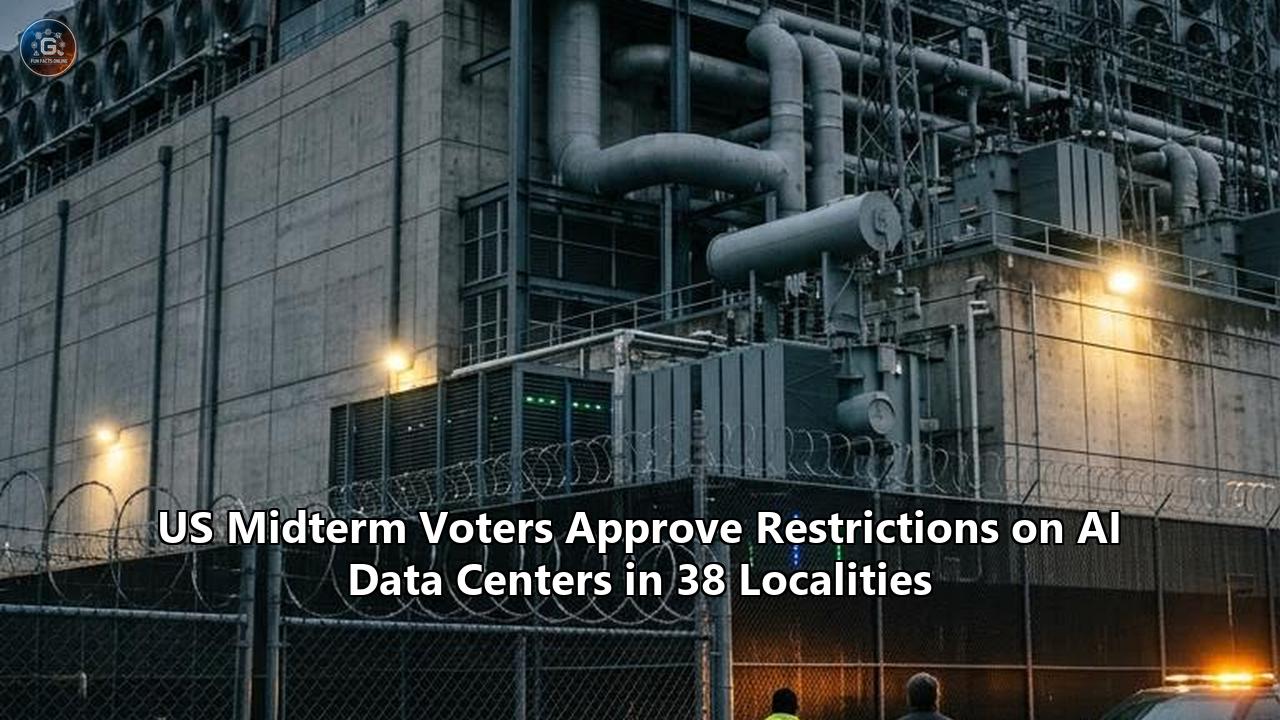
The election results certified across the United States on Wednesday morning, November 4, 2026, confirmed what county election boards had been whispering late into the night: voters delivered an unprecedented, coordinated blow to the physical infrastructure of artificial intelligence. Across 41 local ballot measures in 10 states, citizens in 38 cities, townships, and counties voted overwhelmingly to ban, restrict, or condition the construction of hyperscale data centers.
From the farm borders of Clinton County, Ohio, to the industrial corridors of Joliet, Illinois, and the desert outskirts of southern Nevada, the ballot box emerged as the ultimate circuit breaker. The measures that passed were neither symbolic proclamations nor non-binding expressions of discontent; 28 of them represent hard, legally binding charter amendments, zoning code rewrites, and utility veto triggers that instantly froze billions of dollars in active enterprise capital. In community after community, margins of victory were staggering, frequently clearing 70% to 80% across rural and suburban districts spanning the political spectrum.
National political coverage has fixated on congressional control and gubernatorial flips, treating the data center referendums as isolated flare-ups of traditional NIMBYism. But behind the scenes, planning commission transcripts, regional transmission filings, and municipal election records reveal a fundamentally different narrative. This was not a knee-jerk reaction against technological change; it was a scientifically literate, hyper-organized rebellion against the physical externalities of generative AI.
Voters were armed with technical dossiers detailing electric utility capacity auctions, third-octave acoustic measurements, water table depletion models, and corporate non-disclosure agreements that had secretly bound their local elected officials. In the process, municipal voters dismantled the assumptions that have guided Silicon Valley’s capital expenditure forecasts for the past four years, proving that while digital compute resides in the cloud, its physical footprint remains completely subject to the mechanics of local zoning laws.
The Blueprint of the Revolt: What Passed Across the 38 Localities
The geographic concentration of Tuesday's votes tells the story of an industry that expanded faster than municipal governments could process. Ohio, which has spent the last half-decade positioning itself as the premier Midwest landing zone for hyperscalers escaping the saturated substations of Northern Virginia, was ground zero. Eighteen Ohio municipalities put data center initiatives on the ballot; in all 18, measures curbing the industry carried the day.
In Trenton, Ohio, in Butler County, voters passed Issue 14 with a decisive 80% majority. The measure amended the municipal charter to explicitly ban any commercial computing facility requiring more than 25 megawatts (MW) of electric service. The vote effectively severed the city’s pending effort to annex approximately 600 acres of unincorporated farmland intended for a multi-building, 1,000 MW campus planned by Amazon Web Services.
In neighboring Clinton County, the city of Wilmington saw roughly 80% of voters shoot down four separate city council ordinances that would have cleared 545 acres for data center zoning. Further west, in Piqua, voters carried out a dual-pronged strike: they recalled three sitting city commissioners who had voted to approve a Meta hyperscale campus and simultaneously passed a binding charter amendment barring similar facilities without prior municipal referendum approval. In Grove City, just south of Columbus, 55% of voters approved a charter amendment establishing that any industrial project with an electrical demand exceeding 20 MW or a daily water consumption higher than 500,000 gallons must be submitted to the general electorate for ratification.
The pushback rippled across the Midwest and beyond:
- Illinois: In Joliet Township, near Chicago's sprawling fiber and distribution hubs, nearly 80% of voters approved a ballot question prohibiting local land-use variances for data centers. Voters in Granite City, Venice, Nameoki, and Chouteau rejected local government advisory questions seeking permission to permit large-scale compute sites.
- Wisconsin: In Janesville, more than 60% of residents voted to require mandatory citizen approval before the city can authorize redevelopment plans for a shuttered, 4.8-million-square-foot General Motors assembly site, shutting down a developer’s proposal to transform the brownfield into a $450 million AI cluster.
- Kansas: Voters in both El Dorado and Emporia passed binding development halts aimed at multi-gigawatt facilities seeking tax abatements and utility interconnects along the Flint Hills corridor.
- Florida: In Edgewater, an overwhelming majority voted to ratify Amendment 4, enshrining an outright ban on data center land uses directly into the city charter after city commissioners attempted to explore rezoning coastal utility corridors.
- Maine: Voters in four rural towns approved strict development moratoriums, directly answering Governor Janet Mills’ earlier veto of a statewide legislative pause (LD 307) by enacting local restrictions from below.
- California: In Alhambra, an urban municipality eight miles from downtown Los Angeles, voters passed a measure banning high-impact industrial computing facilities. The measure's broad definition covers high-density GPU server farms and training nodes competing with residential neighborhoods for scarce urban substations.
The legal craftsmanship of these measures marks a clean break from the past. Rather than relying on non-binding advisory resolutions or temporary administrative pauses that expire after six months, organizers systematically targeted municipal charters and zoning definitions. By raising megawatt and water-volume tripwires directly into municipal charters, local coalitions established structural firewalls that cannot be undone by simple city council votes, paving the way for a brand-new generation of AI data center regulations written by grassroots coalitions rather than corporate attorneys.
MUNICIPAL REFERENDUMS AT A GLANCE (NOV 3, 2026)
Total Local Ballot Measures Tracked:       41
Measures Passing Restrictions or Bans:    38 (92.7%)
Binding Charter Amendments / Zoning Bans: 28
Average Margin of Victory on Anti-DC:      68.4%
Total Planned Enterprise Capex Disrupted:  >$130 Billion
The Paper Trail: How Grassroots Organizers Cracked the NDA Strategy
To understand how dozens of disconnected towns coordinated such an overwhelming electoral sweep, one must look at the corporate playbook that provoked it. For nearly a decade, hyperscale developers—operating on behalf of conglomerates like Microsoft, Amazon, Google, Meta, and specialized operators like Vantage and QTS—have approached municipal land acquisition through a rigorous protocol of administrative stealth.
When a developer targets a cluster of parcels, it rarely files paperwork under its own corporate name. Instead, it forms Delaware-registered limited liability companies with deliberately generic titles: "Silverback Infrastructure LLC," "Beaver Creek Holdings," or "Project Blue Sky." The developer’s site selectors then approach county economic development directors and utility account managers, requiring every municipal participant to execute strict Non-Disclosure Agreements (NDAs) before site maps, power demand requests, or water calculations are disclosed.
For local officials, the pitch was historically irresistible: data centers generate substantial commercial property tax revenues while placing zero children in local public school districts and demanding minimal municipal services like trash collection or police patrols. By the time public hearings were scheduled, rezonings were typically listed as "by-right" or fast-tracked through routine consent agendas, leaving residents unaware that an incoming facility would require more electrical capacity than their entire residential county.
Around mid-2025, that strategy collapsed under the weight of its own scale.
In Clinton County, Ohio, the unmasking of a 545-acre data center proposal began not in a city council chamber, but in a public library. When rumors spread that farm parcels adjacent to residential subdivisions were being optioned at three times their agricultural market value, a coalition of local farmers and retired engineers began scouring public regulatory databases. Because municipal officials were muzzled by NDAs, organizers bypassed city hall entirely.
They searched the Federal Aviation Administration’s Obstruction Evaluation database for crane-height permit filings. They reviewed state Environmental Protection Agency storm-water permit applications and combed through the publicly accessible interconnection study queues maintained by regional transmission organizations (RTOs). When they cross-referenced an industrial water connection inquiry filed with the local water district against an electric service request filed with AEP Ohio, the truth emerged: a proposed project, masked as an "advanced logistics and technology park," was in fact a multi-phase, 1,200 MW hyperscale campus.
"By the time our elected council stood up to tell us they couldn't discuss the project due to legal constraints, we already had the interconnection queue numbers, the substation transformer specifications, and the cooling tower water volume calculations printed out on flyers," said Nick Owens, co-founder of Conserve Ohio, a grassroots organization that drafted template charter amendments for ten separate municipal ballots. "The NDAs were designed to buy the tech companies time to secure their permits before the community caught on. All they actually did was convince voters that their local government was acting as an agent for an invading corporation."
By organizing through civic leagues, rural electric cooperatives, and school district social media groups, organizers bypassed the corporate public relations apparatus. They traded advice on state open-records statutes, hired land-use attorneys specializing in citizen-initiated referendums, and gathered signatures with a unified message: if city councils refused to talk to their constituents because of NDAs, voters would take away the council's legal authority to approve the permits.
The Grid Breakdown: How Electric Utility Bills Became a Voting Issue
While local land-use politics served as the vehicle for Tuesday’s rebellion, the primary catalyst was the domestic electric bill.
For decades, the American electric grid was characterized by flat, predictable demand growth of less than 0.5% annually. Utilities built their business plans, rate cases, and transmission lines around a dependable demographic baseline. The sudden, explosive demand curve of generative AI shattered that equilibrium. Unlike traditional cloud computing or corporate enterprise software, training and running inference on frontier Large Language Models (LLMs) requires dense, power-hungry clusters that operate at near-continuous baseload factors. A single modern hyperscale campus can demand between 500 MW and 2 gigawatts (GW)—the equivalent of the power consumed by hundreds of thousands of homes.
The tension point exploded inside PJM Interconnection, the largest regional grid operator in the United States, managing power across 13 states and the District of Columbia. PJM operates a wholesale capacity auction—the Reliability Pricing Model—designed to ensure that enough generation resources exist three years into the future to prevent grid blackouts.
The turning point occurred during the PJM capacity auction for the 2025/2026 and 2026/2027 delivery years. In territory after territory, capacity prices surged directly into the regulatory price caps. Wholesale capacity prices that had cleared at an affordable $28.92 per megawatt-day for the 2024/2025 period vaulted to an unprecedented $329.17 per megawatt-day for 2026/2027. PJM’s own Independent Market Monitor, Monitoring Analytics, published an audit that laid out the financial impact: surging power demand from hyperscale data centers was directly responsible for $6.3 billion of the total auction cost.
PJM CAPACITY AUCTION CLEARING PRICES (Per MW-Day)
2024/2025 Delivery Year:    $28.92   | Base level
2025/2026 Delivery Year:    $269.92  | Early hyperscale acceleration
2026/2027 Delivery Year:    $329.17  | PJM cap reached (+$6.3B shift)
2028/2029 Delivery Year:    $325.00  | Regulatory ceiling pinned
2026 Backstop Auction Cap:  $555.00  | Emergency reliability procurement
Under the regulatory compact governing American public utilities, wholesale capacity and transmission upgrade costs are passed directly down to retail customers through transmission rider adjustments and rate-base tariff cases. Throughout early and mid-2026, homeowners across Ohio, Pennsylvania, Virginia, and Illinois opened their monthly utility bills to find line-item delivery charges spiking between 20% and 45%.
Simultaneously, electric utilities filed rate cases seeking billions in new capital expenditures to build out high-voltage 765 kV transmission corridors, build greenfield substations, and delay the retirement of fossil-fuel baseload generation. In filings before the Public Utilities Commission of Ohio (PUCO), American Electric Power (AEP) and AES Ohio acknowledged that summer peak load in their transmission zones was projected to compound at 5.2% to 5.3% annually over the next decade—more than twelve times their historical projections—driven almost exclusively by data center queues.
"The tech companies argued they were bringing billions of dollars in economic activity to rural communities," said Dr. Sharon Vance, a utility regulatory analyst who advised several Midwest ballot committees. "The reality facing the voter was much simpler: their fixed-income grandparents were paying an extra $70 a month on their utility bills to keep GPU racks cool, while the data center itself was operating under a ten-year, 75% personal property and sales tax abatement approved by their county commissioners."
In town hall meetings leading up to the election, anti-data center organizers bypassed abstract arguments about global greenhouse gas emissions or national technology leadership. Instead, they projected utility bill charts, PJM auction filings, and transmission upgrade riders onto gymnasium walls. Voters realized they were effectively subsidizing the infrastructure of the richest corporations on Earth. When exit polls closed Tuesday night, NBC News reported that 56% of voters described AI infrastructure and data centers as a major or crucial factor in their vote, with rising energy costs driving the sentiment.
The Acoustic Science: Why Standard Decibel Meters Failed Nearby Residents
Beyond the macroeconomic shock of electric bills, the ballot box revolt was sustained by a hyper-local environmental factor that received minimal coverage in national media: acoustic physics.
For decades, developers used standard industrial noise studies to convince municipal planning boards that server warehouses were quiet neighbors. Corporate environmental reports consistently pledged that sound levels at the facility’s property line would not exceed 55 to 60 decibels—comparable to normal human conversation or background suburban traffic.
Those calculations were technically accurate on paper, but practically disastrous in practice because they relied on standard A-weighted decibels, or dBA.
To understand why nearby residents revolted, one must look at what happens inside an AI compute cluster. Legacy enterprise data centers built a decade ago ran standard central processing units (CPUs) that drew an average of 5 to 10 kilowatts (kW) of electricity per server rack. Modern AI clusters, engineered to train neural networks using specialized graphics processing units (GPUs) like NVIDIA's Blackwell architectures and custom enterprise ASICs, draw between 50 and 100 kW per rack.
This ten-fold increase in thermal density requires massive, uninterrupted heat rejection. To keep silicon from melting, hyperscalers operate rows of massive exterior cooling towers, computer room air handlers (CRAHs), industrial liquid chillers, and banks of high-velocity roof-mounted adiabatic fans 24 hours a day, 365 days a year.
THERMAL DENSITY & ACOUSTIC PROFILE SHIFT
Legacy Cloud Data Center (c. 2016):
- Rack Power Density:   5–10 kW per rack
- Thermal Dissipation:  Standard low-speed air exchange
- Primary Acoustic:     Broadband ambient airflow

Modern AI Training Cluster (c. 2026):
- Rack Power Density:   50–100 kW per rack
- Thermal Dissipation:  High-pressure liquid chillers, massive CRAH fans
- Primary Acoustic:     Low-frequency mechanical hum (100–250 Hz tonal peak)
The acoustic energy produced by this equipment does not manifest as a sharp, intermittent noise like highway traffic, construction, or sirens. It is a continuous, mechanical droning that concentrates heavily in the low-frequency spectrum between 100 and 250 Hertz (Hz), augmented by the 60 Hz and 120 Hz electrical harmonics emitted by adjacent high-voltage substation transformers.
This is where municipal zoning codes failed. The A-weighting scale (dBA) used by virtually every small-town noise ordinance in America was mathematically designed in the early 20th century to mimic the human ear’s sensitivity to midrange frequencies—specifically the human voice. To do this, the dBA curve aggressively de-emphasizes low frequencies. At 40 Hz, an A-weighted meter artificially subtracts roughly 35 decibels from its measurement.
A facility can emit massive amounts of low-frequency acoustic energy, measure a legally compliant 52 dBA at the fence line, and pass an environmental audit, all while driving nearby homeowners to distraction. Low-frequency sound waves have physical wavelengths stretching from 4 to 12 feet. They do not disperse easily in the atmosphere, cannot be stopped by standard perimeter foliage or chain-link fences, and pass directly through residential exterior walls, insulation, and double-paned window glass. Once inside a home, these long waves strike interior parallel walls, establishing acoustic standing waves that cause drywall, picture frames, and headboards to vibrate at night.
In communities across Ohio, Illinois, and Pennsylvania, residents who lived near initial phases of data center buildouts began organizing. They purchased Class 1 sound-level meters capable of narrow-band frequency analysis and third-octave band logging.
When community groups presented their findings to their neighbors, they demonstrated that standard municipal ordinances were structurally blind to the low-frequency noise produced by industrial cooling infrastructure. As municipalities drafted these binding AI data center regulations, they realized traditional industrial zoning was structurally ill-equipped to address continuous 24/7 low-frequency acoustic profiles.
Voters incorporated acoustic engineering standards into their referendums. Ballot measures in Ohio and Illinois banned facilities unless developers could guarantee compliance under both C-weighted decibels (dBC)—which does not filter out low frequencies—and third-octave frequency bands from 20 Hz to 200 Hz, with strict tonal penalties applied whenever a single discrete mechanical frequency hummed more than 5 decibels above ambient background levels. For hyperscalers, meeting such low-frequency thresholds at property lines requires hundred-foot physical setbacks, concrete sound-attenuation enclosures, and acoustic baffling that adds tens of millions of dollars to the construction cost of every single building.
The Hydrology Crisis: Potable Water and the Cooling Dilemma
While electrical lines hummed and cooling fans droned, water consumption emerged as the third pillar of local resistance.
Data center cooling architectures are caught in a zero-sum engineering trade-off governed by thermodynamics: developers must trade electricity for water, or water for electricity.
To achieve optimal Power Usage Effectiveness (PUE)—the metric Wall Street and corporate sustainability reports use to evaluate computing efficiency—data center operators have historically relied on direct evaporative cooling towers. In simple terms, warm water circulating through hot server blocks is sprayed into a cooling tower, where outside air evaporates a portion of it, dissipating the heat into the atmosphere.
Evaporative cooling uses far less electricity than mechanical refrigeration chillers, keeping the data center’s PUE score low. However, it consumes water on a massive scale. A standard 100 MW hyperscale facility can evaporate between 1 million and 3 million gallons of water every day during warm summer months—consumption levels equivalent to a small city or hundreds of agricultural irrigation pivots.
In communities relying on confined glacial aquifers or municipal treatment systems, these water demands stressed community supplies.
In Grove City, Ohio, the charter amendment passed on Tuesday set a firm cap: any commercial project consuming more than 500,000 gallons of water per day automatically triggers a mandatory public vote. When hyperscalers attempted to soothe community concerns by pledging to switch to "closed-loop" dry cooling or adiabatic systems that consume minimal water, they ran headfirst into the electrical grid crisis.
Dry cooling relies on massive banks of refrigerant compressors and continuous high-velocity fans to move air, behaving essentially like an enormous household air conditioner. While it saves millions of gallons of water, dry cooling increases the facility’s internal electrical demand by 15% to 25% during summer heat peaks—the exact hours when the surrounding regional electric grid is already facing capacity shortfalls and rolling blackout warnings.
In farm communities across the Midwest, the prospect of an enterprise technology company purchasing agricultural land, drilling high-capacity industrial wells into the local aquifer, and consuming municipal water allocations while driving up electricity bills proved fatal at the ballot box. Farmers, who have spent decades managing local watershed conservation districts, joined with suburban homeowners to fund voter outreach. The alliance was unbreakable: in agricultural counties where industrial zoning had previously sailed through uncontested, data center referendums were rejected by margins that surprised both major political parties.
The Regulatory Counter-Offensive: How Local Laws Rewrote the Playbook
The rapid proliferation of local AI data center regulations has triggered an aggressive pushback from tech trade groups and economic development agencies, which now face an unprecedented legal patchwork across their target markets.
What took place on Tuesday was not merely a set of disconnected local votes; it was the execution of a modular, open-source legal strategy. Throughout late 2025 and early 2026, legal templates drafted by public-interest organizations, such as the PennFuture Model Data Center Ordinance and toolkits from the AI Now Institute, circulated through informal networks of county planners, municipal clerks, and citizen groups.
These models gave local jurisdictions a roadmap for bypassing the legal vulnerabilities that frequently doom municipal moratoria in court. In many states, including Virginia, local governments lack the statutory authority to impose blanket moratoria because state law dictates that land-use applications must be evaluated on their individual merits. Recognizing this, anti-data center organizers shifted their strategy from temporary bans to permanent statutory reclassifications.
LEGAL MECHANISMS OF THE 2026 BALLOT MEASURES
1. Charter Megawatt Ceilings:
   Embeds an absolute power demand cap (e.g., 20–25 MW) directly in the
   municipal charter, superseding ordinary city council zoning authority.
2. Mandatory Voter Ratification:
   Reclassifies high-load compute sites as requiring a public referendum
   before municipal utility hookups or tax abatements can be finalized.
3. Acoustic Frequency Mandates:
   Replaces A-weighted decibel limits with C-weighted and third-octave band
   thresholds (20–200 Hz), imposing strict penalties on tonal hums.
4. Water Consumption Circuit Breakers:
   Institutes daily flow triggers (e.g., >500,000 gal/day) that automatically
   require local watershed district and electorate approval.
By changing the underlying definitions in municipal zoning codes, towns eliminated "by-right" industrial permissions. Under the new local ordinances, data centers are no longer categorized as light industrial uses or public utilities alongside standard warehouses, assembly plants, or telephone switching stations. Instead, they are defined as distinct "High-Impact Computing Facilities" or "Intensive Energy-Conversion Uses," complete with strict, non-negotiable performance standards:
- Setback Distances: Minimum buffer zones ranging from 500 to 1,500 feet from any residential property line, school, hospital, or public park.
- Mechanical Enclosures: Requirements that all rooftop chillers, air-handling units, and substation transformers be enclosed within sound-attenuating, blast-resistant structures.
- Generator Testing Restrictions: Emergency diesel backup generators—which emit 90 to 105 decibels during load testing—can only be tested between 10:00 a.m. and 4:00 p.m. on weekdays, with total runtimes tracked by municipal telemetry.
- Prohibition of Variances: Explicit language prohibiting zoning boards from granting administrative height, setback, or acoustic variances.
By codifying these restrictions directly into municipal charters, local coalitions insulated their wins from standard administrative override. In cities like Trenton and Grove City, Ohio, an incoming city council cannot simply vote to approve an annexation or grant a zoning variance to an enterprise developer. Doing so would violate the municipal charter itself, exposing city officials to immediate taxpayer lawsuits and personal liability.
Statehouse Preemption vs. Home Rule: The Constitutional Clashes Ahead
The morning after the election, the executive suites of technology conglomerates and their utility partners began mobilizing for a secondary confrontation: statehouse preemption.
The tech industry’s primary advocacy vehicle, the Data Center Coalition, along with state chambers of commerce and utility holding companies, is shifting focus toward state legislatures. In statements released late Wednesday, industry spokespersons framed local restrictions as a threat to national technological competitiveness and economic stability. "Ballot measures to restrict or prohibit data center development send a clear signal that these areas are closed for business," stated Dan Diorio, executive vice president of state policy and government affairs at the Data Center Coalition. "These votes deprive local communities of critical investments, tax revenues, and high-wage jobs that fund schools, roads, and emergency services."
In state capitals across the country, corporate lobbyists are preparing preemption bills for the 2027 legislative sessions. Their objective is clear: strip local municipalities of land-use authority over data centers by classifying enterprise computing facilities as "critical state infrastructure" or "regulated public utilities," centralizing siting authority inside state utility commissions or state industrial development boards.
Yet that strategy faces a major constitutional roadblock in the Midwest.
In states like Ohio, municipal authority is protected by the "Home Rule" provisions of the state constitution (Article XVIII, Section 3), which grants municipalities the sovereign right to exercise all powers of local self-government and enforce local police, sanitary, and zoning regulations. While the state legislature can pass uniform laws regarding utility transmission lines, state courts have historically guarded municipal zoning authority against state preemption.
Furthermore, the politics of data center opposition have scrambled traditional partisan alignments. The midterm results demonstrated that anti-data center sentiment is broadly bipartisan. In rural, conservative counties, voters opposed facilities on the grounds of property rights, preservation of farmland, and grid reliability. In progressive suburban districts, voters opposed them over carbon emissions, utility bill equity, and corporate tax dodges.
State legislators who introduce bills overriding local data center votes will be doing so directly in the teeth of their own constituents, who just passed these restrictions with 70% to 80% margins. In Ohio, grassroots leaders have already started drafting a 2027 statewide constitutional amendment that would place a permanent, binding moratorium on all commercial computing facilities exceeding 25 MW until the state's transmission and generation resources can be verified without raising rates on residential consumers.
THE EMERGING PREEMPTION BATTLEFIELD
Industry Strategy:
- Reclassify hyperscale data centers as "critical public utilities"
- Strip municipal zoning authority; transfer siting to state commissions
- Enact state-level tax incentives and fast-track environmental reviews

Municipal Defense Strategy:
- Invoke constitutional Home Rule protections against state overreach
- Pursue statewide citizen-initiated ballot referendums
- File Fifth Amendment takings claims against unmitigated utility line routing
Simultaneously, the political landscape shifted dramatically in Texas, the nation’s second-largest data center growth market. Democratic candidate Gina Hinojosa defeated incumbent Governor Greg Abbott after campaigning on an explicit platform to pause new hyperscale interconnects and establish ratepayer firewalls. With Texas’s standalone ERCOT grid wrestling with an astonishing 494 GW of requested large-load interconnection applications, the election results mean that even traditionally pro-development energy corridors are adopting regulatory scrutiny.
The Hyperscaler Scramble: Where Does Compute Go Now?
Tuesday’s electoral sweep has upended capital deployment timelines across Silicon Valley and Wall Street. Data Center Watch, an infrastructure research project tracking enterprise computing proposals, had already documented that 120 projects worth a collective $198 billion were blocked, delayed, or abandoned due to local municipal opposition in the first six months of 2026 alone. With 38 new localities slamming the door on Tuesday, hyperscalers face a critical supply-chain bottleneck: they have billions of dollars allocated for high-end server clusters, but nowhere with sufficient land, power, and local permits to install them.
This constraint is forcing developers to explore radical, often cost-prohibitive engineering alternatives.
The Nuclear Co-Location Deadlock
Over the past eighteen months, hyperscalers attempted to bypass municipal grid queues by negotiating direct, behind-the-meter (BTM) power purchase agreements with existing nuclear power stations. Projects like Talen Energy’s partnership with Amazon at the Susquehanna nuclear plant in Pennsylvania and Constellation Energy’s planned restart of Three Mile Island (the Crane Clean Energy Center) were designed to pull baseload power directly from reactor switchyards, avoiding the public grid altogether.
However, this pathway ran into a major regulatory barrier. The Federal Energy Regulatory Commission (FERC) intervened, issuing show-cause orders and rejecting amended Interconnection Service Agreements (ISAs) after merchant generators and ratepayer advocates argued that diverting gigawatts of baseload nuclear generation off the transmission system threatened regional grid reliability and shifted billions of dollars in capacity costs onto remaining residential ratepayers. Co-location is no longer the frictionless escape route developers envisioned.
Behind-the-Meter Islanded Microgrids
Faced with blocked grid queues, developers are increasingly turning to behind-the-meter natural gas generation, planning to install banks of industrial aeroderivative gas turbines and reciprocating internal combustion engines (RICE) directly on data center campuses.
Yet this approach frequently trades one regulatory trap for another. Running baseload gas turbines 24/7 immediately triggers Title V Major Source air-quality permitting thresholds under the Clean Air Act for nitrogen oxides ($NO_x$) and volatile organic compounds ($VOCs$), while their cooling systems and jet-engine exhaust stacks generate continuous high-decibel noise profiles that run directly into the newly enacted local acoustic ordinances.
DEVELOPER ALTERNATIVES & THE WALLS THEY HIT
Alternative Strategy:            The Regulatory / Physical Barrier:
Nuclear Co-location (BTM)   -->  FERC rejections over cost-shifting & grid reliability
Islanded Gas Microgrids     -->  EPA Title V Clean Air Act permits & local noise codes
Remote Non-RTO Siting       -->  Lack of long-haul dark fiber & extreme transmission capex
Inference Workload Splitting --> Latency constraints force inference to stay near metros
Workload Bifurcation
The long-term structural outcome will be an engineering bifurcation of artificial intelligence infrastructure.
Model training—the process of feeding petabytes of data into frontier models over months—does not require ultra-low network latency. As municipal barriers rise across populated regions, developers will be forced to push massive multi-gigawatt training clusters into remote, low-density regions where land is plentiful, public opposition is sparse, and power can be generated entirely off-grid.
Inference workloads—the instantaneous queries generated when hundreds of millions of users ask questions of an AI model—cannot be banished to the middle of nowhere. Inference requires sub-millisecond network latency, meaning it must remain physically proximate to population centers, corporate enterprise nodes, and metropolitan fiber-optic backbones. Because inference clusters must reside inside or immediately adjacent to urban and suburban corridors, they will remain directly exposed to municipal zoning jurisdictions, local noise codes, and voter-led referendum mandates.
What to Watch Across the Siting Frontier
The midterm election results confirmed that the unconstrained physical expansion of generative AI has hit a hard social limit. The debate has permanently expanded beyond Silicon Valley's corporate announcements and Wall Street's capital expenditure models, centering squarely on local democracy, public utility law, and municipal zoning.
In the coming months, several critical battlegrounds will determine the future of domestic compute infrastructure:
- The Legal Takings Assault: Expect developers and land-holding trusts to file Fifth Amendment regulatory takings lawsuits against municipalities like Trenton and Wilmington, arguing that zoning amendments and charter restrictions have arbitrarily destroyed the economic value of optioned farmland without just compensation. The legal test will be whether courts view charter megawatt caps as legitimate exercises of local police powers to protect public health and utility infrastructure, or unconstitutional confiscations of private property rights.
- FERC’s Impending Large-Load Orders: The Federal Energy Regulatory Commission is preparing comprehensive rules regarding large-load interconnections and co-located generation. Watch closely whether FERC establishes a standardized national cost-allocation framework requiring hyperscalers to pay 100% of network transmission upgrade costs upfront, ending the socialization of infrastructure upgrades across retail ratepayers.
- State Utility Commission Tariff Restructuring: In Ohio, Pennsylvania, and Virginia, public utility commissions are reviewing utility proposals to create separate, dedicated large-load customer classes for data centers. These tariffs demand financial security deposits, long-term take-or-pay energy commitments, and minimum contract terms of 10 to 15 years to prevent public utilities from building multi-billion-dollar substations only to have developers abandon them if AI workloads evolve.
- The 2027 Statewide Initiatives: Citizen groups in Ohio, Maine, and Wisconsin are actively converting their local victories into statewide signature-gathering operations. If Ohio’s proposed constitutional amendment qualifies for the 2027 ballot, it will be the first time an entire state electorate votes directly on whether to cap AI infrastructure development.
The technological trajectory of artificial intelligence has been treated as an inevitable force of nature, advancing strictly on the timeline of algorithmic improvements and venture funding. On Tuesday, American voters delivered an unmistakable corrective: the digital universe is still tethered to steel, copper, water, and earth. As long as server clusters rely on the public power grid and sit adjacent to residential neighborhoods, the future of the technology will not be decided solely in Silicon Valley boardrooms, but at local ballot boxes in township halls across the country.
Reference:
- https://www.fierce-network.com/cloud/data-centers-hit-wall-ballot-box
- https://capacityglobal.com/news/33-data-centre-curbs-pass-as-us-midterms-turn-the-ai-buildout-into-a-political-liability/
- https://www.route-fifty.com/artificial-intelligence/2026/11/voters-reject-data-centers-local-ballot-initiatives/417033/
- https://www.multistate.us/insider/2026/5/7/voters-target-data-centers-with-local-and-statewide-ballot-measures
- https://timesofindia.indiatimes.com/technology/tech-news/at-least-29-us-communities-vote-to-ban-or-restrict-new-ai-data-centres-with-ohio-approving-10-local-measures-and-texas-electing-a-governor-who-supports-a-construction-pause-challenging-the-industrys-rapid-expansion/articleshow/135542353.cms
- https://computelaw.blog/real-estate/virginia-siting-rules-local-moratoriums/
- https://www.ncsl.org/fiscal/which-states-are-banning-data-centers
- https://www.latimes.com/business/story/2026-11-02/voters-in-dozens-of-cities-will-weigh-data-center-bans-restrictions
- https://policymattersohio.org/research/hyperscale-data-centers-drive-electricity-demand/
- https://enkiai.com/policy-and-regulations/pjm-capacity-market-data-centers/
- https://www.soundtrace.com/blog/data-center-noise-levels-hearing-conservation-osha-compliance
- https://www.landgate.com/news/the-grid-just-changed-the-rules-on-data-centers-power-pricing-and-grid-congestion
- https://stopohiodatacenters.org/data-center-noise-ohio
- https://static1.squarespace.com/static/59af5a537131a5b42451a91d/t/6a9884c2dd3e5069e544a1e3/1788380354151/DataCenter_Noise_General_Guidelines.pdf
- https://shop.knowyourh2o.com/blogs/news/noise-vibration-zoning-ordinances-data-centers-zoning-issues
- https://datacenters.ainowinstitute.org/local/
- https://modoenergy.com/research/en/large-load-interconnection-six-us-markets-data-centers
- https://www.ascendanalytics.com/blog/large-load-interconnection-queues-data-center-grid-access
- https://www.eesi.org/articles/view/communities-are-raising-noise-pollution-concernsabout-data-centers