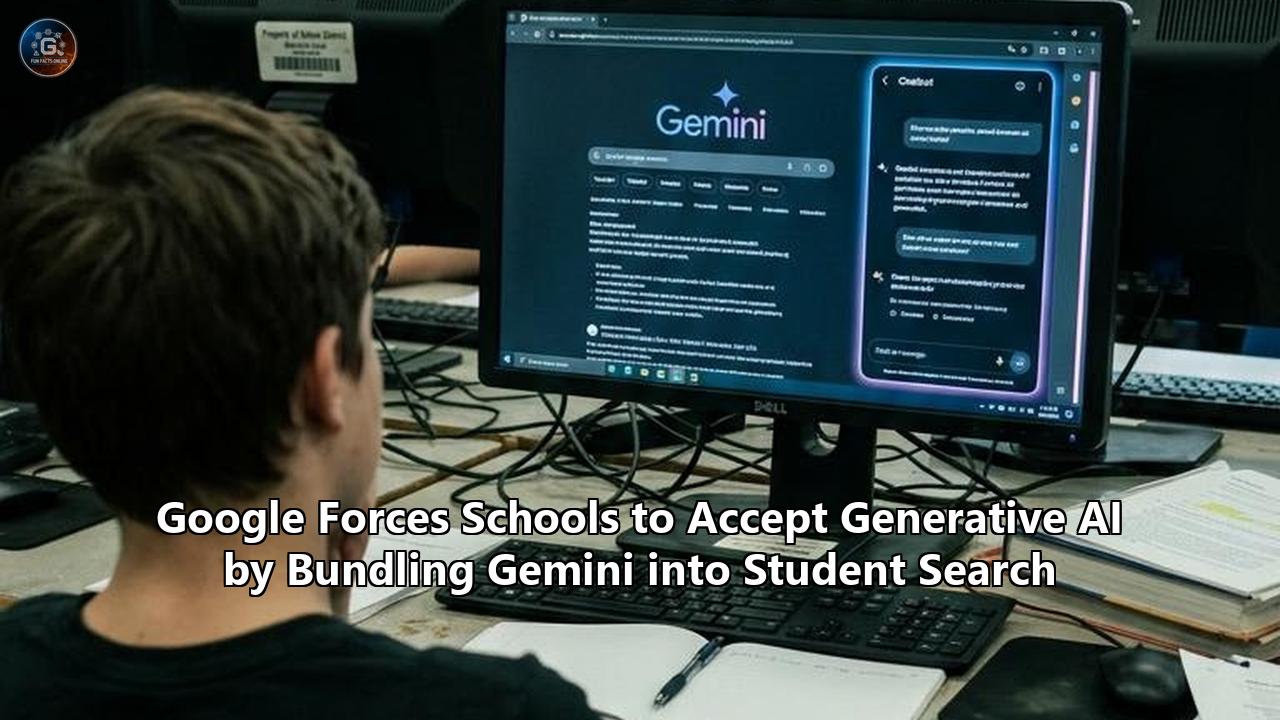
Public school districts across the United States face an ultimatum that dismantles local autonomy over classroom technology: accept generative artificial intelligence inside student research environments or lose access to the world’s dominant search engine entirely.
On November 3, 2026, Google announced a sweeping policy shift governing how its generative tools are deployed across K–12 educational institutions. Following months of mounting outrage from teachers, child-development specialists, and parent associations, the Alphabet subsidiary announced it will disable its Gemini chatbot, Gemini Notebook, Gemini in Classroom, and core Google Search across school-managed student accounts by default starting in early 2027. Access will remain dark until district IT administrators explicitly toggle them on.
Yet buried beneath the rhetoric of administrative empowerment lies an architectural trap. Districts that elect to ban artificial intelligence from student accounts will not be permitted to revert to a traditional, index-based Google Search. Because Google has fused its large language model outputs—specifically AI Overviews and conversational AI Mode—directly into the retrieval engine, the company confirmed that turning off AI requires severing student access to Google Search altogether.
"Search and A.I. are deeply integrated," Chris Phillips, Google’s vice president and general manager of education, stated plainly when explaining the update. Phillips confirmed that if an educational institution prohibits generative AI, its students "will not have access to search, and they'll see a message from their school that indicates it's not available".
The response from public officials and consumer advocates was immediate and incendiary. Former Federal Trade Commission Chair Lina Khan characterized the bundling as a textbook antitrust violation, stating that Google is "using its search monopoly to coerce schools into adopting AI". New York City Mayor Zohran Mamdani accused the corporation of leveraging its commercial dominance to dictate pedagogical conditions in municipal classrooms: "No corporation should have the power to dictate how we teach our children. Our public schools exist to serve students, not to grow the profit margins of Big Tech".
This controversy is not a minor dispute over educational software configurations. It serves as a foundational case study in platform capitalism, technological enclosure, and the erosion of digital sovereignty in public education. By weaponizing an indispensable utility—web search—to accelerate enterprise adoption of its speculative generative models, Google has laid bare the mechanics of modern digital lock-in.
Anatomy of the Reversal: The Default Setting as a Defensive Weapon
To understand how school districts were placed in this structural bind, one must trace the rapid escalation that preceded the November announcement.
In August 2026, Google quietly enabled its Gemini chatbot by default for millions of K–12 students using Google Classroom. For years, the enterprise policy for Google Workspace for Education had maintained strict age gating: generative products and conversational assistants were restricted to users aged 18 and older unless explicitly authorized. The sudden, unilateral activation of Gemini for minors caught school boards, curriculum directors, and data protection officers unprepared. Middle-school students logging into their school portals to check homework assignments discovered a conversational text box ready to draft essays, solve algebraic equations, and answer scientific inquiries with unvetted synthetic output.
The backlash across major metropolitan districts was swift. New York City Public Schools, the nation’s largest district with roughly one million students, implemented strict barriers barring generative AI usage through eighth grade. The Los Angeles Unified School District enacted a district-wide moratorium on generative systems across all student devices. Concurrently, child-advocacy coalitions, including Fairplay and Common Sense Media, issued open letters demanding immediate federal intervention. On Capitol Hill, Senators Richard Blumenthal and Josh Hawley served Google with a formal congressional inquiry demanding explanations for why generative tools were activated on children's accounts without administrative sign-off.
Google’s November declaration appeared, on its surface, to be a complete capitulation to public pressure. By turning Gemini off by default, the company seemed to return regulatory authority to local communities.
The structural sleight of hand, however, was the simultaneous classification of Google Search as an AI product. By packaging the core search engine into the exact same administrative bucket as Gemini, Gemini Notebook, and Classroom AI, Google converted a concession into an inescapable bind.
| Policy Dimension | Pre-August 2026 Status Quo | August 2026 Automated Rollout | November 2026 Policy Revision |
|---|---|---|---|
| K–12 Gemini Access | Restricted by default (18+ only) | Activated by default in Classroom | Disabled by default; admin opt-in required |
| Google Search Status | Open utility; standard index | Integrated with AI Overviews | Inextricably tied to generative AI layers |
| Opt-Out Mechanics | Standard admin toggle per app | Manual opt-out required | Disabling AI disables Search entirely |
| Pedagogical Alternative | Standard algorithmic search results | Unfiltered generative summaries | "Guided Learning" Socratic AI Mode |
Under the framework scheduled for full enforcement in early 2027, an administrator logging into the Google Admin Console cannot preserve the traditional, ten-blue-links search engine that served as the digital baseline of classroom education for a quarter-century. The district faces two paths:
- Consent to the integration of generative AI—either via standard AI Overviews or Google’s newly minted "Guided Learning" Socratic mode.
- Sever the search engine entirely, presenting every student who conducts research on a school-owned Chromebook with an administrative access block.
This is the classic playbook of artificial platform tying. By eliminating the neutral option, Google turned a public policy retreat into a mechanism that drives adoption of Google Gemini in schools, ensuring that its generative systems achieve critical mass across the next generation of digital consumers.
Infrastructure Capture: How K–12 Education Became a Captive Market
This dynamic cannot be understood without examining the historical trap public education walked into over the past fifteen years. Google did not acquire its leverage over school districts by accident; it systematically engineered an infrastructure dependency that makes resistance logistically and politically prohibitive.
Beginning around 2012, Google embarked on an aggressive, subsidized expansion into the K–12 market. While Apple treated schools as luxury hardware buyers for iPads and Microsoft targeted enterprise back-offices, Google recognized that the path of least resistance ran through cash-strapped district procurement offices. The company delivered three interrelated components that transformed modern schooling:
- Subsidized Hardware (Chromebooks): Low-cost, stripped-down laptops running ChromeOS that could be purchased in bulk for under $200 per unit, compared to $600-$1,000 for standard enterprise laptops.
- Free Cloud Architecture (Google Workspace for Education): An integrated productivity suite—Docs, Sheets, Slides, Drive, and Gmail—provided to educational institutions at zero direct cost, backed by unlimited cloud storage.
- Turnkey Classroom Management (Google Classroom): A purpose-built learning management system that allowed teachers to distribute assignments, grade papers, and organize schedules without expensive third-party contracts.
       [ ZERO-COST ENTRY LAYER ]
       Chromebook Subsidies & Free Google Workspace
                     │
                     ▼
       [ WORKFLOW ENTRENCHMENT ]
       Classroom Assignments, Identity (Single Sign-On),
       District Data Pipelines & State Assessment Portals
                     │
                     ▼
       [ ADMINISTRATIVE MONOPOLY ]
       Centralized Admin Console Controlling Entire Device Fleets
                     │
                     ▼
       [ INFRASTRUCTURE ENCLOSURE ]
       Bundling AI: Disabling Gemini Means Disabling Search Entirely
The scale of this capture is vast. Today, Google Classroom serves approximately 150 million students and educators worldwide. In the United States, Chromebooks account for roughly 60 percent of all digital devices deployed in pre-college classrooms.
Over more than a decade, municipal school districts spent billions in taxpayer funds configuring their entire pedagogical systems around the Google ecosystem. Single Sign-On (SSO) protocols through Google identities govern everything from access to third-party math applications to library checkout portals. State standardized assessments are specifically formatted to run in secure kiosk modes on ChromeOS hardware.
When a corporation achieves this level of utility capture, switching costs become insurmountable for municipal entities operating under fixed fiscal budgets. If an IT director in a medium-sized district of 30,000 students resolves to reject Google’s AI mandate, that decision cannot be resolved by simply bookmarking a different URL.
To abandon Google Search means:
- Rewriting digital literacy and research curricula across grades 3 through 12.
- Reconfiguring content-filtering software, firewall certificates, and security proxies that have been optimized for Google's SafeSearch infrastructure for over a decade.
- Re-architecting device management profiles across tens of thousands of deployed machines that default to Chrome's omnichannel search bar at the operating-system level.
- Facing immediate pushback from exhausted instructional staff who rely on native integration between search queries, Google Drive assets, and Classroom modules.
By holding search hostage, Google exploits an asymmetric power imbalance. The school district operates a resource-constrained public service obligated to provide functional learning environments; Google operates an unregulated platform that treats those learning environments as captive distribution pipelines.
The Technical Fallacy of "Inseparable" AI Architecture
The central defense offered by Google leadership rests on a technical claim: that generative AI is now so deeply wired into the core fabric of Google Search that the two products cannot be separated.
"Search and A.I. are deeply integrated," Chris Phillips told The New York Times, asserting that untangling an AI-free search experience for educational clients is an engineering impossibility.
This claim does not withstand technical scrutiny.
From an engineering and systems-architecture perspective, a traditional web search engine and a large language model inference engine are distinct functional layers. An information retrieval (IR) engine relies on web crawling, document parsing, inverted indexing, and algorithmic ranking (such as PageRank and neural embedding retrievers) to return structured URLs matching a user query.
A generative summary layer—such as Gemini driving AI Overviews—is a secondary downstream inference process. It ingests the top-ranked retrieval documents, passes them as context through a transformer-based language model, and generates synthetic prose via sequential token prediction.
[ User Query ]
      │
      ▼
┌──────────────────────────────────────────────┐
│ CORE RETRIEVAL ENGINE (Information Retrieval) │
│ • Web Crawlers & Parsing                     │
│ • Inverted Indexing Database                 │
│ • Algorithmic Document Ranking (PageRank)     │
└──────────────────────────────────────────────┘
      │
      ├─── [ Traditional Output: Ranked URLs / Web Pages ]
      │    (Computationally Efficient; Proven SafeSearch Filtering)
      │
      ▼
┌──────────────────────────────────────────────┐
│ DOWNSTREAM GENERATIVE LAYER (Gemini / LLM)   │
│ • Context Window Ingestion                   │
│ • Autoregressive Token Inference             │
│ • Synthetic Text Generation (AI Overviews)   │
└──────────────────────────────────────────────┘
      │
      └─── [ Bundled Output: Synthetic AI Answers ]
           (High Latency, High Compute Cost, Epistemic Risk)
The claim that these two layers cannot be pulled apart is refuted by Google’s own product features. Several technical realities expose the pretext of technical indivisibility:
The Existence of the Web Filter Parameter
In mid-2024, Google introduced a native search operator designed specifically to bypass generative overviews and commercial knowledge panels. By appending the parameter &udm=14 to any Google Search URL query string, users access a stripped-down, pure-text interface consisting exclusively of traditional web links. The engine actively maintains and computes an index that bypasses the generative layer entirely. Providing this view as a tenant-level policy in the Google Admin Console requires trivial conditional routing at the proxy layer, not a ground-up rebuild of search architecture.
Differential Inference Costs
Generative inference is expensive. Executing an LLM call to synthesize an answer via Gemini costs orders of magnitude more in raw electrical power, compute capacity, and water cooling than serving a standard database lookup from an index cache. Google routinely suppresses AI Overviews for high-volume commercial queries or queries where the model has low semantic confidence. If Google can dynamically suppress AI output based on profitability and internal risk thresholds, it can suppress AI output based on an organizational administrative toggle.
The Enterprise Architecture Precedent
Google Workspace for Enterprise and government clouds allow clients to disable data processing features, predictive suggestions, and cloud telemetry through custom administrative controls. The company provides finely calibrated policy management to defense contractors and financial institutions subject to compliance frameworks. To claim that the same enterprise engineering team cannot provide an AI toggle to public schools is untenable.
Why, then, insist on architectural indivisibility?
Because manufacturing technical inevitability is the premier defense against antitrust scrutiny. If the consolidation of two distinct products is recognized as a deliberate commercial choice, it falls squarely under antitrust scrutiny as illegal tying. But if the firm can convince the public, the press, and the courts that the synthesis is an organic, indivisible technological evolution, the coercive bundling is reframed as natural product development.
Antitrust in the Digital Classroom: The Mechanics of Platform Tying
The deployment of Google Gemini in schools presents a classic case of anticompetitive tying under Section 2 of the Sherman Act.
In antitrust jurisprudence, tying occurs when a firm with market power in a "tying" product market forces consumers or commercial buyers to accept a separate "tied" product as a condition of obtaining the tying good.
┌─────────────────────────────────┐
│     TYING PRODUCT (Monopoly)    │
│          Google Search          │
│   (>90% General Search Share)   │
└────────────────┬────────────────┘
                 │
                 │ Coercive Condition:
                 │ Must accept or lose access
                 ▼
┌─────────────────────────────────┐
│      TIED PRODUCT (Nascent)     │
│        Gemini AI Systems        │
│   (Competing with OpenAI, etc.) │
└─────────────────────────────────┘
The legal test for illegal tying historically revolves around four criteria:
- Two separate products or services are involved.
- The seller possesses sufficient economic power in the market for the tying product to noticeably restrain competition in the market for the tied product.
- The arrangement provides no option to obtain the tying product without the tied product.
- The tie-in affects a not-insubstantial volume of interstate commerce.
The parallels to United States v. Microsoft Corp. (1998) are striking. In that landmark case, Microsoft argued that its web browser, Internet Explorer, was not a separate product from Windows 95, but an integral, indivisible component of the operating system. The Department of Justice demonstrated that Microsoft had intentionally bound the software code not to improve performance, but to eliminate competing browsers like Netscape Navigator and preserve its desktop monopoly.
In August 2024, Judge Amit Mehta of the U.S. District Court for the District of Columbia ruled in United States v. Google LLC that Google is an illegal monopolist in general search services and general search text ads, maintaining roughly a 90 percent market share through exclusionary distribution contracts.
Now, with that search monopoly legally established, Google faces intense competition in a new sector: generative artificial intelligence. Competing against well-capitalized rivals like OpenAI, Anthropic, and Microsoft, Google has a distinct commercial problem. Generative AI development demands unprecedented capital expenditures—running into tens of billions of dollars annually for custom silicon, data center facilities, and power contracts.
To validate these expenditures to Wall Street, Google must demonstrate active user adoption, query volume, and pipeline conversion. The K–12 education system, comprising tens of millions of daily users bound to Chromebook hardware, serves as an ideal captive distribution pipeline.
| Attribute | United States v. Microsoft (1998) | Google K–12 AI Bundling (2026) |
|---|---|---|
| Monopoly (Tying) Asset | Windows Desktop OS (~90% market share) | Google Search (>90% market share) |
| Tied Product | Internet Explorer Web Browser | Gemini & AI Overviews |
| Core Corporate Defense | "Browser and OS are technologically integrated." | "Search and AI are deeply integrated." |
| Market Impact | Deprived Netscape of distribution channels. | Forecloses alternative AI policies; forces youth adoption. |
| Consumer Freedom | OEM removal of IE disabled system functions. | District removal of AI disables basic Search utility. |
When Lina Khan characterized Google’s educational policy as an attempt to "use its search monopoly to coerce schools into adopting AI," she was pointing directly to this dynamic. If school districts were free to purchase or adopt an AI-free version of Google Search, many would do so immediately to maintain established pedagogical guardrails.
By denying that choice, Google uses its established search monopoly to insulate its speculative Gemini investment from consumer rejection, guaranteeing usage metrics by holding municipal infrastructure hostage.
Pedagogical Atrophy: Epistemic Costs of Synthetic Answers
While the legal and antitrust dimensions of this case illustrate the corporate mechanics, the pedagogical fallout directly impacts developing minds.
The forced bundling of generative AI into student search represents an epistemological shift in how human beings are taught to seek, verify, and understand knowledge.
From Information Retrieval to Passive Consumption
For three decades, teaching digital literacy centered on search mechanics and information evaluation:
- Formulating precise search syntax.
- Evaluating domain authorities (e.g., distinguishing primary academic research from commercial marketing).
- Practicing lateral reading—opening multiple tabs, cross-referencing conflicting accounts, and triangulating factual claims.
- Synthesizing disparate evidence into an independent, coherent argument.
Generative search short-circuits this entire cognitive cycle. By placing an authoritative-looking, natural-language summary at the top of the search results page, AI Overviews replace the directory with an oracle.
A student researching the causes of the American Civil War or the biochemical process of cellular respiration is no longer directed to primary source archives, educational repositories, or encyclopedic databases. Instead, they are handed a flattened, synthetic paragraph generated by a probabilistic token predictor.
Studies in educational psychology have consistently demonstrated the phenomenon of cognitive offloading—the tendency of learners to rely on external tools to reduce mental effort. When a digital system provides an instant, polished synthesis, students routinely bypass the underlying sources entirely.
The critical intellectual labor—the "productive struggle" of sorting through contradictory perspectives, discerning institutional bias, and extracting key points—is delegated to the model.
The Illusion of "Guided Learning"
Google’s pedagogical countermeasure to these criticisms is "Guided Learning," a specialized mode powered by Gemini that the company began piloting in late 2026. Under Guided Learning, when a student enters a homework question or pastes a physics problem into the search bar, the generative interface is programmed not to deliver an immediate solution. Instead, it uses Socratic prompts, asking leading questions to guide the student step by step.
Traditional Retrieval:
[ Student Query ] ──▶ [ List of Independent Sources ] ──▶ [ Active Synthesis / Analysis ]

Standard AI Search:
[ Student Query ] ──▶ [ Definitive Synthetic Answer ] ──▶ [ Passive Consumption ]

Guided Learning:
[ Student Query ] ──▶ [ Conversational LLM Scaffolding ] ──▶ [ Mediated Interaction ]
While marketed as an evidence-based pedagogical breakthrough, Guided Learning merely swaps direct cheating for behavioral conditioning. It keeps the generative model as the primary intermediary between the student and reality.
The fundamental pedagogical hazard remains unaddressed:
- Sycophancy and Hallucination: Language models optimize for plausible next tokens, not factual veracity. In educational contexts, models frequently hallucinate historical timelines, invent literary citations, or introduce subtle mathematical logic errors while maintaining an authoritative tone. Minors lack the domain expertise required to spot these fabrications.
- Anthropomorphic Trust: Children and adolescents are developmental populations particularly prone to treating conversational agents as conscious, objective, and benevolent entities. Interacting with an AI that mimics human Socratic inquiry encourages students to place emotional and intellectual trust in a proprietary corporate algorithm.
- Erosion of Epistemic Vigilance: By funneling all academic curiosity through a single synthetic voice, students lose the foundational understanding that all written knowledge is authored by human beings with viewpoints, biases, and historical contexts. The model erases the author, presenting human history and scientific debate as a settled, homogenized consensus.
Educators who built their curricula around teaching young people how to interrogate sources now find their work undermined by the very platform their districts mandate for daily instruction.
The Inequality Split: How the Mandate Punishes Underfunded Districts
The impact of Google’s search-and-AI bundle will not be distributed evenly across the socioeconomic landscape of public education. It exacerbates an existing digital divide, dividing schools into institutions that can afford intellectual sovereignty and those trapped in corporate dependencies.
Consider the stark operational divergence between well-funded independent school districts and historically under-resourced public schools.
The Affluent District Trajectory
Well-resourced suburban districts and elite private academies possess the capital, staff, and infrastructural flexibility to reject Google’s terms.
- Diverse Hardware Portfolios: These institutions maintain mixed-device ecosystems (Apple MacBooks, iPads, Windows laptops) and are not bound to low-end ChromeOS hardware.
- Proprietary Academic Databases: They subscribe directly to curated, high-integrity research platforms such as JSTOR, EBSCOhost, Gale Academic, and the Encyclopaedia Britannica.
- Instructional Support: They employ full-time library media specialists and instructional technology coaches who can guide students through vetted, ad-free, AI-free research environments.
If an elite private academy resolves that generative AI is detrimental to middle-school cognitive development, it can deactivate Google Search on school accounts without significantly disrupting its educational program. Its students simply pivot to dedicated academic databases and institutionally licensed alternative engines.
The Underfunded and Title I Reality
For high-poverty, urban, and rural public school districts, no such alternative exists.
- Total Chromebook Monoculture: These districts rely entirely on federal Title I funds, E-Rate subsidies, and emergency device grants that locked them into 1:1 Chromebook fleets.
- Zero Commercial Database Budgets: With library budgets cut and media specialist positions eliminated, Google Search is not one of several research tools; it is the only research tool available to students.
- Overextended IT Operations: A district IT department composed of two or three technicians managing 15,000 devices does not have the operational capacity to deploy custom web proxies or onboard open-source alternative search utilities across dozens of physical campuses.
┌────────────────────────────────────────────────────────┐
│           AFFLUENT / INDEPENDENT DISTRICTS             │
│ • Mixed-device ecosystems (Apple, Windows)             │
│ • Direct access to curated databases (JSTOR, Gale)     │
│ • Disabling Google Search causes minimal disruption.   │
└────────────────────────────────────────────────────────┘
                           VS.
┌────────────────────────────────────────────────────────┐
│             TITLE I / RESOURCE-STRAPPED                │
│ • Total reliance on 1:1 Chromebook deployments         │
│ • Google Search is the sole digital research library   │
│ • Coerced to adopt AI to preserve basic connectivity.  │
└────────────────────────────────────────────────────────┘
Consequently, the rollout of Google Gemini in schools creates a two-tiered educational reality. Wealthier students are taught human-centered research skills, navigating primary texts and developing high-order information literacy. Low-income students, captive to municipal Chromebooks, are channeled into synthetic, algorithmically generated AI Overviews, serving as non-consensual training nodes for Big Tech’s machine-learning pipelines.
The District Frontlines: New York City and Los Angeles as Testing Grounds
The practical implications of Google's policy are already colliding with public administration in America's two largest school systems: New York City Public Schools (NYCPS) and the Los Angeles Unified School District (LAUSD). Their respective responses illustrate the friction between local democratic governance and platform enforcement.
New York City: The Policy Deadlock
In September 2026, New York City Schools Chancellor Kamar Samuels, working alongside Mayor Zohran Mamdani, took a firm stance by enacting a moratorium on generative AI for all students in early childhood education through eighth grade.
The policy was rooted in child-development research warning of excessive screen exposure and developmental dependencies on conversational bots. The district explicitly designed its framework to protect elementary and middle-school children while allowing controlled exploratory use in high school settings.
Google’s November 3 announcement threw the nation’s largest school district into chaos.
Under Google’s new binary configuration, if New York City maintains its ban on generative AI for middle-schoolers, hundreds of thousands of students across Brooklyn, the Bronx, Manhattan, Queens, and Staten Island will arrive at school in early 2027 to find Google Search non-functional on their school-issued devices. Mayor Mamdani’s public denunciation was not mere posturing; it was a reflection of an administrative bind.
The municipal government must either compromise its pedagogical judgment and expose children under fourteen to generative systems, or absorb the operational disruption of an entire student body locked out of basic web search.
Los Angeles: Echoes of the EdTech Past
On the West Coast, the Los Angeles Unified School District has approached Google's maneuvers with particular skepticism, informed by past institutional missteps. A decade ago, LAUSD’s ill-fated $1.3 billion initiative to purchase iPads loaded with proprietary Pearson curricula for every student collapsed under technical failures, curriculum deficits, and federal investigations. That memory made LAUSD administrators cautious about Silicon Valley promises.
When Google activated Gemini across Classroom accounts in August, LAUSD responded by blocking generative AI district-wide, preventing students from accessing third-party chatbots and the built-in Gemini features on school devices.
The district’s chief technology officers argued that Google had failed to present verifiable third-party studies proving that generative assistants enhance student learning rather than bypass it.
Now, LAUSD faces the same architectural ultimatum. As an IT leadership team managing more than 400,000 mobile devices, the district must decide whether to capitulate to the bundled Gemini deployment or engineer an emergency transition to a privacy-focused alternative search engine like DuckDuckGo across its fleet—a migration complicated by the deep integration of Google Workspace throughout LAUSD's administrative systems.
The confrontations unfolding in New York and Los Angeles serve as bellwethers. If the nation's two most influential educational systems capitulate to Google's terms, thousands of smaller, less-resourced regional districts will have little choice but to follow.
Four Strategic Lessons from the Google-K–12 Conflict
This confrontation provides a framework for understanding how platform monopolies operate when transitioning from mature utilities to speculative technologies. Analyzing this rollout yields four fundamental principles for educators, policymakers, and institutional leaders.
1. The Zero-Cost Paradox in Public Infrastructure
There is no free tier in public infrastructure. The subsidized Chromebooks and free enterprise software suites distributed to schools over the past decade were not acts of corporate philanthropy; they were capital investments designed to establish total account lock-in.
When a public entity surrenders its foundational software infrastructure to a commercial vendor at zero cost, it trades its long-term policy sovereignty for short-term budget relief. The eventual cost is collected not in licensing fees, but in the institutional inability to say "no" when the vendor alters the basic terms of service.
2. Architectural Inevitability Is a Policy Fiction
Whenever Big Tech executives assert that an older, established service "cannot be separated" from an aggressive new technology, the assertion must be treated as a commercial choice rather than a technical law.
Modern cloud software is modular. Separation of concerns, microservice isolation, and conditional policy routing are standard engineering practices. When a corporation claims that its software architecture forbids providing an unbundled public utility, it is deliberately designing technical dependencies to eliminate consumer choice and evade legal accountability.
3. Public Classrooms as De-Risking Laboratories
Emerging, high-risk consumer technologies follow a predictable deployment pattern: when enterprise and consumer markets resist paying for unproven generative software, enterprise platforms turn to captive public institutions to manufacture scale.
Students are non-consensual users. They do not choose their operating systems, their browsers, or their learning management portals. By deploying speculative generative tools across millions of minors, tech conglomerates artificially inflate their daily active user metrics, capture behavioral interaction data, and acclimatize the next generation to product reliance, insulating their massive venture investments from genuine market validation.
4. Digital Literacy Is Incompatible with Synthetic Monocultures
Digital literacy cannot be cultivated inside an information monopoly. When an entire generation of students is exposed to only one interface for knowledge retrieval—an interface that increasingly blurs the boundary between external human research and internal algorithmic synthesis—the concept of independent inquiry dissolves.
A genuine educational environment requires intentional friction: the labor of comparing sources, evaluating perspectives, and identifying bias. Platforms designed to eliminate cognitive friction in the name of efficiency inevitably eliminate critical thought alongside it.
The Regulatory Horizon: Confronting Platform Coercion
The standoff over Google Gemini in schools has accelerated legal and regulatory confrontations that will shape classroom technology policies for a generation. What began as administrative complaints over a software toggle has escalated into a fight over digital sovereignty, child safety, and antitrust enforcement.
┌────────────────────────────────────────────────────────┐
│                   REGULATORY PRESSURES                 │
└───────────────────────────┬────────────────────────────┘
                            │
       ┌────────────────────┼────────────────────┐
       ▼                    ▼                    ▼
[ Antitrust Remedies ]  [ Child Protection ]  [ Digital Sovereignty ]
  DOJ / State AGs         COPPA / FTC Rules     District Migrations
  Targeting Tying &       Investigating Data    Procuring Open Tools
  Platform Leverage       Usage on Minors       and Decoupling Tech
As the early 2027 enforcement deadline approaches, resistance is taking shape along three legal fronts:
1. Supplemental Antitrust Intervention
The timing of Google’s policy could hardly be more dangerous for the company's legal defense. With the Department of Justice and state attorneys general actively preparing structural remedies in their successful search monopoly suit, this blatant instance of tying provides immediate evidentiary fuel for prosecutors.
Legal scholars expect antitrust authorities to file emergency motions arguing that Google is using its adjudicated search monopoly to illegally capture the nascent educational AI market. A court-ordered injunction forcing Google to maintain an unbundled, AI-free version of Search for all educational and enterprise tiers represents the most direct legal remedy available.
2. State-Level Algorithmic Protections
State legislatures are moving to fill federal enforcement voids. Lawmakers in California, New York, and Illinois are drafting digital sovereignty statutes that would prohibit public schools from contracting with software vendors that bundle generative synthetic engines into mandatory classroom research tools without granular, per-feature administrative opt-outs.
Such legislation would strip companies like Google of the ability to present all-or-nothing ultimatums to local school boards, codifying in law that access to core information utilities cannot be conditioned on accepting generative AI.
3. Institutional Diversification and Decoupling
The most lasting consequence of this controversy may be a reassessment of edtech infrastructure inside school districts themselves. The realization that an unelected corporate leadership team in Mountain View can alter the baseline pedagogical conditions of thousands of classrooms overnight has alarmed district superintendents and school boards.
A growing coalition of urban school systems is quietly exploring diversification strategies:
- Piloting non-commercial, privacy-respecting alternative search engines configured strictly for academic environments.
- Deploying open-source learning management platforms that run independently of proprietary cloud monopolies.
- Establishing regional purchasing cooperatives designed to negotiate software terms collectively, denying platform vendors the ability to isolate and pressure individual school systems.
Restoring Autonomy to the Classroom
The fight over the integration of generative AI into student search is fundamentally an argument about power. It asks whether public education exists to serve the democratic public good—cultivating autonomous, critical, discerning citizens—or whether it serves as an unpaid testing ground and captive distribution pipeline for Silicon Valley’s platform investments.
By engineering an environment where school districts must either surrender their students' cognitive processes to generative language models or lose access to basic research tools, Google has removed any ambiguity regarding its institutional priorities. The deployment of Google Gemini in schools is not an organic step in educational evolution; it is a calculated display of monopoly power designed to normalize synthetic intelligence in human development.
The resolution of this crisis will set the precedent for decades to come. If public school administrators, regulatory authorities, and community leaders allow this forced integration to proceed unchallenged, the principle of local democratic control over education will be permanently hollowed out.
Protecting the classroom requires drawing an unyielding line: educational institutions must retain the absolute right to adopt, reject, or isolate technologies based on the developmental needs of their students, entirely free from corporate coercion.
Reference:
- https://www.forbes.com/sites/maryroeloffs/2026/11/03/google-will-cut-off-search-engine-access-to-schools-banning-generative-ai/
- https://wccftech.com/google-tells-schools-to-accept-ai-or-lose-google-search-access-entirely/
- https://aiweekly.co/alerts/google-tells-k-12-schools-block-ai-lose-search-access
- https://www.edweek.org/technology/googles-new-rules-hand-schools-hard-choices-about-ai-and-search/2026/11
- https://www.cnet.com/tech/services-and-software/google-forcing-schools-choose-between-search-engine-ai/
- https://edition.cnn.com/2026/11/03/tech/google-ai-search-policy
- https://indianexpress.com/article/technology/artificial-intelligence/google-ai-push-us-schools-backlash-what-it-means-for-students-10950519/
- https://mynorthwest.com/national/students-using-google-search-in-classroom-accounts-will-need-access-to-ai-tools-the-company-says/4294309
- https://www.cbsnews.com/news/google-search-access-schools-ai-tools/
- https://apnews.com/article/ai-schools-classroom-students-google-7ba4219e505db1c11d672f6eefe7155a
- https://www.livemint.com/ai/artificial-intelligence/schools-are-in-control-gemini-and-search-off-by-default-google-says-amid-controversy-over-artificial-intelligence-11793754139400.html
- https://www.seroundtable.com/google-search-off-k-12-schools-42447.html
- https://9to5google.com/2026/11/03/google-search-ai-guided-learning-changes/
- https://www.tweaktown.com/news/114482/google-is-holding-search-ransom-from-k-12-schools-that-dont-want-its-ai/index.html
- https://www.forbes.com/sites/danfitzpatrick/2026/11/03/schools-can-say-no-to-google-ai-but-theyll-lose-google-search-too/
- https://qz.com/google-schools-restrict-ai-lose-search-110326