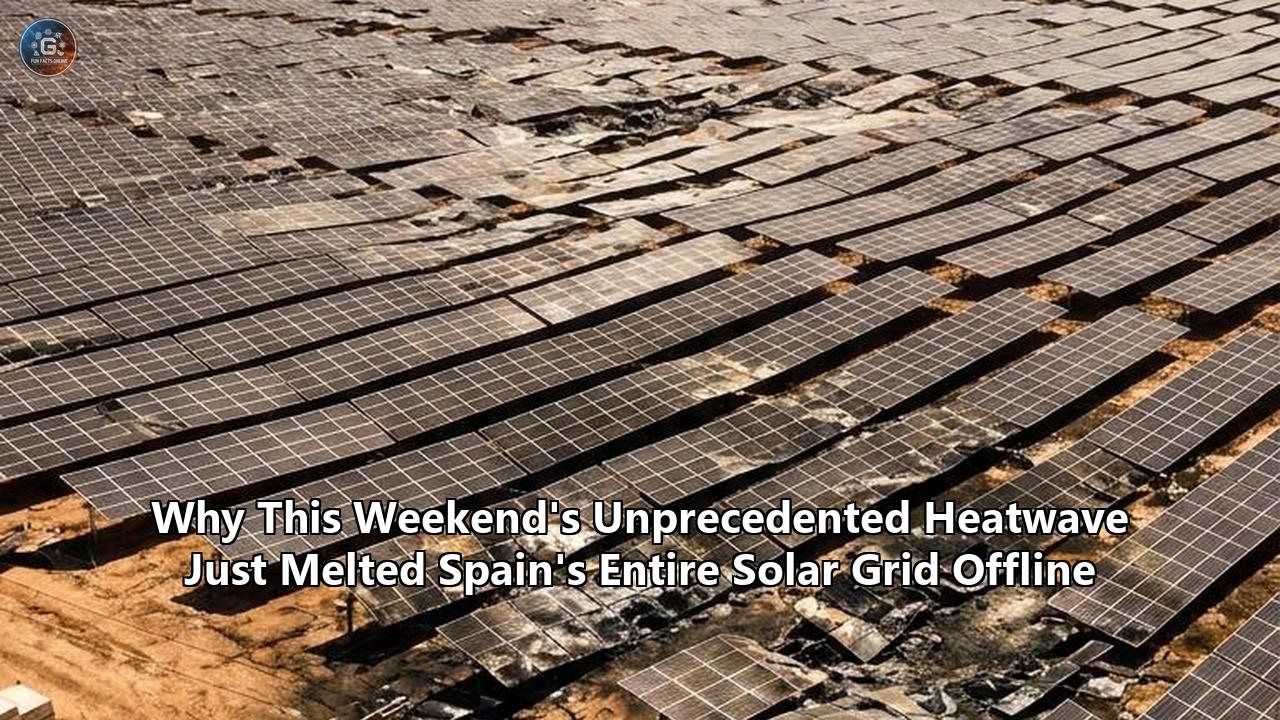
Millions of residents across the Iberian Peninsula awoke this Sunday morning to silenced air conditioning units, darkened transit hubs, and rolling cellular blackouts. At 2:03 PM on Saturday, May 9, the Spanish national electricity network suffered a catastrophic failure, severing its connections to the broader European network and plunging over 40 million people into the dark.
The trigger was not a cyberattack, a sudden winter freeze, or a hurricane. The immediate cause of this weekend’s unprecedented blackout was a historic, unseasonal surge in temperatures that crippled the very infrastructure designed to harvest the sun. As engineers at Red Eléctrica de España (REE) scramble to piece together the fragmented network via a painstaking "black start" process, the anatomy of the Spain heatwave solar grid collapse reveals a terrifying sequence of thermal physics, soaring electricity demand, and cascading infrastructure failures.
To understand how the European benchmark for renewable energy went entirely offline in a matter of minutes, we have to trace the thermal escalation that began building earlier this week.
Wednesday, May 6: The Climate Precursor
The warning signs for this weekend's crisis were etched into the meteorological records weeks ago. The Spanish State Meteorological Agency, AEMET, had just declared April 2026 the hottest on record. National temperatures averaged 15.1°C—a staggering 3.2°C above the 1991-2020 historical average. Between April 18 and April 22, the mercury surged nearly 5°C above seasonal norms, baking the peninsula, breaking multiple absolute heat records, and rapidly depleting the moisture from the soil.
By Wednesday morning, an exceptionally early Saharan heat dome shifted northward across the Strait of Gibraltar. Weather models painted a grim picture for the upcoming weekend: temperatures across Andalusia and Extremadura were projected to breach 42°C (107°F) by Saturday.
For the general public, this meant an early scramble for indoor cooling. For grid operators at REE headquarters in Madrid, it meant preparing for a brutal stress test. Spain has rapidly transformed its energy landscape since 2018, aggressively building out more than 30 gigawatts of photovoltaic capacity. On a mild, sunny spring day, solar energy easily provides massive portions of the nation's daytime electricity needs, allowing the country to heavily reduce its reliance on gas.
Extreme heat, however, alters the electrical behavior of a solar-heavy network. Operators knew they were walking into a dangerous operational window, but the sheer speed at which the physical hardware would degrade under the incoming thermal load remained drastically underestimated. Adding to the pre-existing vulnerability, water levels in southern reservoirs, specifically in the Guadalquivir basin, remained severely depressed following prolonged regional droughts. This effectively eliminated the grid's ability to rely on flexible, rapid-response hydroelectric power to bridge sudden supply gaps.
Thursday, May 7: The Physics of Thermal Clipping
By Thursday afternoon, temperatures in Seville and Córdoba hit 39°C. As the grid absorbed the initial spike in air conditioning demand, a highly technical engineering paradox began to unfold across the vast solar farms of southern Spain: excessive heat actively destroys solar panel efficiency.
Photovoltaic (PV) cells generate electricity by allowing incoming photons to knock electrons loose from their atoms. However, as the physical temperature of the silicon panel rises, the resting kinetic energy of those electrons increases. This narrows the critical voltage difference between the resting state and the excited state, directly reducing the maximum power output.
Solar panels are rated for their maximum capacity at a standard testing temperature of exactly 25°C (77°F). For every single degree Celsius the panel heats up past that threshold, a standard monocrystalline panel loses between 0.35% and 0.5% of its overall efficiency.
On Thursday, ambient air temperatures of 39°C translated to physical surface panel temperatures exceeding 65°C under the blistering, cloudless sky. Across the massive installations in the sun-baked Extremadura region, raw panel efficiency plummeted by roughly 18% below its rated nameplate capacity.
Furthermore, the site inverters—the heavy, computer-controlled power electronics that convert the direct current (DC) generated by the panels into the alternating current (AC) used by the grid—were struggling to cool themselves. Industrial central inverters house massive electronics that require heavy active cooling. When the ambient cooling air being pulled into the units is already nearing 40°C, the thermal delta between the air and the internal heatsinks becomes too narrow to effectively dissipate the megawatts of thermal energy being generated.
To prevent physical melting and catastrophic electrical fires, internal software initiates "thermal clipping." The inverters intentionally throttle the energy output to reduce internal operating temperatures. Despite blinding, uninterrupted sunlight, Spain's solar output began flatlining precisely as national power demand was initiating a vertical climb.
Friday, May 8: The Load Imbalance
The tension within the Spain heatwave solar grid dynamic escalated rapidly on Friday. By 2:00 PM, the thermometer in parts of Andalusia reached 41.5°C.
Millions of residential and commercial air conditioning units were pulling maximum electrical load simultaneously. Spain's building stock, historically optimized to retain heat during the colder months through heavy masonry and minimal cross-ventilation, transforms into ovens during early May heatwaves. The national consumption curve steepened aggressively, creating an enormous requirement for instantaneous, sustained power.
Grid operators traditionally manage these daily peaks by forecasting the "duck curve"—the imbalance between peak solar generation at midday and the massive spike in demand as the sun sets. But Friday introduced a mid-afternoon canyon. The solar generation was clipping and degrading at exactly the moment the AC load was peaking.
REE dispatchers began calling upon natural gas combined-cycle plants to bridge the widening gap. Because the hydro reserves were depleted, the gas turbines were the only dispatchable option left.
Gas plants, however, take hours to fully ramp up to operational temperatures. As they slowly came online to replace the degraded solar output, the grid's operational margin of error shrank to zero. The system barely survived Friday's peak, but the lack of dynamic voltage control became glaringly apparent. Inverter-based resources like solar do not naturally provide the physical "inertia"—the heavy, spinning magnetic mass of traditional turbines—that keeps the grid's AC frequency locked at a stable 50 Hertz when supply and demand fluctuate wildly.
Saturday, May 9, 10:00 AM: Infrastructure Buckling
Saturday morning arrived with relentless intensity. By 10:00 AM, ambient temperatures were already cresting 38°C in the south, aggressively climbing toward an unprecedented 42.5°C.
The crisis migrated from the silicon panels directly to the physical transmission infrastructure. Overhead high-voltage power lines are constructed of conductive aluminum wrapped around a high-strength steel core. When electricity flows through them, they naturally generate internal heat due to electrical resistance. This is calculated via I²R losses (current squared times resistance). When extreme ambient environmental heat is added to the equation, the internal resistance increases, generating a runaway thermal cycle that causes the metal to physically expand.
By mid-morning, grid monitoring sensors noted the massive 400 kV transmission lines sagging dangerously low between their pylons across the central plateau. To prevent these superheated, sagging lines from physically contacting trees or the ground—which would cause an immediate and catastrophic short circuit—grid safety protocols dictate that the capacity of the lines must be artificially downgraded.
REE controllers were forced to manually reduce the amount of power flowing through major southern corridors just as demand was skyrocketing. The national grid was now heavily congested, with power artificially stranded in regions that couldn't safely transmit it to the demanding urban centers of Madrid and Barcelona.
Saturday, 1:12 PM: The Catalyst in Badajoz
The structural breaking point arrived just after 1:00 PM.
At a massive utility-scale solar facility in the Badajoz province, the internal temperatures of the central inverters breached 65°C. The active cooling fans, entirely overwhelmed by the superheated ambient air and atmospheric dust, could no longer dissipate the thermal load.
At exactly 1:12 PM, the plant's automated protection systems engaged. To prevent a catastrophic equipment fire, the primary inverters tripped themselves completely offline.
In a fraction of a second, 500 megawatts of generation vanished from the Spanish grid.
Under normal operational circumstances, the broader European grid would absorb this loss with barely a flicker in the control room. But the network was already operating at the absolute outer limits of its thermal capacity. The sudden, unmitigated loss of generation caused the grid's frequency to instantly drop from the strictly mandated 50.00 Hz down to 49.85 Hz.
Saturday, 1:24 PM: The Chain Reaction
What happened next was a brutal demonstration of cascading failure, echoing vulnerabilities identified in previous, smaller-scale blackouts in 2025 where generators subject to dynamic voltage control obligations failed to absorb reactive power as required by Operating Procedure 7.4.
When the frequency and voltage dipped following the Badajoz trip, the grid required an immediate, heavy injection of "reactive power" to prop up the voltage levels across the transmission network. Traditional spinning power plants handle this automatically through their magnetic stators. However, despite updated grid codes, many older photovoltaic installations across the south lacked the capability to ride through voltage dips and provide dynamic voltage control.
Instead of supporting the struggling network, the onboard software at dozens of neighboring solar plants in Extremadura and Andalusia detected the voltage abnormality on the transmission lines and interpreted it as a critical external short-circuit. Prioritizing strict equipment self-preservation, their under-voltage relays tripped automatically.
- 1:24 PM: Three additional large-scale solar facilities trip offline in rapid succession.
- 1:25 PM: A localized voltage collapse in the south severs a major 400 kV routing substation in Granada.
- 1:27 PM: The sudden shift in electricity flow massively overloads an already thermally degraded transmission line heading north toward the capital. The line's physical protection relays sever the connection to prevent a total line meltdown.
Within exactly fifteen minutes, the primary catalyst for the Spain heatwave solar grid failure had multiplied exponentially. The network had unexpectedly shed over 2,000 megawatts of generation, and the national frequency plunged violently toward the critical, grid-destroying danger zone of 49.00 Hz.
Saturday, 1:40 PM: Severing the Peninsula
At REE headquarters on the outskirts of Madrid, alarms that hadn't sounded in decades dominated the primary control room. The frequency drop was accelerating in real time, and the massive power vacuum centralizing in southern Spain was beginning to aggressively suck electricity across the Pyrenees from France.
If Spain continued to drag down the network frequency, it risked destabilizing the entire European synchronous grid, potentially pulling France, Germany, and Italy into a continent-wide blackout.
Automated safety protocols built into the European Network of Transmission System Operators for Electricity (ENTSO-E) framework intervened. At 1:40 PM, the massive high-voltage interconnectors linking Spain to the French electrical grid automatically severed themselves. Moments later, the synchronous connections to Portugal followed suit.
The Iberian Peninsula was now electrically isolated—an island desperately trying to balance an impossible, heat-driven load.
With the French lifeline cleanly severed, the Spanish grid operators had only one highly destructive option left: automatic load shedding. To save the remaining physical generators from tearing themselves apart under the extreme low frequency, the system began intentionally cutting power to millions of customers. Entire regional substations were dropped into the dark.
Saturday, 2:03 PM: The Total Collapse
The automated load shedding was simply not fast enough.
The massive, erratic imbalance between the towering air conditioning demand and the collapsing, heat-throttled solar supply created a chaotic voltage oscillation that violently whipped back and forth across the isolated national network.
At 2:03 PM, the remaining baseload power plants—nuclear facilities operating in the north and the few spinning gas turbines that had reached operational capacity—detected the violent, unmanageable frequency swings. To prevent the permanent physical destruction of their massive steel turbines, their localized safety systems initiated emergency, hard-stop shutdowns.
Over 15 gigawatts of active generation disappeared in less than five seconds.
The grid went completely black.
Power simply ceased to exist across the entire geography, stretching from the sun-drenched beaches of Málaga to the bustling avenues of Madrid. High-speed AVE trains coasted to sudden, stranding halts in the middle of the scorching countryside. The Madrid Metro went dark, trapping thousands of weekend commuters in sweltering tunnels. Traffic lights extinguished instantly, turning major arterial intersections into chaotic gridlock.
At Adolfo Suárez Madrid-Barajas Airport, terminal operations ground to a halt as the facility was forced to transition entirely to emergency backup generators. Across the southern coast, critical desalination plants—the primary source of fresh water during the drought—shut down instantly. The sheer scale of losing 15 GW simultaneously is equivalent to roughly 15 massive nuclear reactors tripping offline at the exact same moment.
In the immediate aftermath, the stifling weekend silence was pierced only by the distant, staggered rumble of emergency diesel generators kicking on at hospitals and critical data centers.
Sunday, May 10: The Black Start Recovery
As of this morning, the country remains largely paralyzed. Restoring a completely dead national transmission grid is not as simple as flipping a master switch at headquarters. Grid operators are currently executing a highly complex, incredibly dangerous engineering ballet known as a "black start."
Because current solar inverters are generally "grid-following"—meaning they strictly require an existing 50 Hz electrical pulse on the line to synchronize with before they can export a single watt of power—the gigawatts of solar panels sitting under the brutal Sunday morning sun are entirely useless for restarting the network.
Instead, REE must rely entirely on its limited hydroelectric facilities and specialized gas turbines equipped with black-start diesel generators. This process is intensely delicate; the inrush current generated when energizing a dead transformer can cause massive voltage spikes that will instantly trip the system back into darkness. Operators must carefully balance the capacitive charge of the long, empty transmission lines with heavily controlled inductive loads.
The timeline of today's recovery is proceeding in painstaking, block-by-block steps:
- Energizing localized islands: Small pockets of the grid are slowly powered up using hydro and black-start gas turbines.
- Balancing the blocks: Operators slowly add small increments of consumer demand (like a single neighborhood or industrial block) to perfectly match the exact output of the spinning generators.
- Synchronizing the network: These isolated power islands are carefully monitored and synchronized to the exact same frequency phase before being connected to one another.
- Reintegrating renewables: Only after a strong, robust base frequency is established across the heavy transmission lines can operators begin allowing solar plants to safely reconnect to the network.
As of 10:00 AM Sunday, partial power has been restored to critical infrastructure hubs in Madrid and Barcelona, but regional grid authorities warn that rolling blackouts are expected to continue through Tuesday as the network remains incredibly fragile and the unseasonal heatwave persists.
Looking Forward: The Reckoning of the Transition
This weekend’s catastrophic infrastructure failure forces a harsh, unavoidable spotlight on the physical realities of Europe's rapid renewable energy transition. The infrastructure build-out over the last five years heavily prioritized raw generation—putting as many panels in the sun as mathematically possible—while severely underinvesting in core grid resilience, thermal transmission upgrades, and dynamic stabilization.
The systemic vulnerability exposed this weekend is multifaceted, but the regulatory roadmap to prevent the next Spain heatwave solar grid emergency requires immediate and massive structural shifts across the energy sector:
Mandatory Grid-Forming InvertersRegulators in Madrid and Brussels will likely move this week to impose strict new hardware mandates on all existing and future solar installations. The older, grid-following inverters that tripped and exacerbated the voltage collapse must be retrofitted or entirely replaced with "grid-forming" inverters. These advanced electronics can artificially generate their own frequency and inject the required reactive power to stabilize a buckling grid, acting digitally exactly like a traditional spinning turbine.
Aggressive Battery Storage DeploymentThe most glaring operational lesson of Saturday afternoon is the absolute, non-negotiable necessity of utility-scale battery storage. Batteries are no longer just tools for shifting excess solar energy to the nighttime hours; their most critical function in a modernized, renewable grid is instantaneous frequency response. A massive deployment of lithium-ion or sodium-ion battery banks could have recognized the dangerous frequency drop at 1:12 PM and injected compensating power within milliseconds—halting the cascade before the under-voltage relays ever triggered.
Upgrading Physical Transmission CorridorsThe thermal sagging of the 400 kV lines bottlenecked the entire system right when operators desperately needed geographic flexibility. Grid operators will face mounting pressure and require massive capital injections to accelerate the installation of advanced conductors—transmission lines built with specialized composite carbon fiber cores that can carry double the electrical current without physically sagging under extreme heat.
Spain still retains one of the most advanced and ambitious clean energy pipelines in the world. The solar boom has successfully slashed wholesale utility bills, generated immense local investment, and drastically reduced the nation's reliance on imported fossil fuels over the past half-decade. But this weekend serves as a definitive operational boundary line. The energy transition can no longer just be about counting gigawatts of solar capacity. As the climate grows increasingly hostile, the focus must immediately pivot to the highly technical physics of grid resilience, ensuring the infrastructure can actually survive the extreme weather it is actively trying to mitigate.
Reference:
- https://www.youtube.com/watch?v=kPPL0x9J3x4
- https://euroweeklynews.com/2026/05/08/spain-just-recorded-its-hottest-april-ever-and-summer-has-not-even-started/
- https://www.latitudemedia.com/news/open-circuit-no-solar-didnt-cause-spains-grid-collapse/
- https://www.altanea.es/the-story-behind-spain-solar-power-meltdown/
- https://renewablesnow.com/news/spains-grid-operator-blames-solar-farm-for-triggering-april-blackout-1277279/
- https://www.insurancebusinessmag.com/uk/news/catastrophe/was-the-heat-to-blame-spains-blackout-renews-fears-over-climate-and-grid-fragility-533693.aspx