On June 1, 2026, SpaceX quietly submitted an amended Form S-1/A registration statement to the U.S. Securities and Exchange Commission (SEC). The document was part of the final preparations for what is expected to be the largest initial public offering in stock market history: a blockbuster listing targeting a valuation of $1.8 trillion under the ticker SPCX on the Nasdaq.
For weeks, Wall Street analysts had been parsing the details of the company's rocket reuse rates, Starlink's subscriber margins, and Elon Musk’s super-voting Class B shares. However, the revised filing contained an unexpected risk disclosure that caught institutional investors completely off guard:
"Water scarcity, drought conditions, competition for local water resources, or regulatory restrictions on water use could limit our ability to obtain sufficient water for cooling... delay or limit expansion... or require us to implement alternative cooling techniques that may be more costly."
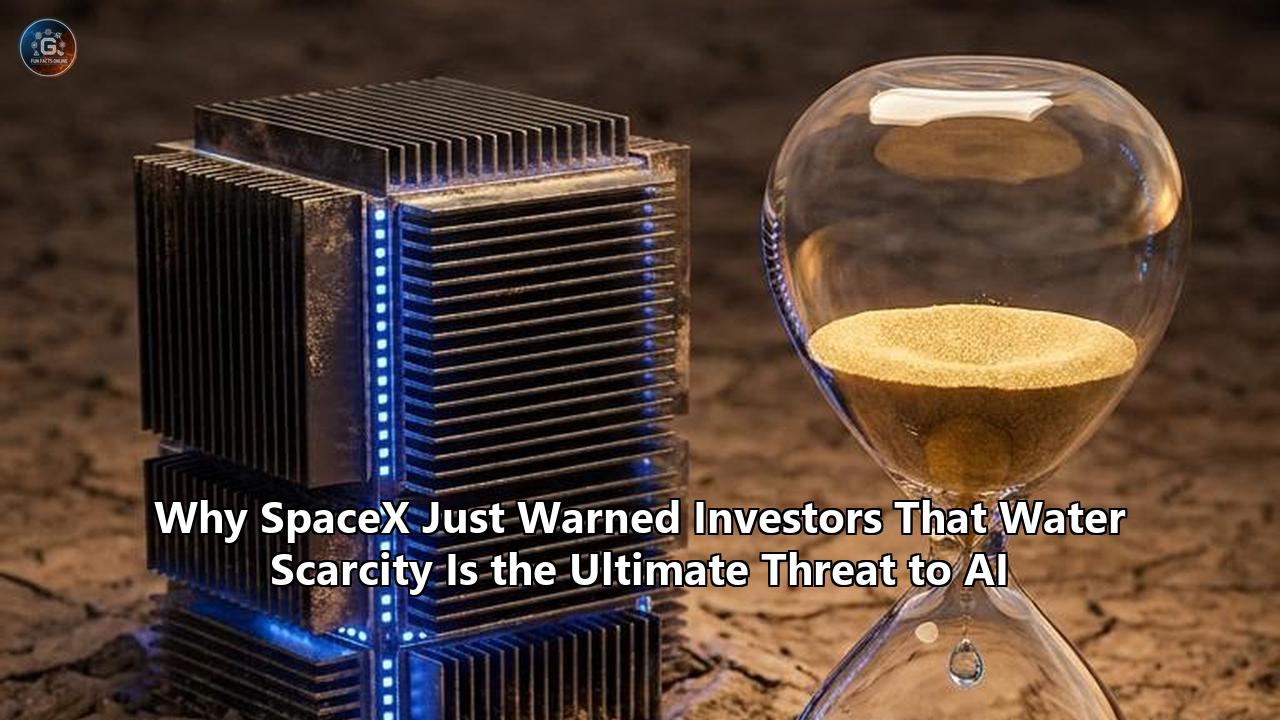
For the first time in a major technology prospectus, freshwater scarcity was listed side-by-side with electricity and advanced semiconductor availability as a primary bottleneck to the scale of artificial intelligence.
This was not a generic corporate social responsibility (CSR) nod to environmental sustainability. This was a cold, legally binding warning to investors that the multi-billion-dollar future of Elon Musk’s AI operations—recently consolidated under the SpaceX corporate umbrella—hinges on the stability of local municipal water taps.
The disclosure represents a pivotal moment for the technology sector. It marks the formal transition of AI water consumption from an environmentalist talking point into a core investment pricing factor that could dictate the valuation of the world’s most powerful computing clusters.
The Thermodynamics of the S-1 Amendment
To understand why a company famous for sending rockets to orbit is suddenly warning Wall Street about plumbing, one must look at the structural changes inside SpaceX’s balance sheet.
Ahead of the IPO, Elon Musk consolidated xAI, his artificial intelligence venture, into SpaceX. The move transformed SpaceX from a capital-intensive aerospace manufacturer into a vertically integrated AI infrastructure play. According to the audited financial results in the S-1, the AI division accounted for a staggering 61% of SpaceX’s consolidated $20.74 billion capital expenditure in 2025. This aggressive capital deployment resulted in an operating loss of $6.4 billion for the AI unit in 2025, driven by a global sprint to build and equip massive physical data centers.
The epicenter of this infrastructure sprint is Memphis, Tennessee, home to xAI’s "Colossus" and "Colossus II" supercomputing facilities. These facilities house hundreds of thousands of Nvidia GPUs, operating as a massive, unified computational engine. But the bottleneck for these next-generation AI brains is no longer just the mathematical limits of the algorithms; it is the thermodynamic limits of planet Earth.
Traditional CPU Server Rack (5–10 kW)
[  Air Cooling / Fans  ] ──> Dissipates heat into ambient room air.

Next-Gen AI GPU Rack (40–100+ kW)
[ Liquid-to-Liquid / Evaporative ] ──> Requires continuous freshwater loop to absorb high-density thermal friction.
A traditional data center hosting basic websites or enterprise email runs on standard Central Processing Units (CPUs) that can be adequately cooled using simple air conditioning systems. AI clusters are entirely different. They utilize thousands of high-density Graphics Processing Units (GPUs) packed tightly into server racks.
An Nvidia Blackwell-based server rack can draw up to 100 to 120 kilowatts of power, radiating heat at a density that makes air cooling physically impossible. To prevent these multi-million-dollar chips from literally melting due to thermal friction, operators must employ water-based cooling.
The cheapest and most common method is evaporative cooling. Water is piped into the data center, where it absorbs heat from the servers and is then sprayed into cooling towers, evaporating into the atmosphere to release the heat. This means that the water is not merely recycled in a closed loop; it is consumed, lost to the local watershed as water vapor. Consequently, the operational uptime of these facilities relies directly on a continuous, uninterrupted supply of millions of gallons of municipal freshwater.
The $15 Billion Anthropic Deal and the Hydrological Threat
The financial stakes of this physical constraint are laid bare in the commercial agreements disclosed in the revised prospectus.
The amended S-1 revealed a massive, highly lucrative cloud computing deal between SpaceX and AI rival Anthropic. Under the terms of the agreement, SpaceX has leased computing capacity equivalent to approximately 325,000 Nvidia GPUs at its Colossus facilities to Anthropic. After a brief ramp-up phase, Anthropic is contracted to pay SpaceX an eye-popping $1.25 billion per month—roughly $15 billion annually—through May 2029.
┌─────────────────────────────────────────────────────────┐
│              SpaceX S-1 Revenue Engine                  │
├────────────────────────────┬────────────────────────────┤
│   Anthropic GPU Lease      │    Starlink Subscriptions  │
│   $1.25 Billion / Month    │    $11.4 Billion / Year    │
│   (325,000 Nvidia GPUs)    │    (10M+ Global Users)     │
└─────────────┬──────────────┘└────────────────────────────┘
              │
              ▼
   Directly Threatened By:
   Hydrological bottlenecks at Colossus (Memphis)
This single contract is a cornerstone of SpaceX’s $1.8 trillion valuation pitch, providing a massive, predictable cash flow to offset the capital-intensive development of the Starship program and Mars colonization goals. However, the prospectus also reveals a critical vulnerability: the Anthropic agreement contains a mutual 90-day cancellation clause.
If a local water shortage, severe drought, or municipal intervention limits the water supply to the Memphis Colossus facility, SpaceX may be unable to maintain the thermal equilibrium of the 325,000 leased GPUs. A drop in cooling capacity immediately throttles compute performance, triggering service-level agreement (SLA) violations. Under such conditions, Anthropic could execute its 90-day escape hatch, vaporizing a $15 billion-a-year revenue stream.
This dynamic illustrates why SpaceX’s S-1/A amendment is a watershed moment for the capital markets. For years, tech giants like Google, Microsoft, and Meta have quietly disclosed their water use in retrospective annual sustainability reports. These disclosures were treated primarily as corporate public relations exercises, aimed at proving environmental, social, and governance (ESG) compliance.
By placing water access directly in the "Risk Factors" section of its pre-IPO prospectus, SpaceX has elevated hydrology to a material financial risk. Before an investor can buy a single share of SPCX stock, they must legally acknowledge that the stability of the company’s core AI cash flow is bound to the local water table.
The Memphis Aquifer: A Battleground of Resource Scarcity
The theoretical risks outlined in SpaceX’s S-1 are actively playing out on the ground in southwest Memphis.
xAI’s choice of Memphis for its Colossus cluster was initially hailed by local officials as a historic win, representing the largest capital investment by a new-to-market firm in the city's history. The region was attractive to the company's leadership for two reasons: access to massive electrical infrastructure via the Tennessee Valley Authority (TVA) and access to some of the purest, cheapest groundwater in the world.
The city sits directly atop the Memphis Sand Aquifer, an ancient underground reservoir that supplies drinking water to hundreds of thousands of residents. Because the aquifer’s water requires minimal treatment before consumption, it is highly sought after by heavy industrial users.
However, environmental groups, led by Protect Our Aquifer, immediately sounded the alarm when it was revealed that xAI’s supercomputer cooling towers would require up to 1.5 million gallons of freshwater per day.
Memphis Sand Aquifer (Drinking Water Source)
  │
  ├───> Municipal Drinking Water (Residents)
  │
  └───> Davis Wellfield (Industrial Drawdown)
          │
          └───> xAI Colossus Cooling Towers (Up to 1.5M gallons/day)
                  │
                  └───> Risk of pulling arsenic-contaminated water
                        from shallow clay layers above the Sand Aquifer.
The issue is not just the volume of water withdrawn, but the delicate hydrogeology of southwest Memphis. The Davis Wellfield, which xAI relies on, is situated near industrial zones that have suffered from decades of chemical pollution.
Sarah Houston, Executive Director of Protect Our Aquifer, has pointed out that continuous, high-volume pumping from the deep Sand Aquifer creates a localized drawdown effect. This localized drop in pressure can pull contaminated water from the shallow, unconfined aquifer above—which contains elevated levels of arsenic and industrial runoff—down into the city’s primary drinking water supply.
Local activist groups like Memphis Community Against Pollution have vocally accused tech conglomerates of treating the city as a "corporate watering hole," taking cheap water and leaving the community to bear the long-term ecological risks.
To defuse the tension, the local utility, Memphis Light, Gas and Water (MLGW), has pushed xAI to assist in the construction of a graywater treatment facility. The plan involves taking municipal wastewater, treating it to industrial-grade standards, and piping it directly to the Colossus facility for cooling purposes. While this would eliminate the need to draw from the drinking-water aquifer, the infrastructure is still years away from completion.
In the interim, xAI must continue to use municipal drinking water, leaving the entire facility vulnerable to sudden regulatory caps or municipal water conservation alerts during extreme weather events.
The Public Rhetoric vs. Legally Binding Disclosures
The inclusion of hydrological risks in the SEC filing stands in sharp contrast to Elon Musk’s public-facing statements on the matter.
On May 21, 2026, just ten days before the S-1 amendment was filed, Musk engaged in a viral debate on X (formerly Twitter) regarding the physical footprint of artificial intelligence. He endorsed an analysis arguing that public anxiety over data center water usage was wildly exaggerated.
The cited analysis noted that even if total AI water consumption tripled by 2030, it would still represent only 8% of the water consumed annually by golf courses in the United States, or a tiny fraction of the water used for irrigated corn farming. Musk agreed with the post, replying simply: "True."
                       [ 2030 U.S. Water Footprint Projections ]

Irrigated Corn Farming (100%) ──────────────────────────────────────────────────────────┐
                                                                                        │
Golf Courses (U.S. Annual Use) ────────────┐                                            │
                                           │                                            │
AI Data Centers (Tripled 2030 Estimate) ───┴────────────────────────────────────────────┘
(Equivalent to just 8% of Golf Course use, yet hyper-concentrated in local municipal grids)
While the golf course comparison is mathematically accurate on a national macro-scale, it obscures the reality of localized resource competition. A golf course is a distributed, non-critical recreational asset, often utilizing non-potable surface water.
A hyperscale AI data center, by contrast, is a hyper-concentrated industrial point-source user that requires continuous, high-purity water delivered to a single, specific geographic location. If five data centers are built in a single county, they do not compete with national golf courses; they compete directly with that county's schools, hospitals, and residential neighborhoods for a finite local water supply.
This friction is why the standard SEC review process does not tolerate public relations spin. While Musk can use high-level comparisons to shape public opinion on social media, the underwriters of the SpaceX IPO—led by Goldman Sachs—are bound by strict legal liabilities.
If the SEC determines that a material risk was downplayed or omitted from a prospectus, the company and its underwriters can face severe civil penalties and class-action shareholder lawsuits after the public debut.
Industry insiders suspect that the sudden addition of the water risk clause in the June 1 amendment was a direct response to a comment letter from SEC regulators during the standard pre-filing review. The SEC has increasingly targeted AI companies for vague or incomplete disclosures regarding their physical infrastructure requirements, forcing firms to provide explicit, detailed risk profiles of their resource dependencies.
The Broader AI Water Consumption Crisis
SpaceX’s regulatory warning is the first major corporate acknowledgement of a systemic bottleneck threatening the entire silicon economy.
Just days after SpaceX filed its revised S-1, the United Nations issued an environmental report on June 4, 2026, details of which highlighted the staggering scale of AI water consumption. The UN found that by 2030, global data centers could consume up to 9.3 trillion liters of water annually—enough to meet the drinking needs of 8.1 billion people for more than a year and a half.
Historically, data center operators focused almost exclusively on the "energy wall"—the challenge of securing gigawatts of clean electricity from strained regional grids. But as the industry has rushed to secure power, it has run headfirst into a "water wall".
A study of U.S. data center operations found that the industry consumed approximately 17 billion gallons of freshwater for direct cooling in 2023, with indirect water consumption—the water used by power plants to generate the electricity that data centers consume—reaching 211 billion gallons. Driven by the rapid expansion of AI, those numbers are projected to double or even quadruple by 2028.
               [ Direct vs. Indirect Data Center Water Use (U.S.) ]

2023 Direct Cooling:   ██ 17 Billion Gallons
2023 Indirect Power:   ████████████████████████████████████████████ 211 Billion Gallons

2028 Projected:        ██████████████████████████████████████████████████████████ 400B+ Gallons
This massive hydrological footprint is already causing severe political and logistical friction globally:
- In the American Southwest: Tech companies built massive solar-powered data centers in the desert to capitalize on cheap land and clean energy, only to find that regional water authorities, facing historic Colorado River shortages, refused to grant them high-volume water extraction permits.
- In Europe: Local protests and municipal water restrictions have delayed or blocked over $64 billion worth of proposed data center developments in Ireland, Germany, and the Netherlands.
- In the United States: More than 11 states have introduced or are actively debating legislative bills to limit, tax, or outright ban new data center developments that draw from municipal drinking water aquifers.
These developments are forcing the technology sector to realize that AI expansion is no longer governed solely by how much money a company has, or how many advanced chips it can hoard. The physical rate of expansion is now tied directly to the slowest water meter.
Alternative Cooling: The Financial and Operational Trade-Offs
In its S-1 amendment, SpaceX noted that if water scarcity prevents it from securing sufficient municipal supplies, it could be forced to implement "alternative cooling techniques". While these alternatives exist, they present severe operational and financial penalties that could significantly erode the company’s operating margins.
┌────────────────────────────────────────────────────────────────────────────────────────┐
│                        Data Center Cooling Technology Trade-offs                      │
├─────────────────────┬──────────────────────────────────┬───────────────────────────────┤
│ Cooling Method      │ Capital Expenditure (CapEx)      │ Thermal & Power Efficiency    │
├─────────────────────┼──────────────────────────────────┼───────────────────────────────┤
│ Evaporative Water   │ Baseline                         │ Highly Efficient              │
│ Air-Cooled Chillers │ +15% to +20% CapEx increase       │ Lower (high parasitic load)   │
│ Liquid-to-Air Loops │ Moderate Increase                │ Temperature Dependent         │
│ Direct-to-Chip      │ Substantial CapEx premium        │ Optimal (complex to retro)    │
└─────────────────────┴──────────────────────────────────┴───────────────────────────────┘
The most obvious backup is air cooling, utilizing closed-loop industrial chillers that function similarly to giant car radiators. While this method consumes virtually no water, its thermal efficiency is substantially lower than water-based evaporative cooling.
Implementing air cooling in a hyperscale facility can increase total capital expenditures by up to 20% compared to traditional water-based solutions, due to the need for massive fans, heat exchangers, and extensive physical footprints.
Furthermore, air-cooled data centers suffer from what engineers call a "parasitic power load." The enormous amount of electricity required to run the heavy industrial fans to blow air over the heat exchangers reduces the overall power available to run the AI chips themselves. In peak summer temperatures, air-cooled facilities must often scale down, or "thermal throttle," their GPU workloads to prevent overheating, directly reducing the computational throughput of the cluster.
Another alternative is direct-to-chip liquid cooling, where a non-conductive dielectric fluid is pumped through closed-loop cold plates attached directly to the processors. While highly efficient, retrofitting existing facilities like Colossus with liquid-to-chip infrastructure is incredibly complex and requires a complete overhaul of the server racks, fluid pumps, and piping systems.
For a company like SpaceX, which is racing to establish dominant market share before its IPO, a forced pivot to these alternative technologies would result in immediate construction delays, ballooning capital costs, and reduced margins on its multi-billion-dollar compute leases.
The Hydro-Geopolitics of Future AI Site Selection
The emerging reality of water scarcity is redrawing the map of global technology infrastructure.
For the past decade, data center site selection was dominated by two variables: cheap electricity and low latency (proximity to major fiber-optic backbones). Today, hydrology is the defining variable.
We are seeing a geographic bifurcation of the AI industry:
[ AI Workload Hubs ] ────> TRAINING (Requires massive, steady compute power & cooling)
                            └──> Sited in cold, wet, or water-secure regions.

                     ────> INFERENCE (Requires low latency close to end-users)
└──> Sited near metropolitan grids with closed-loop systems.- The Cold and Wet Migration: Large-scale training of frontier LLMs—which requires months of continuous, high-intensity compute but is not highly sensitive to physical latency—is moving rapidly to regions with naturally cold climates and abundant water resources, such as the Nordics, Canada, and the Pacific Northwest. In these climates, data centers can use "free air cooling," pulling in the cold ambient outdoor air to cool the servers, eliminating the need to consume local groundwater.
- The Low-Water Inference Edge: Inference tasks—the day-to-day processing of user queries which must run close to population centers to minimize delay—are being forced to adopt highly engineered, closed-loop liquid-cooled architectures, even if it means paying a premium for construction and power.
This geopolitical shift is also driving deep-tech experimentation. SpaceX has actively researched the concept of orbital data centers, leveraging its Starship launch capabilities to deploy up to one million specialized computing satellites into low Earth orbit.
The thesis is that space provides an infinite thermal sink and unattenuated solar flux, completely bypassing terrestrial energy grids and hydrological bottlenecks.
However, orbital computation introduces immense challenges—ranging from cosmic radiation damage to high latency and the staggering capital cost of launching and maintaining space hardware. For the foreseeable future, the battle for AI dominance will be won or lost in the mud, clay, and water pipes of Earth.
What to Watch Next
As SpaceX prepares for its historic June 12, 2026 public debut under the ticker SPCX, its amended filing has set a precedent that the rest of the technology industry cannot ignore. Wall Street is beginning to adjust its models to account for the physical constraints of computing.
Investors and analysts should watch several key developments in the coming months:
1. SEC Comment Letter Disclosures
Once SpaceX’s IPO process is completed, the SEC will make its formal comment letters public. These documents will reveal the exact line of questioning that prompted the S-1/A water amendment.
It will show whether regulators are forcing a standardized, quantitative "water footprint" disclosure for all computing and cloud providers.
2. The Memphis Aquifer Regulatory Battle
The local municipal response in Memphis will serve as a critical case study. If local regulators impose strict daily withdrawal limits on the Davis Wellfield, or if the construction of the graywater treatment facility faces delays, SpaceX may be forced to scale back operations at Colossus, directly testing the durability of its $15 billion Anthropic contract.
3. The 2026 AI IPO Wave
With Anthropic having confidentially filed its S-1 on June 1, and OpenAI reportedly preparing its own prospectus for a public listing later this year, all eyes will be on their risk disclosures.
If these pure-play AI labs reveal similarly severe hydrological constraints or highly vulnerable supplier relationships, it could trigger a broader valuation reassessment across the entire AI ecosystem.
The silicon-based dream of artificial intelligence is ultimately tethered to the physical resources of the planet. As the race to build larger, more powerful neural networks continues, the ultimate bottleneck is no longer just a question of code, capital, or chip design.
The real limit of progress is the physical supply chain—and specifically, the local water infrastructure that keeps the world's digital steam engines from overheating.
Reference:
- https://www.zoomex.com/en-AS/news/42ac49b4
- https://coinpaper.com/17421/elon-musk-s-space-x-amends-s-1-filing-ahead-of-planned-june-12-ipo-launch
- https://www.tradingview.com/news/zacks:49d0b46cc094b:0-spacex-and-anthropic-the-most-exciting-ipos-ever/
- https://www.indmoney.com/blog/us-stocks/spacex-openai-anthropic-ipo-explained
- https://www.aifire.co/p/spacex-warns-water-could-become-ai-biggest-bottleneck
- https://www.binance.com/en/square/post/329628948468225
- https://www.panewslab.com/en/articles/019e8624-79e0-7758-8b4e-7b466fea1872
- https://keepingupwith.ai/articles/spacex-adds-water-scarcity-as-material-risk-in-pre-ipo-sec-filing/
- https://www.crvscience.com/post/off-world-data-centers-a-critical-look-at-the-spacex-xai-merger
- https://www.fxempire.com/forecasts/article/tesla-stock-and-ai-race-heat-up-as-spacex-ipo-targets-1-75-trillion-1601830
- https://www.tbsnews.net/worldbiz/usa/spacex-ai-burning-cash-starlink-earns-1420721
- https://www.waterdaily.com/home/featured/article/15775302/elon-musks-supercomputer-sparks-memphis-water-supply-concerns
- https://www.futunn.com/403
- https://www.youtube.com/watch?v=P7_n_7jIEoc
- https://www.benzinga.com/markets/private-markets/26/06/52929608/elon-musks-spacex-ipo-filing-change-tesla-investors-buzzing
- https://simonwillison.net/2026/May/20/spacex-s1/
- https://cryptorank.io/news/feed/2b79b-spacex-ipo-water-access-risk-factor
- https://time.com/7021709/elon-musk-xai-grok-memphis/
- https://bizfortune.com/2026/05/elon-musk-replies-to-post-controversy
- https://timesofindia.indiatimes.com/technology/tech-news/elon-musk-replies-to-post-claiming-data-centers-arent-stealing-your-water-says-/articleshow/131239609.cms
- https://news.aibase.com/news/28546
- https://www.useluminix.com/reports/company-overviews/what-do-we-know-about-the-anthropic-ipo
- https://www.1news.co.nz/2026/06/04/report-warns-ai-data-centre-boom-threatens-resources/
- https://www.panewslab.com/en/articles/019e8624-79e0-7758-8b4e-7b466fea1872
- https://contentbuffer.com/news/spacex-ipo-water-risks
- https://www.tradingkey.com/analysis/stocks/us-stocks/261939854-spacex-ipo-s1-5percent-risk-water-anthropic-datacenter-musk-tesla-tradingkey
- https://www.techrepublic.com/article/news-spacex-ipo-ai-data-center-water-access/
- https://www.businessinsider.com/anthropic-submits-s-1-joins-ipo-race-with-openai-2026-6
- https://decodethefuture.org/en/ai-ipos-2026-anthropic-openai-spacex/