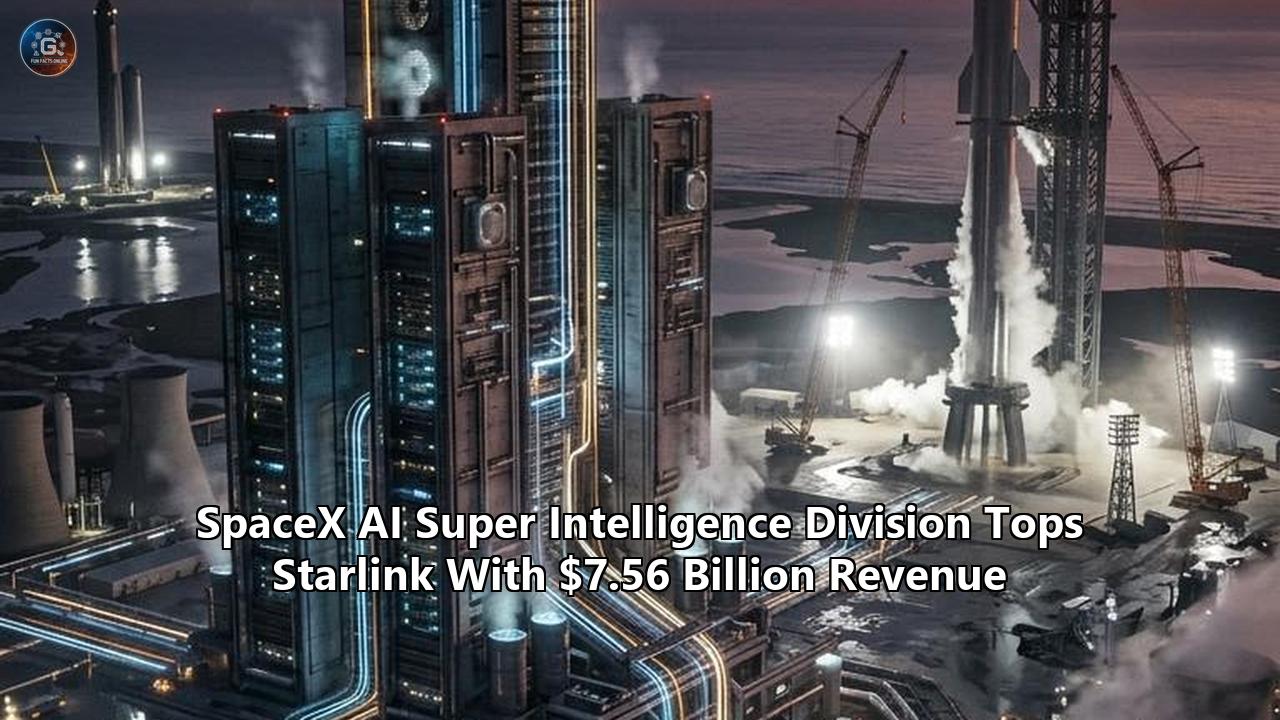
SpaceX has crossed a historic financial threshold, posting third-quarter 2026 revenue of $14.58 billion—driven not by the Falcon 9 launch cadence or Starlink’s satellite broadband, but by its newly integrated artificial intelligence segment. The company’s Super Intelligence (SI) division generated $7.56 billion during the three-month period ending September 30, eclipsing Starlink connectivity to become the aerospace and computing conglomerate’s largest operational business.
The quarterly print, the second published by SpaceX since its listing on the Nasdaq under the ticker SPCX, delivered a net profit of $4.4 billion. That marks a dramatic reversal from a $1.1 billion net loss in the third quarter of 2025 and a $541 million deficit in the second quarter of 2026. Spurred by surging commercial compute agreements and the consolidation of developer platform Cursor, the SpaceX AI division revenue jumped 830% year-over-year from $813 million and nearly tripled on a quarter-over-quarter basis from $2.56 billion.
The announcement sent SPCX shares climbing more than 11% in trading, lifting the broader semiconductor and computing ecosystem. Wall Street had anticipated total revenue closer to $12.72 billion and net income near $1.57 billion. Instead, SpaceX delivered an adjusted EBITDA of $8.8 billion—clearing consensus marks by $2.4 billion—while Chief Executive Officer Elon Musk revealed that SpaceX and Tesla have formed special board committees to formally explore a cross-company merger.
SpaceX has evolved from a launch provider deploying commercial payloads into a vertically integrated sovereign infrastructure operator. Launch services accounted for just 12% of quarterly turnover, while connectivity generated 36%. Super Intelligence accounted for 52% of all company sales.
| Segment | Q3 2026 Revenue | Share of Total | YoY Growth | Q3 Operating Income (Loss) |
|---|---|---|---|---|
| Super Intelligence (AI) | $7.56 billion | 51.9% | +830% | $431 million |
| Connectivity (Starlink) | $5.25 billion | 36.0% | +69% | $2.37 billion |
| Space (Rockets & Starship) | $1.77 billion | 12.1% | +6% | ($7 million) |
| Consolidated Total | $14.58 billion | 100.0% | +161% | $2.79 billion |
Inside the $7.56 Billion Print: Leased Compute, Model APIs, and Cursor
The velocity of the Super Intelligence segment’s expansion surprised even optimistic models. The unit, legally formed through the structural absorption of xAI into SpaceX and recently rebranded as Super Intelligence following a White House policy directive, generated its $7.56 billion through three distinct lines: infrastructure leasing, developer developer-seat software subscriptions, and frontier model APIs.
                 Q3 2026 Super Intelligence Revenue ($7.56B)
 ┌────────────────────────────────────────────────────────────────────────┐
 │ Compute Cluster Leases: ~$5.85B                                        │
 │ (Dedicated GPU/NPU capacity leased to Anthropic, Google, Reflection)   │
 ├────────────────────────────────────┬───────────────────────────────────┤
 │ Developer Platform: $608M          │ Grok Enterprise & Platform: ~$1.1B│
 │ (Cursor acquisition, Aug 14-Sep 30)│ (Model APIs, Enterprise, X.com)   │
 └────────────────────────────────────┴───────────────────────────────────┘
The primary engine was dedicated compute leasing. SpaceX brought its operational nameplate power capacity to 1.7 gigawatts by late September, up from 0.6 gigawatts twelve months prior, anchored by rapid buildouts across its Colossus data center installations. Rather than utilizing this capacity entirely for internal training of the Grok model family, SpaceX leased large blocks of high-density GPU and custom accelerator clusters to outside artificial intelligence laboratories. Contract filings and earnings disclosures confirmed enterprise leases to Anthropic, Google, and open-weights developer Reflection AI.
The second major contributor came through programmatic acquisitions. On August 14, SpaceX closed a $60 billion stock-and-cash acquisition of Cursor, an AI-native code editor platform. In the six weeks between the deal's closing and the end of the third quarter, Cursor contributed $608 million in high-margin enterprise recurring subscription revenue to the Super Intelligence line item.
The remainder of the division’s revenue stemmed from enterprise tier subscriptions to Grok 3 and Grok 4, developer API token billing, and high-margin data access fees routed through the X platform.
The unit registered $431 million in operating profit. While modest relative to its $7.56 billion top line, that figure absorbed approximately $1.2 billion in non-cash stock-based compensation expenses triggered by the Cursor acquisition. A year earlier, the nascent AI unit incurred a quarterly operating loss of $1.72 billion.
"We are in an inflection moment across launch, connectivity, and superintelligence," Musk stated during the investor call. Addressing the physical ramp-up of the company's multi-facility data center campus, Musk added: "The speed at which our infrastructure team brings power, cooling, and compute clusters online is unprecedented. It is like the New York Yankees playing in Little League. The constraints on frontier intelligence are no longer silicon chips; the constraints are transmission lines, substations, and thermal management."
The Capital Intensity Flywheel: A $16.4 Billion Hardware Outlay
The operational results reveal an aggressive capital expenditure cycle. SpaceX invested $19.59 billion in capital expenditures during the third quarter alone, nearly triple the $6.9 billion deployed during the corresponding period of 2025.
The Super Intelligence division swallowed $16.44 billion of that total—approximately 84% of all capital deployed across the corporation.
                     Q3 2026 Capex Allocation ($19.59B)
 ┌──────────────────────────────────────────────────────────────┬─────────┐
 │ Super Intelligence Division: $16.44B (83.9%)                 │ Other   │
 │ (Megawatt substations, servers, cooling systems, Starlink D2C)│ Capex   │
 └──────────────────────────────────────────────────────────────┴─────────┘
The scale of this spending outpaces typical industrial expansion curves. Chief Financial Officer Bret Johnsen informed analysts that capital expenditure will increase to between $35 billion and $40 billion in the fourth quarter as the company accelerates civil engineering works on its Colossus II compute installation. Musk set an internal goal of scaling SpaceX’s dedicated power infrastructure to between 13 and 20 gigawatts of connected capacity before the end of 2027.
The rapid climb in SpaceX AI division revenue is directly tied to this capital deployment. By financing, constructing, and energizing multi-hundred-megawatt sites faster than traditional real estate investment trusts or hyperscale cloud providers, SpaceX has turned power access into enterprise leverage.
"The AI compute landscape has completely bifurcated," explained Ken Herbert, managing director at RBC Capital Markets. "There are software teams waiting twelve to eighteen months for high-density colocation capacity from incumbent utilities, and there is SpaceX, which acts as its own general contractor, procures its own turbines, and connects multi-megawatt facilities in a fraction of that time. That speed premium is why external labs are signing compute leases with SpaceX, even when those labs view Grok as a direct market competitor."
The scale of capital consumption has sparked debate among institutional holders over balance sheet durability. While third-quarter cash flows supported the outlay thanks to $8.8 billion in adjusted EBITDA and upfront liquidity from corporate compute pre-payments, executing a $40 billion quarterly capital envelope will require sustained cash generation from both AI leases and the Starlink satellite fleet.
The Starlink Cash Engine: Expanding Reach, Shifting ARPU
While compute infrastructure drove the headline numbers, Starlink remained the business unit generating steady operating income. SpaceX's Connectivity segment generated $5.25 billion in revenue for the quarter, an increase of 69% from the $3.1 billion recorded in the third quarter of 2025.
Operating income for Connectivity climbed 99% year-over-year to $2.37 billion, yielding an operating margin of 45.1%.
Starlink Consumer Subscriber Growth vs. Average Revenue Per User (ARPU)

Subscribers (Millions)                                           Blended ARPU ($/Month)
15M ─────────────────────────────────────────────────────────    $110 ──────
                                                13.6M    $100 ── $99 (2023)
12M ───────────────────────────────────────────                  $90  ──────
                                                                 $80  ──────
 9M ─────────────────────────── 7.2M                     $70  ────── $69 (Q3 2026)
                                                                 $60  ──────
 6M ───────────────────────────                                  $50  ──────
        Q3 2025                   Q3 2026                               Q3 2025       Q3 2026
Starlink ended September with 13.6 million active consumer subscribers, nearly double the 7.2 million reported a year earlier. However, the service added 1.6 million net consumer connections during the quarter, missing Wall Street expectations of 2.29 million.
Underneath this volume growth lies a shifting monetization dynamic. Blended average revenue per user (ARPU) across the global Starlink subscriber base slipped to $69 per month, down from $99 per month in 2023.
This dilution stems from two intentional commercial pivots:
- Regional Tiering: Accelerated market penetration across Latin America, Southeast Asia, and Sub-Saharan Africa has relied on lower pricing structures designed to match regional purchasing power parities.
- Deprioritized Consumer Plans: SpaceX expanded low-cost, off-peak residential plans in mature Western markets to monetize spare network capacity without degrading service for premium enterprise and maritime tiers.
SpaceX is positioning Starlink to counter residential ARPU compression through terrestrial mobile convergence. During the earnings call, SpaceX Chief Operating Officer Gwynne Shotwell detailed operational plans for a hybrid mobile network slated to enter commercial service in early 2028. The architecture fuses S-band satellite spectrum (acquired via commercial partnership with EchoStar) with low-band 800MHz terrestrial frequencies secured through Grain Management.
Under this design, SpaceX will deploy proprietary micro-radios directly onto existing Starlink enterprise and residential ground installations. Low-band spectrum will manage indoor penetration and cellular fallbacks, while overhead low-Earth orbit (LEO) satellites handle backhaul and direct-to-device connectivity.
Shotwell projected that this dual satellite-terrestrial architecture will unlock several hundred billion dollars in high-margin connectivity revenue over the next decade by bypassing legacy mobile network buildouts.
Launch Operations: From Revenue Anchor to Cost Foundation
The corporate financial results highlight how launch services have shifted from a commercial frontline to an internal cost-center driver. SpaceX's Space division, which executes commercial Falcon 9 missions, Starship orbital test flights, and Department of Defense national security launches, recorded revenue of $1.77 billion—a 6% increase from $1.67 billion in Q3 2025.
The Space segment logged a small operating loss of $7 million, compared to near-breakeven performance in the previous quarter.
                     SpaceX Revenue Composition Shift
       Q3 2024 (Illustrative)                    Q3 2026 (Reported)
 ┌──────────────────────────────┐        ┌──────────────────────────────┐
 │ Launch Operations (Falcon 9) │        │ Super Intelligence: 51.9%    │
 │ Starlink Early Commercial    │        │ Connectivity: 36.0%          │
 │ xAI (Separate Entity)        │        │ Space & Launch: 12.1%        │
 └──────────────────────────────┘        └──────────────────────────────┘
The launch cadence itself set operating records. SpaceX conducted 44 successful Falcon 9 launches during the three-month period, maintaining a regular flight rhythm. The muted revenue growth reflects fleet utilization: over two-thirds of all missions were dedicated to deploying next-generation Starlink V2 satellites and experimental Direct-to-Cell hardware, rather than revenue-generating commercial payloads.
Starship development at Starbase, Texas, absorbed substantial internal capital, with structural costs expensed rather than capitalized. With commercial payload slots on Falcon 9 largely reserved for domestic defense programs and institutional science contracts, launch functions primarily as an internal utility. It offers SpaceX launch pricing at marginal cost, enabling the continuous replacement of satellite assets and the rapid deployment of specialized orbital infrastructure.
Customer Concentration and Counterparty Risk
The rapid expansion of the SpaceX AI division revenue brings significant customer concentration risks that Wall Street analysts are beginning to scrutinize.
Regulatory filings reveal that SpaceX's commercial revenue has become dependent on a small cluster of enterprise accounts:
- During the full fiscal year 2025, a single unnamed commercial entity accounted for 20.9% of SpaceX's consolidated revenue across launch, Starlink, and early computing agreements.
- In the second quarter of 2026, an enterprise customer in the AI compute division contributed 19.5% of total company revenue.
- Combined, just two counterparty accounts generated approximately 38% of SpaceX's consolidated gross turnover in Q2.
                Consolidated Corporate Revenue Concentration
 ┌───────────────────────────────────────┬────────────────────────────────┐
 │ Customer A: ~20% of Company Revenue   │ All Other Enterprise, Retail,  │
 ├───────────────────────────────────────┤ Government, and Defense Sales: │
 │ Customer B: ~19% of Company Revenue   │ ~61% of Total Turnover         │
 └───────────────────────────────────────┴────────────────────────────────┘
The complete Form 10-Q filing for the third quarter will disclose whether this concentration deepened following the expansion of compute contracts with external developers like Anthropic and Google.
This concentration creates a strategic paradox. Major AI labs rent compute capacity from SpaceX because the company controls power access, electrical substations, and colocation infrastructure. Yet those same enterprise clients develop foundation models that directly challenge Grok, the primary native model produced by SpaceX’s Super Intelligence team.
Should an external tenant choose not to renew a multi-gigawatt compute agreement, or if frontier AI labs secure private grid allocations directly from utilities, SpaceX could face excess capacity across high-cost data center locations.
"The earnings print is undeniably strong, but the asset risk profile is changing," noted Colin Canfield, an equity analyst at Cantor Fitzgerald. "Starlink provides a distributed subscriber base with zero single-customer risk. The compute leasing business operates on the opposite model: billion-dollar multi-year commitments concentrated in a handful of high-growth balance sheets. If those labs shift workloads to their own custom silicon, SpaceX must backfill that capacity with internal training runs or accept compressed margins."
The Tesla Mega-Merger: Constructing an Industrial Monolith
Beyond the earnings metrics, Musk added significant market momentum by confirming active structural discussions between SpaceX and Tesla. Both companies have appointed independent special committees to evaluate terms for a full corporate merger, an initiative Musk noted he actively supports.
The strategic rationale focuses on consolidating compute power, autonomous fleets, robotics, and energy infrastructure:
- Physical Compute Integration: Tesla’s autonomous driving inference and training clusters (Dojo and custom architectures) would merge with SpaceX's massive data center portfolio, bringing more than 3 gigawatts of combined computing power under a unified infrastructure banner.
- Energy Generation and Storage: Tesla Energy’s utility-scale Megapack manufacturing would integrate directly into SpaceX's Super Intelligence division, easing grid-connection delays by deploying co-located solar, natural gas turbines, and stationary battery storage units directly to data center locations.
- Robotics Deployment: Tesla's Optimus humanoid development team would integrate with SpaceX’s automation centers, deploying physical robotics across Starship fabrication facilities and orbital launch pads.
- Unified Model Distribution: The software platforms—spanning Cursor, the Grok model family, the X distribution channel, and Tesla's Full Self-Driving (FSD) neural networks—would run on a shared model architecture and compute layer.
The proposal also introduces governance challenges. Institutional shareholders across both boards will scrutinize equity exchange ratios, shared debt facilities, and cross-company capital deployment. In trading following the earnings call, Tesla shares rose 4%, reflecting market enthusiasm for direct exposure to SpaceX’s surging AI infrastructure returns.
The Regulatory and Power Horizon: 20-Gigawatt Ambitions
The primary bottleneck facing SpaceX's AI growth path is no longer access to capital or advanced semiconductor hardware. It is electric utility capacity.
Musk stated during the call that deploying superintelligence is strictly limited by thermal management, high-voltage transformers, and primary generation sources. To reach the 20-gigawatt run rate targeted for the close of 2027, SpaceX has begun deploying behind-the-meter energy solutions:
- Dedicated Generation Sites: The company is bypassing regional utility queues by securing private gas fields and building on-site combined-cycle generation facilities.
- Modular Cooling: Super Intelligence engineers have implemented closed-loop liquid-to-air cooling systems, minimizing industrial water use while maximizing compute density per square foot.
- Orbital Processing Research: In disclosures accompanying the Q3 results, SpaceX acknowledged initial orbital test flights evaluating LEO data center nodes. The long-term architecture envisions routing inter-satellite laser communications directly into specialized, space-based inference processors cooled by the radiative environment of low-Earth orbit.
This energy demand has drawn increased regulatory oversight. Local energy boards and environmental regulators across the southern United States have raised questions regarding the industrial draw of the Colossus data center sites, calling for independent audits of regional water conservation and grid reliability.
SpaceX has countered by pointing out that its dedicated investments in battery storage and localized sub-stations provide grid stabilization reserves that help insulate regional networks from baseline disruptions.
What Wall Street Is Watching: The Road to $100 Billion ARR
SpaceX's performance has altered Wall Street's framework for valuing the business. No longer treated as an aerospace manufacturer, the company trades as an infrastructure sovereign spanning high-bandwidth connectivity and advanced compute.
       Path to Projected Annual Recurring Revenue (Exit Run-Rate)
$120B ─────────────────────────────────────────────────────────
                                                  Target: $100B ARR
$90B ───────────────────────────────────────────  (Dec 2026 Run-Rate)

$60B ───────────────────────────────────────────  Q3 2026 Run-Rate: ~$58.3B
                                                  ($14.58B x 4)
$30B ───────────────────────────

 $0B ───────────────────────────
            2025                       2026 (Reported / Run-Rate)
SpaceX CFO Bret Johnsen reaffirmed the company’s forward guidance: SpaceX is tracking toward a $100 billion annual recurring revenue (ARR) exit run rate by the end of December 2026, calculated by annualizing December monthly top-line results. Musk went further, reiterating his internal forecast of scaling consolidated annual revenues to between $500 billion and $1 trillion by the end of 2027.
To determine whether the company can hit these targets, institutional investors are monitoring several upcoming milestones:
- The Q4 Capex Wave: Analysts will monitor whether SpaceX executes its guided $35 billion to $40 billion capital spend without putting pressure on its new operating profit margins.
- Enterprise Customer Retention: Disclosures in early 2027 will show whether external AI labs renew multi-year commitments or migrate workloads onto proprietary data centers.
- Mobile Convergence Timelines: Network engineering reviews will track the deployment of hybrid satellite-cellular radios across Starlink's base stations, validating Shotwell's long-term commercial telecom targets.
- Board Progress on the Tesla Deal: Special committees will outline the structure, valuation methodologies, and antitrust clearance strategy for a potential tie-up between Tesla and SpaceX.
The structural shift inside SpaceX is definitive. While the company's rockets continue to reach orbit and its satellites orbit the globe, the economic center of gravity has firmly shifted down to the data center floor. As SpaceX AI division revenue climbs past satellite communications and rocket launches combined, the company has repositioned itself at the center of the global race for machine intelligence.
Reference:
- https://thenextweb.com/news/spacex-quarterly-revenue-ai-starlink-q3
- https://www.openingbelldailynews.com/p/spacex-super-intelligence-segment-revenue-oct-20-2026
- https://thewallstreetrepublic.substack.com/p/spacex-is-growing-fast-and-spending
- https://cryptonews.net/news/finance/33624102/
- https://kfiam640.iheart.com/content/2026-10-21-spacex-revenue-surges-on-ai-expansion/
- https://aiweekly.co/alerts/spacexs-super-intelligence-ai-unit-posts-756b-q3-revenue-nearly-triples-from-q2
- https://www.morningstar.com/news/marketwatch/20261021190/why-spacexs-stock-is-surging-and-lifting-the-broader-ai-universe-along-with-it
- https://www.inkl.com/news/spacex-revenue-surged-ai-takes-the-lead-its-stock-is-soaring
- https://www.kucoin.com/news/flash/spacex-posts-first-operating-profit-as-public-company-ai-revenue-surpasses-7-6-billion
- https://www.foxbusiness.com/technology/elon-musk-rebrands-spacexai-following-trump-directive
- https://en.wikipedia.org/wiki/SpaceXAI
- https://hyper.ai/en/stories/d0ed25b4adb5b94a923995b67b4c1619
- https://rcrwireless.com/20261021/network-infrastructure/spacex-eyes-hundreds-of-billions-of-starlink-revenue-ai-see-saws-on-roi