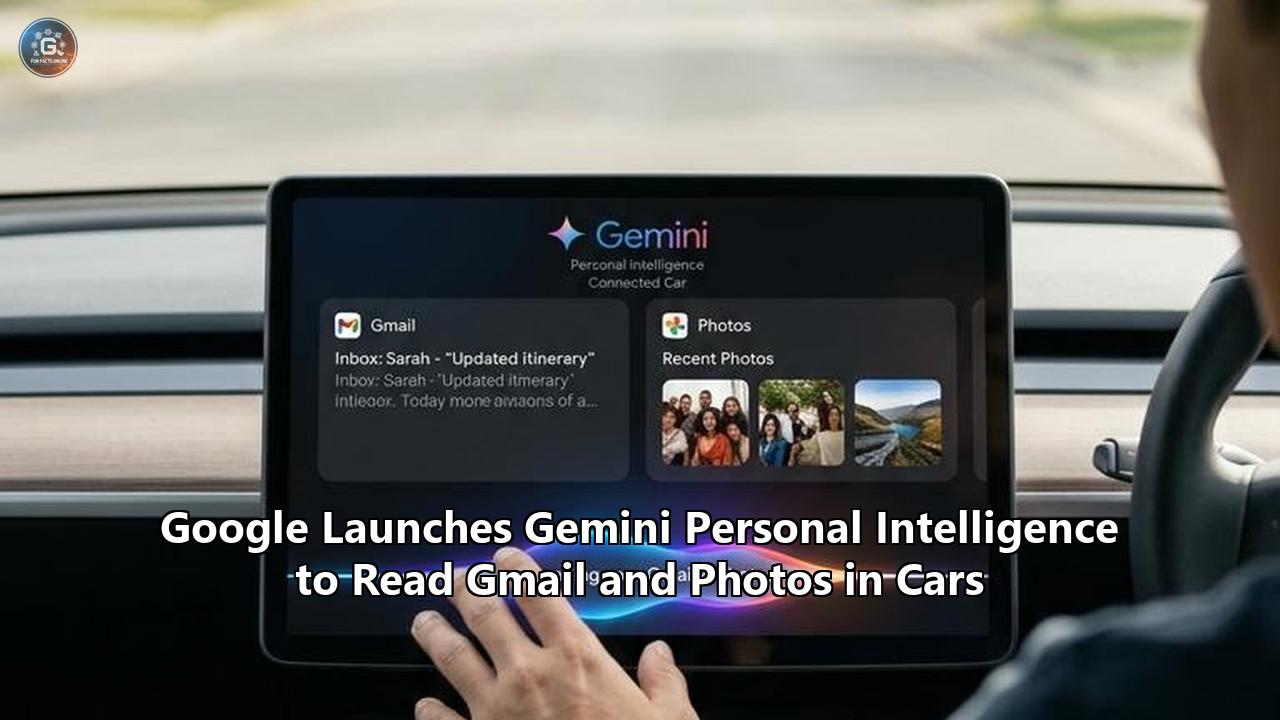
Google has begun rolling out Personal Intelligence for Gemini across vehicles equipped with Android Auto and Android Automotive OS, allowing its conversational artificial intelligence model to directly access and synthesize personal data stored within Gmail, Google Photos, Google Calendar, Google Maps, and YouTube. The feature, which first appeared in mobile and web environments earlier this year, expands the scope of in-cabin assistants from static vehicle controllers to contextual data brokers capable of retrieving unstructured personal records while a vehicle is in motion.
The rollout alters how drivers interact with their digital lives behind the wheel. Instead of requiring precise syntax or rigid commands, the system processes open-ended voice prompts that draw across multiple Google services simultaneously. A driver heading toward an airport terminal can ask, "What's my flight gate, and is my flight on time?" Gemini scans the user's Gmail inbox to extract the airline confirmation code and flight number, queries live flight-tracking data via Google Search, and returns a unified spoken response. Drivers can instruct the system to "take me to the car wash from the photo I took last week," prompting the model to parse visual contents and geographic metadata stored in Google Photos, extract the business's physical coordinates, and initialize a route in Google Maps.
The service is disabled by default, requiring drivers to opt in through Gemini settings on their mobile devices or web portals before vehicle activation occurs. Access is restricted to personal Google accounts belonging to individuals aged 18 and older. Commercial Google Workspace enterprise accounts are excluded from the initial deployment, and Google has geofenced the system away from the European Economic Area, the United Kingdom, Switzerland, and Nigeria due to stringent regional data protection frameworks.
The deployment of Google Gemini in cars marks an inflection point in automotive software design. For decades, in-vehicle infotainment systems have operated as isolated computation islands or dumb projection screens for mobile applications. By establishing a bidirectional bridge between a vehicle's hands-free audio system and a user’s private cloud storage, Google is attempting to solve the cognitive overload that occurs when drivers attempt to manage complex logistics while navigating highway traffic. Yet the technology also introduces technical challenges regarding retrieval latency, driver distraction, acoustic isolation in shared vehicle cabins, and long-term data privacy governance.
From Deterministic Commands to Contextual Cognition
To understand why this rollout represents an architectural shift, one must examine the operational mechanics of legacy vehicle voice systems.
+-----------------------------------------------------------------------------------+
|                           TRADITIONAL IN-VEHICLE VOICE ASSISTANT                  |
|                                                                                   |
|  [Voice Command] ---> [Speech-to-Text] ---> [Intent Parser] ---> [Predefined API] |
|   "Call John"          Deterministic         Slot-Filling         Executes dialer |
+-----------------------------------------------------------------------------------+
                                          vs.
+-----------------------------------------------------------------------------------+
|                         GEMINI PERSONAL INTELLIGENCE (LLM + RAG)                  |
|                                                                                   |
|  [Natural Query] ---> [Cloud LLM] ---> [Vector Retrieval]  ---> [Multi-Tool]      |
|  "Take me to the       Understands      Cross-references        Orchestrates      |
|   car wash from my     unstructured     Photos EXIF & Gmail     Maps, Search,     |
|   photo last week"     language         embeddings              and GPS Route     |
+-----------------------------------------------------------------------------------+
For more than a decade, in-vehicle voice interaction relied on deterministic natural language understanding (NLU). Systems like the original Google Assistant, Apple Siri, and proprietary telematics software from automakers functioned via slot-filling intent classification. When a user uttered a phrase, the system's automatic speech recognition (ASR) engine converted the acoustic waveform into a text string. The NLU engine then scanned that string for hardcoded intents—such as NavigateTo(Address), PlayTrack(SongTitle), or SendSMS(ContactName, Body).
Deterministic architectures possess three critical weaknesses inside an automobile:
- Syntactic Rigidity: If a driver failed to state the precise entity required by the software—for instance, saying "Take me to that doctor's office I visited last spring" instead of stating the street address or named contact—the intent parser returned a null error or triggered a generic web search.
- Contextual Isolation: Legacy systems could not cross-reference disparate data silos. A flight confirmation sitting in an email could not be merged on the fly with a real-time web scraping tool to yield an up-to-the-minute departure gate without manual screen intervention.
- Session Amnesia: Every command existed in isolation. If a driver said, "Find me a coffee shop," followed by, "Is the second one open late?", the assistant struggled to maintain multi-turn conversational state, treating the second utterance as a disconnected fragment.
Large language models (LLMs) fundamentally alter this paradigm through deep contextual reasoning. Instead of matching keywords against predetermined software hooks, Gemini models represent text and multimodal inputs within high-dimensional vector spaces. Within these spaces, concepts that share semantic meaning reside in close geometric proximity.
When Personal Intelligence is layered over this foundation, the AI ceases to be a simple voice controller. It acts as an autonomous query planner. When presented with an ambiguous, multifaceted request, the system decomposes the prompt into discrete programmatic sub-tasks:
- Identifying what personal data repository holds the missing context (e.g., Gmail, Photos, Calendar).
- Formulating internal database queries to fetch that specific context.
- Correlating the retrieved personal data with live external APIs (e.g., Google Maps Traffic, Flight Trackers).
- Synthesizing the final conclusion into concise, natural-sounding audio designed for safe auditory consumption at 65 miles per hour.
The practical result is a reduction in cognitive friction. Drivers no longer need to memorize a catalog of vehicle commands; they can converse with the vehicle using the same conversational shorthand they would use with a human passenger sitting in the navigator's seat.
Under the Hood: Multimodal Retrieval-Augmented Generation in the Cockpit
The engineering engine powering this system relies on Retrieval-Augmented Generation (RAG). In standard LLM deployments, a model's answers are constrained to its pre-trained parametric weights—the knowledge frozen inside the network at the time training concluded. To make an AI aware of what you ate for lunch, what your flight number is, or where you parked your car yesterday, the model must be augmented with non-parametric retrieval mechanisms that pull external data into the prompt context window at inference time.
Executing RAG across a user's entire digital footprint while maintaining the strict latency budgets demanded by a moving vehicle requires a complex, multi-tiered infrastructure.
The Vehicle-to-Cloud Pipeline
When a driver presses the push-to-talk button on their steering wheel or utters the wake phrase inside a vehicle running Android Auto or Android Automotive OS, an intricate chain of distributed computation unfolds:
+---------------------------------------------------------------------------------+
| VEHICLE CABIN                                                                   |
| [Microphone Array]                                                              |
|   | (Beamforming & Noise Cancellation)                                          |
|   v                                                                             |
| [Acoustic Stream Encoded: Opus/AAC]                                             |
+---------------------------------------------------------------------------------+
        |
        | Cellular Uplink (4G LTE / 5G SA: Sub-80ms Latency)
        v
+---------------------------------------------------------------------------------+
| GOOGLE CLOUD INFRASTRUCTURE                                                     |
| [Streaming Automatic Speech Recognition (ASR)]                                  |
|   |                                                                             |
|   v                                                                             |
| [Intent Decomposition & Query Planning Engine]                                  |
|   |                                                                             |
|   +---> Semantic Query ---> [Personal Knowledge Index (Vector Store)]           |
|   |                         - Gmail Embeddings                                  |
|   |                         - Photos Metadata & Visual Embeddings               |
|   |                         - Calendar Schedules                                |
|   |                                                                             |
|   +---> Tool Calling API -> [Live External Endpoints]                           |
|                             - Google Maps Geocoding Engine                      |
|                             - Search Flight Tracker Service                     |
|                             - Real-Time Traffic Routing                         |
|   |                                                                             |
|   v                                                                             |
| [Gemini Core Reasoning Model (Prompt + Retrieved Context Injection)]            |
|   |                                                                             |
|   v                                                                             |
| [Text-to-Speech (TTS) Neural Synthesizer]                                       |
+---------------------------------------------------------------------------------+
        |
        | Cellular Downlink (Audio Bitstream)
        v
+---------------------------------------------------------------------------------+
| VEHICLE CABIN                                                                   |
| [Head Unit DAC / In-Vehicle Infotainment Amplifier]                             |
|   |                                                                             |
|   v                                                                             |
| [Spoken Audio Output & Map Navigation Screen Update]                            |
+---------------------------------------------------------------------------------+
1. Acoustic Ingestion and Speech Processing
The vehicle’s cabin is an acoustically hostile environment characterized by tire slap, wind shear, powertrain hum, and passenger chatter. The car's microphone array uses digital signal processors (DSPs) to run spatial beamforming and acoustic echo cancellation (AEC). The cleaned audio is compressed via low-latency audio codecs (such as Opus) and streamed over the vehicle's cellular modem or connected smartphone link to Google's cloud edge servers.
2. Streaming Speech-to-Text
Cloud-based Conformer-style neural networks convert the audio bitstream into tokenized text in real time, anticipating words before the driver has even finished vocalizing their sentence.
3. Intent Decomposition and Query Planning
Once the transcript resolves, it is ingested by an orchestrator model. If the driver asks, "Find me an indoor restaurant along my route that matches my usual vibe," the orchestrator determines that this request cannot be resolved by standard web search alone. It creates a parallelized execution tree:
- Query sub-system A: Retrieve dining history, high-frequency restaurant searches, saved Google Maps lists, and dietary receipts found in Gmail.
- Query sub-system B: Calculate the vehicle's active GPS trajectory and upcoming freeway exits.
- Query sub-system C: Interrogate Google Places API for indoor seating availability, ratings, and operational hours.
4. Vector Retrieval Over Personal Data
Google’s infrastructure maintains encrypted vector indexes of the user’s personal data. Unstructured content—such as email bodies, flight receipts, calendar descriptions, and image labels—is transformed into high-dimensional vector embeddings using proprietary embedding models. When the user asks a question, the query itself is transformed into a vector. A nearest-neighbor search (such as Hierarchical Navigable Small World, or HNSW) scans the user's private index to identify documents with the highest cosine similarity to the query.
5. Context Injection and Inference
The retrieved snippets (e.g., a flight booking confirmation showing flight UA142 departing at 4:15 PM) are injected into the system prompt of the Gemini model alongside real-time flight tracking data. The model reasons over both texts simultaneously, synthesizing a concise answer: "Your flight, United 142, is on time. It departs at 4:15 PM from Gate B22. Do you want directions to the Terminal 1 parking garage?"
6. Low-Latency Neural Text-to-Speech (TTS)
The output tokens are streamed directly to a neural TTS engine. The synthesized voice response begins playing back through the vehicle’s audio speakers before the entire sentence has finished generating, shaving hundreds of milliseconds off perceived latency.
The Automotive Latency Budget
In consumer desktop computing, a two- or three-second latency delay between entering a prompt and receiving an AI response is acceptable. In a moving automobile, excessive latency degrades safety and usability. Human conversational dynamics dictate that pauses longer than 800 to 1,000 milliseconds feel unnatural and jarring; while driving, delays cause users to look down at their infotainment screens to verify whether the system crashed or failed to hear them.
| Processing Stage | Target Latency Budget | Engineering Strategy |
|---|---|---|
| Acoustic Capture & DSP | < 50 ms | On-device spatial beamforming, hardware noise suppression |
| Cellular Network Uplink | 30 – 80 ms | 5G Standalone (SA) / LTE Advanced priority bearer channels |
| ASR (Speech-to-Text) | 100 – 150 ms | Streaming encoder-decoder architectures with early emission |
| Vector Retrieval (RAG) | 80 – 120 ms | Distributed in-memory vector indexing over private cloud shards |
| LLM Time-to-First-Token | 200 – 350 ms | Speculative decoding, model quantization, optimized TPU clusters |
| Neural TTS Generation | 50 – 100 ms | Chunked streaming synthesis (audio begins on first token batch) |
| Cellular Network Downlink | 30 – 80 ms | Parallelized audio packet streaming to infotainment buffer |
| Total Round-Trip Latency | 540 – 930 ms | Sub-second execution designed to prevent screen-checking |
To meet this sub-second performance envelope, Google relies on model tiering. Heavyweight frontier models like Gemini 1.5 Pro are computationally too slow to handle iterative voice turns within a 700-millisecond window. Instead, in-cabin queries are routed through optimized, lower-latency variants such as Gemini Flash, which have been trained on task distillation and function-calling primitives specifically to output concise, structured responses at high token-per-second rates.
Decoding Visual Retrieval: Transforming Photo Pixels into Road Navigation
One of the most technically demanding elements of the Personal Intelligence integration is the ability to parse Google Photos to resolve navigation commands.
When a driver commands, "Take me to the car wash from the photo I took last week," the system cannot simply match text strings, because the photo itself may contain no explicit textual caption. The resolution requires a complex fusion of computer vision, temporal reasoning, metadata extraction, and geographic mapping.
+------------------------------------------------------------------------------------+
| QUERY: "Take me to the car wash from the photo I took last week"                   |
+------------------------------------------------------------------------------------+
                                           |
                                           v
+------------------------------------------------------------------------------------+
| STEP 1: TEMPORAL REASONING                                                         |
| System resolves "last week" against current system timestamp.                      |
| Formulates temporal filter: [Start_Date: T-7 days, End_Date: T-1 days]             |
+------------------------------------------------------------------------------------+
                                           |
                                           v
+------------------------------------------------------------------------------------+
| STEP 2: MULTIMODAL CANDIDATE FILTERING                                             |
| Queries user's Google Photos index:                                                |
|   - Visual Embeddings (Identifies imagery containing soapy brushes, vehicle bays)  |
|   - Optical Character Recognition (Reads signage: "Super Clean Wash")              |
|   - Semantic Tags (Labels assigned by backend visual classifiers)                  |
+------------------------------------------------------------------------------------+
                                           |
                                           v
+------------------------------------------------------------------------------------+
| STEP 3: GEOSPATIAL EXTRACTION & REVERSE GEOCODING                                  |
| Discovered photo contains EXIF GPS coordinates: 37.7749° N, 122.4194° W.          |
| Alternate fallback: If EXIF is stripped, runs visual landmarking or uses OCR       |
| business name cross-referenced with Google Maps Places database.                   |
+------------------------------------------------------------------------------------+
                                           |
                                           v
+------------------------------------------------------------------------------------+
| STEP 4: NAVIGATION INVOCATION                                                      |
| System hands resolved coordinates to Android Auto / AAOS navigation manager.       |
| Display renders route; audio confirms: "Navigating to Super Clean Auto Spa."       |
+------------------------------------------------------------------------------------+
The Computer Vision Layer
When photos are uploaded to Google Photos, they undergo background indexing by multimodal vision-language models (such as SigLIP or Gemini Vision architectures). These models compute high-dimensional feature representations of image content without requiring human tagging.
When the car-based query initiates:
- Semantic Filtering: The prompt's semantic vector (car wash) is compared against the visual embeddings of photos taken within the resolved temporal window. The model recognizes visual concepts—such as automated rotary brushes, high-pressure spray arches, or vehicle cleaning bays—even if the user never manually tagged the picture with the word "car wash."
- Optical Character Recognition (OCR): Concurrently, text detected within the image frames (such as store banners, logos, or printed receipts) is scanned via cloud OCR pipelines. If a photo displays a neon sign reading "Speedy Shine Wash," that text is extracted as a high-confidence entity.
The Geospatial Resolution Layer
Once candidate images are identified, the system must extract an actionable real-world destination. Digital cameras and modern smartphones typically append Exchangeable Image File Format (EXIF) metadata to image headers. If location permissions were active when the photo was snapped, the EXIF payload contains precise Global Navigation Satellite System (GNSS) data:
$$\text{Latitude: } 37^\circ 46' 29.9'' \text{ N}, \quad \text{Longitude: } 122^\circ 25' 10.1'' \text{ W}$$
If precise EXIF coordinates are missing—for instance, if the photo was taken indoors where GPS lock failed, or if the image was received through a messaging app that stripped EXIF data—the orchestrator executes a fallback pipeline:
- It extracts the business name identified via OCR ("Speedy Shine Wash").
- It pulls the coarse cellular tower or Wi-Fi positioning estimate recorded at the time of the upload.
- It interrogates the Google Maps Places API to cross-reference the business name with the user’s broad geographic area, confirming whether a matching establishment exists within practical driving range.
Once the coordinates are confirmed, they are injected directly into the vehicle's navigation stack via an Android Auto Intent or an Android Automotive OS native service hook. The driver never touches the center console; the vehicle transitions from an ambiguous memory to a turn-by-turn navigation route in a few seconds.
Safety Engineering and Driver Distraction: Cognitive Workload Under Scrutiny
Integrating deep, conversational AI into automobiles places Google directly inside one of the most contentious debates in automotive safety: the balance between voice automation and driver distraction.
The National Highway Traffic Safety Administration (NHTSA) categorizes driver distraction into three distinct domains:
- Visual Distraction: Taking eyes off the road.
- Manual Distraction: Taking hands off the steering wheel.
- Cognitive Distraction: Taking mental focus away from the task of driving.
Automotive interface guidelines, including NHTSA’s Visual-Manual Driver Distraction Guidelines, established the empirical "Two-Second Rule." Any interaction that pulls a driver’s visual attention away from the forward roadway for glances lasting longer than two seconds—or for an accumulated total of more than twelve seconds across a complete task cycle—dramatically elevates the statistical probability of a collision.
VISUAL-MANUAL INTERACTION (Phone or Complex Screen Menus):
[ Eyes on Road ] ---> [ Glance to Screen (1.8s) ] ---> [ Eyes on Road (0.5s) ] ---> [ Glance to Screen (2.2s) ]
                      *HIGH ACCIDENT RISK ZONE (Exceeds 2-second threshold)*

CONVERSATIONAL AI INTERACTION (Gemini Voice Interface):
[ Eyes on Road ] ------------------------------------------------------------------> [ Eyes on Road ]
[ Cognitive Listening / Auditory Processing: Cognitive tunnel risk if complex ]
By allowing drivers to surface deep information via conversational voice commands, Google Gemini in cars eliminates visual and manual distraction vectors. A driver who would previously have pulled over—or, more dangerously, attempted to scroll through their phone's camera roll or search their email inbox while waiting at a red light—can now execute the entire retrieval hands-free.
The Cognitive Tunneling Dilemma
While visual and manual burdens decrease, human factors researchers warn of a secondary phenomenon known as cognitive tunneling or auditory distraction.
When a human engages in a complex cognitive task—such as listening to an assistant read through an intricate email thread, reconciling conflicting calendar times, or evaluating nuanced restaurant recommendations—their brain reallocates metabolic and neurological resources away from visual processing. Even if the driver's eyes remain fixed directly on the windshield, their effective visual field narrows.
Research conducted by the AAA Foundation for Traffic Safety and human factors scientist Dr. David Strayer at the University of Utah has repeatedly demonstrated that voice-based interfaces are not cognitive free passes:
- Category Ratings of Distraction: The Strayer cognitive workload scale grades in-vehicle tasks from Category 1 (listening to the radio; minimal distraction) to Category 5 (imposing extreme cognitive load equivalent to solving mathematical puzzles under time pressure). Simple voice commands typically score around Category 2. However, conversational systems that require users to process complex auditory structures, verify detailed data points, or correct misheard instructions rapidly escalate to Category 3 or Category 4.
- Latent Inattention: Drivers experiencing elevated cognitive load show diminished brain activity in the parietal and visual cortexes. They exhibit "looked-but-failed-to-see" events, failing to perceive pedestrians entering crosswalks, brake lights illuminating ahead, or subtle changes in highway lane markers.
- The Voice Correction Loop: The most severe cognitive spikes occur when an AI system misunderstands a command or hallucinates a detail. If a driver asks Gemini for their flight gate, and the system misidentifies the airline or reads details from a past trip, the driver must shift into diagnostic mode: diagnosing why the AI failed, formulating an alternative command, and listening critically to detect errors. This interactive loop imposes far higher mental workloads than simple manual controls.
The Hallucination Liability Boundary
Large language models are inherently probabilistic; they generate text based on statistical token likelihood rather than deterministic truth verification. In consumer productivity software, an occasional hallucination is an inconvenience. In an automotive environment, where split-second decisions occur at high speeds, inaccurate information carries elevated real-world risks.
If Gemini incorrectly hallucinates a business’s operating status, routes a low-clearance commercial vehicle under a low bridge, or provides an incorrect gate number that induces panic and erratic lane changes, who bears the liability?
Google addresses this risk by embedding explicit liability boundaries within its documentation and platform safeguards. The company explicitly warns that Gemini "can hallucinate" and should not be relied upon for critical, safety-related vehicle operations.
Furthermore, the system’s execution parameters are ring-fenced. While Gemini can suggest navigation paths, adjust cabin climate, or cue media, it is strictly decoupled from the vehicle's safety-critical Controller Area Network (CAN-bus) and dynamic control layers. Gemini cannot execute steering inputs, alter braking thresholds, or disable advanced driver assistance systems (ADAS). The AI operates strictly as an informational overlay, leaving the human driver legally and operationally responsible for vehicle trajectory and environmental monitoring.
In-Cabin Privacy: Shared Cabins, Biometric Blind Spots, and Cloud Retention
The introduction of Personal Intelligence into the automotive space shatters a fundamental assumption of consumer tech privacy: the premise of the single-user interface.
Smartphones and laptops are deeply personal, single-tenant devices. They rarely leave our hands, and their displays are shielded by biometrics like Face ID or fingerprint sensors.
A vehicle, by contrast, is a communal, multi-tenant environment. A driver frequently shares the cabin with romantic partners, children, colleagues, friends, or rideshare passengers. By granting an in-vehicle assistant permission to vocalize contents extracted from personal inboxes, private photo albums, and calendar entries, the boundary between private digital storage and public physical environments becomes blurred.
+-----------------------------------------------------------------------------------+
|                           THE MULTI-TENANT CABIN CONUNDRUM                        |
|                                                                                   |
|  [Driver]                  [Passenger / Coworker]            [Child in Back Seat] |
|     |                               |                                 |           |
|     +-------------------------------+---------------------------------+           |
|                                     |                                             |
|                              (Shared Airspace)                                    |
|                                     |                                             |
|                                     v                                             |
|                       [In-Vehicle Microphone Array]                               |
|                                     |                                             |
|                                     v                                             |
|                            [Google Gemini Engine]                                 |
|                                     |                                             |
|       Does it verify who is speaking before retrieving sensitive data?             |
|                                     |                                             |
|                  +------------------+------------------+                          |
|                  |                                     |                          |
|                  v                                     v                          |
|      [VOICE MATCH VERIFIED]               [NO BIOMETRIC ENFORCEMENT]              |
|     Restricts access strictly to         CURRENT STATE: Any cabin occupant        |
|     the authenticated driver's           can trigger queries that surface         |
|     private digital repositories.        personal emails or calendar items.|
+-----------------------------------------------------------------------------------+
The Acoustic Isolation Problem
Google’s own support documentation clarifies the limitations of the current rollout: Gemini inside Android Auto is accessible to anyone speaking within the cabin, including children or guests, and does not strictly restrict responses based on distinct acoustic user profiles during hands-free driving sessions.
This limitation introduces acute privacy risks:
- Inadvertent Eavesdropping: If an executive carpools with a junior colleague, and asks Gemini to "read my upcoming calendar details," the system may recite sensitive executive meetings, compensation reviews, or merger discussions aloud over the vehicle's speakers.
- Unauthorized Interrogation: A passenger could verbally prompt the vehicle to "Read the last email from my spouse" or "What photos were taken in Las Vegas last weekend?" If the car's head unit is paired to the driver's phone, the system can parse the driver's private cloud archive and output personal details to everyone in the vehicle.
- Age-Inappropriate Content Leakage: Support documentation notes that children occupying the rear seats may issue queries or overhear system outputs containing mature, non-age-appropriate content drawn from email digests or web search summaries.
To mitigate these risks without breaking the hands-free driving experience, Google will need to enforce strict on-device Voice Match biometrics within the vehicle environment. Such systems utilize deep neural networks to extract a speaker’s acoustic embedding—their unique vocal tract signature—and compare it against an authorized template before authorizing RAG queries that reach into personal data stores.
Until voice biometrics are enforced across every in-car interaction, drivers using Personal Intelligence must weigh the convenience of hands-free inbox parsing against the privacy realities of a shared cabin.
The Data Governance and Retention Architecture
For users who choose to enable Personal Intelligence, Google has implemented an opt-in permissions framework configured via mobile device settings under Settings > Personal Intelligence > Connected Apps. Drivers retain granular control to toggle access on or off for individual service pillars:
[x] Google Workspace (Gmail, Google Calendar)
[x] Google Photos
[x] Google Maps & Saved Places
[ ] YouTube & Media History
However, opting in involves significant telemetry tradeoffs governed by Google's broader Gemini Apps Privacy Notice:
- The "Keep Activity" Prerequisite: Google’s technical prerequisites specify that Personal Intelligence cannot function if a user’s account-level "Gemini Apps Activity" setting is disabled. Drivers seeking ephemeral, non-recorded conversational sessions cannot use personal RAG features.
- Human Annotation Pipelines: To improve the quality, accuracy, and safety of the Gemini model family, Google routes a subset of user conversational interactions to human reviewers. Although Google de-identifies these transcripts—stripping them of associated Google Account IDs before human annotators read or analyze them—the underlying text may still contain personal details explicitly uttered by the driver during conversational queries (e.g., names, specific addresses, medical appointments).
- Multi-Year Data Lifespans: Once a conversation transcript has been flagged, processed, and reviewed by human annotators, it is detached from the user's primary account management dashboard. These reviewed records are retained within Google's machine learning evaluation pipelines for up to three years, and they are not excised even if the user subsequently purges their personal "Gemini Apps Activity" history. If a user operates with "Keep Activity" turned off, conversational data is still retained by Google’s production systems for a baseline window of 72 hours to ensure system stability and fulfill response generation pipelines.
This retention model contrasts sharply with the localized privacy models advocated by privacy-focused hardware vendors, raising important questions about the long-term trade-offs of deploying Google Gemini in cars.
The Transatlantic Regulatory Gulf: Why European Drivers Are Excluded
A notable aspect of Google's launch is its strict geographic boundaries. The initial rollout of Personal Intelligence for Gemini in vehicles is available in the United States and selected international regions, but it is explicitly unavailable across the European Economic Area (EEA), the United Kingdom, Switzerland, and Nigeria.
This exclusion is not an accidental technical oversight; it is a calculated response to Europe’s rigorous legal and regulatory environment governing consumer data privacy, corporate platform dominance, and artificial intelligence.
+-------------------------------------------------------------------------------------+
|                      THE REGULATORY HURDLES BLOCKING GEMINI IN EUROPE               |
|                                                                                     |
|   GDPR (General Data Protection Regulation)                                         |
|   - Purpose Limitation (Article 5): Combining email + photos + driving data.        |
|   - Special Category Data (Article 9): Accidental processing of medical info.       |
|   - Human Review Scrutiny: Cloud logging of voice data for model retraining.        |
|                                                                                     |
|   DMA (Digital Markets Act)                                                         |
|   - Article 6(5): Self-Preferencing prohibitions.                                   |
|   - Pre-installing and bundling Google Workspace directly into Android Auto.        |
|                                                                                     |
|   EU AI ACT                                                                         |
|   - Real-world deployment transparency requirements.                                |
|   - Emotion, cognitive strain, and biometric identification compliance barriers.   |
+-------------------------------------------------------------------------------------+
1. General Data Protection Regulation (GDPR) Obstacles
The European Union’s GDPR establishes some of the world's most stringent legal standards for data processing, several of which conflict with the mechanics of cross-application RAG systems:
- Purpose Limitation (Article 5(1)(b)): Under GDPR, personal data collected for one explicit, legitimate purpose cannot be repurposed for incompatible functions. When an individual uses Gmail, the data is collected to facilitate digital correspondence. Utilizing that correspondence to train, ground, or augment an autonomous conversational agent in an automobile requires an airtight legal basis—typically unambiguous, freely given, explicit consent.
- Special Category Data (Article 9): Medical appointments, political affiliations, union memberships, and religious activities often reside within Gmail messages, calendar invites, and personal photo albums. Processing these "special categories of data" is prohibited under GDPR unless strict exceptions are met. If a driver asks Gemini to navigate to an appointment, the system may inadvertently process health-related data (e.g., an appointment at an oncology clinic) without having established the specialized processing protections required by European supervisory authorities.
- Data Protection Impact Assessments (DPIAs): European regulators, such as Ireland’s Data Protection Commission (DPC) and France’s CNIL, require tech platforms to submit exhaustive DPIAs before launching AI services that process high-risk personal data at scale. The risk of human reviewers inspecting unredacted voice transcripts poses a substantial compliance barrier under European audit frameworks.
2. The Digital Markets Act (DMA)
Designated as a digital "gatekeeper" under the European Union’s Digital Markets Act, Alphabet faces strict statutory constraints designed to foster competition:
- Self-Preferencing Prohibitions (Article 6(5)): Gatekeepers are barred from treating their own services and products more favorably in ranking or system integration than equivalent third-party services. By natively integrating Gmail, Google Photos, and Google Maps into the vehicle’s operating stack, Google risks accusations of anti-competitive bundling. Third-party email providers (like ProtonMail or Microsoft Outlook) or competing mapping applications could argue that Google is leveraging its Android Auto monopoly to foreclose competition in the vehicle cabin.
- Cross-Service Data Siphoning (Article 5(2)): The DMA strictly forbids gatekeepers from combining personal data obtained from a core platform service with personal data collected from other services without presenting the user with a neutral, explicit choice screen. Implementing these compliance checks within the constrained interface of an in-dash car infotainment display is a legal and design challenge.
3. The European Union AI Act
The phased enactment of the European Union AI Act introduces another layer of compliance oversight. The AI Act categorizes artificial intelligence systems by their potential societal risk. Systems deployed within physical transportation infrastructure face scrutiny regarding transparency, risk management, and output validation.
Given Gemini's known propensity to hallucinate, deploying an ungrounded model that parses private records while advising drivers on road maneuvers creates regulatory friction that Google’s legal teams opted to sidestep by temporarily geofencing European users out of the rollout.
Ecosystem Economics: Tech Platforms, Automakers, and the Battle for the Dashboard
The automotive cockpit has become one of tech's fiercest battlegrounds. Drivers spend hundreds of hours inside their vehicles each year, transforming the center console into a high-value consumer touchpoint for software subscriptions, location-based commerce, and digital ecosystem lock-in.
The rollout of Personal Intelligence highlights the divergent technical approaches across the automotive landscape.
+------------------------------------------------------------------------------------+
|                         THE THREE CABIN ARCHITECTURAL CAMPS                        |
+------------------------------------------------------------------------------------+
| 1. PHONE PROJECTION (ANDROID AUTO / APPLE CARPLAY)                                 |
|    - Infotainment acts as a remote display client; computation on mobile device.   |
|    - Low hardware integration; zero CAN-bus sensor telemetry access.              |
+------------------------------------------------------------------------------------+
| 2. EMBEDDED TECH PLATFORMS (ANDROID AUTOMOTIVE OS / GOOGLE BUILT-IN)               |
|    - Google OS runs natively on vehicle silicon (Polestar, Volvo, GM, Ford).       |
|    - Full integration: reads battery status, adjusts climate, deep voice control.  |
+------------------------------------------------------------------------------------+
| 3. WALLED-GARDEN OEM PROPRIETARY PLATFORMS (TESLA, MERCEDES MB.OS)                 |
|    - Automakers reject Google/Apple to maintain 100% data ownership.               |
|    - Build bespoke LLM architectures, monetizing recurring service revenue.        |
+------------------------------------------------------------------------------------+
The Three Architectural Camps
1. Phone Projection (Android Auto / Apple CarPlay)
In this framework, the vehicle’s infotainment head unit acts as an external monitor running a remote display protocol (via Wi-Fi or USB). The computational heavy lifting, cellular communications, and AI execution reside on the driver’s smartphone.
This model offers broad compatibility across millions of legacy vehicles, but it suffers from low hardware integration. The projection layer cannot easily read real-world vehicle sensors, such as dynamic battery degradation, tire pressure warnings, or mechanical diagnostic faults.
2. Embedded Operating Systems (Android Automotive OS / Google Built-in)
Pioneered by automakers like Polestar, Volvo, General Motors, Ford, and Honda, Android Automotive OS (AAOS) embeds Android directly into the vehicle’s dashboard silicon.
In these vehicles, Gemini is not an app streamed from a phone; it is the vehicle's native operating environment. It has direct access to the vehicle's internal networks, allowing the AI to integrate personal data with vehicle telemetry.
A single command like, "Take me to my sister's wedding," can prompt Gemini to fetch the venue address from a Gmail invite, check the vehicle’s current 42% battery charge level, analyze topographical elevation changes along the route, calculate aerodynamic drag, and automatically insert an optimal 20-minute fast-charging stop along the way.
3. Bespoke OEM Operating Systems (Tesla, Mercedes-Benz, Ferrari)
A minority of automakers have explicitly rejected Google built-in to retain ownership over their software stacks and customer relationships:
- Tesla: Uses a proprietary, Linux-based operating system. Tesla completely rejects Android Auto and Apple CarPlay, relying on its own neural network-based vision pipelines, native routing, and proprietary infotainment software.
- Mercedes-Benz: Developing MB.OS, an architecture built alongside partners like NVIDIA. Mercedes integrates Microsoft Azure OpenAI service endpoints to power its own conversational agents, seeking to protect its brand cachet from being subsumed by Silicon Valley tech giants.
- General Motors: In a controversial move, General Motors phased out Apple CarPlay and Android Auto projection in its next-generation electric vehicles (starting with the Chevrolet Blazer EV), steering customers toward an embedded Google built-in system. GM's strategy is driven by software economics: by controlling the native operating stack, GM aims to capture high-margin software subscriptions, in-car commerce transactions, and targeted user services over the lifetime of the vehicle.
The Monetization Endgame: Turning Mobility into a Service Pipeline
Why are tech giants expending massive engineering resources to teach in-car assistants to parse personal emails and photos? The answer lies in consumer lifetime value (LTV) and ecosystem lock-in.
The traditional automotive business model—selling a physical metal chassis once every seven years—is evolving toward recurring monthly subscriptions. Automakers and tech platforms want to monetize vehicles long after they roll off dealership lots.
+------------------------------------------------------------------------------------+
|                               THE SUBSCRIBER MOAT                                  |
|                                                                                    |
|  [Hardware: Vehicle] ---> [OS: Android Automotive] ---> [AI: Gemini Personal Intel]|
|                                                                 |                  |
|                                                                 v                  |
|                                                     [Google One AI Premium]        |
|                                                     Recurring Monthly Subscription |
|                                                     Consumer Retention Moat        |
+------------------------------------------------------------------------------------+
By embedding Personal Intelligence into the daily commute, Google creates an ecosystem moat. A consumer who relies on Google Gemini in cars to manage their daily routine, navigate to meetings, surface flight logistics, and parse their travel photos becomes far less likely to abandon the Google ecosystem. Migrating to an alternative platform like Apple iOS or open-source solutions would mean losing these integrated, hands-free automotive conveniences.
Furthermore, as advanced AI reasoning features become more computationally expensive, access to these systems is increasingly tied to premium subscription tiers, such as the Google One AI Premium plan. The vehicle cabin is transforming from a traditional transit space into an active software subscription hub.
The Next Frontier: Agentic Vehicle Autonomy and Edge Silicon
The launch of Personal Intelligence represents the first phase of in-cabin conversational AI: the Informational Retrieval Phase. The assistant acts primarily as an auditory reader, summarizing and vocalizing data stored across disjointed clouds.
The industry is already moving toward the second phase: Agentic Autonomous Execution.
PHASE 1: INFORMATIONAL RETRIEVAL (Current Gemini Deployment)
User: "What's my flight gate?"
Gemini: "Your flight UA142 departs at 4:15 PM from Gate B22."

PHASE 2: AGENTIC WORKFLOW EXECUTION (The Emerging Horizon)
User: "I'm running 30 minutes late for my flight."
Gemini: - Autonomously parses Gmail ticket reservation.
        - Identifies airline rebooking API.
        - Checks seat availability on the 5:45 PM departure.
        - Calculates traffic delays and re-reserves airport parking.
        - Prompts driver: "I can rebook you on Flight 882 for $45. Confirm?"
In an agentic paradigm, the AI does not simply vocalize answers; it performs actions across external systems with minimal user intervention. If a driver running behind schedule says, "I'm going to miss my meeting with Sarah," an agentic assistant could autonomously scan the user's calendar, draft an apology email referencing the active GPS arrival estimate, send the message through Gmail, and reschedule the appointment for an open slot the following afternoon.
Executing this vision safely requires addressing key hardware and architectural challenges:
1. Hybrid Edge-Cloud Compute Architectures
Today's Personal Intelligence pipeline is heavily reliant on persistent cloud connectivity. If a vehicle enters a mountain tunnel, an underground parking structure, or a rural cellular dead zone, the assistant’s contextual retrieval breaks down completely.
To eliminate this vulnerability, the automotive sector is shifting toward hybrid edge-cloud processing. Modern automotive chipsets—such as the Qualcomm Snapdragon Cockpit Elite Platform and NVIDIA DRIVE Thor—feature dedicated Neural Processing Units (NPUs) delivering dozens of TOPS (Trillions of Operations Per Second) of INT4/INT8 compute.
These automotive NPUs can run small language models (SLMs), such as Gemini Nano, locally within the vehicle's dashboard. A localized SLM handles real-time vehicle commands, privacy-sensitive biometric processing, and offline semantic searches without transmitting data over cellular networks.
When complex external reasoning is required—such as parsing multi-year email archives or coordinating travel logistics—the edge model calls the cloud, blending offline resilience with cloud intelligence.
2. Deep In-Cabin Sensor Fusion
The integration of personal data with real-time in-cabin computer vision sensors opens new horizons for contextual safety. Modern vehicles are increasingly equipped with interior driver monitoring cameras (DMS) designed to track head pose, eye gaze vectors, and eyelid closure rates for signs of drowsiness or distraction.
An intelligent assistant integrated with the vehicle's DMS could dynamically modulate its conversational pacing based on the driver's real-time cognitive state:
- If the DMS detects the driver's eyes scanning heavy merge traffic or navigating severe weather, Gemini could defer incoming email notifications and silence conversational interruptions.
- If the DMS detects early signs of driver microsleep or fatigue, the assistant could step in, offering spoken interaction, locating nearby rest stops, or suggesting coffee locations drawn from the user’s personal saved maps.
Milestones to Watch
As Google scales Personal Intelligence across Android Auto and the broader automotive landscape, three milestones will determine whether this technology becomes standard automotive infrastructure or an experimental detour:
- Resolution of Cabin Biometrics: Whether Google introduces localized voice-print isolation to prevent passengers and unauthorized occupants from accessing the driver's private email records and photo archives.
- European Regulatory Settlement: How Alphabet modifies the underlying data flow and self-preferencing parameters to satisfy the European Data Protection Board and the European Commission, opening the door for deployment across EU markets.
- Automaker Software Coexistence: Whether legacy automakers continue to yield their dashboard real estate to tech giants, or whether mounting competitive tensions prompt them to build their own bespoke, localized AI architectures.
Google's deployment of Personal Intelligence within the vehicle cockpit demonstrates that consumer AI is no longer confined to smartphones and desktop browsers. By bridging private data stores with real-time transit environments, conversational models are reshaping how we interact with information on the road. The modern automobile is no longer just a piece of transportation hardware; it is rapidly transforming into a physical computing environment that moves with you.
Reference:
- https://9to5google.com/2026/10/20/gemini-android-auto-personal-intelligence/
- https://www.youtube.com/watch?v=jB8nJAFA7ec
- https://www.pcmag.com/news/android-auto-gets-gemini-personal-intelligence-heres-how-it-can-help
- https://www.tomsguide.com/ai/google-gemini-just-got-a-major-upgrade-for-your-car-and-it-could-make-your-daily-drives-a-whole-lot-easier
- https://www.notebookcheck.net/Gemini-in-Android-Auto-can-now-use-your-Gmail-and-Calendar.1429991.0.html
- https://blog.google/products-and-platforms/platforms/android/android-auto-cars-with-google-built-in-gemini-personal-intelligence/
- https://www.androidcentral.com/apps-software/android-auto/personal-intelligence-hits-the-road-google-gemini-rollout-android-auto