The grand galleries of the Château de Versailles have witnessed many epoch-defining alliances, but the agreement finalized there this week marks a fundamentally modern shift in the geopolitical balance of power. At the ninth annual "Choose France" investment summit, hosted by French President Emmanuel Macron, foreign investors pledged a record-breaking €93 billion ($101 billion) to fund the country's industrial and technological future.
Dwarfing all other announcements was a colossal commitment from Japanese technology conglomerate SoftBank Group Corp.. Led by its visionary and high-conviction founder, Masayoshi Son, SoftBank pledged up to €75 billion ($87 billion) to construct a massive network of artificial intelligence computing clusters across France.
At full capacity, the planned 5-gigawatt (GW) complex will consume as much electricity as five standard nuclear power plants—approaching the peak power demand of New York City. It is the largest single AI infrastructure investment SoftBank has ever made outside the United States.
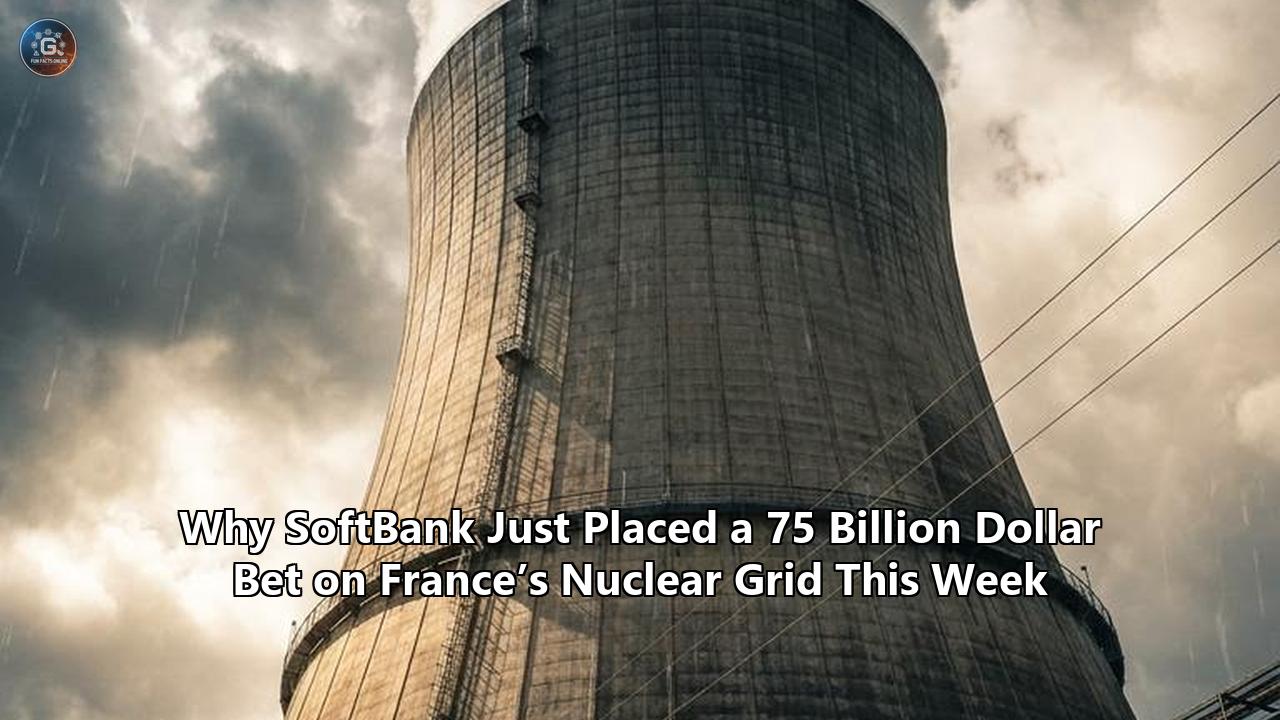
Yet, this is not merely a story about data centers or silicon chips. It is a story about the raw, uncompromising physics of the AI age. At its core, SoftBank’s massive layout is a strategic bet on France's state-owned, nuclear-powered electricity grid.
As generative AI models grow exponentially larger, the tech sector's primary bottleneck is no longer algorithm design or venture capital; it is continuous, low-carbon electricity. By anchoring its European AI infrastructure directly to France’s 56-reactor nuclear fleet, SoftBank is attempting to solve the energy crisis currently crippling the expansion of artificial intelligence in the United States and the United Kingdom.
To understand how this blockbuster deal came together, one must trace a timeline of mounting gridlock, geopolitical disruption, and a quiet diplomatic courtship that culminated in this week's historic announcement.
The Gathering Storm (2023–Mid-2025): The Global AI Power Bottleneck
To trace the origin of SoftBank's French expansion, we must first look to the physical limits that began strangling the AI boom in late 2023 and throughout 2024.
When OpenAI released ChatGPT, it kicked off a global arms race among tech giants to build ever-larger Large Language Models (LLMs). But while training a model requires substantial computational burst, keeping these models alive to handle billions of daily queries—known as inference—demands a constant, uninterrupted river of electricity.
The Exponential Curve of Data Center Power Demand
By mid-2024, the energy mathematics of artificial intelligence became alarmingly clear. A single AI-driven search query consumes up to ten times more electricity than a traditional Google search. Furthermore, the latest generation of AI-optimized servers, packed with power-hungry Nvidia H100s and Blackwell chips, require up to 40 to 100 kilowatts per rack—a massive jump from the 5 to 10 kilowatts consumed by standard cloud computing racks.
In the United States, the traditional homeland of tech infrastructure, the power grid began to buckle under the strain:
- Northern Virginia, the data center capital of the world, saw its utility company, Dominion Energy, warn developers that connection queues for new data centers could face delays of up to six years due to transmission constraints.
- In Ohio, where SoftBank had backed a massive 10GW data center project, developers ran into a stark reality: the local grid simply could not supply the necessary energy. To feed the facility, SoftBank had to plan a parallel $33 billion investment to construct a dedicated, 9.2GW natural gas turbine power plant.
- In the United States overall, the Department of Energy was forced to allocate $1.9 billion in emergency funding just to upgrade existing transmission lines, yet grid connection queues remained hopelessly backlogged.
The British Warning Sign: The Shelving of "Stargate"
The energy crisis reached a critical turning point in late 2025 when OpenAI was forced to indefinitely shelve its planned flagship project, code-named "Stargate". Originally envisioned as a massive computing facility in Northeast England, the project was killed by two compounding factors: the UK's exorbitant industrial electricity costs—which ran more than four times higher than U.S. rates—and a heavily congested National Grid that could not promise timely connections.
This high-profile collapse sent shockwaves through the technology investment landscape. It proved that without a reliable, sovereign, and competitively priced energy supply, even the most well-funded AI ambitions would grind to a halt. Masayoshi Son, who has positioned SoftBank to sit at every level of the AI value chain—from chip design via Arm Holdings to frontier models via a 13% stake in OpenAI—realized that the bottleneck of the future was the power grid.
This realization turned the Japanese conglomerate’s attention toward alternative, energy-secure geographies, establishing the foundation for a significant SoftBank nuclear investment thesis.
The Geopolitical Pivot (Late 2025–Early 2026): Escaping Gulf Volatility
As U.S. and European grids struggled to adapt, global AI capital initially looked to the Middle East. With vast sovereign wealth funds and an eager desire to transition away from fossil-fuel-dependent economies, nations like the United Arab Emirates pitched themselves as the ultimate host for the physical infrastructure of artificial intelligence.
By late 2025, SoftBank had actively begun planning a 5GW data center project in Abu Dhabi. The region offered flat desert land, massive capital backing, and ambitious plans to build solar-to-gas hybrid grids.
The Closure of the Strait of Hormuz
However, the geographic calculations of global tech infrastructure are highly sensitive to geopolitical instability. In late 2025 and early 2026, escalating regional conflicts in the Middle East severely disrupted these plans.
As global oil prices surged past $100 a barrel, key shipping lanes—most notably the Strait of Hormuz—faced prolonged closures. The threat of kinetic attacks on critical physical infrastructure, coupled with supply chain disruptions that delayed the import of high-end silicon and cooling systems, forced institutional investors to reassess their risk profiles.
For Masayoshi Son, the Middle Eastern disruption was a clarifying moment. An AI cluster running critical, sovereign enterprise data cannot afford even a millisecond of downtime, let alone the existential risk of regional war. To scale his global AI ecosystem, Son needed a geography that offered three non-negotiable characteristics:
- Political and regulatory stability within a major democratic framework.
- Abundant, continuous, non-fluctuating "baseload" electricity that did not rely on weather-dependent solar or wind.
- Extremely low carbon intensity to satisfy the strict ESG (Environmental, Social, and Governance) mandates of Western tech clients and European Union regulators.
Only one country in the Western hemisphere fit this description perfectly: France.
The Catalyst (April 2026): A Private Dinner in Tokyo
While SoftBank was navigating global gridlocks and geopolitical pivots, French President Emmanuel Macron was executing a highly calculated, multi-year industrial strategy.
Since taking office in 2017, Macron has consistently pursued pro-business policies designed to reverse France's decades-long deindustrialization. Through tax cuts, labor reforms, and the creation of the annual "Choose France" summit, Macron sought to position France as the premier European destination for high-tech manufacturing and foreign capital.
Leveraging the Nuclear Advantage
As the AI boom took hold, Macron’s administration recognized that France possessed a unique competitive advantage: its historical commitment to nuclear energy.
Following the oil shocks of the 1970s, France had rapidly constructed a vast fleet of pressurized water reactors, producing roughly 70% of its electricity from nuclear fission. This made France the largest net exporter of electricity in Europe, with industrial power prices that were consistently half of those found in the UK and Germany.
Average European Industrial Electricity Prices (Relative Scale)
============================================================
United Kingdom:  [██████████████] (Highest - High natural gas reliance)
Germany:         [██████████]       (High - Post-nuclear phase-out)
France:          [████]              (Lowest - Abundant nuclear baseload)
============================================================
In early April 2026, President Macron traveled to Japan on an official diplomatic visit. The crown jewel of his itinerary was a private dinner in Tokyo with Masayoshi Son.
According to sources familiar with the meeting, Macron did not just pitch France as a general investment destination. Instead, he presented Son with a highly detailed, technical blueprint of the French electrical grid, highlighting its capacity to absorb massive, continuous power draws without risking stability.
Macron’s pitch transformed what could have been a standard infrastructure deal into a direct SoftBank nuclear investment thesis. He highlighted several key components:
- The Nuclear Baseload: France’s grid could provide guaranteed, 24/7 carbon-free electricity, completely avoiding the intermittent generation issues of solar and wind.
- Fast-Tracked Permitting: The French government would designate major AI data center developments as "projects of national interest," cutting through standard bureaucratic red tape and bypassing the lengthy environmental litigations that stall U.S. grid connections.
- State-Backed Security: The French state-owned utility, Électricité de France (EDF), would work directly with SoftBank to identify decommissioned industrial sites already connected to high-voltage transmission lines, saving years in construction timelines.
To sweeten the proposal, Macron introduced Son to Bernard Fontana, whom Macron had appointed as Chairman and CEO of EDF in May 2025. Fontana's mandate was simple: accelerate the construction of France's next-generation EPR2 nuclear reactors while maximizing the economic utility of France's existing grid assets.
The Tokyo dinner succeeded. Son was convinced. The machinery of both the French state and the Japanese investment giant immediately began moving at an unprecedented pace.
The Escalation and Partnership Framework (May 2026): Forging the Alliances
In the weeks following the Tokyo dinner, teams of engineers, lawyers, and financial analysts from SoftBank, EDF, and French engineering titan Schneider Electric worked round-the-clock to turn a high-level conceptual agreement into a legally binding reality.
Rather than building a single, massive, vulnerable mega-facility, SoftBank opted for a decentralized, highly resilient cluster network across the northern French region of Hauts-de-France. This region was strategically selected for its abundant land, its historically strong industrial workforce, and its immediate proximity to the core economic hubs of Northern Europe, including Paris, London, Brussels, Amsterdam, and Frankfurt.
         [ London ]          [ Amsterdam ]
             \                    /
              \                  /
               * [ Dunkirk ]    /
              /   (Loon-Plage) /
             /                /
     [ Bosquel ] -------- [ Bouchain ]
            \                /
             \              /
              \            /
                [ Paris ]
The execution plan focused on three primary sites, each serving a unique role in the overarching network, and representing a major milestone in this SoftBank nuclear investment journey:
1. Bouchain: Repurposing Fossil Fuel Infrastructure
In late May 2026, EDF announced that it had selected SoftBank as the preferred bidder to design, construct, and operate a 400-megawatt (MW) AI data center on the site of its former thermal power plant in Bouchain, Northern France.
The Bouchain site was highly symbolic. Once home to a massive coal-fired plant that went offline in 2015, the site still retained its direct, high-capacity connection to the national high-voltage transmission grid.
By leasing this site from EDF, SoftBank bypassed the single most time-consuming step in data center development: securing grid connection rights.
EDF's CEO, Bernard Fontana, noted the strategic value of the project, stating:
"The project selected for the Bouchain site demonstrates France's ability to host large-scale digital infrastructure, supported by competitive, sovereign, and low-carbon electricity. It reflects EDF's commitment to selecting projects that combine industrial excellence and environmental standards while giving a new purpose to our former industrial sites."
2. Bosquel: The 1-Gigawatt "AI Factory" Joint Venture
Simultaneously, SoftBank finalized a majority-owned joint venture with Sesterce, an emerging French AI infrastructure specialist. Together, the companies announced the development of a massive 1-GW AI data center campus in the commune of Bosquel.
Designed by the renowned architectural firm Patriarche, the Bosquel campus is envisioned as a sovereign "AI Factory" designed specifically for the extreme thermal and electrical demands of next-generation generative models.
To secure local political support, the joint venture pledged a €10 million ($11.6 million) endowment fund to build a community center, host educational programs, and support AI training initiatives for local students and businesses.
Youssef El Manssouri, CEO and co-founder of Sesterce, described the partnership as a historical turning point:
"This partnership with SoftBank represents a defining moment for Sesterce and for the future of sovereign AI infrastructure in Europe. Together, we believe Bosquel has the potential to become a flagship AI Factory, combining energy, compute, and execution at the scale required by the next generation of artificial intelligence."
3. Dunkirk (Loon-Plage): The Vertical Integration Hub
The third pillar of the network was established at the Port of Dunkirk (Loon-Plage). Here, SoftBank partnered with Schneider Electric, a global leader in energy management and industrial automation, to build a heavily integrated industrial cluster.
The Dunkirk hub will feature two parallel, state-of-the-art facilities:
- One facility, operated directly by SoftBank, will manufacture specialized, high-durability server enclosures and cooling racks.
- A second facility, operated by Schneider Electric, will manufacture prefabricated, modular data center power systems.
By vertically integrating its supply chain right at the deep-water port of Dunkirk, SoftBank can manufacture, assemble, and deploy modular AI data center blocks at scale, completely bypassing the global supply chain bottlenecks that have delayed U.S. data center buildouts by years.
The Breaking Moment (This Week): The Blockbuster Announcement at Versailles
On May 31, 2026, the diplomatic, industrial, and financial pieces of the puzzle fell into place. As corporate leaders and global policymakers gathered at the Château de Versailles for the Choose France summit, Masayoshi Son and President Emmanuel Macron took the stage to officially announce the historic partnership.
The announced investment package is structured as a massive, phased roll-out designed to scale alongside the growing global demand for AI compute:
- Phase One (The Firm Commitment): SoftBank will invest €45 billion ($52 billion) over the next five years to complete the first 3.1 GW of capacity across the Hauts-de-France region (Dunkirk, Bosquel, and Bouchain) by 2031.
- Phase Two (The Expansion Option): Based on subsequent market demand, SoftBank plans to deploy an additional €30 billion ($35 billion) to build out an additional 2 GW of capacity across secondary sites in France, bringing the total investment to €75 billion ($87 billion) and 5 GW of capacity.
SoftBank's French AI Infrastructure Phased Roll-out (By 2031)
========================================================================
Phase 1 (Firm):      €45 Billion ──> 3.1 GW (Dunkirk, Bosquel, Bouchain)
Phase 2 (Planned):   €30 Billion ──> 1.9 GW (Secondary Sites)
────────────────────────────────────────────────────────────────────────
Total Bet:           €75 Billion ──> 5.0 GW of AI Compute Capacity
========================================================================
The scale of the announcement instantly sent waves through the global financial markets. Shares of SoftBank Group jumped 14% on the Tokyo Stock Exchange in Monday trading, pushing its year-to-date gains past 70% as public markets reacted to Son’s successful securing of Europe’s most valuable energy assets.
Speaking to the French publication La Tribune du Dimanche, a triumphant Masayoshi Son explained why France had ultimately won out over competing global bids:
"AI is entering a new era, and the countries that build the infrastructure for this transformation will shape the future of technology, industry, and society. The fact that the country is a producer and exporter of energy is absolutely decisive for investments in AI infrastructure. France is uniquely positioned to become a leading AI infrastructure hub in Europe."
The deal represents a major victory for President Macron, whose pro-nuclear, pro-business policies have faced intense domestic and European criticism over the years. By securing SoftBank’s commitment, Macron has validated his central economic thesis: that in the 21st century, sovereign, low-carbon energy is the ultimate economic currency.
Deep Dive: The Decisive Energy Math of France's Nuclear Fleet
To truly appreciate why SoftBank is investing €75 billion in France, one must look closely at the engineering and thermodynamic realities of the modern AI data center.
An AI computing cluster is not like a traditional office building or even a standard internet data center. Its power consumption is incredibly dense, continuous, and highly sensitive to voltage fluctuations.
The Problem with Intermittent Renewables
Many tech giants, under intense pressure to meet net-zero carbon goals, have signed massive Power Purchase Agreements (PPAs) with solar and wind developers in the U.S. and Northern Europe. But solar and wind are intermittent energy sources; the sun does not always shine, and the wind does not always blow.
To keep an AI cluster running continuously on wind and solar, operators must deploy one of two expensive solutions:
- Massive battery storage systems that can store hours of power, adding billions in capital expenses.
- Fossil-fuel backup generation, typically using natural gas turbines, which immediately destroys the company's carbon-neutral credentials.
This is why this massive SoftBank nuclear investment represents a major paradigm shift. Nuclear fission operates as a pure, continuous "baseload" power source. A nuclear reactor operates at a constant, steady output for months at a time, matching the continuous, non-fluctuating thermodynamic draw of millions of AI GPUs perfectly.
The Grid Carbon Intensity Divide
Furthermore, the environmental math of the French nuclear grid is unmatched in Europe. Because France relies so heavily on nuclear energy and hydropower, its grid carbon intensity is incredibly low—averaging just 26 to 30 grams of CO2 equivalent per kilowatt-hour (gCO2e/kWh).
In comparison, the grids of neighboring nations are significantly more carbon-intensive due to their reliance on natural gas and coal:
- The United States average grid carbon intensity sits at approximately 360 gCO2e/kWh.
- Germany's grid carbon intensity, following its political decision to phase out its own nuclear power plants, averages roughly 380 gCO2e/kWh.
- The United Kingdom's grid averages around 150 gCO2e/kWh.
Grid Carbon Intensity comparison (gCO2e/kWh - Lower is Better)
==============================================================
Germany:        [██████████████████████████████████████] (380g)
United States:  [████████████████████████████████████]   (360g)
United Kingdom: [███████████████]                       (150g)
France:         [██]                                     (26g)
==============================================================
For global tech giants looking to deploy AI services within the European Union, running workloads on SoftBank’s French network allows them to instantly comply with the EU’s strict Corporate Sustainability Due Diligence Directive (CSDDD). They can run highly complex AI training runs while maintaining a carbon footprint that is nearly 15 times smaller than if they had run those same workloads on a German or American grid.
The Risks, Debt, and Political Fault Lines
Despite the optimism in Versailles and Tokyo, a project of this unprecedented scale carries substantial execution, financial, and political risks. No investment of €75 billion is guaranteed, and several complex dynamics could still disrupt Masayoshi Son's grand European ambitions.
1. SoftBank's High-Wire Financial Act
The first and most immediate risk lies within SoftBank's own balance sheet. Masayoshi Son is famous for his high-risk, high-reward investment style, but the sheer volume of his concurrent global commitments is testing the limits of public market tolerance.
As of mid-2026, SoftBank Group carries a massive net debt of approximately $122.9 billion. To fund its aggressive expansion into generative AI, the company has had to engage in highly complex financial engineering:
- In March 2026, SoftBank took out a massive $40 billion bridge loan to fund its ongoing cash commitments to OpenAI, in which it holds a 13% stake.
- The company has increasingly begun borrowing against its primary assets, most notably its ~90% ownership stake in Arm Holdings.
- To complicate matters, lenders recently cut a planned $10 billion loan against SoftBank’s OpenAI holdings down to just $6 billion, citing growing institutional skepticism over the long-term profitability and high private valuations of frontier AI laboratories.
While the €45 billion first phase in France is a firm commitment, the remaining €30 billion is currently structured as an optional plan rather than a locked-in contractual guarantee. If global capital markets tighten, or if the monetization of generative AI services fails to match the massive capital expenditures required to build these "AI factories," SoftBank could face a severe liquidity squeeze.
Whether Son can successfully tap enough cheap capital to simultaneously deliver on his 10GW Ohio project, his Abu Dhabi ambitions, and his French network remains the single most critical question watching analysts.
2. The Restive French Public and the "Banana Skin" of Energy Costs
The second major risk is political. While President Macron can champion the deal as a sovereign victory, the physical footprint of these data centers could trigger a severe domestic backlash.
Data centers are notorious water and energy consumers. Once SoftBank’s planned 5 GW network is fully operational, its annual electricity consumption will match the output of five dedicated nuclear reactors.
This massive draw comes at a time when the French domestic population is highly sensitive to rising household utility bills and living costs.
If French citizens perceive that their state-subsidized, taxpayer-funded nuclear energy is being prioritized to power foreign-owned AI computing clusters rather than lowering household electricity bills, it could trigger widespread public anger.
Furthermore, data centers create relatively few permanent, blue-collar jobs relative to their massive land and energy usage. While the Bosquel campus joint venture is expected to create 400 permanent skilled roles, and the overall network will support "thousands" of construction and engineering jobs during the buildout, critics will likely argue that the economic trade-off is highly unequal.
With Macron unable to run for re-election in France's next presidential cycle due to term limits, a future populist or nationalist administration could easily weaponize public anger over "energy colonization" to impose heavy local taxes or strict usage caps on foreign-owned data center operators.
The Road Ahead: Milestones and Global Ramifications
The €75 billion bet placed by SoftBank this week marks the beginning of a long, highly complex industrial journey. Over the next twelve to eighteen months, the global tech and energy sectors will be watching several key milestones:
- The Bouchain Due Diligence (Late 2026): SoftBank and EDF will enter a rigorous technical and environmental study phase to finalize the preliminary construction lease for the 400 MW Bouchain site, establishing the regulatory template for repurposing former coal sites.
- Dunkirk Supply Chain Tooling (2027): Schneider Electric and SoftBank will begin constructing their integrated manufacturing plants at the Port of Dunkirk, a critical test of whether vertical integration can successfully insulate data center developers from global supply chain shocks.
- The First MW Online (2031): The official target for completing Phase One (3.1 GW) in northern France, which will serve as the ultimate proof-of-concept for sovereign European AI compute running on nuclear baseload.
Ultimately, SoftBank’s historic move to anchor its AI infrastructure to France’s nuclear fleet signals a broader, more profound transformation in the global technology race.
For the past decade, the tech sector was defined by software, algorithms, and venture capital. But as we enter the mature phase of the artificial intelligence era, the ultimate battleground has shifted to the physical world.
In this new era, the nations and corporations that control the steady, uninterrupted, and decarbonized flow of electrons will be the ones that shape the future of human progress. By placing its historic $87 billion bet on France’s nuclear grid, SoftBank has made its choice: the road to artificial intelligence does not run through the cloud; it runs through the atom.
Reference:
- https://capacityglobal.com/news/softbank-ai-campus-drives-record-e93bn-investment-haul-at-choose-france-summit/
- https://sifted.eu/articles/softbank-choose-france-record-93bn
- https://www.techradar.com/pro/softbank-offers-eur75-billion-to-help-build-europes-biggest-data-centre-project
- https://www.ft.com/content/1022f9bd-5b6d-44a5-9303-c8b05b8c6463?syn-25a6b1a6=1
- https://www.tradingkey.com/analysis/stocks/us-stocks/261937497-softbank-bets-75-billion-france-build-europe-largest-ai-cluster-masayoshi-tradingkey
- https://www.tomshardware.com/tech-industry/softbank-to-spend-up-to-75-billion-on-french-ai-data-centers
- https://www.youtube.com/watch?v=uz7vDlI2ejQ
- https://thenextweb.com/news/softbank-75-billion-ai-data-centres-france-macron
- https://www.reddit.com/r/europe/comments/1tsylpw/softbank_to_spend_up_to_87_billion_on_french_ai/
- https://techfundingnews.com/softbank-commits-up-to-e75b-to-build-ai-data-centres-in-france-but-only-e45b-is-firm/
- https://africa-news-agency.com/choose-france-2026-softbank-announces-up-to-e75-billion-investment-in-data-centers/
- https://www.telcotitans.com/infrawatch/softbank-picks-france-for-75bn-mega-bet-on-european-data-centres/10514.article
- https://cyprusshippingnews.com/2026/06/04/softbank-to-build-up-ai-data-centres-in-france-with-major-investment/
- https://lesechos-comfi.lesechos.fr/press-release/edf-epa-edf-edf-appointment-of-bernard-fontana-as-chairman-and-chief-executive-officer-of-edf-FVHl2dSTf0U
- https://energynews.oedigital.com/energy-markets/2025/03/21/france-selects-new-ceo-of-edf-before-nuclear-buildout
- https://www.telecoms.com/ai/softbank-to-spend-75bn-building-ai-data-centres-in-france
- https://www.telecoms.com/ai/softbank-to-spend-75bn-building-ai-data-centres-in-france
- https://bebeez.eu/2026/06/02/edf-selects-softbank-and-eclairion-to-deliver-ai-data-center-projects-at-former-power-stations-in-france/
- https://dcpulse.com/news/softbank-sesterce-ai-data-center-france
- https://www.blackridgeresearch.com/news-releases/softbank-group-and-sesterce-launch-joint-venture-to-build-1-gw-ai-data-center-campus-in-bosquel-france
- https://group.softbank/en/news/press/20260531
- https://www.neura.market/news/softbank-75-billion-euro-ai-data-center-france
- https://www.sesterce.com/newsroom/softbank-group-sesterce-1gw-ai-data-center-bosquel-france
- https://capacityglobal.com/news/softbank-ai-campus-drives-record-e93bn-investment-haul-at-choose-france-summit/
- https://qz.com/softbank-ai-data-centers-france-75-billion-060126