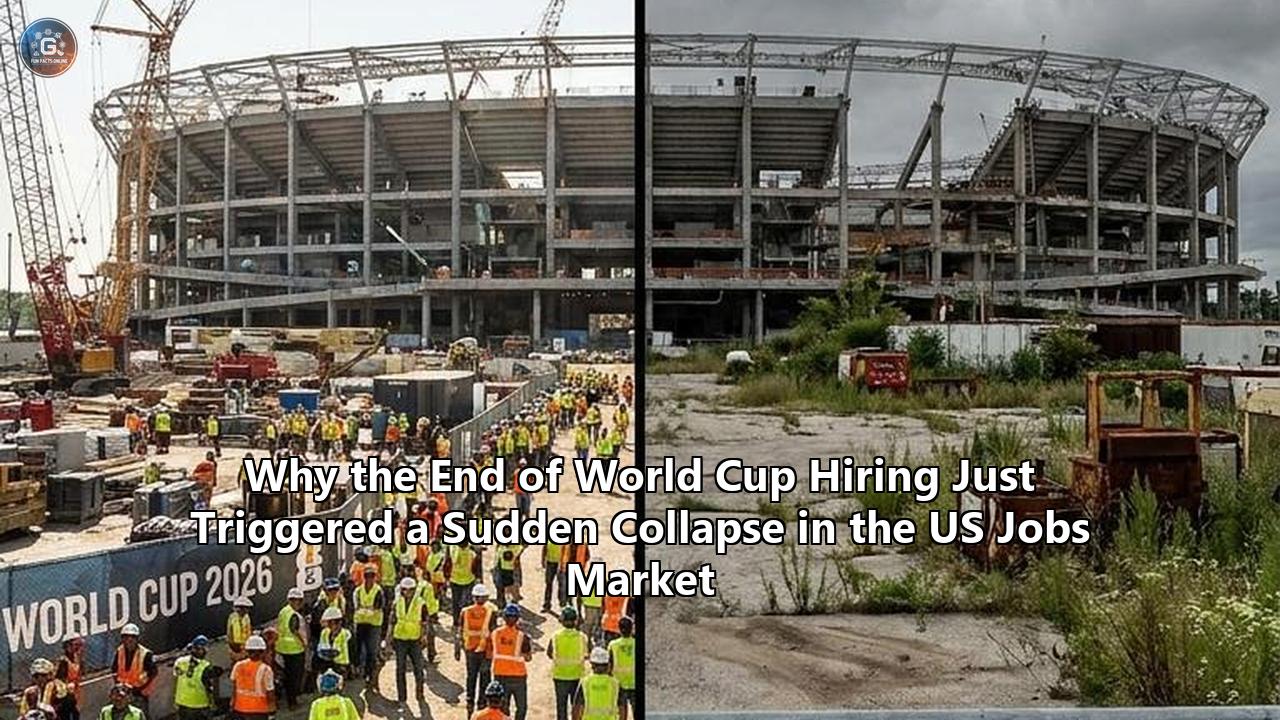
On Thursday, July 2, 2026, the United States Bureau of Labor Statistics (BLS) delivered an employment report that sent a chill through financial markets and completely upended the prevailing macroeconomic narrative of the summer. Nonfarm payrolls grew by a meager 57,000 in June, arriving at roughly half of the 110,000 consensus estimate projected by Wall Street economists. To make matters worse, the BLS slashed its previously reported figures for April and May by a combined 74,000 jobs, revealing that the labor market possessed far less underlying momentum than previously assumed.
The most glaring anomaly of the June report was found in the leisure and hospitality sector, which unexpectedly shed 61,000 jobs. This massive contraction occurred at the exact moment the United States was co-hosting the 2026 Men's FIFA World Cup—the largest and most highly anticipated sporting event in North American history, which kicked off on June 11 across 11 major American cities. Goldman Sachs had confidently projected that the tournament would inject 40,000 temporary hospitality jobs into June payrolls; instead, the sector experienced its worst monthly decline in years.
This sudden downturn is not merely a statistical quirk. It serves as a stark warning sign of a structural shift in the American economy. By analyzing the abrupt end of the pre-tournament hiring sprint as a diagnostic lens, we can see how the collapse of World Cup-related staffing has exposed the real depth of the US jobs market decline. Once the artificial stimulus of mega-event preparation was stripped away, the illusion of labor market resilience vanished, leaving behind a highly fragile, low-churn environment that economists are struggling to reconcile with the Federal Reserve's restrictive monetary stance.
The Illusion of the Mega-Event: Why the World Cup Predictions Failed
In the lead-up to the summer of 2026, both government officials and corporate forecasters painted a picture of a World Cup-fueled economic golden age. The White House FIFA 2026 Task Force, collaborating with tournament organizers, estimated that the games would generate an eye-watering $17.2 billion in U.S. GDP and support 185,000 full-time equivalent jobs across the country. Major corporate sponsors, local tourism bureaus, and commercial real estate developers anticipated that millions of international visitors would unleash a tidal wave of consumer spending, requiring hotels, restaurants, and event venues to staff up aggressively.
On the ground in May, that optimistic thesis seemed to be playing out. Data compiled by hospitality recruiting platform OysterLink revealed that job postings in the 11 U.S. host metropolitan areas surged by an average of 30.3% compared to the first four months of the year. In certain key cities, the race to secure labor was feverish:
- Philadelphia saw hospitality postings skyrocket by 83% above its early-year average.
- Boston experienced a 61% spike.
- Atlanta posted a 55% increase.
- Houston and Dallas-Fort Worth recorded gains of 54% and 40% respectively.
Yet, this regional hiring frenzy masked a deeply troubling divergence. While host cities were locked in an early staffing sprint, hospitality job postings in non-host U.S. markets plummeted by 23.8% over the same period. The aggregate national labor demand was not growing; rather, it was being highly concentrated into a handful of geographic corridors.
Hospitality Postings (May 2026 vs. Jan–Apr Average)
==================================================
Philadelphia         [████████走█████████████] +83%
Boston               [████████走████████] +61%
Atlanta              [████████走█████] +55%
Houston              [████████走████] +54%
Dallas-Fort Worth    [████████走██] +40%
--------------------------------------------------
National Non-Host    [-███████] -23.8%
When the tournament finally commenced on June 11, this localized front-loaded hiring came to an abrupt halt. By mid-June, the "hiring phase" was over. The temporary scaffolding that had propped up national payroll numbers was suddenly dismantled, exposing a hollow core.
As Neil Birrell, Chief Investment Officer at Premier Miton, observed on the day of the BLS release:
"Hopes of a World Cup hiring boost for the US economy have been dashed. The World Cup was expected to have a positive effect on the US jobs market as the hospitality sector hired to cope with an influx of international fans; but that did not transpire, with payrolls rising by much less than expected in June, and the two-month number also being revised downwards."
To understand how a sporting event of this scale could yield a net loss of 61,000 sector jobs at its peak, we must extract the critical economic lessons of this development.
Lesson 1: The Front-Loading Fallacy and the "Cliff-Edge" Effect of Temporary Labor
The primary structural miscalculation made by Wall Street forecasters was the failure to account for the temporal dynamics of mega-event staffing. This phenomenon, which we can call the Front-Loading Fallacy, occurs when economists mistake the intense, brief preparation phase of an event for sustained, ongoing labor demand.
In the case of the 2026 World Cup, the vast majority of physical hiring was completed weeks before the first whistle blew on June 11. Security firms, stadium operators, and large hotel chains finalized their temporary W-2 workforces in April and May.
Once the event began, these employers transitioned immediately from "active recruiting" to "headcount freeze and optimization." Because the tournament spans a compressed 39-day window, there was no logical incentive for businesses to continue hiring once the matches were underway.
Mega-Event Labor Cycle: The Cliff-Edge
Hiring Volume
  ^
  |        / \ (Hiring Peak: May 2026)
  |       /   \
  |      /     \
  |     /       \________________________
  |    /                                 \ (Operational Freeze: June 11)
  |   /                                   \_________
  +---------------------------------------------------> Time
     Jan-Apr              May                 June
For small-to-medium enterprises (SMEs) in host cities, the reality of this cliff-edge became clear almost immediately. In Houston, while some high-profile stadium partners like Truth BBQ staffed up aggressively—deploying 12 to 16 workers per game to manage NRG Stadium activations—other local business owners held back, paralyzed by uncertainty. Tracy Vaught, owner of the H Town Restaurant Group, noted during the tournament's first week:
"I don't have any idea what's going to happen. We talk about it almost daily, and it's just confusing. It's very hard to predict what's going to happen, because some folks are saying that the hotels aren't fully booked. We might see sales roar at certain times, and crickets at other times."
Because of this extreme volatility, many hospitality owners chose to stretch their existing, underemployed staff rather than take on the balance-sheet risk of new hires.
When the calendar turned to June, the absence of new pre-event postings merged with the structural pullback in non-host markets, causing the national data to drop sharply.
The lesson for analysts is clear: temporary mega-events do not create a smooth, upward ramp in employment; they create a highly volatile, front-loaded pulse that masks the underlying trajectory of the wider economy.
Lesson 2: The Macroeconomic Reality of "Crowding Out" and "Substitution"
The second economic principle highlighted by this jobs report is the power of the crowding out and substitution effects. Before the tournament, S&P Global Market Intelligence published a skeptical assessment, concluding that the World Cup was highly unlikely to produce a measurable, positive impact on national economic data. Their researchers pointed to two primary forces: the substitution of domestic spending and the crowding out of non-tournament travel. The June jobs data proved their thesis correct.
When 4.6 million fans flooded into U.S. host venues, they did not simply represent net-new economic activity. Instead, their presence actively displaced traditional summer tourism and corporate travel.
High-spending business travelers and families planning standard summer vacations deliberately avoided host cities like New York, Los Angeles, and Miami to escape skyrocketing hotel room rates, clogged transit systems, and swarming crowds.
The Crowding-Out Dynamic in Host Cities
=========================================================
[Expected Influx]      International Fans + Soccer Tourists
      vs.
[Displaced Outflow]    Traditional Vacationers + Corporate Travelers (Avoided due to high costs)
      equals
[Net Result]           Volatile, uneven demand and a stagnant regional hospitality sector.
This displacement created a severe economic leakage. While a select few hotels directly adjacent to stadiums or official FIFA fan zones operated at maximum occupancy, thousands of retail shops, independent restaurants, and cultural institutions outside those immediate security perimeters experienced a sharp drop-off in foot traffic—what restaurant owners described as the "crickets" effect.
Because the average international football supporter spends their budget predominantly on match tickets, official merchandise, and localized accommodation—revenues that flow directly to FIFA's untaxed international accounts rather than the local economy—the broader regional service sector failed to capture the expected windfall.
Faced with declining revenues from traditional domestic customers, service-sector employers outside the immediate tournament footprint began scaling back their headcounts. This dynamic explains why, despite millions of soccer fans filling stadiums, the leisure and hospitality sector suffered a net loss of 61,000 jobs in June.
The positive economic impact of the tournament was highly concentrated and insular, while the negative displacement effects were distributed nationally, exacerbating the broader US jobs market decline.
Lesson 3: The Deeper Malady—The "Slack Water" Labor Market
The sudden removal of the World Cup hiring veneer has laid bare a highly unusual and fragile macroeconomic state. Laura Ullrich, Director of Economic Research at the Indeed Hiring Lab, has conceptualized this current phase of the American labor market using an oceanographic metaphor: the phenomenon of slack water.
Slack water is the brief, deceptive period of absolute stillness between an incoming and an outgoing tide, when the water barely moves in either direction. In the context of mid-2026, the U.S. labor market has settled into a "low-hire, low-fire" equilibrium.
Very few employers are actively creating new roles, yet very few are executing mass layoffs. The ground feels stable for those who currently hold jobs, but for anyone looking to enter or move within the market, the lack of momentum is a major obstacle.
The "Slack Water" Equilibrium
=========================================
  Inflow (Hiring Rate)   ===> VERY LOW
  Outflow (Layoff Rate)  ===> VERY LOW
=========================================
Result: Deceptive stability masking a complete absence of upward momentum.
The June jobs report provides clear evidence of this stagnant state:
- Low Job Creation: The addition of 57,000 jobs is a fraction of the historical average needed to keep pace with population growth.
- Collapsing Labor Force Participation: The official unemployment rate edged down from 4.3% to 4.2%. In a healthy economy, this would be cause for celebration. However, this dip was driven entirely by a massive exodus of 720,000 workers leaving the labor force in a single month.
- Falling Participation Rate: The national labor force participation rate dropped by 0.3 percentage points to 61.5%, its lowest level since March 2021—the height of the pandemic-era labor disruptions.
- Household Survey Divergence: While the establishment survey showed a nominal gain of 57,000 payrolls, the household survey revealed that total employment actually declined by 507,000.
This massive drop in participation signals a growing cohort of discouraged workers. Heather Long, an economist at Navy Federal Credit Union, described the workforce exodus as "shocking," indicating that hundreds of thousands of Americans are simply abandoning their job searches due to a complete lack of viable opportunities.
When job seekers look at the market, they no longer see a dynamic ladder of upward mobility; they see a stagnant pool. This dynamic is a core feature of the US jobs market decline: the headline unemployment rate remains low only because the numerator—the active labor force—is shrinking at an unprecedented rate.
June 2026 Labor Force Flow (Household Survey)
=======================================================
[Employed Population]  ======> -507,000 (Decline)
[Active Job Seekers]   ======> -213,000 (Decline)
-------------------------------------------------------
Total Labor Force Exit ======> -720,000 (Exited to Inactive)
To illustrate the breadth of this stagnation, we can look at the performance of various sectors in June 2026. The job gains were heavily concentrated in a small number of non-cyclical, heavily subsidized sectors, while the rest of the private economy remained completely flat or contracted:
| Sector / Industry | June 2026 Net Job Change | Trend Analysis / Drivers |
|---|---|---|
| Private Education & Health Services | +69,000 | Continued to carry the bulk of private-sector growth, though heavily insulated from consumer demand. |
| Professional & Business Services | +36,000 | Modest growth, driven primarily by administrative support (+21,200) and management consulting (+7,300). |
| Social Assistance | +25,000 | Growth concentrated in individual and family services (+17,000). |
| Construction | +11,000 | Stagnant; high interest rates continue to suppress new commercial and residential breaks. |
| Government | +8,000 | Minimal public sector additions. |
| Manufacturing | +3,000 | Flat; sector continues to suffer from supply-chain adjustments and high capital costs. |
| Wholesale Trade | +2,400 | Virtually unchanged. |
| Transportation & Warehousing | +2,300 | Ongoing consolidation following post-pandemic over-expansion. |
| Retail Trade | -7,500 | Contraction; reflecting consumer pullback and automation of checkout roles. |
| Information | -9,000 | Contraction; tech sector layoffs and AI integration continue to impact headcounts. |
| Leisure & Hospitality | -61,000 | Massive contraction; the post-World Cup hiring freeze collided with a sharp decline in domestic tourism. |
This table shows how uneven the current economic landscape is. If you strip away the defensive, non-cyclical sectors of healthcare and social assistance, the private, consumer-facing engine of the American economy is shedding jobs rapidly.
The World Cup was supposed to be the bridge that carried the consumer economy through this period of high interest rates. Instead, the bridge collapsed under its own weight, leaving the reality of a broader US jobs market decline fully exposed.
Lesson 4: Policy Disconnection—The Fed and the White House Out of Sync
The June jobs report has created a major policy dilemma in Washington, highlighting a clear gap between the White House’s optimistic economic narrative and the Federal Reserve's restrictive monetary approach.
Throughout the spring, the administration used the World Cup and the upcoming United States 250th anniversary celebrations as evidence of economic strength. They pointed to these massive public celebrations as proof that the U.S. economy was poised for a strong second half of 2026.
Behind the scenes, however, the Federal Reserve has remained highly concerned about inflation, which has risen to its highest levels in more than three years due to ongoing geopolitical tensions in the Middle East.
To combat this, Fed policymakers have kept interest rates in the 3.50%–3.75% range and hinted at further hikes later in the year. This high-rate environment has steadily drained liquidity from the private sector, making it increasingly expensive for businesses to carry debt, fund expansion, or maintain headcounts.
The June data places the Fed in a very difficult position. On one hand, a cooling labor market is exactly what the central bank's models require to bring service-sector wage growth down toward its long-term targets. On the other hand, the sheer speed of the slowdown suggests that the economy is decelerating much faster than expected.
Chris Low, Chief Economist at investment firm FHN Financial, highlighted this challenge:
"From a Federal Reserve point of view, there is not enough job strength to suggest the Fed should hike to slow job growth, but neither is there enough weakness to justify cuts."
The Federal Reserve's Policy Tightrope
========================================================================
[INFLATION RISK]           [SLACK WATER LABOR REALITY]
Middle East tensions       Only 57,000 jobs added in June
CPI sticky at ~3.9%        720,000 workers exit labor force

===> RESULT: Fed remains frozen, unable to cut rates to relieve pressure.
========================================================================
Following the report, traders immediately adjusted their expectations, pricing in a much lower chance of a July rate hike, though a September tightening is still seen as a possibility.
This policy delay is creating a highly challenging environment for American businesses. Because the Fed is unlikely to cut rates anytime soon, employers will continue to face high capital costs.
Without the temporary boost of World Cup preparations to support hiring, the private sector is now fully exposed to these high interest rates.
The disconnect between the government's celebration of temporary events and the Fed’s focus on inflation has left the private sector without a clear path forward, raising the risk that this US jobs market decline could deepen heading into the autumn.
Strategic Case Studies: How Host Metros Experienced the Shift
To fully understand how the end of the World Cup hiring cycle impacted the labor market, we can examine how different major host cities experienced this sudden shift. The economic outcomes varied significantly across different regions, illustrating how unevenly the tournament's impact was felt.
Houston: The Stadium-Centric Squeeze
Houston, which hosted matches at NRG Stadium, serves as a prime example of the front-loading trend. In May, hospitality job postings in the metro area jumped by 54% compared to the early-year average as venues rushed to secure staffing.
However, local business owners quickly realized that this demand was highly concentrated. While stadium vendors and official FIFA hotels were fully booked, restaurants and retail shops just a few miles away in downtown Houston and the East End (EaDo) saw a notable drop-off in their regular local clientele.
Once the group stage matches began on June 13, hiring stopped entirely. Local businesses faced a double squeeze: they had to pay higher wages to retain staff during the tournament, but did not see the broad-based bump in customer traffic they had expected.
By late June, many independent operators began reducing hours for their part-time staff, contributing directly to the state's broader leisure and hospitality job losses.
Los Angeles: The Cost-Push Crisis
In Los Angeles, which hosted the opening match at SoFi Stadium, the local service sector faced an even tougher environment. Hospitality postings in LA rose by a modest 19% in May—well below the national host city average—as employers navigated a high-cost environment.
With the state’s minimum wage standards and high operating costs, local business owners like Dina Samson, co-owner of Rossoblu in downtown LA, were highly conservative about hiring new staff.
Instead of adding seasonal workers, LA businesses relied heavily on mobile ordering apps, automated scheduling, and cross-training existing employees to handle the influx of fans.
This shift toward automation and efficiency meant that even though millions of fans visited the area, very few new jobs were actually created.
When the initial wave of tourists departed after the group stage, local hospitality demand returned to its baseline, leaving the region's service-sector employment flat.
Host Metro Operational Models during June 2026
===================================================================
[HOUSTON]       Aggressive pre-hiring (+54%) -> Uneven match-day demand
                -> Underutilized staff -> Quick post-event hours cuts.

[LOS ANGELES]   Conservative hiring (+19%) -> Heavy reliance on automation
                -> No net-new jobs -> Flat structural employment baseline.
===================================================================
The Lessons of the World Cup Shock
The sudden downturn in the June 2026 employment data offers several important lessons for corporate leaders, municipal planners, and macroeconomic forecasters. Mega-sporting events are often promoted as reliable economic engines, but this jobs report reveals a more complex reality.
1. The Myth of the Mega-Event Economic Boost
The most important lesson from this development is that mega-events are highly unreliable tools for driving sustainable economic growth.
The projections offered by FIFA and local tourism bureaus are frequently based on optimistic models that assume all visitor spending is net-new to the economy. These models consistently fail to account for the substitution and crowding out effects that displace regular, reliable economic activity.
For municipal planners, the takeaway is clear: hosting major international events should be viewed as a branding and long-term infrastructure play, rather than a reliable short-term fix for a slowing labor market.
2. The Danger of Over-Reliance on Temporary Stimulus
For corporate leaders and hiring managers, the World Cup staffing cycle highlights the risks of temporary over-hiring.
Businesses that rushed to expand their headcounts in May based on optimistic demand forecasts were left with excess capacity and high overhead costs once the reality of uneven tourist spending set in.
In a low-churn, high-interest-rate environment, maintaining excess labor capacity can quickly erode operating margins.
The modern economy favors operational flexibility, cross-training, and targeted technology integration over large-scale seasonal hiring.
3. The Need for Dynamic Labor Market Metrics
For macroeconomic forecasters, the June report shows the limitations of relying too heavily on headline numbers like the official unemployment rate.
A low unemployment rate is often interpreted as a sign of economic health, but the June data shows how this metric can mask a significant labor market slowdown when hundreds of thousands of discouraged workers are leaving the labor force entirely.
To build an accurate picture of economic health, analysts must look past headline payrolls and closely monitor underlying indicators, including:
- Labor force participation trends
- The ratio of household-to-establishment employment
- Unemployment duration
- Voluntary quit rates
Looking Ahead: The Autumn Outlook for the Labor Market
As the World Cup matches wrap up and the tournament concludes on July 19, the U.S. economy faces a challenging transition. The temporary hiring that helped support the labor market during the spring has run its course, and the actual post-tournament layoffs have not yet fully shown up in the official data.
According to Goldman Sachs' updated projections, U.S. payrolls are expected to add a modest 10,000 jobs in July before shedding at least 15,000 positions in August as temporary event operations are wound down.
Given the weakness already visible in the June report, many independent economists fear these projections may prove optimistic.
Without the temporary boost of World Cup preparations, the structural pressures of high interest rates and sticky inflation are likely to weigh heavily on the private sector.
Projected Post-Tournament Payroll Impact (Goldman Sachs)
========================================================
June 2026 (Actual)    [█████████████] +57,000 (Hiring ends early)
July 2026 (Projected)  [██]            +10,000 (Tournament wraps up)
August 2026 (Proj.)   [-███]          -15,000 (Post-event layoffs)
September 2026 (Proj.) [-█████]        -25,000 (Secondary adjustments)
========================================================
The key trend to watch in the coming months is whether the Federal Reserve will adjust its policy in response to this cooling labor data.
If the central bank remains focused on sticky service-sector inflation and keeps interest rates elevated through the end of 2026, the lack of new hiring could turn the current "slack water" labor market into a more pronounced downturn.
Alternatively, if the Fed sees the sharp drop in labor force participation and the contraction in leisure and hospitality as signs of broader economic weakness, they may consider cutting rates earlier than Wall Street currently expects.
The end of the World Cup hiring surge has stripped away the temporary economic supports of the spring, giving policymakers and business leaders a clear look at the structural challenges facing the American workforce.
As the stadium lights fade and international fans return home, the focus will shift back to the fundamental health of the U.S. economy.
The lessons of this summer's hiring cycle will be crucial for understanding how the labor market navigates this period of transition and whether the current slowdown can be managed before it deepens into a more significant US jobs market decline.
Reference:
- https://www.aljazeera.com/economy/2026/7/2/us-job-growth-slows-in-june-hospitality-sheds-roles-despite-world-cup
- https://thedailyrecord.com/2026/07/02/us-job-growth-slows-june-unemployment-rate-falls/
- https://www.roberthalf.com/us/en/insights/research/june-2026-jobs-report-employers-add-57000-jobs
- https://www.theguardian.com/business/2026/jul/02/us-job-growth-slowed-june
- https://www.theguardian.com/business/live/2026/jul/02/uk-cost-of-living-squeeze-diesel-record-fall-mortage-rates-stock-markets-us-jobs-report-live-news-updates
- https://www.kellyservices.com/insights/world-cup-2026-workforce
- https://www.almfirst.com/resources/beyond-the-headlines/july-2-2026-headlines
- https://www.jec.senate.gov/public/index.cfm/republicans/2026/7/57k-jobs-added-in-june-as-unemployment-rate-ticks-down
- https://www.americanprogress.org/article/june-jobs-numbers-are-not-the-boost-for-workers-that-was-expected/
- https://partnersrealestate.com/research/market-edge-by-partners-fifa-world-cup-2026/
- https://tradingeconomics.com/united-states/non-farm-payrolls
- https://www.prnewswire.com/news-releases/hospitality-hiring-jumps-30-across-world-cup-2026-host-cities---oysterlink-302790123.html
- https://www.upday.com/wm/hospitality-sector-sheds-61000-jobs-despite-46-million-world-cup-fans-flooding-us/zjpd2t1
- https://nyeventsny.com/sport-event-staff/
- https://www.marketplace.org/story/2026/06/05/did-world-cup-preparations-boost-hospitality-hiring
- https://www.hiringlab.org/2026/07/02/june-2026-jobs-report-an-unmoving-tide/
- https://wolfstreet.com/2026/07/02/labor-market-tightens-despite-tepid-job-growth-as-labor-force-declines-further-amid-crackdown-on-illegal-immigration/
- https://www.hiringlab.org/2026/07/02/june-2026-jobs-report-an-unmoving-tide/
- https://www.rothstaffing.com/bls-u-s-economy-adds-57000-jobs-in-june-2026/
- https://siepr.stanford.edu/publications/policy-brief/us-economy-2026-what-watch
- https://www.staffingindustry.com/research/research-reports/americas/july-2026-us-jobs-report
- https://www.morningstar.com/economy/june-us-jobs-report-57000-rise-payrolls-below-forecasts
- https://www.theguardian.com/business/2026/jul/02/us-job-growth-slowed-june
- https://tradingeconomics.com/united-states/unemployment-rate
- https://www.americanprogress.org/article/june-jobs-numbers-are-not-the-boost-for-workers-that-was-expected/
- https://www.cbsnews.com/news/june-jobs-report-57000-jobs-hiring-slows/
- https://www.wyclifffamilydentistry.com/expert-time/June-Jobs-Report-US-Labor-Market-Shifts-from-Sprint-to-Jog-as-Job-Gains-Sharply-Miss-Expectations-42-7376
- https://www.bls.gov/news.release/pdf/empsit.pdf