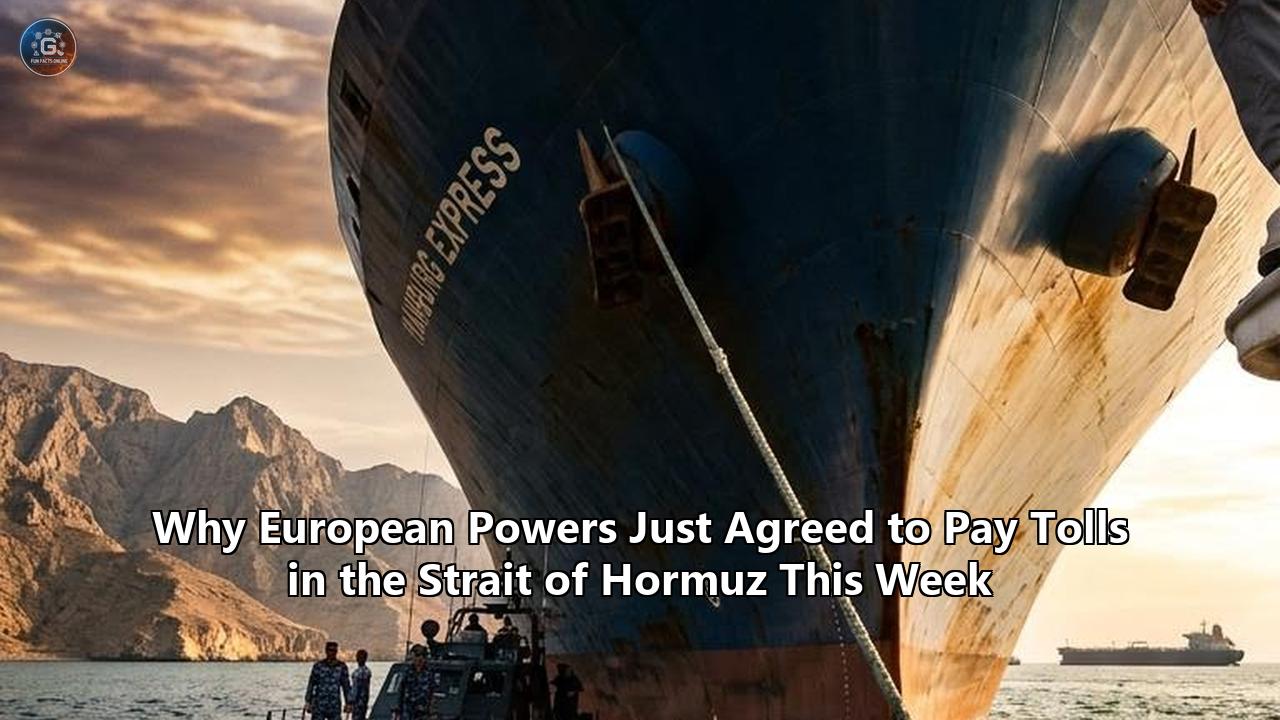
The strategic calculus governing global maritime commerce has undergone a quiet but seismic shift. Behind closed doors, several of Europe’s leading maritime powers—most notably the United Kingdom and France—have privately conceded that commercial vessels transiting the world's most critical energy chokepoint will likely have to pay transit fees to Iran and Oman.
This quiet concession represents a major departure from decades of Western insistence on absolute freedom of navigation. The sudden willingness of London and Paris to accommodate the Strait of Hormuz tolls represents a pragmatic, if legally painful, capitulation to geographical and economic realities.
                THE STRAIT OF HORMUZ CHOKEPOINT

      [ Persian Gulf ]
            \ \
             \ \    <-- Internationally recognized
              \ \       Traffic Separation Scheme (TSS)
  IRAN         \ \
  ==============\=\========================================
                 \ \     Larak Island
                  \ \   (Northern route / Iranian waters)
  -----------------\-\-------------------------------------
                    \ \  Musandam Peninsula (Omani waters)
  OMAN               \ \
  ====================\=\==================================
                        \ \
                         \ \
                       [ Gulf of Oman ] -> [ Indian Ocean ]
The context for this development is a highly volatile region. On June 17, 2026, the United States and Iran signed an interim Memorandum of Understanding (MoU) to pause the ruinous maritime conflict that erupted following the U.S. and Israeli airstrikes of Operation Epic Fury on February 28. Under this temporary agreement, Tehran consented to a 60-day window of toll-free transit to facilitate broader peace negotiations.
However, that fragile truce is already on the verge of collapse. On July 7, 2026, projectile and drone attacks targeted three commercial vessels in the strait, including the Qatari liquefied natural gas (LNG) tanker Al Rekayyat, which caught fire off the coast of Oman. The U.S. military responded immediately with airstrikes against Iranian targets, and Washington promptly revoked a license that had authorized limited Iranian oil sales under the June agreement.
With the 60-day interim window set to expire in mid-August, European nations are facing a stark reality: when the clock runs out, the era of free passage through the Strait of Hormuz may be gone forever.
While the United States remains officially opposed to any form of monetization of the waterway, European capitals are quietly preparing their shipping lines to pay up. To understand why Europe is willing to break ranks with Washington and upend nearly two centuries of maritime law, one must look at the complex convergence of international legal loopholes, the mathematics of shipping economics, and the geographical vulnerability of European energy security.
The Geopolitical Backdrop: From "Epic Fury" to the Doha Brink
To appreciate the gravity of Europe's concession, it is necessary to trace the conflict that brought the global energy market to its knees in early 2026. The spark was Operation Epic Fury on February 28, 2026—a highly coordinated campaign of U.S. and Israeli airstrikes targeting military assets inside Iran. In immediate retaliation, the Islamic Revolutionary Guard Corps Navy (IRGCN) effectively sealed the Strait of Hormuz.
The economic fallout was swift and devastating:
- The Shipping Collapse: According to data from Lloyd’s List Intelligence, commercial vessel transits through the strait plunged by 94.6% in March 2026, with only 142 vessels recorded compared to 2,652 during the same period in 2025.
- The Energy Shock: Brent crude futures spiked to $138 per barrel on April 7, 2026. QatarEnergy was forced to declare force majeure on all LNG shipments on March 4, instantly severing a supply line that accounts for roughly 12% to 14% of Europe’s total gas imports.
- The Stranded Fleet: The International Maritime Organization (IMO) estimated that at the peak of the blockade, more than 2,000 commercial vessels and 20,000 seafarers were effectively trapped inside the Persian Gulf.
The June 17 interim agreement was designed as a release valve. The deal established a 60-day "cool-down" period during which U.S. naval forces stood down from their counter-blockade, Iran permitted free transit, and indirect diplomatic talks commenced in Doha, Qatar, mediated by Omani and Qatari officials.
Yet, even as oil prices fell back toward $75 per barrel in late June, Tehran made it clear that the pre-war status quo would not return. Iranian officials, supported by Muscat, immediately began drafting plans to implement permanent charges on all shipping transiting the strait once the 60-day window closes.
The stakes were raised further on July 5, 2026, when Abdolreza Rahmani Fazli, Iran’s ambassador to China, announced at the World Peace Forum in Beijing that Iran would formally impose "service fees" on the waterway, offering exemptions and "special considerations" only to geopolitical allies like China and Russia.
The drone strikes of July 7 have only accelerated Europe's determination to find a diplomatic and financial compromise. European powers recognize that if they do not agree to a formal payment structure, their commercial fleets will remain primary targets for aggressive interdiction, boarding, or drone strikes.
Legal Alchemy: When Is a Toll Not a Toll?
The primary obstacle to any country charging for passage through the Strait of Hormuz is the United Nations Convention on the Law of the Sea (UNCLOS), the foundational treaty governing the world's oceans. Under Part III of UNCLOS, international straits enjoy a highly protected legal status known as transit passage.
| Legal Concept | Innocent Passage (Territorial Seas) | Transit Passage (International Straits) |
|---|---|---|
| Suspensibility | Can be temporarily suspended by coastal state for security. | Cannot be suspended under any circumstances. |
| Submarine Transit | Submarines must transit on the surface and show flag. | Submarines may transit submerged. |
| Overflight Rights | No automatic right of overflight for aircraft. | Automatic right of overflight. |
| Taxation/Fees | No charges allowed except for specific services rendered. | Strictly fee-free; no transit tolls may be levied. |
Articles 38 and 44 of UNCLOS explicitly state that coastal states bordering international straits cannot suspend, impede, or hamper transit passage, nor can they levy tolls simply for the right of crossing. This has been the bedrock of global shipping since the convention was opened for signature in 1982.
However, Iran has utilized a sophisticated blend of legal non-ratification and linguistic rebranding to construct a loophole.
The Non-Ratification Argument
While Iran signed UNCLOS in 1982, its parliament never ratified the treaty. Tehran argues that it is not bound by treaty-based concepts like "transit passage". Instead, Iran maintains that the Strait of Hormuz is subject only to the older, more restrictive regime of innocent passage under customary international law.
Under innocent passage, a coastal state retains the right to police, monitor, and temporarily suspend transit if it deems a vessel’s presence "prejudicial to the peace, good order, or security" of the state.
By forcing ships out of the internationally recognized Traffic Separation Scheme (TSS) and into its sovereign territorial waters—specifically the narrow corridors around Larak Island—the IRGC Navy has effectively asserted physical and administrative jurisdiction over passing ships.
The Rebranding: "Service Fees" vs. "Tolls"
Knowing that the unilateral imposition of a transit "toll" would invite universal legal condemnation, Iranian Foreign Ministry spokesman Esmaeil Baghaei and other officials have carefully avoided the word "toll". Instead, they argue that Iran and Oman are entitled to collect maritime service fees.
Tehran points to Article 26 of UNCLOS, which, ironically, does permit coastal states to charge foreign ships for "specific services rendered to the vessel". Iran argues that maintaining the Strait of Hormuz is an incredibly expensive sovereign undertaking that yields no direct tax revenue from foreign-flagged ships.
They have laid out a menu of "services" that they claim justify these fees:
            THE IRANIAN "SERVICES RENDERED" FRAMEWORK

   ┌────────────────────────────────────────────────────────┐
   │ 1. MINE CLEARANCE                                      │
   │    Neutralizing an estimated 80 naval mines            │
   │                                                        │
   │ 2. ENVIRONMENTAL PROTECTION                           │
   │    Mitigating oil spills and industrial de-pollution   │
   │                                                        │
   │ 3. NAVIGATIONAL AID                                    │
   │    Operating lighthouses, radar, and vessel tracking   │
   │                                                        │
   │ 4. MARITIME SECURITY                                   │
   │    Active escort by IRGC naval assets to deter piracy  │
   └────────────────────────────────────────────────────────┘
By framing these charges as mandatory payments for de-mining, environmental monitoring, and navigational safety, Iran has provided European powers with the necessary diplomatic cover to agree to the payments.
European legal advisers have concluded that while paying a "toll" for passage is a clear violation of international law, paying a "service fee" to a joint Omani-Iranian authority for navigational safety and environmental preservation represents a gray area they can legally tolerate to secure their supply chains.
This is not a new legal sleight of hand. It mirrors the historic resolution of the Danish Sound Dues. For more than four centuries, Denmark charged international shipping for passing through the narrow Öresund strait, leading to intense diplomatic friction.
The practice was finally abolished by the Copenhagen Convention of 1857, which established the modern precedent that natural international straits must be free of transit charges. By conceding to Iran’s "service fee" model, Europe is effectively reversing a 169-year-old consensus of maritime law.
Precedents and False Equivalencies: Canals vs. Straits
To justify the imposition of Strait of Hormuz tolls, Iranian state media and diplomatic representatives have frequently compared their proposed regime to existing maritime toll systems, most notably the Suez Canal, the Panama Canal, and the Turkish Straits.
However, from both a technological and a legal standpoint, these comparisons rely on false equivalencies.
                     MARITIME PASSAGE TYPOLOGIES

  [ ARTIFICIAL CANALS ]                 [ NATURAL STRAITS ]
  e.g., Suez, Panama                    e.g., Hormuz, Gibraltar

  ┌─────────────────────────┐           ┌─────────────────────────┐
  │ • Human-built channels  │           │ • Naturally occurring   │
  │ • Massive capital costs │           │ • No engineering costs  │
  │ • Locks/dredging needed │           │ • Covered by UNCLOS     │
  │ • Explicit treaty tolls │           │   transit passage       │
  └─────────────────────────┘           └─────────────────────────┘
The Canal Distinctions
The Suez and Panama Canals are artificial, human-made waterways carved through landmasses at astronomical engineering and financial costs. The sovereign nations that constructed and maintain them (Egypt and Panama) were granted explicit treaty-based authority to levy tolls to recoup construction costs, fund continuous dredging, and operate complex lock systems.
The Strait of Hormuz, by contrast, is a naturally occurring channel of water. No state spent capital to build it, and it requires no mechanical intervention, such as locks, to remain navigable.
The Turkish Straits Precedent
A more complex and legally relevant comparison involves the Bosporus and Dardanelles, the natural straits controlled by Turkey that connect the Black Sea to the Mediterranean. Turkey has charged transit fees on commercial vessels navigating these straits since 1936 under the Montreux Convention.
On July 1, 2026, Turkey enacted an 8.3% to 15% increase in these transit fees, raising its annual maritime revenue projections to roughly $900 million. These fees are calculated using a historical currency unit known as the Gold Franc and cover three specific categories:
- Sanitary inspection services.
- Lighthouse maintenance and monitoring.
- Lifesaving and salvage services.
While Iran points to the Turkish model as proof that natural straits can be monetized, international legal scholars note that the Montreux Convention is a highly specific, pre-UNCLOS treaty that was signed long before the modern concept of "transit passage" was codified.
No such historical treaty exists for the Strait of Hormuz.
Furthermore, Turkey’s fees are transparent, non-discriminatory, and universally applied to all nations. Iran's proposed system, which explicitly seeks to penalize Western-aligned nations while granting free passage to geopolitical allies, violates the fundamental non-discrimination principles that even Turkey must uphold.
The Economic Math of Maritime Detours
The primary driver behind Europe’s quiet capitulation is not a sudden change in legal philosophy, but cold, hard economic calculation. For European shipowners and energy importers, the financial impact of the Strait of Hormuz tolls is being weighed against the alternative: bypassing the Middle East entirely and routing ships around the Cape of Good Hope at the southern tip of Africa.
                    GLOBAL SHIPPING ROUTE COMPARISON

       EUROPE <───────────────  ( 6,400 nm ) ───────────────> PERSIAN GULF
       [ Via Suez Canal & Strait of Hormuz ]

       EUROPE <───────────────────────── ( 11,500 nm ) ─────────────────────────> PERSIAN GULF
       [ Via Cape of Good Hope ]
To understand why a $2 million transit fee is preferable to a detour, one must analyze the daily operating economics of a modern Very Large Crude Carrier (VLCC) or a Suezmax tanker.
Fuel and Time Economics
A standard VLCC carries approximately 2 million barrels of crude oil. When traveling from the Persian Gulf to Western Europe via the Suez Canal, the journey is roughly 6,400 nautical miles and takes approximately 18 to 21 days.
If the Strait of Hormuz is blocked or avoided due to prohibitive war-risk insurance premiums, the vessel must route around the Cape of Good Hope. This extends the voyage to approximately 11,500 nautical miles, adding 12 to 15 days of transit time in each direction.
The financial penalty of this detour accumulates rapidly across several cost centers:
- Daily Fuel Burn: A VLCC traveling at a standard service speed of 13 knots consumes roughly 45 to 55 metric tons of Very Low Sulfur Fuel Oil (VLSFO) per day. At 2026 prices of approximately $650 per metric ton, the fuel cost alone is roughly $32,500 per day. Adding 14 days of travel increases the fuel bill by $455,000 per leg.
- Vessel Charter Rates: Due to the severe shortage of available tankers caused by the sudden lengthening of global routes, spot charter rates for VLCCs have skyrocketed. In Q2 2026, daily spot rates for crude tankers averaged between $55,000 and $75,000 per day. An extra 14 days of transit at a $65,000 daily charter rate adds $910,000 to the cost of the voyage.
- Carbon Taxes and Fuel Penalties: Under the European Union’s Emissions Trading System (EU ETS), maritime shipping is subject to carbon emissions pricing. The extra fuel burned during a Cape of Good Hope detour adds significant carbon tax penalties, often exceeding $150,000 per voyage.
When these factors are combined with standard crew wages, provisions, and hull depreciation, a single round-trip detour around Africa adds more than $1.6 million in operational costs to a single voyage.
The Insurance Equation
During the height of the crisis in March and April 2026, "war-risk" insurance premiums for vessels transiting the Strait of Hormuz surged to as high as 2.5% to 3% of the total hull value of the ship. For a modern, $120 million VLCC, this translated to a staggering $3 million to $3.6 million in insurance premiums for a single transit.
By agreeing to pay a regulated, predictable "service fee" to an established maritime authority overseen by Iran and Oman, European shipowners can drastically reduce their risk profile.
Underwriter syndicates in London have privately indicated that if a formal, legally recognized transit fee system is established alongside an international de-mining coalition, war-risk premiums will collapse back to pre-war levels of less than 0.1%.
For a shipping company, paying a $2 million flat fee or a graduated tariff of $0.50 to $1.20 per barrel is a highly rational economic choice when compared to the unpredictability of war-risk insurance or the guaranteed $1.6 million penalty of a Cape detour.
                ECONOMIC COMPARISON (PER VLCC VOYAGE)

  Detour around Africa (Cape of Good Hope):
  ┌───────────────────────────────────────────────────┐ $1,600,000+
  └───────────────────────────────────────────────────┘ (Guaranteed extra cost)

  Hormuz Transit (With Proposed Service Fees):
  ┌─────────────────────────────────────────┐ $500,000 - $2,000,000
  └─────────────────────────────────────────┘ (Depending on cargo/vessel size)
The Oman Factor and the Split Western Alliance
The divergence between the United States and its European allies over the Strait of Hormuz tolls highlights a deeper, structural rift in the Western security architecture. This rift has been carefully exploited by the Sultanate of Oman, which occupies a unique and indispensable role in the crisis.
                    THE GEOPOLITICAL SCHISM

  [ COERCIVE RESISTANCE ]               [ PRAGMATIC CONCESSION ]
  United States                         United Kingdom & France

  ┌─────────────────────────┐           ┌─────────────────────────┐
  │ • Energy self-sufficient│           │ • Energy import-reliant │
  │ • Enforce sanctions     │           │ • Prioritize stability  │
  │ • Zero-tolerance tolls  │           │ • Accept "service fees" │
  └─────────────────────────┘           └─────────────────────────┘
The Omani Diplomatic Pivot
Oman is the co-littoral custodian of the Strait of Hormuz. While Iran controls the northern coastline, the vital deep-water channels used by outbound supertankers lie entirely within the territorial waters of Oman’s Musandam Peninsula.
Historically, Oman has acted as a neutral diplomatic bridge between Tehran and the West. However, the sheer scale of the 2026 conflict convinced Muscat that the pre-war security model of the strait was unsustainable.
Oman’s economy was severely impacted by the proximity of the conflict, and its waters suffered significant environmental degradation from damaged vessels and bunker fuel leaks.
In late June 2026, Sultan Haitham bin Tariq of Oman conducted a rare, high-stakes diplomatic visit to Paris to meet with French President Emmanuel Macron. During these meetings, Omani officials delivered a blunt message: Muscat would no longer underwrite the security and environmental safety of Western shipping for free.
Oman asserted that it intended to partner with Iran to establish a joint administrative body to oversee the strait, charge "navigational and environmental safety fees," and use those revenues to fund permanent oil-spill response capabilities and vessel-traffic monitoring systems.
Omani Foreign Minister Badr bin Hamad Al-Busaidi defended the move by comparing it to the voluntary "Cooperative Mechanism" used in the Strait of Malacca, arguing that user states must share the physical and financial burdens of the coastal states that guard these vital corridors.
The American Red Line
This Omani-Iranian joint proposal was met with immediate, fierce resistance in Washington. The Trump administration has taken a hardline, zero-tolerance stance on any monetization of the strait.
- Secretary of State Marco Rubio publicly dismissed the proposal as a flagrant violation of international law, declaring that "no country is allowed to charge tolls or fees on an international waterway".
- Treasury Secretary Scott Bessent went further, warning that the United States would "aggressively target any actors involved directly or indirectly in facilitating tolls for the Strait" with severe secondary sanctions.
The U.S. concern is not merely economic; it is systemic. Washington fears that if Iran is allowed to successfully monetize a natural strait through military coercion, it will create a highly dangerous global precedent.
Why Europe Broke Ranks
Europe does not have the luxury of ideological purity. While the United States is a net exporter of oil and natural gas, Europe remains deeply dependent on seaborne energy imports from the Persian Gulf.
The industrial baseline of Western Europe, already strained by years of energy decoupling from Russia, cannot survive a prolonged, multi-month shutdown of Middle Eastern LNG and crude flows.
Furthermore, European diplomats recognize that the U.S. strategy of naval escorts and military deterrence has failed to guarantee long-term stability in the strait.
Even with massive U.S. naval assets deployed in the region, the July 7 drone attacks proved that merchant ships remain highly vulnerable to low-cost, asymmetric aerial and maritime drone strikes that can bypass traditional naval air defenses.
By quietly agreeing to pay Oman and Iran's "service fees," European powers are choosing a path of pragmatic appeasement to buy maritime peace. They are effectively decoupling their maritime transit policy from Washington’s broader "maximum pressure" sanctions campaign against Tehran.
Opening Pandora’s Box: The Strait of Malacca Threat
The most profound implication of Europe's concession on the Strait of Hormuz tolls is the immediate risk of a "domino effect" across other critical maritime chokepoints. If a coastal state can successfully weaponize a natural waterway to extract billions of dollars in transit fees, every vulnerable chokepoint on Earth will be reassessed.
                 VULNERABLE GLOBAL CHOKEPOINTS

                                          [ Turkish Straits ]
                                          Controlled by Turkey
                                          Monetized since 1936
                                                 |
  [ Strait of Gibraltar ]                        |
  Bordered by Spain/Morocco                      |
         |                                       |
  ───────┼───────────────────────────────────────┼───────────────
         |                                       |
         v                                       v
   Mediterranean Sea ──────────> Suez Canal ──────────> Red Sea
                                 (Egypt)            (Bab el-Mandeb)
                                                         |
                                                         v
                                                   Indian Ocean
                                                         |
                                                         v
                                                Strait of Malacca
                                                (Indonesia/Malaysia/
                                                 Singapore)
The immediate focus has turned to the Strait of Malacca, which handles roughly 22% of all global maritime trade—dwarfing the volume of Hormuz.
The Malacca Strait narrows to just 1.7 miles at its tightest point (the Phillips Channel in the Singapore Strait) and is bordered by three littoral states: Indonesia, Malaysia, and Singapore.
The Malacca Precedent
In April 2026, as the Hormuz crisis raged, Indonesia’s Finance Minister floated a trial balloon, suggesting that Jakarta should introduce a sovereign transit levy on ships passing through its territorial waters in the Malacca Strait to fund environmental protection and maritime security.
The proposal was met with immediate, panicked pushback from neighboring Singapore and Malaysia, as well as major user states like China and Japan. Indonesian Foreign Minister Sugiono was forced to issue a clarifying statement to reassure the international community that Indonesia would respect UNCLOS and would not unilaterally impose tariffs.
However, maritime security analysts warn that the Indonesian retreat may only be temporary.
If European shipping giants like Maersk, CMA CGM, and MSC begin routinely paying millions of dollars in "service fees" to Iran and Oman, the domestic political pressure on governments bordering the Malacca Strait to monetize their own corridors will become overwhelming.
The Voluntary Alternative: The Cooperative Mechanism
Historically, the Malacca Strait has avoided tolls through a unique framework known as the Cooperative Mechanism on Safety of Navigation and Environmental Protection, established in 2007 in coordination with the IMO.
This mechanism relies on three voluntary pillars:
- The Cooperation Forum: A platform for open dialogue between littoral states, user states, and shipping industries.
- The Project Coordination Committee: A body to oversee specific safety and environmental projects.
- The Aids to Navigation Fund (ANF): A voluntary trust fund to which user states (such as Japan, China, and Saudi Arabia) and industry groups contribute to pay for the maintenance of lighthouses, buoys, and radar systems.
Since its inception, the ANF has raised tens of millions of dollars.
However, the key word is voluntary. Shipping lines are not denied transit if they do not contribute.
If the "Hormuz Model" of mandatory, coercive "service fees" becomes the new international norm, the voluntary cooperative model of Malacca could quickly be replaced by a mandatory, state-enforced toll regime.
Other critical waterways, such as the Bab el-Mandeb (bordering Yemen and Djibouti) and even the Strait of Gibraltar, could see littoral states asserting sovereign rights to extract transit fees under the guise of "security and environmental services".
What Lies Ahead: A Multi-Tiered Ocean
As the mid-August deadline for the 60-day interim agreement approaches, the global maritime order is rapidly fracturing along geopolitical lines. The concession by European powers has effectively set the stage for a fragmented, multi-tiered ocean where the rules of the sea depend entirely on the flag flying from a ship's mast.
Based on current diplomatic and military developments, the maritime administration of the Strait of Hormuz is likely to settle into three distinct tiers:
                  THE NEW TRI-TIERED MARITIME ORDER

  [ TIER 1: THE EXEMPT FLEET ]
  China, Russia, India
  • No fees, no inspections, uninterrupted transit

  [ TIER 2: THE COMPLIANT FLEET ]
  United Kingdom, France, European Union
  • Pay mandatory "service fees"
  • Protected by joint European/Omani-Iranian security framework

  [ TIER 3: THE EXCLUDED / ESCALATORY FLEET ]
  United States, Israel
  • Refuse to pay tolls on principle
  • Face active naval blockades, boarding, or drone interdiction
The De-Mining Dilemma
One of the key unresolved questions of this new arrangement is how to handle the physical safety of the strait. An estimated 80 naval mines remain scattered throughout the primary shipping lanes, laid by the IRGC during the peak of the spring conflict.
The United Kingdom and France have proposed deploying a joint international naval coalition to assist with mine clearance. However, Tehran has insisted that any foreign military operations within its territorial waters must be approved and coordinated through the new Omani-Iranian maritime authority.
This creates a profound military dilemma: can British and French minesweepers operate in the strait without implicitly recognizing the legitimacy of the very toll authority they are trying to bypass?
The Risk of Regulatory Creep
Furthermore, shipping industry groups are warning of "regulatory creep." While the initial service fees may be set at manageable levels to avoid a sudden shock to global energy markets, there are no institutional checks to prevent Iran and Oman from unilaterally raising these fees in the future.
Without an independent international tribunal to arbitrate disputes, the Strait of Hormuz will effectively become a sovereign-controlled cash cow for a sanctioned regime.
The United States finds itself increasingly isolated in its pursuit of absolute freedom of navigation. If Washington continues to forbid its domestic shipping lines from paying the tolls while its European and Asian allies comply, American cargo and energy exports will be placed at a severe structural disadvantage.
The alternative is an ongoing, low-intensity naval war between the U.S. Navy and Iranian forces to force open a waterway that the rest of the world has already agreed to pay for.
The era of the global maritime commons—where any ship could sail anywhere on Earth free of sovereign taxation—is quietly drawing to a close in the shallow, volatile waters of the Strait of Hormuz. What was once protected by the ironclad laws of the sea has now been reduced to a simple transaction: pay the price, or face the consequences.
Reference:
- https://newsukraine.rbc.ua/news/europe-sees-paid-transit-through-hormuz-as-1783091268.html
- https://sg.finance.yahoo.com/news/european-nations-now-believe-pay-072743857.html
- https://www.businesstimes.com.sg/international/global/after-us-iran-war-free-navigation-strait-hormuz-gone-good
- https://247wallst.com/investing/2026/07/07/hormuz-tolls-are-just-the-beginning-the-worlds-busiest-shipping-route-could-be-next/
- https://www.instituteforenergyresearch.org/international-issues/iran-and-oman-want-to-charge-fees-for-services-through-the-strait-of-hormuz/
- https://www.cbsnews.com/news/us-iran-war-strait-of-hormuz-future-shipping/
- https://www.consilium.europa.eu/en/press/press-releases/2026/06/08/freedom-of-navigation-in-the-strait-of-hormuz-eu-lists-two-individuals-and-one-entity/pdf/
- https://houseofsaud.com/iran-hormuz-toll-booth-sovereign-maritime-regime/
- https://www.youtube.com/watch?v=8PHouJSi1js
- https://www.reddit.com/r/Economics/comments/1ulp56i/european_nations_now_believe_some_hormuz_fees_are/
- https://www.jpost.com/middle-east/iran-news/article-901450
- https://gk365.in/current-affairs-articles/international/iran-hormuz-toll-tax-unclos-transit-passage-legal-analysis-2026/
- https://chinaus-icas.org/research/the-strait-of-hormuz-transit-passage-and-conditionality-under-pressure/
- https://lawdisorder.substack.com/p/the-law-of-the-sea-what-is-the-legal
- https://www.chathamhouse.org/2026/04/strait-hormuz-shipping-and-law
- https://medium.com/@mudasar.rizwan/can-iran-charge-the-world-for-using-the-strait-of-hormuz-international-law-says-no-c342fc07e8b8
- https://www.qil-qdi.org/the-strait-of-hormuz/
- https://houseofsaud.com/iran-hormuz-toll-law/
- https://www.jpost.com/middle-east/iran-news/article-901450
- http://opiniojuris.org/2026/05/06/the-closure-of-the-strait-of-hormuz-by-iran-considerations-over-the-law-of-the-sea-and-law-of-naval-warfare/
- https://www.youtube.com/watch?v=cbl-dCSa4t0
- https://files.pca-cpa.org/pcadocs/2017-06/3.%20Ukraine%20-%20Revised%20Memorial%20-%20Legal%20Authorities/3.%20Ukraine%20-%20Revised%20Memorial%20-%20Legal%20Authorities/UAL-133.pdf
- https://www.dailysabah.com/business/economy/transit-fees-through-turkish-straits-hiked-by-nearly-15
- https://alanyabrand.ru/en/article/turtsiya-uvelichit-platu-za-prohody-sudov-cherez-bosfor-i-dardanelly
- https://www.balkanweb.com/en/Turkey-increases-fees-for-crossing-the-Bosphorus-and-Dardanelles/
- https://www.cbsnews.com/news/us-iran-war-strait-of-hormuz-future-shipping/
- https://brill.com/abstract/book/edcoll/9789004284081/B9789004284081_013.xml
- https://ipdefenseforum.com/2026/05/stakeholders-favor-open-free-malacca-strait/
- https://www.channelnewsasia.com/asia/indonesia-not-impose-tariffs-strait-malacca-foreign-minister-sugiono-6076516
- https://www.cambridge.org/core/books/abs/legal-regime-of-straits/cooperative-schemes-the-special-case-of-the-straits-of-malacca-and-singapore/F05912070847982666A086BE53E88D04