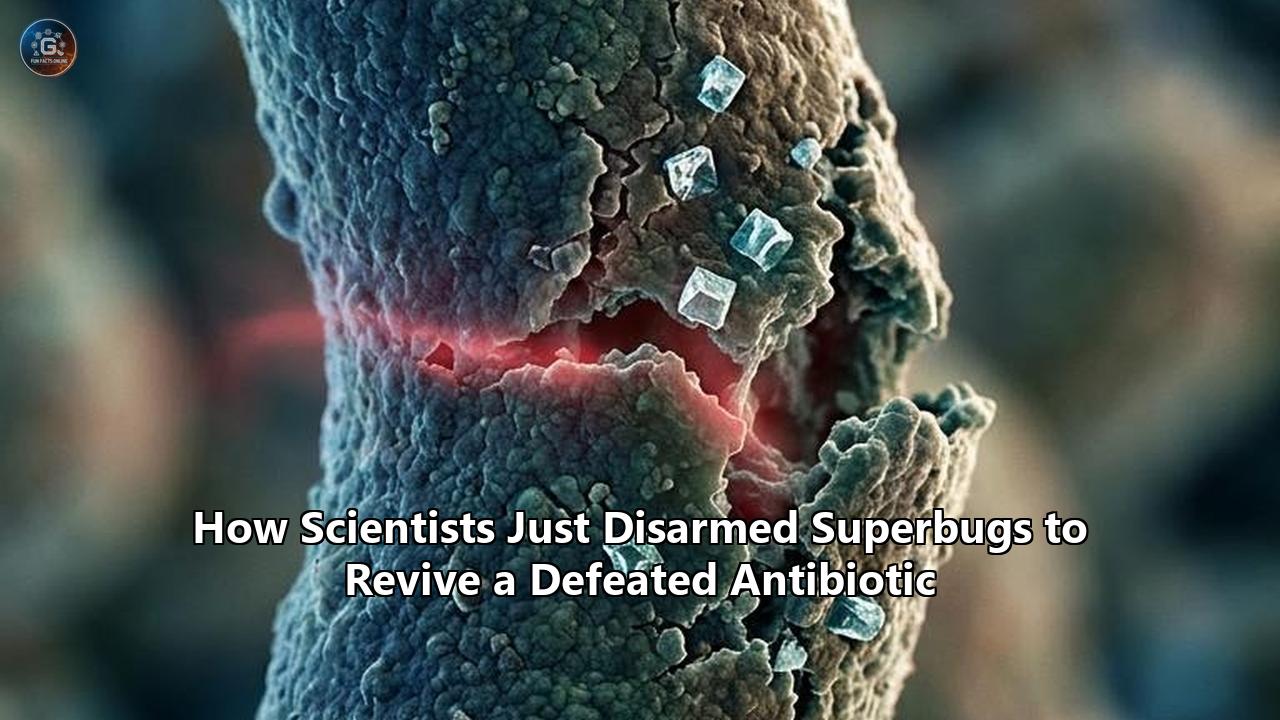
In a landmark study published in Nature Communications, researchers from Cold Spring Harbor Laboratory (CSHL) and Scripps Research revealed how they successfully restored the killing power of vancomycin—a frontline, last-resort antibiotic that superbugs had rendered ineffective.
Rather than manufacturing an entirely new antibiotic class from scratch, the multi-institutional team paired vancomycin with a small-molecule adjuvant named pghi-4. This chemical helper does not kill bacteria directly; instead, it selectively targets and blocks a critical bacterial enzyme called secreted antigen A (SagA).
When drug-resistant strains of Enterococcus faecium (VREfm) express SagA, the enzyme actively remodels the bacterial cell wall, altering its molecular architecture so vancomycin can no longer bind. By introducing pghi-4 to inhibit SagA, the researchers stripped the bacteria of their defensive shield. Stripped of this enzymatic defense, the superbug became instantly vulnerable to vancomycin once again.
┌─────────────────────────────────────────────────────────────────────────┐
│                      THE SAGA-INHIBITION STRATEGY                       │
├─────────────────────────────────────────────────────────────────────────┤
│ 1. RESISTANT STATE:                                                     │
│    Resistant Bacteria ──► Secreted Antigen A (SagA) Enzyme              │
│                             │                                           │
│                             ▼                                           │
│                        Remodels Peptidoglycan Cell Wall                 │
│                             │                                           │
│                             ▼                                           │
│                        Vancomycin Blocked ──► Superbug Survives         │
├─────────────────────────────────────────────────────────────────────────┤
│ 2. DISARMED STATE (ADJUVANT THERAPY):                                   │
│    pghi-4 Molecule ──► Covalently Inhibits SagA Enzyme                  │
│                             │                                           │
│                             ▼                                           │
│                        Cell Wall Remodeling Halts                       │
│                             │                                           │
│                             ▼                                           │
│                        Vancomycin Binds Lipid II ──► Superbug Destroyed │
└─────────────────────────────────────────────────────────────────────────┘
The breakthrough highlights the power of targeted chemistry in combatting antimicrobial resistance (AMR). The compound pghi-4 was originally discovered in 2020 by Professor John E. Moses at CSHL using a chemical methodology known as Diversity Oriented Clicking (DOC). By building a library of over 150 versatile molecules, Moses’s team provided the exact key needed by Professor Howard Hang’s laboratory at Scripps Research to disarm vancomycin-resistant enterococci.
"This discovery came from fundamental chemical research," explained John Moses, professor at CSHL. "Reaction development led to the discovery of the first inhibitor of an important enzyme involved in antibiotic resistance. This is a process we're constantly refining to both keep our library of molecules up to date and add more for collaborators to take advantage of in their research".
The implications of this discovery reach far beyond E. faecium. The SagA enzyme belongs to a broader family of peptidoglycan hydrolases that many dangerous hospital-acquired pathogens—including methicillin-resistant Staphylococcus aureus (MRSA) and Clostridium difficile—depend upon to evade human immunity and antimicrobial treatments. By neutralizing the enzyme that drives cell wall remodeling, scientists have established a clinical blueprint for reviving an entire class of defeated medicines.
The Challenge: The Molecular Armor of Drug-Resistant Pathogens
To understand why reviving vancomycin matters, one must examine the molecular arms race between human medicine and bacterial evolution. Discovered in 1953 and introduced clinically in 1958, vancomycin is a glycopeptide antibiotic that served for decades as the ultimate wall of defense against severe Gram-positive bacterial infections.
Vancomycin works by binding to D-alanyl-D-alanine (D-Ala-D-Ala) termini on peptidoglycan precursors—specifically Lipid II—outside the bacterial cytoplasmic membrane. By forming five hydrogen bonds with this target, vancomycin physically blocks the transpeptidase and transglycosylase enzymes needed to cross-link peptidoglycan chains. Without a structurally sound cell wall, osmotic pressure causes the bacterial cell to burst and die.
       VANCOMYCIN BINDING (SENSITIVE STRAIN)

       Vancomycin Molecule
            │  │  │  │  │  (5 Hydrogen Bonds)
            ▼  ▼  ▼  ▼  ▼
      [ D-Ala ] ─── [ D-Ala ]  ◄── Peptidoglycan Precursor (Lipid II)

      Result: Cell Wall Synthesis Blocked ──► Osmotic Lysis (Bacterial Death)

--------------------------------─────────────────────────────────────────

       VANCOMYCIN RESISTANCE (VAN-MUTATION STRAIN)

       Vancomycin Molecule
            │  │  │  │  x  (Binding Lost: 1,000x Lower Affinity)
            ▼  ▼  ▼  ▼
      [ D-Ala ] ─── [ D-Lac ]  ◄── Altered Precursor (vanA / vanB operons)

      Result: Cell Wall Synthesis Continues ──► Superbug Survives
Over decades of widespread clinical use, bacteria developed sophisticated defense mechanisms to bypass this lethal trap:
- Target Alteration (vanA and vanB Operons): Resistant bacteria swap the terminal D-alanine residue for D-lactate (D-Ala-D-Lac), removing a single hydrogen bond. This miniscule chemical modification reduces vancomycin’s binding affinity by a factor of 1,000, rendering standard therapeutic doses completely useless.
- Enzymatic Cell Wall Remodeling (SagA and NlpC/P60 Hydrolases): Pathogens like E. faecium rely on enzymes such as Secreted Antigen A (SagA) to cleave and restructure peptidoglycan fragments. This active remodeling alters wall thickness, surface charges, and cross-linking density, effectively screening D-Ala-D-Ala binding sites from circulating antibiotic molecules.
- Enzymatic Degradation: Gram-negative and Gram-positive superbugs produce specialized enzymes—such as beta-lactamases and aminoglycoside-modifying enzymes—that neutralize antibiotics before they reach their targets.
- Active Efflux Systems: Multidrug-resistant pumps (such as AcrAB-TolC in E. coli or MexAB-OprM in Pseudomonas aeruginosa) systematically eject drug molecules that penetrate the outer membrane.
- Permeability Barriers: Alterations in porin channels and thick outer membrane lipopolysaccharides prevent polar antibiotics from entering bacterial cells altogether.
When E. faecium acquired the ability to execute cell wall remodeling through SagA while deploying altered peptidoglycan precursors, vancomycin-resistant enterococci (VRE) emerged as a major cause of hospital-acquired morbidity. VRE infections frequently strike critically ill, immunocompromised, or post-surgical patients, causing endocarditis, bloodstream infections, urinary tract infections, and surgical site complications.
Treating VRE has historically forced clinicians to rely on newer, far more expensive, and often more toxic alternatives such as daptomycin or linezolid. Yet, resistance to these newer agents has already been documented in ICU wards worldwide, threatening a scenario where common surgical procedures become untreatable.
The Economic and Biological Pipeline Failure
The SagA discovery addresses a fundamental crisis in public health: the complete collapse of traditional antibiotic discovery pipelines.
For more than thirty years, global pharmaceutical companies have largely abandoned the development of novel antibacterial drugs. Developing a new antibiotic class from scratch requires over a decade of R&D and routinely costs upwards of $1.5 billion. However, unlike chronic disease medications for hypertension, diabetes, or oncology—which patients take daily for years—antibiotics are prescribed for short, 5-to-14-day courses.
Furthermore, when a novel, highly effective antibiotic reaches the market, public health organizations immediately classify it as a "reserve drug" of last resort. Hospitals are urged to restrict its usage to prevent early resistance development. From a venture capital or corporate finance perspective, this creates an unsustainable business model: companies spend billions to invent a product that stewardship guidelines require clinicians not to use.
               TRADITIONAL ANTIBIOTIC DISCOVERY COLLAPSE

   ┌────────────────────────────────────────────────────────┐
   │ High R&D Costs ($1.5B+) & 10–15 Year Timelines         │
   └───────────────────────────┬────────────────────────────┘
                               │
                               ▼
   ┌────────────────────────────────────────────────────────┐
   │ Short Treatment Duration (5–14 Days per Patient)       │
   └───────────────────────────┬────────────────────────────┘
                               │
                               ▼
   ┌────────────────────────────────────────────────────────┐
   │ Immediate Restriction as "Last Resort Reserve Drug"    │
   └───────────────────────────┬────────────────────────────┘
                               │
                               ▼
   ┌────────────────────────────────────────────────────────┐
   │ Financial Insolvency / Bankruptcy for Biotech Firms    │
   └───────────────────────────┬────────────────────────────┘
                               │
                               ▼
   ┌────────────────────────────────────────────────────────┐
   │ Zero New Classes Discovered ──► Accelerated AMR Crisis │
   └────────────────────────────────────────────────────────┘
The commercial reality of this market failure is stark. Multiple biotech firms that successfully secured regulatory approvals for innovative antibiotics over the last decade declared bankruptcy shortly after product launch due to stagnant sales volumes.
Meanwhile, the biological tax of antimicrobial resistance continues to accumulate rapidly:
- Global Mortality: Data published in The Lancet and monitored by the World Health Organization (WHO) indicates that bacterial AMR directly causes 1.27 million deaths annually and plays a role in nearly 5 million fatalities globally.
- Future Trajectory: Unchecked resistance is projected to cause up to 39 million direct deaths between 2025 and 2050, disproportionately affecting elderly populations and patients requiring complex medical care.
- Economic Impact: The World Bank estimates that severe AMR scenarios will add $1 trillion in extra annual healthcare costs by 2050 and reduce global Gross Domestic Product (GDP) by $1.1 trillion to $3.4 trillion annually due to prolonged hospitalizations and labor productivity losses.
- The Threat to Modern Medicine: Without effective antibacterial cover, routine chemotherapy, organ transplants, joint replacements, and premature infant care become high-risk procedures.
Because creating brand-new antibiotic molecules is plagued by commercial and scientific hurdles, exploring non-traditional antibiotic resistance solutions offers a far more sustainable, cost-effective economic and biological pathway.
Instead of searching for new targets that bacteria will inevitably mutate against within a few years, disarming bacterial defense mechanisms allows clinicians to recycle decades of proven safety and pharmacokinetic data associated with existing antibiotics.
  ========================================================================================
                                 GLOBAL IMPACT METRICS OF AMR
  ========================================================================================
  Metric                                    Value / Estimate                Reference
  ----------------------------------------------------------------------------------------
  Direct Annual Global Deaths               1.27 Million                    Lancet / WHO
  Associated Annual Global Deaths           4.95 Million                    Lancet / WHO
  Projected Cumulative Deaths (2025–2050)   39 Million                      WHO Projections
  US Annual AMR Infections                  2.8 Million+                    CDC Reports
  US Annual AMR Fatalities                  35,000+                         CDC Reports
  Projected Annual Healthcare Cost (2050)   $1.0 Trillion USD               World Bank
  Projected Annual Global GDP Loss          $1.1T to $3.4T USD              World Bank
  ========================================================================================
The Adjuvant Strategy: Disarming Bacteria to Restore Existing Drugs
The success of Moses and Hang in restoring vancomycin efficacy demonstrates the therapeutic power of antibiotic adjuvants—also known as resistance-breakers or potentiators. Adjuvants are companion compounds that carry little or no inherent bactericidal activity at therapeutic doses. Instead, they systematically dismantle the molecular shields that pathogens build against antimicrobial agents.
Adjuvants fall into distinct functional classes based on their pharmacological target and mechanism of action.
┌─────────────────────────────────────────────────────────────────────────┐
│                    TAXONOMY OF ANTIBIOTIC ADJUVANTS                     │
├─────────────────────────────────────────────────────────────────────────┤
│ CLASS IA: INHIBITORS OF ACTIVE RESISTANCE                               │
│  • Target: Directly block resistance enzymes & efflux systems          │
│  • Examples: Beta-lactamase inhibitors (Avibactam), SagA inhibitors    │
│    (pghi-4), Efflux pump inhibitors (EPIs)                              │
├─────────────────────────────────────────────────────────────────────────┤
│ CLASS IB: INHIBITORS OF PASSIVE RESISTANCE                              │
│  • Target: Alter physical permeability barriers & membrane structures   │
│  • Examples: Polymyxin derivatives, Pentamidine analogues,              │
│    Cationic membrane potentiators                                       │
├─────────────────────────────────────────────────────────────────────────┤
│ CLASS II: HOST-DIRECTED & PHYSIOLOGY ADJUVANTS                          │
│  • Target: Modulate host immunity, disrupt biofilms, alter ROS dynamics │
│  • Examples: Catalase-infused dressings, Immune-checkpoint modulators   │
└─────────────────────────────────────────────────────────────────────────┘
1. Class IA: Direct Inhibitors of Resistance Enzymes
This category represents the most clinically established group of adjuvants. The classic paradigm is clavulanic acid, paired with amoxicillin (Augmentin). Clavulanic acid irreversibly binds and inactivates beta-lactamase enzymes produced by bacteria to destroy penicillin ring structures.
Modern efforts have expanded this strategy to combat carbapenemases:
- Serine Beta-Lactamase Inhibitors: Compounds such as avibactam, vaborbactam, and relebactam inhibit Class A and Class C beta-lactamases, restoring carbapenem sensitivity against Klebsiella pneumoniae carbapenemase (KPC)-producing Enterobacteriaceae.
- Metallo-Beta-Lactamase (MBL) Inhibitors: Newer candidates target zinc-dependent enzymes like New Delhi metallo-beta-lactamase-1 (NDM-1) and Verona integron-encoded metallo-beta-lactamase (VIM), which break down almost all beta-lactam antibiotics.
- Peptidoglycan Hydrolase Inhibitors (pghi-4): The discovery from CSHL and Scripps establishes a new frontier within Class IA. By covalently targeting SagA, pghi-4 stops peptidoglycan remodeling, leaving bacterial cell wall synthesis open to vancomycin inhibition.
                         THE PGHI-4 / SAGA MECHANISM

  [ VRE Cell Wall ] ──► Expresses SagA Hydrolase ──► Remodels Peptidoglycan ──► Vancomycin Repelled
                                 │
                                 ▼ (Inhibition by pghi-4)
  [ pghi-4 Adjuvant ] ──► Covalently Blocks SagA ──► Remodeling Halts ──► Vancomycin Binds D-Ala-D-Ala
The chemistry behind pghi-4 relies on Diversity Oriented Clicking (DOC), a modular synthetic platform created in John Moses’s laboratory. DOC utilizes Sulfur-Fluoride Exchange (SuFEx) and click-chemistry hubs to connect diverse molecular building blocks with near-perfect reliability. This allowed the researchers to quickly screen hundreds of candidate molecules against bacterial enzymes, isolating pghi-4 as a potent blocker of SagA activity.
2. Class IB: Membrane Potentiators and Efflux Blockers
Pathogens—particularly Gram-negative superbugs—feature dense, low-permeability outer membranes that prevent large or hydrophobic antibiotic molecules from entering. Class IB adjuvants weaken these physical barriers without killing the cell outright:
- Pentamidine Analogues: Research published by chemistry consortia demonstrates that modified pentamidine compounds disrupt outer lipopolysaccharide (LPS) layers in Acinetobacter baumannii and Pseudomonas aeruginosa. When paired with large-molecule antibiotics like novobiocin or rifampicin, these potentiators breach the outer membrane barrier, rendering Gram-negative pathogens sensitive to drugs that previously could not cross into the bacterial cell.
- Efflux Pump Inhibitors (EPIs): Small molecules that bind to membrane-spanning pumps (like AcrAB-TolC) block bacteria from expelling drugs. This maintains lethal intra-bacterial drug concentrations even in strains carrying resistance genes.
3. Aptamer-Based Adjuvants
Novel adjuvant formats are expanding beyond standard small molecules. Research teams at IIT Bombay led by Prof. Ruchi Anand and Prof. Pradeepkumar P. I. introduced a class of antibiotic adjuvants made from DNA aptamers.
These single-stranded nucleic acid sequences fold into specialized three-dimensional structures that bind bacterial resistance proteins with high target specificity. By blocking enzyme active sites or preventing target modification, aptamers re-sensitize multidrug-resistant isolates to standard treatment.
================================================================================================================================
                                MAJOR ANTIBIOTIC ADJUVANT CLASSES & CLINICAL STATUS
================================================================================================================================
Adjuvant Compound       Target Mechanism                  Companion Antibiotic    Pathogens Targeted           Development Status
--------------------------------------------------------------------------------------------------------------------------------
Avibactam               Serine Beta-Lactamases            Ceftazidime             K. pneumoniae, E. coli       FDA Approved / Clinical
Vaborbactam             KPC Carbapenemases                Meropenem               Enterobacteriaceae           FDA Approved / Clinical
Ledaborbactam etzadroxil Class A, C, D Beta-Lactamases     Ceftibuten              MDR Enterobacteriaceae       Phase III Clinical Trials
pghi-4                  SagA Peptidoglycan Hydrolase      Vancomycin              VREfm, MRSA, C. diff         Preclinical (CSHL/Scripps)
Pentamidine Analogues   Outer Membrane LPS Structure      Novobiocin              A. baumannii, P. aeruginosa  Preclinical Discovery
DNA Aptamers (IIT)      Bacterial Defense Enzymes         Beta-lactams            MDR Gram-Negative Strains    Preclinical Discovery
================================================================================================================================
Disarming bacterial defense mechanisms is emerging as one of the most clinically viable antibiotic resistance solutions available to modern medicine. Adjuvants reduce the evolutionary selection pressure that drives traditional antibiotic resistance.
Because an adjuvant like pghi-4 does not kill the bacterium on its own, it minimizes the survival pressure that causes bacteria to rapidly mutate. When paired with a revived antibiotic, the bacterial population is eradicated before escape mutations can take hold.
Alternative Frontiers in Combating Drug-Resistant Superbugs
While small-molecule adjuvants lead the effort to revive defeated drugs, researchers are also evaluating alternative antibiotic resistance solutions that bypass traditional bactericidal mechanisms entirely.
                             NEXT-GENERATION THERAPEUTIC FRONTIERS

          ┌──────────────────────────────────────────────────────────────┐
          │             Bacteriophage & Endolysin Therapy                │
          │  • Tailored lytic phages kill specific superbug strains      │
          │  • Recombinant lysins degrade cell walls externally          │
          └──────────────────────────────┬───────────────────────────────┘
                                         │
                                         ▼
          ┌──────────────────────────────────────────────────────────────┐
          │               CRISPR-Cas Anti-Plasmid Tools                  │
          │  • Cut specific resistance genes (vanA, blaNDM)              │
          │  • Clear plasmids; restore wild-type drug sensitivity        │
          └──────────────────────────────┬───────────────────────────────┘
                                         │
                                         ▼
          ┌──────────────────────────────────────────────────────────────┐
          │             Microbial Metabolism & Biofilm Tools             │
          │  • Neutralize reactive species (Catalase enzymes)            │
          │  • Disrupt extracellular polymeric matrix; restore healing   │
          └──────────────────────────────┬───────────────────────────────┘
                                         │
                                         ▼
          ┌──────────────────────────────────────────────────────────────┐
          │               Synthetic Target Overhaul                      │
          │  • Fully synthetic compounds (Cresomycin)                    │
          │  • Pre-organize binding to overcome ribosomal methylation    │
          └──────────────────────────────────────────────────────────────┘
1. Bacteriophage Therapy and Engineered Endolysins
Bacteriophages—viruses that infect and destroy specific bacterial strains—offer an alternative to systemic broad-spectrum antibiotics.
- Precision Targeting: Unlike broad-spectrum drugs that disrupt the host microbiome, phages destroy only target pathogens.
- Evolving Counter-Defenses: If a bacterium develops resistance to a phage, the phage can co-evolve or be genetically altered to overcome that resistance mechanism.
- Recombinant Lysins: Purified phage-derived endolysins can be applied directly to bacterial cell walls. These enzymes degrade peptidoglycan bonds externally, causing rapid cell lysis regardless of antibiotic resistance profiles.
2. CRISPR-Cas Anti-Plasmid Systems
Researchers are using CRISPR-Cas gene-editing tools to target resistance genes inside living host tissues. Delivered via modified bacteriophages or lipid nanoparticles, Cas endonucleases are programmed to seek out and cut plasmid-borne resistance markers like vanA, blaNDM-1, or mcr-1 (colistin resistance).
Cutting these plasmid sequences degrades the resistance gene, killing the plasmid and sensitizing the remaining bacterial population to standard antibiotic treatments.
3. Targeting Biofilm and ROS Metabolism
Bacteria in chronic wound infections or medical device biofilms enter a protected metabolic state that renders antibiotics ineffective.
International research teams led by Nanyang Technological University (NTU Singapore) uncovered a method to disarm antibiotic-resistant E. faecalis in chronic wounds. The researchers discovered that the bacteria produce excess hydrogen peroxide, which damages human tissue cells and halts wound healing.
Rather than attempting to kill the bacteria with stronger antibiotics, the team treated infected tissue with catalase—an antioxidant enzyme that breaks down hydrogen peroxide into water and oxygen. Neutralizing this bacterial metabolic byproduct eliminated host cell stress and allowed native skin cells to repair tissue.
  [ E. faecalis Biofilm ] ──► Secretes Excess H2O2 ──► Host Cell Damage & Chronic Wound
                                      │
                                      ▼ (Catalase Treatment)
  [ Antioxidant Dressings ] ──► Converts H2O2 ──► H2O + O2 ──► Tissue Healing Restored
This approach demonstrates that disarming bacterial virulence mechanisms can resolve persistent infections without relying on direct-kill bactericidal agents.
4. Synthetic Target-Overhaul Chemistry
Where adjuvants are unavailable, synthetic chemists are engineering antibiotic scaffolds that physically override bacterial resistance mutations.
A prominent example is Cresomycin, a synthetic macrolide candidate. Many drug-resistant pathogens mutate or methylate their ribosomal RNA, preventing traditional macrolide antibiotics (such as erythromycin or azithromycin) from binding. Cresomycin features a rigid, pre-organized conformation that locks onto altered bacterial ribosomes despite structural target mutations.
In pre-clinical studies, Cresomycin showed complete clearance against MRSA, multidrug-resistant Pseudomonas aeruginosa, and vancomycin-resistant isolates.
Policy, Global Stewardship, and the Clinical Horizon
Restoring defeated antibiotics using adjuvants like pghi-4 requires changes to global healthcare policies, drug regulatory frameworks, and pharmaceutical funding models.
Regulatory and Clinical Trial Alignment
Developing combination therapies introduces regulatory challenges. Drug approval agencies like the U.S. Food and Drug Administration (FDA) and the European Medicines Agency (EMA) historically evaluated new drugs as standalone monotherapies. Assessing an adjuvant combination requires proving both safety and synergy:
- Demonstrating that the adjuvant itself carries an acceptable toxicity profile across diverse patient demographics.
- Proving that the adjuvant-antibiotic combination provides statistically superior clinical clearance compared to the antibiotic alone.
- Establishing precise clinical dosing schedules to ensure target serum concentrations for both compounds are maintained simultaneously.
┌──────────────────────────────────────────────────────────────────────────┐
│                   STAKEHOLDER ACTION MATRIX FOR AMR                      │
├──────────────────────────────────────────────────────────────────────────┤
│ RESEARCH INSTITUTIONS & LEADING LABS                                     │
│  • Expand synthetic libraries using modular chemistry (e.g., DOC)        │
│  • Target non-lethal bacterial enzymes (SagA, MBLs, Efflux pumps)       │
├──────────────────────────────────────────────────────────────────────────┤
│ PHARMACEUTICAL & BIOTECH FIRMS                                           │
│  • Prioritize adjuvant-antibiotic combinations to revive generic drugs   │
│  • Conduct joint pharmacokinetic studies to align clinical dosing        │
├──────────────────────────────────────────────────────────────────────────┤
│ GOVERNMENT REGULATORS & POLICYMAKERS                                     │
│  • Enact "pull" incentives (PASTEUR Act, Netflix-style subscriptions)    │
│  • Streamline combination-therapy approval pathways                      │
├──────────────────────────────────────────────────────────────────────────┤
│ HOSPITALS & HEALTH SYSTEMS                                               │
│  • Deploy rapid molecular diagnostics (NGS, AI profiling)                │
│  • Integrate adjuvant therapies into formal antimicrobial stewardship    │
└──────────────────────────────────────────────────────────────────────────┘
To encourage development in this area, global policy frameworks must incentivize antibiotic resistance solutions that reward value over volume.
Governments are testing pull-incentive strategies like subscription-based reimbursement models. Pioneered by the National Health Service (NHS) in the United Kingdom, this "Netflix model" pays pharmaceutical developers a fixed annual fee based on an antibiotic's value to public health rather than the volume of pills sold.
In the United States, proposed legislation like the PASTEUR Act aims to establish similar subscription models, providing developers with reliable return on investment while preserving antimicrobial stewardship.
                 TRADITIONAL VS. SUBSCRIPTION REIMBURSEMENT

  TRADITIONAL MODEL:
  Revenue = (Volume of Drugs Sold) x (Price per Unit)
  │
  └──► Conflict: Stewardship dictates LOW volume ──► Financial Loss / Bankruptcy

----------------------------------------------------------------─────────

  SUBSCRIPTION ("NETFLIX") MODEL:
  Revenue = Fixed Annual Government Fee (Based on Public Health Value)
  │
  └──► Alignment: Guaranteed return on investment + STRICT stewardship enforced
Global Health Equity and Diagnostic Precision
The burden of AMR is highest in low- and middle-income countries (LMICs), where access to costly second- and third-line antibiotics remains limited. Adjuvant therapies like pghi-4 offer an affordable alternative: because vancomycin is off-patent and produced at scale globally, pairing it with an adjuvant molecule can deliver effective treatments to resource-limited healthcare systems at a fraction of the cost of new patented drugs.
Non-profit global partnerships like CARB-X (Combating Antibiotic-Resistant Bacteria Biopharmaceutical Accelerator) and GARDP (Global Antibiotic Research and Development Partnership) are investing in adjuvant R&D, rapid diagnostic platforms, and equitable distribution initiatives.
  ========================================================================================
                          KEY ORGANIZATIONS ADVANCING AMR SOLUTIONS
  ========================================================================================
  Organization    Type                       Core Focus Strategy             Reference
  ----------------------------------------------------------------------------------------
  CARB-X          Global PPP Non-Profit      Early-stage drug R&D funding
  GARDP           Global Non-Profit          Late-stage development / LMICs
  CSHL Moses Lab  Academic Chemistry Lab     Diversity-Oriented Clicking
  Scripps Hang    Microbiology Laboratory    Bacterial enzyme target mapping
  IIT Bombay      Academic Research          DNA aptamer-based adjuvants
  ========================================================================================
At the same time, clinical success relies on rapid diagnostic technologies. Point-of-care Next-Generation Sequencing (NGS) and AI-driven diagnostic platforms can analyze a patient's infection profile within two hours, identifying specific resistance mechanisms—such as SagA expression, vanA operon activation, or carbapenemase production.
Clinicians can then select targeted adjuvant-antibiotic combinations tailored to the exact bacterial defense profile present, eliminating reliance on empiric broad-spectrum antibiotics.
What to Watch Next
- Clinical Translation of pghi-4: Following the publication of the Moses and Hang findings in Nature Communications, pre-clinical safety, toxicity, and pharmacokinetic studies will determine whether pghi-4 advances to Phase I human clinical trials.
- Expansion to Other Pathogens: Researchers are testing whether SagA-like NlpC/P60 hydrolase inhibitors can restore antibiotic activity against other high-priority pathogens, including MRSA and C. difficile.
- Late-Stage Combination Approvals: Phase III clinical trial readouts for advanced adjuvants—such as ledaborbactam etzadroxil combined with ceftibuten—will test market viability for next-generation resistance-breakers.
- Legislative Progress: Watching whether key global economies adopt subscription funding mechanisms will indicate whether commercial conditions will support ongoing adjuvant discovery.
By disarming superbugs instead of searching for new ways to destroy them, scientists have unlocked a practical strategy in the fight against antibiotic resistance. Restoring vancomycin proves that with targeted chemical tools, defeated antibiotics can become effective medical treatments once again.
References
- Cold Spring Harbor Laboratory (CSHL) & Scripps Research. (2026). Inactivation of peptidoglycan remodeling promotes antibiotic susceptibility in vancomycin-resistant Enterococcus faecium. Nature Communications / bioRxiv.
- World Health Organization (WHO). (2024–2026). Antimicrobial Resistance Global Report and Priority Pathogens List.
- Royal Society of Chemistry (RSC). (2026). Current antibacterial discovery and development landscape. RSC Drug Discovery.
- Frontiers in Pharmacology. (2025–2026). Small molecule strategies and antibiotic adjuvants to overcome Antibiotic Resistance (AR).
- Down To Earth / IIT Bombay Research. (2026). Disabling bacterial defence mechanisms: β-lactamase inhibitors and DNA aptamer-based adjuvants.
- Nanyang Technological University (NTU Singapore). (2026). Neutralizing bacterial metabolism ROS in chronic wound infections.
- IQVIA Institute for Human Data Science. (2025–2026). Global AMR Pipeline Analysis and CARB-X Portfolio Metrics.
- Clinical Leader / TAXIS Pharmaceuticals. (2025–2026). Strategic Research Imperatives and Clinical Trial Trends for AMR.
Reference:
- http://www.cshl.edu/a-secret-weapon-against-superbugs/
- https://www.biorxiv.org/content/10.1101/2025.09.11.675460v1
- https://www.cshl.edu/a-secret-weapon-against-superbugs/
- https://ground.news/article/scientists-revive-a-powerful-antibiotic-that-superbugs-had-defeated
- https://news.ssbcrack.com/researchers-restore-effectiveness-of-vancomycin-against-drug-resistant-bacteria/
- https://www.downtoearth.org.in/health/alternative-therapies-may-offer-a-new-way-to-fight-antibiotic-resistance
- https://www.clinicalleader.com/doc/the-rise-of-antimicrobial-resistance-and-strategic-research-imperatives-for-2026-0001
- https://www.sciencedaily.com/releases/2025/10/251029002855.htm
- https://pubs.rsc.org/cs/article/doi/10.1039/d5cs00617a/1266910/Antibacterial-drug-discovery-challenges-and
- https://www.frontiersin.org/journals/microbiology/articles/10.3389/fmicb.2025.1517772/full
- https://www.youtube.com/watch?v=I8OXNQtyEmM
- https://www.iqvia.com/-/media/iqvia/pdfs/library/white-papers/steps-towards-addressing-antimicrobial-resistance-iqvia-white-paper.pdf
- https://atlasidp.com/scientists-revive-a-powerful-antibiotic-that-superbugs-had-defeated/
- https://www.frontierspartnerships.org/journals/journal-of-pharmacy-pharmaceutical-sciences/articles/10.3389/jpps.2026.16158/full
- https://www.ijpsjournal.com/article/Antibiotic+Resistance+Current+Challenges+and+Future+Directions
- https://moseslab.cshl.edu/publications/
- https://www.ntu.edu.sg/research/research-at-ntu/detail/new-way-to-disarm-antibiotic-resistant-bacteria-and-restore-healing-in-chronic-wounds