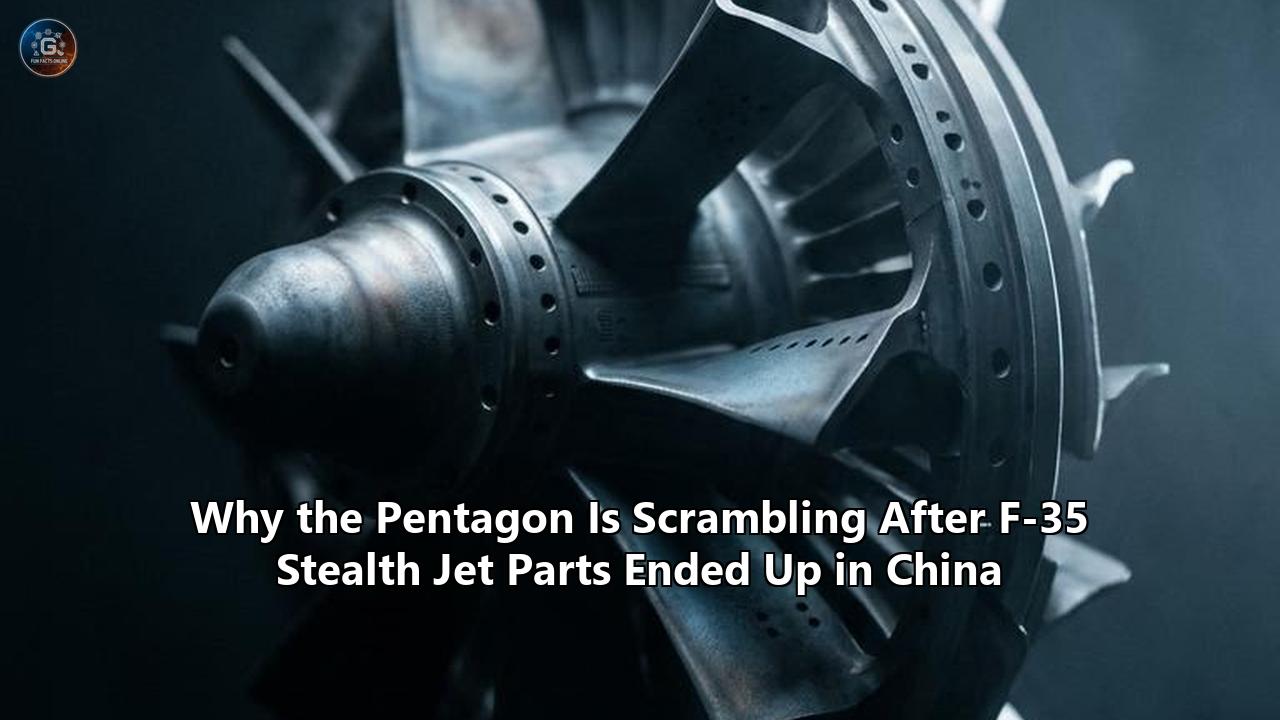
A transpacific cargo shipment containing two classified structural assemblies from a Royal Australian Air Force (RAAF) F-35A Lightning II—a cockpit canopy and an internal weapons-bay door—was diverted to Hong Kong and seized by Chinese government authorities, setting off an emergency interagency scramble across the Department of Defense, the U.S. State Department, and Capitol Hill. The transit failure, which occurred in late May 2026 and emerged publicly following closed-door congressional inquiries, has placed authentic fifth-generation stealth hardware coated in radar-absorbing material directly into the hands of the People’s Liberation Army (PLA).
The components were removed from an Australian F-35A operating out of RAAF Base Williamtown and routed via RAAF Base Edinburgh near Adelaide. Packaged for return to Lockheed Martin facilities in the United States for maintenance, nondestructive testing, or disposal, the crates were entrusted to commercial freight handler UPS and logistics intermediary CEVA Logistics.
Flight tracking records and export documents indicate the shipment departed Australia, transited a major commercial hub at Incheon International Airport in South Korea, and then, under circumstances still under federal investigation, was rerouted into Hong Kong International Airport.
Upon touchdown in the Special Administrative Region, mainland Chinese security agencies took physical custody of both assemblies. Despite immediate diplomatic interventions and formal recovery demands, Beijing has refused to return the hardware.
TRANSIT ANOMALY: FLIGHT MANIFEST & ROUTING TIMELINE
Origin:             RAAF Base Williamtown / Edinburgh, Australia
Destination:        Lockheed Martin Depot, Fort Worth / Palmdale, United States
Contracted Route:   Adelaide (ADL) -> Seoul/Incheon (ICN) -> Anchorage (ANC) -> Continental US
Actual Diversion:   Seoul/Incheon (ICN) -> Hong Kong (HKG) [Terminal Retention]
Assemblies Lost:    1x Monolithic Polycarbonate Canopy (RAM/ITO Vapor Coated)
                    1x Internal Weapons-Bay Structural Door Assembly
Custody Status:     Retained by PRC State Authorities (Non-Responsive to Recovery)
Logistics Providers: CEVA Logistics / UPS Commercial Cargo
The physical presence of authentic F-35 parts in China represents a catastrophic failure of defense distribution networks. While Australian Defense Minister Richard Marles attempted to mitigate public fallout by asserting that the crates did not contain "sensitive equipment," Pentagon technical teams and weapons inspectors view the incident with alarm.
The assemblies carry the exact geometric tolerances, composite bonding agents, and proprietary chemical coatings that give the multirole fighter its microscopic radar cross-section (RCS). The diversion has transformed a chronic logistics headache into a national security emergency, forcing the Pentagon’s F-35 Joint Program Office (JPO) to audit the entire overseas transit architecture supporting more than 1,340 delivered airframes across 19 operating nations.
The Stealth Geometry: What 0.0015 Square Meters Means in the Laboratory
To assess why the Pentagon scrambled emergency teams to retrieve two physical panels, one must understand the math governing fifth-generation low observability. The F-35 possesses an operational radar cross-section widely estimated at approximately 0.0015 square meters—equivalent to the radar return of a steel golf ball or a large marble.
Achieving this signature requires an uncompromising combination of airframe shaping, composite edge treatments, and proprietary radar-absorbent materials (RAM).
RADAR SIGNATURE COMPARISON (RADAR CROSS SECTION IN METERS SQUARED)
--------------------------------------------------------------------------------
Su-27 Flanker (Russian 4th Gen):        10.0 m²  [■■■■■■■■■■■■■■■■■■■■]
F-15C Eagle (US 4th Gen):               5.0 m²   [■■■■■■■■■■]
F/A-18E Super Hornet (4.5 Gen):         0.1 m²   [■]
Chengdu J-20 (Estimated Chinese 5th Gen):0.01 m²  [▪]
F-35 Lightning II (US 5th Gen):         0.0015 m² [▫]
--------------------------------------------------------------------------------
For two decades, China’s primary intelligence vector against the Joint Strike Fighter was cyber espionage. Between 2007 and 2012, cyber operators associated with the PLA compromised sub-tier defense contractors, exfiltrating terabytes of design data, structural schematics, and simulation models. That stolen digital data accelerated the development of China’s fifth-generation Shenyang J-35 (formerly FC-31) naval stealth fighter and the Chengdu J-20 heavy interceptor.
Yet virtual models differ fundamentally from actual physical components. Having intact F-35 parts in China grants Beijing’s aerospace engineers and materials scientists access to production-grade physical solutions that cannot be replicated through computer-aided design (CAD) blueprints.
PHYSICAL REVERSE-ENGINEERING TARGETS (CANOPY & WEAPONS BAY DOOR)
+------------------------+-----------------------------+-----------------------------+
| Component              | Material Science Layering    | Technical Intelligence Risk |
+------------------------+-----------------------------+-----------------------------+
| Cockpit Canopy         | Polycarbonate Substrate;    | Measurement of exact ITO    |
|                        | Indium-Tin Oxide (ITO) and  | vapor deposition thickness; |
|                        | Gold Vapor Attenuation;    | Cockpit cavity return       |
|                        | Dielectric Interlayers      | calibration; X-band tuning  |
+------------------------+-----------------------------+-----------------------------+
| Weapons-Bay Door       | Carbon-Bismaleimide (BMI);  | Resins, binders, and filler |
|                        | Sintered Carbon-Iron Matrix | grain sizes; Edge diffusers;|
|                        | Fibermat Skin Integration   | Surface wave dissipation    |
+------------------------+-----------------------------+-----------------------------+
The Cockpit Canopy
The cockpit transparency of an advanced fighter is typically one of its most vulnerable radar reflectors. An untreated cockpit acts as a hollow electromagnetic cavity; radar energy enters through the transparent bubble, bounces off the pilot's helmet, the ejection seat rails, and the instrument displays—generating a radar return often exceeding one square meter.
To eliminate this cavity resonance, the F-35’s canopy is manufactured via a proprietary autoclave process that embeds microscopic layers of indium-tin oxide (ITO) and metallic vapor (including gold) directly between structural polycarbonate plies. This creates a conductive, transparent shield that deflects incident radar waves across the 8-to-12 GHz X-band while allowing visible light transmission for the pilot.
With physical possession of the canopy, technicians at the Aviation Industry Corporation of China (AVIC) do not have to guess at the coating thickness or chemical binding agents. Spectroscopic analysis, focused ion beam milling, and transmission electron microscopy allow them to map the exact cross-section to the nanometer.
The Weapons-Bay Door Assembly
While the canopy controls electromagnetic entry into the cockpit, the internal weapons-bay doors manage boundary-layer current flows and edge diffraction. The F-35's skin utilizes a "fibermat" radar-absorbent material integrated directly into the resin matrices of the composite structures, rather than the fragile, high-maintenance topcoats previously employed on the B-2 Spirit and early F-22 Raptors.
The weapons-bay doors are high-stress moving panels subjected to intense aerodynamic turbulence and thermal cycles during supersonic dash profiles. The structural tolerances where the door seam interfaces with the fuselage are held to under 0.005 inches (5 mils) to prevent surface-traveling radar waves from catching on discontinuities and radiating back to threat radars.
Direct laboratory testing of these panels provides Chinese engineers with empirical data on:
- Complex Dielectric Permittivity ($\epsilon_r$) and Magnetic Permeability ($\mu_r$): The exact electromagnetic absorption properties across ultra-high frequency (UHF), L-band, S-band, and X-band radars.
- Filler Ratios and Carbon Micro-Structures: The precise distribution of carbonyl iron, ferrite particles, and carbon nanotubes dispersed within the bismaleimide (BMI) resin.
- Acoustic and Mechanical Damping: How Lockheed Martin bonds moving mechanical edges to prevent micro-cracking and stealth degradation over thousands of flight hours.
Possessing these materials allows Chinese counter-stealth radar developers—chiefly the 14th Research Institute of China Electronics Technology Group Corporation (CETC)—to fine-tune ground-based and airborne radars like the JY-27A 3-D meter-wave surveillance system and the KLJ-7A airborne active electronically scanned array (AESA) to spot specific signature gaps in the F-35 profile.
Tracking Breakdown: The Mechanics of the Commercial Supply Chain Diversion
The primary question reverberating across Capitol Hill is operational: How did primary stealth components from the frontline strike fighter of an allied military get routed into Chinese territory on a commercial freight carrier?
GLOBAL LOGISTICS INTERACTION
--------------------------------------------------------------------------------
[RAAF 72x F-35A Fleet]
          │ (Maintenance Extraction)
          ▼
[CEVA Logistics Ground Handling]
          │ (Commercial Air Manifest Creation)
          ▼
[UPS Commercial Air Freight] ──► [Incheon Hub (ICN)] ──► [ABNORMAL DETOUR]
                                                                 │
                                                                 ▼
                                                       [Hong Kong Hub (HKG)]
                                                                 │
                                                                 ▼
                                                       [PRC State Seizure]
--------------------------------------------------------------------------------
Unlike legacy fighter fleets where each nation managed isolated domestic stockpiles of spare parts, the F-35 program operates on a centralized "Global Spares Pool" governed by Lockheed Martin and managed through algorithmic distribution networks. All participating nations—the United States, the United Kingdom, Australia, Italy, the Netherlands, Norway, Japan, and other Foreign Military Sales (FMS) operators—draw from and contribute to this shared inventory.
The Royal Australian Air Force operates 72 F-35A aircraft. When a component requires higher-level depot maintenance or non-destructive ultrasonic evaluation, it enters the global repair pipeline. Because military air transport (such as C-17 Globemaster III or C-130J Hercules flights) is reserved for priority combat deployments or weapons movements, the program relies systematically on third-party commercial logistics providers (3PL).
The components in question were cataloged as "unserviceable repairable items" and processed through CEVA Logistics, an intermediary freight forwarder operating under Lockheed Martin's overarching supply contract. From there, custody transferred to UPS for transpacific air cargo movement.
A standard logistics route from Australia to North American repair depots routes through regional consolidation points in East Asia before transiting to Anchorage, Alaska, and into the continental United States. During the shipment in late May, following a layover at Incheon, South Korea, the cargo container was placed on a flight destined for Hong Kong.
The Pentagon’s Defense Contract Management Agency (DCMA) and the Air Force Office of Special Investigations (AFOSI) are currently interrogating three hypotheses:
- Automated Cargo Misrouting: A system misread or mislabeling error during high-volume transshipment in Incheon routed the pallet onto a standard commercial parcel feeder bound for the Hong Kong logistics hub.
- Contractor Compliance Failure: Commercial intermediaries routed the package through lower-cost regional sorting infrastructure without cross-checking the manifest against International Traffic in Arms Regulations (ITAR) Category VIII prohibitions and Munitions List geographic restrictions.
- Targeted Physical Interdiction: Intelligence services orchestrated or exploited a shipping vulnerability, intentionally rerouting the package into Chinese sovereign territory via digital manifest manipulation.
When the components cleared into Hong Kong customs, automated tracking flagged the military part numbers. Hong Kong Customs and Excise Department personnel and Chinese state security officials impounded the containers. By the time UPS filed a report of diversion with the Directorate of Defense Trade Controls (DDTC) at the U.S. State Department, Chinese military technical specialists had already assumed custody of the hardware.
The 1-Million-Part Blind Spot: Audits Expose the Pentagon's Systemic Vulnerability
The diversion of the Australian assemblies to Hong Kong is not an isolated supply chain error. It is the real-world manifestation of an institutional failure documented in audits published by the Government Accountability Office (GAO).
GAO AUDIT DATA: F-35 GLOBAL SPARE PARTS OVERSIGHT (GAO-23-106098)
+-------------------------------------------------------------+--------------------+
| Audit Metric                                                | GAO Recorded Value |
+-------------------------------------------------------------+--------------------+
| Total Spare Parts Lost Over 5-Year Period                   | > 1,000,000 items  |
| Total Valuation of Lost Spare Parts                         | > $85,000,000      |
| Proportion of Losses Formally Reviewed by DOD JPO           | < 2.0%             |
| Unreported Spare Part Losses by Prime Contractor (Oct 2022) | > 900,000 items    |
| Value of Prime Contractor Unreported Losses                 | > $66,000,000      |
| Backlogged Parts Awaiting Disposition Instructions (Years)   | > 19,000 parts     |
| Average Wait Time for Disposition Protocols                 | Up to 5 Years      |
+-------------------------------------------------------------+--------------------+
In report GAO-23-106098, federal auditors uncovered that the Department of Defense lacks independent visibility or real-time accounting over the F-35 global spares pool.
Between May 2018 and October 2022, prime contractors incurred losses of more than 1 million spare parts, valued at over $85 million. The Pentagon’s F-35 Joint Program Office reviewed circumstances surrounding less than 2% of those lost items.
Even more alarming, the GAO noted that as of late 2022, the prime contractor had accumulated an internal backlog of more than 900,000 lost parts worth over $66 million that it had not formally reported to the Department of Defense.
Specific case files included in the GAO audit read like a blueprint for equipment loss:
- In the fourth quarter of 2019, 34 precision actuator doors valued at $3.2 million vanished from an inventory pool and went entirely unreported to the Pentagon for years.
- Over 19,000 parts sat in storage across more than 50 non-prime contractor and commercial transit depots across the globe, waiting anywhere from several months to five years for the government to issue disposition or movement instructions.
The root cause of this vulnerability is a decades-long legal dispute over property categorization. The Department of Defense and Lockheed Martin have failed to formalize an agreement on whether spare parts in the global pool constitute "Government-Furnished Property" (GFP).
Because the JPO does not record these parts in an official Accountable Property System of Record (APSR), the government has zero autonomous tracking capability. It depends entirely on contractor proprietary databases.
When contractors contract shipments out to third-party air parcel services, the Pentagon operates completely blind. The sudden detection of F-35 parts in China stripped away that administrative detachment. The theoretical loss of parts on paper became a strategic compromise on the tarmac in Hong Kong.
Availability Rates and the $2 Trillion Sustainment Cliff
This supply chain leak occurs at a moment when the entire F-35 enterprise is struggling under mounting operational costs, declining aircraft readiness, and logistical friction.
F-35 FLEET OPERATIONAL READINESS COLLAPSE (GAO HISTORICAL TRENDS)
--------------------------------------------------------------------------------
Metric                     FY2021 Rate        FY2025 Rate        Target Minimum
--------------------------------------------------------------------------------
Mission Capable (MC)          67%                44%                 75%-80%
Full Mission Capable (FMC)    38%                25%                 60%
--------------------------------------------------------------------------------
GAO Measured Drop: MC down -23% | FMC down -13% in four fiscal years
According to GAO data, the Mission Capable (MC) rate for the U.S. F-35 fleet plummeted from 67% in FY2021 to just 44% in FY2025. The Full Mission Capable (FMC) rate—indicating an aircraft capable of performing every assigned wartime mission without system degradation—dropped to a critical 25%. Three out of every four aircraft in the frontline fleet were unavailable for full-spectrum combat, primarily due to shortages of spare parts, depot maintenance backlogs, and logistical pipeline delays.
THE $2.1 TRILLION LIFECYCLE COST DISTRIBUTION (THROUGH 2088)
+-----------------------------------------------+-------------------+------------+
| Program Lifecycle Segment                     | Estimated Cost    | Percentage |
+-----------------------------------------------+-------------------+------------+
| Research, Development, Test & Eval (RDT&E)    | $86.7 Billion     | 4.1%       |
| Total Aircraft Procurement (2,456 Units)      | $442.3 Billion    | 21.1%      |
| Military Construction (Bases, Depots, Silos)  | $15.8 Billion     | 0.8%       |
| Lifetime Operations & Sustainment (O&S)       | $1,580.0 Billion  | 74.0%      |
+-----------------------------------------------+-------------------+------------+
| TOTAL PROGRAM ESTIMATED LIFETIME COST         | $2,124.8 Billion  | 100.0%     |
+-----------------------------------------------+-------------------+------------+
The Modernized Selected Acquisition Report (MSAR) projects total lifetime lifecycle costs for the F-35 fleet at $2.124 trillion across a 94-year lifespan stretching through 2088.
The primary cost engine is not original manufacturing: flyaway costs for a baseline Lot 18 F-35A stand at approximately $92 million. Rather, sustainment accounts for 74% to 75% of the entire program life-cycle expenditure, totaling $1.58 trillion.
F-35 Sustainment Funding Trajectory
2018 Estimate:  $1.10 Trillion
2023 Estimate:  $1.58 Trillion (+43.6% Increase)
2026 Need:      +$13.7 Billion through 2031 (Required Spares Infusion)
To stabilize this deteriorating sustainment profile, the GAO confirmed that the Department of Defense requires an emergency infusion of $13.7 billion in supplemental funding through 2031 solely to purchase extra spare parts and repair components to keep flight lines viable.
The incident in Hong Kong highlights the security vulnerabilities created by this system: the push to cut sustainment costs by relying on off-the-shelf commercial logistics networks has introduced points of failure that threaten the integrity of the aircraft's stealth systems.
Historical Supply Chain Penetrations: A Pattern of Compromise
The Hong Kong canopy seizure is not an isolated event; it represents the latest in a series of security breaches involving Chinese materials and manufacturing in the F-35 supply chain. Over the past decade, repeated audits have exposed how Chinese components and materials have surfaced inside the F-35 production lines.
CHRONOLOGY: F-35 SUPPLY CHAIN CHINESE PENETRATIONS & BREACHES
--------------------------------------------------------------------------------
YEAR   INCIDENT / COMPONENT                    IMPACT & STATUTORY RESOLUTION
--------------------------------------------------------------------------------
2013   Exception PCB (UK Subsidiary of PRC)    Shenzhen Fastprint-owned circuit
                                               boards uncovered in F-35 radars,
                                               landing gear, and engine sensors.
--------------------------------------------------------------------------------
2014   Titanium Bracket Fasteners              Uncertified Chinese-sourced raw
                                               titanium discovered in Lot 6
                                               fuselage components. Waived.
--------------------------------------------------------------------------------
2022   Honeywell Turbomachine Magnet           Samarium-Cobalt alloy sourced from
                                               China in IPP pump. 126 aircraft
                                               deliveries halted. DFARS waiver.
--------------------------------------------------------------------------------
2026   Australian Canopy & Door Detour         UPS commercial transport rerouted
                                               to Hong Kong; authentic RAM-coated
                                               hardware seized by PRC authorities.
--------------------------------------------------------------------------------
The 2022 Honeywell Turbomachine Delivery Halt
In September 2022, the Pentagon halted deliveries of all newly built F-35 fighters after the Defense Contract Management Agency (DCMA) discovered that a samarium-cobalt (SmCo) permanent magnet used inside the Integrated Power Package (IPP) turbomachine had been manufactured using alloy sourced from China.
The turbomachine, manufactured by Honeywell, acts as a combined auxiliary power unit (APU) and air cycle machine, providing high-pressure bleed air, emergency power, and main engine starting capabilities.
The supply chain path was deeply obscured:
- Prime Contractor: Lockheed Martin
- First-Tier Subcontractor: Honeywell Aerospace
- Second-Tier Supplier: Lubrication Pump Manufacturer
- Third-Tier Supplier: Magnetic Rotor Assembler
- Fifth-Tier Smelter: Chinese Alloy Manufacturer
The Defense Federal Acquisition Regulation Supplement (DFARS 252.225-7009) prohibits the incorporation of specialty metals melted or produced in designated adversary nations, including China, Russia, Iran, and North Korea.
Because halting deliveries risked shuttering assembly facilities in Fort Worth, Texas; Cameri, Italy; and Nagoya, Japan, Pentagon acquisition executive William A. LaPlante was forced to execute a formal National Security Waiver on October 8, 2022.
The waiver applied retroactively to 126 aircraft spanning Lots 12, 13, and 14, certifying that while the metal violated federal procurement statutes, the magnets possessed no electrical connectivity or software logic capable of transmitting telemetry or exfiltrating tactical data.
The Exception PCB Electronic Scandals
Three years prior to the magnet crisis, British and American investigative reviews discovered that printed circuit boards (PCBs) utilized throughout the F-35’s avionics bays were being manufactured by Exception PCB, a firm operating out of Tewkesbury, United Kingdom.
While Exception PCB was an established aerospace supplier, it had been acquired in 2013 by Shenzhen Fastprint Circuit Tech—a firm headquartered in Shenzhen, China, with clear ties to Chinese industrial development programs.
The boards were integrated into:
- Active Electronically Scanned Array (AESA) radar backplanes
- Landing gear control and deployment modules
- Cockpit display interface processors
- Main flight-control electronic monitoring matrices
Although intelligence reviews concluded that the circuit boards were passive bare printed boards lacking embedded microcode or programmable chips, the reality remained: a Chinese-owned company held active sub-tier production contracts for the free world’s premiere stealth platform.
The latest incident, however, differs fundamentally from those historical precedents. While previous cases centered on raw material origins or low-tier components entering Western assembly lines, the Hong Kong diversion delivered complete, operational American stealth components directly to China.
Tactical Countermeasures: How the PLA Will Exploit the Hardware
Military aerospace researchers emphasize that the physical compromise of the canopy and weapons-bay door creates three immediate tactical vulnerabilities for U.S. and allied forces operating in the Indo-Pacific theatre:
TECHNICAL EXPLOITATION MATRIX: PLA AEROSPACE RESEARCH INSTITUTES
================================================================================
INSTITUTE / FACILITY            PRIMARY TASK            ACTIONABLE OUTPUT
================================================================================
CETC 14th Research Institute    Electromagnetic         Calibrates anti-stealth
(Nanjing)                       Signature Analysis      radar algorithms to spot
                                                        canopy / door frequencies
--------------------------------------------------------------------------------
Shenyang 601 Institute /        Microstructural RAM     Replicates multi-layer
AVIC Shenyang Aircraft Corp     Chemical Mapping        fibermat coatings for
                                                        J-35 naval stealth jets
--------------------------------------------------------------------------------
Beijing Institute of            High-Power Microwave    Calculates lethal energy
Aeronautical Materials (BIAM)   & Laser Vulnerability   thresholds to degrade or
                                                        burn off RAM coatings
================================================================================
1. Radar Optimization and Filter Calibration
Ground-based anti-stealth radars, such as the PLA’s truck-mounted JY-27A VHF active phased-array radar, operate on metric wavelengths between 1 and 2 meters. While metric radars can detect the bulk resonant signature of an F-35 airframe, their broad beamwidths make weapons-grade tracking difficult.
To conduct surface-to-air missile targeting, the Chinese military couples low-frequency early warning radars to high-frequency X-band and Ku-band tracking fire-control radars.
By taking the seized F-35 canopy and weapons-bay door and placing them in an anechoic test chamber, the CETC 14th Institute can run precise multi-axis radar cross-section sweeps across every azimuth and elevation angle at intervals of fractions of a gigahertz.
Rather than relying on theoretical modeling, they can measure the exact scattering centers and diffraction angles generated by the edges of the weapons-bay door. These findings can be coded directly into the tracking filters of HQ-9B and HQ-19 long-range surface-to-air missile systems, expanding the engagement envelope against Western fifth-generation fighters by nautical miles.
2. Materials Cloning for the J-35 Carrier-Borne Fighter
China’s primary naval fighter program, the Shenyang J-35, is designed to operate off the Type 003 Fujian aircraft carrier and subsequent nuclear-powered supercarriers. The J-35 mimics the twin-engine, canted-tail aerodynamic layout of the F-35, but Chinese aerospace firms have struggled to match Western radar-absorbing material durability.
Naval carrier environments are corrosive: salt air, heat, and hydraulic fluid degrade radar-absorbing coatings rapidly. The F-35's baked-in composite skin solves this maintenance bottleneck.
Analyzing the physical composition of the captured weapons-bay door gives materials chemists at the Beijing Institute of Aeronautical Materials (BIAM) a precise look at the binders, conductive layers, and protective sealants developed by Lockheed Martin. Replicating this material could cut years of trial-and-error research from China's J-35 production lines.
3. Directed-Energy Targeting
Stealth skins operate by turning radio-frequency energy into heat. This makes them uniquely vulnerable to focused thermal energy.
By analyzing the chemical bonding breakdown points of the F-35’s stealth coatings, Chinese weapons labs can determine the exact power density and wavelength needed for high-energy laser weapons or high-power microwave (HPM) emitters to scorch, bubble, or chemically alter the RAM surface.
Burning away the outer coating turns the stealth jet into a visible target for conventional air defense radars.
Congressional Firestorm and the Looming NDAA Mandates
On Capitol Hill, the diversion of the components has catalyzed an immediate, bipartisan pushback across the House Armed Services Committee, the Senate Armed Services Committee, and the House Foreign Affairs Committee.
During closed-door briefings, lawmakers pressed officials from the Defense Contract Management Agency, the JPO, and Lockheed Martin on how such high-value components could be entrusted to commercial air freight without chain-of-custody escorts.
REGULATORY GAPS: DEFENSE PROCUREMENT VS. COMMERCIAL LOGISTICS
+-----------------------------+-----------------------------+-----------------------------+
| Operational Vector          | Defense Standard Requirement| Current Commercial Practice |
+-----------------------------+-----------------------------+-----------------------------+
| Transportation Asset        | Dedicated Mil-Air (C-17)    | Mixed Commercial Freight    |
|                             | or Sealed Courier Van       | (e.g., UPS, CEVA, FedEx)    |
+-----------------------------+-----------------------------+-----------------------------+
| Geolocation Monitoring      | Continuous Encrypted Active | Passive Optical Barcode     |
|                             | GPS / Satcom Transponder    | Scans at Transit Gateways   |
+-----------------------------+-----------------------------+-----------------------------+
| Handling Personnel          | Secret-Cleared U.S./Allied  | Non-Cleared Foreign         |
|                             | Logistics Personnel         | Commercial Cargo Handlers   |
+-----------------------------+-----------------------------+-----------------------------+
| Reroute / Diversion Protocol| Instant Abort & Intercept;  | Standard Carrier Discretion |
|                             | Armed Recovery Protocol     | for Logistics Efficiency    |
+-----------------------------+-----------------------------+-----------------------------+
Lawmakers have begun drafting provisions for the upcoming National Defense Authorization Act (NDAA) to restructure how the F-35 fleet handles logistics.
Anticipated legislative actions include:
- The Elimination of Commercial 3PL for Low-Observable Structures: Mandating that all components classified as signature-critical—including canopies, rudders, leading-edge flaps, weapons doors, and sensor windows—be moved exclusively via military airlift (Air Mobility Command) or dedicated, armed courier escorts under Defense Counterintelligence and Security Agency (DCSA) supervision.
- Mandatory Accountable Property Systems Implementation: Forcing the Pentagon to formally designate all spare parts in the global pool as Government-Furnished Property (GFP) within 180 days, closing the legal loophole that allows contractors to keep loss records locked inside proprietary software.
- Active Transponder Tracking: Requiring active, tamper-evident satellite transponders featuring remote geofencing alerts on all unclassified but sensitive aviation components traveling overseas. If a shipment breaches an unauthorized airspace or borders a restricted nation, autonomous fail-safes will notify federal security operations centers instantly.
- Supply Chain Securing and Penalties: Implementing financial penalties and clawbacks against prime contractors when negligence by sub-tier freight handlers results in the loss of critical military equipment to foreign adversaries.
Strategic Implications for Global Arms Deals
Beyond the immediate technical damage, the seizure has introduced uncertainty into future F-35 Foreign Military Sales (FMS). The program rests on an allied partnership model: the United States shares its premier weapons system with trusted international partners on the condition that these nations maintain rigorous operational and physical security standards.
CURRENT AND PROJECTED INTERNATIONAL F-35 OPERATORS (GLOBAL EXPOSURE)
--------------------------------------------------------------------------------
PARTNER NATIONS:        United States, United Kingdom, Italy, Netherlands,
                        Norway, Denmark, Australia, Canada.
--------------------------------------------------------------------------------
FOREIGN MILITARY SALES: Israel, Japan, South Korea, Poland, Belgium,
(Active Operators)      Switzerland, Singapore, Finland, Germany.
--------------------------------------------------------------------------------
PENDING / PLANNED:      Czech Republic, Greece, Romania,
                        Pending Deals Under Review: United Arab Emirates, Saudi Arabia.
--------------------------------------------------------------------------------
Fleet Footprint:        > 1,340 Airframes Active Across 19 Nations.
The transit failure outside of Australia raises questions among defense planners: If an established tier-one partner operating 72 aircraft within the AUKUS security umbrella can lose track of classified assemblies, how will security be maintained as the platform expands to newer operators across Europe and the Middle East?
Pending sales to nations operating close to contested regions—such as prospective agreements with Middle Eastern states—already face strict technology-security thresholds. Congressional opponents of these sales now have clear precedent to argue that the program's global logistics network cannot protect its own components from foreign interception.
The presence of F-35 parts in China has stripped away the Pentagon's assumptions regarding supply-chain resilience. The scramble underway across defense agencies and contractor boardrooms is not simply about recovering two missing crates from a Hong Kong warehouse. It is a race to isolate the technical compromises, reinforce logistics corridors, and determine how much of the free world's fifth-generation advantage was surrendered to a commercial parcel routing error.
Reference:
- https://mynorthwest.com/national/pentagon-investigates-after-china-obtains-parts-from-f-35-stealth-fighter-jet/4279267
- https://theweek.com/defence/china-f35-parts-hong-kong-us
- https://seekingalpha.com/news/4646342-fminus-35-parts-with-stealth-coating-diverted-to-hong-kong-taken-by-china
- https://timesofindia.indiatimes.com/defence/international/f-35-parts-diverted-to-hong-kong-has-china-gained-access-to-us-stealth-tech/articleshow/134352249.cms
- https://www.wthr.com/article/news/nation-world/pentagon-investigation-china-f-35-stealth-fighter-jet/507-16abbc7d-9332-45d7-9fdc-26dcc0d5a2aa
- https://theprint.in/defence/f-35-parts-en-route-to-us-from-australia-diverted-to-hong-kong-china-takes-possession/3052428/?amp
- https://aerospaceglobalnews.com/news/missing-f35-parts-hong-kong/
- https://www.f35.com/f35/news-and-features/the-f35s-unrivaled-stealth.html
- https://en.wikipedia.org/wiki/Lockheed_Martin_F-35_Lightning_II
- https://www.wionews.com/photos/-ghost-of-the-sky-how-stealthy-is-the-us-f-35-really-1774091768614
- https://theprint.in/defence/f-35-parts-en-route-to-us-from-australia-diverted-to-hong-kong-china-takes-possession/3052428/
- https://www.indiatoday.in/world/story/us-missing-f35-fighter-jet-parts-australia-hong-kong-seized-china-mystery-3001720-2026-09-24
- https://www.zona-militar.com/en/2026/09/21/over-1-million-parts-lost-valued-at-85-million-the-f-35-supply-chain-falters-again-this-time-with-a-stealth-component-diverted-to-hong-kong/
- https://www.quora.com/What-kind-of-radar-coating-does-the-F-35-have
- https://www.mobilityengineeringtech.com/component/content/article/48298-report-finds-f-35-program-cannot-track-millions-in-spare-parts
- https://defence-industry.eu/u-s-lawmakers-investigate-f-35-parts-including-stealth-canopy-diverted-to-hong-kong-during-shipment-from-australia-to-united-states/
- https://www.businessinsider.com/why-lockheed-martin-2-trillion-f-35-program-so-expensive-2026-4
- https://www.gao.gov/products/gao-23-106098
- https://www.gao.gov/blog/f-35-will-now-exceed-2-trillion-military-plans-fly-it-less
- https://www.dvidshub.net/news/494810/clarification-f-35-program-cost-estimate-providing-facts-behind-2t-number
- https://www.defensenews.com/air/2022/09/07/pentagon-suspends-f-35-deliveries-over-chinese-alloy-in-magnet/
- https://www.facebook.com/bloombergbusiness/posts/the-chinese-government-has-taken-possession-of-potentially-sensitive-f-35-stealt/1510586757594079/
- https://www.twz.com/f-35-deliveries-halted-after-chinese-alloy-discovered-in-key-component
- https://www.heritage.org/defense/commentary/chinese-f-35-part-shows-the-pentagon-needs-fix-its-supply-chain-visibility
- https://www.airandspaceforces.com/deliveries-of-new-f-35s-with-chinese-magnets-resume-with-pentagon-waiver/