The discovery of a late Cretaceous predator in the windswept plains of southern Argentina has challenged long-held ideas about dinosaur hunting behavior. On May 28, 2026, a team of paleontologists led by Dr. Matías Motta of the Bernardino Rivadavia Natural Sciences Museum in Buenos Aires published a study in the Journal of Vertebrate Paleontology describing Kank australis, a newly identified species of unenlagiid dinosaur.
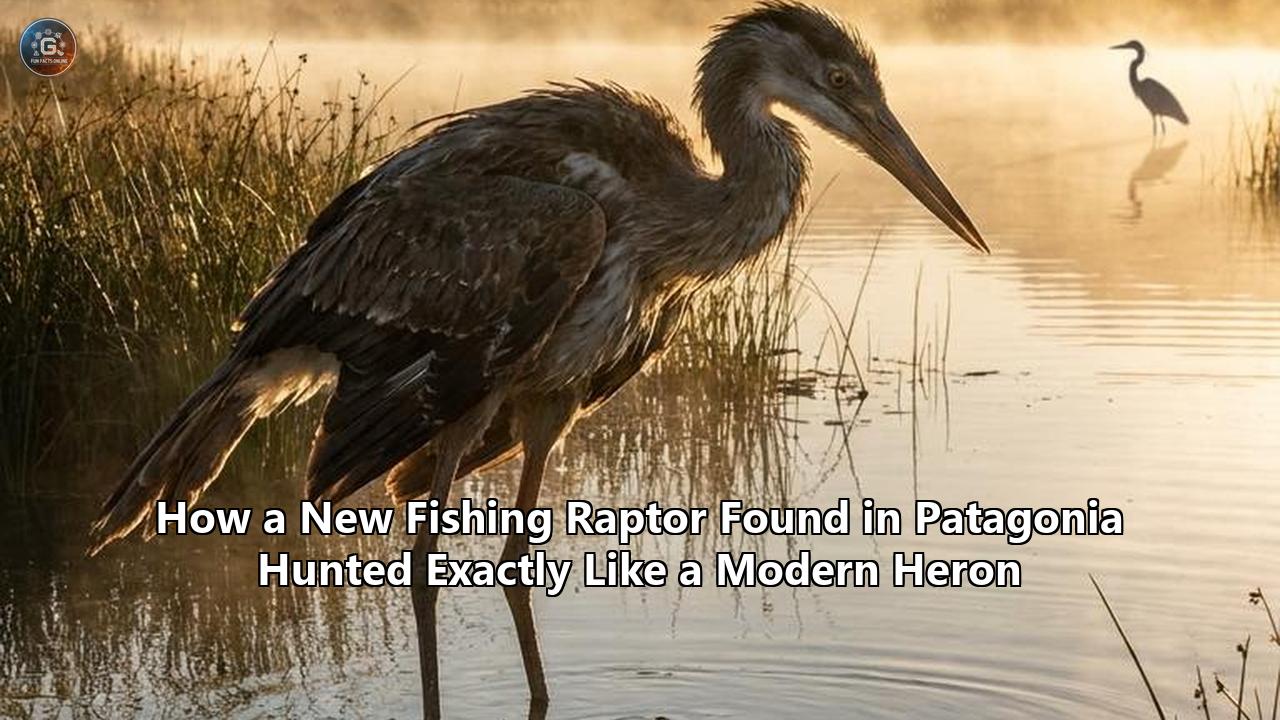
Living approximately 70 million years ago, this bird-like predator did not pursue terrestrial prey like its famous Northern Hemisphere relative, Velociraptor. Instead, the newly described Patagonia fishing raptor waded through humid, meandering wetlands, utilizing a specialized, S-shaped neck and unique jaw structures to snatch fish from shallow waters with the explosive precision of a modern heron.
The path to identifying Kank australis was a lesson in paleontological persistence. The first fragmentary remains—consisting of teeth and toe bones—were unearthed in 2018 at the La Anita farm near the tourist hub of El Calafate in Santa Cruz Province. However, these early discoveries lacked the diagnostic features necessary to establish a new genus.
The critical breakthrough arrived during a subsequent expedition in 2024, when researchers recovered a beautifully preserved cervical (neck) vertebra. This single bone unlocked the animal’s identity and revealed a startling example of evolutionary convergence. The vertebra featured internal air chambers (pneumatization) and muscle-attachment sites that are virtually identical to those found in modern wading birds.
                  [Late Cretaceous Unenlagiidae]
                                |
               +----------------+----------------+
               |                                 |
     [Northern Patagonia]               [Southern Patagonia]
               |                                 |
      - Austroraptor cabazai            - Kank australis
        (Giant, 5m piscivore)             (Gracile, 2.5-3m fisher)
      - Buitreraptor gonzalezorum         *Bridges biogeographical
        (Small, 1.5m longirostrine)        gap to Antarctica*
This discovery has sparked intense debate among vertebrate paleontologists. By examining competing ecological models, anatomical mechanics, and biogeographical patterns, scientists are contrasting Kank with both its terrestrial northern cousins and other semi-aquatic dinosaurs like Spinosaurus. The resulting analysis highlights how distinct evolutionary pressures in the ancient supercontinent of Gondwana produced some of the most specialized predators in dinosaur history.
The Wetland of the Lost Giant: Southern Patagonia’s Cretaceous Oasis
To understand the lifestyle of this Patagonia fishing raptor, one must look past the cold, arid, and windswept steppe that defines modern Santa Cruz Province. During the Maastrichtian stage of the Late Cretaceous, southern South America was a temperate, highly humid wetland ecosystem. The Chorrillo Formation, where Kank was discovered, preserves an ancient landscape carved by meandering river deltas, slow-moving streams, and seasonal floodplains.
This humid sanctuary was dense with aquatic vegetation, including ancestral water lilies, and teemed with life. It was an environment that offered abundant resources for a specialized fisher. Kank lived alongside diverse fish species, freshwater mollusks, frogs, turtles, and early semi-aquatic mammals. Among its most notable neighbors was Patagorhynchus pascuali, a primitive monotreme related to modern platypuses and echidnas.
However, this wetland paradise was also a landscape of extreme danger. Kank australis, which stood at an estimated length of 2.5 to 3 meters (8 to 10 feet) and weighed roughly 27 kilograms (60 pounds), was far from the top of the food chain. It shared its habitat with Maip macrothorax, a terrifying megaraptorid predator that exceeded 10 meters (33 feet) in length.
This ecological dynamic suggests that Kank occupied a tense, highly vigilant niche. While wading along the shorelines to hunt, it had to keep one eye trained on the water for fish and the other on the dense, riparian forests to avoid becoming prey for the giant megaraptorids lurking nearby.
========================================================================
             ECOSYSTEM PROFILE: CHORRILLO FORMATION (70 MYA)
========================================================================
Climate:             Temperate, highly humid, seasonal rainfall
Landscape:           Meandering river deltas, marshy lagoons, floodplains
Flora:               Conifers, ferns, ancestral water lilies
Fauna:
  - Apex Predator:   Maip macrothorax (10m+ megaraptorid)
  - Mesopredator:    Kank australis (2.5-3m unenlagiid)
  - Small Vertebrates: Frogs, turtles, lizards, platypus-like monotremes
  - Aquatic Prey:    Abundant freshwater fish, diverse mollusks, insects
========================================================================
The S-Neck Solution: Muscle Mechanics and the "Slingshot" Strike
The central anatomical feature that distinguishes Kank australis from almost all other non-avian theropods is its neck. In modern herons (Ardeidae), hunting relies on a highly specialized cervical skeletal structure. Herons possess an elongated, highly modified neck containing a specialized "kink" at the sixth and seventh vertebrae. This structural bend acts as a mechanical spring.
When a heron spots a fish, it coils its neck into a tight S-curve. Powerful, fast-contracting ventro-flexive muscles attach to prominent bony ridges on the vertebrae. When released, these muscles pull the head downward and forward in an explosive, slingshot-like strike, spearing or pinching the prey in milliseconds.
Because these rapid movements subject the neck to extreme deceleration forces upon striking the water, herons have evolved deep carotid processes—bony channels that physically shield the carotid arteries and jugular veins from being pinched or damaged during high-velocity impacts.
The 2024 discovery of Kank's cervical vertebra revealed that the anatomical features of this Patagonia fishing raptor suggest an identical biomechanical solution. According to Dr. Motta, the neck bones of Kank show:
- Extreme Pneumatization: The vertebrae contain large, internal air chambers (lateral pleurocoels and neural canal recesses) that reduced the weight of the neck. This lightweight construction was essential for achieving rapid acceleration during a strike.
- Pronounced Parapophyses: Exceptionally developed lateral projection points provided expanded surface areas for the insertion of powerful neck-flexing muscle groups.
- Carotid Processes: Specialized bony structures that formed a protective guide channel for the neck's primary blood vessels, preventing vascular trauma during sudden, violent vertical strikes.
  Modern Heron Cervical Vertebra         Kank australis Cervical Vertebra
      [Deep Carotid Canal]                    [Carotid Processes]
               |                                       |
  (Shields blood vessels during            (Protects carotid artery from
    high-speed water impacts)               strike deceleration shear)
               \                                       /
                +------------------+------------------+
                                   |
                     Convergent Strike Biomechanics
This S-neck morphology represents a stark contrast to Northern Hemisphere dromaeosaurs like Velociraptor or Deinonychus. The neck vertebrae of northern raptors were robust, tightly interlocking, and designed to withstand the violent lateral thrashing of struggling terrestrial prey, such as small ceratopsians or ornithopods.
While Velociraptor used its neck as a stable anchor for a crushing, side-to-side tearing bite, Kank sacrificed lateral biting leverage in favor of lightning-fast vertical mobility. It was an evolutionary trade-off: Kank was structurally unsuited for grappling with large, armored land animals, but it was unmatched in its ability to target small, elusive aquatic prey in shallow water.
The "Hell Heron" Debate: Kank vs. Spinosaurus
The comparison between dinosaurs and herons is not entirely new, but previous applications of the model have been highly controversial. For years, a fierce debate has raged over the paleobiology of spinosaurids—specifically Spinosaurus aegyptiacus from North Africa and Ceratosuchops inferodios (whose name literally translates to "horned, crocodile-faced hell heron") from the Isle of Wight.
To fully understand why the discovery of Kank australis is unique, it is necessary to contrast its anatomy with the competing models of spinosaurid wading behavior.
=============================================================================================
                  COMPARING THEROPOD "HERON" MODELS: KANK VS. SPINOSAURUS
=============================================================================================
Anatomical Trait           Spinosaurus aegyptiacus                Kank australis
---------------------------------------------------------------------------------------------
Estimated Mass             6,000 to 7,000 kg (7 Tons)     ~27 kg (60 lbs)
Total Length               13 Meters (43 Feet)            2.5 to 3 Meters
Hindlimb Proportions       Comically short, dense bones   Long, slender, gracile
Foot Morphology            Broad, potentially webbed       Elongated, bird-like claws
Neck Adaptations           Massive muscle scars, limited S-flex   Highly pneumatic, carotid processes
Water Displacement         Extreme; highly disruptive             Minimal; silent wading
Ecological Fit             Shoreline generalist / Pelican  True Heron analogue
=============================================================================================
The Spinosaurus Dilemma: Too Big to Wade?
Following the discovery of a sail-like tail in Spinosaurus, researchers led by Dr. Nizar Ibrahim argued that the dinosaur was a highly specialized, active, pursuit-swimming aquatic predator that chased down large fish in deep rivers. This model was challenged by Dr. Dave Hone of Queen Mary University of London and Dr. Thomas Holtz Jr. of the University of Maryland.
Hone and Holtz argued that Spinosaurus was poorly designed for underwater pursuit. Its massive dorsal sail would have generated extreme hydrodynamic drag, and its sensory systems were not adapted for tracking prey in murky water. Instead, they proposed the "wading giant heron" model, suggesting Spinosaurus stood along the shorelines, dipping its crocodile-like snout into the water to snatch fish.
However, this "hell heron" model for Spinosaurus faces significant mechanical and physical challenges:
- Water Displacement and Buoyancy: A 7-ton animal entering a shallow river delta creates massive physical displacement and surface waves. Any fish in the vicinity would be alerted by the hydraulic pressure waves long before the dinosaur could strike.
- Substrate Sinking: Riverbeds and estuary floors are composed of soft, waterlogged silt and mud. A creature weighing as much as an elephant would sink deep into the substrate, miring itself and expending massive amounts of energy simply trying to extricate its feet.
- Hindlimb Anatomy: Spinosaurus had notoriously short hindlimbs. Wading in water deeper than a meter would quickly submerge its chest, forcing the animal to swim and preventing it from maintaining a stable, stationary wading posture.
Why Kank is the True Heron Analogue
Kank australis bypasses every one of the mechanical limitations that plague the Spinosaurus wading model, making it the most anatomically consistent heron-like non-avian dinosaur discovered to date.With a body mass of around 27 kilograms, Kank was light enough to walk over soft, waterlogged mud flats without sinking deep into the substrate. Its long, slender hindlimbs allowed it to wade in varying water depths while keeping its torso completely dry and out of the water.
Crucially, its small size meant it produced virtually no water displacement or seismic vibrations as it slowly moved through the shallows. Like a modern heron, Kank could remain perfectly motionless, casting a minimal shadow, before utilizing its specialized neck to strike with pinpoint accuracy.
While Spinosaurus is perhaps better compared to an oversized, generalist pelican or a shoreline crocodile, Kank australis is the first theropod that perfectly matches the scale, weight, and specific biomechanics required to execute a dedicated, heron-style ambush-fishing strategy.
Fluted Fangs vs. Serrated Blades: The Mechanics of Piscivorous Teeth
The evolutionary divergence between terrestrial dromaeosaurs and the Patagonia fishing raptor is equally evident in their teeth.
Terrestrial theropods typically possess "ziphodont" dentition. These teeth are flattened side-to-side (labiolingually compressed), strongly recurved (pointing backward), and lined with microscopic, razor-sharp serrations called denticles on both the front (mesial) and back (distal) cutting edges.
This design is optimized for a specific predatory mechanic: when the dinosaur bites down and pulls its head back, the serrations saw through tough skin, muscle, and sinew, allowing the animal to tear off chunks of meat.
       Terrestrial Dromaeosaur Tooth                Unenlagiid / Kank Tooth
             (e.g., Velociraptor)                      (Kank australis)

                   /\                                        /\
                  /  \                                      /||| \
                 /    \                                    / |||  \
                 | *  | <--- Serrated                      | |||  | <--- Longitudinal
                 | *  |      Edges                         | |||  |      Flutes (Ridges)
                 | *  |                                    | |||  |
                 \____/                                    \______/

          [Optimized for Slicing]                   [Optimized for Gripping]
            - High drag in water                      - Low drag, easy pierce
            - Tears terrestrial flesh                 - Prevents fish escape
The teeth of Kank australis show an entirely different mechanical focus. Recovered shed teeth from the Chorrillo Formation reveal that the dinosaur’s teeth were:
- Labiolingually Compressed but "8"-Shaped in Cross-Section: This unique shape, shared with Buitreraptor, provided lateral structural rigidity while maintaining a highly slender profile.
- Devoid of Serations on the Lower Two-Thirds: The mesial cutting edges (carinae) are completely smooth along most of the tooth, with fine, crenulated serrations restricted strictly to the apical third (the tip).
- Lined with Apicobasal Flutes: The outer (labial) and inner (lingual) surfaces of the tooth crowns feature prominent, vertical longitudinal ridges (flutes). Kank typically has two to three pronounced flutes per tooth.
These features represent highly specialized adaptations for a fish-dominated diet. In an aquatic hunting scenario, ziphodont teeth are actually disadvantageous. If a dinosaur bites a slippery, scale-covered fish with serrated teeth, the serrations can catch on the scales, increasing the force required to puncture the prey and potentially breaking the tooth.
Furthermore, flat, serrated teeth create high drag when jaw-snapping underwater.
The vertical flutes on Kank's teeth solved this hydrodynamic problem. The ridges acted as escape channels for water and mucus as the tooth punctured the prey. By reducing hydraulic suction and surface contact between the tooth and the fish's wet skin, the flutes allowed the tooth to slide deeply and effortlessly into the prey.
Because fish do not need to be chewed or sliced, but rather held securely before being swallowed whole, the needle-like, fluted teeth of the Patagonia fishing raptor acted as a perfect mechanical cage. Once a fish was impaled on these specialized fangs, the lack of serrations allowed for a smooth release as the dinosaur flipped the fish in the air to swallow it head-first, exactly like a modern heron or crocodile.
The Wetland Sickle Claw: Adaptive Tradeoffs of the Raptor Foot
The defining characteristic of dromaeosaurid dinosaurs is the "sickle claw" located on the second toe of the foot (pedal phalanx II-3). In classic terrestrial raptors like Deinonychus, this claw was massive, highly curved, and held off the ground during locomotion to keep it razor-sharp.
According to the "Raptor Prey Restraint" (RPR) model proposed by Dr. Denver Fowler and colleagues, these claws were not used to slash prey open, as popularized in fiction. Instead, raptors used them to pin small-to-medium prey to the ground under their body weight, using their wings to flap for stability while using their jaws to consume the prey alive—a strategy identical to modern accipitrid birds of prey (hawks and eagles).
For a wading predator, however, the classic RPR foot design presents a serious functional conflict. Walking through soft, unstable wetland mud requires maximum surface area to distribute body weight and prevent sinking.
An animal that walks on only two functional toes (the third and fourth), while keeping its second toe hyperextended in the air to protect a giant sickle claw, sacrifices critical surface area and lateral stability in slippery environments.
      Terrestrial Raptor Foot (RPR)               Wading Unenlagiid Foot (Kank)

             [Digit II-3] (Raised)                      [Digit II-3] (Reduced/Angled)
                  \                                          \
                _ _\   _                                   _  \   _
               (_\_ \ / )                                 ( \_ \ / )
                  \ | |/                                    \ | |/
                   || |                                      || |
                   || |                                      || |

         - High, sharp sickle claw                  - Reduced distal condyles
         - Optimized for pinning prey              - Improved contact with mud
- Reduced stability on mud - Balanced wading stabilityThe second phalanx of the second digit (phalanx II-2) in Kank displays a distinct reduction of the distal condyles (the joint ends) and collateral pits located exceptionally close to the upper corner of the bone. This specific anatomy is highly unusual for unenlagiids and closely resembles the foot structure of troodontids.
This structural modification points to two competing functional hypotheses:
- The Weight-Distribution Hypothesis: The reduction of the joint condyles allowed the second toe to be lowered closer to the ground than in terrestrial raptors. While this slightly dulled the claw's tip over time, it allowed the foot to function more like a broad, three-toed snowshoe, providing vital stability when navigating slippery, waterlogged riverbeds.
- The Submerged Pinning Hypothesis: Kank did not use its claw for terrestrial prey restraint, but rather for underwater pinning. When striking at large, powerful freshwater fish, Kank may have used its feet to clamp the struggling prey against the riverbed mud, preventing it from wriggling free while the dinosaur adjusted its jaw grip.
This structural adaptation shows that Unenlagiidae was a highly diverse clade. Rather than adhering to a rigid evolutionary template, these southern raptors modified their ancestral toolkit, finding a unique middle ground between the predatory utility of the sickle claw and the physical demands of wetland wading.
Gondwana vs. Laurasia: Biogeographical Divergence in Raptor Evolution
The discovery of Kank australis highlights a major biogeographical split in dinosaur evolution during the Late Cretaceous.
During this period, the supercontinents of Laurasia in the north and Gondwana in the south were completely isolated from one another by expansive equatorial seaways. This isolation led to vastly different evolutionary trajectories for dromaeosaurid dinosaurs on either side of the globe.
┌────────────────────────────────────────────────────────────────────────┐
│                      LATE CRETACEOUS BIOGEOGRAPHY                      │
├───────────────────────────────────┬────────────────────────────────────┤
│       LAURASIAN ECOSYSTEMS        │        GONDWANAN ECOSYSTEMS        │
│          (North America/Asia)     │           (South America)          │
├───────────────────────────────────┼────────────────────────────────────┤
│ - Apex Predators: Tyrannosaurids  │ - Apex Predators: Megaraptorids    │
│ - Dromaeosaurs: Velociraptorinae │ - Dromaeosaurs: Unenlagiidae       │
│ - Predator Niche: Terrestrial,    │ - Predator Niche: Semiaquatic,     │
│   agile cursorial ambushers       │   longirostrine shoreline fishers  │
│ - Key Adaptation: High bite force │ - Key Adaptation: Flexible necks,  │
│   and robust skulls               │   fluted needle teeth              │
└───────────────────────────────────┴────────────────────────────────────┘
In Laurasia, ecosystems were dominated by massive tyrannosaurids, which occupied the apex predator niches. Under this evolutionary pressure, northern raptors (like Velociraptor, Deinonychus, and Saurornitholestes) remained strictly terrestrial.
They focused on speed, agile cursorial pursuit, and robust skulls capable of delivering high bite forces to exploit small-to-medium-sized land herbivores.
In Gondwana, however, tyrannosaurids were absent. The apex predator roles were filled by abelisaurids and megaraptorids. In this environment, the "southern raptors"—the Unenlagiidae—found immense evolutionary success by pivoting toward the waterways.
They evolved long, slender snouts, highly flexible necks, and un-serrated, fluted teeth to target the abundant aquatic life of Gondwana's massive river systems.
The discovery of Kank australis in the southernmost tip of Argentina is highly significant for understanding this regional development. Previously, seven distinct unenlagiid species had been identified in northern Patagonia (such as the giant Austroraptor cabazai and the small, highly gracile Buitreraptor gonzalezorum).
However, the fossil record for southern Patagonia was limited to scattered, indeterminate fragments that could not be assigned to a specific species.
Kank australis bridges this critical distributional gap. It connects the fossil records of northern Argentina with those of Antarctica, proving that these highly specialized fishing raptors were not an isolated evolutionary novelty.Instead, they were widely distributed across diverse latitudes, dominating the rich wetland margins of the southern hemisphere for tens of millions of years.
Unresolved Questions and Future Horizons
While the May 2026 description of Kank australis has provided exciting new insights, it has also raised several new questions that paleontologists are eager to investigate.
Several key areas of research will help clarify the life and habits of this remarkable predator:
1. Calcium and Oxygen Stable Isotope Analysis
While the presence of Kank's fossils alongside fish remains strongly suggests a piscivorous diet, it does not confirm that the dinosaur ate fish exclusively. Researchers plan to perform stable isotope analysis on the enamel of Kank’s teeth.
By measuring the ratios of Calcium-44 to Calcium-42 and Oxygen-18 to Oxygen-16, scientists can determine where Kank fell on the food chain and whether it was a strict aquatic specialist or a generalist that also targeted land animals like lizards, frogs, and early mammals.
2. Finite Element Analysis (FEA) of Neck Biomechanics
To test the "heron-strike" model, biomechanical engineers are building 3D virtual models of Kank's cervical vertebrae. Using Finite Element Analysis, they can simulate the exact physical stresses of a high-speed strike.
This modeling will calculate the maximum velocity Kank's neck could achieve, how much drag it would experience when entering the water, and whether its carotid processes were structurally sufficient to absorb the forces of impact without fracturing.
3. Integument and Feather Waterproofing
As a close relative of modern birds, Kank australis was undoubtedly feathered. However, a wading lifestyle requires specialized feather maintenance. Modern ducks and preening birds use uropygial glands to coat their feathers in waterproofing oils.
Conversely, herons possess specialized "powder down"—breakaway feathers that crumble into a fine, water-absorbent powder used to clean fish slime and oil from their plumage.
Future exceptional fossil discoveries from the Chorrillo Formation may preserve soft tissues or carbonized feather halos, potentially revealing whether Kank possessed waterproof contour feathers or relied on primitive powder down to stay dry in its wetland home.
Ultimately, Kank australis stands as a powerful testament to the diversity of the dinosaur kingdom. It serves as a reminder that "raptors" were not monocultures of terrestrial pack hunters, but an incredibly adaptive group of animals.
By stepping off the dry land and wading into the prehistoric rivers of Patagonia, this remarkable dinosaur carved out a highly successful lifestyle that modern birds would inherit and perfect millions of years later.
References
- Motta, M. J., Aranciaga Rolando, A. M., Rozadilla, S., Agnolín, F. L., Brissón Egli, F., Álvarez Herrera, G. P., Chimento, N. R., Lo Coco, G., Tsuihiji, T., Manabe, M., Pol, D., & Novas, F. E. (2026). "New unenlagiid from the Chorrillo Formation (Late Cretaceous, Maastrichtian), SW Patagonia, Argentina." Journal of Vertebrate Paleontology, e2656456.
- Hone, D. W. E., & Holtz, T. R. (2021). "Evaluating the ecology of Spinosaurus: Shoreline generalist or aquatic pursuit predator?" Palaeontologia Electronica, 24(1), a03.
- Barker, C. T., et al. (2021). "New spinosaurids from the Wessex Formation (Early Cretaceous) of the Isle of Wight and the evolution of the group." Scientific Reports, 11, 19376.
- Fowler, D. W., et al. (2011). "The Predatory Ecology of Deinonychus and the Evolution of Flapping in Relation to the Origin of Flight." PLOS ONE, 6(12), e28964.
Reference:
- https://ground.news/article/heron-like-fish-eating-dinosaur-from-70-million-years-ago-discovered-in-argentina
- https://www.discovermagazine.com/this-70-million-year-old-dinosaur-looked-like-a-raptor-but-may-have-fished-like-a-heron-49169
- https://scitechdaily.com/this-dinosaur-had-the-claws-of-a-raptor-but-hunted-like-a-heron/
- https://en.igihe.com/environment/article/fossils-reveal-raptor-like-dinosaur-with-heron-style-hunting-habits
- https://www.earth.com/news/raptor-like-dinosaur-kank-australis-ate-fish-behaved-like-modern-herons-70-million-years-ago/
- https://www.sciencedaily.com/releases/2026/05/260529043636.htm
- https://www.miragenews.com/70m-year-old-heron-like-dino-found-in-argentina-1682563/
- https://www.qmul.ac.uk/news/latest-news/2021/se/study-sheds-new-light-on-the-behaviour-of-the-giant-carnivorous-dinosaur-spinosaurus-as-a-monstrous-heron.html
- https://connectsci.au/news/news-parent/9459/Heron-like-dinosaur-discovered-in-Argentina
- http://novataxa.blogspot.com/2026/05/kank.html
- https://www.discovermagazine.com/this-70-million-year-old-dinosaur-looked-like-a-raptor-but-may-have-fished-like-a-heron-49169
- https://www.tandfonline.com/doi/full/10.1080/02724634.2026.2656456
- https://watchers.news/epicenter/new-heron-like-dinosaur-discovered-in-patagonia-argentina/
- https://www.nationalgeographic.com/science/article/fierce-hell-heron-dinosaur-puts-new-wrinkles-in-spinosaurus-origin-story
- https://www.youtube.com/watch?v=7-_ZvWNfDE8
- https://www.reddit.com/r/Paleontology/comments/10i7xaj/new_spinosaurus_theory_the_sequel_the_antiheron/
- https://www.youtube.com/watch?v=k-2CQIrlQXk
- https://www.researchgate.net/publication/312398588_The_cranial_osteology_of_Buitreraptor_gonzalezorum_Makovicky_ApesteguIa_and_AgnolIn_2005_Theropoda_Dromaeosauridae_from_the_Late_Cretaceous_of_Patagonia_Argentina
- https://www.researchgate.net/publication/379862767_Morphological_disparity_and_structural_performance_of_the_dromaeosaurid_skull_informs_ecology_and_evolutionary_history
- https://dinodata.de/bibliothek/pdf_e/2026/rsos.252139.pdf
- https://www.researchgate.net/publication/334466385_A_new_paravian_dinosaur_from_the_Late_Jurassic_of_North_America_supports_a_late_acquisition_of_avian_flight
- https://www.sci.news/paleontology/kank-australis-14804.html